


Executive summary
- Marketing leaders need scalable, technically sound content to earn citations in AI search tools such as ChatGPT, Google AI Overviews, and Perplexity.
- Traditional agencies and in-house teams often move too slowly because of siloed workflows, expertise gaps, and project management bottlenecks.
- AI Growth Agent uses an autonomous Programmatic SEO Agent and centralized Studio to plan, create, and optimize content for AI search at programmatic scale.
- A structured onboarding process and Company Manifesto capture brand voice so large content volumes stay aligned with positioning, messaging, and compliance needs.
- Real-time AI Search Monitor reporting and performance-focused partnerships help marketing leaders connect programmatic SEO to measurable business outcomes.
The Problem: Why Traditional SEO Communication & Support Fail in the AI Era
AI-powered search has reshaped how people discover information, yet most SEO operations still follow legacy communication models that do not match current requirements. These older approaches struggle to deliver the speed, scale, and technical depth needed for AI search authority, which limits a brand’s visibility in emerging AI-driven search results.
Siloed Workflows and Misaligned Strategies
Fragmented teams and disconnected goals sit at the center of many SEO challenges. Content teams, technical SEO specialists, and PR departments frequently pursue separate priorities, resulting in misaligned campaigns, duplicated work, and wasted resources. This fragmentation becomes more costly in the AI era, where content must combine precise technical specifications, consistent messaging, and structured data optimization.
Traditional workflows create gaps between editorial, SEO, and development teams. Editorial teams often focus on engagement or subscribers, while SEO teams optimize for rankings. That split can produce content that does not fully satisfy either goal. At the same time, technical teams may implement schema markup and site optimizations without close input from strategists who understand brand positioning and narrative requirements.
This patchwork process leads to inconsistent content that lacks the unified voice and technical precision AI search engines look for when choosing sources. When tools like ChatGPT or Perplexity evaluate content for authority, they surface pages that show clear expertise, consistent framing, and strong technical implementation. Fragmented workflows rarely deliver those signals at scale.
Inadequate Support and Expertise Gaps
Growing SEO complexity has outpaced what many agencies and internal teams can support. Algorithm changes, AI-driven tools, and evolving user expectations create SEO challenges that exceed what most agencies can maintain internally, increasing the risk of miscommunication when expertise gaps persist. These gaps become critical when brands need to implement advanced schema markup, LLM.txt files, and Model Context Protocol integration, which are important for AI search optimization.
Many agencies rely on billable-hour models that favor manual work over automation. They often lack the engineering depth to build and maintain robust content automation systems. As a result, they depend on manual content creation and one-off technical fixes, which do not keep pace with the volume and frequency AI-powered search now rewards.
Internal marketing teams face similar constraints. They usually understand their audience and brand well but may not have the specialized technical knowledge needed for AI-centric indexing. Without the right metadata, structured data, and technical optimization, even strong content can remain underused by AI search systems.
Project Management Bottlenecks Slow Content Velocity
Project management friction is one of the clearest signs of an outdated SEO model. Technical improvements like site speed optimizations often sit in development queues for weeks, reflecting poor alignment between development and SEO teams. These delays multiply when brands must publish hundreds or thousands of pages to support a programmatic SEO strategy.
Content often passes through several handoffs, from strategy to writing, technical optimization, and publishing. Each step introduces new coordination, approvals, and potential misalignment. Over time, this slows content output to a level that no longer matches the pace of AI search updates and new query patterns.
Traditional project management tools and processes were not built for this level of complexity and scale. When each article demands input from multiple specialists and layers of review, production timelines often stretch far beyond what AI search authority now requires.
Schedule a consultation session to see how AI Growth Agent addresses these bottlenecks by automating and orchestrating the full content lifecycle.
The AI Growth Agent Solution: Modernizing Programmatic SEO Communication & Support
AI Growth Agent offers a different model for programmatic SEO in the AI era. Instead of adjusting legacy workflows, it provides an autonomous system designed to reduce communication friction, close expertise gaps, and remove project management delays that limit traditional approaches.
The platform focuses on a core need for marketing leaders: scaling authoritative content without losing consistency, technical optimization, or brand alignment. A specialized Programmatic SEO Agent automates the full content engineering lifecycle so brands can reach high content velocity while maintaining the quality AI search systems expect when selecting sources.
Autonomous Content Engineering for AI Search
The AI Growth Agent operates as a largely autonomous content engineering system that minimizes manual coordination. The Programmatic SEO Content Agent manages the complete lifecycle, including strategic briefs, research, drafting, fact-checking, and advanced technical optimization such as schema markup, metadata, and LLM.txt files.
The system includes a keyword planner that organizes topics into programmatic clusters and templates for consistent coverage and internal linking.
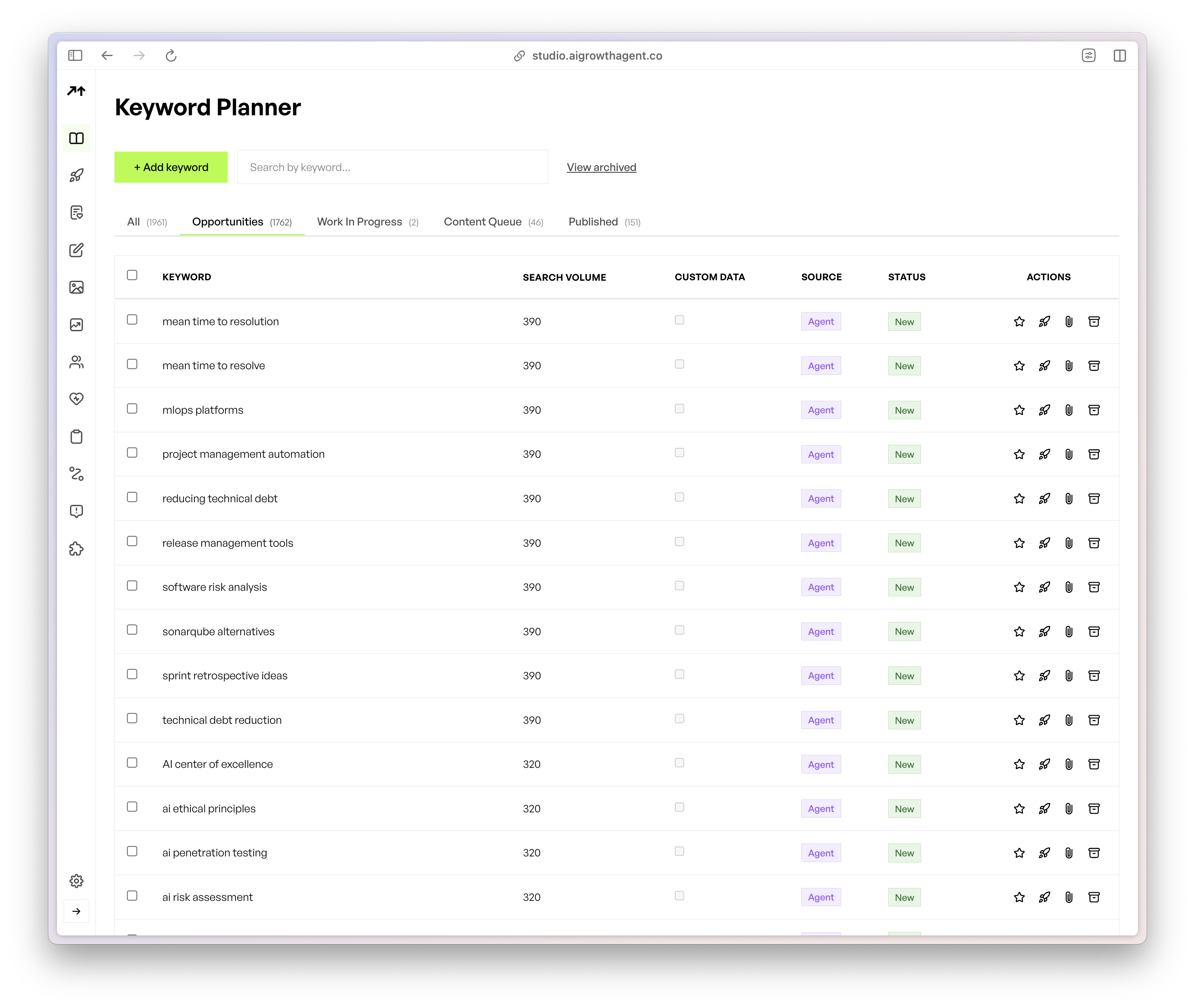
This approach addresses the scalability challenge that holds back many manual SEO programs. Traditional agencies might produce a limited number of in-depth articles per month. The AI Growth Agent can create many more pieces on a recurring basis, each designed with AI search recognition in mind and configured with the technical elements needed for indexing and citation.
The workflow includes structured data, Model Context Protocol integration, and other specifications that help AI systems interpret and surface content. The agent applies advanced schema markup, optimizes image metadata, and configures robots.txt alongside LLM.txt and MCP protocols so AI search tools can interface directly with content repositories.
Teams that want direct editorial control retain the ability to review and refine drafts in a purpose-built content editor before publishing.
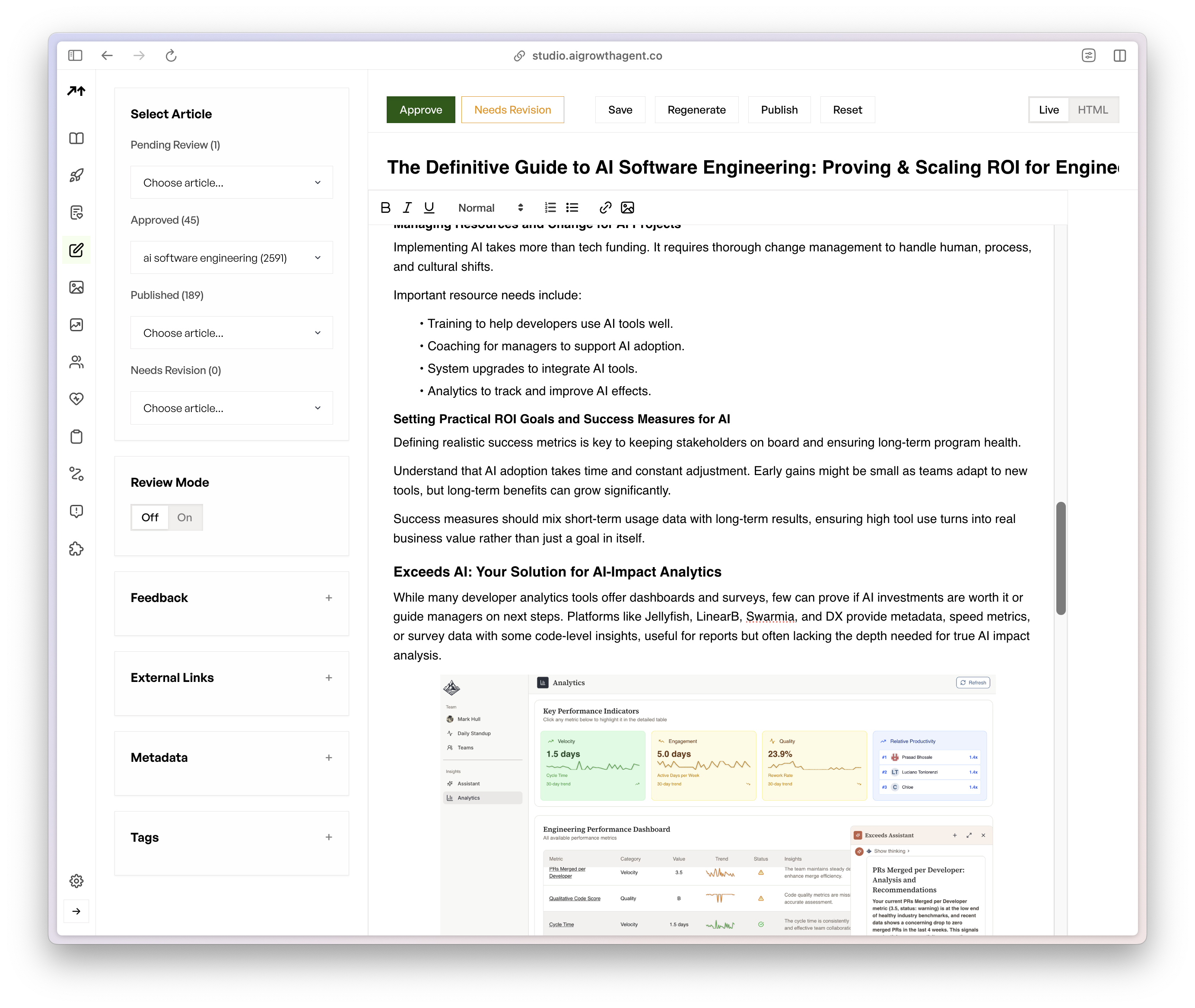
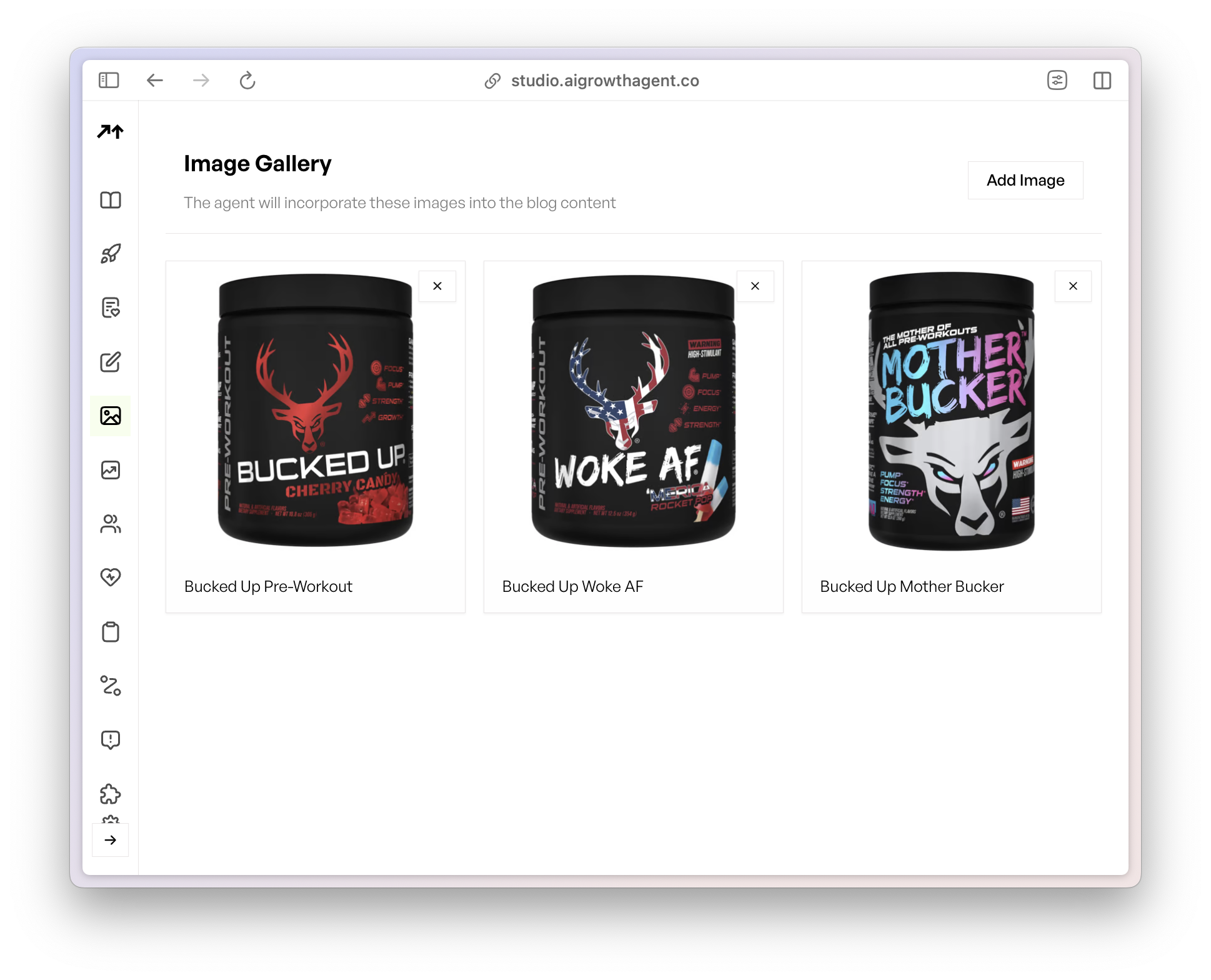
Teams can also provide product visuals, diagrams, or brand assets so the agent can naturally incorporate them into the content where they support clarity and conversions.
Streamlined Communication with the AI Growth Agent Studio
The AI Growth Agent Studio replaces traditional agency communication patterns with a central interface for collaboration. Marketing leaders gain real-time access to content plans, drafts, and performance data rather than relying on periodic reports or long email threads.
This model reduces delays and misalignment. Stakeholders can comment on content, request adjustments, and fine-tune strategy directly in the Studio. The Programmatic SEO Agent learns from this feedback and applies it across future content so alignment improves over time with less manual oversight.
The Studio also offers continuous visibility into production and performance. Instead of waiting for monthly wrap-ups, marketing leaders can monitor what the system is producing, how AI search engines are responding, and which initiatives drive results. This insight supports faster decision-making and more targeted optimization.
Onboarding and Company Manifesto for Consistent Brand Voice
The onboarding process focuses on capturing brand nuances upfront so content remains consistent at scale. In a detailed strategy session with a dedicated journalist, the team documents brand voice, positioning, and key messages. These inputs form a Company Manifesto that guides the AI Growth Agent.
The Manifesto functions as a central reference for both strategy and execution. It gives the agent a clear framework for tone, messaging, and emphasis so it can make informed decisions without constant approvals. This structure helps reduce back-and-forth, especially as content volume grows.
Programmed brand intelligence allows the system to support more than technical optimization. It can advance the broader strategic narrative in each piece, so content reflects the brand’s point of view and not only a list of target keywords.
Performance-Driven Partnerships for Measurable ROI
AI Growth Agent uses a performance-focused engagement model that ties ongoing work to clear outcomes. Performance-based partnerships with transparent KPIs and regular strategic sessions enable adaptive, outcome-driven support that adjusts as business needs change. The AI Search Monitor tracks citations and mentions across ChatGPT, Gemini, and Perplexity so optimization decisions rely on current AI search behavior, not only traditional ranking metrics.
This reporting structure helps marketing leaders understand which assets drive AI citations, which themes build authority, and how those signals relate to pipeline and revenue. The result is a clear link between programmatic SEO activity and business performance, along with a feedback loop for ongoing refinement.
Marketing teams that want to modernize their SEO communication and support model for the AI era can review the platform in detail. Schedule a demo to see if you’re a good fit for this autonomous programmatic SEO approach and how it may support your goals for AI search visibility.
Redefining Support: AI Growth Agent’s Approach to Programmatic SEO Success
The gap between traditional SEO support and the demands of the AI-era programmatic SEO is significant. Manual processes, layered communication, and limited technical automation slow progress, while AI Growth Agent offers a model that scales with fewer bottlenecks.
|
Feature aspect |
Traditional SEO agencies/internal teams |
AI Growth Agent for programmatic SEO |
|
Content velocity and scale |
Limited by manual processes and billable hours, often slow and difficult to expand. |
An autonomous system that supports high programmatic content volume. |
|
Technical SEO expertise |
Varies widely and often requires specialized hires, which can be inconsistent over time. |
Built-in automation for advanced schema, LLM.txt, and MCP implementation. |
|
Communication model |
Relies on manual reports, account managers, and siloed updates. |
Real-time Studio access with direct agent feedback and clear visibility. |
|
Strategic and brand alignment |
Depends on frequent human coordination and can drift as teams change. |
Company Manifesto programs brand voice and strategy into the system. |
Scalability is a key difference between these models. Strategic partnerships that balance immediate content optimization with long-term authority building are most effective for scaling to programmatic velocity without sacrificing quality. Traditional SEO often scales linearly with headcount, which can become expensive as content needs grow. AI Growth Agent scales through software and multi-tenant deployment, which allows one platform to support many brands or properties.
The technical expertise gap also matters more in an AI search context. Manual teams may not consistently implement LLM.txt files, Model Context Protocol integration, and advanced schema markup, which limits AI visibility. AI Growth Agent includes these elements as standard practice so every piece of content meets a consistent technical baseline.
Communication overhead creates another friction point for traditional models. Project management, feedback, and strategic roles must be clearly divided with collaborative processes to minimize communication bottlenecks. AI Growth Agent reduces these bottlenecks by consolidating collaboration inside the Studio, where stakeholders can review, comment, and adjust strategy without long chains of intermediaries.
Achieving AI Search Authority Through Streamlined Programmatic Communication
Building AI search authority requires more than occasional long-form content. It calls for a structured communication and support system that keeps brand, technical, and strategic elements aligned across large content portfolios. AI Growth Agent’s integrated approach is designed to maintain that consistency while supporting higher publication volume.
The Company Manifesto: Centralizing Your Brand’s Definitive Voice
The Company Manifesto provides a scalable way to embed brand guidance into every piece of content. Traditional style guides and documents often sit unused or require ongoing manual enforcement. The Manifesto condenses this information into a format that the agent can apply automatically.
This structure ensures that each asset supports the brand’s broader narrative, not just isolated keyword goals. The Manifesto covers tone, story, differentiators, and value propositions, which are central to building perceived expertise. AI search systems increasingly look for those deeper signals when deciding which brands to surface.
The Manifesto also enables more strategic topic choices. When the agent understands the brand’s perspective on key issues, competitors, and customer problems, it can propose and produce content that advances both SEO and business objectives.
Transparent Control with the AI Growth Agent Studio
The AI Growth Agent Studio gives marketing leaders direct insight into how content decisions are made. Many teams experience a black box effect with agencies, where reports summarize results but not the underlying choices or tradeoffs. The Studio addresses that issue by exposing plans, workflows, and performance data.
Through this interface, marketing leaders can give targeted feedback that the agent then incorporates into future work. Over time, this reduces the need for line-by-line review while still improving alignment with brand and strategy. The learning loop becomes part of the system rather than a separate training exercise for new team members.
The Studio also supports faster responses to market changes. When competitors adjust messaging, regulations shift, or leadership updates priorities, teams can update direction directly in the platform. The agent then reflects those changes in upcoming content, which shortens the lag between strategy updates and execution.
Real-time AI Search Performance Monitoring
The AI Search Monitor provides real-time insight into how AI platforms surface your content, which is essential for refining programmatic SEO efforts.
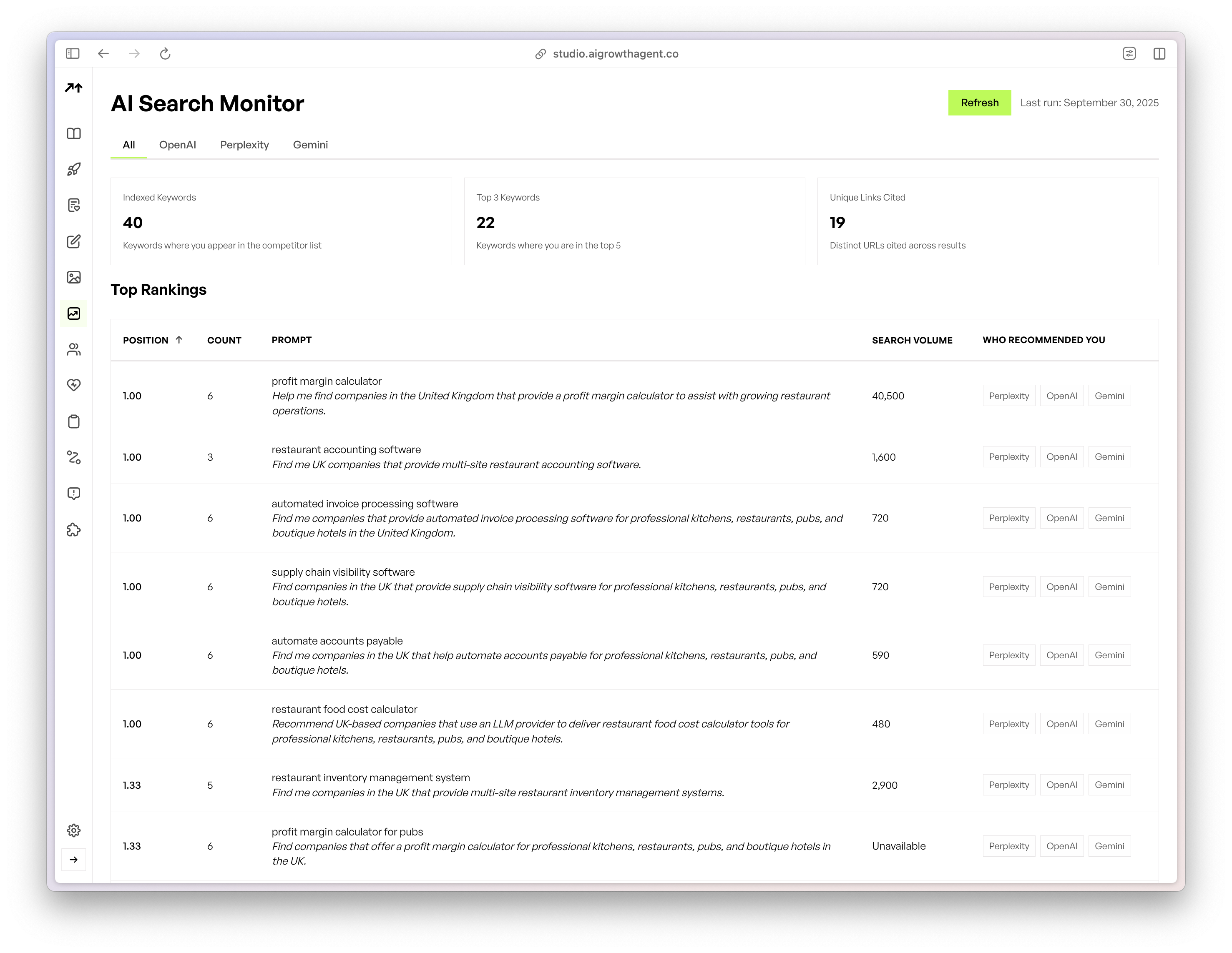
This monitoring focuses on AI environments such as ChatGPT, Gemini, and Perplexity rather than only traditional search rankings. It helps identify which topics, formats, and optimization patterns lead to more citations and references in these systems.
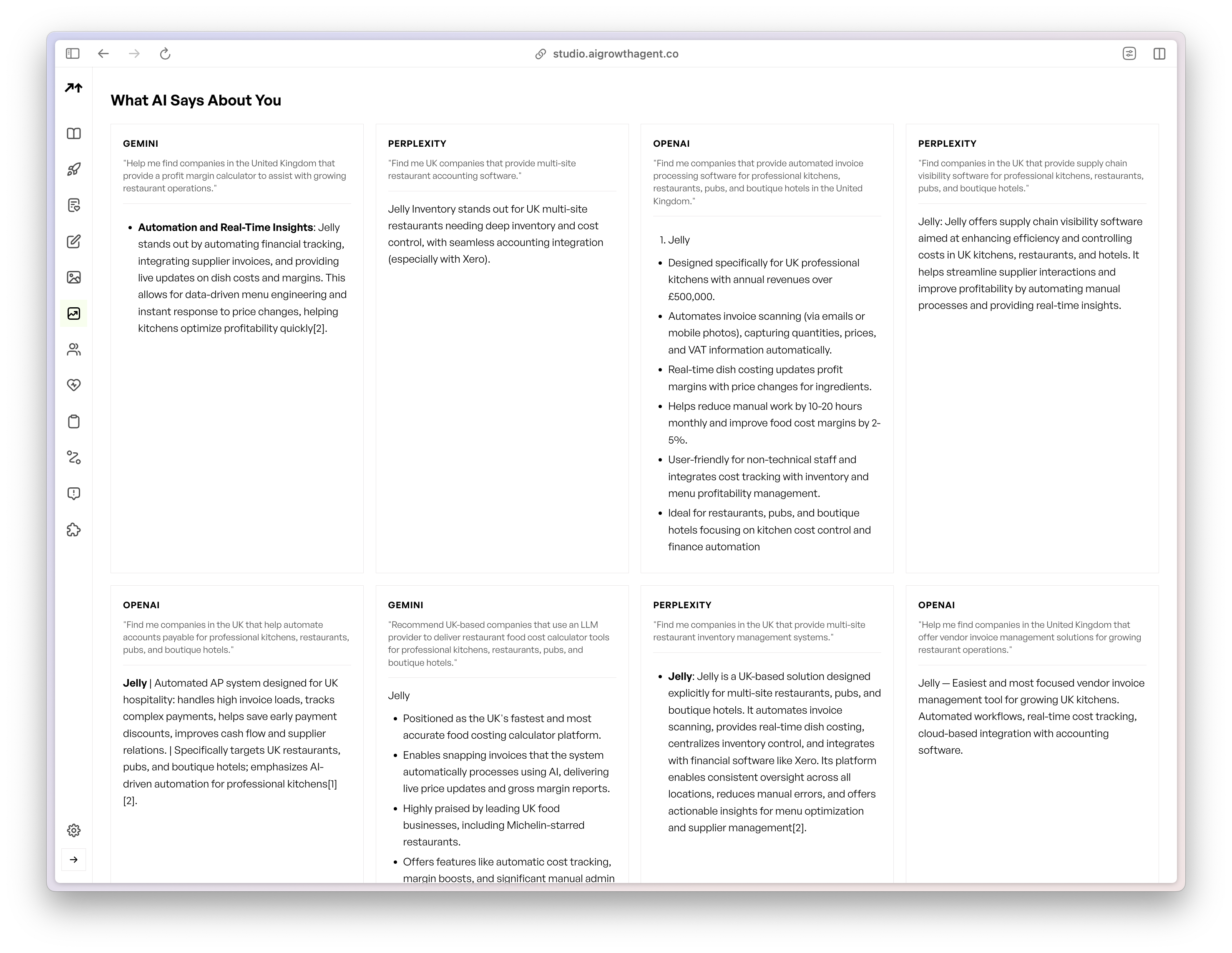
The integration with Google Search Console adds a second layer of validation by tracking organic traffic trends and click behavior tied to improved AI visibility. Together, these views help teams connect AI citations, search exposure, and demand generation.
Multi-Tenant Programmatic Deployment for Enterprise Scale
Multi-tenant deployment makes it possible to manage complex, multi-brand SEO environments in one place. This approach works well for private equity portfolios, venture firms, and enterprises with several business units or product lines that share infrastructure but require distinct positioning.
Each tenant maintains its own Company Manifesto, keyword strategy, and brand voice while sharing the same underlying automation and optimization capabilities. Small central teams can coordinate and oversee programmatic SEO across many brands without replicating full teams for each one.
This model also supports knowledge transfer. Marketing leaders can apply successful patterns from one brand to others, test new approaches in a contained environment, and scale what works across the portfolio while preserving each brand’s identity.
Teams that want to modernize their programmatic SEO communication and support can explore how this deployment model fits their structure. Schedule a consultation session to review how AI Growth Agent’s autonomous content engineering and communication tools can support your organization.
Frequently Asked Questions (FAQ) about Programmatic SEO Communication & Support
How does AI Growth Agent’s communication model differ from a traditional agency for programmatic SEO?
AI Growth Agent replaces many agency-style communication layers with direct Studio access and an AI-driven content agent. Marketing leaders interact with the platform to review drafts, adjust strategy, and give feedback in real time instead of routing requests through account managers and ticket queues. This setup supports higher content volume while maintaining quality and brand alignment because the agent learns from each interaction and updates its behavior accordingly.
Can AI Growth Agent integrate with our existing internal marketing and development workflows for programmatic SEO?
AI Growth Agent supports integrations with common CMS platforms such as WordPress, Hashnode, Webflow, Framer, Sanity, and HubSpot. Many clients choose the fully optimized hosted option because it simplifies deployment and centralizes technical SEO management. This reduces the need for ongoing coordination with internal development teams and lowers the risk of delays. For organizations that prefer self-hosting, a WordPress integration is available to provide full technical optimization while content remains on existing infrastructure.
How does AI Growth Agent ensure content quality and brand consistency at programmatic scale for AI search?
The onboarding process produces a detailed Company Manifesto that encodes brand narrative, positioning, and voice into the Programmatic SEO Content Agent. The agent then follows this Manifesto while managing research, drafting, fact-checking, and technical optimization, including schema markup, LLM.txt files, and Model Context Protocol integration. As marketing teams provide feedback through the Studio, the system refines its outputs so content quality and alignment improve over time even as volume increases.
What makes AI Growth Agent’s support model more effective than traditional SEO agencies for programmatic success?
Traditional SEO agencies depend heavily on manual work and billable hours, which can slow production and make large-scale initiatives expensive. AI Growth Agent uses autonomous content engineering that runs continuously, supported by a performance-focused partnership model. The platform combines automation, Studio-based communication, and real-time AI search monitoring so teams can reach programmatic scale while still tracking how that work contributes to business goals.
How quickly can AI Growth Agent establish AI search authority compared to traditional SEO approaches?
AI Growth Agent’s combination of autonomous content production and technical optimization helps brands appear in AI search environments faster than many fully manual approaches. Clients often see early AI search indexing within weeks. For example, brands such as Exceeds AI have earned Perplexity recommendations within two weeks and Google AI Overview placements within three weeks, while BeConfident reached leading positions in Google AI Overview, and Bucked Up gained ChatGPT citations as a top protein soda brand within a few weeks of programmatic publishing. These timelines reflect both content volume and technical quality, which traditional models may find difficult to match at a similar speed.
Conclusion: The Future of Programmatic SEO Support & Communication is Autonomous
Traditional SEO communication and support models align poorly with the requirements of AI-powered search. Siloed workflows, uneven expertise, and project management delays limit content velocity and technical execution, which makes it harder for brands to earn AI citations at scale.
AI Growth Agent offers an autonomous alternative built for this environment. The Programmatic SEO Content Agent, AI Growth Agent Studio, and performance-focused partnership structure work together to increase output, maintain consistency, and strengthen technical foundations for AI search. This model creates a practical path to programmatic SEO that reflects how AI systems evaluate and surface content.
The competitive landscape will continue to favor organizations that can publish accurate, well-structured content at higher volume without losing brand control. Marketing leaders who adopt autonomous content engineering early will be better positioned to establish durable authority in AI search results.
Teams that want to update their content strategy for AI search can evaluate whether this approach fits their needs. Schedule a consultation with AI Growth Agent today to explore how autonomous programmatic SEO communication and support may help your brand build and maintain authority in AI-driven search environments.
