


Written by: Mariana Fonseca, Editorial Team, AI Growth Agent
Executive summary
- Agencies often work within SEO retainers that limit how much high-quality content they can produce, even though AI-driven search now favors comprehensive, well-structured coverage across entire topics.
- Manual workflows create a content bottleneck, where research, writing, and optimization consume most of the budget and restrict the ability to publish at the volume needed for strong search and AI visibility.
- Programmatic SEO provides a structured way to scale content production by automating research, technical optimization, and publishing while preserving human oversight for strategy and brand voice.
- AI Growth Agent applies Programmatic SEO principles across the full content lifecycle, helping agencies deliver larger content programs at a predictable cost without sacrificing quality.
- Agencies that adopt Programmatic SEO and tools like AI Growth Agent can improve AI search visibility, strengthen topical authority, and serve more clients effectively under existing budget constraints.
The Squeeze: Why Content Budgets Cripple SEO Agency Growth
SEO agencies operate in a tight financial environment where client expectations often exceed available resources. Most small businesses allocate between $500 and $7,500 per month for SEO, yet AI-driven search now rewards brands that publish large volumes of structured, high-quality content across an entire topic area. Agencies must meet these standards while staying within budgets that leave little room for experimentation or inefficiency.
Resource Strain: The Manual Content Bottleneck
Manual content creation quickly becomes a bottleneck as agencies scale. An average agency-led SEO program costing about $3,209 per month must cover strategy, technical work, content, and reporting across many keywords and pages. When teams rely on manual processes, each article demands research, writing, editing, on-page optimization, and publishing coordination, which can consume 8 to 12 hours of billable time for a single piece.
This cost structure does not hold up when competitors publish daily. A dedicated writer who produces two strong articles per week can create about 100 pieces per year. Competitors using programmatic methods can match that volume in a single month while keeping technical standards high. Meeting similar output levels with traditional staffing models often requires more writers, editors, and technical specialists, which drives up operating costs without a proportional increase in revenue.
Teams also face mounting pressure as they try to meet both quality and volume expectations. Writers may rush research, editors may skip detailed technical checks, and project managers may struggle to coordinate complex calendars. Quality then starts to slip, which weakens topical authority and undermines long-term performance. Agencies are left choosing between hitting deadlines and producing the kind of content that builds durable search visibility.
The “Quality vs. Quantity” Dilemma
Budget constraints often force agencies to choose between deep, authoritative content and the volume needed to compete in AI-driven search. Typical SEO budgets that allocate about 40% to content and 20% to on-page optimization can support a solid strategy, but they rarely support the scale required to cover an entire topic in depth.
Creating one high-quality, research-heavy article can take 15 to 20 hours when done carefully. That level of effort supports strong topical authority but limits how many pages an agency can produce each month. AI search systems, however, favor brands that answer hundreds of related questions across a topic, not just a handful of cornerstone pieces. An agency that publishes one exceptional article per month will struggle to compete with a rival that releases high-quality content weekly across several subtopics.
Agencies that lean toward quantity face a different risk. Rapid production often means shallow research, limited subject-matter review, and light technical optimization. These shortcuts produce articles that may attract some traffic but rarely earn citations or recommendations from AI systems. Without robust structure, schema, and clear topical positioning, content does not stand out as the most reliable or comprehensive source.
Competitive industries raise the bar even higher. New content must not only match existing leaders on quality, it must offer more depth, clarity, or specificity to win rankings. That rising standard increases the time and cost required for each piece, which makes purely manual production even less efficient relative to potential returns.
Low Visibility in the AI Search Era
Limited content depth and volume directly reduce an agency’s ability to earn mentions and citations from AI search engines. Modern AI systems evaluate authority at the site and topic level, looking at how completely a brand covers a subject, how well content is organized, and how consistently it uses structured data.
AI search experiences such as Google AI Overviews draw from collections of sources when generating answers. Brands with dense, interlinked, and well-structured coverage across related topics tend to appear more often in these responses than brands that publish strong but isolated articles. Agencies that cannot support ongoing content programs across a full topic cluster fall behind, even if individual pieces are well written.
Technical gaps can deepen this visibility problem. AI systems and search engines favor content with accurate schema, consistent metadata, and clear internal structure. Manual workflows often treat these elements as secondary tasks that get skipped when deadlines are tight or technical skills are limited. As a result, search systems may struggle to interpret and categorize otherwise solid content.
Over time, this combination of low volume, narrow topical coverage, and incomplete technical optimization creates a feedback loop. Agencies that cannot publish enough structured content lose visibility in AI search. Their clients then lose traffic and market share to competitors with more comprehensive content programs, which makes client retention and new business development harder.
Agencies that want to break free from content budget constraints need systems that raise content volume and quality at the same time. AI Growth Agent’s Programmatic SEO platform gives agencies a structured way to scale content production efficiently. Schedule a consultation session to evaluate whether autonomous content engineering fits your client portfolio.
The Solution: Strategic Content Engineering for Budget-Conscious Agencies
Agencies can address content budget constraints by shifting from manual production toward structured automation that preserves quality. Optimization alone cannot solve volume problems. Teams need new workflows that combine human judgment with systems that handle repetitive research and technical tasks at scale.
Beyond Manual: The Need for Content Automation
Budget plans that dedicate about 40% to content and 20% to on-page optimization provide a reasonable starting point, but they are not enough without automation. Agencies need tools that amplify the work of strategists, writers, and editors instead of simply generating more raw text.
Effective automation improves process efficiency while preserving editorial standards. Advanced systems can consolidate research, propose content structures, apply technical optimization, and manage publishing workflows. Human experts then focus on activities that create real differentiation, such as competitive analysis, content architecture design, and performance tuning, instead of spending most of their time on repetitive production tasks.
Efficient Keyword And Content Strategy
Structured, data-driven research helps agencies prioritize the right topics. Automated keyword clustering uncovers how related terms group together, which supports the design of complete content architectures rather than isolated posts. Each page then occupies a clear role in a broader topical map, which strengthens authority signals.
Advanced keyword analysis also reveals gaps in competitor coverage and emerging themes that lack strong content. Agencies can move quickly into these openings with pages that match user intent and business goals. Aligning content types and formats with search intent improves engagement metrics and increases the likelihood that AI systems recognize the brand as a useful, reliable source.
Content Repurposing And Optimization
Thoughtful reuse of existing assets extends the value of earlier investments. High-performing articles can expand into clusters of related content that explore subtopics, formats, or user segments in more detail. A single strong guide can support comparison pages, how-to articles, checklists, and FAQ pages that target long-tail queries.
Ongoing optimization of existing content also improves AI search visibility. Automated audits can flag missing metadata, schema issues, and structural problems across large archives. Once corrected, historical content contributes more to current topical authority instead of fading into the background.
Programmatic SEO: The Engine for Scalable Authority
Programmatic SEO treats content as a system that can be designed, engineered, and scaled. Instead of creating each page as a one-off project, agencies define patterns for how topics, templates, and structured data work together. Automation then applies these patterns consistently across many pages.
What Is Programmatic SEO?
Programmatic SEO uses automation and structured data to create large sets of technically sound, search-focused pages that target long-tail and complex queries in a systematic way. It goes beyond basic AI content generation by combining strategy, information architecture, technical implementation, and ongoing optimization inside one framework designed for search authority.
This approach treats each page as part of a larger system. Content architecture comes first, with clear rules for topics, relationships, and internal links. Once that structure is in place, automation helps generate, optimize, and publish content that fits within those rules. The result is more consistent quality and technical compliance at much higher volumes than manual methods can support.
Advanced programmatic systems link real-time search data, competitor analysis, and performance metrics to content production. When patterns shift or new opportunities appear, the system can adjust topic coverage, templates, and optimization settings. This flexibility helps agencies stay current in fast-changing search environments.
Scaling Quality Content Without Linear Cost Increases
Programmatic SEO reduces the cost per page by automating tasks that typically consume the most time, such as research aggregation, template creation, and technical implementation. Traditional SEO efforts often need three to twelve months before returns become clear. Structured programmatic approaches can show traffic and visibility gains sooner because they deploy comprehensive topic coverage in a shorter window.
Cost efficiency comes from better process design, not from lowering content standards. Automation handles repeatable steps while experienced strategists define quality thresholds, review key assets, and refine the model as data accumulates. Agencies can then offer larger content programs to more clients without increasing headcount at the same pace.
Over time, programmatic systems learn from performance data and editorial feedback. They improve topic selection, internal linking, and optimization settings, which enhances both efficiency and outcomes. Early setup work then pays off repeatedly as the system supports ongoing campaigns.
Engineered for AI Search
Programmatic SEO aligns naturally with AI search requirements because it emphasizes structure and completeness. Automated schema, consistent metadata, and clear information hierarchies help AI systems understand what each page covers and how it relates to other content on the site.
Modern implementations also support emerging AI search standards. Techniques such as LLM.txt files and Model Context Protocol integration give AI systems more direct, reliable access to site content. These elements improve the chances that AI assistants and search experiences draw from programmatically generated content when answering user questions.
Comprehensive topic coverage further supports AI recognition. Instead of scattered articles that compete for attention one by one, a programmatic content model builds connected clusters of pages that collectively signal deep expertise. That structure makes it easier for AI search systems to treat a brand as a default source within its category.
Agencies that want to reset their content strategy can use autonomous content engineering to reach programmatic scale. Schedule a demo to see how AI Growth Agent supports Programmatic SEO for agencies that work with demanding clients.
AI Growth Agent: Your Autonomous Solution to Content Budget Constraints
AI Growth Agent is a Programmatic SEO agent that designs and executes high-authority content architectures to help companies stand out in their category. The platform supports agencies that face strict content budgets by automating the content lifecycle from strategy through technical optimization and publishing, while keeping human teams in control of positioning and quality.
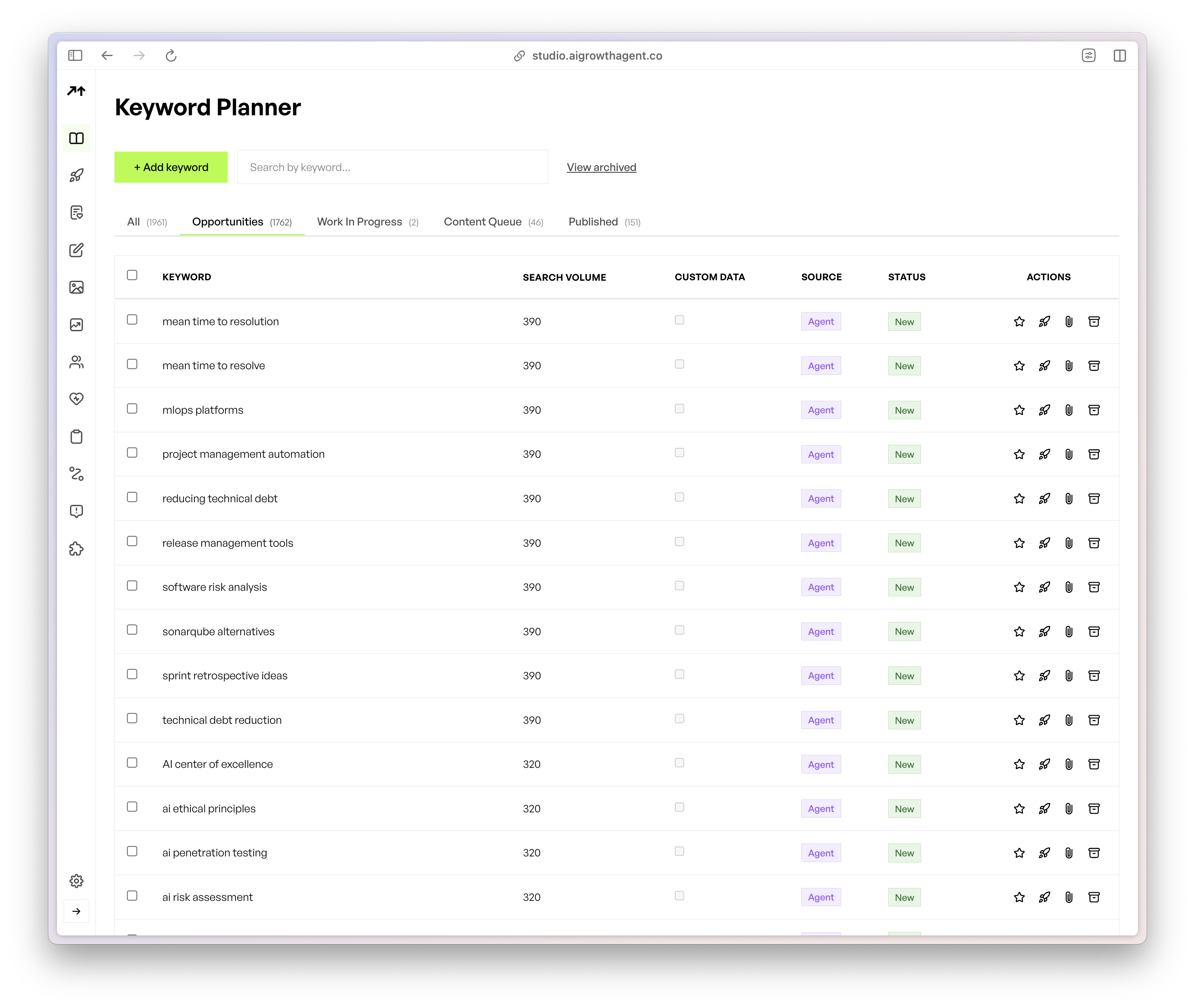
How AI Growth Agent Addresses Content Challenges
AI Growth Agent concentrates automation on the most expensive parts of content production. It keeps agencies in control of strategy, client communication, and brand voice while reducing the manual effort needed for research, drafting, technical work, and deployment.
Autonomous Content Engineering
AI Growth Agent automates the content engineering pipeline from end to end. The platform supports keyword research, clustering, content briefing, drafting, fact-checking steps, technical optimization, and publishing in a coordinated flow. It also manages schema markup, metadata, image optimization, and scheduling so that content goes live in a search-ready state.
Quality controls help maintain consistency with brand standards. The agent learns voice, tone, and positioning preferences through feedback cycles at the beginning of an engagement. Over time, it requires less manual review while still aligning output with client guidelines.
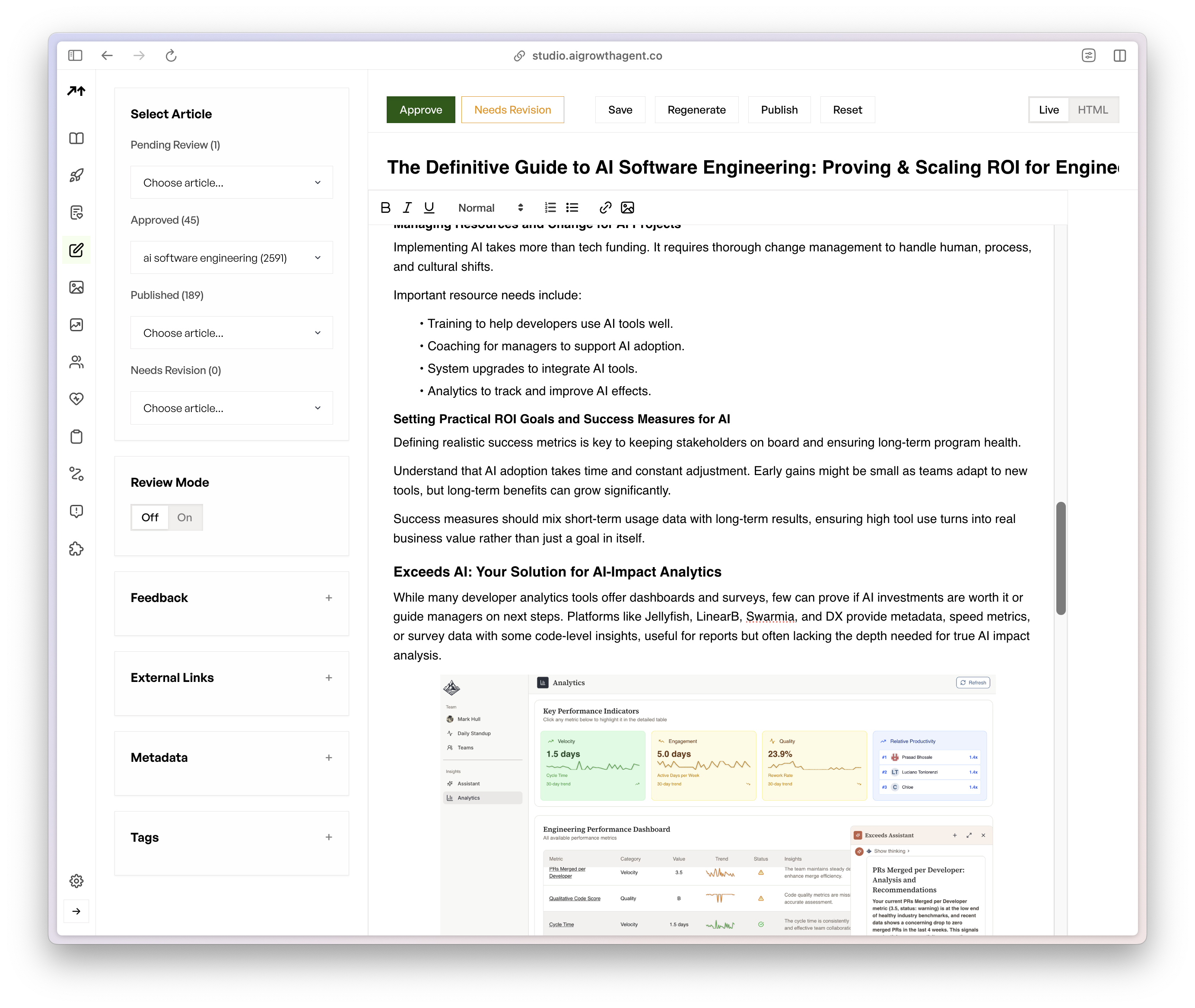
Agencies can also provide brand-approved images and graphics that the agent incorporates naturally into content. This support for visual assets keeps articles on brand and improves engagement without adding more manual work for design or content teams.
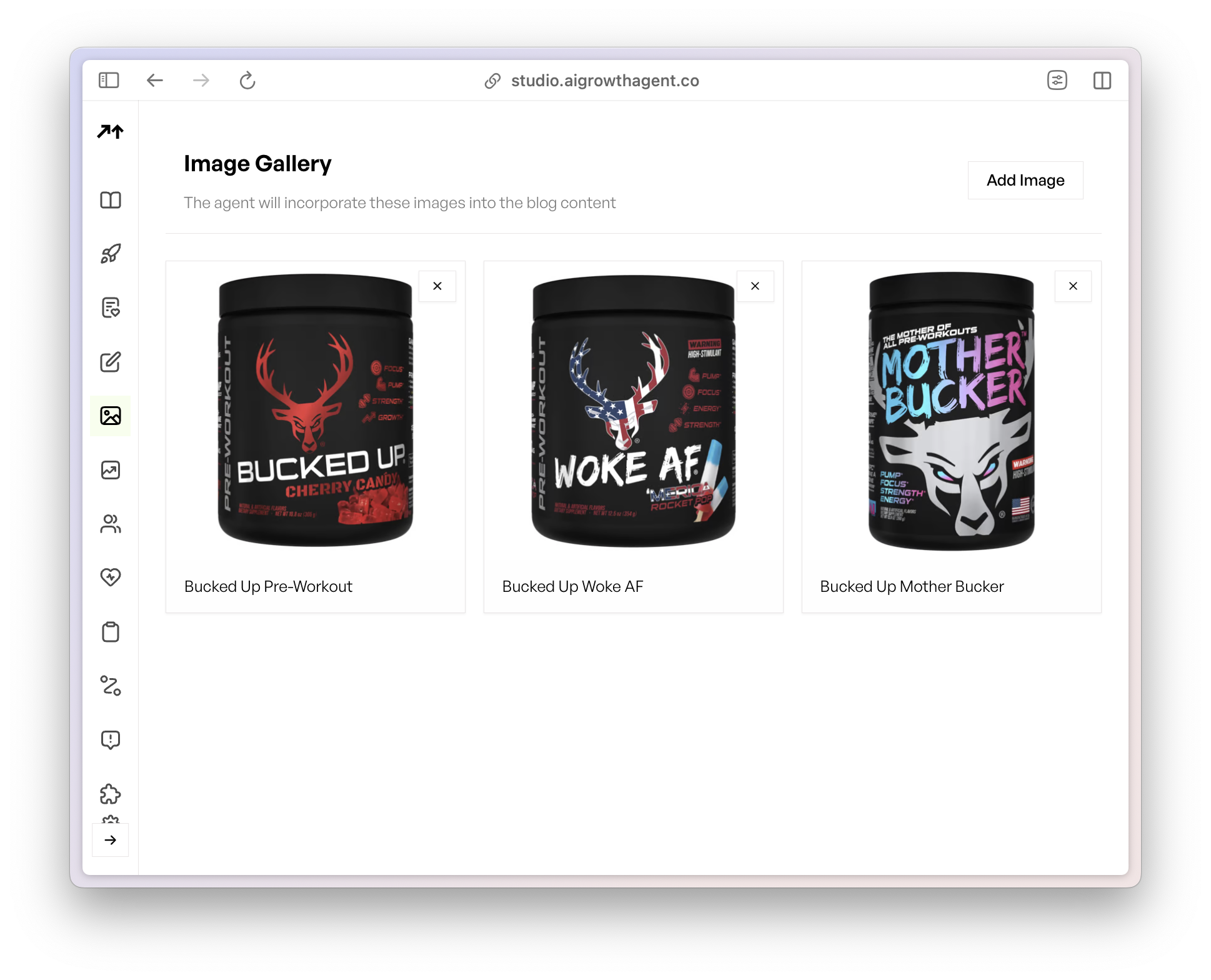
Predictable And Scalable Investment
AI Growth Agent uses a predictable model for content production, which helps agencies plan multi-month content programs with clear output expectations. Instead of tying content volume directly to headcount, agencies can cover larger topic areas and support more clients within a stable cost framework.
This predictability enables more ambitious content architectures. Agencies can commit to full topic clusters, not just a small set of priority pages, which supports stronger topical authority and more durable AI search visibility.
Optimized for AI Search Visibility
AI Growth Agent structures content for AI search from the start. Each piece includes advanced schema and metadata that clarify entities, relationships, and intent signals. The platform also supports techniques such as LLM.txt files and Model Context Protocol to improve how AI systems access and interpret client content.
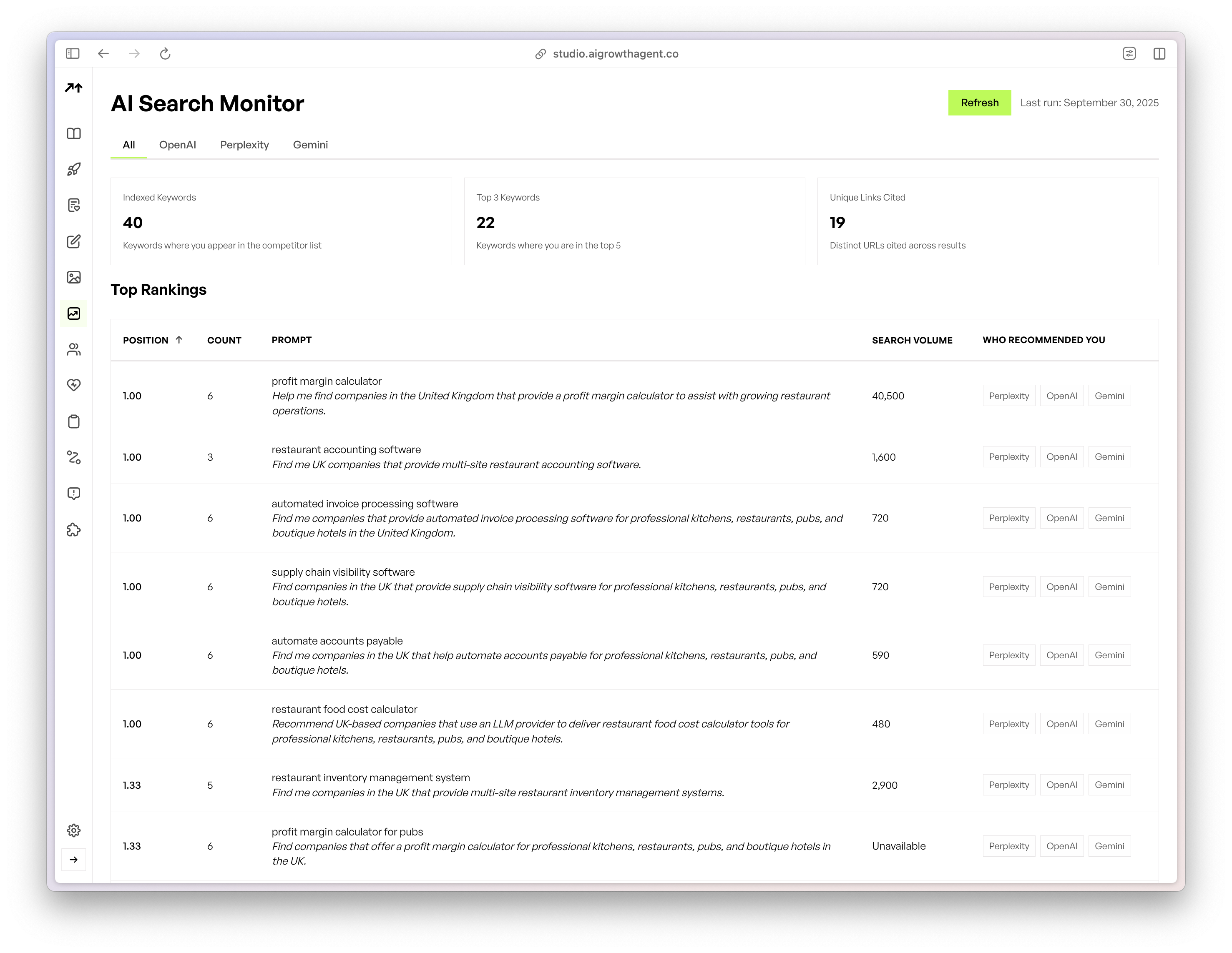
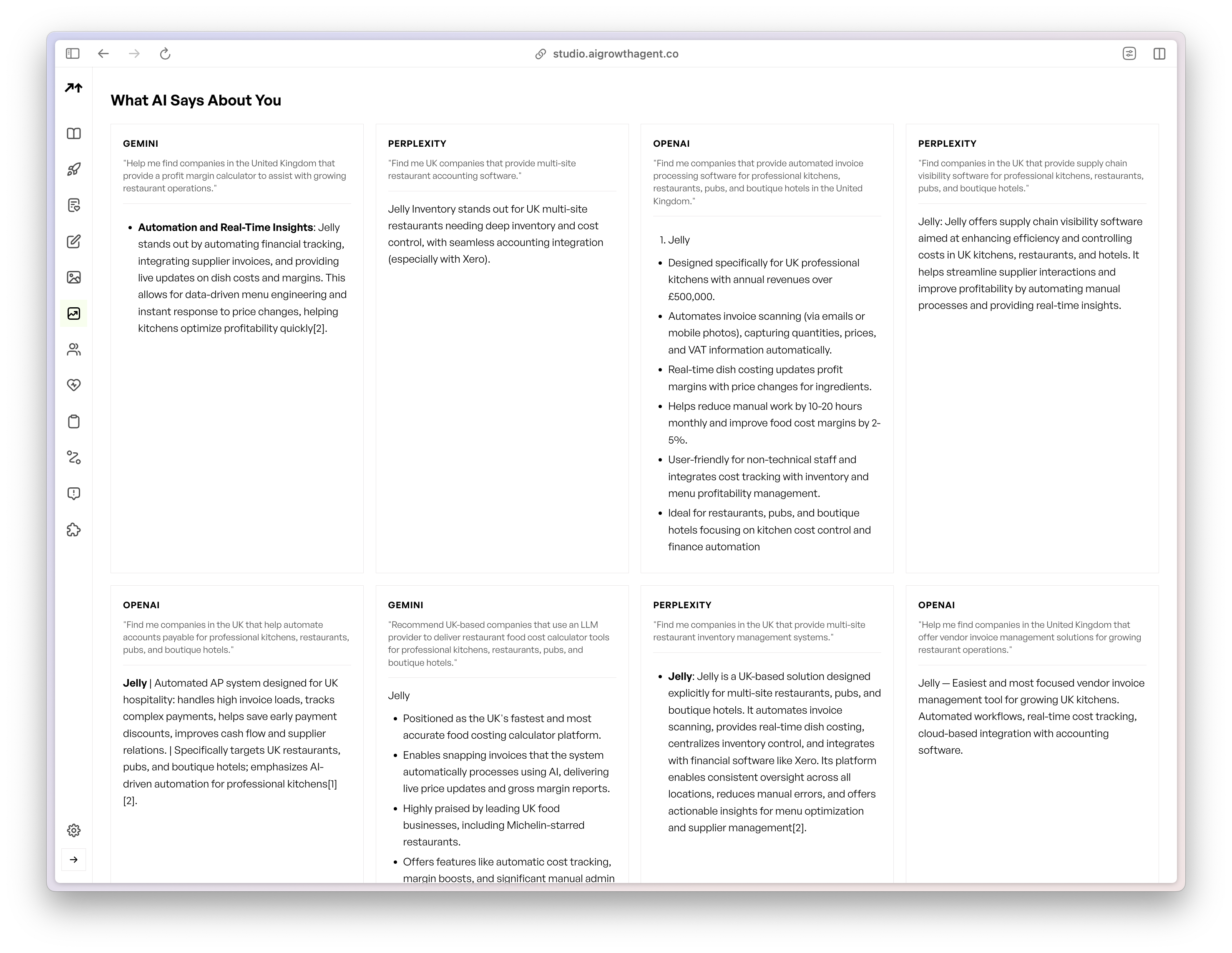
AI Growth Agent also monitors how AI systems reference client brands across assistants like ChatGPT, Gemini, and Perplexity. This feedback loop helps agencies refine content strategies to strengthen citation potential over time.
Breakthrough Capabilities for Content Scaling
AI Growth Agent includes capabilities that support advanced, agency-level operations for managing many clients and fast-changing topics.
Multi-tenant programmatic deployment allows teams to manage multiple client content strategies from a single interface while preserving distinct brand voices, editorial rules, and publishing destinations for each account.
Real-time programmatic content injection supports rapid responses to trending topics or breaking news. Agencies can use this capability to publish brand-aligned content in minutes, capture short-term search demand, and contribute timely perspectives on relevant developments.
Database-to-content automation converts existing client data into structured content programs. Agencies can turn product catalogs, service lists, or internal datasets into SEO-focused landing pages and resources without duplicating research work.
AI Growth Agent vs. Manual And Basic AI Solutions: A Comparison
|
Feature / Solution |
Traditional SEO Agencies |
Self-Service AI Tools |
AI Growth Agent |
|
Cost Model |
High, variable |
Subscription plus usage |
Predictable investment |
|
Content Scale |
Limited by headcount |
Depends on human prompts |
High, autonomous workflows |
|
Technical SEO |
Manual effort |
Relies on user expertise |
Automated, advanced implementation |
|
AI Search Visibility |
Possible, often slow |
Low, unstructured output |
Designed for citation potential |
Agencies that want to produce more content without exceeding client budgets can use AI Growth Agent to support that goal. Schedule a demo today to see how the platform operates in practice.
Frequently Asked Questions About Cost-Effective Content Production
How can SEO agencies scale content production without increasing their budget linearly?
SEO agencies can scale content production by adopting Programmatic SEO automation with AI Growth Agent. The platform handles research, drafting, technical optimization, and publishing workflows in a coordinated system. This approach removes common bottlenecks and allows teams to maintain quality through feedback loops rather than adding new staff for every increase in output.
What role does AI play in cost-effective content marketing for agencies?
AI supports cost-effective content marketing by automating repeatable tasks across the workflow. With AI Growth Agent, agencies can automate keyword research, content briefing, technical SEO checks, schema markup, and publishing steps. The system learns brand voice over time through feedback, which reduces the amount of manual editing needed while still aligning with client standards.
How quickly can agencies see results from Programmatic SEO with AI Growth Agent?
Programmatic SEO with AI Growth Agent can generate visible improvements in organic traffic and AI search presence within a few weeks, depending on the starting point and site authority. The platform accelerates results by deploying comprehensive topic coverage and strong technical foundations in a short period, rather than releasing isolated pages slowly over many months.
Can Programmatic SEO replace human content creators in an agency?
Programmatic SEO with AI Growth Agent does not replace human content creators. Instead, it shifts their focus from repetitive production work to strategy, messaging, and client collaboration. The platform manages large parts of content engineering and optimization, while human experts ensure that narratives, positioning, and examples align with business goals.
Conclusion: Strengthen AI Search Performance With AI Growth Agent
Content budget constraints present a significant challenge for agencies that must compete in an AI-driven search environment. Programmatic SEO offers a practical way to scale both the volume and quality of content without tying every increase in output to added headcount.
AI Growth Agent provides an autonomous content engineering platform that helps agencies build comprehensive, well-structured content architectures for their clients. By combining automation with human oversight, agencies can improve topical authority, AI search visibility, and long-term performance within realistic budgets. Schedule a consultation today to explore how AI Growth Agent can support your agency’s growth and client results.


