


Written by: Mariana Fonseca, Editorial Team, AI Growth Agent | Last updated: January 10, 2026
Key Takeaways
- AI search engines such as ChatGPT, Gemini, and Perplexity now shape how audiences discover information, so enterprise content strategies need to move beyond traditional keyword-focused SEO.
- Marketing leaders benefit from evaluating AI writing tools on scalability, technical SEO depth, integration, brand voice control, and measurable impact on AI and organic visibility.
- AI writing assistants and SEO-first AI platforms improve drafting speed and traditional search performance but still depend heavily on human workflows.
- AI Growth Agent provides autonomous content engineering that is designed for AI citation, which supports sustainable category authority at scale.
- Enterprise teams that want an AI-first, programmatic content engine can work with AI Growth Agent, and can schedule a demo to review fit for their organization.
The AI Search Imperative: Why Traditional Content Strategies Fall Short in 2026
AI search now sits at the center of content discovery. Platforms such as ChatGPT, Google AI Overviews via Gemini, and Perplexity increasingly mediate how audiences find and evaluate brands. This shift reduces the visibility of many branded properties that relied on conventional search behavior.
Your company’s digital footprint shrinks when automated content production outpaces your own publishing cadence. Manual SEO approaches that focus on periodic keyword research and a few new articles each month struggle to compete with programmatic content engines. The current standard favors consistent publication of technically optimized, machine-readable content that AI systems can crawl, interpret, and reuse as citations.
The relationship between brands and search has shifted from ranking for keywords to supplying structured, reliable information that large language models can reference. Brands that do not provide enough structured data and expert coverage give competitors room to define the category narrative inside AI responses. Over time, this dynamic can reduce visibility in both AI and traditional search interfaces.
Manual content programs, whether run by agencies or internal teams, rarely match the required volume and technical rigor. Enterprise leaders who want durable visibility increasingly look for systems that combine programmatic scale with strong editorial and technical standards.
Essential Criteria for Evaluating Advanced AI Blog Content Writing Tools for the Enterprise
Scalability and Content Velocity
Enterprise teams need tools that can publish a steady flow of high quality, technically sound content. The ideal platform supports frequent publication across many topics without overloading internal staff.
Technical SEO and AI Indexing
Modern AI writing platforms need to work beyond basic keyword usage. Effective tools support schema markup, metadata control, LLM.txt files, Model Context Protocol implementation, and formatting that makes content easy for AI systems to parse and reuse.
Autonomous Integration and Workflow
Enterprise-ready tools integrate into existing stacks or offer hosted options that reduce operational overhead. The strongest options automate planning, production, and publishing with minimal manual steps.
Brand Voice Engineering and Authority Building
Content at scale must still sound like the brand. Advanced platforms encode positioning, messaging, and tone so that large content libraries remain consistent and credible.
Strategic Impact and Quantifiable ROI
Effective solutions provide measurable improvements in organic traffic, AI citations, and category presence. Reporting should connect content production to visibility and demand outcomes.
Usability and Enterprise Adaptability
Marketing teams benefit from tools that are straightforward to adopt, easy to manage over time, and flexible enough to support multiple brands, regions, or product lines.
Category 1: AI Writing Assistants – Augmenting Human Content Creation
Overview
AI writing assistants such as Jasper AI, Writesonic, Rytr, and Copy.ai function as drafting aids. These platforms generate ideas, outlines, and first drafts that human editors refine before publication.
Key Strengths
AI assistants accelerate individual writers and small teams. Jasper AI offers strong brand voice customization, including style and tone controls. Many tools provide template libraries, collaboration features, and basic SEO options.
Inherited Limitations
These platforms still rely on humans for strategy, technical SEO, and publishing. Advanced elements such as rich schema, AI indexing files, and complex internal linking usually require manual configuration or other tools.
Ideal Use Case
Teams that want faster social posts, emails, and blog drafts, while keeping strategy, editing, and technical implementation in house.
Marketing leaders who outgrow manual drafting workflows can explore more programmatic options and schedule a consultation to review Programmatic SEO for their content program.
Category 2: SEO-First AI Platforms – AI-Driven Content Optimization for Traditional SERPs
Overview
SEO-first AI platforms such as Frase, Semrush’s ContentShake AI, Koala Writer, Surfer SEO, and NeuronWriter connect content creation with keyword research and SERP analysis. They focus on performance in traditional search results.
Key Strengths
These tools support topic research and structured drafting. Frase builds detailed briefs from top-ranking pages, including headings and questions. Writesonic provides workflows geared toward search-optimized content, including keyword analysis.
Inherited Limitations
Most SEO-first tools focus on traditional rankings and on-page optimization. They may not fully support AI-specific structures such as LLM.txt, MCP, or robust schema libraries without additional engineering.
Ideal Use Case
SEO specialists who want to improve existing content, generate briefs for writers, and strengthen performance in conventional search results.
Category 3: Programmatic SEO Agents – Autonomous Authority Engineering for AI Search
Overview
Programmatic SEO Agents represent a newer category focused on autonomous content engineering. These systems plan, draft, optimize, and publish content architectures designed for both AI search citation and traditional search performance.
AI Growth Agent: Programmatic SEO for Enterprise Teams
Autonomous Technical Infrastructure
AI Growth Agent sets up and manages optimized blog architectures on subdomains. The platform aligns layouts with brand standards while keeping the technical base clean and tuned for AI and search crawlers.
Programmatic Content Agent
The system covers the full content lifecycle, from topic strategy and research through drafting, fact-checking, and technical optimization. Output includes schema markup, metadata, LLM.txt, and Model Context Protocol integration.
Multi-Tenant Deployment
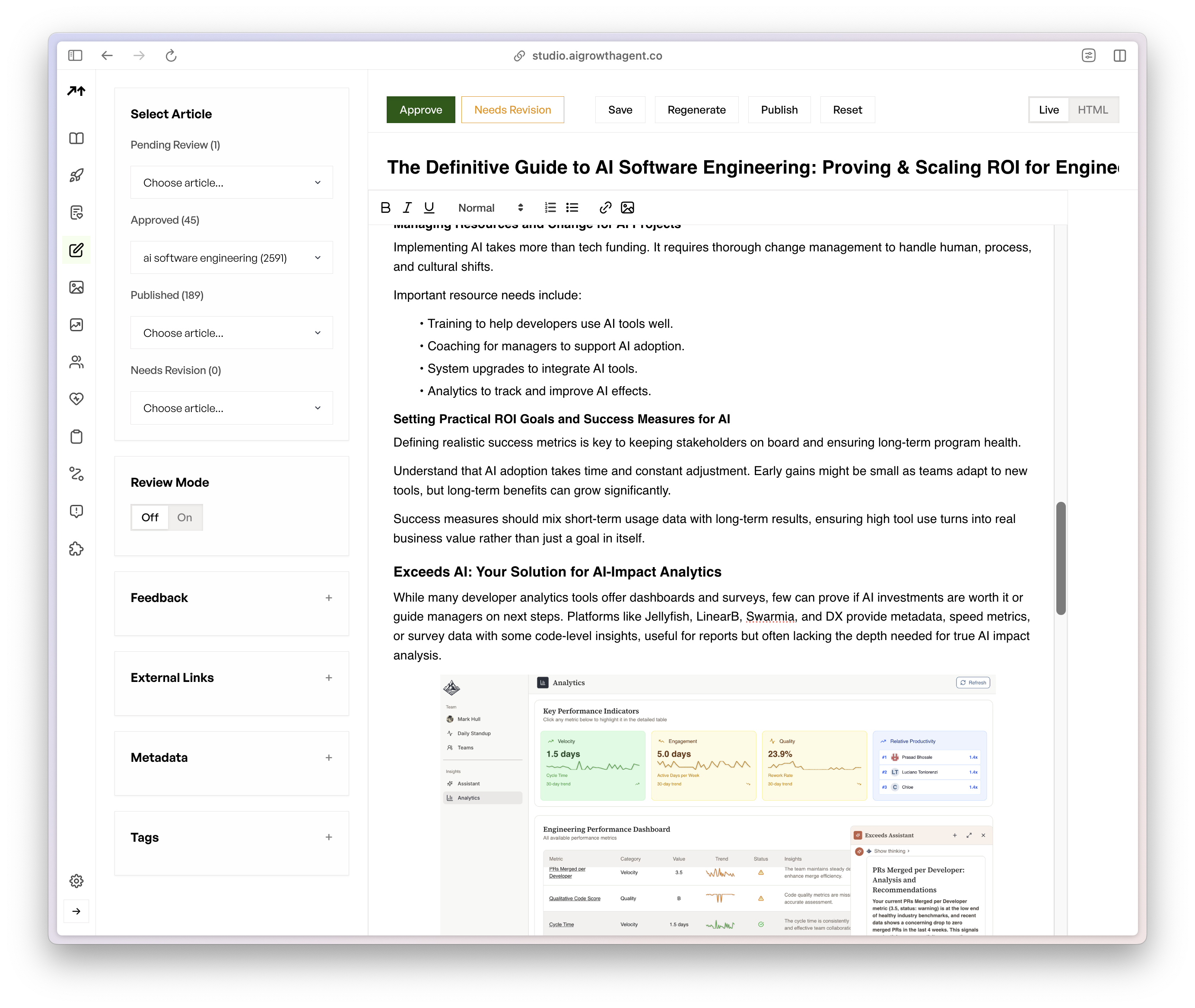
Enterprise users can manage multiple content agents from a single interface. This structure supports separate engines for regions, product lines, or brands while keeping governance centralized.
Real-Time Content Injection
AI Growth Agent can generate articles that respond to timely topics, which helps teams address new search demand quickly with optimized content.
Database-to-Content Automation
The platform converts internal datasets into structured content libraries. This approach surfaces product, usage, or performance data that might otherwise remain unindexed.
AI Search Monitor and Feedback Loop
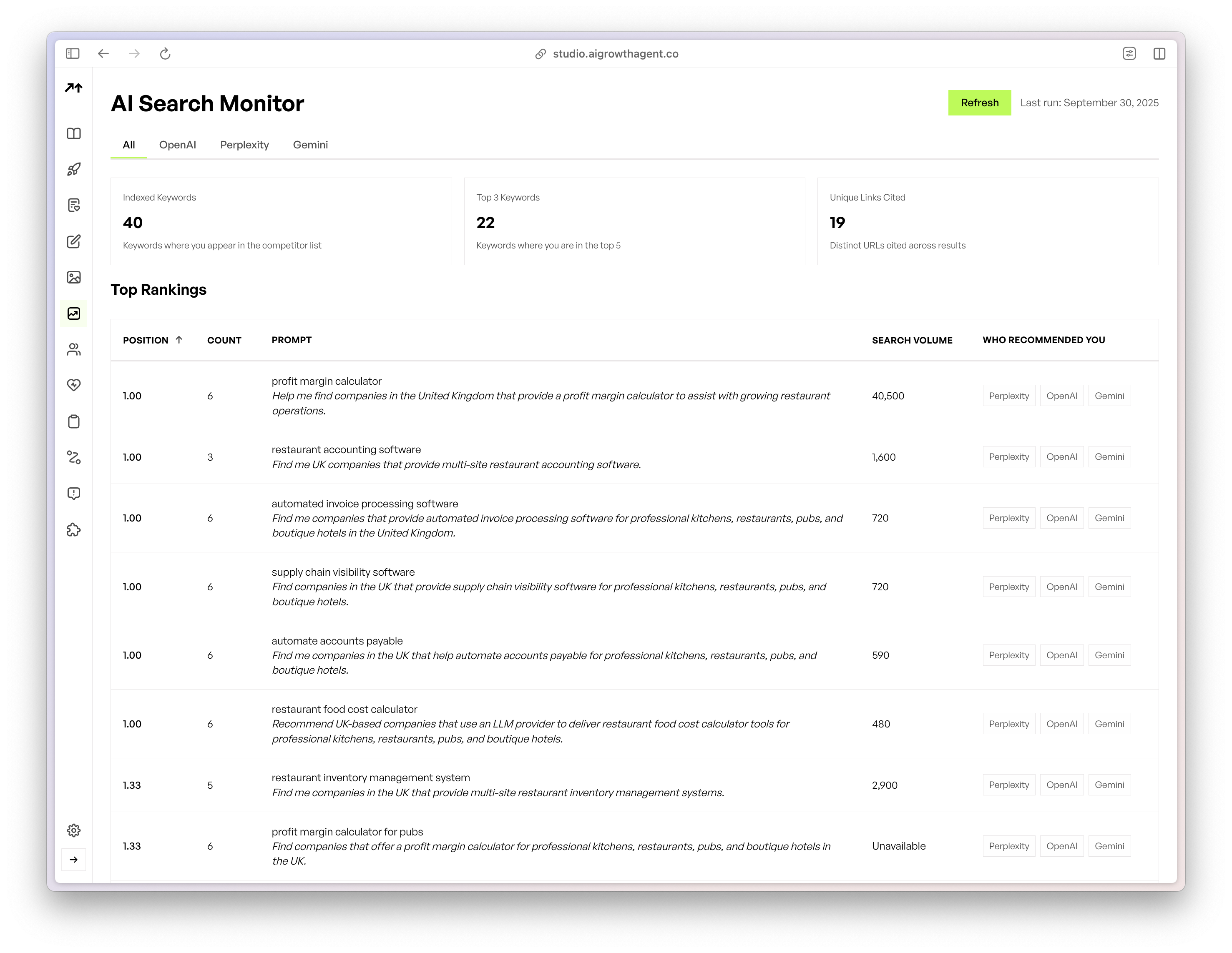
AI Growth Agent tracks how content appears across AI interfaces such as ChatGPT, Gemini, and Perplexity. Visibility and citation data then inform ongoing topic and optimization decisions.
Key Strengths
AI Growth Agent provides autonomous execution of technical SEO at scale. The system focuses on AI citation, internal structure, and consistent brand voice without requiring line-by-line human drafting.
Differentiated Limitations
Programmatic SEO works best when an organization has a clear positioning strategy and a basic technical foundation in place. AI Growth Agent emphasizes authority building, not core site repair.
Ideal Use Case
Enterprise leaders who want a dedicated content engine aimed at category leadership, AI visibility, and efficient coverage of complex topic maps.
Teams that want to explore this model can schedule a demo of AI Growth Agent’s programmatic SEO capabilities.
AI for Blog Content Writing Tools Comparison Matrix (2026)
|
Feature / Tool Category |
AI Writing Assistants (for example, Jasper AI) |
SEO-First AI Platforms (for example, Frase, Surfer SEO) |
Programmatic SEO Agents (AI Growth Agent) |
|
Primary Function |
Content generation and editing support |
SEO content optimization and drafting |
Autonomous content engineering and authority building |
|
Scalability |
High volume drafting |
Targeted content generation |
Programmatic scale with automation |
|
Technical SEO Depth |
Basic, keyword focused |
Mid level, SERP analysis and some structured data |
Advanced schema, LLM.txt, MCP, and AI indexing support |
|
Autonomy Level |
Low, human dependent workflow |
Low to mid, human strategy and review |
High, automated planning and publishing |
|
AI Search Optimization |
Indirect, traditional keyword focus |
Focus on conventional SERP rankings |
Direct focus on AI citation and recommendation |
|
Integration Ease |
API and some CMS plugins |
Selected CMS integrations |
Hosted options and integrations for common CMS and enterprise stacks |
|
Brand Voice Control |
Configurable settings |
Template driven, varies by tool |
Manifesto based modeling and programmatic enforcement |
|
Strategic Value |
Productivity boost for writers |
Improved organic visibility and rankings |
Category authority and AI search presence |
This comparison shows how AI assistants and SEO-first tools improve productivity and traditional SEO, while Programmatic SEO Agents focus on automated authority building and AI visibility.
Frequently Asked Questions (FAQ) about Advanced AI Blog Content Writing
How do advanced AI tools handle brand voice and consistency at scale?
Many tools, including Jasper AI, allow teams to set tone and style guidelines. AI Growth Agent extends this idea with a Company Manifesto model that encodes brand narrative, positioning, and guardrails inside the agent configuration. This structure helps large volumes of content reflect the same voice and priorities.
How do AI tools support fact-checking and accuracy for enterprise content?
Basic assistants often depend on human editors for verification. Programmatic SEO Agents such as AI Growth Agent incorporate checks into the production pipeline so that content is reviewed against trusted sources or client inputs before publishing.
What is the impact of AI-generated content on overall SEO strategy?
AI-generated content now influences both search rankings and how AI systems answer questions. Programmatic approaches that produce reliable, structured, and well scoped information give AI systems more reasons to reference a brand, which supports both AI citations and traditional organic performance.
Conclusion: Building a Sustainable AI-First Content Engine
AI search has changed how audiences find and trust information. Enterprise marketing leaders who rely only on manual workflows and basic AI drafting tools risk slower output, weaker technical foundations, and limited visibility in AI interfaces.
AI writing assistants and SEO-first platforms remain useful for teams that want to speed up drafting or improve search optimization. Programmatic SEO Agents such as AI Growth Agent add another layer by automating the content lifecycle, enforcing brand standards, and optimizing for AI citation across channels.
Organizations that invest now in programmatic, AI-aware content systems are better positioned to guide category conversations over the next several years. Teams that want to examine this approach in detail can schedule a consultation to evaluate AI Growth Agent for their brand.


