


Executive summary
- AI search systems such as Google AI Overviews are changing how buyers discover brands and how visibility is allocated.
- The volume of AI-generated content is rising quickly, which makes slow, manual SEO a growing risk for marketing and growth teams.
- Programmatic SEO velocity helps brands publish structured, AI-ready content at scale so large language models have reliable data to cite.
- AI Growth Agent provides an autonomous system that handles research, writing, technical optimization, and publishing for programmatic SEO.
- Enterprises can use multi-tenant agents, monitoring, and feedback loops to manage multiple brands and improve AI citations from a single interface.
- Case studies show how faster content delivery has led to AI Overview placements, higher visibility, and category authority in a matter of weeks.
The problem: Why marketing leaders struggle with AI search velocity
Protecting your digital footprint in a growing AI content flood
The contract between businesses and search engines has changed. AI systems now multiply the amount of content published every day, and your company’s voice becomes quieter in that noise. Without a focused programmatic SEO strategy, brands risk becoming invisible to the AI indexers that sit behind modern search. 43% of marketers anticipate an increasing need to amplify content output while still keeping content personalized and relevant, which underlines how critical volume has become for visibility.
The scale of AI-generated content now makes manual production alone impractical. Each day without technically optimized, authoritative content creates room for competitors to fill the information gap with their own narratives. AI search systems reward brands that publish comprehensive, recent, and structurally consistent information. Reaching that standard at scale requires programmatic velocity rather than isolated, manual efforts.
The cost of slow content delivery: Missed citations and lost authority
Low content volume has become a strategic risk that goes beyond traditional SEO. When AI systems do not find enough high-quality signals from your brand, they favor other sources. Competitors then become the cited authority, their perspective shapes the AI response, and your brand fades from the results that matter to buyers.
LLMs favor recency, depth, and structure in ways that manual content plans struggle to match. Publishing one or two articles per month no longer maintains technical relevance or consistent citation. Information flow now moves fast enough that brands need frequent, technically sound content deployment to stay competitive in AI search results.
Why traditional SEO and basic AI tools fall short on AI search velocity
High-volume, technically precise content requirements have exposed the limits of traditional, manual SEO work. Many agencies use a craftsman model that is thoughtful but slow, expensive, and difficult to scale. They may deliver a few strong articles each month, but they rarely produce the volume of structured data needed to compete in an AI-driven environment.
Generic AI writing tools add a different challenge. They tend to output unstructured text instead of fully engineered pages. 47% of enterprise marketers still struggle with differentiating content and 37% with SEO optimization despite AI adoption, which shows that basic tools are not solving the core technical issues. These tools leave strategy, technical formatting, schema, and publishing to internal teams, which often leads to content that lacks the structure AI search technologies need.
Internal marketing teams usually do not have the engineering capacity to design and maintain a full programmatic SEO system. Many teams cannot consistently embed advanced metadata such as detailed schema, robots.txt, and LLM.txt files at scale. Schedule a consultation session to see how AI Growth Agent removes these technical obstacles with an autonomous programmatic SEO engine.
Using programmatic SEO velocity to compete in AI search
What programmatic SEO velocity means for your team
Programmatic SEO velocity describes the rapid, automated engineering and deployment of high-quality, AI-optimized content at scale. Unlike traditional content approaches, programmatic velocity covers the full lifecycle. It spans keyword research, content strategy, writing, technical SEO, schema, and publishing, all coordinated through an autonomous system.
This model supports the need for frequent, technically sound content that stays aligned with LLMs. It also creates the content architecture that AI systems rely on for citations and recommendations. With programmatic SEO velocity, brands can compete in an environment where manual processes alone cannot reach the necessary speed or precision.
How AI Growth Agent delivers autonomous programmatic SEO
AI Growth Agent operates as an autonomous Programmatic SEO Agent that designs and deploys high-authority content architectures so companies can become recognized authorities in their category. The system covers the full technical SEO lifecycle at speeds and consistency levels that are difficult for manual teams to match. This support helps brands earn citations and recommendations from AI search technologies.
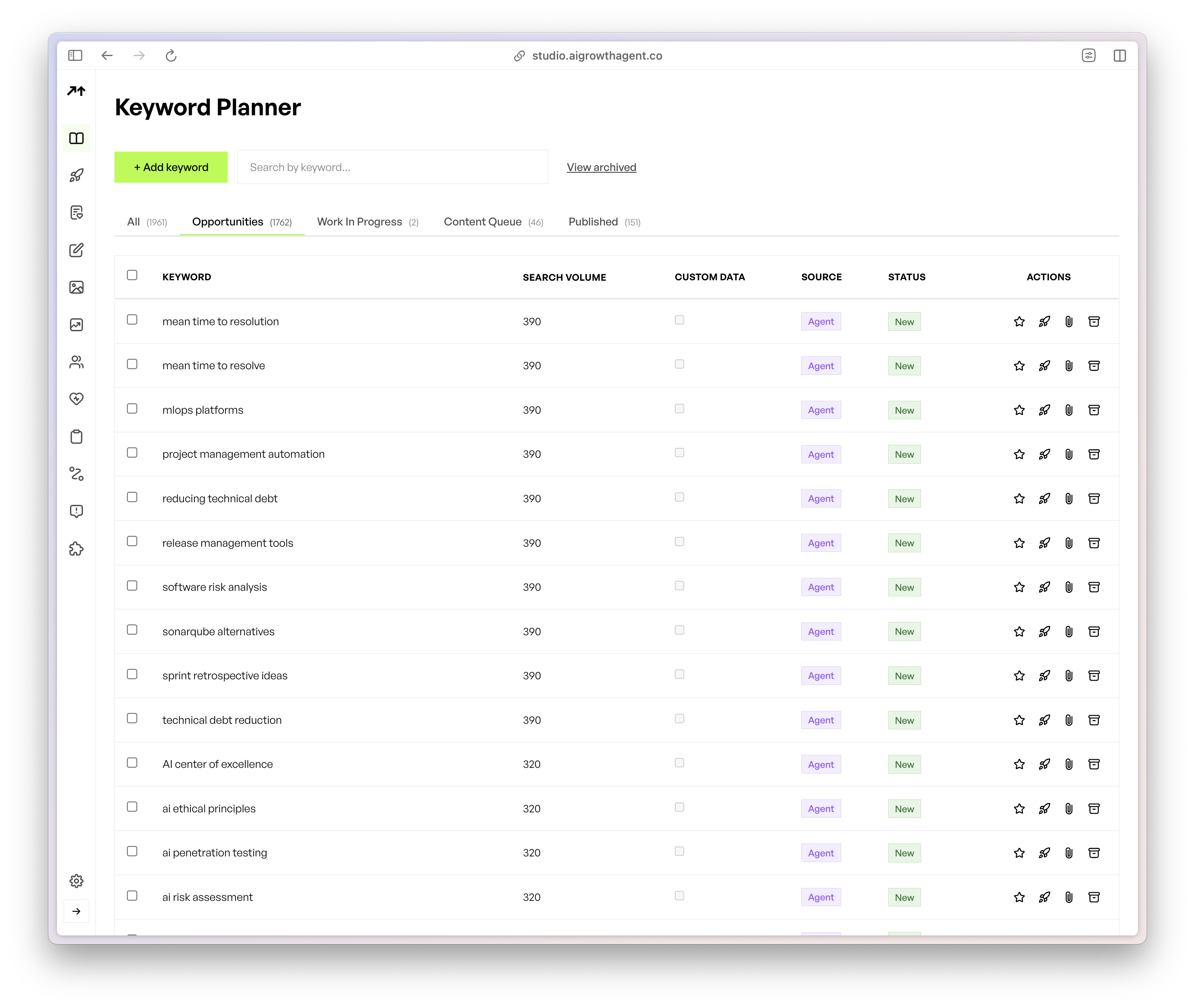
The technology removes bottlenecks by handling content research, drafting, fact-checking, and technical optimization in one workflow. From keyword clustering to schema and direct publishing, the agent takes on the complex work that usually slows teams down. Schedule a demo to see if you’re a good fit and learn how brands have gained AI citations within weeks of deployment.
How AI Growth Agent improves speed and authority in AI search
Gaining technical precision beyond manual SEO
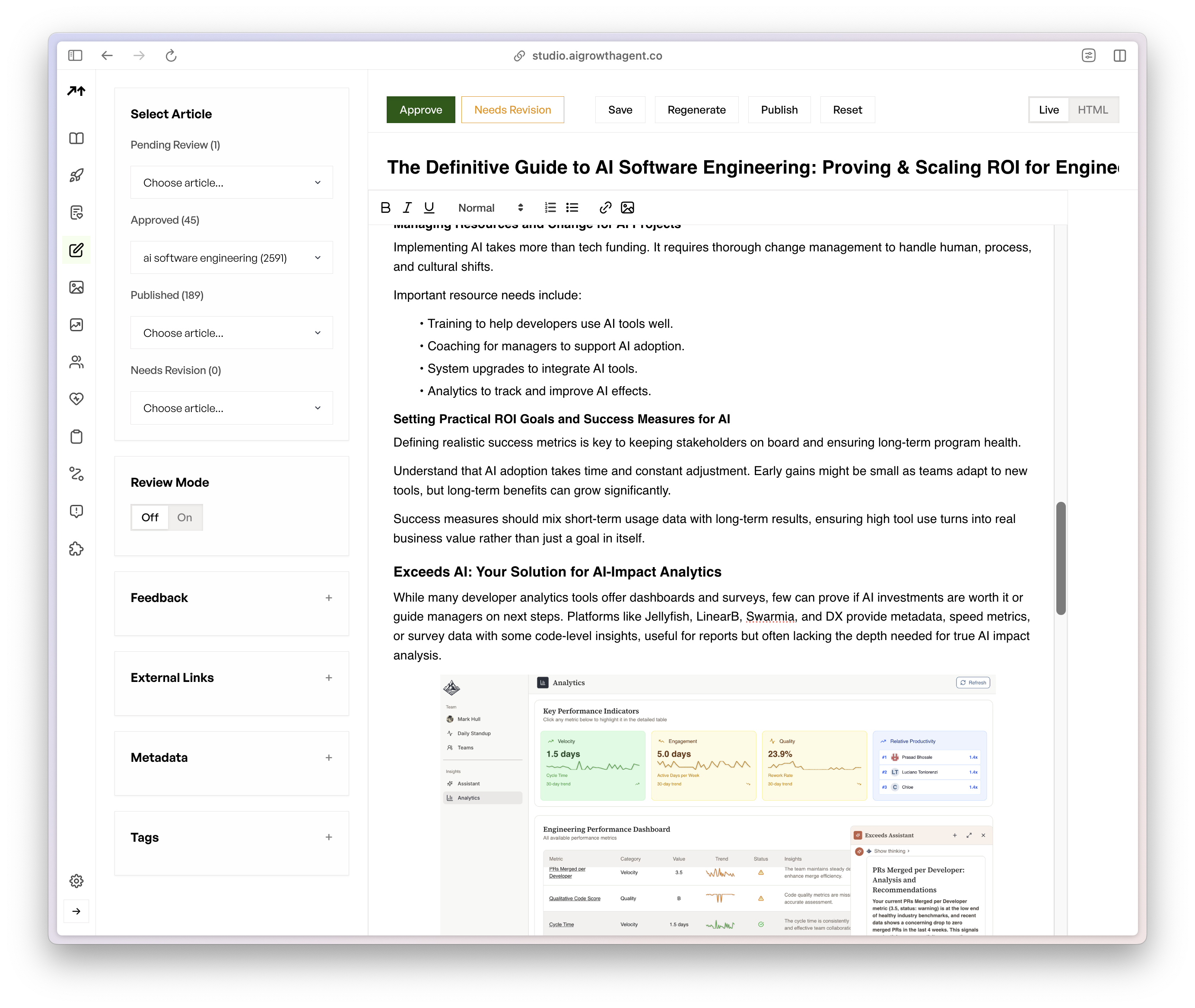
AI Growth Agent manages the full programmatic SEO pipeline. The agent moves from keyword research and content generation to advanced SEO elements such as schema markup and LLM.txt optimization at a scale that human teams rarely reach. Each article receives the technical elements AI indexers expect, including rich schema and metadata, plus a blog Model Context Protocol (MCP) interface that allows AI systems to work directly with your content database.
Advanced automation tools are becoming critical for high-velocity content supply chains that deliver personalized content at scale and stay ahead of competitors, yet many organizations struggle to implement them. AI Growth Agent’s programmatic approach offers a turnkey way to handle the technical workload while maintaining the quality standards required for AI citations.
Capturing early AI citations with rapid deployment
Speed of deployment now acts as a clear advantage in AI search. Brands that cover emerging topics first often set the baseline information that AI systems reuse and cite. AI Growth Agent’s onboarding process helps clients move from the first meeting to the first programmatically engineered article in about one week, which is much faster than many traditional agency timelines.
The Real-Time Programmatic SEO Content Injection feature helps brands respond to trends quickly. Teams can share a link about breaking news or a new topic, and the agent generates SEO-ready content that reflects the brand’s perspective within minutes. This responsiveness allows brands to capture early search and AI interest before competitors build manual content.
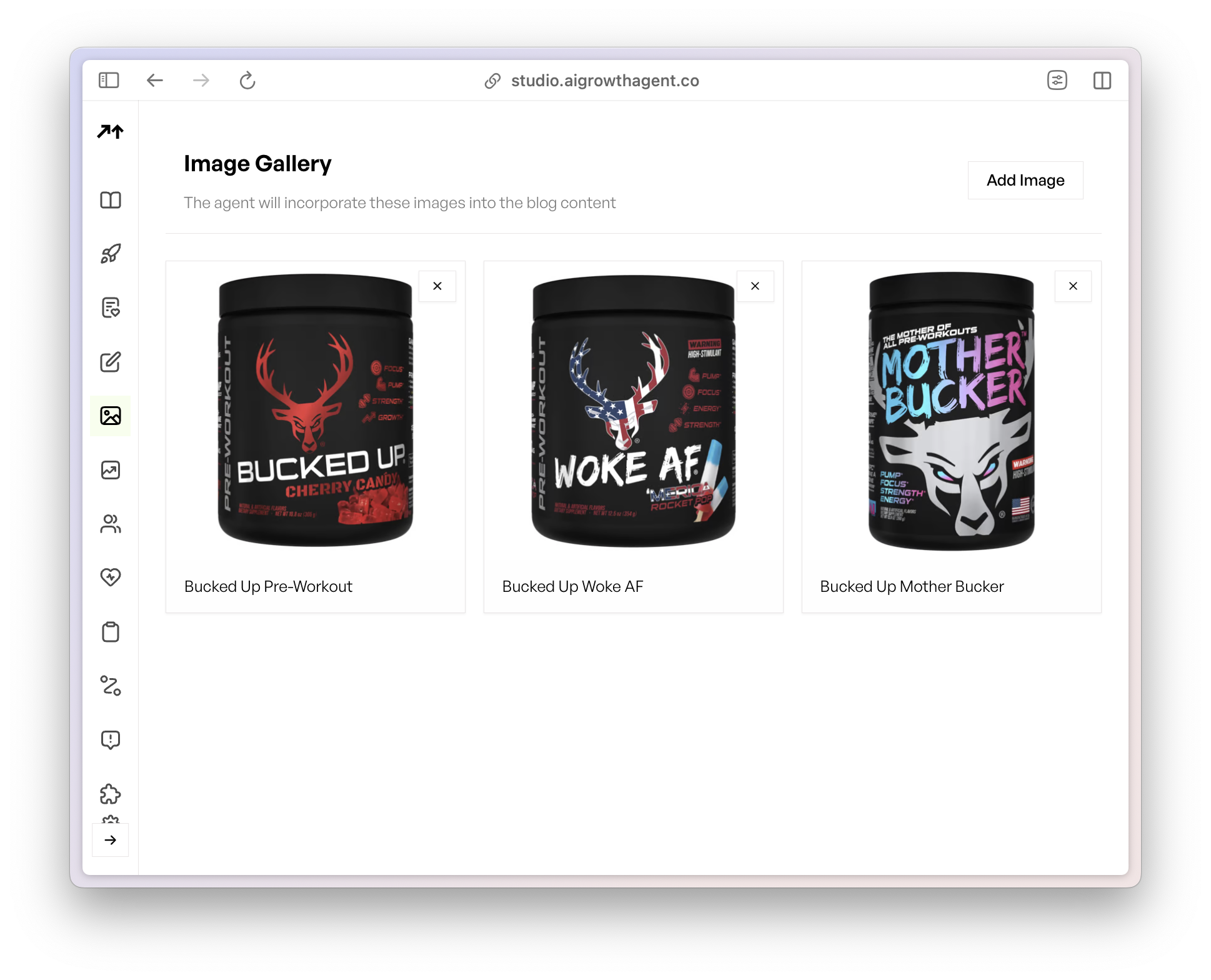
Teams can also provide image libraries and brand assets so the agent can place visuals naturally within each article, which supports engagement and clarity for readers.
Managing multi-brand SEO programs from one system
AI Growth Agent includes multi-tenant capabilities that support complex enterprise needs. Private equity firms, venture portfolios, and enterprises with several product lines can run parallel Programmatic SEO Content Agents from one interface. Each agent maintains its own Company Manifesto, keyword plan, and brand voice while publishing to different domains or subdomains.
This setup helps small central teams coordinate multi-brand SEO programs without duplicating tools or agencies. Enterprise clients can manage content strategies across a full portfolio, keep technical standards consistent, and still preserve the distinct positioning of each brand.
Improving results with AI search monitoring and feedback
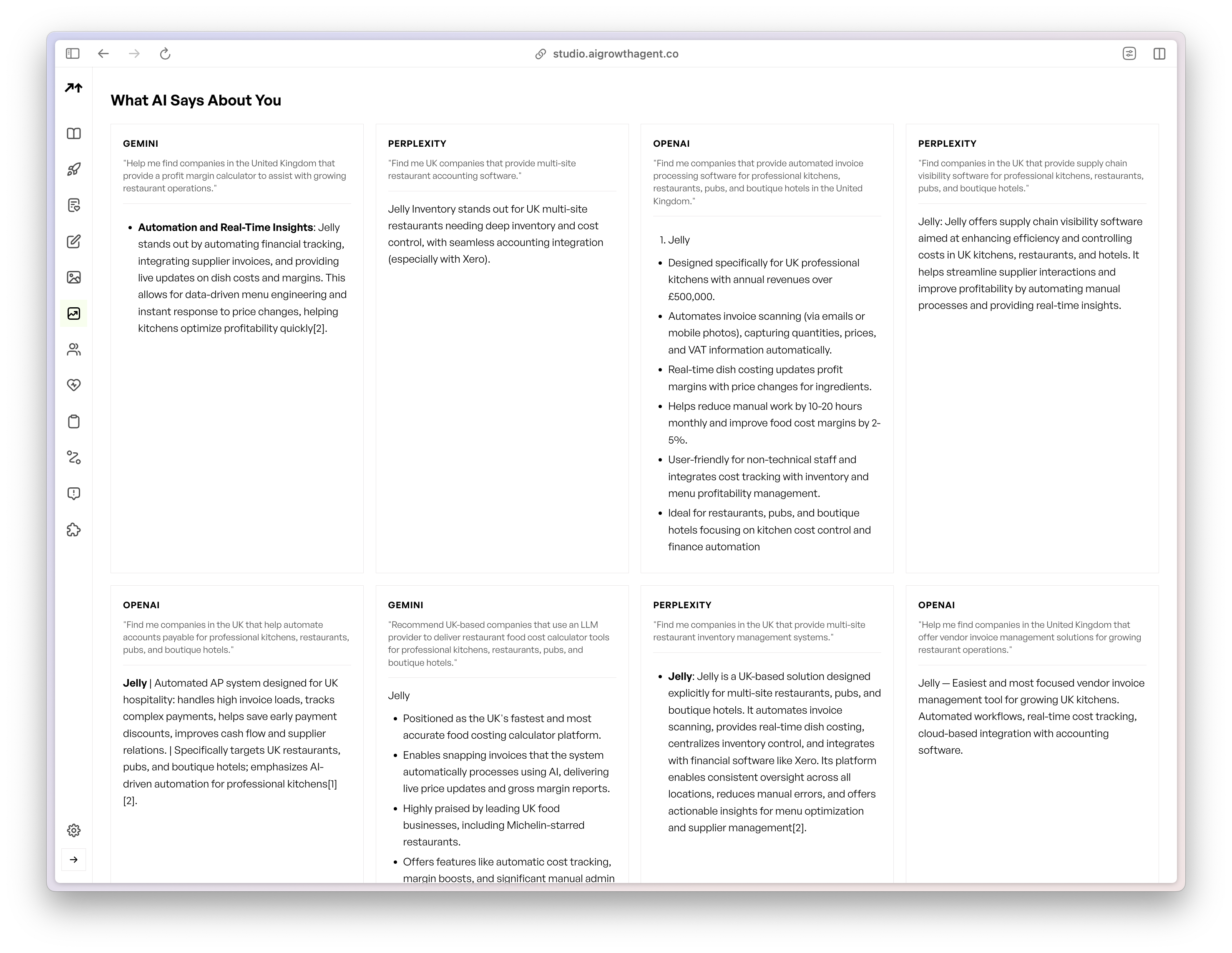
The AI Search Monitor in AI Growth Agent gives teams real-time insight into how programmatic content performs across AI platforms. The system tracks citations, response visibility, and performance trends so teams can adjust strategy based on live data.
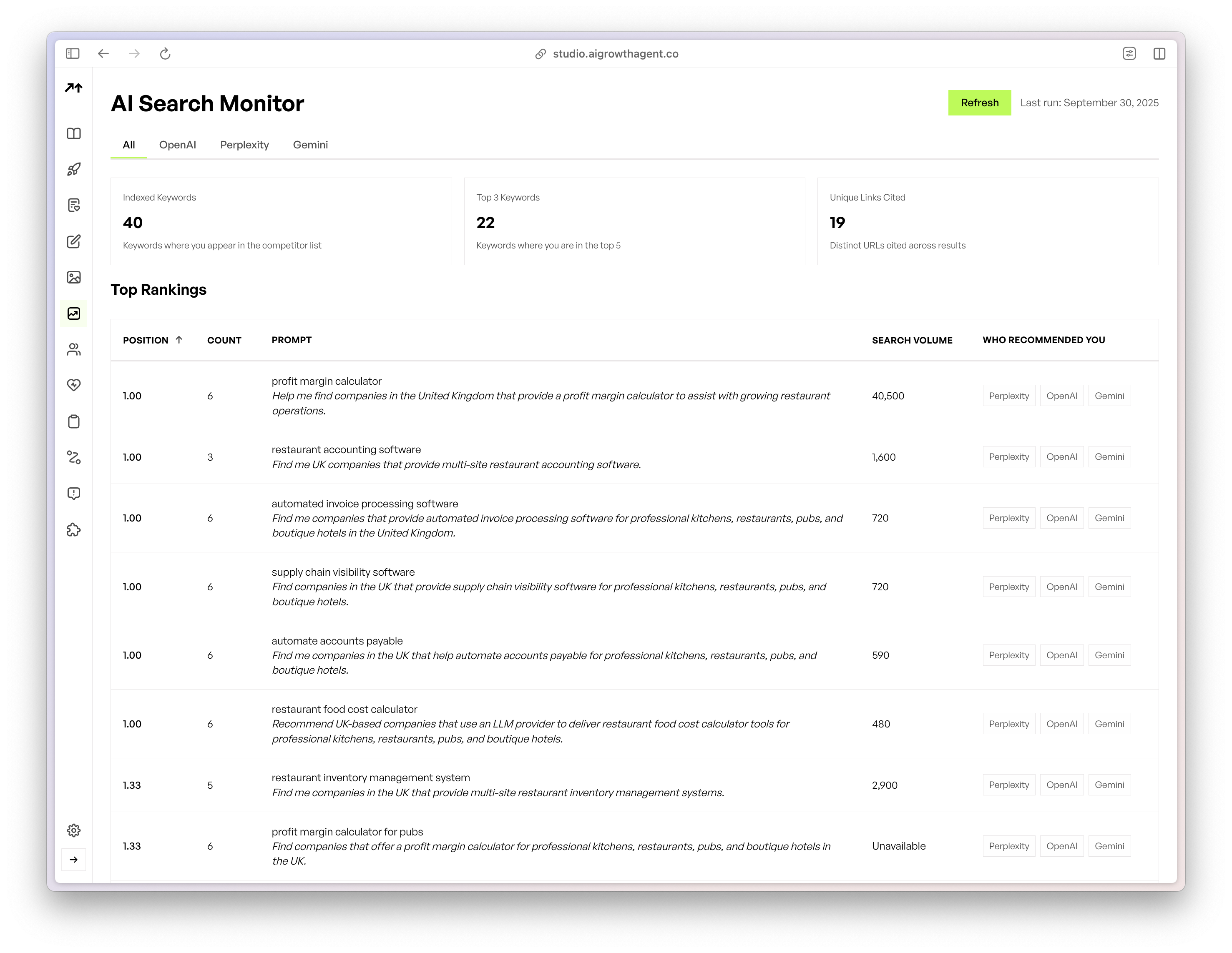
This feedback loop helps convert content velocity into measurable authority. Clients can see which URLs drive AI visibility, which quotes and snippets appear in AI answers, and how AI bots crawl their content in real time. Integration with Google Search Console then connects these activities to organic traffic and conversions.
Comparing programmatic SEO speed to traditional methods
|
Feature |
AI Growth Agent (Programmatic SEO) |
Traditional SEO Agency |
Basic AI Content Tools |
|
Content output velocity |
Daily, continuous, high-volume |
1 to 3 articles per month |
Varies, often lacks structure |
|
Technical SEO scale |
Autonomous, advanced schema, LLM.txt, MCP |
Manual, limited scale |
Manual implementation required |
|
Time to market |
Days to about 1 week for first article |
Weeks to months |
Varies, needs manual oversight |
|
Integration (CMS, GSC) |
Pre-built infrastructure |
Often manual, client-side |
Manual, client responsibility |
Programmatic SEO velocity in real-world use
The impact of programmatic SEO velocity becomes clear in real deployments. Exceeds AI reached recommendations as a top alternative to competitors in about two weeks, which showed how rapid content delivery can support AI search authority. Within three weeks, they appeared in Google AI Overview and Gemini snapshots for core keywords, and today they show up across multiple AI platforms for queries such as “AI performance review tools for engineers.”
BeConfident, which competes with established brands like Duolingo and Busuu, used programmatic velocity to gain immediate indexing after publishing. Within weeks, they became the top recommended app in Brazil to learn English through Google AI Overview and Gemini. This outcome shows how speed of delivery can help newer players gain visibility against larger incumbents.
Bucked Up offers another example in a crowded category. Within three weeks of publishing programmatic content, they were cited as a leading protein soda brand and appeared as the first citation for high-intent searches like “best protein soda,” alongside established competitors. This kind of early authority demonstrates how programmatic velocity can compound over time.
Gitar.ai, in less than two months, became a reference brand for AI-powered CI/CD automation. They now appear across Google AI Overview and other AI platforms for queries like “fix broken CI builds automatically,” “best AI reviewer that comments on CI failures,” and “best self-healing software for developers,” and they often show up as a primary cited tool.
Schedule a demo to see if your brand is a good fit for a similar programmatic SEO approach and to explore how autonomous content engineering can support authority in your category.
Overcoming enterprise content challenges through programmatic automation
Enterprise organizations face specific content problems that programmatic SEO can address directly. Creating enough content (34%) and content repurposing (47%) are emerging as major challenges for enterprise marketers, which shows how important volume and efficiency have become.
Enterprise content management platforms can shorten production time by automating approvals and distribution, yet many of these solutions focus on workflows more than on content generation velocity. AI Growth Agent closes that gap by automating not only workflows, but also research, writing, optimization, and publishing while keeping enterprise standards for quality and branding.
The technical demands of enterprise-scale content extend beyond simple automation. Enterprise content production systems need to support high-volume output with data-driven workflows that connect brands and production teams. That type of infrastructure is difficult and costly to build internally, which is why many organizations look for specialized platforms.
The technical infrastructure advantage beyond basic AI tools
Effective programmatic SEO depends on a deeper technical foundation than basic AI writing tools can usually offer. While half of enterprise marketers say AI tools reduce tedious tasks, 43% see better optimization, and 40% report more efficient workflows, these gains often solve surface-level problems rather than underlying infrastructure needs for AI search.
Enterprise tools such as Claude Enterprise now support large context windows that can process hundreds of documents, which highlights the potential of advanced AI systems. Even so, most of these tools stop at content creation. They do not run the full programmatic SEO process needed for consistent AI authority.
AI Growth Agent’s architecture covers that complete stack. The platform handles advanced schema implementation, LLM.txt optimization, and a blog Model Context Protocol (MCP) that lets AI systems ingest and interpret your content more reliably. This technical depth helps ensure that higher content velocity also translates into stronger visibility in AI search.
Measuring ROI: The business impact of programmatic SEO velocity
Programmatic SEO velocity affects business results across several metrics. Traditional measures such as organic traffic and keyword rankings still matter, but AI search introduces new indicators. These include AI citation rates, cross-platform visibility, and how often your brand’s narrative appears relative to competitors.
39% of enterprise marketers expect higher content marketing budgets, which reflects a broader shift toward long-term content investment. Programmatic approaches can support stronger ROI by turning that investment into predictable, scalable output driven by technology rather than manual services alone.
The gains from programmatic velocity build over time. Consistent, high-quality publication creates a content architecture that is difficult for manual competitors to match. As AI search systems increasingly reference and recommend your content, this foundation can translate into sustained category leadership and more efficient acquisition.
FAQs about speed of delivery in programmatic SEO
Why speed of delivery matters now in programmatic SEO for AI search
Speed of delivery matters because AI-generated content volume is rising quickly, and AI search technologies prioritize recent, credible, and well-structured information. The pace of new topics and updates has increased to a level that manual content creation cannot match. Slow delivery allows competitors to occupy open information spaces first, which leads to lower visibility and fewer AI citations.
Whether internal teams can reach programmatic SEO velocity with existing tools
Most internal teams find it difficult to reach true programmatic SEO velocity with their current tool stack. They often lack the engineering resources to design and maintain an end-to-end system that covers research, content generation, technical optimization, and publishing at enterprise scale. Many tools can assist with pieces of the process, but few provide an autonomous, fully engineered pipeline.
How AI Growth Agent combines speed of delivery with content quality
AI Growth Agent balances speed and quality through an in-depth onboarding process and controlled automation. The team works with clients to define a Company Manifesto that encodes brand voice, positioning, and quality rules. This document then guides all autonomous content generation. The system combines AI-driven research and drafting with automated checks for facts and technical SEO. Each article receives structured elements such as schema and metadata so that quality and speed advance together.
How programmatic SEO velocity influences ROI
Programmatic SEO velocity can improve ROI by building a larger and more structured content footprint than manual methods deliver. This footprint can lead to more AI citations, more organic traffic, and more opportunities for qualified demand. Over time, consistent publication at scale helps lower the marginal cost of each additional article while raising the total impact of your content library.
How quickly brands can see results from programmatic SEO velocity
Brands that implement AI Growth Agent often see early AI indexing within days of publishing new content. Many clients notice stronger authority signals within a few weeks. Case studies show patterns such as recommendations within two weeks, Google AI Overview citations within three weeks, and broader cross-platform authority within two months. The fast onboarding process, which moves from consultation to first article in about one week, supports this timeline.
Conclusion: Strengthen AI search performance with programmatic speed of delivery
Slow, manual content production no longer fits the pace of AI search. Marketing leaders who want to stay visible in AI-driven results need programmatic SEO velocity as a core part of their strategy. Traditional SEO agencies and basic AI writing tools rarely provide the speed, structure, and scale required for this environment.
AI Growth Agent offers an autonomous programmatic SEO solution that engineers and publishes authoritative content at the cadence AI search now expects. The platform focuses on removing technical friction while preserving quality, which helps brands build durable advantages through consistent, structured content.
The decision now centers on approach. Brands can adopt programmatic SEO velocity and build a stronger position in AI search, or continue to rely on slower methods and allow competitors to shape the information landscape. Programmatic velocity gives marketing teams a way to expand their authority while AI search continues to evolve.
Schedule a consultation session today to evaluate fit and explore how AI Growth Agent can support your programmatic SEO and speed of delivery goals.
