Written by: Mariana Fonseca, Editorial Team, AI Growth Agent
Key Takeaways
- AI search systems like ChatGPT, Google AI Overviews via Gemini, and Perplexity now shape how enterprise buyers discover and evaluate brands, so content quality and structure directly affect visibility.
- Enterprise teams need tools that combine accurate AI-generated content with strong technical SEO, including schema, metadata, and AI-focused standards such as LLM.txt and Model Context Protocol.
- The most effective platforms support programmatic SEO at scale, automating research, writing, optimization, and publishing while fitting smoothly into existing workflows and governance.
- Traditional AI writing assistants and SEO audit tools each solve parts of the problem, but they rarely deliver autonomous, authority-focused content systems that move AI search citations and revenue outcomes.
- AI Growth Agent provides an autonomous programmatic SEO engine for enterprises, and you can see it in action by scheduling a demo at AI Growth Agent.
Why AI-Generated Content Quality Is Now a Business Imperative
AI-driven search in 2026 places language models between your brand and your buyers. ChatGPT, Google AI Overviews via Gemini, and Perplexity interpret your content, summarize it, and then decide whether to recommend your brand.
Content volume and structure now influence how these systems see you. LLMs favor recent, deep, and consistently formatted content, so a handful of manual posts per month often fails to generate enough data for models to trust and cite your brand.
Competitive risk grows when you do not publish at sufficient scale. Sparse coverage leaves AI systems searching for alternative sources, and your competitors then become the default entities cited as category leaders and recommended solutions.
You can see how AI Growth Agent keeps enterprise content visible in AI search by scheduling a demo.
What Enterprise Teams Should Evaluate in AI Content Quality Tools
Tool selection should focus on objective quality, technical readiness for AI search, and the ability to support enterprise workflows at scale.
Output Quality and Factual Consistency
Reliable tools prioritize accurate, coherent content. Critical metrics include hallucination rate and factual consistency scores, which indicate how closely model outputs match verified source data. Strong citation coverage, where most claims link to valid references, supports both user trust and AI model confidence.
Technical SEO and AI Search Integration
Enterprise-ready systems handle more than copywriting. They manage schema markup, metadata, internal linking patterns, LLM.txt files, and Model Context Protocol integration so AI systems can parse and index content accurately for both traditional and AI search environments.
Scalability and Automation for Programmatic SEO
Large brands need consistent content output across hundreds or thousands of pages. Effective platforms automate research, drafting, optimization, and publishing, and they apply shared rules and templates so each new asset reinforces your topical authority.
Usability and Workflow Integration
Adoption depends on how well a tool fits into current processes. Integrations with major CMS platforms, straightforward interfaces, and structured feedback loops help teams review, improve, and approve content without excessive friction.
Bias, Policy Alignment, and Governance
Enterprise teams must manage risk. Robustness metrics are vital for real-world reliability, including resistance to adversarial prompts, policy compliance rates, and bias detection. Strong guardrails help ensure content remains appropriate, accurate, and aligned with brand and regulatory requirements.
Total Value for Enterprise and Programmatic SEO
True value appears in outcomes, not feature lists. The most effective tools increase AI search citation frequency, improve organic traffic quality, and strengthen your position as a trusted source in your category over time.
How Different AI Content Tool Categories Compare
Enterprise marketers benefit from understanding how major tool categories address different parts of the AI content quality problem.
Traditional AI Content Assistants (Jasper, Surfer AI, Writesonic)
These platforms focus primarily on content creation support.
- Strengths: Generate drafts quickly, assist with ideation, and provide basic optimization suggestions for individual articles or landing pages.
- Limitations: Often require significant human editing, usually rely on manual technical SEO work, and rarely deliver autonomous, programmatic content systems that reach enterprise scale.
Technical SEO Audit and Monitoring Platforms (SEMrush, Ahrefs, Sitebulb, Profound AI Search Monitor)
SEO platforms excel at diagnostics and performance monitoring.
- Strengths: Identify technical issues, surface keyword opportunities, analyze competitors, and monitor visibility in both traditional and AI search environments.
- Limitations: Highlight problems but do not automatically create, optimize, and publish new content at scale, so teams still need manual workflows or additional tools to execute.
AI Growth Agent as a Programmatic SEO Authority System
AI Growth Agent focuses on programmatic SEO and authority building rather than isolated content generation. The platform operates as an autonomous content architecture system that helps brands become reliable sources for AI search engines.
Key capabilities include:
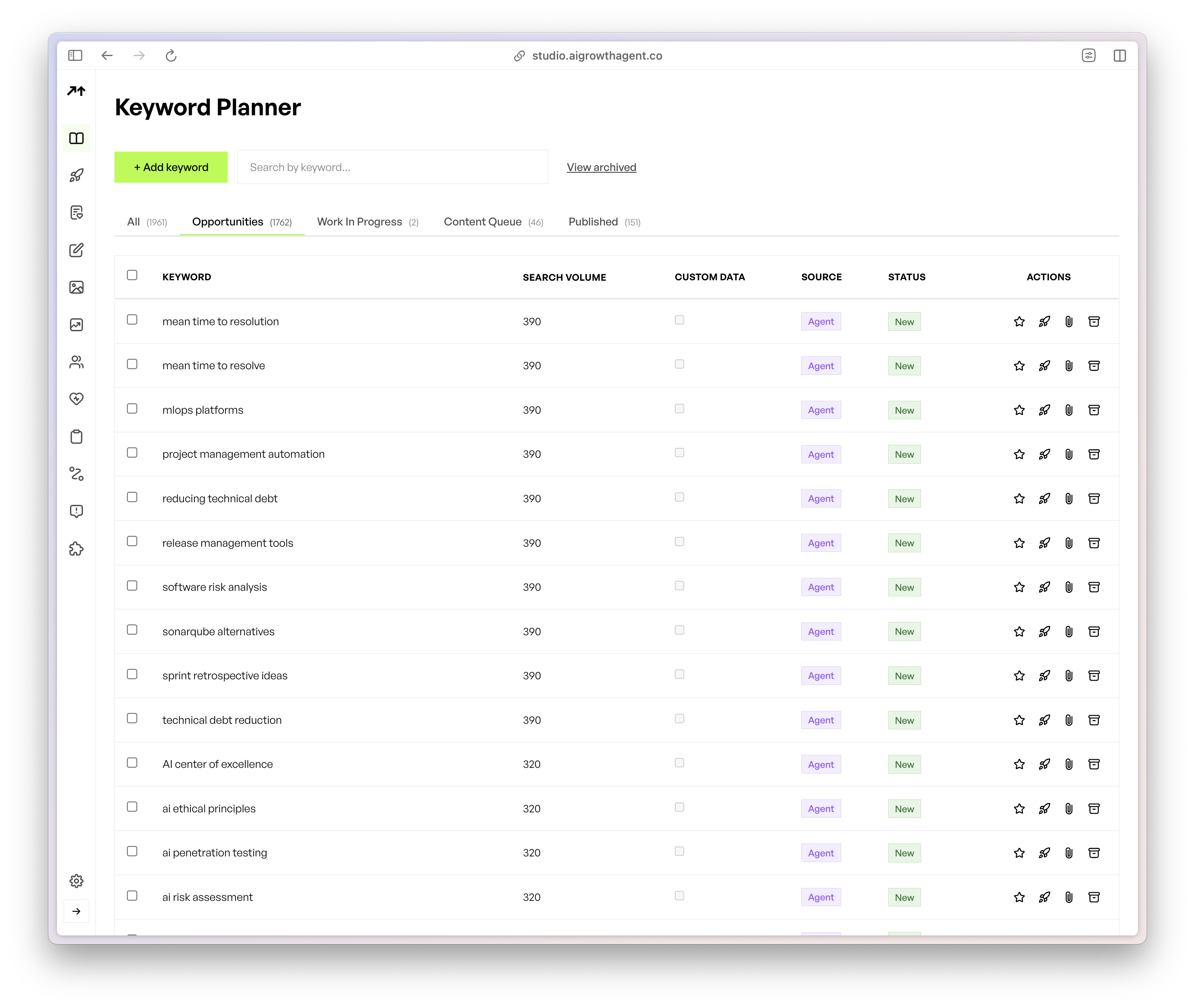
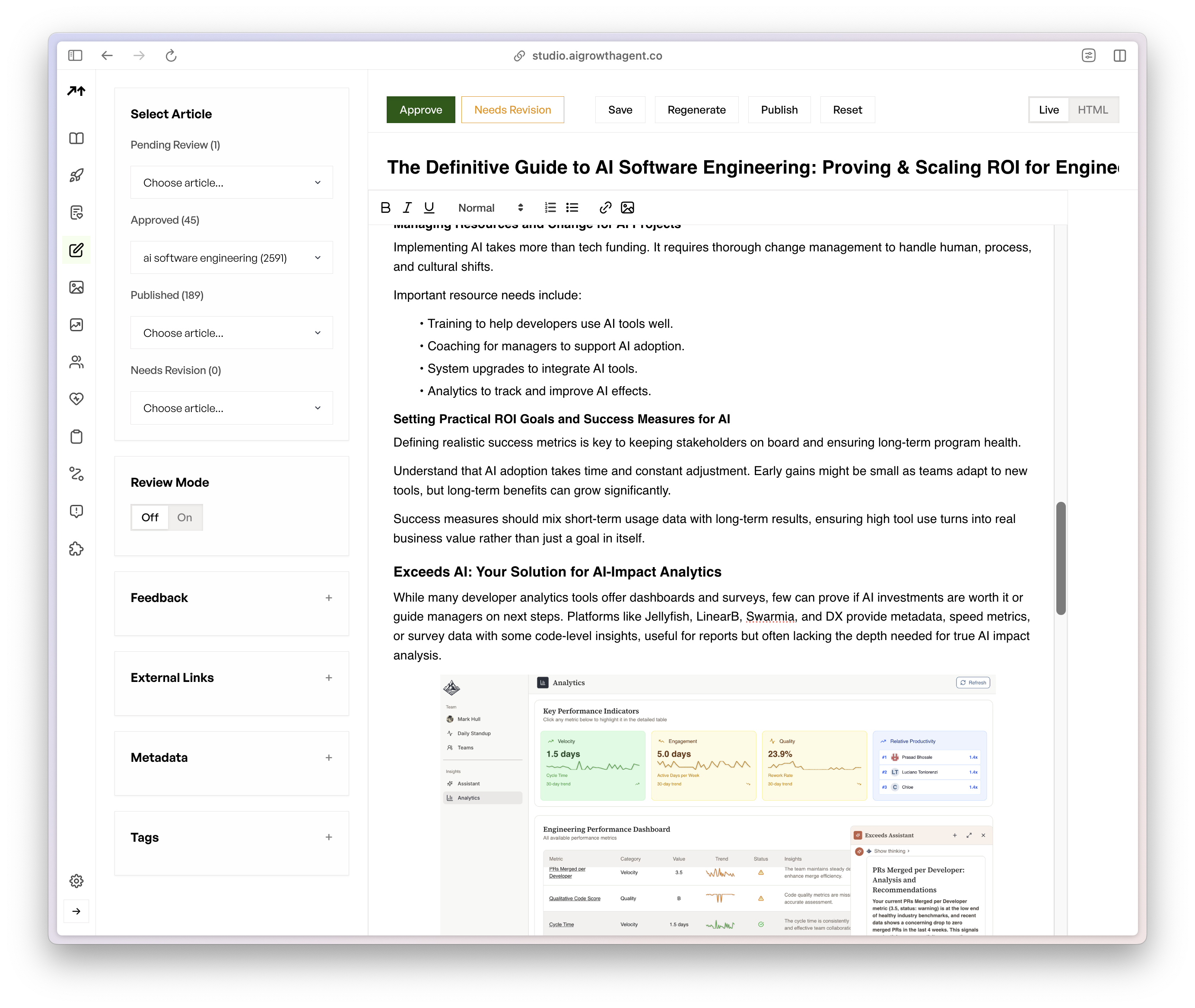
- End-to-end pipelines that research, draft, optimize, and publish content across large keyword landscapes.
- Deep technical SEO integration, including schema markup, LLM.txt, and a blog Model Context Protocol that exposes structured context to AI models for more accurate indexing and citation.
- A Company Manifesto framework that encodes brand voice, positioning, and constraints so outputs remain consistent across pages, products, and campaigns.
- Multi-tenant support for enterprises managing several brands or business units from a single interface with distinct strategies.
- Options for real-time content injection and database-to-content automation to surface proprietary data in a structured, indexable form.
The pricing model emphasizes automation instead of billable hours, so teams gain ongoing content output without relying on linear agency time.
Comparison Table: AI-Generated Content Quality Tools for Enterprise Marketers
|
Feature or Metric |
Traditional AI Content Assistants |
Technical SEO Audit Tools |
AI Growth Agent |
|
Primary Function |
Text generation and basic optimization |
SEO auditing, keyword research, monitoring |
Autonomous programmatic SEO and authority building |
|
Technical SEO Integration |
Limited, often requires manual setup |
Diagnostic only, no content creation |
Comprehensive coverage including schema, LLM.txt, and MCP |
|
Content Velocity and Scale |
Moderate, depends heavily on human oversight |
Not applicable, does not generate content |
High output at scale through autonomous pipelines |
|
Factual Consistency and Authority |
Often requires manual fact-checking |
Not applicable for content generation |
Guided by a Company Manifesto and ongoing feedback loops |
How Enterprise Brands Use AI Growth Agent in Practice
Customer examples illustrate how programmatic SEO can influence AI search results across industries.
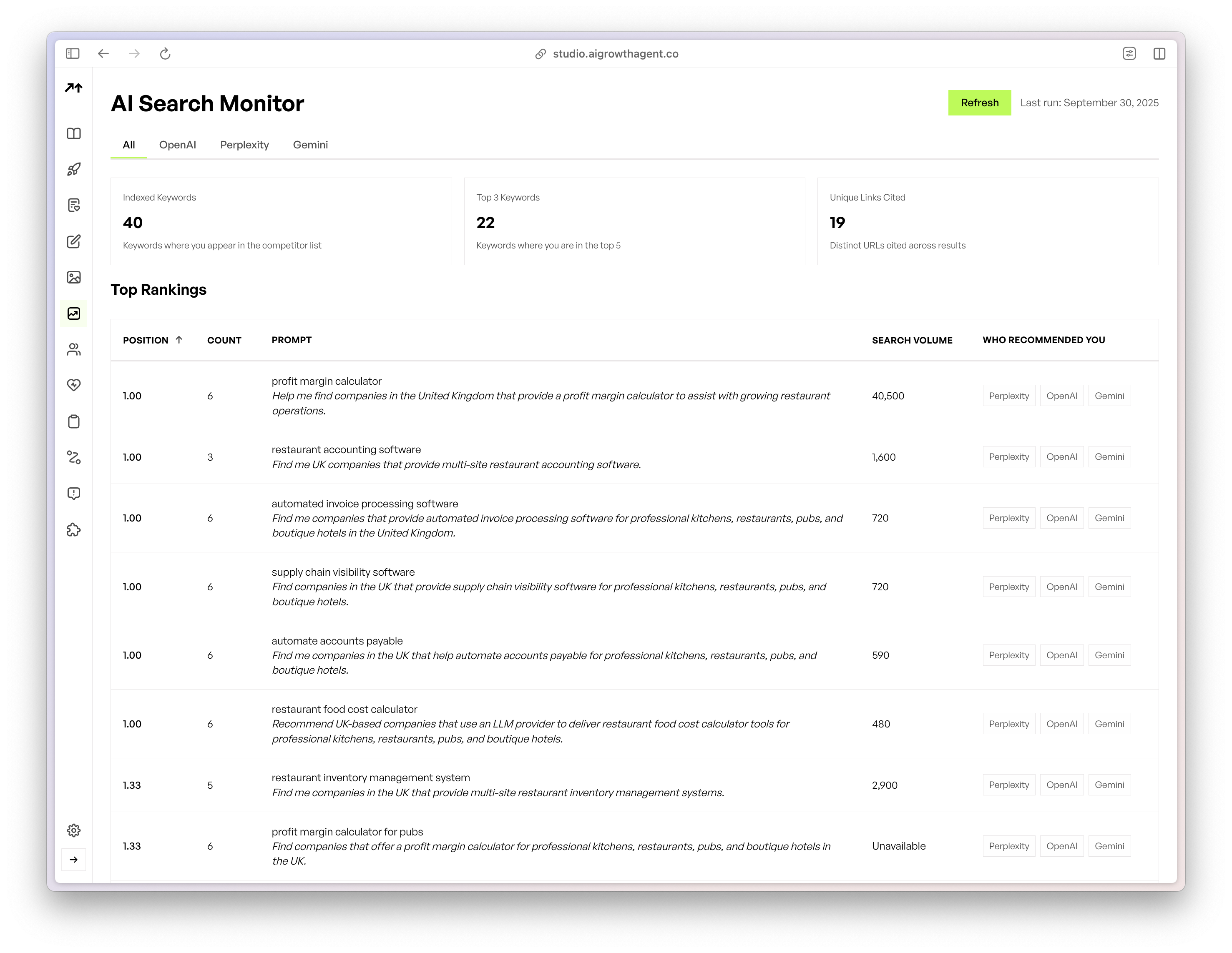
- Exceeds AI reached Perplexity recommendations as a top alternative to competitors within two weeks, showing how focused content structures can accelerate authority.
- BeConfident, in a crowded English learning market, earned leading recommendations in Brazil in Google AI Overview and Gemini for English learning applications within weeks.
- Sports nutrition brand Bucked Up began receiving ChatGPT citations as a top protein soda brand within three weeks, appearing alongside larger incumbents in high-intent conversations.
- Gitar, an AI-powered CI/CD automation platform, now appears frequently as a reference for automated CI build fixes and self-healing pipelines across multiple AI search engines.
To explore whether this kind of programmatic approach fits your roadmap, you can schedule a consultation session.
Frequently Asked Questions (FAQ)
How does AI Growth Agent maintain content consistency compared to other tools?
AI Growth Agent uses a Company Manifesto that encodes your positioning, tone, and messaging rules. The system applies this manifesto across every page and uses feedback loops to refine outputs over time, so new content continues to match your preferred narrative.
What is the Model Context Protocol (MCP), and why is it important for AI search?
The Model Context Protocol is a technical method that lets AI systems understand your blog structure, content relationships, and metadata with high precision. Direct access to this structured context improves indexing and makes it easier for LLMs to select and cite your content when answering user questions.
Can AI Growth Agent integrate with my existing CMS?
AI Growth Agent works with major platforms such as WordPress, Hashnode, Webflow, Framer, Sanity, and HubSpot. Many enterprises choose the hosted environment to gain a clean, SEO-optimized architecture and consistent branding while still connecting to internal systems and analytics.
How quickly do enterprises usually see results from AI Growth Agent?
Most enterprise customers start seeing changes in AI citation patterns and rankings within a few weeks. The combination of structured content, technical SEO, and programmatic coverage helps AI systems quickly reassess your authority on key topics.
Is AI Growth Agent suitable for small businesses or individual marketers?
AI Growth Agent focuses on enterprise and upper mid-market organizations that need to solve scale and quality at the same time. The platform works best for brands that already have strong products and clear positioning and now want to be recognized as category leaders in AI search.
Conclusion: Programmatic SEO Shapes the Future of AI Search Visibility
AI-driven search in 2026 turns content marketing into an engineering challenge that blends quality writing with rigorous technical structure and scale. Manual publishing and generic AI writing tools rarely provide the coverage and consistency needed to earn sustained citations from large language models.
Enterprise marketers who adopt programmatic SEO systems can build durable visibility as AI search matures. To see how AI Growth Agent supports that strategy end to end, you can schedule a demo with the team.