


Written by: Mariana Fonseca, Editorial Team, AI Growth Agent
Key Takeaways
- AI search engines like ChatGPT, Gemini, and Perplexity now rely on structured, high-volume, and frequently updated content, which makes programmatic SEO essential for sustained visibility.
- Traditional agencies, manual content teams, and generic AI writers struggle to provide the speed, structure, and scale needed for consistent AI search citations.
- Programmatic SEO platforms differ widely in automation depth, technical SEO support for AI indexing, and required human effort, so marketing leaders need clear criteria before investing.
- Effective adoption depends on realistic timelines, technical readiness, and AI-specific performance tracking, including citations and visibility across AI search surfaces.
- AI Growth Agent provides end-to-end programmatic SEO automation for brands that want AI search visibility at scale; schedule a demo to see how it fits your 2026 content strategy.
The Imperative of Programmatic SEO in the AI Search Era
AI search has shifted visibility from a few manual pages each month to large, structured content libraries that AI systems can reliably cite. Brands now compete on consistent data signals rather than isolated blog posts.
Why Digital Footprints Shrink Without Programmatic Content
AI multiplies new content every day, so static or slow content programs lose relative share of voice. Brands that do not expand their structured content footprint risk falling below the threshold where AI systems notice and cite them.
Programmatic Velocity as the New Baseline
LLMs favor recency, depth, and structural consistency at a scale that manual publishing cannot match. One or two handcrafted posts each month rarely provide enough coverage or freshness to support authority in AI-driven results.
How Competitors Capture Your Narrative
AI systems rely on available, well-structured content when summarizing topics and brands. If your organization does not provide enough high-quality signals, AI will lean on competitors with richer content libraries, which allows their messaging to frame market conversations.
Limits of Agencies, Internal Teams, and Generic AI Tools
Most agencies still run manual, project-based workflows that move too slowly for AI search. Internal teams often lack the engineering support to run programmatic SEO at scale. Generic AI tools such as standalone chat interfaces output text but not complete, optimized web experiences, so strategy, formatting, and deployment still fall back on internal teams.
How We Evaluated AI Content Strategy Automation Tools
This comparison focuses on the needs of marketing leaders at brands that care about quality, control, and scale in AI search. Each platform is evaluated on automation depth, technical SEO for AI indexing, content quality controls, implementation effort, and reporting strength.
Key Selection Criteria
- Scalability and automation depth: Ability to produce and manage large content libraries without linear headcount growth.
- Technical SEO for AI indexing: Support for schema markup, LLM.txt, Model Context Protocol, and clean site architecture.
- Content quality and brand voice: Controls that keep tone, positioning, and claims consistent at scale.
- Implementation and integration: Effort required to connect with CMS, analytics, and existing workflows.
- Reporting and feedback: Insight into AI search visibility, content performance, and optimization opportunities.
Data Sources and Perspective
This overview reflects product documentation, user feedback, and feature analysis to outline where each platform fits. The goal is to help teams match tools to specific use cases, not to declare a single universal winner.
AI Growth Agent: Programmatic SEO Automation Built for AI Search
AI Growth Agent focuses on autonomous programmatic SEO for brands that want AI search visibility and authority. The platform engineers structured content architectures, publishes optimized pages, and maintains ongoing technical SEO without heavy internal overhead.
AI Growth Agent Overview
The system operates as a Programmatic SEO agent that covers keyword strategy, content planning, technical setup, and publishing. Teams typically move from kickoff to the first live, programmatically generated article in about one week, due to prebuilt infrastructure and playbooks.
Core Capabilities for AI Content Strategy Automation
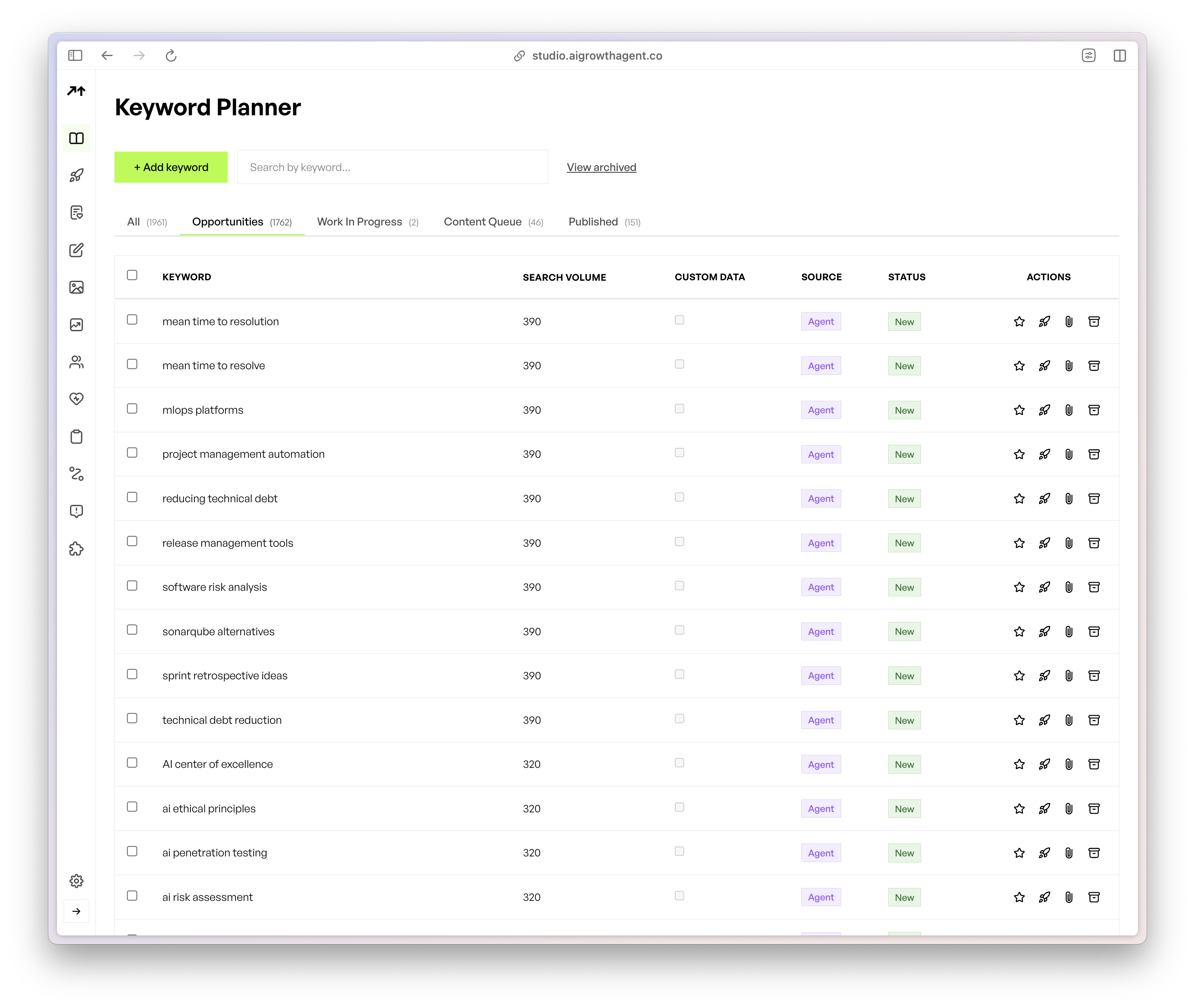
Programmatic keyword and content research ingests your positioning and products, then evaluates large sets of search queries to form pillars and clusters aligned with AI search behavior.
Autonomous technical infrastructure sets up an optimized blog environment that matches your existing brand while providing a clean base for programmatic SEO. The platform can integrate with tools such as WordPress, Webflow, Framer, Sanity, Hashnode, and HubSpot, or run on a hosted option for lower technical overhead.
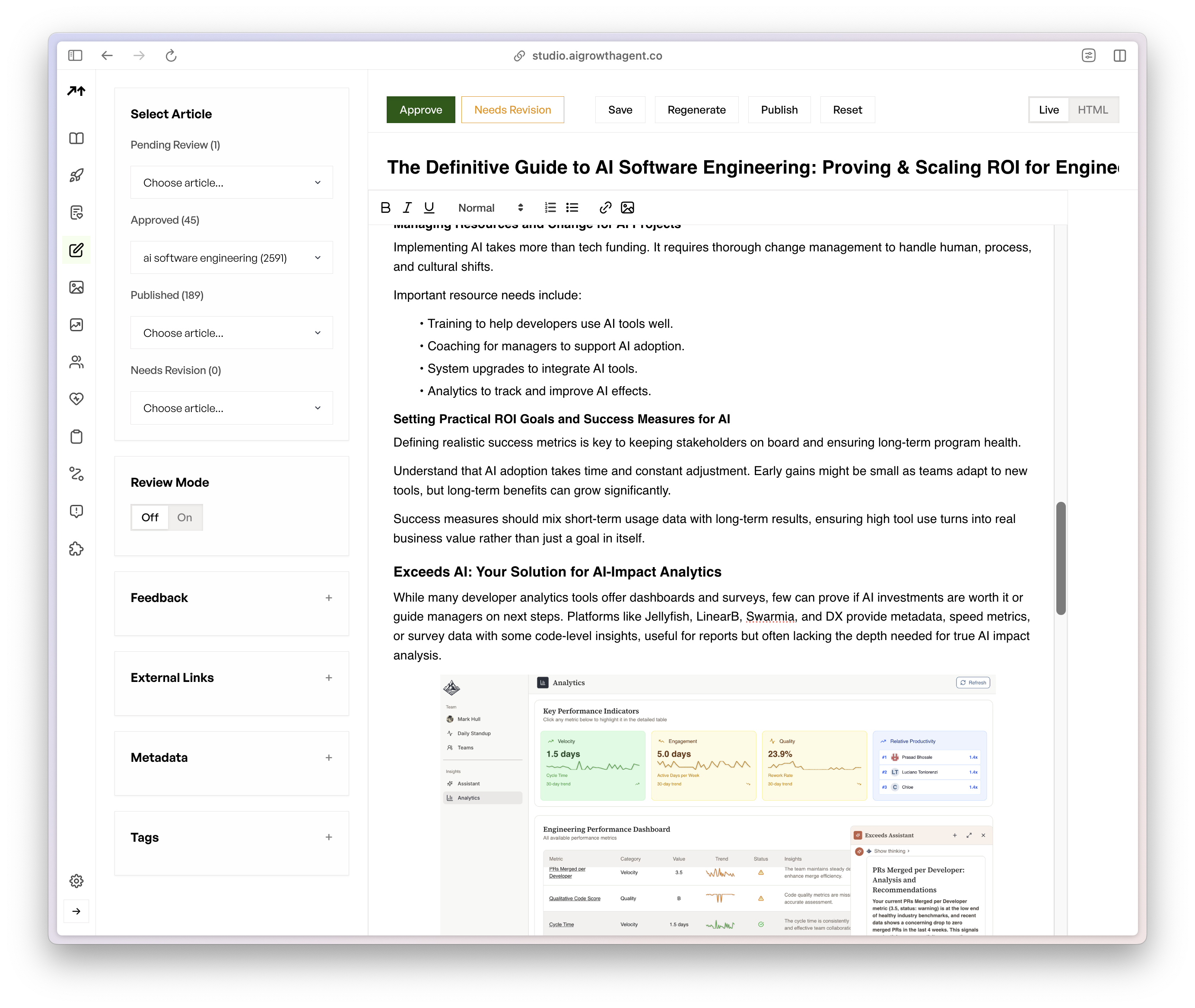
The Programmatic SEO Content Agent covers research, drafting, factual grounding, on-page optimization, and structured data. Each article includes rich schema markup, tuned metadata, and support for LLM.txt and Model Context Protocol so AI systems can more easily interpret and cite the content.
Strengths and Best-Fit Use Cases
Multi-tenant programmatic deployment allows a single interface to run separate content agents for multiple brands, product lines, or portfolio companies. Each agent maintains its own voice and domain configuration, which supports private equity firms, holding companies, and complex enterprises.
Real-time programmatic content injection makes it possible to respond quickly to emerging topics and news, so brands can capture search interest close to the moment it appears. Database-to-content automation converts structured internal data, such as product attributes or recommendations, into indexable pages that expand topical coverage.
AI Growth Agent works best for organizations that already have solid technical SEO foundations and clear growth goals. The platform assumes that basic site health is in place and focuses on scaling authority, not repairing critical technical issues.
Pricing and Engagement Model
AI Growth Agent uses an enterprise-style, value-based pricing model that reflects its role in long-term authority building. The emphasis is on measurable returns from programmatic SEO rather than on lowest cost per article.
Schedule a demo to discuss how AI Growth Agent can support your AI search strategy.
Other Tools for AI Content Strategy Automation
The broader landscape includes tools that focus on writing assistance, optimization guidance, analytics, or workflow consolidation. Each approach supports part of the content lifecycle but requires different levels of human effort.
Jasper: AI Content Generation Across Channels
Jasper helps teams create copy for blogs, ads, email, and social with brand voice controls and integrations such as WordPress and Zapier. The platform suits marketing teams that want faster drafting across many channels.
Jasper does not run end-to-end programmatic SEO. Strategy, technical optimization, and publishing remain manual or require custom workflows.
Surfer SEO: On-Page Optimization and Content Planning
Surfer SEO provides SERP-based recommendations for on-page optimization and content planning. It works well for teams that already write manually and want data-backed guidance to improve existing or new pieces.
The platform does not automate content creation or deployment, so users still own writing and publishing tasks.
SEMrush Content Toolkit: Broad SEO and Content Suite
SEMrush Content Toolkit combines topic research, brief generation, writing assistance, and performance tracking within a larger SEO platform. This structure benefits teams that want a single environment for research and reporting.
SEMrush operates as a toolkit rather than an autonomous engine, which means content creation, formatting, and technical SEO still require manual execution.
MarketMuse: Content Intelligence and Topic Authority
MarketMuse emphasizes content intelligence, gap analysis, and topic authority planning. It helps larger content teams understand where to invest effort and how to cover topics comprehensively.
MarketMuse focuses on strategy and analysis, while content production and deployment depend on separate workflows and resources.
Other Notable AI Content Tools
Averi supports automation from planning to publishing with an emphasis on unifying scattered tools. Blaze.ai provides consistent cross-channel content for smaller teams. Writesonic, ContentBot, Clearscope, and Storychief each cover parts of the workflow, including bulk generation, briefs, and content operations management.
Side-by-Side Comparison: AI Content Strategy Automation for AI Search
Key Differences at a Glance
|
Feature/Criteria |
AI Growth Agent |
Jasper |
Surfer SEO |
SEMrush CT |
|
Core Function |
Programmatic SEO Automation |
AI Content Writing |
On-Page SEO Optimization |
Content Marketing Suite |
|
Automation Level |
Full Lifecycle (Autonomous) |
Assistive (Writer Augmentation) |
Analysis/Guidance |
Assistive (Research/Briefs) |
|
Technical SEO for AI |
Advanced (LLM.txt, MCP, Schema) |
Basic/Manual |
On-Page Guidance |
Basic/Manual |
|
Scalability |
Enterprise-Grade Programmatic |
High (Content Volume) |
High (Optimization Volume) |
High (Research/Briefs) |
|
Content Deployment |
Autonomous w/ Tech Stack |
Manual/Integrations |
Manual |
Manual/Integrations |
|
Ideal User |
Premium Brands (CMOs, VPs) |
Marketers, Writers |
SEO Specialists |
Content Marketers |
How to Read the Landscape
AI Growth Agent focuses on autonomous programmatic SEO, while Jasper, Surfer, SEMrush, and MarketMuse primarily extend human capability. These tools are valuable, but they treat programmatic SEO as a manual or semi-manual initiative.
Technical SEO designed for AI search stands out as a key separator. Features such as LLM.txt support and Model Context Protocol influence how AI models interpret and reference your content, which goes beyond basic keyword optimization.
Schedule a consultation session to see how autonomous programmatic SEO compares to augmentation tools in your stack.
Implementing and Evaluating AI Content Strategy Automation
Practical Adoption Factors
Implementation timelines, data migration needs, and integration complexity differ across tools. AI Growth Agent typically activates production content in about a week, while more manual platforms require setup time for templates, workflows, and training.
Teams should map platforms to their current stack, including CMS, analytics, and CRM, and confirm long-term maintainability as content volume grows.
Evaluation Checklist for AI Search Authority
- Content volume and coverage targets for key topics and stages of the funnel.
- Technical SEO automation, including schema, AI-specific protocols, and site architecture.
- Governance for brand voice, approvals, compliance, and version control.
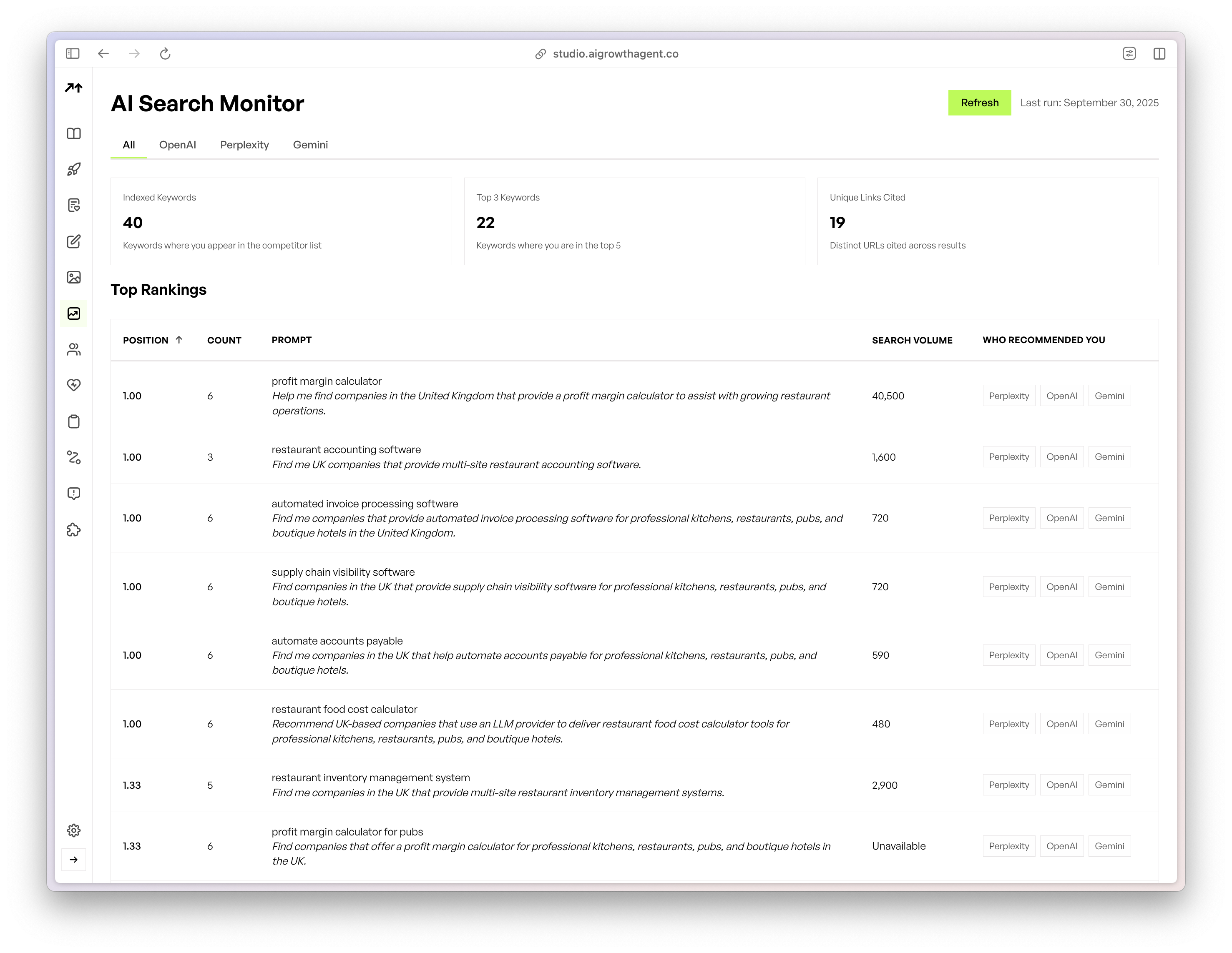
- Measurement of AI search visibility, including citations and inclusion in AI overviews and conversational answers.
Schedule a demo to review how AI Growth Agent approaches implementation and reporting.
Key Concepts and Common Questions About AI Content Strategy Automation
Programmatic SEO and AI-Driven Content Automation in AI Search
Programmatic SEO uses automation to create and optimize large sets of pages that cover a topic space in a structured way. In AI search, this approach focuses on consistent metadata, schema, and internal linking so models can understand and trust the content. AI-driven content automation connects research, writing, optimization, and publishing into one workflow instead of separate manual steps.
Differences From Traditional Agencies and Generic AI Writers
Traditional SEO agencies rely on human-heavy processes that limit velocity and consistency. Generic AI writers generate copy but do not enforce structure, schema, or deployment. Programmatic SEO platforms add engineering and automation so teams can scale content and technical quality together.
Data Privacy and Security Considerations
Teams should confirm how each platform stores and processes brand data, including encryption, access controls, and regional hosting. Contract terms should cover ownership of generated content and safeguards for sensitive product or customer information used in prompts or training.
Timelines for AI Search Impact
Impact on AI search visibility depends on current authority, content volume, and technical health. Many brands begin seeing AI citations and inclusion in AI overviews within a few weeks of publishing well-structured content, with growth compounding as topic coverage expands over time.
Schedule a consultation session to plan a pilot for AI content strategy automation.
Conclusion: Position Your Brand for AI Search in 2026
AI search in 2026 rewards brands that provide structured, comprehensive, and regularly updated content libraries. Programmatic SEO and AI content automation help teams meet that standard without unsustainable manual effort.
Jasper, Surfer SEO, SEMrush, MarketMuse, and other tools each support part of the workflow, while AI Growth Agent focuses on full lifecycle programmatic SEO for AI search. Brands that invest in this capability now can guide how AI systems describe their category and offerings for years to come.
Schedule a demo with AI Growth Agent to see how autonomous programmatic SEO can support your 2026 growth goals.


