Written by: Mariana Fonseca, Editorial Team, AI Growth Agent | Last updated: July 28, 2026
Key Takeaways For AI-Era Keyword Research
- Information-gain keyword research replaces volume-first tactics by prioritizing original data, contrarian angles, and zero-volume executive queries that AI surfaces actually cite.
- Topic-ecosystem mapping builds structured clusters around seed terms, fan-out queries, and citable claims to strengthen entity signals and earn multi-query AI citations.
- Problem-first keyword discovery mines discovery calls, sales notes, and community dialogue to surface high-intent, zero-volume opportunities before competitors find them.
- An opportunity-scoring model weights business relevance, executive interest, and citation potential over raw search volume, using E-E-A-T signals and AI trigger rates to prioritize content that earns citations.
- AI Growth Agent turns these scored keyword universes into living, self-healing content that compounds authority across ChatGPT, Perplexity, and Google AI Mode; book a demo to see how.
Building Topic Ecosystems That Earn AI Citations
A keyword list is a collection of terms, while a topic ecosystem is a structured map of how those terms relate. The ecosystem shows which entities they reinforce and which sub-queries fan out from each seed. The distinction matters because Google now uses entity matching rather than isolated keyword matching to determine topical authority, and AI surfaces follow the same logic when deciding which sources to cite.
Topic-ecosystem mapping starts with seed terms that anchor a brand’s entire market. Each seed term then spawns dozens of long-tail queries underneath it. The mapping process uses real-time Google and ChatGPT data to identify SERP overlap between those queries. That overlap reveals which sub-topics cluster naturally and which require dedicated coverage.
The structural advantage of ecosystem mapping over keyword lists appears at the entity level. A controlled experiment spanning a 2.3x entity-density range found no measurable effect on LLM citation rates once domain authority was insufficient. In a documented SaaS case, implementing a topical map substantially increased non-brand traffic and LLM citation rates within nine months.
Fan-out query behavior strengthens this advantage further. Surfer SEO’s analysis found that pages ranking for multiple fan-out queries are far more likely to earn AI Overview citations than pages optimized for a single keyword. When AI Mode processes a user query, it generates multiple related sub-queries and pulls citations from those sub-query SERPs, not just the primary result. A brand whose ecosystem covers those sub-queries earns citations a brand with a simple keyword list never reaches.
The citation dynamics from the Princeton GEO study confirm this structural edge. Adding statistics to content improved visibility by up to 41% and adding citations improved visibility by 28% in generative engine responses, while keyword stuffing performed 10% worse than the baseline. For ecosystem mapping, that means the nodes in a topic ecosystem should center on citable claims, named frameworks, and original data, not keyword density.
Maintaining a topic ecosystem requires a recurring cadence rather than a one-time build. Born Digital recommends monthly review of Google Search Console data for emerging queries and quarterly reassessment of keyword clusters to account for shifts in SERP composition and intent. Static maps decay. Living ecosystems compound.
Finding Problem-First Keywords In Real Conversations
The most valuable keywords for thought leadership content rarely appear in keyword tools. They live in discovery calls, sales notes, client proposals, and the repeated questions executives answer every week. 2025 data from Ahrefs showed that 92% of keywords get fewer than 10 searches per month, so the bulk of real traffic comes from thousands of tiny long-tail queries that volume tools rarely surface individually. Problem-first discovery uncovers those queries before competitors see them.
The process begins with internal sources that capture real buyer language. The language executives use to describe problems in first calls is often the exact phrase their peers type into search. Discovery call notes, sales objections, consulting proposals, and case study briefs contain raw material for zero-volume keyword opportunities that map directly to high-value buyer intent. Kyyte categorizes commercial friction into three forms for keyword mining: questions that keep returning, decisions that keep slowing down, and assumptions that keep getting corrected. Each category produces a distinct class of keyword opportunity.
Structured expert interviews accelerate this work. Targeted questions such as “What do people regularly misunderstand?” and “Which popular approach would you question?” extract the contrarian angles that AI surfaces cite because they supply information no existing page already contains. Martijn Holtes recommends that executives write down the three questions colleagues, partners, or clients ask repeatedly and answer them publicly in the exact same words they already use in private conversations. Those repeated questions reflect actual audience problems rather than assumed ones.
Community dialogue mining extends problem-first discovery beyond internal sources. Reddit threads, LinkedIn discussions, industry Slack communities, and G2 or Capterra reviews contain the unfiltered language buyers use when no vendor is listening. High-intent, unindexed buyer language for SaaS keywords can be mined from sales call transcripts, support tickets, G2 and Capterra reviews, and industry Reddit or Slack communities rather than relying solely on SEO tools.
Intent classification across five categories becomes essential once problem-first keywords are collected. Keyword research in 2026 must evaluate informational, commercial, transactional, navigational, and conversational or AI intent categories, because AI Overviews and tools like Perplexity serve natural-language questions directly and require content structured as precise, citable Q&A pairs. A zero-volume query with conversational or AI intent and strong executive problem language outperforms a high-volume informational query that AI Overviews already fully resolve.
The executive-language mapping framework from Obility’s 2026 Thought Leadership Playbook adds a credibility layer. Assigning keyword clusters based on individual executive credibility is the most effective approach for building cited authority in AI search, with the CEO owning category-defining trends, the CTO owning technical proof points, and the CRO owning ROI and pipeline impact. Matching the keyword to the most credible internal voice strengthens E-E-A-T signals and increases citation probability.
Scoring Keyword Opportunities For AI Citations
A keyword universe built on topic-ecosystem mapping and problem-first discovery still requires clear prioritization. The scoring model here weights business relevance, executive interest, and citation potential over search volume, drawing on 2026 research into E-E-A-T signals, AI trigger rates, and incremental visibility.
The foundational shift replaces the traditional Volume × Difficulty model with a citation-weighted alternative. GEO keyword strategy uses the weighted scoring formula Trigger Probability × Citation Accessibility × Business Relevance to calculate opportunity. Each dimension receives an independent score before weighting.
Business Relevance scores alignment between the keyword and revenue-generating outcomes. Business value is scored 1 to 5, where 5 indicates keywords directly related to a product with high conversion intent and 1 indicates keywords unrelated to business goals. Keywords that reinforce an existing topic cluster receive a strategic fit bonus because they strengthen entity signals rather than diluting topical authority.
Executive Interest scores the degree to which the keyword maps to language and problems sourced from executive interviews, discovery calls, and community dialogue mining. Keywords derived directly from internal sources score higher because they reflect actual buyer language rather than tool-generated approximations. A 2024 LinkedIn–Edelman B2B Thought Leadership Impact Report surveying approximately 3,500 senior decision makers highlighted the value of original research and supporting data in thought leadership, confirming that executive-sourced angles carry disproportionate citation value.
Citation Potential scores the likelihood that content targeting the keyword will be cited by AI surfaces. Citation accessibility is assessed by querying target keywords in ChatGPT and Perplexity, then evaluating cited sources on domain traffic, content freshness (pages updated within two months are 28% more likely to be cited in Google’s AI Mode than those that have not been updated for over two years), E-E-A-T signals (96% of AI Overview citations come from sources with strong E-E-A-T signals), and structured format. AI Overview trigger rates provide an additional signal. Question-based queries trigger AI Overviews 57.9% of the time and 7+ word queries trigger them 65.9% of the time, which makes these formats high-priority targets for citation-focused content.
Soren Patel’s three-pillar citation framework adds a pre-writing validation layer. Topics are scored 0 to 5 on search intent, competitive gap, and AI-answer opportunity, summed out of 15, with scores below 9 deprioritized and scores above 12 prioritized for immediate development. Topics that passed all filters have been shown to earn more referring domains within six months than those that failed one or more filters.
The final scoring matrix applies differential weights to reflect business reality. Final prioritization assigns high weight to business relevance and citation accessibility, medium weight to AI trigger probability and search volume, and low weight to traditional keyword difficulty. Zero-volume keywords with high business relevance and strong citation potential rank above high-volume keywords that AI Overviews already fully resolve. Zero-volume keywords can deliver higher ROI than high-volume terms when they match exact problems faced by high-value buyers such as CTOs with large budgets.
One structural finding from 2026 research reinforces the model’s logic. Ahrefs’ March 2026 analysis of 863K keyword SERPs and 4M AI Overview URLs found that top-10 organic results accounted for only 38% of AI Overview citations, down from 76% in July 2025. Ranking first on Google no longer guarantees citation in AI surfaces, so citation potential must be scored independently of ranking feasibility. But scoring keywords is only half the framework. The other half converts those scored opportunities into content that AI surfaces actually cite, which requires a different execution model.
Turning Research Into Living, Citable Authority
A scored keyword universe becomes valuable only when it turns into content that AI surfaces can find, trust, and cite. The conversion layer is where most keyword research frameworks fail, because the research is sound but the execution produces static content that decays as soon as it ships.
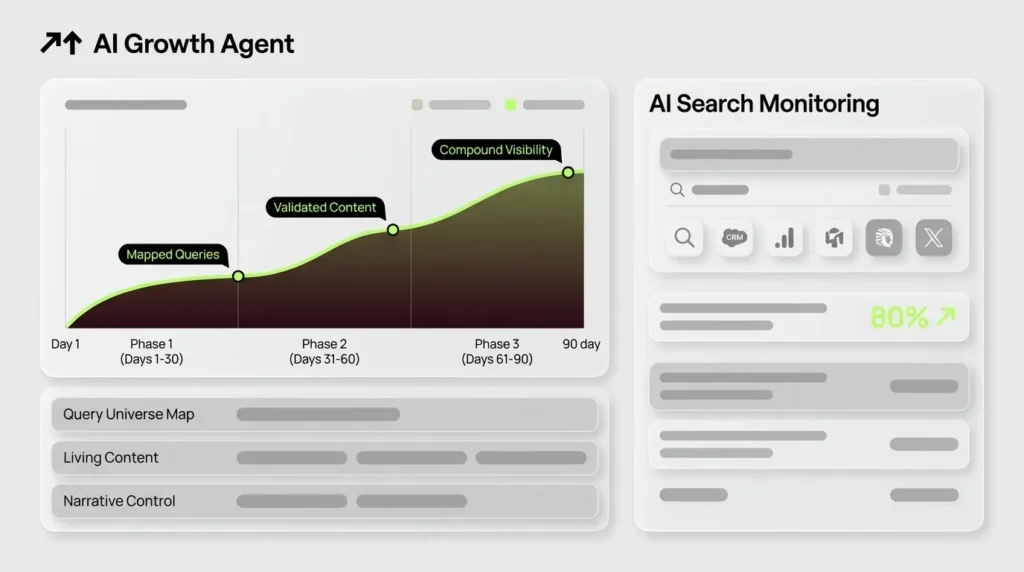
The three research pillars, topic-ecosystem mapping, problem-first discovery, and opportunity scoring, produce a strategic keyword universe. Converting that universe into content that AI surfaces actually cite requires four operational pillars working together. Search Intelligence maps the traditional search landscape continuously, identifying which seed terms and long-tail queries are winning and where white space exists.
That search data alone remains incomplete without insight into how AI surfaces interpret and cite the content. AI Analytics fills that gap by tracking brand value and consumer behavior across the full journey, from external AI-tool queries through content consumption and sentiment. Knowing what AI surfaces cite only helps when you also know when and how they read your content. Bot Tracking provides that visibility by recording every crawl, citation, and training sweep.
AI Ranking closes the loop by monitoring order of mention and citation context across AI surfaces week over week. This approach replaces the static ranking number with a dynamic position signal that shows whether citation authority is growing or decaying.
Content produced against the scored keyword universe must be structured for passage-level citation, not just page-level ranking. Ziptie (2025) research found that 44.2% of all LLM citations are extracted from the first 30% of a page, which requires keyword-focused introductions that contain self-contained direct answers for thought leadership content targeting AI surfaces. Evertune’s May 2026 study of nearly 400 million LLM citations across 25,000 URLs found that 63% of citations point to listicle pages, confirming that problem-solving queries structured as ranked lists earn disproportionate citation share.
Self-healing content closes the decay loop and keeps that authority active. When the year turns, articles refresh automatically. When Google Search Console signals that a page is losing impressions, the engine updates the content and strengthens internal linking to adjacent cluster pages. The keyword universe does not shrink over time. It compounds as new long-tail queries are identified, scored, and covered. Domains using well-structured topical maps can achieve faster time-to-rank for long-tail queries compared with traditional keyword-list approaches, and that advantage widens as the ecosystem matures.
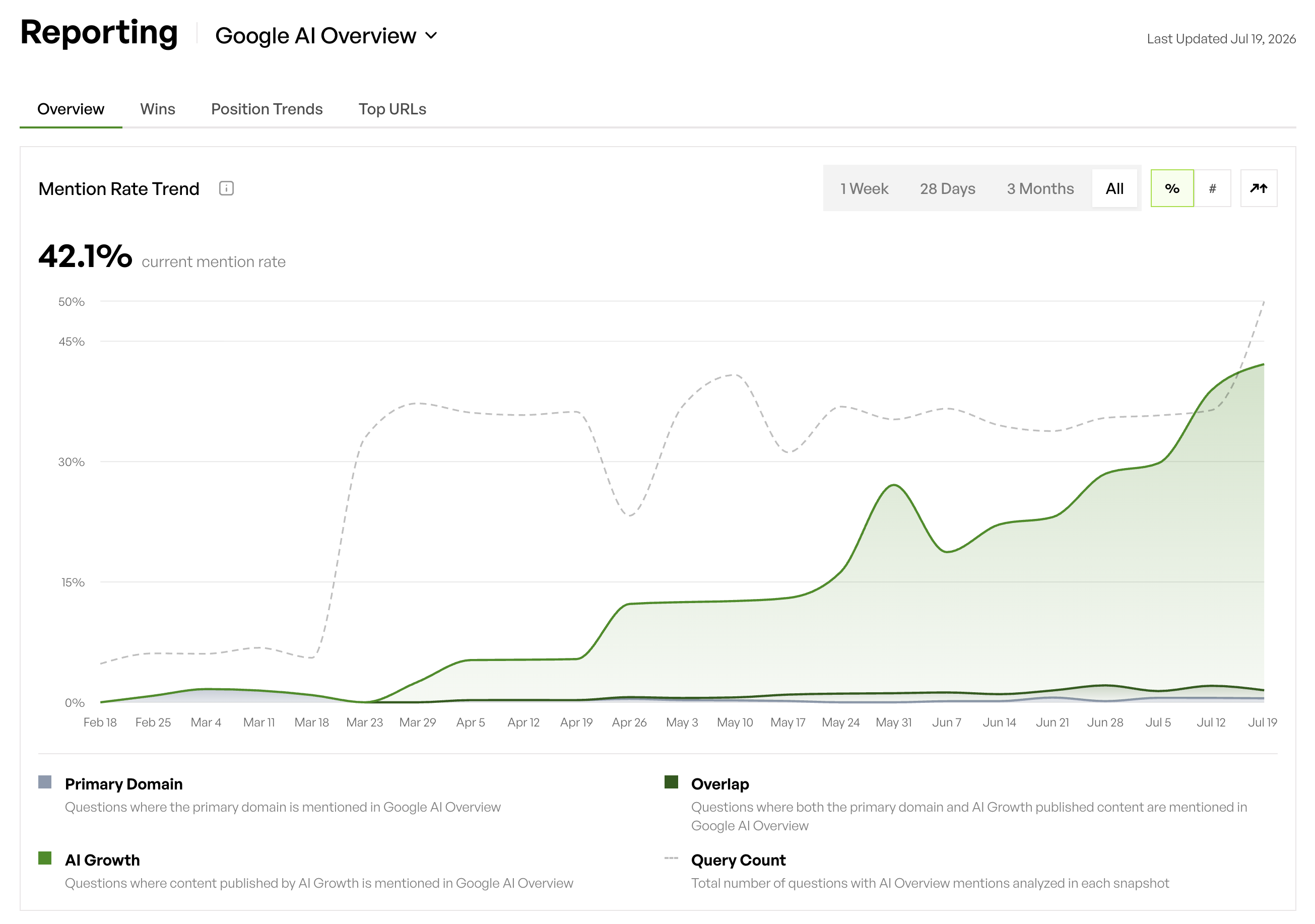
Incremental visibility reporting then isolates what the framework actually generated, separate from visibility the brand already had. Bot traffic, Google Search Console impressions, and citation data cross-referenced week over week produce a defensible measure of compounding authority rather than a vanity metric that rides existing brand equity.
Frequently Asked Questions
What is information-gain scoring and how does it differ from traditional keyword difficulty scoring?
Information-gain scoring evaluates whether a topic supplies new, citable data or contrarian expert angles that no existing top-ranking page already covers. Traditional keyword difficulty scoring measures how hard it is to outrank existing pages based on domain authority and backlink profiles. The two metrics answer different questions. Keyword difficulty tells you whether you can rank, while information-gain scoring tells you whether ranking will earn citations from AI surfaces. A topic can have low keyword difficulty and zero information gain, which produces content that ranks briefly and is never cited. A topic can have high keyword difficulty and high information gain, which produces content that earns AI citations regardless of primary-query rank because AI Mode’s fan-out sub-queries pull from passage-level cosine similarity rather than primary-query position. In 2026, both scores matter, but information-gain scoring takes priority for thought leadership content because AI surfaces now account for a growing share of the discovery surface where buying decisions form.
How do you mine executive language for zero-volume keyword opportunities?
The most reliable sources are internal assets such as discovery call notes, sales objection logs, consulting proposals, client interview transcripts, and case study briefs. The language executives use to describe problems in first calls frequently matches the exact phrase their peers type into search, and keyword tools rarely surface these queries because their volume is too low to register. Structured expert interviews accelerate the process. Asking subject-matter experts what their clients most often misunderstand, which popular approaches they would question, and what has changed in the market that buyers have not yet recognized produces the contrarian angles that AI surfaces cite.
Community dialogue mining then extends the method externally. Reddit threads, LinkedIn discussions, industry Slack communities, and review platforms like G2 and Capterra contain unfiltered buyer language that no internal source captures. The combined output is a problem-first keyword list that maps directly to executive intent rather than approximating it through tool-generated suggestions.
How do you evaluate citation potential before writing a piece of content?
Citation potential is assessed through a three-step pre-writing validation. First, query the target keyword in ChatGPT and Perplexity and examine which sources are cited, what format those sources use, and whether the current answers are vague or incomplete. A vague AI answer signals a citation gap that original data or a named framework can fill.
Second, score the topic on AI-answer opportunity by checking whether the AI response contains a numeric statistic, a named source, or a step-by-step process. Topics where the AI answer is incomplete or relies on generic synthesis score higher for citation potential. Third, evaluate the content format against citation data. Ranked listicle formats earn disproportionate citation share, question-based queries trigger AI Overviews at higher rates than head terms, and pages updated within 60 days are more likely to be cited than stale content. Topics that pass all three checks are prioritized for immediate development, while topics that fail one or more are deprioritized or reframed until they score above the threshold.
Can zero-volume keywords realistically drive business outcomes for mid-market and enterprise brands?
Zero-volume keywords often represent the highest-value opportunities for mid-market and enterprise thought leadership because they map to the exact problems high-value buyers face during active evaluation. A query with 40 monthly searches from procurement directors or CTOs with large budgets outperforms a query with 40,000 monthly searches from general audiences who never convert. The B2B buying dynamic reinforces this pattern. Only a small fraction of the target market actively searches for solutions at any given time, and buyers who move from out-of-market to in-market typically have two or three brands already in mind before they run a single search.
Thought leadership content targeting zero-volume executive problem language builds that pre-search familiarity and earns AI citations that surface the brand when the buyer finally searches. The compounding effect becomes measurable over time. Brands that establish authoritative content on zero-volume expert angles now are training the next generation of AI models with their own narrative, while brands that wait are training those models with whatever happens to be sitting on the open web.
How often should a topic ecosystem be updated to maintain citation authority?
A topic ecosystem requires continuous maintenance rather than periodic overhaul. At the article level, content should be refreshed whenever Google Search Console signals declining impressions or when the underlying facts change, because pages updated within 60 days are meaningfully more likely to earn AI citations than stale content. At the cluster level, monthly review of Search Console data surfaces emerging queries that belong in the ecosystem but were not present at launch.
At the ecosystem level, quarterly reassessment of keyword clusters accounts for shifts in SERP composition, new AI Overview trigger patterns, and changes in executive problem language sourced from ongoing sales and discovery calls. The brands that maintain citation authority over time treat their topic ecosystem as a living system rather than a deliverable. Static content decays. Living content compounds, and the compounding advantage widens as the ecosystem matures and internal linking strengthens entity signals across the full cluster architecture.
Conclusion: Turning Volume-First Research Into AI-Ready Authority
Volume-first keyword research now produces content that AI surfaces ignore. The three-pillar framework here replaces it with a system built for the discovery environment that actually exists in 2026. Topic-ecosystem mapping strengthens entity signals and earns fan-out citations. Problem-first keyword discovery surfaces zero-volume executive angles before competitors find them. An opportunity-scoring model then weights business relevance, executive interest, and citation potential over raw search volume.
The research confirms this structural advantage. First Page Sage’s 2026 analysis found that thought-leadership-focused B2B SEO programs delivered 748% three-year ROI. The decoupling of rankings and citations described earlier means the majority of cited pages fall outside the top 10, reinforcing why topic ecosystems outperform keyword lists.
AI Growth Agent converts the resulting keyword universe into living, self-healing content that compounds incremental visibility across ChatGPT, Perplexity, and Google’s AI Mode, without added headcount. The data backbone described earlier, tracking search, AI behavior, bot activity, and citation position, turns research into owned, citable authority week over week.