


Last updated: February 9, 2026
Key Takeaways
- AI-generated content dominates 2026 search engines, so end-to-end research automation now determines academic visibility and impact.
- Top 7 tools like Gatsbi AI, Elicit, and Perplexity support parts of the workflow but lack full publishing, scale, and programmatic SEO.
- Free tools such as ChatGPT, Notebook LM, and GitHub frameworks like LangChain and n8n help with entry-level automation but still require manual integration and publishing.
- AI Growth Agent delivers a complete 6-step workflow with programmatic scale, real-time content creation, and technical SEO for AI search dominance.
- Researchers cut publication timelines by up to 10x and gain AI citations within weeks; schedule a demo with AI Growth Agent to automate your research publishing pipeline.
The 6-Step AI Agent Workflow for Research Publishing
Modern AI agents for research automation follow a systematic six-step workflow that mirrors advanced ChatGPT processes but runs autonomously at scale.
1. Research Scraping and Data Collection: The agent searches academic databases, web sources, and proprietary datasets to gather relevant information on specified topics. Perplexity performs approximately 8 searches per query, consulting 42 sources to provide broad coverage.
2. Content Generation and Drafting: Using large context windows up to 200,000 tokens, the agent turns research into structured academic papers with proper formatting, citations, and scholarly tone.
3. Analysis and Fact-Checking: Self-verification capabilities use internal feedback loops to autonomously correct errors in multi-step workflows, which improves accuracy and reliability.
4. Review and Editing: The agent edits for clarity, coherence, and academic standards while preserving the researcher’s voice and perspective.
5. Technical SEO and Metadata Setup: Schema markup, metadata, and AI-focused SEO prepare content for maximum visibility in AI-powered search engines.
6. Automated Publishing and Promotion: The system publishes directly to academic platforms, institutional repositories, and promotional channels without manual copying.
Most existing tools cover only 1 to 3 of these steps, which forces manual handoffs and limits scale. Schedule a demo to see if you’re a good fit for AI Growth Agent’s programmatic SEO capabilities.
Top 7 AI Agents for Research Writing and Publishing in 2026
The 2026 landscape includes several focused tools that handle specific stages of the research pipeline.
• Gatsbi AI: Focuses on research generation with strong reference integration. It produces initial drafts with proper citations but offers no publishing automation and cannot support high-volume content production.
• Elicit: Specializes in scientific search, literature review automation, and research reports. It excels at research discovery and summaries but lacks publishing features, so researchers must assemble full papers manually.
• SciSpace: Uses access to 280 million research papers for analysis and summarization. It shines during the research phase but provides limited autonomous writing and no publishing automation.
• Paperpal: Focuses on editing, language refinement, content generation, and research assistance. It works well for polishing and drafting, but offers shallow research depth and no direct publishing pipeline.
• Jenni AI: Provides AI-assisted drafting with citation support. It supports content creation but does not automate research or connect to a publishing workflow.
• Consensus: Delivers evidence-based analysis and AI-generated summaries by synthesizing findings across multiple papers. It offers strong analysis and summarization, but does not create full papers or manage publishing.
• Perplexity: Produces 1,300-word reports in under 3 minutes with broad source coverage, which makes it powerful for research. Researchers still need to convert outputs into an academic format and handle publishing separately.
These tools function as partial solutions, so researchers must stitch together workflows across platforms. None delivers the programmatic scale required to compete in 2026’s AI-saturated content environment. Schedule a demo to see if you’re a good fit for a unified solution that removes these integration gaps.
Free AI Agents and GitHub Builds for Research Papers
Free tools and open frameworks give researchers a low-cost way to experiment with AI-driven research workflows.
Free Tools: ChatGPT workflows support basic research and writing through prompt engineering. Notebook LM excels in research by uploading documents or searching the open web, which works especially well with custom research materials. Both tools still require manual orchestration and do not automate publishing.
No-Code Frameworks: n8n enables rapid prototyping of AI agents via drag-and-drop interfaces that connect LLM actions and integrations. A basic research-to-draft workflow includes four steps: 1) setting up research triggers, 2) connecting to GPT-4 for content generation, 3) adding simple fact-checking loops, and 4) wiring basic publishing endpoints.
GitHub Examples: LangChain provides modular frameworks for Python and JavaScript to create complex AI agents for research automation, with LangSmith for monitoring and LangServe for deployment. LangFlow offers an open-source visual interface for building LLM workflows without writing code.
These free options help teams learn and prototype, but still demand configuration effort for complex workflows and lack enterprise-grade automation. Schedule a demo to see if you’re a good fit for automation that removes technical overhead.
Side-by-Side Comparison of AI Research Agents
|
Tool |
Automation Level |
Publishing |
Scalability |
References |
|
Gatsbi AI |
Partial |
No |
Low |
Yes |
|
Elicit |
Research + Reports |
No |
High |
Yes |
|
SciSpace |
Analysis |
No |
Medium |
Yes |
|
Perplexity |
Research |
No |
Medium |
Yes |
|
ChatGPT |
Manual |
No |
Low |
Limited |
|
Jenni AI |
Drafting |
No |
Low |
Yes |
|
AI Growth Agent |
Full Programmatic SEO |
Yes |
High |
Accurate |
AI Growth Agent stands alone by combining full programmatic SEO automation, direct publishing, and high scalability for high-authority content. Schedule a demo to see if you’re a good fit for the only comprehensive solution in this space.
Why AI Growth Agent Leads Programmatic SEO for Research Content
AI Growth Agent delivers capabilities that move beyond partial tools and manual workflows.
Complete End-to-End Automation: AI Growth Agent runs the entire content lifecycle autonomously. After configuration, it handles keyword research, research scraping, drafting, editing, technical setup, and publishing without ongoing manual work.
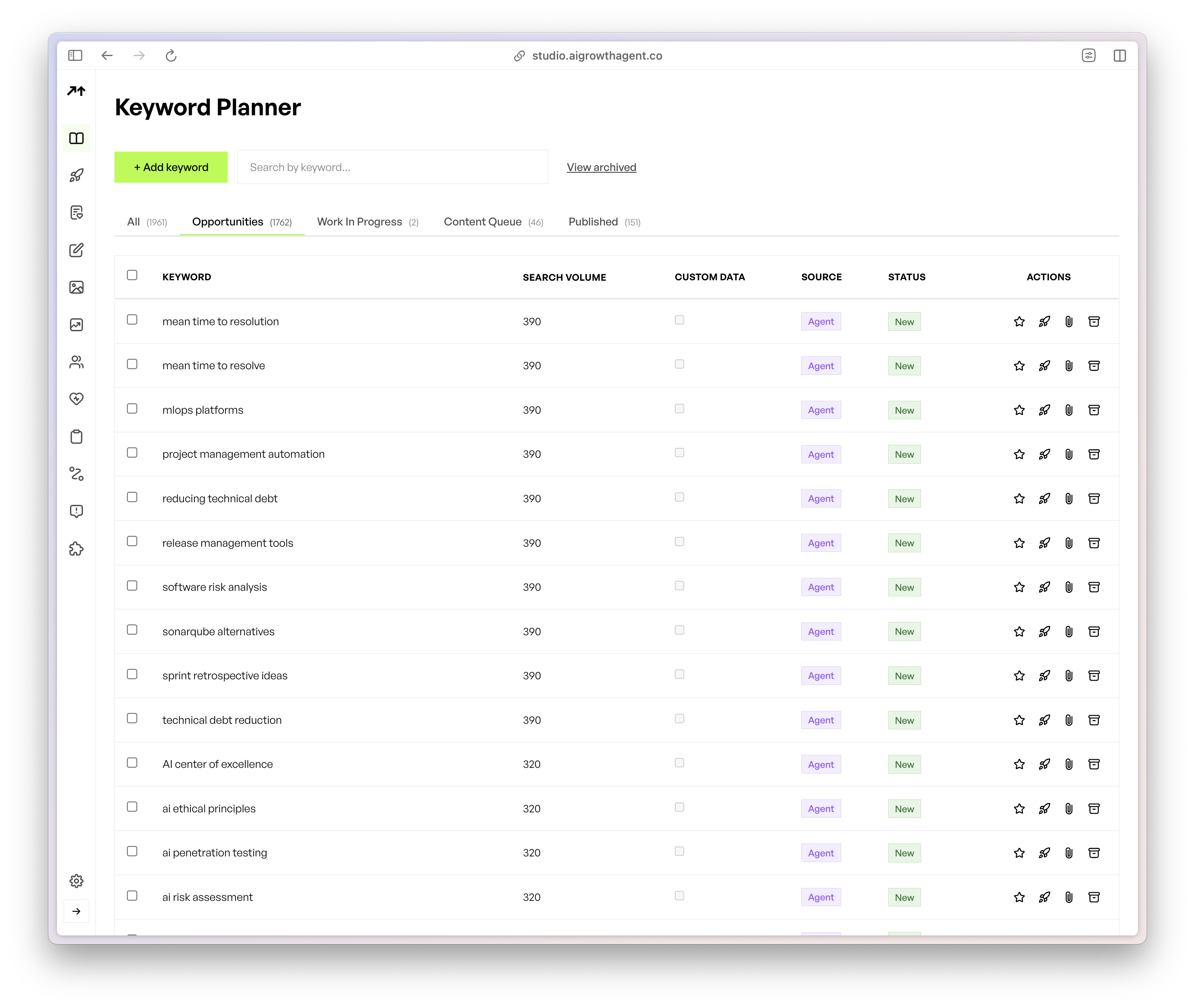
Programmatic Scale: The platform supports multi-tenant deployment, so organizations can run parallel agents for different brands or strategies from one interface. This structure solves the scale problem that manual processes cannot address.
Real-Time Content Injection: The system creates high-quality, SEO-focused articles from trending topics within minutes. Teams capture emerging search demand programmatically instead of reacting days or weeks later.
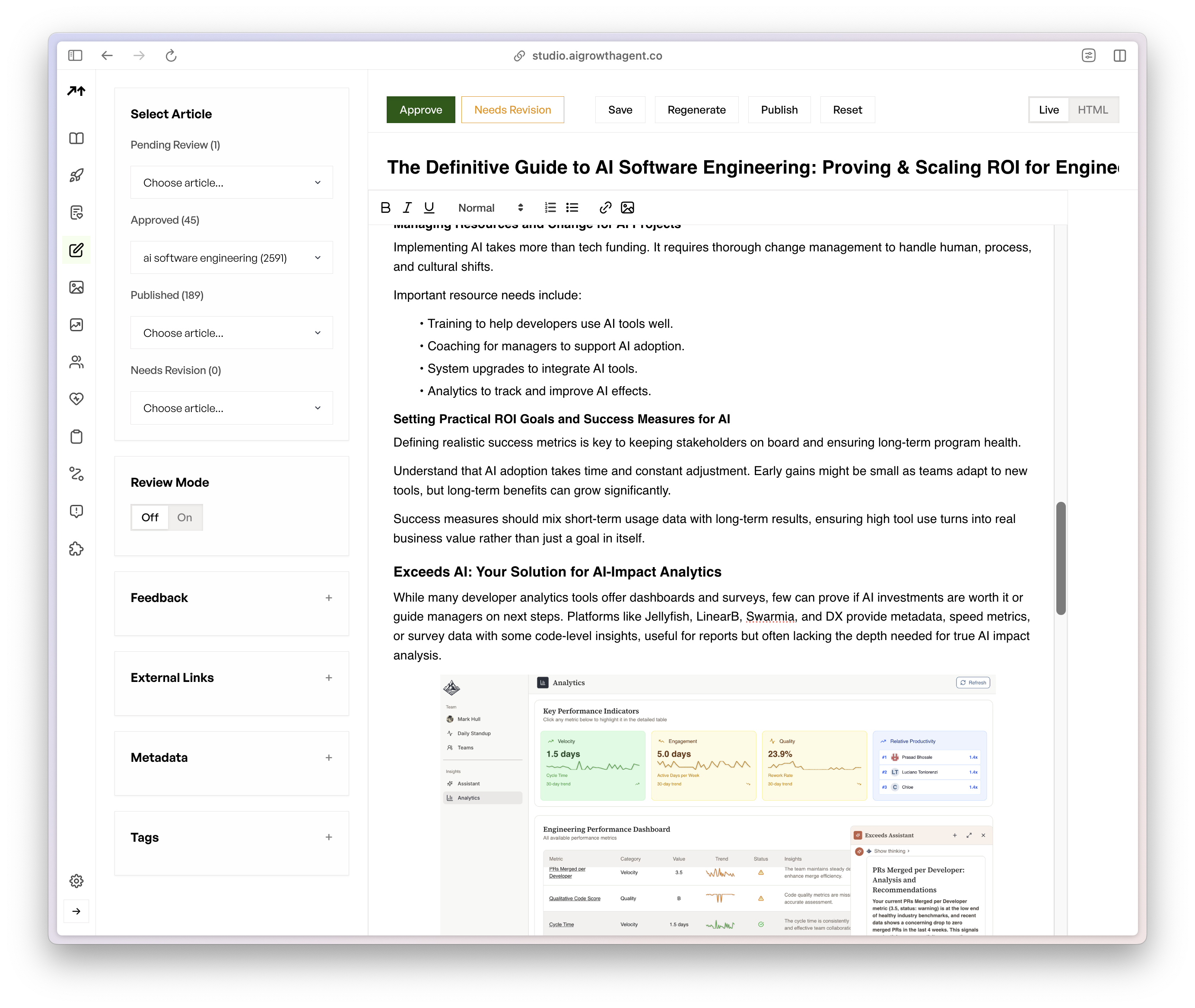
Advanced Technical Infrastructure: Automatic schema markup, metadata, LLM.txt, and Model Context Protocol configuration improve visibility in AI-powered search engines.
AI Growth Agent Studio: A central control panel gives teams transparency, editing tools, feedback integration, and performance tracking across AI search engines such as ChatGPT, Gemini, and Perplexity.
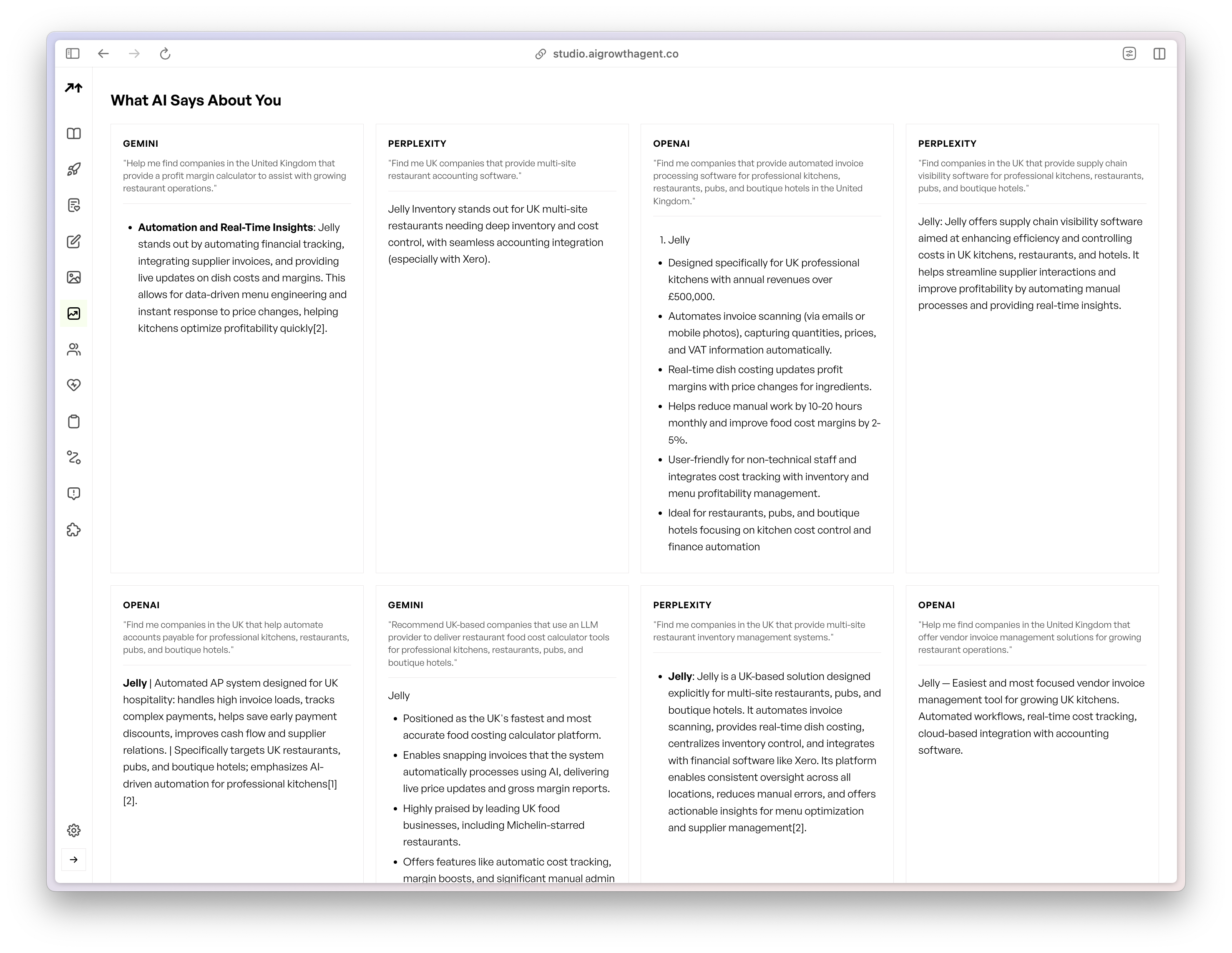
Client results highlight this impact. Exceeds AI-gained Perplexity recommendations within 2 weeks and ChatGPT citations within 3 weeks. Manual processes and partial tools rarely reach this level of performance. Schedule a demo to see if you’re a good fit for this approach to content automation.
Ethical Implementation and 2026 AI Research Trends
Successful AI agent deployment depends on clear ethics, governance, and alignment with emerging research norms.
AI-generated papers raise authorship and accountability issues, requiring disclosure of AI involvement to protect academic integrity. Research teams need explicit policies for AI disclosure and strong fact-checking standards.
Key implementation steps include structured onboarding with institutional guidelines, bias detection and mitigation, citation accuracy checks, and compliance with journal and conference rules. AI agents will actively join scientific discovery by generating hypotheses and controlling experiments, so ethical frameworks will matter more each year.
Agentic AI experiments and programmatic content velocity will accelerate through 2026, which makes early adoption of comprehensive automation a competitive requirement for research institutions.
FAQs
What is an AI agent for research publishing?
An AI agent for research publishing is an autonomous system that runs the full pipeline from topic selection to publication and promotion. It handles research scraping, content generation, fact-checking, technical SEO, and automated publishing without constant human input. These agents operate continuously and scale research output beyond what manual teams can sustain.
What is the best free AI research paper writer?
ChatGPT and Notebook LM currently stand out as the strongest free options for AI research paper writing. ChatGPT supports long-context drafting and iterative editing, while Notebook LM excels at analyzing uploaded documents. Both still require manual coordination and do not automate publishing, so they fall short for scaled academic output. Free tools cannot match the automation depth and quality controls of dedicated research publishing platforms.
How does Gatsbi AI compare to other research tools?
Gatsbi AI offers strong reference integration and initial content generation, which makes it more suitable for academic work than basic AI writing tools. It still lacks publishing automation, scalability features, and technical SEO for AI search visibility. Gatsbi functions as a partial solution that needs manual completion, unlike platforms that manage the full research-to-publication pipeline.
How does AI Growth Agent handle references and publishing?
AI Growth Agent uses multi-source research and validation protocols for advanced fact-checking. The platform automatically applies technical SEO, including schema markup and metadata, to support AI indexing. It publishes content directly to optimized blog infrastructures such as blog.yourcompany.com and surfaces full audit trails and performance metrics inside AI Growth Agent Studio.
What are typical timelines for AI-generated research papers?
With AI Growth Agent, clients usually see their first programmatically generated article published within one week after onboarding. Setup covers manifesto creation, keyword strategy, and technical infrastructure deployment. Once live, the agent can produce publication-ready content daily, and quality improves through ongoing feedback. This pace often represents a 10x acceleration over traditional manual content workflows.
Conclusion: Programmatic SEO as the New Research Advantage
The publishing landscape now favors AI-powered automation and programmatic SEO strategies. Manual processes cannot match the scale and consistency needed for visibility in 2026’s AI-heavy environment. AI Growth Agent delivers programmatic SEO automation that builds high-authority content architectures for AI citation and recommendation. Schedule a demo to see if you’re a good fit and position your research for the next wave of AI search.
