Key takeaways from this article:
- AI-powered search experiences, such as Google AI Overviews with Gemini, ChatGPT, and Perplexity, now mediate how buyers discover brands, which compresses organic visibility for traditional content.
- Brands need AI agents to publish technically optimized, programmatic content at scale so AI search engines can interpret, cite, and recommend their expertise with confidence.
- The five strategies in this guide cover scalable, personalized content production, technical optimization for AI search, autonomous infrastructure, real-time adaptation, and continuous brand consistency.
- AI Growth Agent provides a Programmatic SEO Content Agent, advanced technical SEO infrastructure, and an AI Search Monitor that work together inside a single studio.
- Marketing leaders can evaluate fit and see these capabilities in action by scheduling a consultation session with the AI Growth Agent team.
Why AI Agents are Indispensable for Content Authority Today
AI-powered search now reshapes content marketing. Search experiences such as Google AI Overviews with Gemini, ChatGPT, and Perplexity summarize information instead of listing long pages of links. Brands that want to stay visible need AI-ready content that these systems can understand, rank, and reference.
Overall content volume grows every day, while the space available in search results and AI answers stays limited. Human-only content teams struggle to keep pace with this environment. AI agents give marketing leaders a way to maintain visibility and authority through programmatic scale, consistent structure, and technical rigor.
AI search engines synthesize answers from a small set of trusted sources. If your content is not structured, deep, and consistent enough to be cited, your brand risks disappearing from the conversations that shape buying decisions.
The Shrinking Digital Footprint: Why Your Content is Becoming Invisible
AI-generated content multiplies the volume of material published every day. Your company’s digital presence, your pixel on the internet, becomes a smaller share of the total content landscape over time. Millions of new articles, posts, and media assets compete for the same limited attention and ranking positions.
Content saturation creates a straightforward mathematical problem. Total content grows exponentially, but the number of positions in search results and AI summaries stays almost fixed. Your probability of being discovered declines unless you increase both the amount and the quality of content you publish.
Modern AI search engines such as ChatGPT, Perplexity, and Google Gemini do more than rank pages. They synthesize answers by extracting key points from sources they consider authoritative. Content that lacks clear structure, depth, and consistency is less likely to be selected or cited. In that case, your brand becomes less visible both in traditional rankings and in AI-generated answers that users increasingly rely on.
Programmatic Velocity: The New Baseline for Content Production
Content velocity now exceeds what manual workflows can support. AI agents automate scheduling, multi-channel publishing, and reporting, enabling faster research, accelerated creation, and deeply personalized segmentation. Large Language Models reward recency, depth, and structural consistency, so occasional manual posts are no longer enough to stay relevant.
Programmatic content production changes the scale equation. A traditional content marketing team might deliver 10 to 20 strong articles in a month. AI agents can engineer hundreds of technically optimized, brand-aligned pieces in the same period. The goal is not volume without substance, it is volume combined with quality through repeatable systems.
Modern baselines involve daily publishing, diverse formats, and continuous optimization. Teams need consistent internal linking, schema markup, and topical coverage to help AI understand their expertise. Half of marketers now create content with AI, and a similar share uses AI to optimize content for email campaigns and SEO, which shows how quickly programmatic methods are becoming standard.
Define Your Narrative or Competitors Will: The Stakes of AI Search
Content volume and coverage now shape how AI systems describe your market. If your brand does not supply enough clear, consistent information, AI search engines turn to other sources, often your competitors. Their point of view then becomes the default narrative that AI uses when answering buyer questions.
AI search engines often exhibit winner-take-most dynamics. The most authoritative source for a topic attracts the majority of citations and recommendations. Traditional search spreads traffic across multiple links, while AI-generated answers commonly highlight a small set of primary references.
Marketing leaders face a narrowing window for category definition. AI models constantly retrain on current web content. Brands that invest now in programmatic content authority can shape how AI understands their segment and capture a durable advantage in citations and recommendations.
1. Engineer Hyper-Personalized, Programmatic Content at Scale
AI agents make it practical to generate hyper-personalized content at scale. AI agents in content marketing for 2025 enable enhanced personalization, automate repetitive tasks such as A/B testing and keyword research, and generate tailored content at scale. These systems move beyond basic personas and segments to reflect intent, behavior, and channel context.
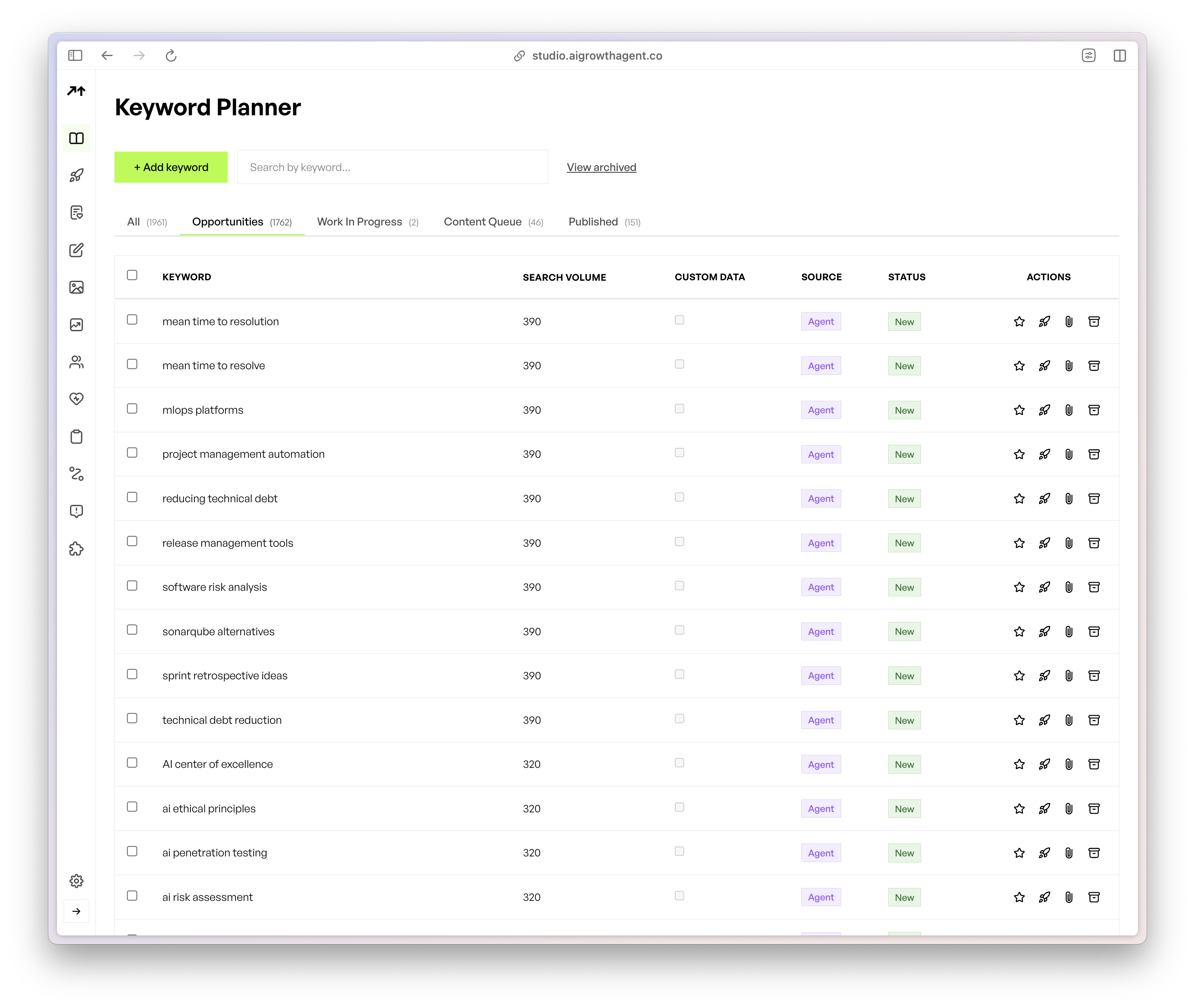
AI Growth Agent’s Programmatic SEO Content Agent automates the full content lifecycle, from deep keyword clustering to long-form drafts that match your brand. The agent supports hyper-personalization while preserving consistency, so content production becomes an engineered system rather than a series of ad hoc tasks.

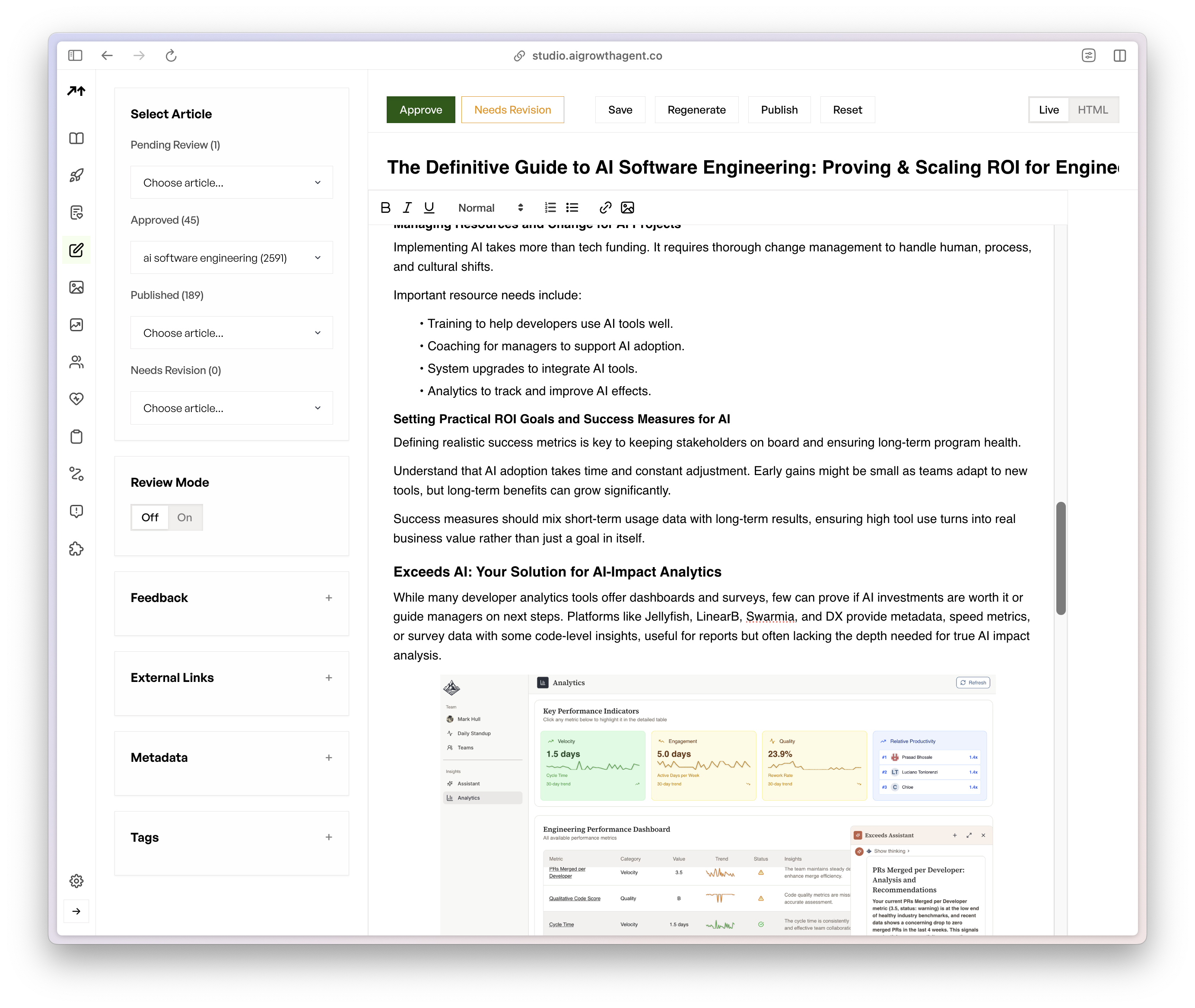
AI Growth Agent also provides an in-browser editor so teams can review, adjust, and approve content inside one workspace before publishing.

Generative AI: From Ideation to Multi-Format Creation
Core AI capabilities for content marketing in 2025 include generative AI for ideation and content creation, predictive analytics for anticipating audience needs, and sentiment analysis for extracting themes and trending topics. Modern systems support multiple formats such as blog posts, video scripts, infographics, social updates, and interactive content.
Contextual generation now matters as much as raw output. Effective AI agents preserve brand voice while adapting to different segments, search intents, and channels. Strong systems can produce publication-ready assets that align with brand messaging, technical SEO requirements, and audience value without requiring extensive rewrites.
Generative AI now extends into videos, music, 3D visuals, and interactive experiences, which supports rapid asset creation and multi-format campaigns. This variety allows marketing teams to build authority across formats while maintaining coherent positioning and technical optimization.
Predictive Analytics: Delivering Content Before the Ask
Leading AI agents support predictive content planning instead of reacting only after demand appears. Programmatic AI agents can study behavior patterns and search trends to move marketers from reactive to predictive strategies, so teams deliver content before audiences explicitly request it.
Predictive engines analyze search trends, social conversations, industry news, and competitor content to surface emerging topics early. Teams that publish authoritative content as these topics begin to rise often earn durable visibility and citations.
Predictive plans also support seasonal demand, product launches, and crisis scenarios. AI agents can build content libraries that answer likely questions and scenarios in advance so brands maintain authority even when markets move quickly.
Marketing leaders who want to apply predictive content strategies in their programs can schedule a demo to see how AI Growth Agent structures this process end to end.
2. Master Technical Optimization for AI Search Engines
Technical SEO for AI search extends well beyond keywords. AI-driven SEO tools now automate metadata, keyword optimization, and competitor analysis, which supports more advanced content engineering than simple text generation. AI search engines rely on structured signals to interpret, categorize, and cite content.
AI Growth Agent decorates every post with advanced technical SEO, including rich schema markup and a blog-specific Model Context Protocol, so AI search engines can interface with your content in a clear, structured way. Learn more in a demo.
Beyond Keywords: Automated Metadata and Schema Markup
Modern technical optimization requires more than inserting target phrases into copy. Strong content architectures rely on metadata and schema markup that tell AI systems what each page represents and how pages relate to each other.
Schema markup acts as a shared language between your site and AI indexers. It signals whether a page is original research, a product page, a how-to guide, or an opinion piece. Clear schema helps AI categorize content correctly and select it as a source when assembling answers.
Specialized programmatic SEO agents focus on schema markup, link building, and real-time SERP analysis to deliver stronger technical outputs than general-purpose writing tools. Automated schema ensures each piece includes the cues that AI needs for reliable indexing.
Metadata optimization also covers image alt text, video transcripts, and audio descriptions. These elements allow AI systems to understand non-text assets, which expands your authority footprint across formats.
LLM.txt and Model Context Protocol: Directing AI Indexers
AI search introduces new standards for how crawlers interpret content. LLM.txt files work as instruction sets for AI crawlers, similar in spirit to robots.txt for traditional search engines. These files clarify how AI systems should read, categorize, and cite your material.
AI Growth Agent implements a blog-focused Model Context Protocol, a technical standard that lets AI search engines connect directly to your content database. This protocol maps your content hierarchy, topical clusters, and authority signals in a machine-readable format.
The Model Context Protocol helps your blog function as a structured knowledge base rather than a set of disconnected posts. When AI search engines receive questions related to your expertise, they can draw on this mapped context, which raises the likelihood of accurate and frequent citations.
This infrastructure increases the chance that your content becomes a primary source for AI-generated responses about your industry, products, or focus areas.
3. Autonomous Infrastructure & Multi-Tenant Deployment
Autonomous content infrastructure replaces manual, tool-by-tool workflows with integrated systems. AI agents help teams increase content volume and speed to market while scaling production without matching increases in headcount. This approach covers research, creation, publishing, and optimization inside one framework.
AI Growth Agent can deploy a new, technically optimized blog architecture and support Multi-Tenant Programmatic Deployment so enterprises manage multi-brand programmatic SEO from a single AI Growth Agent Studio.
End-to-End Publishing: Research to Distribution Autonomous Workflows
Autonomous workflows remove bottlenecks that slow traditional editorial calendars. Custom AI agents can power campaign lifecycles by using existing campaign data, public sources, and integrated workflows for ideation, copywriting, review, and translation.
Workflows typically start with research that analyzes markets, competitors, and search intent. AI agents identify keyword clusters, map them to business goals, and generate structured briefs.
Drafting then follows an engineering-style process that encodes your brand manifesto, subject-matter expertise, and technical SEO requirements. Each article is formatted for readability, equipped with schema, and prepared for fast indexing.
Distribution includes automatic publishing to your CMS, social syndication, and integration with your marketing automation stack. Teams can then spend more time on strategy, experimentation, and collaboration with sales and product.
Scaling Across Brands: Multi-Tenant Programmatic Deployment
Multi-tenant AI deployments let teams scale content across product lines while maintaining brand consistency and performance monitoring from centralized dashboards. This model suits private equity portfolios, venture studios, and enterprises with multiple brands.
Multi-tenant architecture allows one core team to manage programmatic SEO for many brands at once. Each brand keeps distinct positioning, audience definitions, and content themes, while sharing infrastructure, best practices, and analytics.
This setup often lowers per-brand content costs, since organizations do not need a full content team for every product. At the same time, technical quality and brand consistency improve because the same system enforces standards across all properties.
Portfolio-level monitoring then surfaces which formats, angles, and topics perform best. Marketing leaders can roll out winning patterns across brands quickly, using data instead of guesswork.
4. Real-Time Adaptation and Data-Driven Optimization
Modern markets move quickly, and content strategies need to adjust in near real time. Social listening and engagement prediction support real-time adaptation to trending topics, which can raise engagement and improve the efficiency of content strategies.
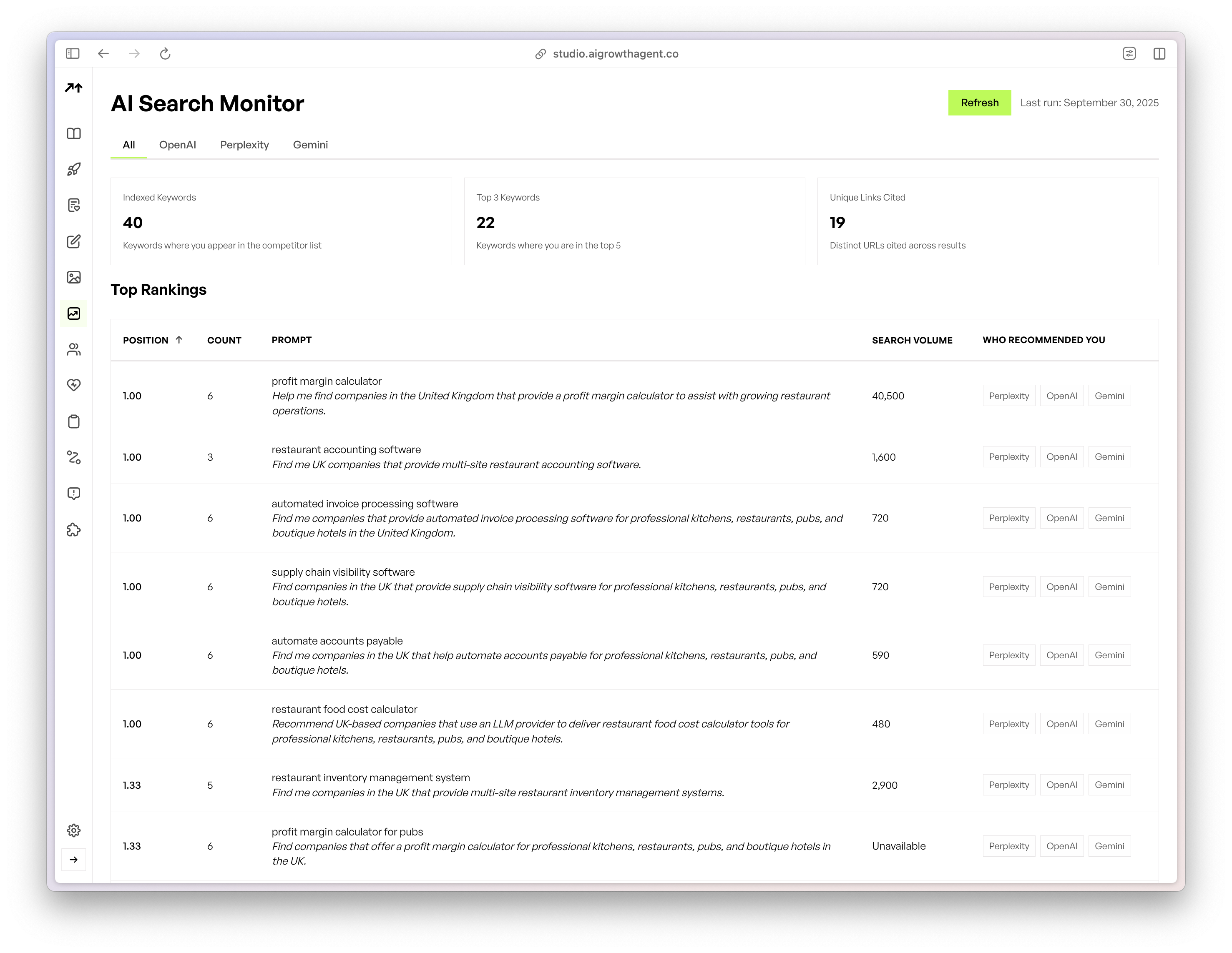
The AI Growth Agent Studio gives clients clear visibility into performance and AI citations across ChatGPT, Gemini, and Perplexity. This feedback loop supports continuous optimization and authority growth.


Capitalizing on Trends: Real-Time Content Injection
Real-time content injection helps teams participate in relevant conversations while they are still fresh. Early publication on an emerging topic can help a brand become the reference point AI systems use when summarizing that subject.
Systems monitor social channels, news, industry publications, and search trends to detect spikes in interest. When a topic aligns with your expertise, the agent can prepare briefs and draft articles quickly, often within minutes.
This capability supports seasonal campaigns, launches, and competitive responses as well. Editorial calendars can adapt automatically to market conditions while keeping brand voice and technical standards consistent.
Real-time adaptation also relies on performance data. As new content ships, AI agents evaluate engagement, rankings, and conversion signals, then adjust topics and formats to reflect what works best.
Measurable ROI: AI Analytics and Citation Tracking
Real-time performance tracking and AI analytics help marketers connect objectives to measurable metrics, which improves ROI visibility. Content programs now need to measure both traditional SEO outcomes and AI-powered discovery.
AI citation tracking monitors how often your pages are mentioned, quoted, or recommended by systems such as ChatGPT, Perplexity, and Google Gemini. Citation patterns provide a direct signal of authority and influence in AI-driven channels.
Dashboards typically include organic traffic, rankings, AI citation counts, and conversions attributed to content. These views help marketing leaders explain impact in language that resonates with finance and executive teams.
Analytics also uncover optimization opportunities and competitive dynamics. Teams can see which topics and structures correlate with higher authority and citation rates, then refine strategy around those insights.
Marketing leaders who want deeper visibility into AI-era authority can schedule a consultation session to explore AI Growth Agent’s analytics and monitoring capabilities.
5. Strategic Onboarding and Continuous Brand Consistency
AI agents perform best when they are programmed with clear brand guidance and updated regularly as strategy evolves. AI agents can create content that matches brand voice and audience expectations autonomously, supporting high-volume yet contextually relevant output across channels.
AI Growth Agent uses a structured onboarding process that programs your agent with a Company Manifesto, then refines outputs over time inside the Studio environment. Schedule a demo to see how this workflow operates in practice.
Translating Brand Identity: The Company Manifesto
The Company Manifesto distills your strategy into a format AI systems can apply. It goes deeper than a standard style guide by combining positioning, value propositions, audience insights, and communication principles in one reference.
Manifesto development usually starts with a structured discovery session run by experienced interviewers. Sessions cover founding story, mission, values, market perspective, and nuanced elements such as tone, stances on key industry debates, and differentiation.
Programming and onboarding AI agents with brand manifestos and clear value propositions relies on precise instructions and feedback loops. The manifesto then becomes the core dataset that guides how the agent writes, frames topics, and prioritizes messages.
The document can also include competitor profiles, positioning statements, and content strategy rules. This detail helps the agent produce content that supports business goals, not just brand tone.

Teams can also supply approved images and visual guidelines so the agent incorporates on-brand visuals naturally into articles and landing pages.
Iterative Learning: AI Refinement for Consistent Messaging
Iterative learning turns a static AI setup into an adaptive system. The agent updates its approach based on feedback and performance data, which improves quality over time.
The process usually begins once the initial content goes live. Editors and marketers review outputs, share structured feedback on tone, accuracy, and depth, and then adjust rules and examples that the agent uses.
Marketers can assess ROI by tracking production speed, engagement metrics, and how quickly they adapt messaging for competitive advantage. These signals feed back into content plans and prompt libraries.
The learning loop also incorporates changes in product strategy, new markets, and shifting buyer needs. As your business evolves, the AI agent receives updated guidance so content continues to align with current objectives.
Advanced programs add A/B testing, search performance data, and algorithm updates from search and social platforms into the loop. This structure helps keep your content strategy effective as digital channels change.
|
Strategy Component |
Traditional Approach |
AI Agent Approach |
Authority Impact |
|
Content Production |
10-20 articles/month |
100+ optimized articles/month |
10x citation opportunity |
|
Technical SEO |
Basic keyword optimization |
Advanced schema + MCP |
Higher AI indexing accuracy |
|
Brand Consistency |
Style guide compliance |
AI manifesto programming |
Systematic brand authority |
|
Performance Tracking |
Traffic and rankings |
AI citation monitoring |
Authority measurement |
Frequently Asked Questions (FAQ) About AI Agents for Content Marketing
What is an AI agent in the context of content marketing?
An AI agent in content marketing is an autonomous software system that manages tasks across the content lifecycle, from strategic research and ideation through creation, optimization, and distribution. Unlike basic text generators, AI agents can handle programmatic SEO, real-time trend adaptation, technical infrastructure, and multi-tenant deployment. These systems run end-to-end workflows, respond to feedback, and maintain consistent brand voice and strategic alignment across large content libraries.
How do AI agents differ from traditional content creation tools?
AI agents extend beyond traditional tools in both scope and depth. Conventional tools focus on generating individual pieces of content and apply limited optimization. AI agents design and maintain content architectures with advanced SEO, such as schema markup, metadata strategies, and Model Context Protocols that connect directly to AI search engines. Agents also manage keyword research, briefing, drafting, internal linking, and publishing, often across multiple brands, while providing analytics and AI citation tracking in one environment.
Can AI agents truly establish definitive authority for brands in AI search?
AI agents can support authority building by combining high volume with consistent quality and technical precision. AI search engines such as ChatGPT, Perplexity, and Google Gemini need substantial, coherent datasets to recognize a brand as an authority in a category. Programmatic agents enable brands to publish hundreds of technically optimized, on-message pieces that cover their key topics thoroughly. This depth and consistency help AI systems select the brand as a primary reference when generating answers.
What specific technical optimizations do AI agents provide for AI search?
AI agents can automate a wide range of technical optimizations that matter for AI indexing and citation. These include advanced schema markup that explains the purpose and structure of each page, LLM.txt files that guide AI crawlers, and Model Context Protocols that expose content hierarchies to AI tools. Agents also manage metadata generation, alt text, internal linking, and server-level settings that affect crawlability. Together, these elements create a structured data environment that helps AI systems interpret and trust your content.
How quickly can AI Growth Agent help my brand gain authority in AI search?
AI Growth Agent is designed for fast deployment. Most clients move from initial consultation to first published, fully optimized article within about a week of onboarding. The process includes Company Manifesto creation, infrastructure setup, and initial strategy, so early content ships with the right technical and brand foundations. Many clients see signs of authority, such as AI Overview appearances, Perplexity recommendations, or ChatGPT citations, within the first month of consistent publishing, although timelines vary by category and competition.
Conclusion: Build AI Search Authority with AI Growth Agent
Content marketing is shifting toward programmatic methods, and AI agents now sit at the center of that shift. Brands that embrace hyper-personalized content at scale, rigorous technical optimization, autonomous infrastructure, real-time adaptation, and consistent brand programming are better positioned to remain visible as AI search adoption grows.
The five strategies in this article describe a structured way to build that capability. Organizations that implement them systematically can strengthen their presence across both traditional search and emerging AI discovery channels.
Organizations that capture value from AI typically invest in strategy, operating models, scalable technology, high-quality data, and adoption. Integrating AI agents into content marketing aligns directly with this pattern.
AI Growth Agent provides a comprehensive, autonomous Programmatic SEO Agent that helps your company supply clear, authoritative answers for AI search engines. The combination of technical infrastructure, autonomous workflows, and structured onboarding creates a practical path to stronger authority in AI-driven discovery.
The advantage available from programmatic content authority is likely to grow as AI search becomes a primary discovery channel in more markets. Early adopters who establish clear, well-structured content footprints may hold that advantage for an extended period.
Marketing teams that want to strengthen their authority and increase the odds of being cited and recommended by AI search engines can schedule a consultation session with AI Growth Agent to explore whether this programmatic approach fits their goals.