Written by: Mariana Fonseca, Editorial Team, AI Growth Agent
Key Takeaways
- AI brand authority work centers on evidence-based content that AI engines can read, trust, and repeatedly cite for category questions.
- The shift to AI-mediated discovery has sharply reduced clicks, with AI Overviews in over 13% of searches and click-through rates falling by up to 58% for top results.
- Winning in AI search requires visibility across four pillars: Search Intelligence, AI Analytics, Bot Tracking, and AI Ranking, so teams see their full market presence.
- The 7-step headless marketing process maps queries, builds evidence-backed content, deploys technical SEO, and produces articles that AI engines cite and train on.
- Brands that want to control their AI narrative and see measurable citation growth can schedule a consultation with AI Growth Agent to get started.
The Discovery Shift Reshaping Brand Visibility
The search behavior that defined digital marketing for two decades is being rewritten. Google AI Overviews appeared in 6.49% of U.S. desktop searches in January 2025 and grew to 13.14% by March 2025 (Semrush/Datos analysis of >10M keywords), and Google I/O 2026 confirmed AI Mode crossed 1 billion monthly users within its first year, with queries more than doubling every quarter since launch. The surface area of AI-mediated discovery is expanding faster than any previous shift in search.
This expansion fundamentally restructures how brands capture attention. The consequence for brands is structural. Clicks occur at nearly twice the rate when no AI summary appears on Google results pages compared to when one does (15% versus 8%), and only 1% of users click links inside AI summaries. Roughly 83% of people report skepticism toward AI answers, yet behavior does not follow the stated attitude. For most users, the answer the model gives becomes the answer they accept. Click-through rates dropped 34.5% (later updated to 58%) for top-ranking results across queries that trigger AI Overviews, and that number will only move in one direction.
Traditional SEO suites and monitoring tools were built for a world where clicks were the unit of value. In a zero-click environment, they report rearview data: where the brand stood last week, which keywords ranked, how many impressions accrued. None of that changes what the AI says. The leaderboard is being written now, and the brands establishing authoritative content in 2026 are training the next generation of models with their own narrative.
See how AI Growth Agent can map your query universe and position your brand in AI answers, then schedule a consultation to get started.
The Four Pillars That Reveal Your AI Citation Footprint
Winning in AI search requires visibility across four distinct data layers. Any team operating on fewer than all four is blind to part of its own market. The table below defines each pillar, the inputs required, and the outputs that drive action.
| Pillar | What It Covers | Required Inputs | Outputs |
|---|---|---|---|
| Search Intelligence | Complete portrait of the traditional search landscape: positioning, competition, search volume, and who is winning each result | Real-time Google data, competitor domains, seed terms, long-tail query sets | Actionable diagnosis of the battleground, with a weekly snapshot of ranking URLs, top YouTube videos, Reddit threads, and competitor movements |
| AI Analytics | Brand value and consumer behavior across the full journey, from external AI-tool queries through content consumption, demographics, and sentiment | ChatGPT and AI Mode query data, brand mention feeds, demographic signals | Citation context map showing where the brand appears in AI answers, who it is grouped with, and what claim it is cited for |
| Bot Tracking | Every bot interaction, traditional crawlers and AI training agents alike, including every crawl, citation, and training sweep | Server-level bot logs, WordPress plugin data, per-article crawl records | Real-time visibility into which AI systems are reading the content and when, including the bot ChatGPT uses to cite sources |
| AI Ranking | Order of mention and citation context in AI answers, the functional replacement for a static ranked list | Weekly prompt runs across ChatGPT, Perplexity, and Google AI Mode, plus citation position records | Week-over-week leaderboard showing brand position in AI answers and how that position evolves against the content plan |
A 2026 analysis found that AI local visibility is up to 30x harder than ranking in Google, which means teams that can see all four pillars and act on them in the same week hold a structural advantage over those running disconnected dashboards.
The 7-Step Process for Narrative Control Through Headless Marketing
Step 1: Map the Full Universe of Seed Terms and Long-Tail Queries
Goal: Build a complete picture of every query a potential customer might use to find, evaluate, or compare the brand. Inputs: Real-time Google and ChatGPT data, competitor domains, brand manifesto. Validation checkpoint: The universe covers hundreds of seed terms with dozens of long-tail queries beneath each one. This comprehensive scope is necessary because AI platforms decompose every user query into multiple simultaneous retrieval sub-queries, many of which have zero or low Google search volume and are invisible to traditional keyword tools. That is why the map must be built from AI Overview and ChatGPT results, not a keyword export. Exact output: A prioritized query universe refreshed weekly, with 3,000+ searches run per week for mature clients reaching 1,600+ queries.
Step 2: Turn the Query Map into an Evidence-Based Content Topology
Goal: Translate the universe map into a strategic hierarchy of content anchored in the brand manifesto. Inputs: Manifesto, primary-source URLs, product pages, real-time AI Overview and ChatGPT results as the objective function. Validation checkpoint: Every seed term has a content plan backed by evidence of what is already winning the result and where the gap is. Brands producing 12 or more new or optimized pieces of content per month achieve up to 200x faster visibility gains in AI engines compared to those producing just four. Exact output: A Content Topology and Content Planner showing where to win, with white space identified against competitor domains.
Step 3: Deploy Agentic Technical SEO on Day One
Goal: Make every published page machine-readable, agent-discoverable, and citation-ready before the first article ships. Inputs: WordPress plugin, reverse proxy rewrite, brand domain. Validation checkpoint: Blog MCP, llms.txt, llms-full.txt, full schema suite, advanced robots.txt, sitemap.xml, OpenAI discovery via /.well-known/, and Agent Card guidance are all live. These technical elements work together to make content machine-readable and citation-ready. Implementing comprehensive schema markup increases AI citation chances by 140% (2.4x), and Pages with sequential heading structures have 2.8x higher citation odds; pages with rich schema are 13% more likely (or up to 3.2x more likely) to earn AI citations. Exact output: A fully instrumented owned property live within the first week, with no engineering hours required from the client.
Step 4: Generate Authoritative, Self-Healing Content Validated Against Primary Sources
Goal: Produce content that earns citations by meeting the evidentiary standard AI surfaces apply when selecting sources. Inputs: Manifesto, memories, primary-source links, multi-provider AI orchestration across OpenAI, Anthropic, Gemini, Grok, Perplexity, Exa, and Firecrawl. Validation checkpoint: Every claim, source, and quote is validated against evidence found online, and a cascade of anti-hallucination checks runs before any article moves to publish. Pages that have not been updated recently are more likely to lose citations, so content is living by design. Exact output: 2 to 50 publish-ready articles per day per client, with brand voice, legal disclaimers, and deny lists enforced automatically.
Step 5: Launch an Owned, Reverse-Proxied Blog in the First Week
Goal: Give the brand a fully optimized owned property that AI crawlers can read, cite, and train on without touching the existing main site. Inputs: Brand domain, reverse proxy rewrite (subdirectory or subdomain), WordPress plugin. Validation checkpoint: The blog is styled to match the brand, connected under the client's domain, and the client owns it outright with no agency dependency. Exact output: First article live in approximately one week, with content indexing in as little as ten days.
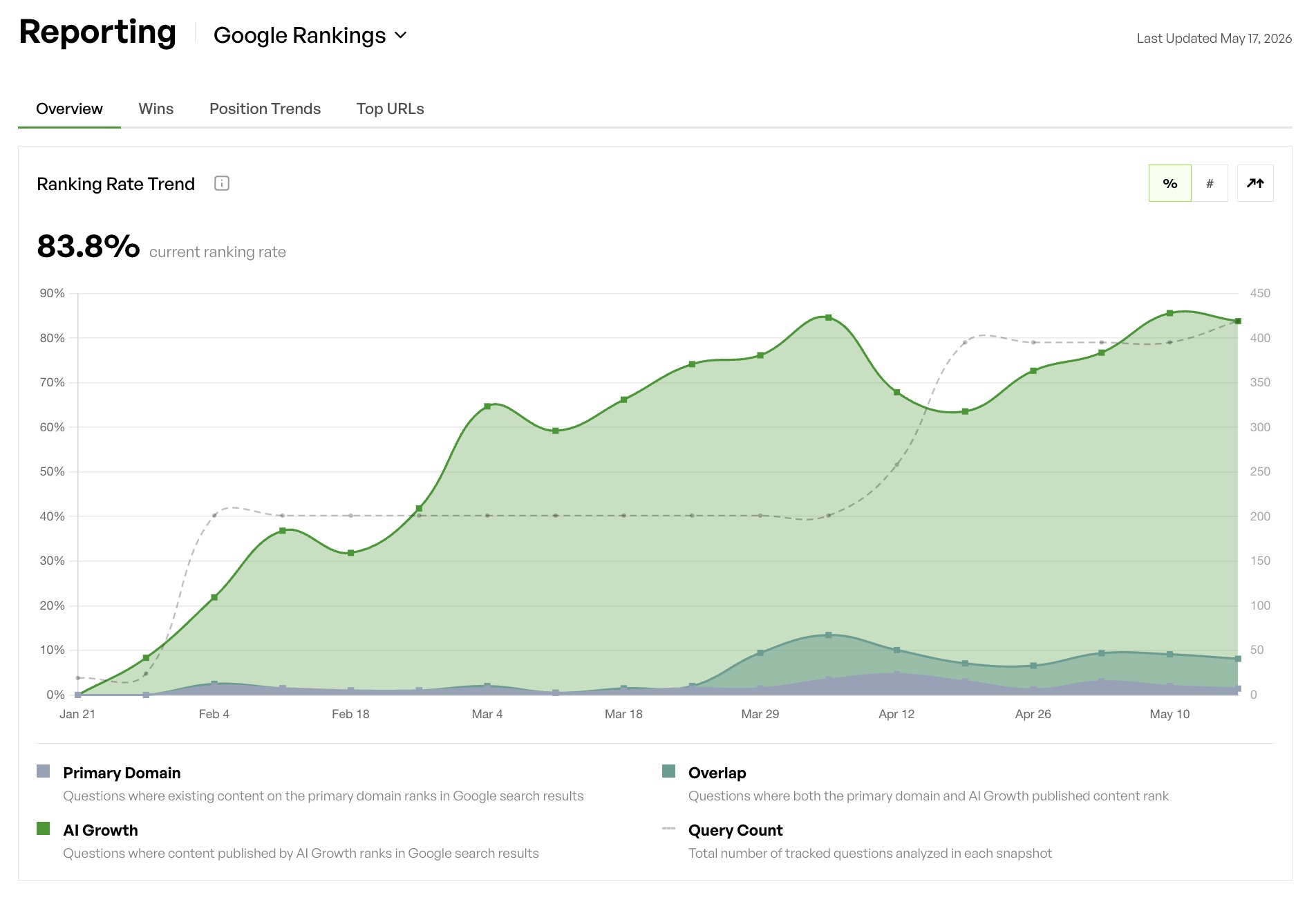
Step 6: Measure Incremental Visibility, Bot Traffic, and Citation Context
Goal: Prove exactly what the engine generated, isolated from visibility the brand already had. Inputs: Per-article bot logs, Google Search Console, weekly prompt runs across ChatGPT, Perplexity, and Google AI Mode. Validation checkpoint: Reporting cross-references bot traffic, impressions, and citation data that no single monitoring tool brings together. The NAV43 framework recommends running top priority queries across ChatGPT, Perplexity, and Google AI Mode each week to document new citations gained, citations lost, and sentiment changes. Exact output: Week-over-week incremental visibility report with averages across the first twelve weeks that match the citation growth and bot traffic increases mentioned earlier.
| Metric | Baseline | 12-Week Average Result | Source |
|---|---|---|---|
| AI citations and mentions | Brand's existing citation count | +12,000 incremental citations | AI Growth Agent client averages |
| Bot visits | Brand's existing bot traffic | +100,000 incremental bot visits | AI Growth Agent client averages |
| Impressions lift | Brand's existing Google Search Console impressions | +20% incremental impressions | AI Growth Agent client averages |
Step 7: Let the Engine Self-Heal and Refresh Content Automatically
Goal: Compound authority over time rather than letting it decay as the world changes. Inputs: Google Search Console signals, bot-traffic awareness, annual refresh triggers, memory systems. Validation checkpoint: Stale articles are identified and refreshed automatically, and every article's relationships, performance, and indexing data are centralized. Pages updated within 2 months earn roughly 28% more citations from AI engines than older pages. Exact output: A living content library where authority compounds week over week, with no manual refresh cycle required from the client.
Why Headless Marketing Replaces Both Agency Stacks and Monitoring Tools
Most marketing leaders reach for one of two options when they decide to take AI search seriously, and both are structurally broken. The agency route runs approximately three months for an RFP, then three more to produce the first assets, which puts the brand close to a year behind before anything is live. The monitoring-tool route tells the brand it is not showing up and stops there, leaving the content problem entirely unsolved.
Headless marketing provides the architecture those options cannot support. It decouples the brand's curated main site from the engine running its AI search presence, similar to how headless commerce separates the storefront from the fulfillment backend. The brand keeps its marketing pages. AI Growth Agent stands up a separate, fully optimized blog the brand owns, connected through a reverse proxy rewrite, and the engine writes, publishes, monitors, self-heals, and reports without adding headcount.
Earned media accounts for 82% of all AI citations, with non-paid sources accounting for 94%, which means the content the engine produces must meet the evidentiary standard of a primary source, not the output standard of a content factory. The brand manifesto and a journalist with 10+ years of experience on the founding team create the differentiation a generic tool cannot replicate.
One engine replaces the SEO agency, the content tool, the web agency, the GEO monitor, the schema plugin, the analytics stack, and the PR firm. Pricing is a flat fee with no per-article charges, credit limits, or per-prompt billing, so clients see their entire universe instead of a capped handful of tracked terms. The client owns the site, the content, and the relationship with the AI surfaces from day one.
Ready to replace your agency stack with one engine and keep your existing site intact? See if headless marketing fits your brand, then book a demo and get your first article live on the rapid deployment timeline mentioned earlier.
Frequently Asked Questions
How quickly can the first article go live and index?
The first article is typically live within approximately one week of kickoff. The kickoff week begins with a journalist-led interview that builds the brand manifesto, which the engine uses to generate the keyword topology and first articles. Content has indexed in as little as ten days and often within two weeks. The standard engagement is a three-month pilot because indexing timelines vary by industry and domain authority, but clients consistently see movement early in that window.
Who owns the content and the site?
The client owns both outright. AI Growth Agent stands up a fully optimized blog connected to the client's domain through a reverse proxy rewrite, typically under a subdirectory, or through a subdomain. There is no agency in the loop and no dependency to manage. The client owns every article produced, and the site is theirs to keep regardless of the engagement status. This is a deliberate design choice, because the old model where an agency controls the site is one of the structural problems headless marketing is built to eliminate.
What technical dependencies exist on the client side?
The only integration step required from the client is the reverse proxy rewrite that connects the blog and the technical SEO stack to a subdirectory under their domain. AI Growth Agent generates setup documentation for the client's host, whether Cloudflare, Vercel, or another provider. Everything else, including the full technical and agentic SEO stack, the WordPress plugin, Blog MCP, llms.txt, schema, sitemaps, robots.txt, instant indexing, autoredirects, and 404 tracking, is included in every package and requires no action from the client's team. No engineering background is needed on the brand side.
How is incremental visibility measured and isolated from existing brand traffic?
AI Growth Agent publishes into a separate environment so it can report only on the visibility it actually generated, never taking credit for visibility the brand already had. Reporting cross-references per-article bot tracking, Google Search Console as an independent audit, and weekly prompt runs across ChatGPT, Perplexity, and Google AI Mode. The result is a week-over-week incremental visibility report that shows exactly what the engine contributed in citations, bot visits, and impressions. Clients who measure conversion most rigorously capture traffic source at the conversion moment and consistently see a lift in organic leads that correlates with the citation growth the engine produces.
Conclusion: Take Narrative Control This Year
The AI search leaderboard is being written in 2026. The brands establishing authoritative, self-healing content now are training the next generation of models with their own narrative. The brands that wait are training those models with whatever happens to be sitting on the open web.
Brand web mentions correlate at 0.664 with AI Overview visibility, three times stronger than traditional backlinks at 0.218, and brands in the top quartile for web mentions earn an average of 169 AI mentions compared to just 14 for the next quartile. As noted earlier, brand web mentions show a far stronger relationship with AI visibility than traditional backlinks, and the gap between top-quartile brands and the rest continues to widen.
AI Growth Agent delivers measurable citation growth without added headcount. Across the first twelve weeks, clients average more than 12,000 additional AI citations and mentions, over 100,000 additional bot visits, and a 20%+ lift in impressions. The single-engine approach discussed earlier eliminates the need for multiple vendors and tools, while the client owns the site and the content from day one.
Traditional search tools show you where your brand stands. AI Growth Agent makes your brand the answer.