AI Content Creation ROI: Enterprise Comparison Guide

Explore AI Summary

If you are not producing a critical mass of fresh, detailed, technically sound content, your digital footprint, the small pixel your brand occupies on the internet, shrinks over time.

In this context, experimenting with AI content is not a side project. It is a core strategic decision about how your organization will secure and grow brand authority and revenue in an AI-driven discovery environment.

The most reliable way to make that decision is to think rigorously about ROI, what you measure, how you measure it, and which tools can realistically deliver the required outcomes. What you’ll see in this article:

  1. AI search engines such as ChatGPT, Gemini, and Perplexity now influence how buyers discover brands, which makes AI content performance a direct driver of enterprise visibility and revenue.
  2. Measuring AI content ROI only by time or cost savings hides the real levers of value, including authority, AI citations, organic growth, and impact on pipeline.
  3. Basic generative AI tools and AI-assisted agencies can increase output, but they struggle to deliver the scale, technical depth, and consistency needed for AI-era category leadership.
  4. Autonomous content platforms like AI Growth Agent use coordinated AI agents, technical SEO automation, and AI search monitoring to operate as a full content engine rather than a drafting aid.
  5. Enterprises that seek category leadership in AI search benefit from platforms that integrate with existing stacks, protect brand voice and compliance, and provide clear ROI measurement across web and AI discovery.

Why AI Content ROI Now Directly Impacts Enterprise Visibility

The old content playbook was built for a web where human searchers typed queries into Google, skimmed results, and clicked links. You could compete with a handful of high-quality articles per month, a focused keyword strategy, and a few strong backlinks.

That world is gone. Today, AI models intermediate much of discovery. When a buyer asks ChatGPT for “the best enterprise cybersecurity platforms” or Perplexity for “B2B marketing analytics tools with the fastest implementation,” the model decides whose content gets cited and whose brand narrative defines the category.

For modern marketing leaders, this creates three urgent realities:

1. Shrinking digital footprints and AI search displacement. As AI multiplies web content, any single brand’s visibility becomes a smaller share of the whole. Without a deliberate AI content strategy, your brand’s relevance in AI search decays, even if your Google rankings appear stable in the short term.

2. Traditional content models as a strategic liability. Agencies and internal teams operating on human timelines cannot keep up with the required publishing velocity and depth. Producing a few hero pieces each month is no longer enough to establish or maintain authority. That model may keep your marketing calendar full, but it quietly concedes the AI search landscape to faster, more technically sophisticated competitors.

3. Competitors can define your narrative in AI search. In AI search, the model will always answer the query. If your content is not present, someone else’s will be. Competitors’ claims about your category, your product’s relative position, and even your pricing or capabilities can become the default version that AI systems repeat to your prospects.

Defining True ROI for Enterprise AI Content: Beyond Simple Cost Savings

Many first-generation AI content projects framed ROI as hours of writer time saved. That narrow view ignores the value of quality, authority, and revenue impact. It often leads to low-cost, generic content that erodes brand equity over time.

True ROI for enterprise AI content needs to address a more demanding standard. The core issue is whether the content engine helps your company become the definitive, most-cited authority in its category and whether that authority contributes to pipeline and revenue.

To reach that level, you need to evaluate both the technology and the business outcomes.

Key criteria for assessing AI content solutions

When you compare AI writing tools or content partners, evaluate them on these dimensions:

Scalability and publishing velocity. Confirm whether the solution can support daily, high-quality publishing across multiple product lines, geographies, and personas, without adding headcount.

Integration into your stack. Check if it connects directly to your web and analytics stack, such as your CMS, subdomains, Google Search Console, and AI search monitors, or if your team must manage fragile workflows and manual uploads.

Usability for marketing teams. Determine whether non-technical marketers can operate and guide the system, or if it introduces new dependencies on engineering or data teams.

Content quality and authority. Assess whether the output reads like generic AI copy or reflects a deep understanding of your brand, market, and customers, with enough depth to be a credible source for AI engines to cite.

AI search visibility and technical SEO. Look for automated support for AI indexers, including schema, metadata, and emerging standards such as LLM.txt and Model Context Protocol. Simple keyword placement is no longer sufficient.

Total value and risk. Evaluate whether the platform lowers brand risk, such as hallucinations, off-brand messaging, or compliance issues, while increasing output. A tool that requires your team to become full-time AI editors can quickly dilute ROI.

Essential metrics for quantifying AI content ROI

Your measurement framework should match the complexity of your goals. Teams that track AI content ROI effectively tend to combine several types of metrics:

1. Engagement, traffic, and keyword performance. Engagement rates, organic traffic growth, and keyword rankings are foundational for assessing whether AI-generated content resonates and gains visibility. Modern frameworks for measuring AI-generated content ROI emphasize these core indicators. They show whether you are earning meaningful audience attention, not just publishing more pages.

2. AI citations and SERP or AI rankings. In 2025 and beyond, rankings should include how often AI engines such as ChatGPT, Gemini, and Perplexity surface and quote your content. Organic traffic, keyword rankings, and AI citation patterns together reveal whether your content shapes buyer journeys in the new discovery layer, a view detailed in forward-looking analyses of content marketing ROI in 2025.

3. Conversion, cost, and strategic value. Robust ROI frameworks combine conversion rates, cost per content asset, and strategic impact such as brand authority and risk mitigation into a single picture. Enterprise studies of generative AI deployments show that evaluating both labor efficiency and revenue impact, rather than time saved alone, produces a more accurate view of ROI. End-to-end ROI analyses for generative AI writing platforms illustrate this point clearly.

4. Operational productivity and time to market. Productivity gains, quality improvements such as fewer errors and lower edit rates, and shorter production cycles are critical parts of AI ROI. A practical formula, (Productivity Gains + Cost Savings – AI Investment) / AI Investment × 100, helps quantify these benefits alongside revenue acceleration and opportunity capture. ROI frameworks for generative AI tools describe how to apply this approach.

5. End-to-end content supply chain impact. Enterprises achieve the highest returns when AI supports the full content lifecycle, including strategy, creation, governance, compliance, and distribution, not just drafting. Holistic, integrated content AI can raise ROI by more than 20 percent compared with isolated tools. Holistic analyses of AI-driven content supply chains highlight these gains.

When you align these metrics with your business goals, such as pipeline generated, influenced revenue, and category leadership, you create a scoreboard that shows which AI content solutions build a defensible advantage and which mainly produce low-impact volume.

To benchmark your AI content creation ROI against what is possible with an autonomous platform, schedule a consultation session with AI Growth Agent.

Comparative Analysis: AI Content Creation Solutions for Enterprise Scale

The market for AI content solutions has fragmented into three broad categories. Each offers AI-powered content, but their effect on ROI differs significantly.

Basic Generative AI Tools

Description: Basic generative AI tools are general-purpose models and self-service applications designed to help individuals and small teams generate drafts quickly. They work well for ideation, first-pass outlines, and lightweight content tasks.

Where they help:

For individual marketers, these tools can be useful assistants for drafting emails, summarizing reports, or producing simple blog outlines. They lower friction for one-off pieces and support experimentation.

Limitations for enterprise ROI:

Quality and authority. Even with detailed prompts, outputs often feel generic and interchangeable. They reflect the average of the internet rather than your differentiated point of view. Enterprise-grade content requires unique narratives, deep product knowledge, and nuanced positioning. Without that depth, AI search engines have little reason to treat your content as a definitive answer. Evaluations of generative AI ROI in content workflows show how low-quality automation under-delivers strategically, even when it saves time.

Technical SEO and AI indexability. Basic tools do not natively handle the technical engineering required for AI search performance, including rich schema, advanced metadata, LLM.txt, Model Context Protocol, and other emerging standards. Your team or agency must perform this work, which adds bottlenecks.

Scalability. These tools generate words rather than systems. They do not perform deep keyword research, maintain a strategy-aligned backlog, orchestrate multi-article campaigns, or publish autonomously. Humans must manage each step, from brief creation to editing, optimization, and publishing, which limits throughput.

Integration and workflow friction. Connecting basic tools to your CMS, analytics, and governance stack is typically your responsibility. Content operations teams end up maintaining custom workflows that can break when tools or APIs change.

True ROI. At scale, what appears inexpensive can become costly. Hidden labor for briefing, editing, optimization, and publishing reduces perceived savings. Generic content often fails to move the needle on traffic, authority, or pipeline. The organization gains speed at the draft level but limited impact at the business level.

AI-Powered Content Agencies and Managed Services

Description: Many traditional agencies now promote AI-assisted or AI-augmented content, with human writers supported by AI tools to accelerate research and drafting.

Where they help:

For brands without internal content teams, agencies still provide value through strategy workshops, brand positioning support, and editorial oversight. When they use AI responsibly, they can produce solid assets faster than fully manual teams.

Limitations for enterprise ROI:

Scalability and speed. Agencies remain constrained by human bandwidth and billable hours. Even with AI, most cannot sustain the level of daily, multi-article publishing that strong AI search visibility requires, especially across several regions, products, and languages.

Cost efficiency. The economic structure remains similar. You continue to pay per asset or per hour. AI may reduce internal effort, but that efficiency rarely passes through at scale, particularly when contracts center on fixed deliverables.

Technical specialization. Most agencies are not building proprietary systems for AI indexation, such as LLM-optimized metadata, schema automation, AI search monitoring, or Model Context Protocol implementations. They often apply traditional SEO practices to AI-era challenges, which leaves performance potential unused.

Integration and control. Agency workflows usually sit outside your stack. You receive drafts and reports rather than a fully integrated content engine. Visibility into how content is produced, optimized, and measured can be limited. Adapting quickly to new AI search behaviors becomes harder.

True ROI. You may see incremental improvements in content volume and delivery speed, but the model remains linear. More budget buys more content, without much leverage from automation. There is no step-change in scale or AI authority.

Autonomous Content Platforms: The AI Growth Agent Difference

Description: Autonomous content platforms turn AI from a drafting assistant into an orchestrated system of agents that handle the entire content lifecycle, including research, strategy, writing, technical engineering, and publishing, without relying on human billable hours. AI Growth Agent is built for this operating model.

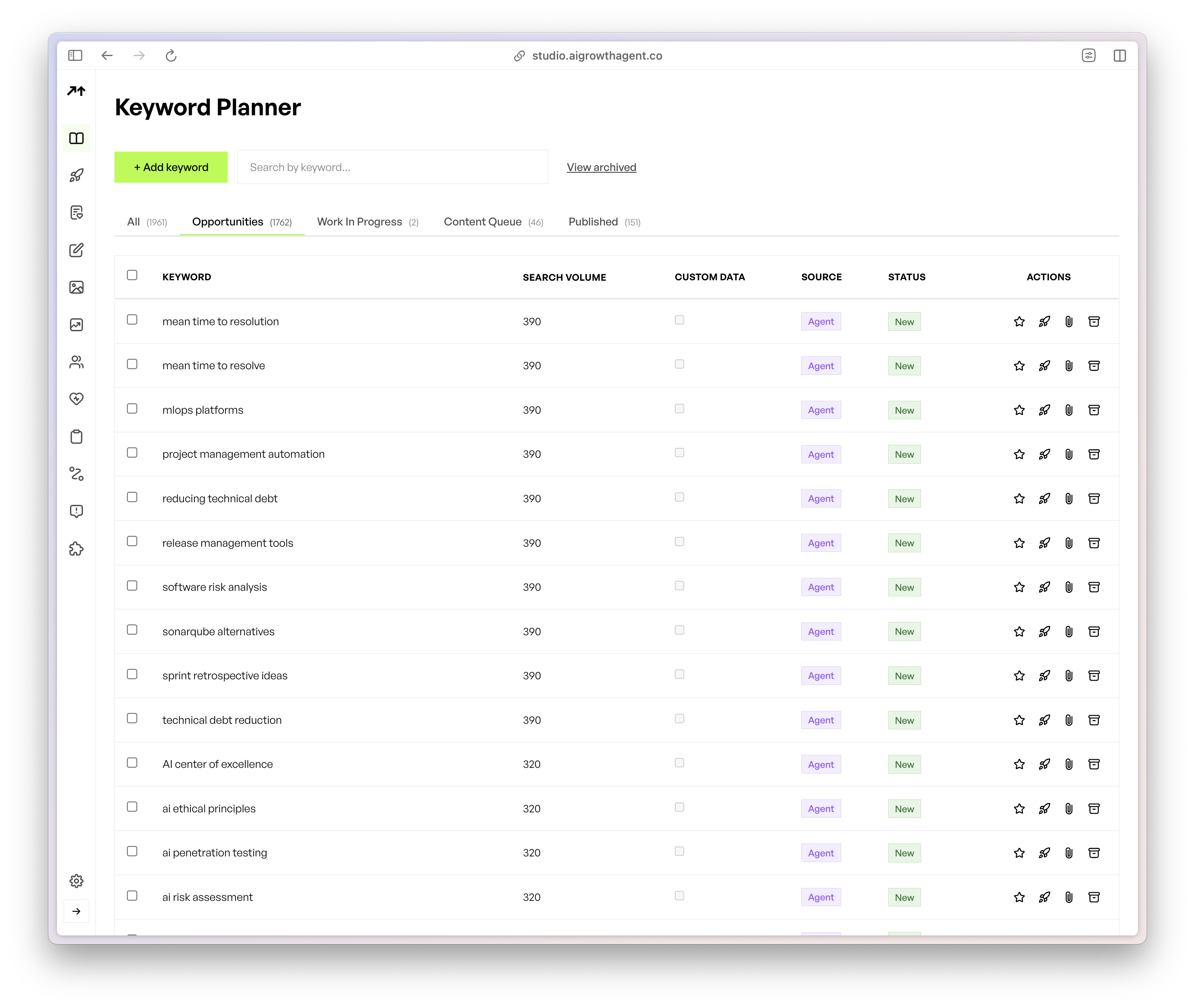
Instead of functioning as another AI tool, AI Growth Agent operates as an always-on system of specialized AI agents that replicate the work of a full content agency. Your team retains control and oversight through an interactive command center.

AI Growth Agent Keyword Planner Screenshot

How AI Growth Agent creates stronger enterprise ROI:

1. Authority and quality through a Company Manifesto. Every deployment begins with a white-glove onboarding session with a professional journalist who translates your positioning, narrative, and product truths into a detailed Company Manifesto. This Manifesto becomes the source of truth for all AI agents, so each article remains on-brand, factually grounded, and tailored to your audience.

2. High scalability through specialized agents. After onboarding, a Keyword Deep Research Agent analyzes large volumes of search queries to build a comprehensive content strategy. The Core Content Agent then executes each article from end to end, including briefing, research, drafting, fact-checking, and optimization. Work that once required weeks can be compressed into minutes, enabling a consistent daily publishing cadence.

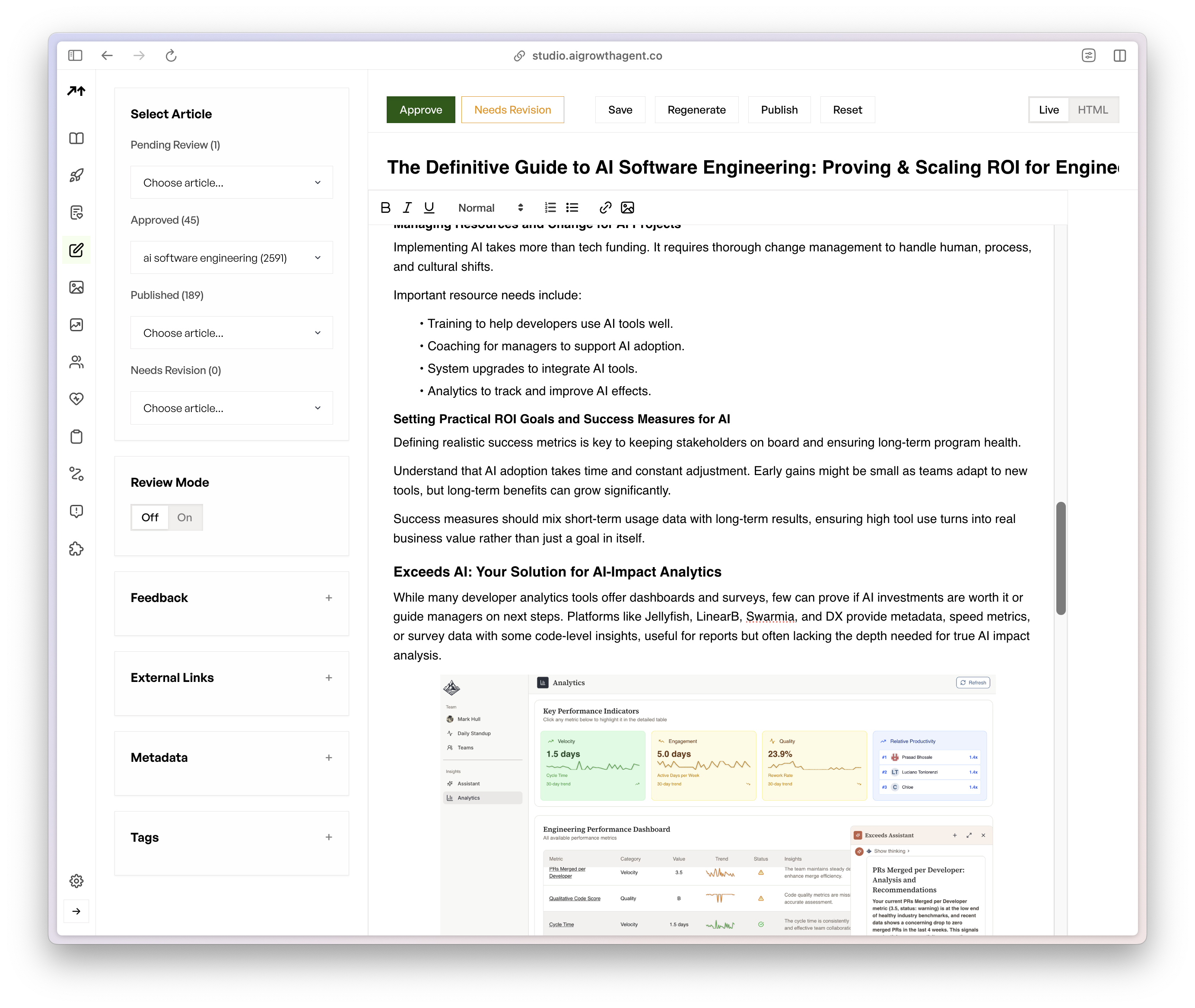
AI Growth Agent Rich Text Content Editor

3. Technical SEO engineered for AI search. AI Growth Agent goes beyond plain text. Each post is automatically enriched with advanced technical SEO, including schema markup, optimized metadata, image tags, and an LLM.txt file. The platform also configures a Model Context Protocol for your blog so AI search engines can interpret your content library with greater clarity.

4. Integration, transparency, and editorial control. AI Growth Agent can autonomously deploy an optimized blog as a subdomain, such as blog.yourcompany.com, that matches your existing brand. It can also integrate with major CMS platforms when publishing within your current infrastructure is preferred. Through the AI Growth Agent Studio, your team can review, edit, approve, or comment on any article. Over time, agent behavior can adapt to your feedback and require less oversight.

Teams can also upload brand-approved images, diagrams, and charts for agents to incorporate naturally into content, creating richer assets without extra design cycles.

Provide the agent with images to naturally incorporate into your content.

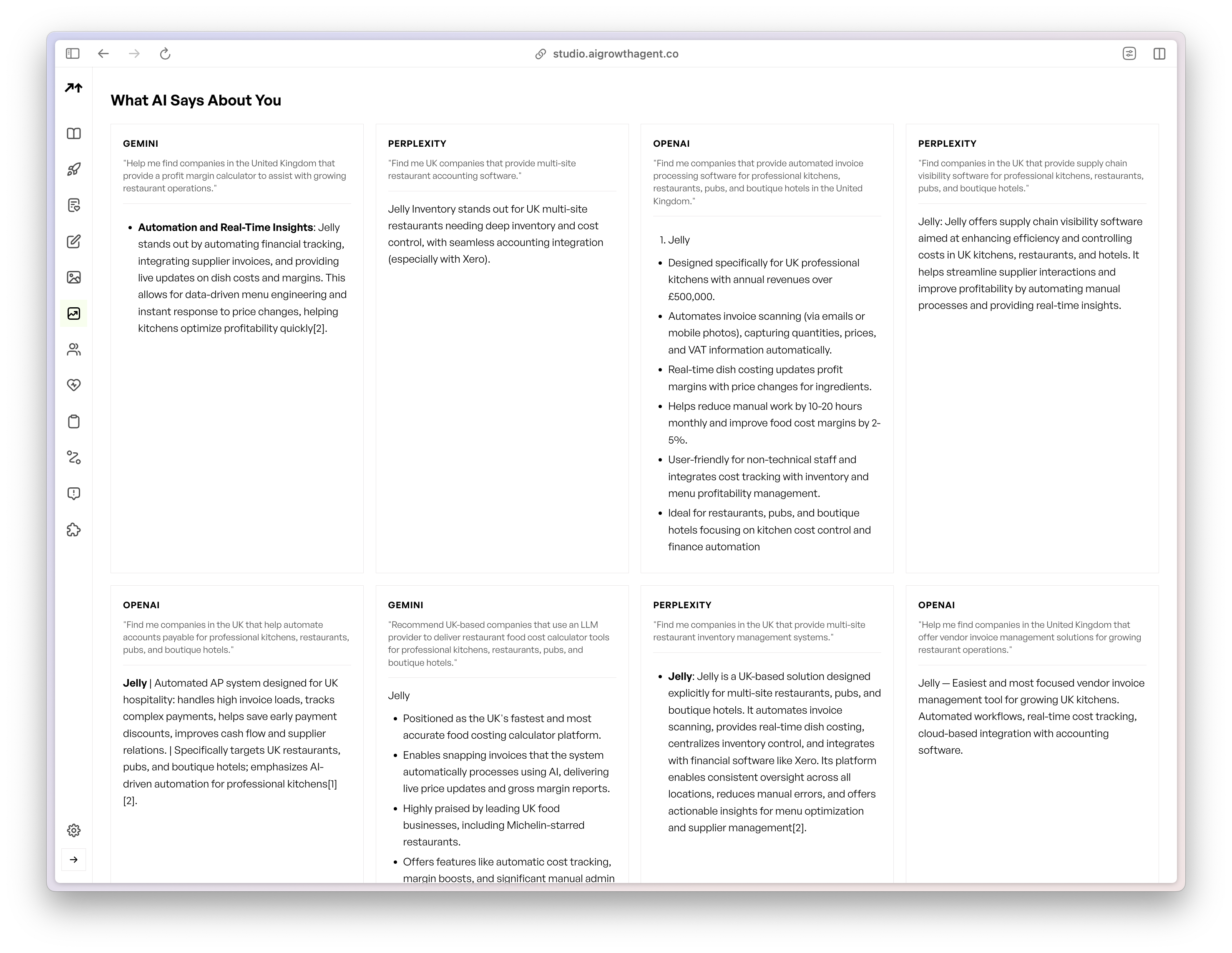
5. Measurable impact across AI and traditional search. The AI Search Monitor and Performance Agent continuously track performance across AI search engines and traditional search results. Inside the AI Growth Agent Studio, you can see which articles AI models cite, which keywords you own, how your rankings compare to competitors, and which bots, including Google, ChatGPT, and Perplexity, crawl your pages most often. The platform also surfaces Google Search Console data for organic traffic and clicks.

Screenshot of AI Growth Agent AI Search Monitor
Screenshot of AI Search Monitor where you can see what AI is saying about you across ChatGPT, Gemini, and Perplexity

6. Total value across the content supply chain. Where basic tools optimize only drafting, AI Growth Agent supports the full content supply chain, including strategy, creation, engineering, analytics, and iteration. This structure aligns with findings that AI delivers the strongest ROI when it provides visibility and coordination across processes. Holistic AI ROI assessments across the content supply chain describe this effect.

The result is a compounding advantage in AI search authority that uses technology to scale high-quality content creation efficiently.

Schedule a consultation session with AI Growth Agent to see how an autonomous platform compares to your current toolset.

Comparative ROI Table: AI Content Tools at a Glance

To clarify how these approaches differ, the table below compares basic generative AI tools, AI-powered agencies, and AI Growth Agent across key ROI drivers for enterprise marketing leaders.

Key ROI Metric

Basic Generative AI Tools

AI-Powered Content Agencies

AI Growth Agent

Content Quality and Brand Voice

Generic, template-like outputs that require extensive editing to reflect brand perspective and expertise.

Higher quality through human writers but variable consistency, with institutional knowledge residing in people rather than systems.

Company Manifesto-driven content that captures consistent voice and a clear point of view in each article.

Technical SEO for AI Search

Limited mostly to keyword usage with no native support for schema, LLM.txt, Model Context Protocol, or AI-specific indexing.

Traditional SEO best practices with technical enhancements dependent on agency skill and manual effort.

Automated schema, metadata, LLM.txt, and Model Context Protocol implemented in every post for AI-native indexability.

Publishing Velocity and Scale

Fast drafting, but total throughput constrained by manual strategy, editing, and publishing.

Bound by human bandwidth and billable hours, which makes a daily multi-article cadence difficult to sustain.

Autonomous agents manage tasks from strategy through publishing, enabling consistent daily output across brands and product lines.

Transparency and Control

High control at the prompt level but low visibility into consistency and governance across a large content library.

Limited transparency into workflows, with revisions and approvals following agency timelines.

Full visibility and editorial control through the AI Growth Agent Studio, with feedback loops that improve agent performance.

Measurable AI Search Impact

No built-in tracking of AI citations or cross-engine visibility, relying on manual monitoring.

Reporting centered on traditional SEO and content performance with minimal insight into AI search behavior.

Dedicated AI Search Monitor that tracks citations, keyword coverage, competitor positions, and bot crawl patterns across AI and web search.

Cost Efficiency and Total Value

Low direct cost per draft but high hidden labor costs and limited strategic impact.

High per-asset cost with results that scale linearly with spend and limited leverage from AI.

Platform investment that supports high throughput and authority through autonomous technology.

For enterprise leaders, the key point is that basic tools and hybrid agencies can lower some costs or improve convenience, but autonomous platforms like AI Growth Agent focus on building a technology-driven content engine.

To understand how these differences would appear in your own AI content ROI comparison, schedule a demo with AI Growth Agent.

Real-World Impact: How AI Growth Agent Builds Content Authority

The impact of an autonomous platform becomes clearer when viewed through common enterprise scenarios.

Scenario 1: Multiple product lines and fragmented messaging

In this scenario, you lead marketing for a company with three major product lines, each targeting different personas and industries. Historically, each line has had its own small content budget and ad hoc agency support. The result is inconsistent messaging, duplicated topics, and a thin library of content for each product.

With basic tools: Individual product marketers might use generative AI tools to draft blog posts when time allows. Quality varies, and there is no unified strategy or cross-product narrative. AI search engines see scattered, shallow coverage rather than a coherent authority.

With AI-powered agencies: You can assign an agency to each product line or one large agency across all lines. Content quality improves, but volume remains limited and expensive. Coordination across product lines is slow, and updating content to reflect new positioning or features can take weeks.

With AI Growth Agent: You can run several specialized Content Agents in parallel, one per product line, each with its own Manifesto and keyword strategy. All agents publish to a unified, optimized blog structure that supports your master brand while addressing each audience. This approach builds a dense, interconnected body of articles that supports buyer journeys for each product.

Scenario 2: Rapid response to breaking news and industry shifts

In dynamic categories shaped by regulatory updates, security incidents, or economic shifts, being late to the conversation reduces mindshare and weakens your presence when buyers are actively searching and asking AI systems for guidance.

With basic tools: A team member can prompt an AI model to draft a reaction piece, but aligning that draft with your brand stance, legal guidelines, and product positioning needs significant editing. By the time the article is approved and published, the moment may have passed.

With AI-powered agencies: You can request rapid response content, but turnaround times remain constrained by calendars and competing client priorities. Agencies may not know your risk posture well enough to move quickly without detailed review.

With AI Growth Agent: You can provide a link to breaking news or updates inside the Studio. The Core Content Agent can quickly generate an analysis framed by your Manifesto, which shortens review cycles and supports publishing within hours. This speed helps capture relevance in AI search engines while the topic is active.

Scenario 3: Turning proprietary data into an AI search asset

Many companies hold rich proprietary data in products, mobile apps, or internal reports that has never been fully surfaced as public content. Traditionally, turning that data into SEO assets would require a large and ongoing content investment.

With basic tools: Your team might paste small data snippets into a model to generate a few reports or posts, but scaling to hundreds or thousands of pages is operationally difficult.

With AI-powered agencies: An agency could design a content program around this data, but the cost and time to extract, synthesize, and publish at scale would be significant.

With AI Growth Agent: You can integrate proprietary data directly into the platform. The Content Agent then generates structured, SEO- and AI-optimized articles for each data slice, such as location-based recommendations or industry benchmarks. Each page is engineered for web and AI indexation, turning hidden data into a visible, high-authority content asset.

Across these scenarios, AI Growth Agent functions as a content operating system that uses your brand knowledge, data, and strategy to strengthen AI-driven discovery.

Guided Decision Support: Choosing the Right AI Content Partner for Your Enterprise

When evaluating potential AI content partners, many teams start with price comparisons or feature checklists. For enterprise leaders, it is more productive to define the type of content engine required to reach strategic goals in AI search.

Use the following considerations as a decision framework:

1. Clarify your ambition level. If your goal is to produce some content more efficiently, basic AI tools or hybrid agencies may be sufficient. If your objective is to become a definitive authority in your category, you may need an autonomous system designed to support that level of depth and scale.

2. Assess your operational reality. Consider how much capacity your internal team has for strategy, editing, technical SEO, and publishing. If resources are already stretched, tools that increase operational workload will not deliver the expected ROI.

3. Examine integration and change management. Confirm whether the solution can connect to your existing stack without extensive engineering support and whether marketing can own and operate it day to day. Autonomous platforms like AI Growth Agent are designed to reduce engineering friction.

4. Require transparent, measurable ROI. Any credible AI content solution should help you track performance across AI and web search and highlight optimization opportunities. If you cannot clearly see how your investment affects key metrics, it becomes difficult to adjust your strategy.

5. Align with premium brand expectations. If you are a premium brand with a strong foundation, AI Growth Agent focuses on organizations that aim to be category leaders and treat content and AI search dominance as strategic priorities.

Ultimately, the decision centers on whether you seek incremental efficiency or a more durable edge in AI search. For enterprises that prioritize the latter, an autonomous platform can act as a strategic asset.

Schedule a consultation session to evaluate whether AI Growth Agent is the right AI content creation engine for your enterprise.

Frequently Asked Questions (FAQ) About AI Content Creation ROI

How does AI Growth Agent measure the true ROI of its content compared to other tools?

AI Growth Agent measures ROI across several layers to give enterprise leaders a clear view of impact.

First, the platform tracks traditional performance metrics such as organic traffic, impressions, click-through rates, and keyword rankings through integration with Google Search Console.

Second, the AI Search Monitor tracks visibility in AI search engines. It shows where content is cited within answers from systems like ChatGPT, Gemini, and Perplexity, which URLs drive citations, and how frequently AI systems crawl your content.

Third, the platform supports attribution to business outcomes by correlating content initiatives with lead volume and pipeline growth, which helps refine strategy.

Finally, AI Growth Agent quantifies operational ROI by monitoring content production volume, cost efficiency, publishing cadence, and internal time freed for higher-level work. Together, these metrics provide a more complete view than time savings alone.

Can AI Growth Agent integrate with our existing marketing tech stack?

Yes. AI Growth Agent is designed to minimize integration friction for enterprise teams.

The platform can deploy a fully optimized blog as a subdomain, such as blog.yourcompany.com, configured to match your brand’s look and feel with appropriate technical SEO enhancements. If you prefer to publish within your existing infrastructure, AI Growth Agent offers integrations with leading CMS platforms and can push content with pre-configured SEO elements.

On the analytics side, AI Growth Agent integrates with Google Search Console so that performance data appears inside the AI Growth Agent Studio while still supporting your existing reporting workflows.

What makes AI Growth Agent’s content authoritative for AI search compared to other AI writing tools?

Three elements shape how AI Growth Agent content performs for AI search engines and readers.

First, the Company Manifesto captures your brand’s narrative, product truths, and risk boundaries during onboarding and guides every article, which supports consistency and alignment.

Second, the Keyword Deep Research Agent builds a detailed content roadmap that targets nuanced queries across the buyer journey. This roadmap supports a dense set of articles that demonstrate expertise rather than isolated posts.

Third, AI-native technical engineering equips each article with schema, metadata, LLM.txt, and Model Context Protocol configurations. These elements provide AI systems with a structured map of your content library, which supports accurate indexing.

How does AI Growth Agent handle content quality and brand voice consistency at scale?

AI Growth Agent scales quality through a structured onboarding process that captures tone, style, and preferences in the Company Manifesto. This document serves as a system-level input for all agents.

The Core Content Agent draws from the Manifesto and your existing content to maintain consistency in phrasing and narrative style. Inside the AI Growth Agent Studio, your team can review outputs and provide targeted feedback. Agents then adapt to that feedback over time, which supports a gradual move toward higher-confidence, lower-touch publishing.

Is AI Growth Agent right for every brand?

AI Growth Agent is not designed for every brand, and that focus is intentional.

The platform is optimized for premium brands with a solid technical foundation and a clear ambition to lead their category. It is not an SEO repair service for fundamentally broken websites. It works best for organizations that:

  1. Have a clear, defensible product and market position.
  2. Need to scale high-quality content across multiple products, markets, or segments.
  3. Treat AI search visibility and organic growth as strategic priorities.
  4. Want to free internal teams from manual content production so they can focus on strategy.

For organizations that match this profile, AI Growth Agent can act as the autonomous backbone of the content strategy.

Conclusion: Competing in AI Search With Autonomous Content

The era of AI-assisted content as a novelty has passed. For enterprise marketing leaders, AI now operates as an infrastructure layer that influences which stories AI search engines highlight and which brands remain less visible.

Basic generative AI tools can help individual marketers work faster, but they rarely build durable authority or a scalable content system. AI-powered agencies can deliver strong assets, yet they remain limited by human speed and linear service models.

Autonomous content platforms like AI Growth Agent represent a different approach. They convert your brand narrative and strategy into an AI-native content engine, with coordinated agents handling the full content lifecycle, advanced technical SEO by default, and unified measurement across AI and web search.

In an environment where AI systems field constant questions, brands that supply accurate, visible, and reference-worthy answers gain an advantage. AI Growth Agent is built to help enterprises create and maintain that position.

Schedule a demo with AI Growth Agent to explore how an autonomous content platform can support your long-term advantage in AI search.

Publish content that ranks in AI search

START RANKING NOW