


Key Takeaways
- Enterprise content strategies in 2026 must account for AI search systems like ChatGPT, Google AI Overviews, and Perplexity that now influence how buyers discover brands.
- AI content platforms use different pricing models, including usage-based, subscription, and tiered structures, and each model affects predictability, scale, and long‑term cost in distinct ways.
- Total cost of ownership often exceeds the headline subscription price once implementation, integrations, data work, and internal team time enter the equation.
- Generic AI tools and traditional SEO agencies can support content creation, but they rarely provide the autonomous, technically precise programmatic SEO needed for AI search authority.
- AI Growth Agent offers an autonomous programmatic SEO approach for enterprises that want to turn content into measurable AI search authority at scale; you can see the platform in action by scheduling a demo.
The New Reality of Content: Why AI Search Authority Matters More Than Ever
AI-driven search now favors structured, programmatic content that earns citations inside Large Language Models rather than isolated, manually targeted pages. Authority depends on consistent, technically sound publishing that AI systems can parse, rank, and reference.
Your digital footprint can erode as AI-generated content volume expands. Brands that lack a programmatic publishing strategy risk losing visibility inside AI search results, even if they once performed well in traditional SEO.
Legacy content approaches struggle here. Manual SEO agencies move slowly and become expensive at scale. Basic AI writing tools generate unstructured text that often misses schema, metadata, and other technical signals needed for AI citation. AI Growth Agent addresses this gap by combining content strategy, technical SEO, and publishing in one autonomous system.
Schedule a demo to evaluate whether this approach fits your enterprise roadmap.
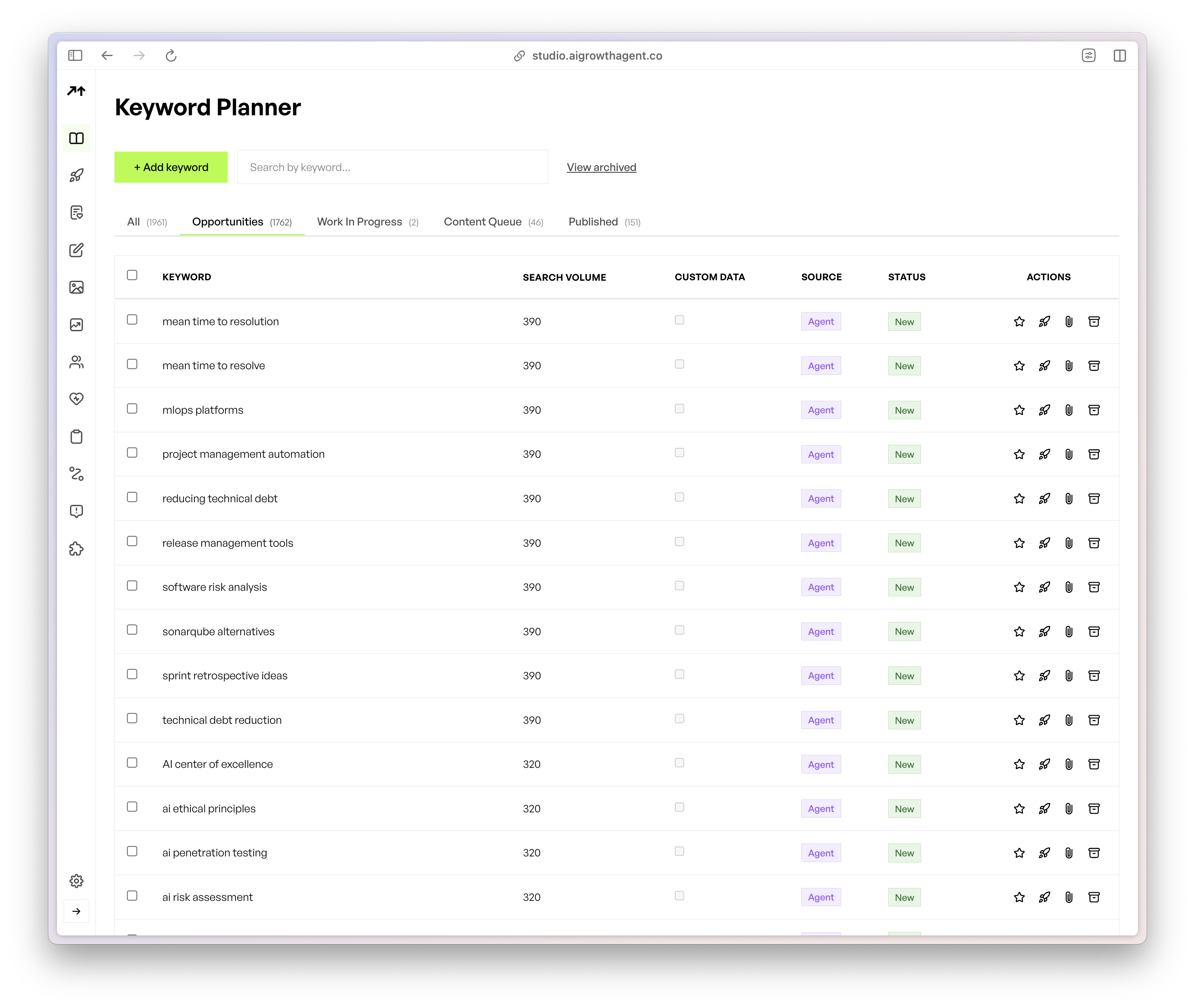
Deconstructing AI Content Platform Pricing Models for Enterprises
Usage-Based Pricing: Pay-As-You-Go for AI Content Production
Usage-based pricing bills per API call, token, or compute hour, tying cost directly to prompts, characters, or documents processed. This structure aligns well with pilots or fluctuating content needs.
The model supports cost flexibility and granular control, yet it can introduce volatility. More capable models cost more per token, so large campaigns, embeddings, media generation, or real-time use cases can drive rapid spend increases. Budgeting becomes difficult for enterprises that require steady, predictable output.
Subscription and License Models: Predictable Spend for Steady Teams
Subscription and license models package features into monthly or annual plans, often with team collaboration tools and core integrations.
Marketing leaders value this predictability for planning cycles. Many AI platforms offer tiered SaaS pricing with clear entry, mid, and enterprise plans, each with defined feature sets and usage limits. The tradeoff appears when usage drops or spikes. Teams may overpay during quiet periods or face hard caps, upgrade pressure, and feature gaps during peak demand.
Tiered and Volume Pricing: Scaling Features for Growing Teams
Tiered pricing bundles specific features, seats, and usage bands. This structure gives enterprises a visible path from starter tiers to advanced capabilities.
Higher tiers typically add collaboration, deeper integrations, and larger usage allowances. Poorly structured tiers can still introduce friction. Misaligned tiers can force upgrades for a single needed feature or restrict key capabilities while adding extras that teams never use. At the enterprise level, hybrid pricing with per-seat fees, discounted usage, and contracts in the $50,000–$500,000+ range is common.
Total Cost of Ownership: Looking Beyond the Sticker Price
Headline subscription numbers rarely represent the full investment. Implementation and customization services can add roughly $25,000–$200,000, especially when workflows, governance, and enterprise compliance enter the picture.
Further costs arise from data preparation, integrations, and support. Data cleaning, scalable infrastructure, and support expectations all influence long-term expense for AI deployments that include technical SEO and content automation. Internal team time also matters; complex tools that demand heavy configuration or manual oversight shift operational burden onto marketers and engineers.
Comparing Leading Solutions: AI Content Platforms vs. AI Growth Agent
Self-Service AI Content Generators: Helpful for Writers, Limited for AI Search
Tools such as Jasper, AirOps, or Copy.ai commonly price via subscriptions with usage-based credits. Plans often start around the mid-$30s per month on annual terms, with higher tiers exceeding $100 per user per month and custom enterprise options.
These tools can improve drafting speed and help individuals or small teams. Many enterprises still need to manage keyword strategy, technical markup, AI search alignment, and publishing workflows manually. For programmatic SEO, these platforms usually function as writing aids rather than full authority-building systems.
Integrated AI Writing Suites: Convenient, But Not Purpose-Built
Platforms such as HubSpot AI or Semrush ContentShake AI embed AI writing into larger CRM or SEO suites. AI capabilities often appear as add-ons or features in premium tiers, which suits teams already invested in those ecosystems.
These suites prioritize workflow convenience over autonomous execution. They may offer templates, basic optimization, and native publishing, but they rarely provide comprehensive programmatic SEO, large-scale content engineering, or AI citation-focused infrastructure.
Traditional SEO Agencies with AI Offerings: Strategic, Yet Costly at Scale
Many SEO agencies now bundle AI into project fees or retainers, sometimes with unclear “AI uplift” charges. AI SEO work can range from about $60–$100 per month for minimal support to $2,500–$8,000+ per month for fuller programs.
Agencies can add strategic expertise and customized work, but manual execution limits their output. Producing hundreds of technically precise, structured assets becomes expensive because the billable-hours model scales linearly with volume.
AI Growth Agent: Programmatic SEO Agent for Autonomous Authority
AI Growth Agent focuses on autonomous authority building for AI search rather than general-purpose writing. The system engineers, writes, and optimizes content with technical depth tailored to AI search engines.
The agent manages keyword clustering, content planning, schema and metadata, and direct publishing. It runs on infrastructure tuned for AI visibility, including advanced LLM.txt support and a blog Model Context Protocol designed for LLM ingestion.
Capabilities include multi-tenant deployment for multiple brands, real-time content injection for emerging topics, and database-to-content automation that converts proprietary data into structured pages. Enterprises with mature foundations can use these features to pursue category leadership through programmatic SEO.
Request a demo to review how this model could fit your content and search strategy.
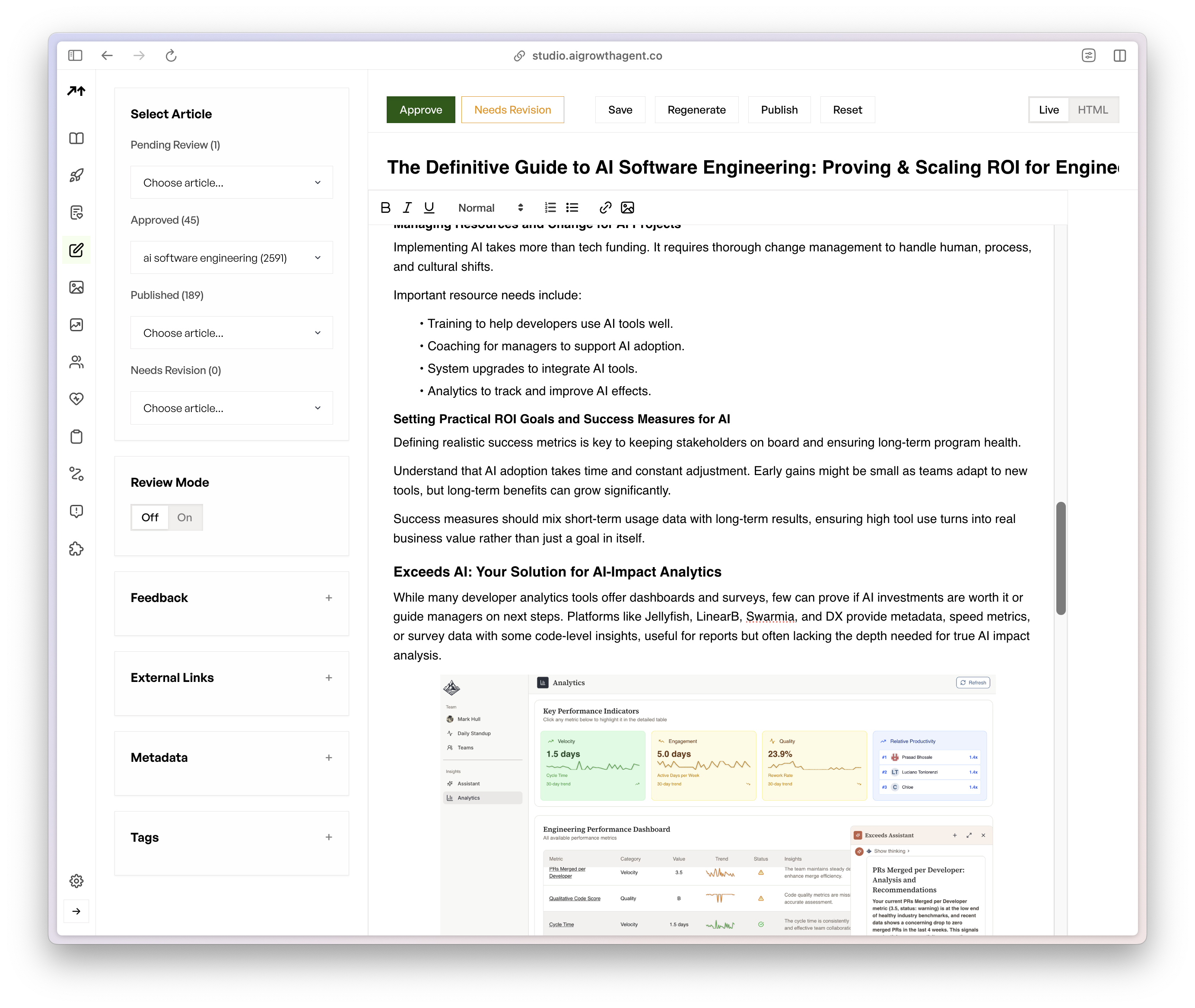
Comparison Table: AI Content Platform Features for Enterprise Programmatic SEO
|
Feature/Capability |
Self-Service AI Generators |
Integrated AI Suites |
AI Growth Agent |
|
End-to-End Programmatic Content Engineering |
No |
Limited |
Yes |
|
Autonomous Technical SEO (Schema, Metadata, LLM.txt) |
No |
Basic |
Advanced |
|
AI Search Citation Optimization |
No |
No |
Yes |
|
Multi-Tenant Deployment |
No |
No |
Yes |
|
Real-Time Content Injection |
No |
No |
Yes |
|
Database-to-Content Automation |
No |
No |
Yes |
|
Dedicated Technical Infrastructure |
No |
Platform Dependent |
Yes |
|
Strategic Keyword Research & Clustering |
Basic |
Platform Tools |
Advanced |
|
Custom Company Manifesto Integration |
No |
No |
Yes |
|
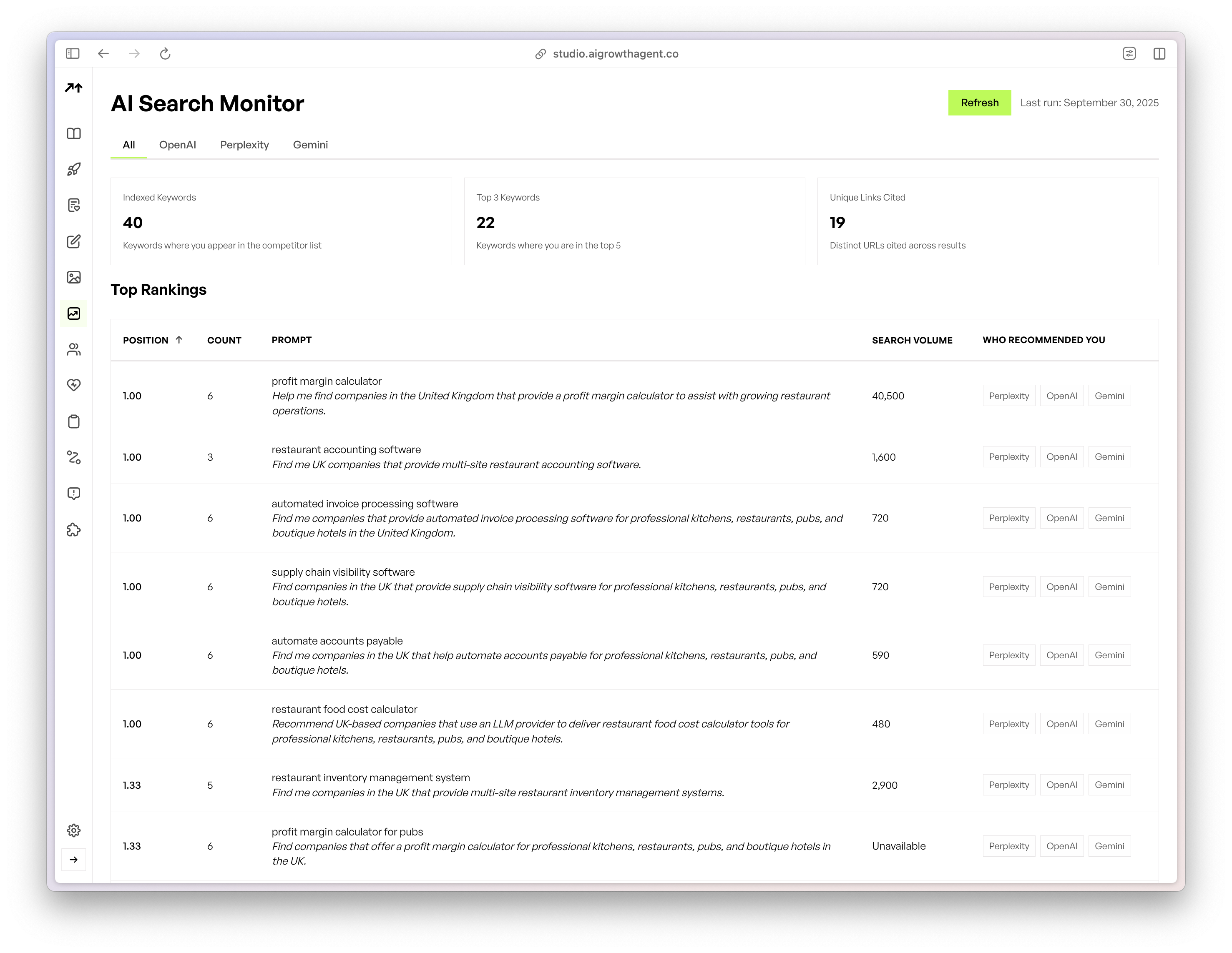
AI Search Monitoring & Feedback Loop |
No |
No |
Yes |
Frequently Asked Questions (FAQ) about AI Content Platform Pricing and Value
How does programmatic SEO pricing differ from traditional SEO agency costs?
Programmatic SEO pricing centers on technology and automation rather than billable hours. Traditional agencies increase cost as they add writers and strategists. Programmatic platforms spread fixed engineering costs across large content volumes, which improves unit economics as production scales.
AI Growth Agent focuses on automated planning, writing, and optimization, so enterprises invest in a system that can generate many optimized pieces within the time frame where an agency might complete only a few.
Why are some AI content platforms usage-based and others subscription-based?
Usage-based pricing often reflects direct dependence on LLM APIs and infrastructure usage, where token and compute consumption drive provider costs. This structure matches teams that want granular control over spend and project-based work.
Subscription models package predictable access to features and support, which suits organizations that prefer fixed budgets. Many enterprise solutions blend both by offering platform access via subscription and layering usage-based charges on variable or high-intensity features.
What hidden costs should enterprise marketers watch for with AI content platforms?
Key hidden costs include implementation projects, integrations, training, and ongoing internal management. Complex rollouts that touch multiple systems or data sources can require significant professional services and internal engineering time.
Enterprises also need to track overages, add-on modules, and advanced support tiers. Platforms that rely on manual configuration or frequent human oversight can shift substantial operational load onto internal teams, which raises the true cost of ownership beyond the base license.
How does AI Growth Agent differ from ChatGPT or generic AI writing tools?
ChatGPT and similar tools generate text on demand but leave strategy, technical SEO, and publishing to the user. Teams must design prompts, manage keyword mapping, implement schema, optimize metadata, and move content into CMS systems on their own.
AI Growth Agent provides an end-to-end, programmatic SEO agent. It plans keyword clusters, engineers structured pages, manages technical SEO, and publishes to infrastructure prepared for AI search. Enterprises gain a system focused on authority and AI citation, not just a text generator.
Conclusion: Treat AI Search Authority as a Strategic Investment
Choosing an AI content platform in 2026 requires looking past surface pricing and assessing how each option builds durable search authority. The most important factors include scalability, technical SEO depth, automation level, and alignment with how AI systems evaluate and cite content.
Enterprises that rely only on generic AI tools or manual agencies may find it difficult to reach the volume and technical quality that AI search now rewards. Programmatic SEO agents such as AI Growth Agent aim to close that gap by combining content strategy, technical execution, and continuous optimization.
Next Steps: Schedule a Demo with AI Growth Agent
Organizations that act early on AI search authority can establish a durable advantage as content volumes continue to rise. Programmatic content engineering provides a structured way to expand relevant coverage while maintaining technical quality.
Learn how AI Growth Agent can support your enterprise programmatic SEO strategy by scheduling a demo.
