


Executive summary
- AI search engines are becoming primary discovery tools, so content now needs to earn citations and recommendations from systems like ChatGPT, Google AI Overviews via Gemini, and Perplexity, not just rankings on traditional SERPs.
- Effective AI content tools must help your brand build recognizable authority in AI search by creating comprehensive, citable content and a consistent knowledge footprint in your category.
- Technical SEO for AI, including structured data, schema, and emerging formats like LLM.txt and Model Context Protocol, is a major driver of ROI and often missing from basic AI tools.
- Daily or near-daily publishing with consistent quality is increasingly important for AI visibility, which makes scalability and end-to-end automation key evaluation criteria.
- Clear AI search metrics such as citations, recommendations, and AI visibility need to sit alongside traditional traffic metrics to prove ROI and guide strategy.
- AI Growth Agent is built as an autonomous Programmatic SEO (pSEO) agent that addresses these five factors through autonomous planning, content production, technical deployment, and AI search performance monitoring.
Voice and AI search already account for more than 20% of mobile queries, and this share continues to grow. Brands that do not adapt content strategy for AI search visibility risk losing exposure to potential customers, while those that align with these five evaluation factors can strengthen their position in AI-driven discovery.
AI Growth Agent operates as an autonomous pSEO agent that engineers, publishes, and optimizes AI-ready content architectures at scale; schedule a consultation session to see if you’re a good fit and evaluate its impact on your AI content tool ROI.
The New Reality of AI Search: Your Digital Footprint is Shrinking
The relationship between businesses and customers on the internet has changed. Traditional search rewarded keywords and backlinks. AI search now evaluates expertise, context, and citation value inside Large Language Models (LLMs) like ChatGPT, Google AI Overviews via Gemini, and Perplexity.
The Urgent Need for Authority and Citation
AI search engines do more than index pages. They assess content for trustworthiness, depth, and suitability as a cited source. Google AI Overviews emphasize expertise, authoritativeness, and trustworthiness, which moves content strategy beyond simple keyword optimization. When selecting AI content tools, marketing leaders need to judge whether those platforms can produce content that AI systems will confidently cite and recommend.
This change shifts the goal. Traditional SEO focused on ranking for human readers who would click through to your website. AI search focuses on delivering a complete answer inside the AI interface, referencing your content as the source. Content therefore needs to stand on its own as a complete, accurate answer, not just a teaser that invites a click.
Why Current Solutions Often Miss AI Search Requirements
Many existing content solutions were built for a pre-AI environment and struggle to keep pace with current expectations.
Traditional SEO agencies rely on human capital and billable hours, which tend to be slow and costly. They may deliver a few strong articles each month, yet they usually cannot support the volume and cadence required to build category authority for AI search. Daily or near-daily publishing is difficult to sustain with human-only models.
Internal marketing teams understand the brand but face headcount limits and competing priorities. Many teams also lack the technical skills needed for advanced schema markup, LLM.txt files, Model Context Protocol, and other elements that support AI indexing.
Basic AI content tools such as generic writing assistants often expect your team to handle strategy, editing, technical formatting, and publishing. These tools can follow structured prompts and help increase output, but they may not consistently provide a distinctive brand perspective without detailed guidance. The level of human oversight needed can vary significantly and can reduce overall ROI.
Marketing teams that want to improve content ROI in this environment benefit from platforms that combine strategy, production, and technical deployment. Schedule a demo to see if you’re a good fit with AI Growth Agent and compare autonomous content operations with incremental writing tools.
1. Beyond Volume: The Imperative of Authority and Citation Potential for AI Search ROI
The first non-negotiable factor for AI content tool ROI is the ability to generate authoritative content that AI systems recognize and cite. Content volume alone is no longer a reliable indicator of effectiveness. Authority, accuracy, and depth now play a central role in AI search visibility.
Evaluating Tools for Authority Generation
AI content tools should help position your brand as a leading expert in its category. Google’s generative AI search capabilities give preference to comprehensive, well-researched content from credible sources, not brief, keyword-heavy posts.
When reviewing tools, look for platforms that can:
- Research and synthesize complex topics. The tool should gather information from multiple high-quality sources and present it as clear, accurate, and distinct content that reflects your brand’s perspective.
- Generate original insights. The platform should avoid simple rephrasing of existing content and instead add context, structure, and analysis that move industry conversations forward.
- Create interconnected content ecosystems. Strong authority grows when your site covers related subtopics in depth and links them into a coherent knowledge base.
- Maintain brand voice and positioning. Each article should reinforce your positioning, messaging, and differentiation.
AI Growth Agent supports this through its Company Manifesto system, a structured knowledge transfer process that captures your brand narrative, positioning, and proof points. The system helps ensure that every article contributes to a consistent authority signal in your market.
The Importance of LLM-Citable Content
AI search engines rely on content that is structured so they can extract and reference it reliably. Content that is clear, factual, and well structured is more likely to be cited within AI answers.
Evaluation of AI content tools should include their ability to help your team:
- Structure information hierarchically. Content should use clear headings, subheadings, bullet lists, and logical flows that make it easy for models to parse and segment.
- Include specific, citable facts and statistics. AI systems favor content that provides verifiable data points and clearly stated claims.
- Provide comprehensive topic coverage. Articles should answer key questions around a topic in one place, reducing the need for AI tools to assemble answers from many different sources.
- Implement technical elements for AI consumption. Structured data, schema markup, and emerging formats like LLM.txt help AI systems understand content scope, relationships, and relevance.
Content that earns citations from AI search engines can generate ongoing visibility, since those citations may appear in many related queries over time. This compounding effect can become a significant source of ROI as AI search usage increases.
2. Technical SEO for AI: The Unseen ROI Driver in Content Tools
The second non-negotiable factor is a platform’s ability to handle advanced technical SEO for AI search. This work goes beyond classic on-page SEO and has a direct impact on how AI systems interpret and surface your content.
Advanced Technical SEO Requirements for AI Search
AI-driven discovery relies on machine-readable context. Modern indexing now depends heavily on metadata, structured data, and clear signals about how content should be used.
Key technical elements for AI search ROI include:
- Advanced schema markup. Rich structured data clarifies entities, relationships, and context for AI systems.
- LLM.txt implementation. A specialized file that gives AI crawlers guidance about your content, priority pages, and usage preferences.
- Model Context Protocol (MCP). A framework that lets AI systems connect to your content sources for more direct and timely access.
- AI-optimized internal linking. Thoughtful internal links reinforce topic clusters and help AI models understand how knowledge is organized on your site.
- Optimized image metadata. Clear alt text, captions, and image-related structured data allow AI systems to interpret and sometimes cite visual content.
Why Most AI Content Tools Fall Short
Many AI content tools concentrate on generating text and stop there. As a result, they leave technical implementation to internal teams or agencies, which can limit the upside of the content they help produce.
Common technical gaps include:
- Generic output formatting. Drafts often require manual restructuring, tagging, and technical clean-up before publication.
- No schema markup automation. Missing or incomplete structured data reduces clarity for AI systems and can limit citation potential.
- Basic CMS integration. Simple publishing connectors rarely include deeper technical SEO controls or AI-specific configuration.
- No AI-specific optimization. Many tools were built around traditional SEO and have not yet adapted to AI search needs.
These gaps can reduce the effectiveness of content in AI contexts. Pages may generate some organic traffic but still fail to achieve consistent AI citations or recommendations.
AI Growth Agent’s Engineered Content Advantage
AI Growth Agent takes an engineered approach, treating each article as both a human-readable asset and a machine-readable object for AI systems. The platform automates advanced technical SEO steps, including:
- Automated rich schema markup for every article, which helps AI systems interpret entities, topics, and relationships.
- LLM.txt and Model Context Protocol implementation, which enables AI systems to access and understand your blog content more directly.
- AI-optimized internal linking strategies that support topic clusters and authority within your content library.
- Advanced metadata optimization that captures details traditional SEO tools may overlook.
This technical work runs in the background for each piece of content, so your team does not need deep SEO engineering expertise to benefit from AI-ready publishing. Schedule a demo to see if you’re a good fit and review how automated technical deployment can support your AI search goals.
3. Scalability Without Compromise: Achieving Daily Publishing for AI Relevance
The third non-negotiable factor is scalability. AI search tends to favor brands that publish consistently, cover topics in depth, and keep information current. Meeting those requirements at scale is difficult without automation.
The Need for Consistent, High-Frequency Publishing in the AI Era
AI models often weigh recency, consistency, and breadth of coverage when selecting sources. Content freshness has become an important ranking factor, particularly for fast-moving topics.
Modern baselines for AI relevance often include:
- Daily or near-daily publishing. Regular publication signals active expertise and up-to-date knowledge.
- Comprehensive topic coverage. Brands need content that addresses the main questions across their domain, not just isolated topics.
- Timely response to market changes. Teams should be able to quickly publish around emerging trends, new regulations, and industry developments.
- Strategic content interconnection. Each new piece should reinforce existing content and strengthen overall authority on key themes.
Brands that maintain a steady cadence of high-quality content are more likely to see positive AI search outcomes than those that publish sporadically or in short bursts.
Assessing Scalability: Quality and Strategic Alignment
Scalability is not only about producing more content. It also requires maintaining quality, relevance, and brand alignment as volume grows.
Important evaluation criteria include:
- Quality consistency. Content should meet defined editorial standards even when production ramps up.
- Strategic coherence. Articles need to map back to business objectives, ICPs, and campaigns rather than existing as isolated assets.
- Brand voice consistency. Output should read as if it comes from the same organization, even when many articles are produced in parallel.
- Operational efficiency. Teams should be able to oversee strategy and quality without spending extensive time on manual drafting and formatting.
- Technical performance. The platform should support publishing and optimization at high volume without slowdowns or errors.
Autonomous Platforms vs. Human-Led Content Generation
Human-led approaches often reach a ceiling when trying to meet AI-era publishing demands.
Agency teams, even strong ones, are bound by human bandwidth. Daily publication of in-depth content from an agency usually becomes cost-prohibitive.
Internal marketing teams face similar limits, since content production competes with campaign management, product launches, and sales enablement. Sustaining daily, high-quality publishing can force trade-offs with other priorities.
Many teams must choose between quantity and quality. AI search visibility, however, typically requires both depth and consistency.
AI Growth Agent is designed as an autonomous Programmatic SEO (pSEO) agent that reduces these bottlenecks. Its agents learn your brand, strategy, and technical standards so they can support high-frequency, high-quality production without adding headcount pressure.
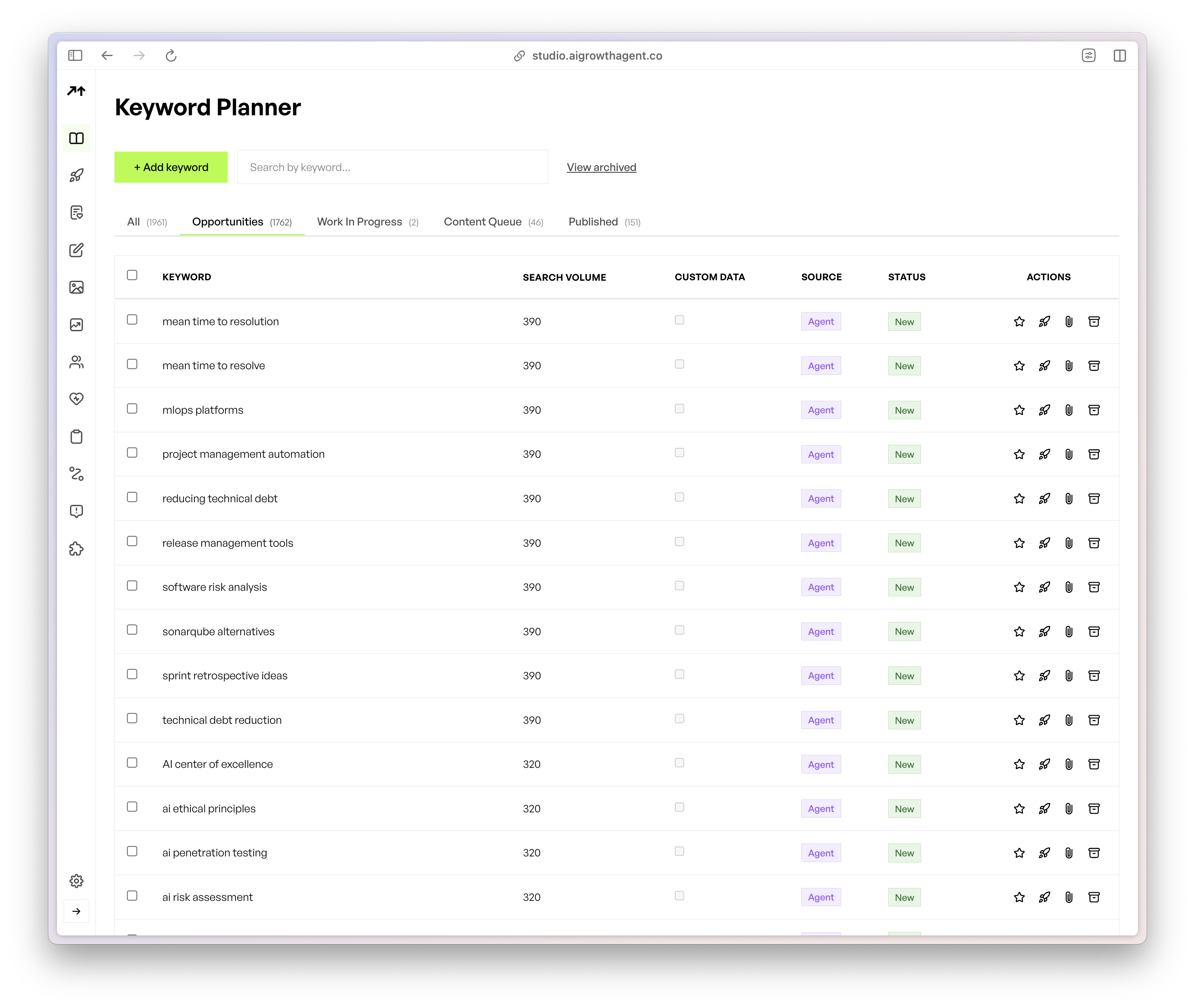
The platform’s Content Planning Research Agent evaluates thousands of potential search queries and clusters them into structured, prioritized topic plans. This planning work helps ensure that daily publishing builds a deliberate authority footprint rather than a collection of unconnected posts.
4. End-to-End Automation vs. Incremental Assistance: The True Value Proposition of AI Content Tools
The fourth non-negotiable factor is how much of the content lifecycle an AI tool can manage. There is a meaningful difference between tools that assist with drafting and platforms that support strategy, production, optimization, and monitoring.
Distinguishing Between Piecemeal Solutions and Autonomous Platforms
Many AI tools function as advanced writing assistants. They can generate drafts but rely on humans for topic selection, outline creation, editing, formatting, SEO, and publishing.
Piecemeal solutions typically offer:
- Content generation only. They produce drafts that still require strategy, editing, and optimization from your team.
- Manual keyword research. Content teams must decide which keywords to target and how to prioritize them.
- Basic publishing assistance. Integrations may push content into a CMS but often stop short of technical configuration.
- Limited brand consistency controls. Outputs can feel generic unless heavily guided and revised.
- No performance monitoring. Teams must use separate tools to understand how content performs, especially in AI search.
Autonomous pSEO platforms aim to handle more of this workload by:
- Automating strategic planning. Agents analyze search landscapes, competitors, and customer questions to build content roadmaps.
- Managing end-to-end production. Systems cover research, drafting, editing, and technical formatting within one workflow.
- Capturing brand-specific rules. Platforms embed your voice, messaging, and positioning into repeatable content patterns.
- Supporting continuous optimization. Performance data loops back into planning to refine future content.
- Maintaining technical standards. Advanced SEO and AI-optimization practices are built into the publishing pipeline.
Calculating the ROI of Team Bandwidth and Manual Overhead Reduction
Bandwidth savings and reduced manual effort can represent a large portion of AI content tool ROI. Generative AI has the potential to significantly increase productivity in marketing functions when integrated into workflows that reduce repetitive tasks.
To estimate impact, consider:
- Content team salary costs. Compare the headcount required to sustain a daily publishing cadence manually with the license cost of an autonomous platform.
- Opportunity cost of internal resources. Measure what your team could focus on, such as experimentation or partner programs, if not writing and formatting every article.
- Agency fee reduction. Factor in any savings from consolidating or replacing external content production.
- Time-to-market gains. Consider the value of publishing timely content within days instead of waiting weeks for human-led delivery.
- Quality consistency. Evaluate how stable quality levels affect conversion rates, sales cycle influence, and brand perception.
For many established brands, reducing manual content overhead while improving AI visibility becomes a strong part of the investment case for autonomous pSEO platforms.
AI Growth Agent’s Comprehensive Autonomous Deployment
AI Growth Agent is designed as an autonomous pSEO agent to support an end-to-end content lifecycle through coordinated agents.
- Strategic planning through the Content Planning Research Agent. It reviews large sets of search data to build structured keyword and topic plans.
- Complete content production via the Core Content Agent. It handles research, drafting, fact-checking steps, and technical structuring in one flow.
- Advanced technical deployment. The platform applies AI search optimization, schema, and other SEO elements at publish time.
- Continuous performance monitoring. The AI Search Monitor tracks how content appears across key AI platforms and search experiences.
- Parallel agent deployment. Multiple content streams can run simultaneously, which is useful for multi-product or multi-region organizations.
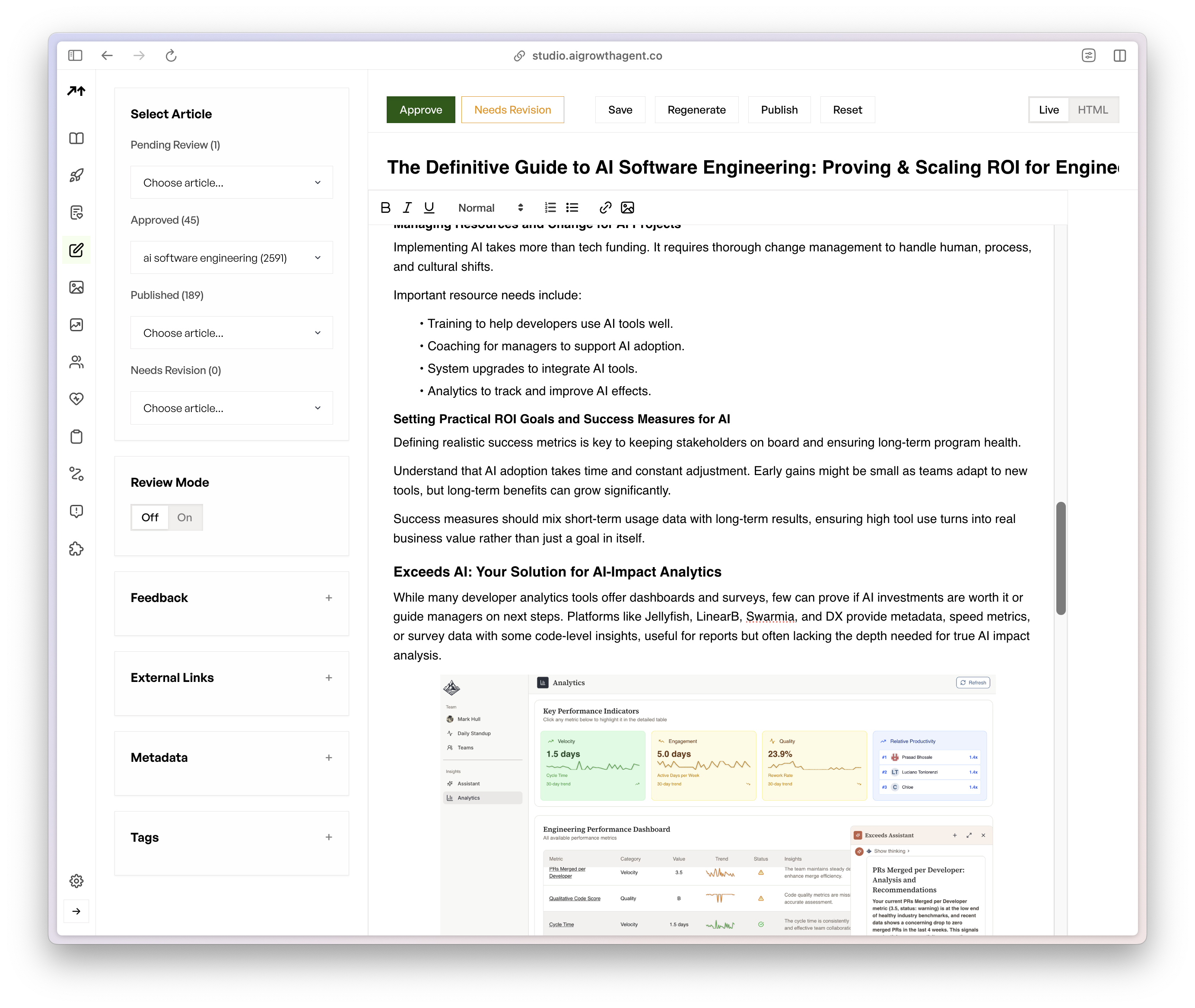
The rich text editor environment allows your team to review, adjust, and approve content before publishing while still benefiting from automated structure and SEO preparation.
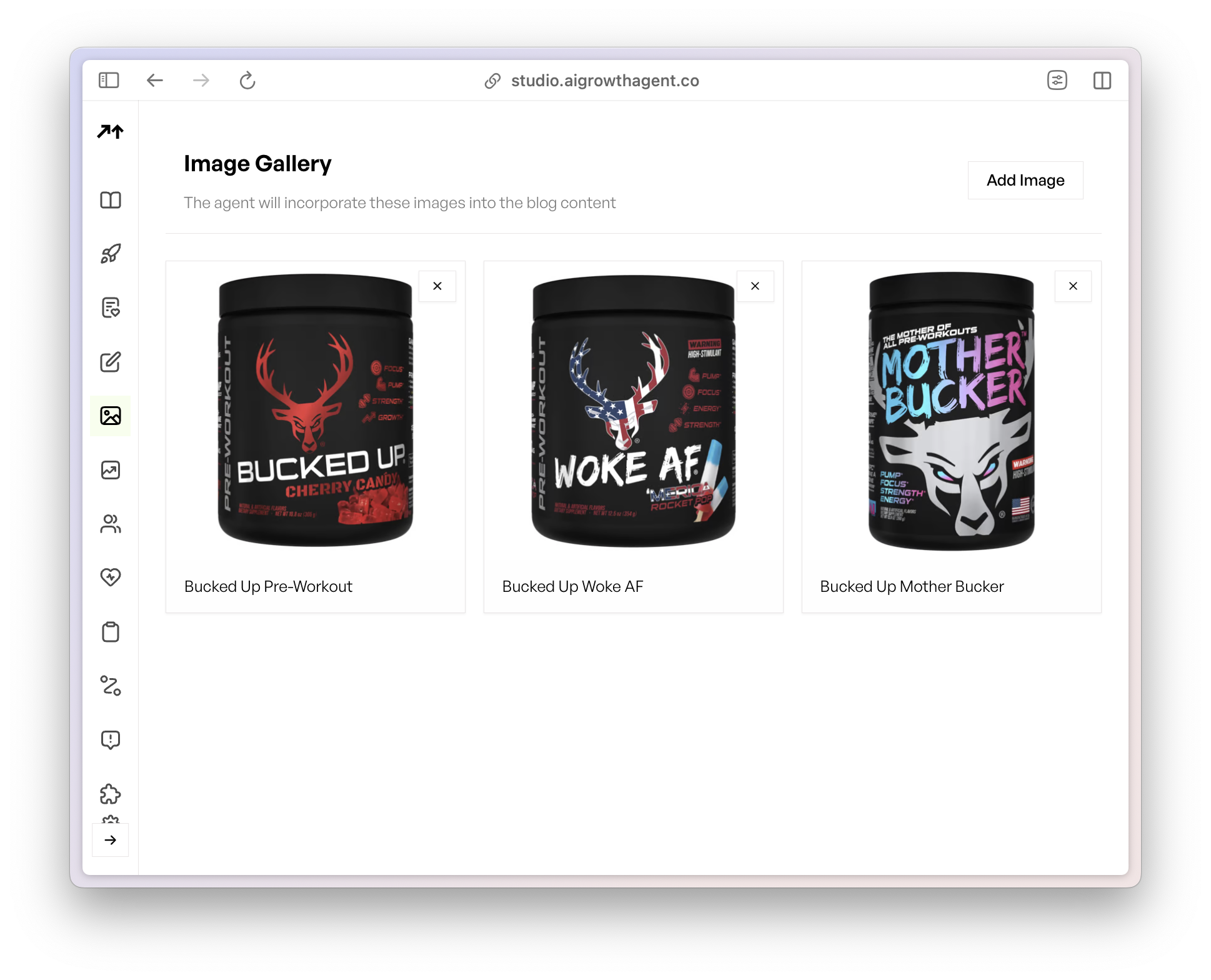
Teams can also provide brand images, charts, and product visuals for the agent to incorporate naturally into content, which supports richer on-page experiences and more complete answers for readers and AI systems.
This level of automation is designed to reduce manual effort while still giving marketing teams control over strategy and approvals. Schedule a demo to see if you’re a good fit and review how this approach compares with your current workflows.
5. Actionable Performance Metrics: Proving AI Search ROI of Content Tools
The fifth non-negotiable factor is measurement. AI search introduces new visibility patterns that traditional analytics do not always capture, so platforms need to provide metrics that show impact beyond standard traffic reports.
Moving Beyond Traditional Organic Traffic Metrics
Organic traffic remains important, but AI search adds layers such as citations, recommendations, and model-level recognition. Evaluating AI Overviews and similar features now involves tracking visibility within AI-generated answers, not only classic ranking positions.
Useful AI search metrics include:
- AI citation frequency. How often AI systems reference your content when answering relevant questions.
- Recommendation positioning. How frequently your brand appears as a recommended provider or resource for target queries.
- AI visibility coverage. The range of topics and keywords where AI systems recognize your brand as a relevant source.
- Competitive AI positioning. How your visibility compares to competitors within AI-powered results.
- Content indexing velocity. How quickly new content is picked up and used by AI systems.
These metrics reveal how well your content strategy supports AI search authority, not just traditional SEO performance.
Evaluating Reporting Capabilities for AI Search Impact
Reporting is a core part of any AI content tool assessment. Platforms should surface how content performs in AI contexts so marketing leaders can adjust strategy based on real outcomes.
Key capabilities to look for include:
- Multi-platform AI search monitoring. Coverage across major AI engines and experiences, not just a single provider.
- Citation tracking and analysis. Insight into which pieces are being cited and in what contexts.
- Competitive intelligence. Comparative views that show where competitors are gaining or losing AI visibility.
- Content performance correlation. The ability to map individual articles to specific AI visibility gains.
- ROI attribution. Clear connections between AI search performance, traffic, and business outcomes where possible.
Without these capabilities, it can be hard to justify investment in advanced AI content tools or to refine the strategy over time.
AI Growth Agent’s AI Search Monitor and Performance Agent
AI Growth Agent includes an AI Search Monitor and Performance Agent designed to track these emerging metrics.
- Real-time AI search heatmaps. Dashboards show how content performs across relevant AI platforms for target keywords.
- Citation tracking and quotes. The system surfaces where AI tools quote or reference your content within generated answers.
- Competitive positioning analysis. Reports highlight how your brand appears relative to key competitors for high-value topics.
- Crawler activity monitoring. Logs show which AI crawlers and bots access your content and which pages attract the most attention.
- Integrated traditional metrics. Connections to tools such as Google Search Console help correlate AI visibility with organic traffic and conversions.
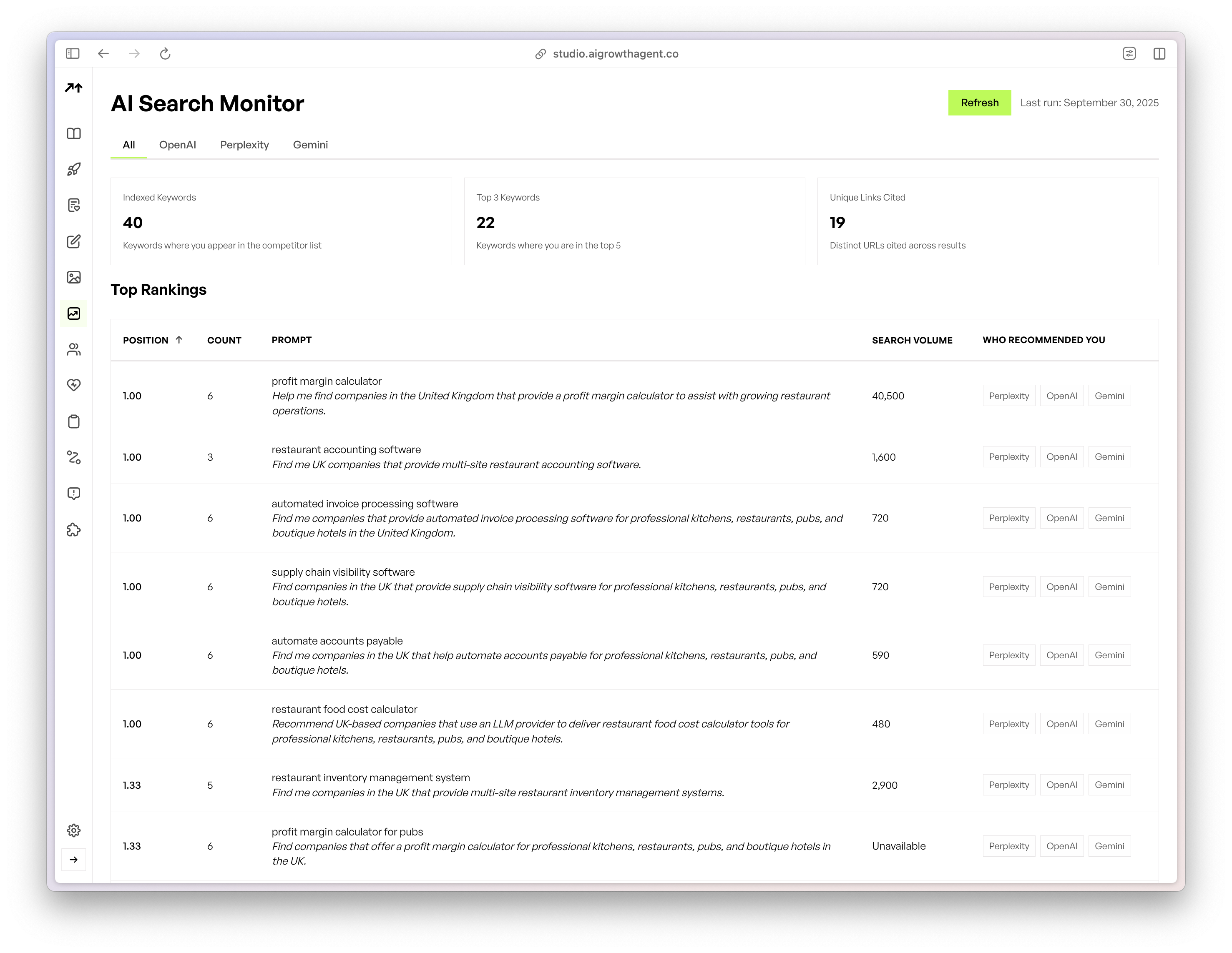
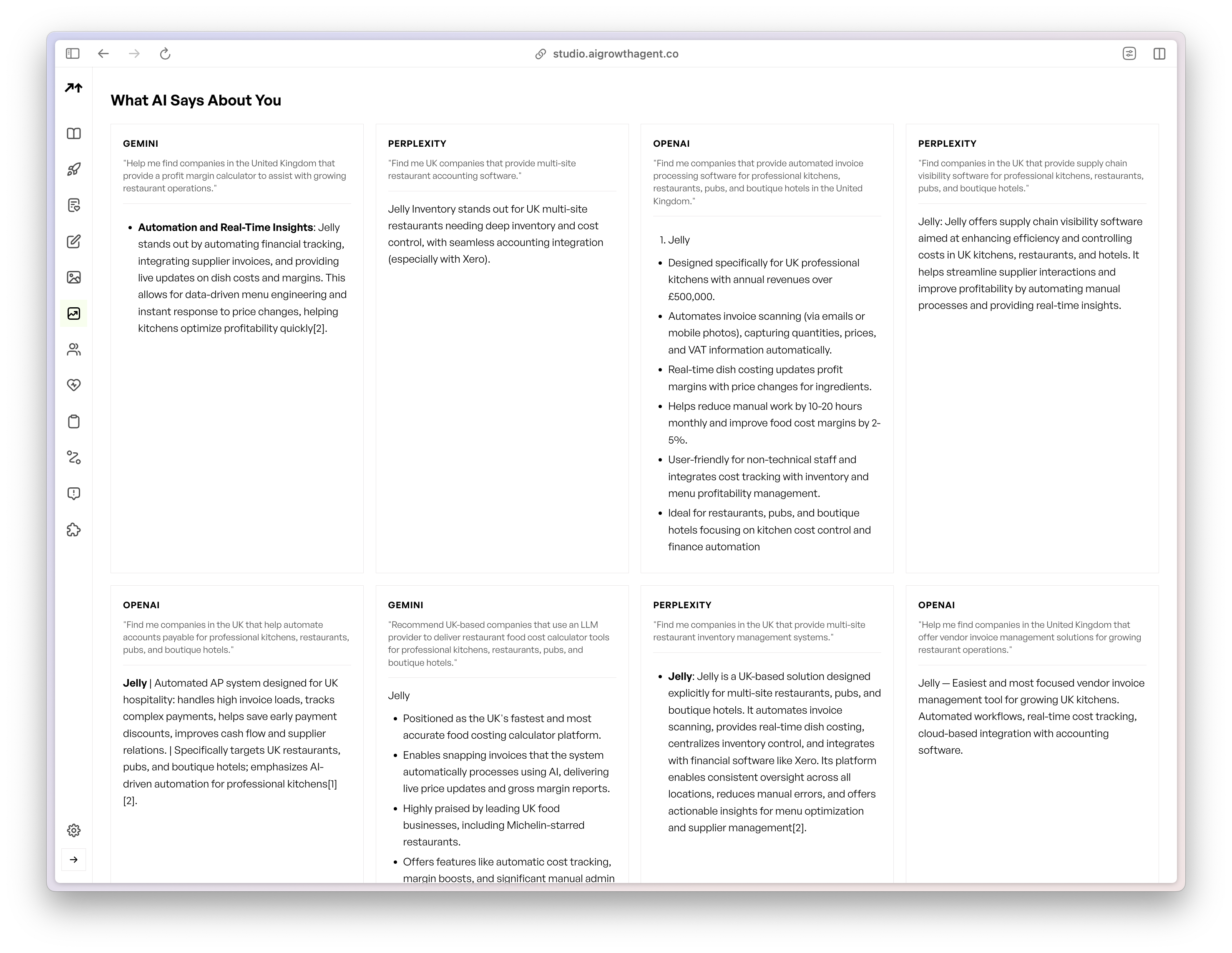
These capabilities give teams clearer evidence of AI search ROI and help them refine content plans based on how AI systems actually use their material.
|
ROI factor |
Traditional methods |
Basic AI tools |
AI Growth Agent |
|
Content volume |
1–2 articles per month |
Higher volume with variable quality |
Daily or near-daily high-quality publishing |
|
AI citation potential |
Limited focus on authority and structure |
Generic, less citable content |
Content engineered for AI citation potential |
|
Technical AI SEO |
Basic on-page optimization |
Minimal or no technical implementation |
Advanced schema, LLM.txt, MCP, and structured metadata |
|
Team burden |
High manual overhead |
Drafts still need substantial editing |
Automation reduces manual production and formatting |
|
Time-to-value |
Months to see consistent results |
Gradual gains tied to manual effort |
First article typically live within a week, with early AI visibility possible in subsequent weeks |
|
AI search monitoring |
No AI-specific tracking |
Traditional SEO metrics only |
Dedicated AI visibility and citation monitoring |
Frequently Asked Questions (FAQ) about AI Content Tool ROI
Q1: How does “AI search visibility” differ from traditional SEO rankings?
AI search visibility focuses on whether AI systems such as ChatGPT, Google AI Overviews via Gemini, and Perplexity cite, recommend, or otherwise use your content in their answers. Traditional SEO rankings focus on where a page appears on a search engine results page. AI visibility requires content that is authoritative, well structured, and easy for models to reference, so users encounter your expertise directly inside AI responses instead of only through links on a SERP.
Q2: Can basic generative AI tools provide sufficient ROI for AI search?
Basic generative AI tools can increase content volume, but they often fall short on strategic planning, technical SEO, and AI-specific optimization. Their drafts may require significant human oversight to align with brand voice, meet editorial standards, and satisfy AI search requirements. Without those additional steps, the content they generate may be less likely to be treated as authoritative by AI systems.
Q3: What role does “authority” play in AI content ROI?
Authority is central to AI content ROI. AI search engines aim to provide accurate and reliable answers, so they favor content from sources that appear knowledgeable and consistent. Platforms and workflows that help you produce comprehensive, well-supported content across your category make it easier for AI systems to view your brand as a credible source. Over time, this authority can translate into more citations, recommendations, and business outcomes.
Q4: How quickly can a brand expect to see ROI from an autonomous content platform like AI Growth Agent?
AI Growth Agent’s onboarding process is built so that the first article can usually go live within about a week. Many brands begin to see signs of AI search visibility, such as early citations or recommendations, within a few weeks of consistent publishing, depending on competition and topic complexity. This timeline reflects the platform’s focus on AI-oriented content structure and technical optimization.
Q5: What is the most important factor when evaluating AI content tool ROI?
End-to-end automation combined with AI-specific technical optimization is often the most important factor. Focusing only on draft quality or content volume can overlook the impact of technical deployment, AI-readiness, and reduced manual workload. Tools that require extensive human editing and separate technical work may deliver slower, less reliable ROI than platforms that integrate planning, production, and AI optimization in one system.
Conclusion: Secure Your Brand’s Authority and Maximize AI Content Tool ROI with AI Growth Agent
The five non-negotiable factors for evaluating AI content tool ROI are authority and citation potential, technical SEO for AI, scalable publishing, end-to-end automation, and actionable performance metrics. Together, they define how well a platform can help your brand adapt to AI-driven discovery.
Traditional approaches and basic AI tools often address only parts of this picture, which can leave gaps in AI visibility and measurement. Autonomous platforms that integrate these factors can better support brands that want to maintain or expand their presence as AI search adoption grows.
AI Growth Agent approaches this challenge as an autonomous Programmatic SEO agent with a system of coordinated AI agents that handle planning, content creation, technical deployment, and AI performance monitoring. Brands such as Exceeds AI, BeConfident, Bucked Up, and Gitar have used the platform to strengthen their AI search presence within weeks of implementation, positioning themselves more clearly in their categories.
Marketing leaders now face a choice between maintaining existing processes or adopting more automated, AI-aware content operations. AI systems are already shaping how customers discover solutions. AI Growth Agent is designed to help your company provide clear, reliable answers in that environment. If you are an established brand with a strong foundation and growth goals in AI search, schedule a demo to see if you’re a good fit with AI Growth Agent and review how autonomous content operations can support your ROI targets.
