


AI-driven search experiences in Google, Gemini, Perplexity, and ChatGPT are changing how brands earn visibility, authority, and citations. Developer-free AI content platforms allow marketing teams to launch technically optimized, programmatic content systems without engineering support. What you’ll see in this article:
- Tools support scale, brand consistency, AI-friendly metadata, and fast iteration, which are now core requirements for AI search visibility.
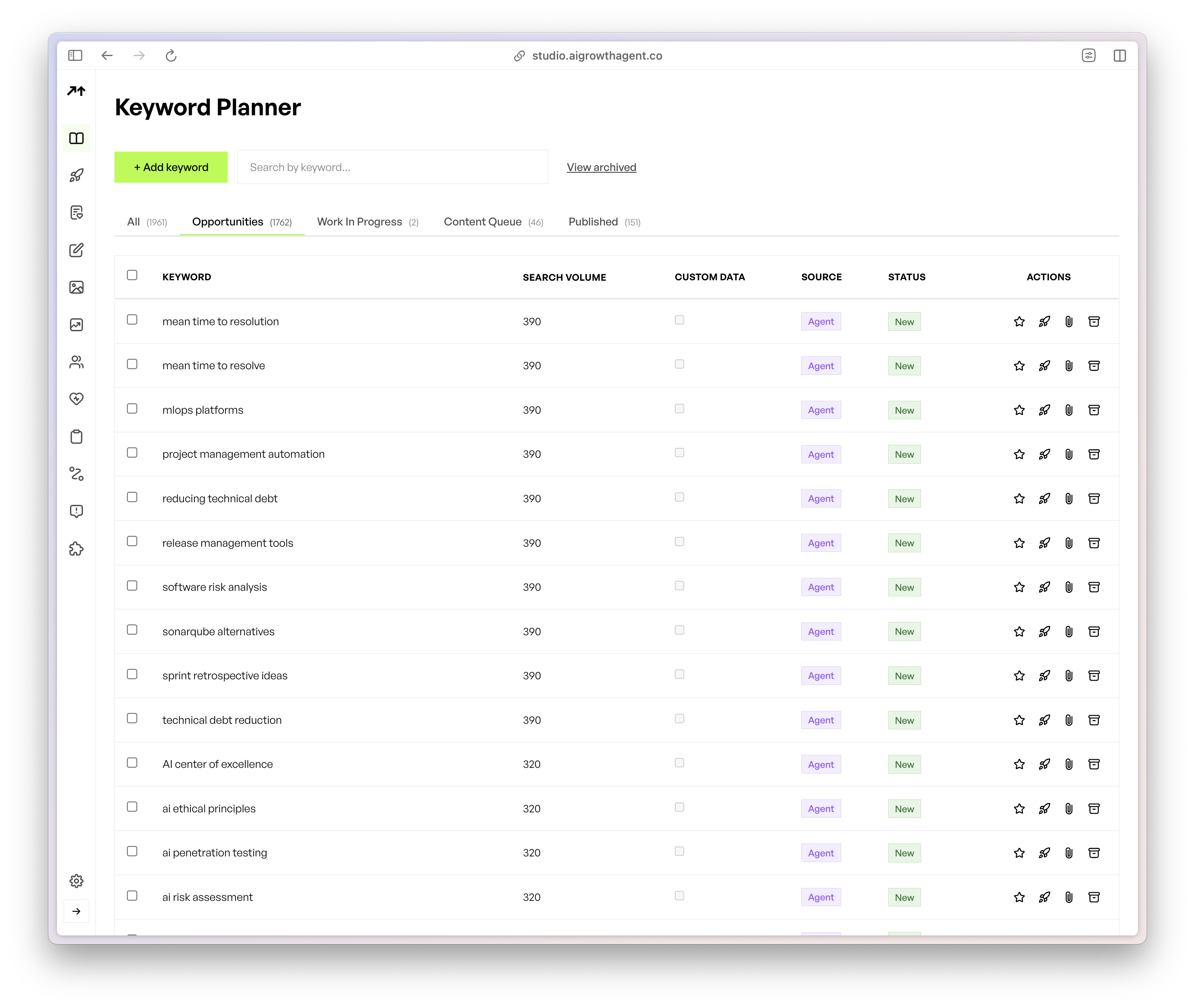
- AI Growth Agent is an example of a developer-free platform that combines keyword planning, content generation, technical SEO, and AI search monitoring in one system.
- Marketing leaders who act early on developer-free AI content infrastructure are better positioned to become trusted sources for AI-generated answers in their markets.
Marketing leaders who want to position their companies as reliable authorities in AI search can schedule a demo with AI Growth Agent.
Mastering the AI Search Landscape: Why Developer-Free AI Content Tools are Essential for Marketing
1. Unlocking Technical SEO Without Engineers
Technical SEO has long been a barrier for marketing teams that lack dedicated engineering support. Developer-free AI content tools now automate many of these complex tasks, so marketers can launch advanced SEO initiatives without writing code.
These platforms can inject rich schema markup, optimize metadata, and implement emerging protocols like LLM.txt and Model Context Protocol. Marketing teams control strategy and inputs while the system manages the technical details in the background.
This shift allows more brands to compete in AI search. Teams that adopt these tools can deploy technical SEO structures that previously required custom development, which levels the playing field with larger organizations.
The benefits are both strategic and operational. Marketing teams reduce time to publish, lower implementation costs, and keep control of their content architecture instead of relying on external technical resources. This independence supports faster iteration and real-time optimization as AI search behavior evolves.
For practical implementation, marketing leaders should prioritize developer-free platforms that manage the full technical lifecycle. Platforms like AI Growth Agent’s Programmatic SEO system handle technical SEO elements while offering clear, intuitive interfaces for configuration, so teams can operate at scale in the AI search environment.
2. Scaling Content Production with Autonomous AI Agents
Content velocity now plays a central role in staying visible within AI-driven search results. Developer-free AI content tools give marketing teams the ability to reach production levels that are difficult to match with manual workflows.
These platforms can research topics, build content roadmaps, draft articles, fact-check information, and publish optimized content while following brand guidelines and SEO standards. Teams define strategy and quality thresholds, then the system executes at scale.
This move from manual production to autonomous content generation is a strategic adjustment to how AI search works. AI systems favor content that is recent, comprehensive, and structured consistently. Organizations that cannot maintain this pace and depth risk losing visibility as AI models select other sources.
Advanced developer-free platforms, such as AI Growth Agent, use Programmatic SEO Content Agent models. Marketing leaders configure these agents using a “Company Manifesto,” a structured source of truth that captures brand voice, audience, and positioning. The system then produces articles mapped to specific keyword clusters and topics to help the brand become an authoritative reference.
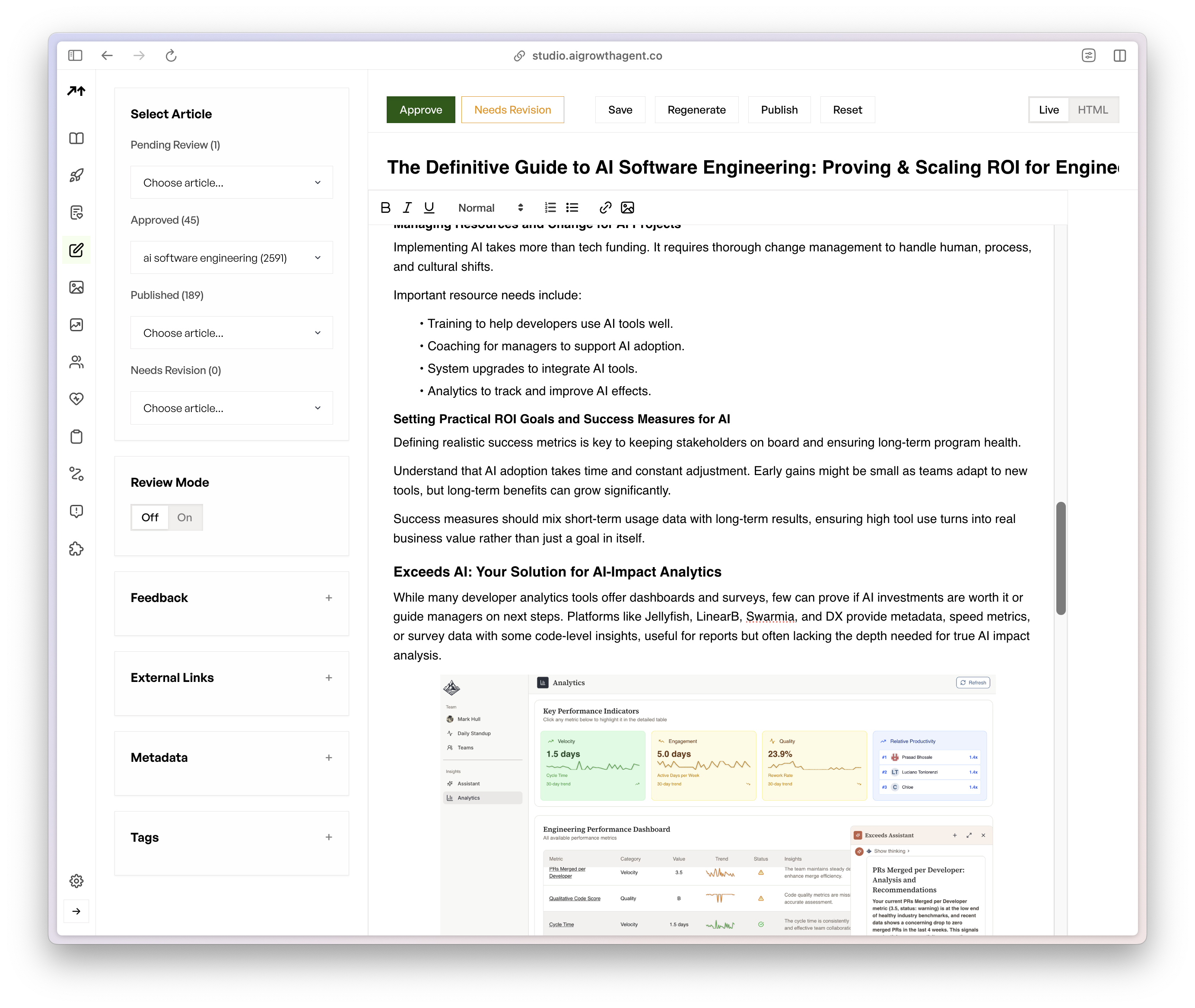
This approach improves more than volume. Autonomous systems maintain consistent structure and technical quality while allowing teams to respond to new topics and industry conversations quickly. As a result, brands can participate in relevant discussions while interest is still high.
Marketing teams that want to increase content velocity and AI search visibility can schedule a demo with AI Growth Agent to see how a developer-free content agent model fits their workflows.
3. Fortifying Brand Authority Through Consistent Messaging
Brand consistency becomes more challenging as content volume grows. Developer-free AI content tools help solve this problem by encoding brand rules into the system so each new asset supports the same narrative and positioning.
AI search systems evaluate more than single pages. These systems assess patterns across an entire content set, including topical depth, tone, and reliability. When messaging or quality fluctuates, models may treat the brand as a weaker source relative to more consistent competitors.
Insufficient or fragmented content coverage can also create risk. If a brand does not provide enough high-quality material on core topics, AI models may rely on competitors that publish more comprehensive coverage. Over time, those competitors can become the default references for important queries.
Marketing leaders can limit this risk by using tools that support detailed brand intelligence transfer. AI Growth Agent uses a Company Manifesto as a central document that captures positioning, voice, audience priorities, and product context. The content engine follows this guidance and adapts over time based on feedback, so quality and alignment improve as the system publishes more.
4. Optimizing for AI Citation and Recommendations
Content optimization in the AI search era now includes a clear focus on earning citations and recommendations from AI systems. Developer-free AI content tools contribute by implementing the structures that help AI models interpret, index, and reuse brand content.
Platforms like AI Growth Agent embed content with structured metadata, advanced schema markup, and protocols such as LLM.txt. These elements help AI systems understand topical relevance, entity relationships, and usage permissions when selecting sources for responses.
Teams using AI-focused optimization tools gain better visibility into how AI models reference their content. AI Growth Agent provides AI search monitoring capabilities that surface citation performance, brand mentions, and URL presence across different AI platforms.
The platform tracks metrics such as citation frequency, topic coverage, URL performance in AI-generated answers, and crawl behavior from AI-oriented bots. This data helps teams refine content strategy based on how AI systems actually interact with their sites.
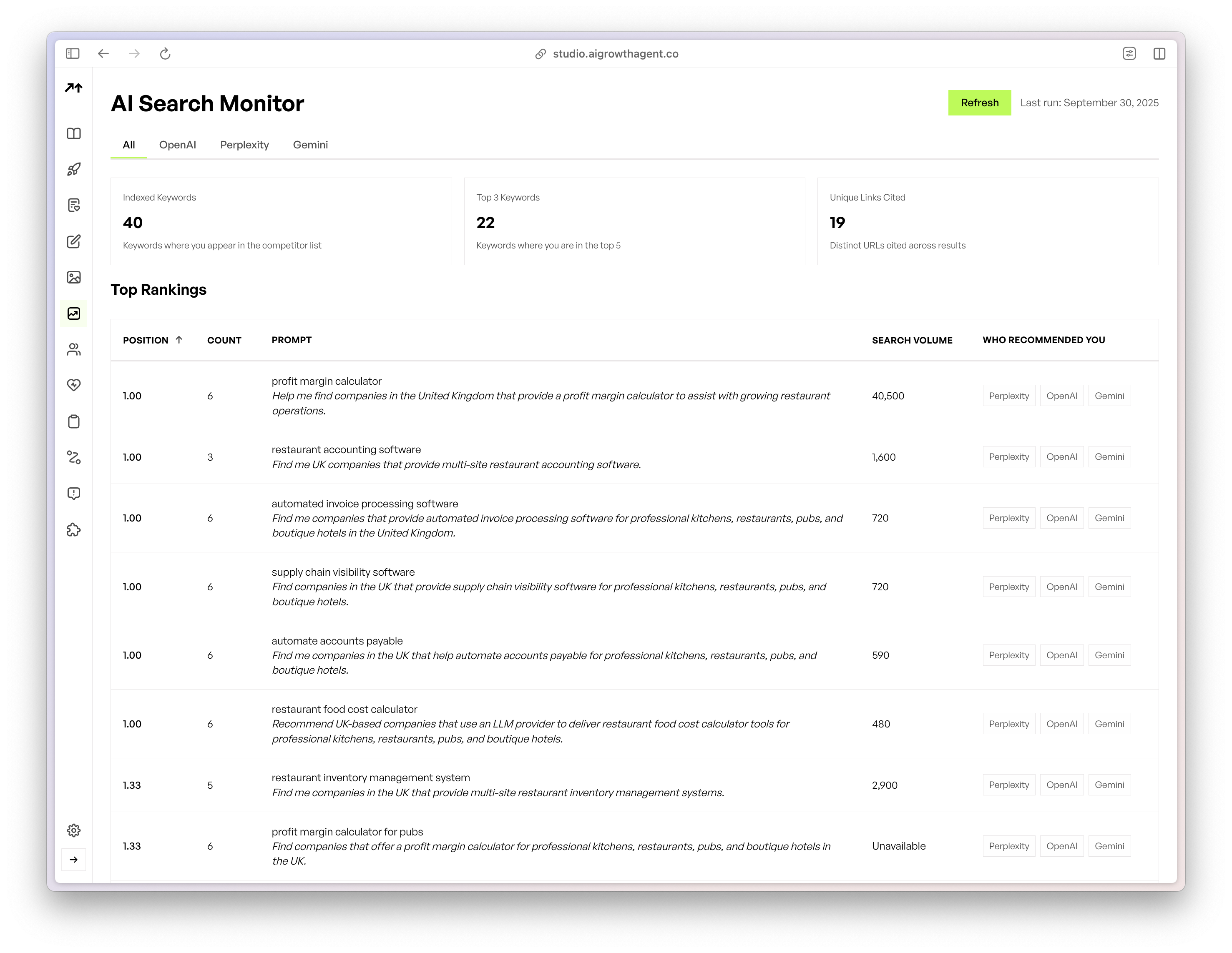
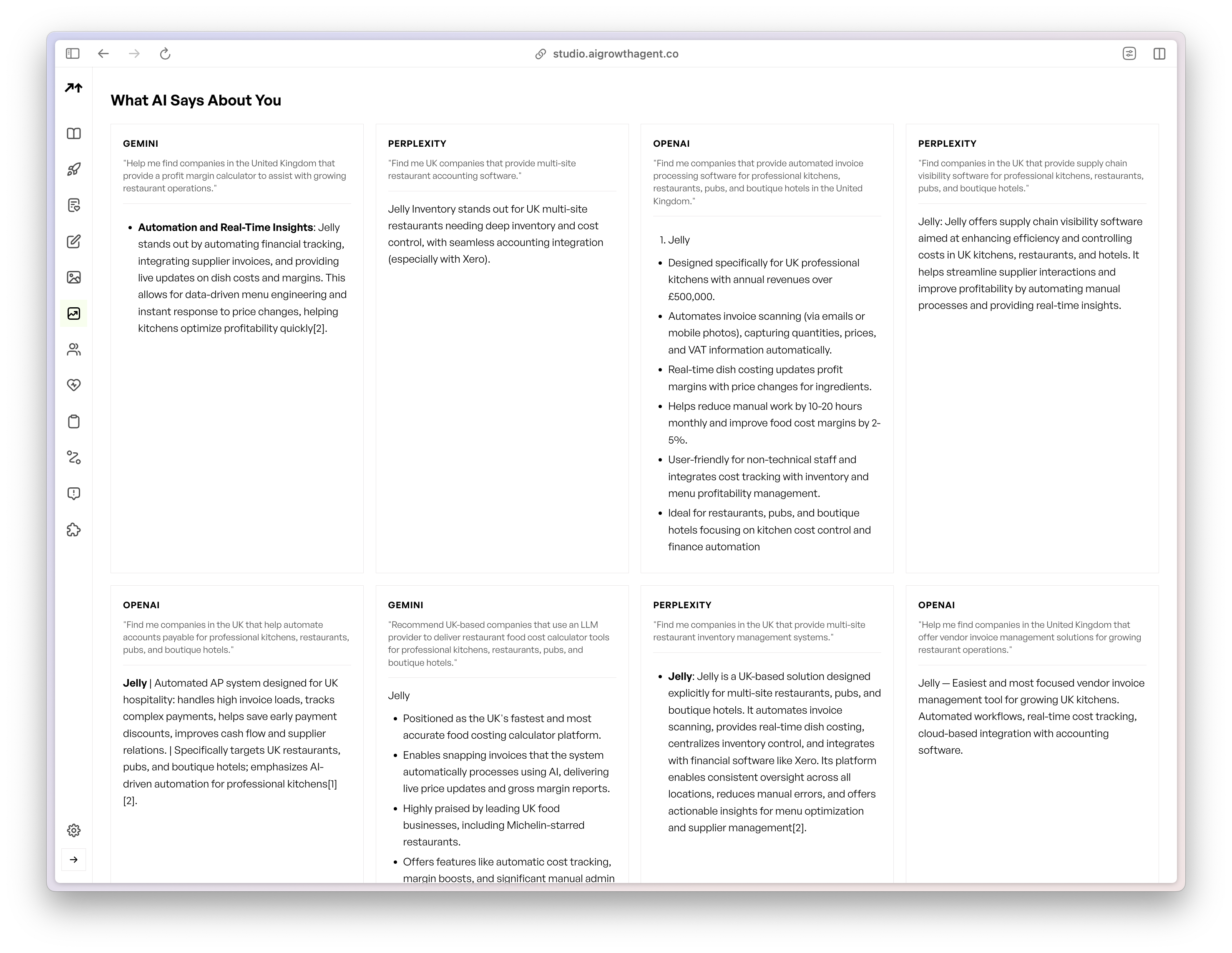
Marketing leaders evaluating tools for AI citation should look for automation of these technical protocols and clear reporting on AI search performance. AI Growth Agent offers real-time visibility into where and how content appears in AI-generated responses, which supports ongoing optimization.
5. Empowering Iterative Content Strategy and Rapid Adaptation
Market conditions, search behaviors, and AI models change quickly, so content strategies need to adapt on short timelines. Developer-free AI content tools give marketing teams the means to iterate based on performance data and emerging topics.
Platforms like AI Growth Agent support near real-time content updates by pulling in trending topics, updating articles, and launching new pages as conditions change. This responsiveness helps brands address new questions and shifts in demand before they become saturated.
AI Growth Agent also includes capabilities such as real-time content injection from trending articles, database-to-content automation that turns proprietary data into indexable pages, and intelligent asset placement to improve visual structure and SEO impact.
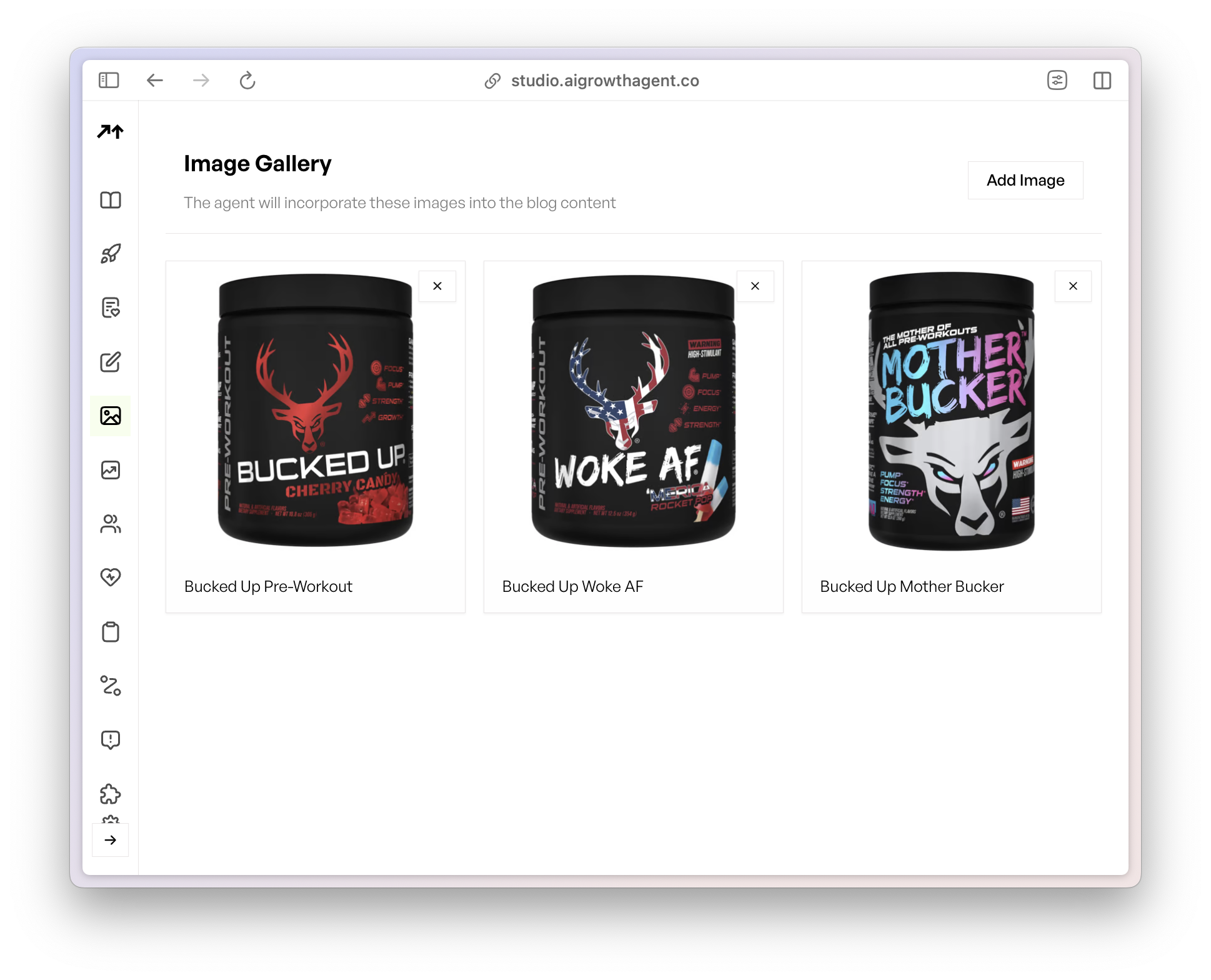
These features keep content libraries current while drawing more value from existing company data and creative assets. Teams can test new topics or formats, then scale the ones that perform best based on AI citation data and engagement metrics.
Marketing leaders who want to use developer-free tools to build an adaptable content system can book a strategy session with AI Growth Agent.
Frequently Asked Questions About Developer-Free AI Content Tools for Marketing Leaders
How do “developer-free” AI content tools differ from standard AI writing assistants?
Developer-free AI content tools operate as full content engineering systems rather than simple writing assistants. While basic tools like ChatGPT or Jasper focus mainly on text generation, developer-free platforms automate the broader workflow that surrounds the writing process.
These platforms can include deep keyword research, technical SEO implementation, schema markup, metadata optimization, and autonomous publishing. Marketing teams do not need coding skills or custom integrations to benefit from these features.
Standard AI writing assistants usually produce unstructured text and leave optimization, formatting, and publishing tasks to the user. They can help with drafts but do not manage infrastructure or enforce technical standards. Developer-free platforms, such as AI Growth Agent, close this gap by turning business intelligence into optimized, published content through end-to-end automation.
More advanced systems add capabilities like programmatic keyword clustering, automated infrastructure setup, real-time AI search monitoring, and brand consistency controls driven by structured training inputs like Company Manifestos.
Can developer-free AI tools match the quality of human-written content?
Well-configured developer-free AI tools can match or exceed human-written content in several dimensions, particularly technical optimization, structure, and consistency. Quality depends on how thoroughly the system is trained on brand standards and subject matter.
Platforms like AI Growth Agent rely on detailed Company Manifestos that capture brand voice, positioning, and audience expectations. With this information, the AI can produce content that aligns with brand tone while applying technical best practices in a consistent way.
Programmatic systems also excel at tasks that humans often overlook, such as precise schema markup, clean internal linking patterns, and strict adherence to AI search protocols. These elements improve machine interpretability and can increase the likelihood of citation.
Quality assurance features, including automated checks and learning from human feedback, help the system improve over time. As more content is produced and reviewed, the model refines its understanding of what high-quality output looks like for that brand.
What specific technical SEO elements can developer-free AI content tools automate?
Developer-free AI content tools can automate most of the technical SEO tasks that typically require developer support. Examples include selecting and applying schema types for articles or products, generating and updating metadata, and creating internal link structures that match topic clusters.
These platforms can also implement image alt text aligned with keyword strategies and accessibility guidelines. Many systems manage sitemap updates and optimize URL structures to support clean information architecture.
Platforms like AI Growth Agent extend this automation to AI search optimization. Features can include LLM.txt file generation, Model Context Protocol support for interactions with AI systems, and robots.txt configurations tuned for both traditional search crawlers and AI-focused bots.
Infrastructure components such as hosting and security can be handled by the platform as well, which simplifies setup for marketing teams. An intuitive interface lets non-technical users manage strategy and monitor health while the system takes care of the backend.
How do these tools ensure brand consistency without human oversight for every piece?
Developer-free AI content tools maintain brand consistency by encoding brand guidelines and preferences into the core of the system. The process usually starts with structured onboarding that captures brand intelligence in a reusable format.
With AI Growth Agent, this takes the form of a Company Manifesto, which documents positioning, messaging pillars, tone preferences, and audience segments. The system references this document whenever it generates content, so each piece aligns with the same underlying rules.
Ongoing feedback loops then refine performance. Marketing teams review output, submit adjustments, and highlight exemplary content. The AI incorporates this feedback into future work, which strengthens consistency and accuracy as more iterations occur.
Are developer-free AI content tools only for large enterprises, or can smaller teams benefit?
Smaller teams can gain significant value from developer-free AI content tools because these platforms provide access to capabilities that typically require larger headcount or agency support. A lean team can manage research, production, and technical optimization at a higher scale than manual methods allow.
Resource constraints often limit how much content smaller organizations can produce or how deeply they can optimize it. Tools like AI Growth Agent reduce the need for multiple specialized roles while preserving the sophistication of the output.
This shift can change how smaller teams approach growth. Instead of adding headcount for each new content initiative, leaders can configure the platform to handle more of the workload and then focus human effort on strategy, subject matter expertise, and creative direction.
Scalable pricing and modular features also allow organizations to start with targeted use cases and expand as they see results. Over time, the same system can support a broader content program without a complete process overhaul.
Developer-Free AI Content Tools: The Strategic Comparison
Marketing leaders evaluating developer-free AI content tools benefit from comparing them with both traditional workflows and basic AI writing assistants. The table below highlights how these approaches differ across key capabilities.
|
Capability |
Traditional Content Creation |
Basic AI Writing Tools |
Developer-Free AI Platforms |
|
Technical SEO Implementation |
Requires developers |
Manual implementation needed |
Fully automated |
|
Content Production Speed |
2-4 articles/month |
10-20 articles/month |
100+ articles/month |
|
Brand Consistency |
Variable quality |
Inconsistent without oversight |
Programmatically enforced |
|
AI Search Optimization |
Manual technical work |
Not available |
Built-in protocols |
This comparison shows why many marketing leaders now prioritize developer-free platforms that automate full content lifecycles. As AI search expands, scalable technical implementation and consistent production become central to maintaining visibility and topic authority.
The Evolution of Content Authority in AI Search
Content authority in AI search environments differs from traditional keyword-based ranking. Marketing leaders need to account for how AI systems evaluate and assemble responses from multiple sources.
AI search engines weigh technical structure, consistency, topical depth, and reliability when assessing authority. Links and rankings still matter, but machine-readability and citation-worthiness play a larger role in how models select sources.
These requirements make manual content creation alone difficult to sustain. Brands that cannot maintain a high, consistent output level with strong technical foundations may see their material referenced less often than content from programmatically supported competitors.
Developer-free AI content tools, including AI Growth Agent, provide the technical and operational framework needed to build and maintain this type of authority at scale. Marketing teams can use them to coordinate keyword coverage, on-page structure, and publication cadence in a single system.
Measuring Success in the AI Search Era
Traditional SEO metrics such as rankings and organic traffic still matter, but they do not fully reflect performance in AI-driven search. Marketing leaders need additional indicators that relate directly to AI citations and topical authority.
Platforms like AI Growth Agent offer analytics that track mentions and citations across AI systems. These tools show where brand content appears in AI-generated answers, how often it is referenced, and for which topics or questions.
Key indicators include citation frequency across AI platforms, the context in which the brand is mentioned, coverage across priority topics, and the relative presence of competitors for the same queries. Together, these metrics provide a clearer view of AI-era visibility.
Teams can then refine strategy using this data. High-performing topics can receive additional coverage and deeper content, while underrepresented areas may need new pages or updated information to strengthen authority.
Implementation Strategy for Marketing Leaders
Marketing leaders planning to adopt developer-free AI tools should start with an assessment of current content assets, technical foundations, and AI search visibility. This baseline helps clarify where automation can provide the most impact.
Implementation works best when platforms offer structured onboarding that captures brand intelligence and technical requirements. AI Growth Agent, for example, collaborates with teams to create a Company Manifesto that guides content generation and optimization.
Integration typically involves aligning the platform with existing CMS workflows, defining approval processes, and setting up monitoring dashboards. Advanced tools provide enough flexibility to adapt to current operations while still enforcing AI-focused optimization standards.
Clear success metrics support ongoing measurement and improvement. Teams can define targets for publication cadence, topic coverage, AI citation levels, and authority milestones over specific timeframes to evaluate return on investment.
Conclusion: Build AI Search Authority with Programmatic Content
Developer-free AI content tools now function as core infrastructure for marketing teams operating in an AI-first search environment. Leaders who continue to rely only on manual workflows or basic writing assistants may struggle to keep pace with competitors using programmatic systems.
The transition from simple keyword queries to AI-generated answers changes what it takes to be visible. Content volume, technical quality, and consistent brand representation are no longer optional for organizations that want AI models to reference their expertise.
AI Growth Agent provides an end-to-end programmatic content platform for teams that recognize this shift. The system automates research, content creation, technical optimization, and AI search monitoring so marketing leaders can manage authority building from a single environment.
Competition for AI search visibility is increasing as more brands deploy similar tools. Organizations that act now to build structured, developer-free content engines are likely to secure stronger positions in their categories.
Marketing leaders who want their companies to serve as reliable sources in AI search can schedule a demo with AI Growth Agent today and review how autonomous content and ranking technology can support their growth strategy.
