


AI search engines like ChatGPT, Gemini, and Perplexity now shape how buyers discover brands, which reduces the impact of traditional SEO and blog strategies.
AI content workflow automation lets marketing leaders publish structured, machine-readable content at scale so AI systems can understand, trust, and cite their brand. What you’ll see in this article:
- This guide explains how to choose AI content workflow automation software, program AI Growth Agent for your brand, automate technical deployment, and monitor performance across AI search platforms.
- AI Growth Agent provides an autonomous Programmatic SEO system that manages research, writing, technical SEO, and publishing without heavy internal engineering support.
- Marketing leaders who adopt structured automation early can build durable AI search authority, while slower competitors risk losing visibility and share of voice in their categories.
The AI Search Revolution: Why Traditional Content Strategies Fail
The relationship between businesses and search engines has changed. Manual keyword targeting used to be enough to rank. AI search now rewards programmatic content that shows authority and provides clear data that large language models, or LLMs, can reference and cite.
Your digital footprint keeps shrinking as AI tools generate massive volumes of new content. Without a structured, high-volume content program that is designed for AI systems, your brand voice becomes harder to find.
The pace of information has also increased. Many teams still publish one or two manually crafted posts each month. That pace rarely keeps up in an environment where LLMs reward recency, depth, and consistent structure.
Content gaps create risk. If your brand does not define itself across the topics that matter, competitors will fill that space. When AI engines lack enough data points from your site, they rely on other sources. Those competitors then receive citations and recommendations, and their perspective starts to shape how AI systems describe your category.
Understanding AI Search Authority: What AI Engines Prioritize
Defining “Authority” in AI Search
Authority in AI search follows different rules than traditional SEO. AI engines favor machine-readable precision, structured data, canonical facts, and writing that is easy to attribute and cite.
Schema markup, logical metadata, and structured data play a central role in discoverability and AI citation. These elements signal that your content is organized, reliable, and technically ready for machines to process.
Traditional search has often relied on backlinks and domain authority. AI engines place more weight on factual accuracy, structural clarity, and the presence of canonical data points. Well-engineered content with strong technical optimization can earn authority even without legacy backlink profiles.
Assessing Your Current Content Infrastructure for AI Readiness
Most marketing teams discover gaps when they assess their content infrastructure for AI search. Legacy workflows often lack the technical depth needed for programmatic scale and miss advanced schema markup, structured metadata, and consistent machine-readable formatting.
Begin your audit by checking whether your content includes:
- Comprehensive schema markup across key page types
- Structured data that reflects how your products, services, and use cases relate
- Consistent metadata and taxonomies across all content assets
- Formatting that makes attribution and citation straightforward for AI systems
Many brands find that agencies and internal teams have not implemented these elements at scale because they require engineering capabilities, not just copywriting or basic SEO skills.
Volume requirements make the limitations of manual approaches clear. Human-only content creation rarely achieves the quantity of high-quality, technically optimized content needed to cover your topical landscape in the level of detail that AI engines prefer to cite.
Step 1: Choosing the Right AI Content Workflow Automation Software
Key Capabilities for AI Search Dominance
Effective AI content workflow automation software should handle the full lifecycle, not just generate drafts. Core capabilities include:
- Programmatic content generation at scale across your priority topics
- Advanced technical optimization, including schema and metadata injection
- Real-time or near real-time performance monitoring across AI platforms
- Autonomous operation that reduces day-to-day manual oversight
Basic AI tools and prompt templates usually output unstructured text. They leave strategy, technical formatting, schema injection, and publishing to your team. The result often lacks the structure AI engines need for reliable citation.
Purpose-built AI content workflow automation software manages the technical pipeline from keyword strategy to content creation, optimization, and publishing. This end-to-end automation supports the scale and consistency required for strong AI search performance.
Introducing AI Growth Agent: A Leading Solution for Programmatic SEO
AI Growth Agent is built for Programmatic SEO, with specific attention to how AI search works. It operates as an autonomous system that executes the technical SEO lifecycle at a pace and scale that manual teams find difficult to match.
The agent model means the system can own strategy development, keyword research, content creation, technical optimization, and performance monitoring. This approach reduces the need to build and maintain a separate internal programmatic SEO stack and lets marketing teams add scale without adding large technical teams.
Onboarding moves quickly. Clients often move from the initial meeting to the first programmatically engineered article in about one week. This short ramp-up helps brands start building AI search presence without long implementation projects.
Ready to launch your autonomous content engine? Schedule a demo to see if AI Growth Agent is right for you.
Step 2: Programming Your AI Growth Agent for Optimal Performance (The “White-Glove” Onboarding Process)
Crafting Your Company Manifesto for AI Context
Effective AI content workflow automation starts with a clear Company Manifesto that sets the strategic context for content. AI Growth Agent captures this through a focused kickoff session with a professional journalist who helps program the “brain” of your agent with your narrative, positioning, and voice.
This working session explores your business model, competitive landscape, and unique story. The resulting Manifesto becomes a living source of truth and sets the guardrails for your Programmatic SEO Agent. Every article then reflects your brand strategy while still following the technical standards needed for AI citation.
The Manifesto process helps the system generate content that feels authentic to your brand, rather than relying on generic prompts or one-off templates.
Developing a Programmatic Keyword and Content Strategy
After the Manifesto is created, AI Growth Agent activates its research protocols to build a programmatic content strategy. The agent ingests your company context and evaluates thousands of search queries and topics in your market, then flags opportunities for visibility and citation.
The strategy is organized into pillars and clusters that reflect how AI search tools group and interpret queries. Each content asset targets a specific opportunity, which reduces random or one-off article creation and builds structured topical coverage instead.
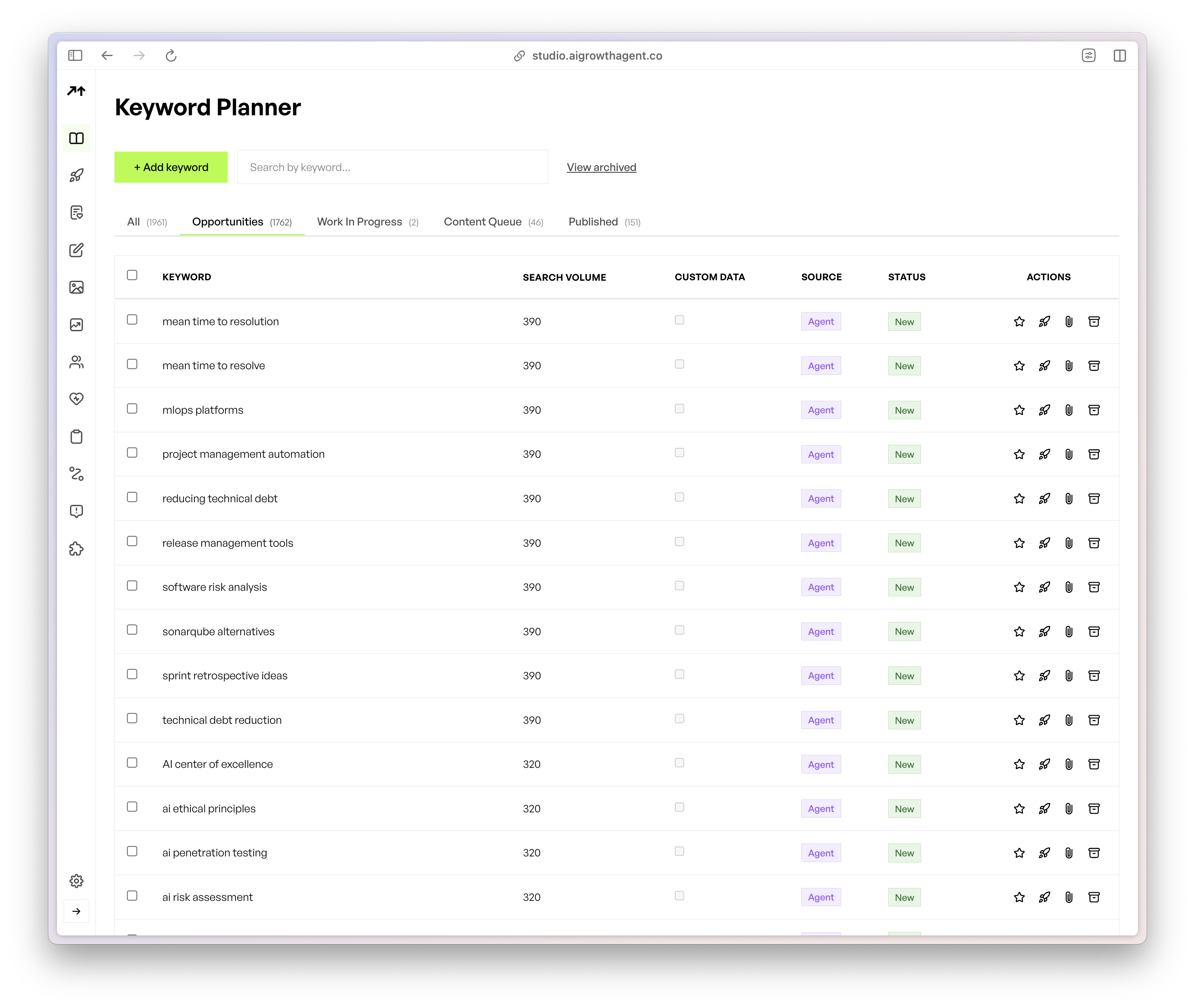
This programmatic planning gives you a competitive edge by revealing content opportunities at scale, while still keeping the overall content architecture coherent and aligned with your goals. Manual approaches rarely uncover this breadth of opportunity with the same level of structure.
Step 3: Automating Technical Implementation and High-Volume Content Generation
Autonomous Technical Infrastructure Deployment
AI Growth Agent removes much of the engineering friction by deploying an optimized blog architecture on a subdomain of your site, such as blog.yourcompany.com. The design matches your existing brand while using a clean technical foundation that is tuned for Programmatic SEO.
Many clients choose the hosted option because it offers a fast path to an optimized setup. For teams that prefer to self-host, a WordPress instance with a custom integration path can provide strong results.
Deployment includes advanced technical SEO features such as schema markup, metadata structures, LLM.txt, and a blog Model Context Protocol, or MCP. These elements help AI search engines interface more directly with your blog database and interpret your content with greater accuracy.
The Programmatic SEO Content Agent in Action: Full Content Engineering Lifecycle
Once you approve the keyword strategy, the Programmatic SEO Content Agent runs the content engineering lifecycle. Each piece of content receives a clear brief and a defined role within your broader content map.
The research stage draws on your Manifesto and credible web sources to generate accurate information. Drafting then produces content that can range from short tactical articles to long-form pillar pieces, all written to align with your brand voice.
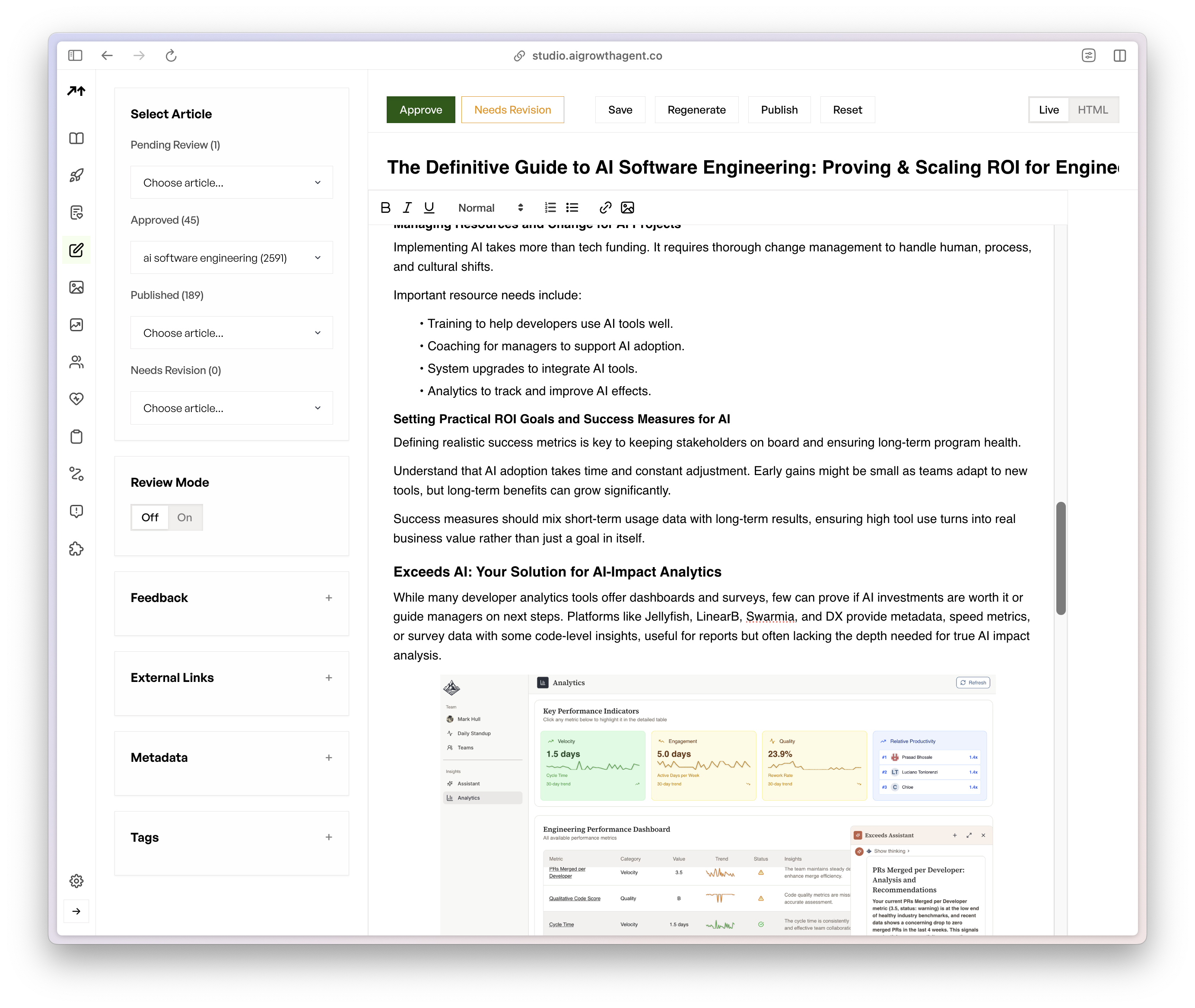
Technical engineering decorates each post with SEO elements, including rich schema, metadata, and image tags, so AI engines can interpret and cite the content more effectively. Fact-checking workflows help keep information accurate, and autonomous publishing pushes content live without slow manual handoffs.
This end-to-end automation enables high-velocity publishing with consistent quality, which is a key factor in building AI search authority across a wide set of topics.
Step 4: Monitoring, Iteration, and Advanced Strategies for AI Dominance
Utilizing the AI Growth Agent Studio for Control and Feedback
The AI Growth Agent Studio serves as the command center for programmatic SEO operations. Marketing leaders can review content in a text editor, make direct edits, provide feedback, and manage approvals in one place.
Feedback cycles teach the agent your preferences over time. As the system learns, it can move toward higher levels of autonomy. Auto-Pilot mode allows the agent to generate and publish content within your defined guidelines, so your team can focus on strategy and oversight instead of manual production.
AI Search Monitor & Feedback Loop for Continuous Growth
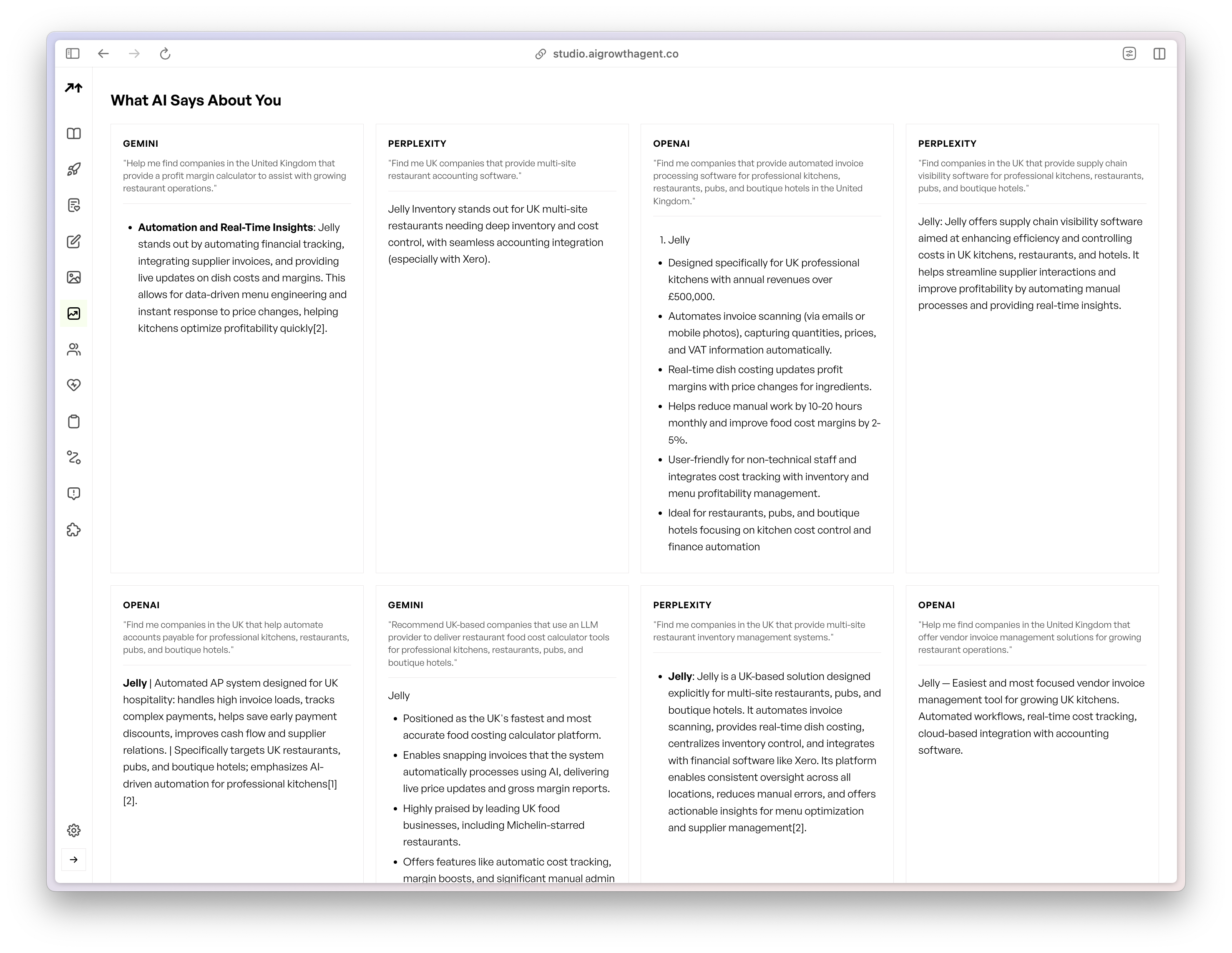
The AI Search Monitor creates a feedback loop for optimization by tracking performance across ChatGPT, Gemini, and Perplexity. The dashboard surfaces keyword indexing patterns, URLs that drive AI visibility, and citations within AI responses, including real-time tracking of ChatGPT citations.
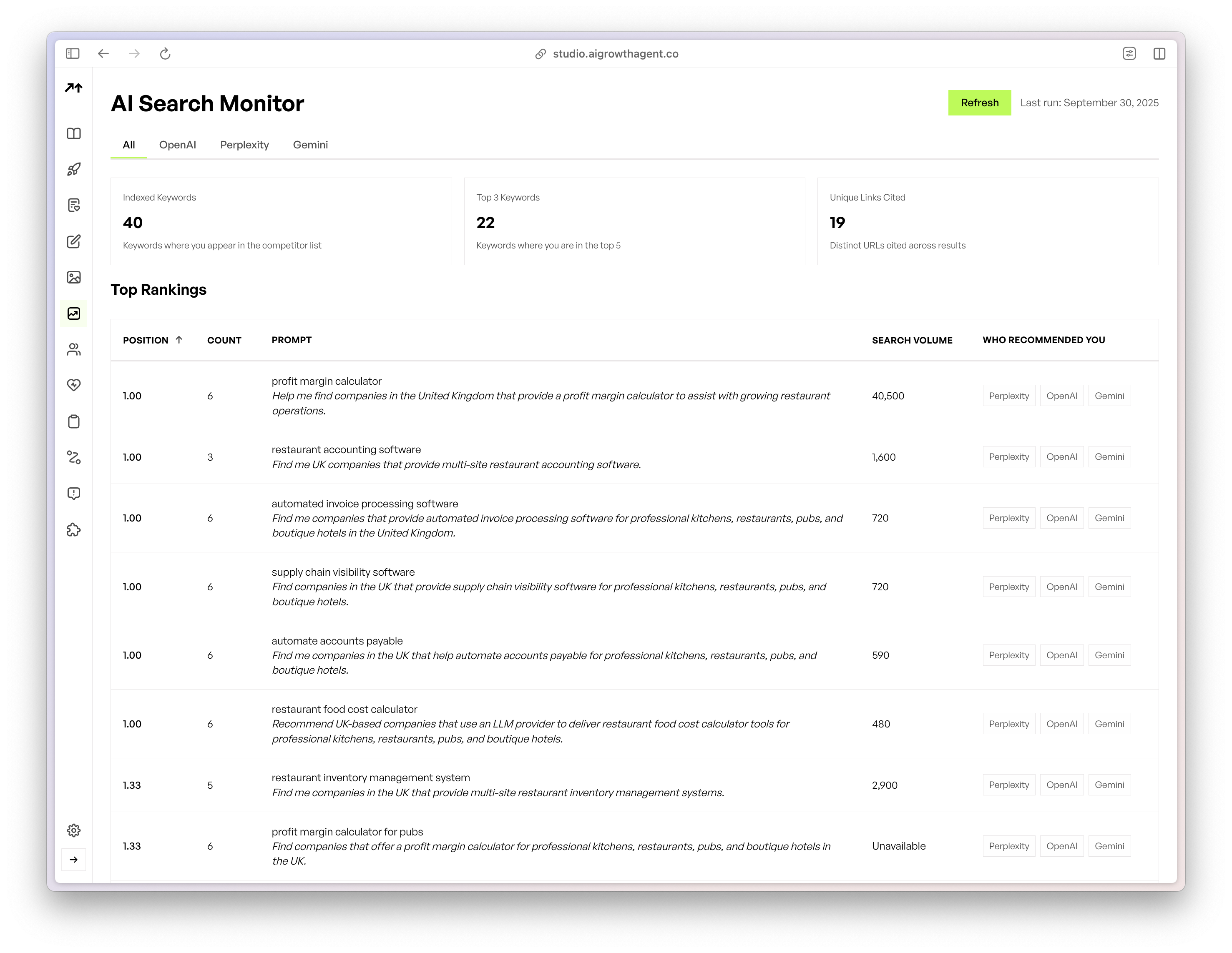
Integration with Google Search Console highlights organic traffic growth and clicks driven by the agent’s content. Crawl statistics from Google, ChatGPT, and Perplexity bots show how AI engines interact with your architecture so you can refine technical and content decisions.
|
Client |
Initial Impact |
Current AI Search Presence |
|
Exceeds AI |
Recommended by Perplexity in 2 weeks, ranking in Google AI Overview or Gemini in 3 weeks |
Featured in ChatGPT, Google AI Overview or Gemini, and Perplexity as a key source for “AI performance review tools for engineers.” |
|
BeConfident |
Indexed immediately after programmatic publishing |
Recommended as a leading English learning app in Brazil by Google AI Overview or Gemini within weeks. |
|
Bucked Up |
Cited by ChatGPT as a notable protein soda brand within 3 weeks |
Appears as a primary citation for “best protein soda” alongside major competitors. |
|
Gitar |
Emerged as a reference brand for AI-powered CI or CD automation in less than two months |
Consistently appears as a top-cited tool across Google AI Overview or Gemini, ChatGPT, and Perplexity for queries like “fix broken CI builds automatically.” |
Advanced Capabilities for Authority in AI Search
Multi-tenant programmatic deployment helps groups that manage multiple brands, such as private equity firms, venture portfolios, or enterprises with several product lines. From a single interface, they can run separate Programmatic SEO Content Agents, each with its own Manifesto, strategy, and voice.
Real-time programmatic SEO content injection supports rapid response to relevant news or trends. Teams can feed a news link into the system and generate optimized content within minutes, which helps capture search demand while interest is high.
Database-to-content automation converts proprietary data into search assets, such as turning offline recommendation lists into structured content, like “best bagels in New York.” This process unlocks SEO value from information that otherwise stays buried in spreadsheets or internal systems.
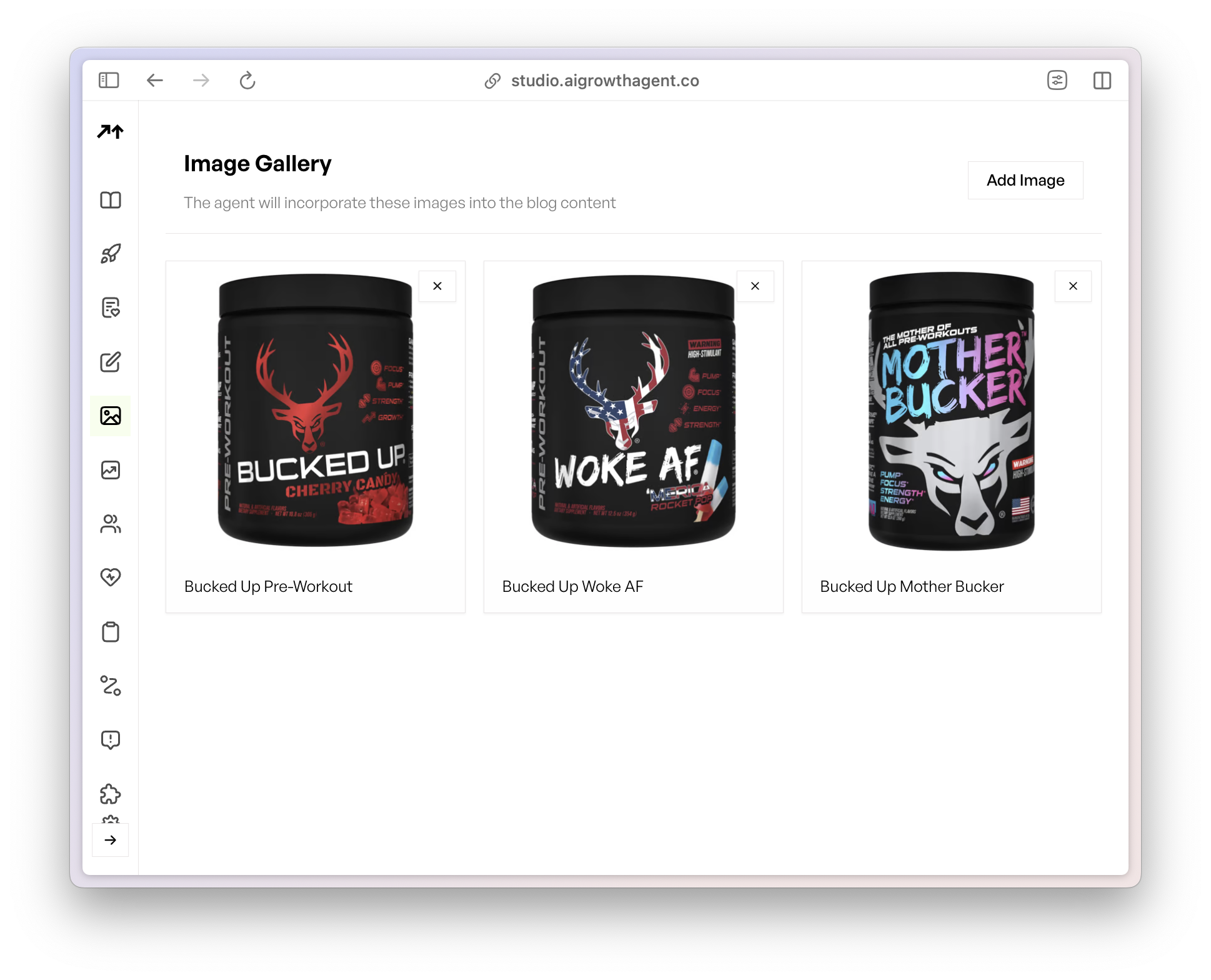
Intelligent image and asset placement selects relevant visuals or generates new ones with AI, then applies metadata to support image SEO and visual consistency.
Best Practices and Pitfalls in AI Content Workflow Automation for Marketing Leaders
Best Practices for Sustained AI Search Dominance
Sustained success with AI content workflow automation depends on ongoing evaluation and clear standards. Focus on structured, machine-interpretable content that states facts clearly and follows a logical outline.
Writing that makes attribution easy can increase the likelihood of citation. Reference your own data and resources in ways that AI engines can parse, and keep information current across the site. Ongoing performance monitoring across AI platforms helps you track citation frequency, query coverage, and your presence in AI-generated answers relative to competitors.
Common Pitfalls and How AI Growth Agent Mitigates Them
Many teams worry that automation will reduce authenticity or quality. AI Growth Agent addresses this through the Manifesto system, which anchors content in your brand voice, and through journalist involvement during onboarding.
Concerns about data bias and tone drift are mitigated by the depth of the brand context that the Manifesto provides. That context guides the agent so automated content reflects your perspective while still scaling production. The end-to-end design also helps prevent bottlenecks that arise when teams cobble together partial tools for research, drafting, and publishing.
Update your content strategy for the AI search era. Schedule a demo to see how AI Growth Agent can help establish your brand as an authority in your category.
Frequently Asked Questions about AI Content Workflow Automation
How is AI content workflow automation different from just using ChatGPT?
AI content workflow automation provides an end-to-end programmatic system that includes strategy, optimization, schema injection, and publishing. Tools like ChatGPT usually provide unstructured text, while systems like AI Growth Agent generate fully engineered web pages that are optimized for AI citation and ready to publish.
Can my internal marketing team manage this type of automation?
Internal marketing teams can own goals and messaging, but advanced automation often requires technical capabilities that many teams do not have in-house. Requirements such as LLM.txt, schema markup at scale, and custom metadata structures call for engineering support. AI Growth Agent reduces this burden by delivering a complete solution that does not depend on internal engineering resources.
What kind of ROI can I expect from implementing AI content workflow automation?
Organizations that adopt sophisticated automation often see returns through organic traffic growth, stronger brand authority via AI citations on platforms like ChatGPT and Gemini, and more opportunities to be discovered across AI search experiences. The scale of automated content production usually creates more touchpoints than manual efforts alone.
How quickly can I see results with AI content workflow automation?
With AI Growth Agent, many clients see their first programmatically engineered article live within about one week. Early indicators, such as AI citations and ranking improvements across major AI search platforms, often appear within the first 2 to 3 weeks after publishing begins, depending on the category and competition.
Will AI-generated content hurt my brand’s authenticity?
Well-designed automation can strengthen authenticity by enforcing a consistent voice and message. AI Growth Agent’s Manifesto process uses a professional journalist to document your brand perspective and then uses that source of truth to guide automated content, so scale and authenticity work together.
Conclusion: Secure Your Brand’s Authority in the Era of AI Search
AI-driven search is now central to digital discovery, and traditional content strategies alone do not provide enough coverage or technical sophistication for strong visibility. Marketing leaders at premium brands need systems that match the speed and structure of AI search.
AI content workflow automation gives brands the ability to publish high-quality, technically optimized content at scale. AI Growth Agent supports this with an integrated approach that spans Manifesto development, autonomous content generation, technical deployment, and performance monitoring.
Brands that act now can build durable positions in AI search results while the landscape is still taking shape. Brands that wait risk losing visibility as AI-driven recommendations influence how buyers evaluate options and choose partners.
Ready to ensure your brand is cited by AI search engines? Schedule a consultation session today to explore AI content workflow automation with AI Growth Agent.
