


Key Takeaways
- AI-driven personalization now delivers 1:1 experiences at enterprise scale, and customers increasingly expect this level of relevance across channels.
- Generative AI and predictive analytics make customer support, campaign planning, and demand forecasting faster, more accurate, and easier to measure.
- AI search favors structured, authoritative, and technically optimized content, so enterprise SEO now requires programmatic content architectures and continuous monitoring.
- Enterprise marketers can unlock trapped internal data and manage multi-brand portfolios with programmatic content systems, gaining category depth and long-tail visibility.
- AI Growth Agent gives enterprises an autonomous content and AI search engine strategy; schedule a demo to see how it supports AI search dominance.
1. Hyper-personalization at enterprise scale
Enterprise teams now use AI to deliver individualized customer experiences across every touchpoint, moving beyond basic segments to true 1:1 personalization.
AI systems already power customized recommendations, emails, newsfeeds, and loyalty offers based on behavior and preferences. Most companies now prioritize AI personalization, and many customers report frustration when it is missing.
- AI models infer intent and preferences from large datasets.
- Content, offers, and experiences adapt in real time across digital touchpoints.
- Personalized engagement increases conversion rates, loyalty, and customer lifetime value.
Enterprises need reliable data pipelines and clear privacy policies so personalization efforts stay compliant and accurate.
2. Next-generation customer experience with generative AI
Generative AI now supports more complex customer interactions, including Tier 2 support, detailed product guidance, and knowledge-base search.
Modern assistants can synthesize answers from multiple documents, giving faster resolutions for nuanced questions. Enterprises also use AI to connect chat, email, search, and apps into a unified experience.
- Virtual agents and chatbots handle routine and mid-complexity issues.
- Content is generated and tailored for FAQs, help centers, and in-product guidance.
- Responses stay available 24/7 and reduce support costs.
Teams need clear guardrails for tone, approvals, and factual accuracy so AI interactions match brand standards.
3. Autonomous content architectures for AI search dominance
AI-first search favors brands that design content architectures for machine understanding and citation, not just human readers.
Enterprise leaders now pair programmatic content generation with technical SEO, schema markup, and machine-readable files such as LLM.txt so AI systems can interpret and trust their information.
- Programmatic keyword and topic research aligned to customer journeys.
- High-volume publication of structured, authoritative content.
- Automated schema, metadata, and LLM-focused indexing assets.
This approach requires engineering capacity that many traditional SEO providers do not offer.
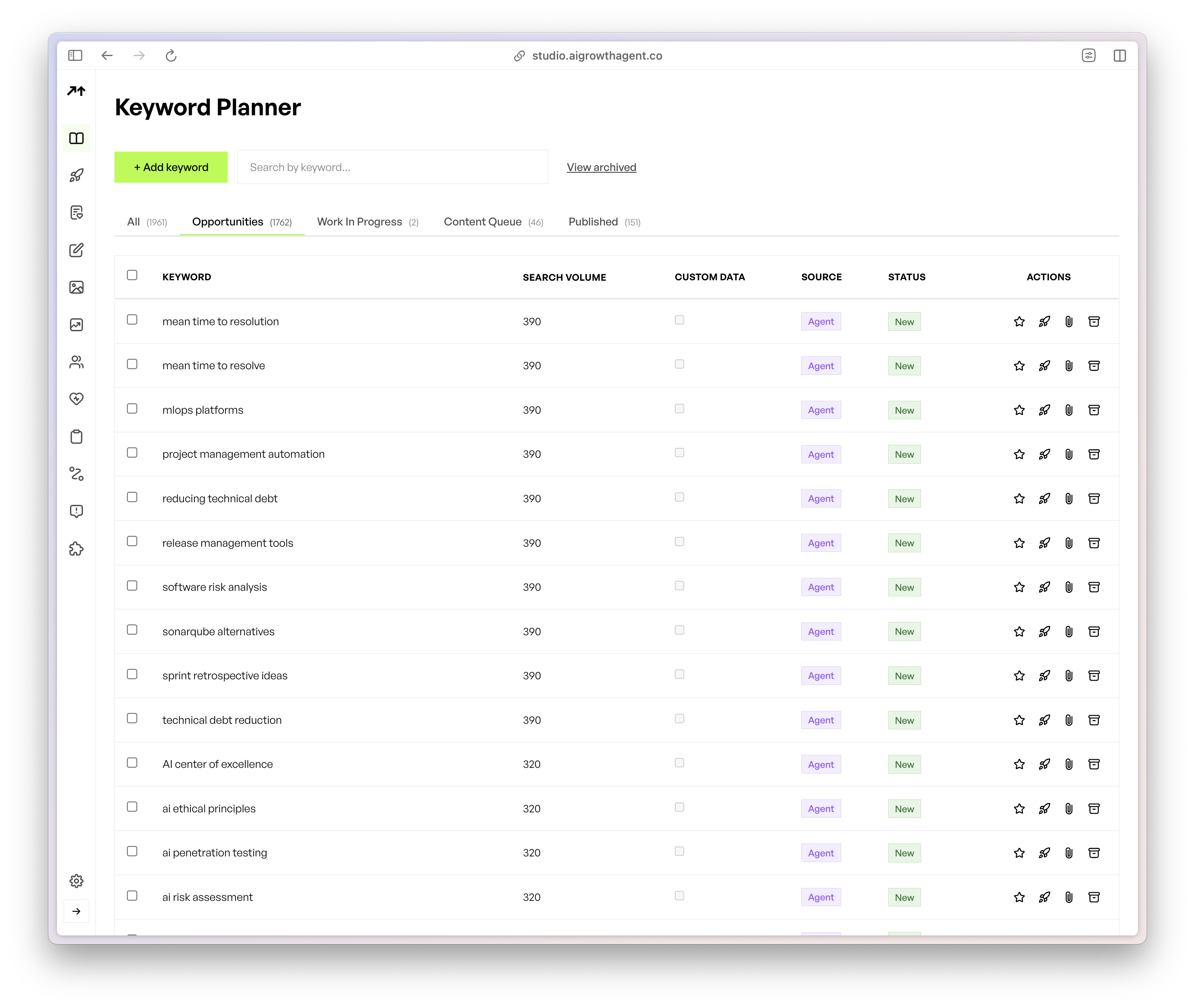
Enterprises that invest in these architectures place themselves in a better position to become default sources in AI-generated answers.
4. Predictive analytics for proactive marketing
Predictive analytics lets marketers act before problems or opportunities surface in traditional reports.
- Churn models flag at-risk customers so teams can intervene earlier.
- Forecasts reveal demand patterns that influence inventory and media planning.
- Anomaly detection alerts teams to unusual traffic, campaign, or pricing shifts.
Effective programs sit on a strong data foundation with unified customer and performance data instead of siloed systems.
5. AI-powered SEO beyond keywords
AI-powered SEO now centers on intent, semantics, and structured information that large language models can trust.
Enterprise content strategies increasingly optimize for conversational queries, voice search, and LLM citation rather than isolated keywords.
- Semantic clarity and topical depth across clusters of related content.
- Structured data, knowledge graphs, and LLM-friendly files such as LLM.txt.
- Integration with protocols like Model Context Protocol so AI systems can ingest authoritative sources efficiently.
Teams that treat SEO as content engineering for AI systems gain stronger visibility in AI summaries and responses.
6. Multi-tenant programmatic content deployment
Large enterprises, holding companies, and portfolio firms now centralize content systems while preserving distinct brand strategies.
- Central teams manage shared infrastructure, governance, and reporting.
- Each brand or product line operates its own tailored content agent and manifesto.
- Portfolios gain scale and consistency without losing voice or positioning.
This model supports faster launches, easier experimentation, and clearer oversight across complex brand families.
7. Real-time content injection and trend coverage
Timely content around emerging topics helps brands capture short-lived demand and visibility in AI search.
AI agents now monitor news, social signals, and search trends, then propose or draft content within minutes.
- Topical articles, landing pages, and posts align with breaking conversations.
- Governed templates and review paths keep speed high and risk low.
- Enterprises gain first-mover advantage on fast-rising queries.
Teams need clear rules for when to publish, how to handle sensitive topics, and how to retire content once interest drops.
8. Database-to-content automation
Many enterprises hold valuable internal data that AI can convert into public-facing content at scale.
- Product data can produce specification pages, comparisons, and buying guides.
- Location or listing data can support area guides, service coverage content, and directories.
- Research and surveys can expand into whitepapers, explainers, and FAQ hubs.
Structured automation turns dormant information into search-visible assets, building depth and long-tail coverage without manual writing for every variation.
9. Intelligent image and asset placement for visual search
AI now helps match and optimize images and multimedia for both users and search systems.
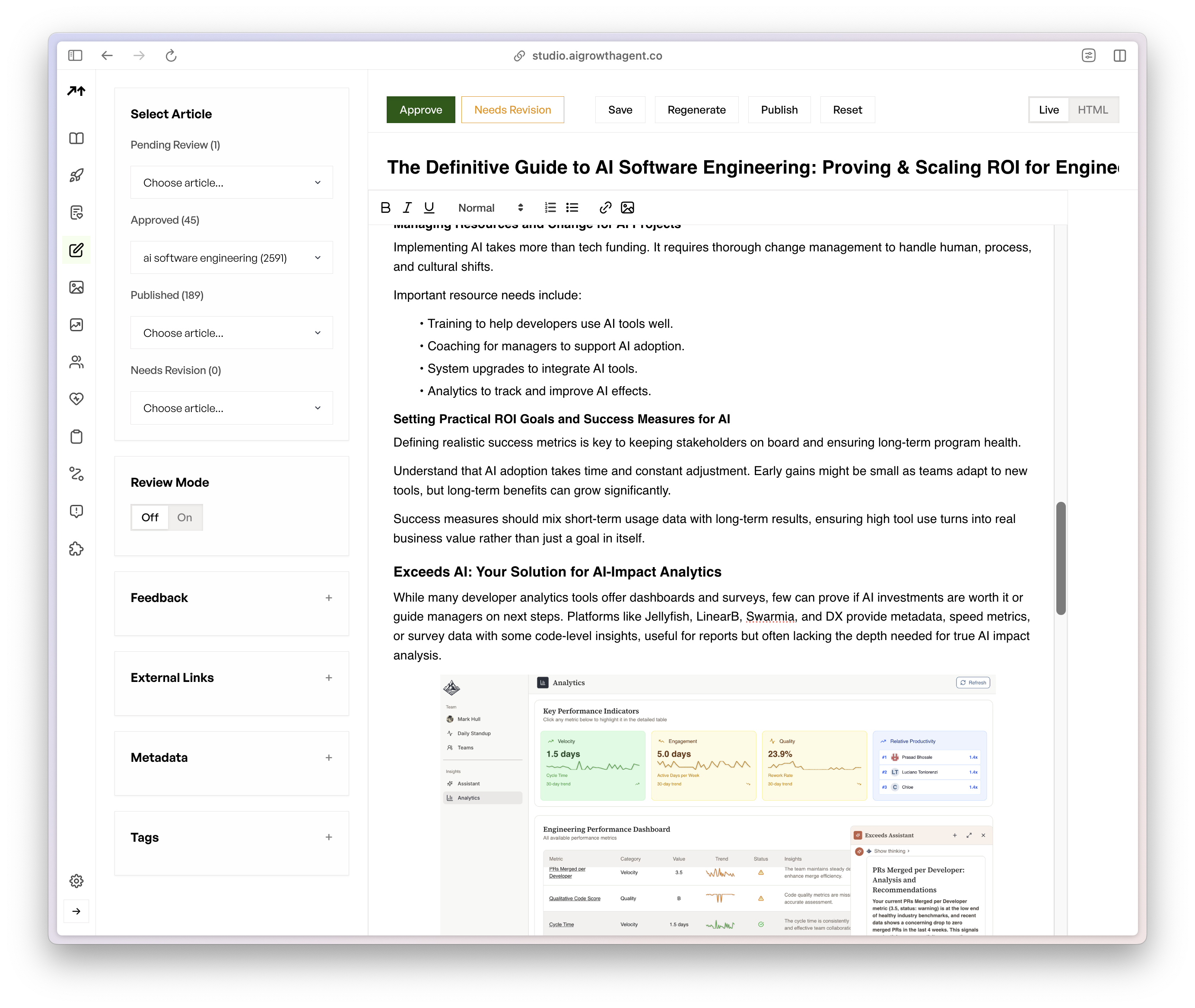
- Algorithms select contextually relevant visuals for each article or section.
- Alt text, captions, and metadata update at scale for accessibility and SEO.
- Visual assets stay consistent with brand standards across large content libraries.
These practices improve image search rankings, strengthen multimodal relevance, and give AI systems richer signals when assessing page quality.
10. AI search monitoring and feedback loops
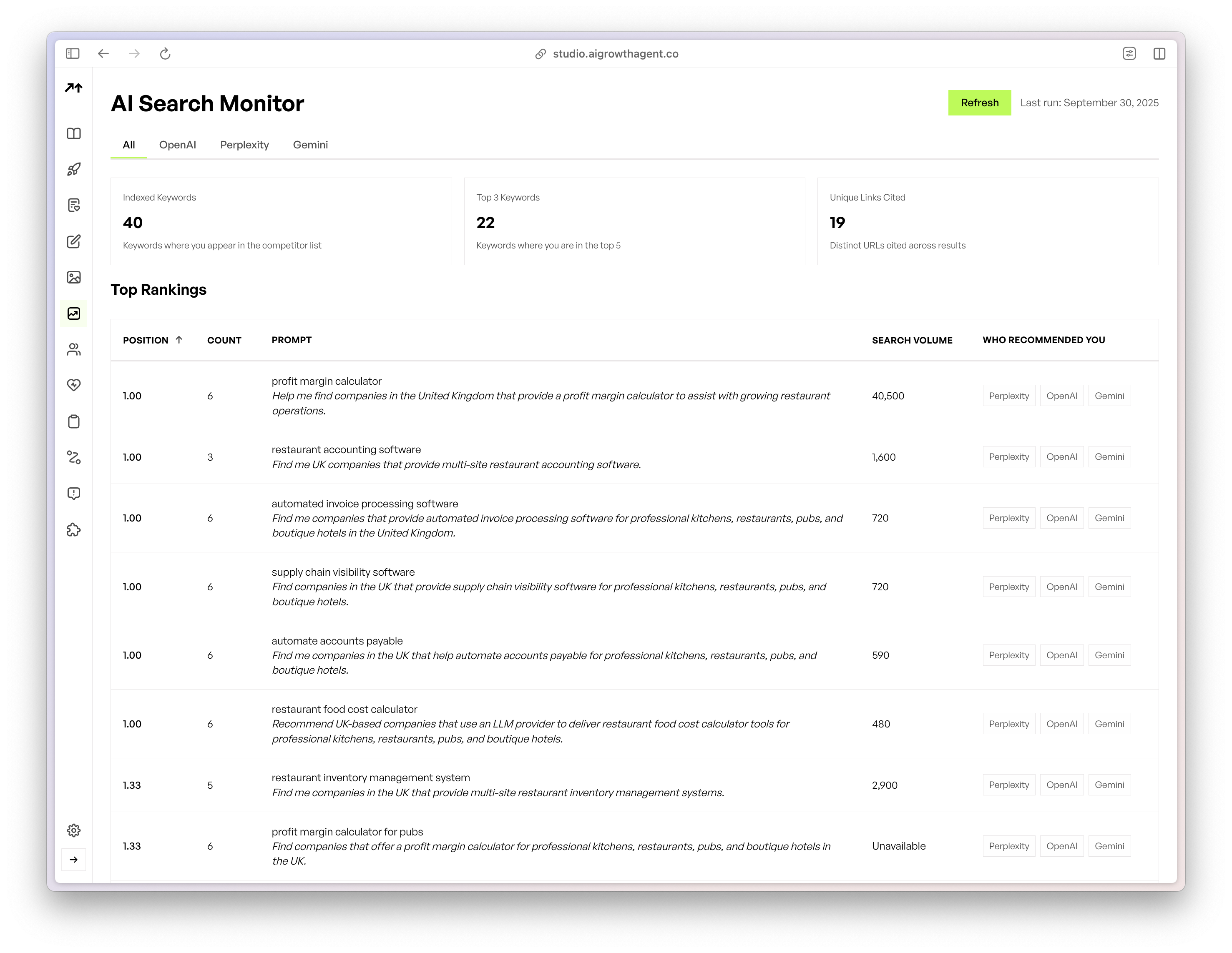
AI search monitoring tools now show how content appears inside AI-generated answers, not only in traditional SERPs.
- AI citation maps reveal which URLs surface in ChatGPT, Gemini, Perplexity, and similar tools.
- AI-specific crawl data shows how bots access key pages and schemas.
- Dashboards track visibility for strategic topics and entities across AI interfaces.
These insights help teams refine structures, topics, and internal links to improve performance in AI search over time.
Implementation considerations for enterprise teams
Enterprise adoption of these trends depends on strategy, data, and change management.
- Strategic alignment: Define where AI should drive measurable outcomes, such as acquisition efficiency, support cost reduction, or share of voice in AI search.
- Data foundation: Build accessible, governed data pipelines so AI systems can use accurate customer, product, and performance information.
- Pilot programs: Run focused pilots, such as a programmatic content cluster for one product line, then scale based on clear ROI.
- Vendor selection: Favor partners that combine content generation, technical SEO, multi-tenant control, and AI search monitoring in one coherent system.
AI Growth Agent vs. other solutions
Enterprises often compare traditional agencies, generic AI tools, and specialist AI search platforms when planning next steps.
|
Feature/Capability |
Traditional SEO Agencies |
Generic AI Content Tools |
AI Growth Agent |
|
Content Volume |
Low (Manual, limited) |
Medium (Unstructured) |
High (Autonomous, scalable) |
|
Technical SEO Automation |
Limited (Manual) |
None |
Full (Schema, metadata, LLM.txt) |
|
Strategic Research |
Manual |
Limited (User-driven) |
Autonomous (Programmatic) |
|
AI Citation Focus |
Indirect (Keyword) |
None |
Direct (Engineered for LLMs) |
Schedule a demo to evaluate whether AI Growth Agent aligns with your enterprise requirements for AI search and content scale.
Frequently asked questions about AI digital marketing trends
What is the biggest shift AI brings to enterprise digital marketing in 2026?
The major shift is from manual, article-by-article SEO to programmatic content engineering for AI search. Enterprises now need scalable systems that produce technically structured, authoritative content so AI models recognize them as reliable sources.
How can enterprise teams measure the ROI of AI initiatives in marketing?
Teams can track AI-related metrics such as visibility in AI results, citation frequency within AI-generated answers, and incremental organic traffic from AI-powered interfaces. These metrics sit alongside conversion, revenue, and customer lifetime value to show financial impact.
How is AI-powered SEO different from traditional SEO?
Traditional SEO focuses on keywords and basic on-page elements. AI-powered SEO focuses on intent, semantics, entity coverage, and machine-readable structure that help large language models interpret and reuse brand content in their answers.
What are the main challenges for enterprises adopting AI in marketing?
Common challenges include fragmented data, gaps in technical expertise, governance for AI-generated content, and limited capacity to maintain both quality and volume. Many generic tools do not address these enterprise-scale requirements.
Conclusion: Building durable advantage in AI search
AI now sits at the center of how customers search, compare, and decide. Enterprise brands that invest in structured content architectures, predictive analytics, and AI-aware SEO gain durable advantages in visibility and authority.
Teams that move early can secure leading positions in AI-generated results for their categories. Schedule a demo with AI Growth Agent to see how autonomous content engineering and AI search monitoring can support your 2026 roadmap.
