


Key takeaways from this article:
- AI search engines now behave like citation systems, prioritizing sources that demonstrate depth, clarity, and technical readiness for large language models.
- Traditional, manual content programs lack the scale, structure, and consistency needed to earn frequent citations from AI systems.
- AI Growth Agent automates content engineering, semantic optimization, and technical SEO so brands can build durable topical authority for AI search.
- Real-time content injection helps brands publish expert perspectives around breaking topics while search demand and AI interest are highest.
- Continuous AI search monitoring reveals how often and where AI platforms surface your content, creating a feedback loop for ongoing optimization.
Brands that want to stay visible in AI search need programmatic workflows that combine scale, structure, and technical rigor. Schedule a consultation session with AI Growth Agent to evaluate how programmatic thought leadership can support your growth goals.
The AI Search Era: Why Traditional Thought Leadership Falls Short
AI-powered search engines such as ChatGPT, Google AI Overviews, and Perplexity have changed how people discover, consume, and trust information. These platforms do more than rank content. They synthesize, cite, and recommend specific sources as authoritative answers to complex queries, which shifts search from keyword-based ranking toward authority-based citation.
The “shrinking digital footprint” problem now affects brands in nearly every industry. As AI increases the volume of content produced each day, individual company voices become harder to detect without a structured, programmatic strategy. Google’s integration of AI-generated overviews into search results means brands now compete not only for rankings, but also for citations and recommendations inside AI-driven summaries.
Traditional content creation methods, whether manual agency workflows or basic AI writing tools, cannot keep pace with the velocity and technical requirements of AI indexing. AI models process vast amounts of information and reward brands that publish consistent, technically optimized, and clearly structured content.
Manual strategies that once produced one or two strong articles per month no longer provide enough depth for AI search engines to recognize topical authority. The new baseline combines programmatic velocity with advanced technical implementation, and most traditional approaches cannot deliver this combination at scale.
1. Automated Content Engineering That Scales Authority
Modern AI platforms have evolved from simple writing tools into full content engineering systems. This shift moves the focus from producing individual articles to building entire content architectures that align with how AI systems read, index, and cite material.
Content engineering includes site structure, internal linking, metadata, schema markup, and semantic optimization so AI search engines can correctly understand and reference your expertise. The goal is to serve both human readers and AI models with clear, structured information.
AI Growth Agent applies this approach through autonomous Programmatic SEO capabilities. The platform automates planning, drafting, and technical optimization at a scale that exceeds manual workflows, while still giving teams the ability to review and refine content through an intuitive editor.
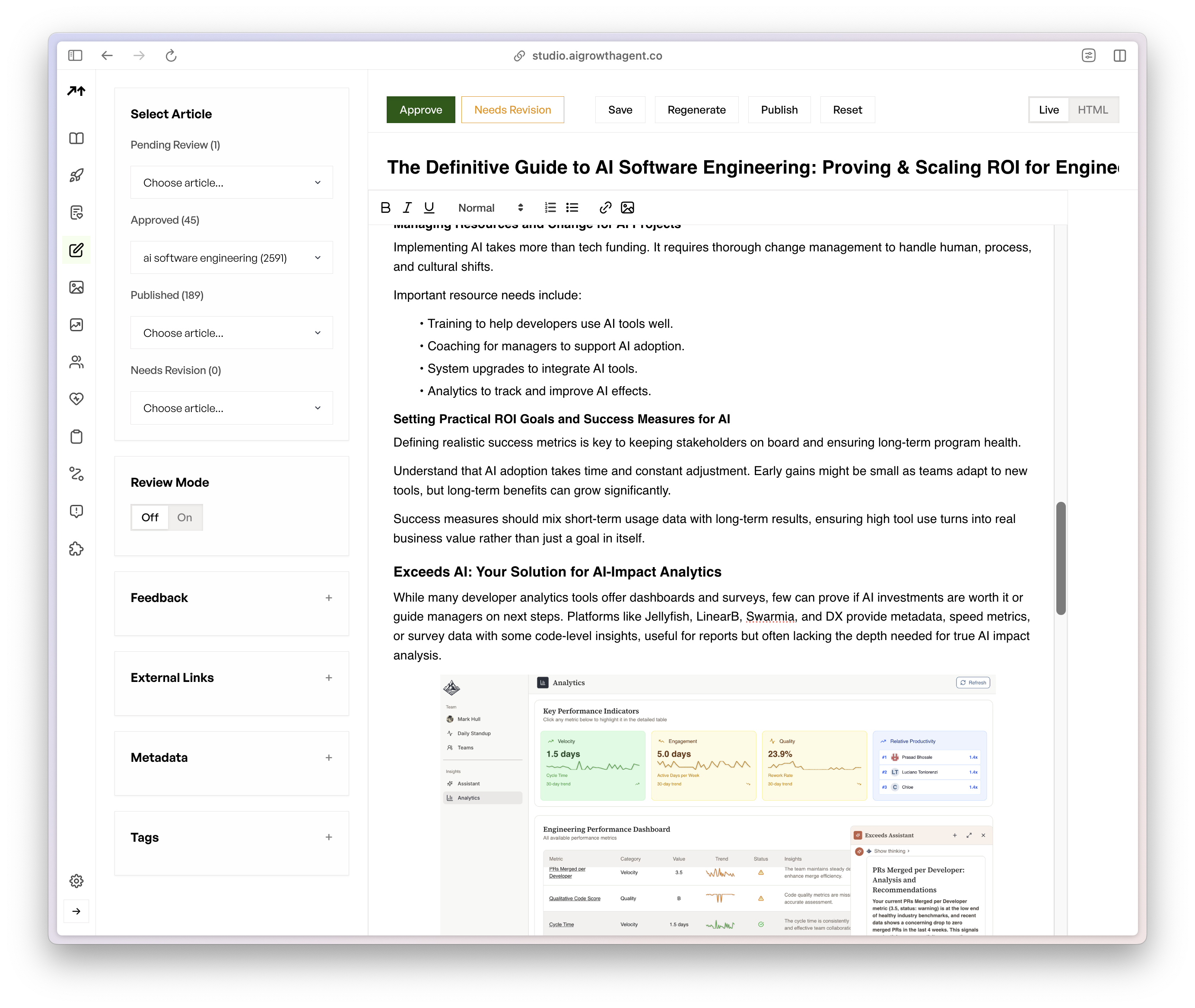
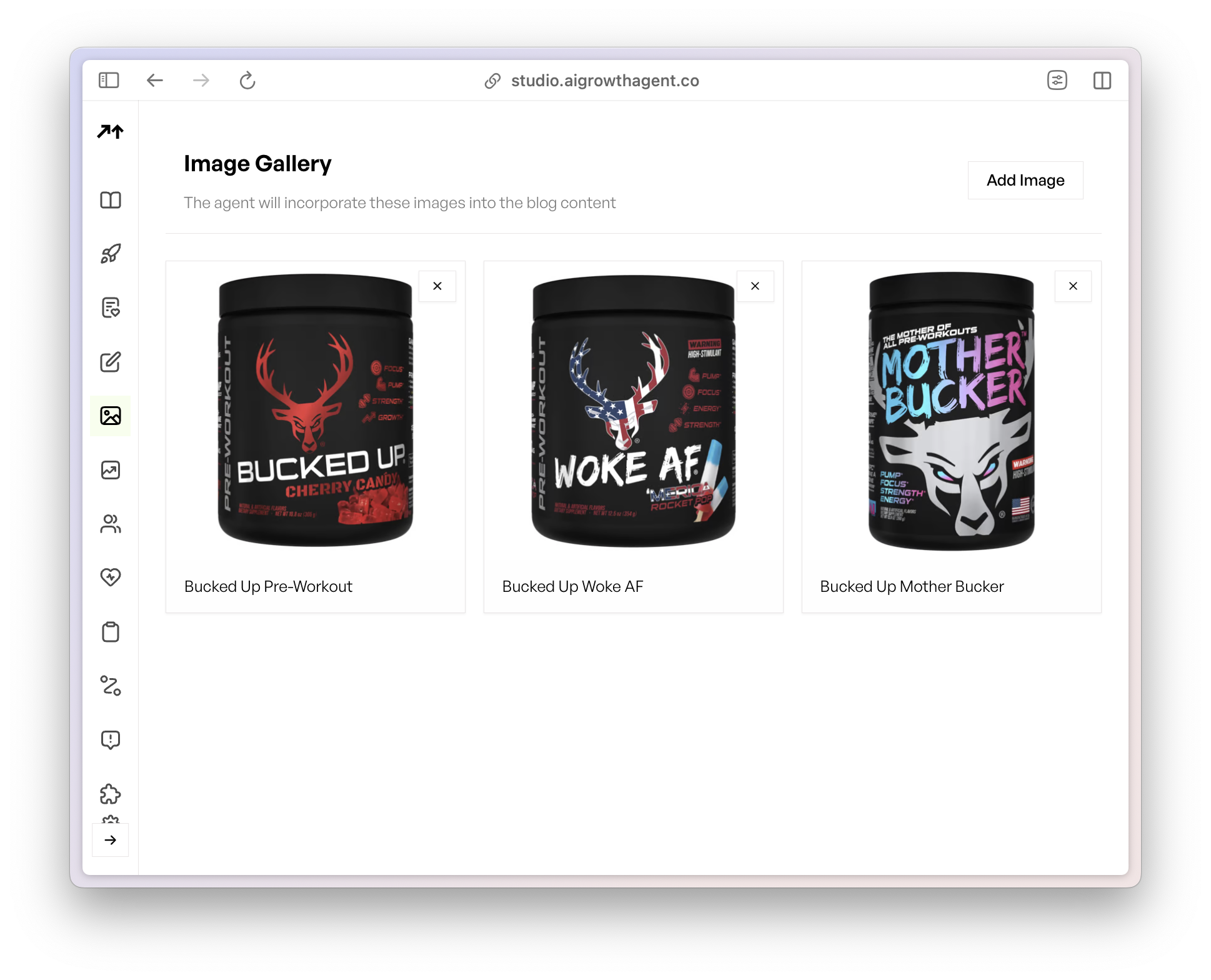
Teams can also provide approved visuals and brand assets, so the agent incorporates images where they add context, clarify complex ideas, or support product storytelling.
AI Growth Agent also implements advanced technical SEO elements by default. The system creates complete content ecosystems with structured data, LLM.txt files, and a blog Model Context Protocol (MCP) that allows AI search engines to interface more directly with your content database.
AI search engines such as ChatGPT Search benefit from specific technical configurations that make crawling and interpretation more reliable. AI Growth Agent handles schema markup, metadata, and structured data in a consistent way, which makes each page easier for AI models to understand.
This engineered architecture supports continuous, large-scale publishing rather than isolated articles. Over time, this structure creates the depth and consistency that help position your brand as a trusted source for AI citations within your market.
2. Precision Targeting and Semantic Optimization for AI Indexing
AI search engines interpret context, intent, and semantic relationships instead of relying only on keyword matching. Content strategy therefore needs to shift from targeting single keywords to building semantic clusters and topical authority.
AI Growth Agent conducts programmatic keyword and topic research across tens of thousands of queries related to your domain. It organizes these insights into content pillars and clusters that align with how AI systems group and answer related questions.
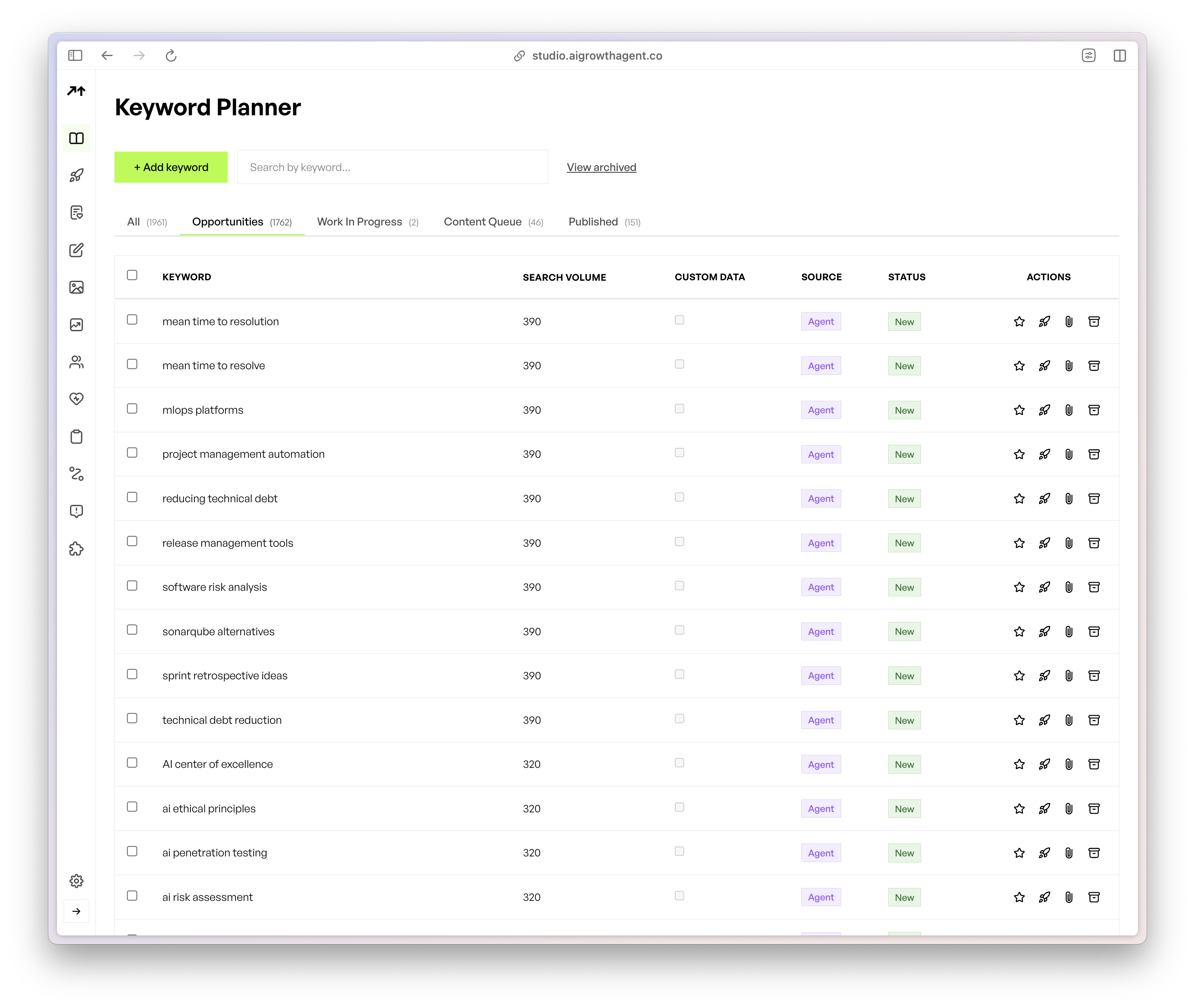
This structure reflects how AI search engines reward comprehensive topic coverage instead of isolated keyword optimization. When someone asks an AI system about your industry, the model draws on its understanding of your entire topical footprint, not just a single article.
Semantic optimization also depends on clear technical signals. Structured data and schema markup help AI models interpret how different articles, guides, and resources relate to one another within your site. Schema.org structured data implementation supports this understanding by describing content types, relationships, and entities.
Specialized elements such as LLM.txt files extend this technical layer. These files give AI crawlers guidance on how to interpret, attribute, and cite your content. When implemented consistently, this specification increases the likelihood that AI models will reflect your brand’s perspective accurately in generated answers.
To strengthen your content’s authority in AI search, you need both semantic depth and technical clarity. Schedule a consultation session with AI Growth Agent to explore a programmatic approach to semantic coverage in your market.
3. Real-Time Responsiveness and Dynamic Content Injection
Search behavior in the AI era moves quickly, especially around breaking news and emerging topics. Brands that respond in near real time can capture disproportionate visibility in both traditional and AI search results.
AI platforms enable rapid response to new developments by generating expert content while interest is still peaking. This speed helps position your brand as a timely and relevant source when AI systems look for current information.
AI Growth Agent’s Real-Time Programmatic SEO Content Injection feature supports this need. Users submit a link to breaking news or a trending conversation, and the platform generates an SEO-ready article that incorporates the brand’s informed perspective. This workflow allows companies to capture search demand around new topics within minutes instead of days or weeks.
Real-time responsiveness is especially important because AI search platforms often highlight recent, credible sources when answering queries about current events. Brands that publish clear, well-structured explanations quickly are more likely to be cited as reference points.
AI Growth Agent supports this speed with automated publishing workflows, instant technical SEO implementation, and integrations with leading content management systems. As a result, rapid-response content maintains the same technical quality as planned, evergreen material.
Agile content strategies that allow rapid deployment of expert insights on emerging trends now provide a meaningful edge in AI search. In many cases, timing determines which brand becomes the cited authority on a topic and which ones remain unseen.
4. Technical SEO Automation Beyond Manual Capacity
Technical SEO for AI search is more demanding than traditional optimization. AI models benefit from detailed metadata, structured relationships, and explicit guidance about how to interpret content, which is difficult to maintain manually at scale.
AI Growth Agent automates this complex technical layer. The platform sets up rich schema markup, optimized metadata, robots.txt guidance, LLM.txt files, and Model Context Protocols that help AI search engines crawl and understand site content with greater precision.
The LLM.txt implementation offers a dedicated channel for communicating with AI crawlers. These files describe how to interpret different sections of the site and how to handle citations, which improves the consistency of AI-generated references. AI Growth Agent generates and maintains these files automatically as your content portfolio grows.
Model Context Protocols add another layer of structure by enabling AI agents to interact more directly with your content database. This structure helps AI systems understand relationships and hierarchies inside your content, which supports more accurate citations and summaries.
Many agencies and internal teams struggle to maintain this level of technical optimization across large content libraries. Implementing and updating advanced schema markup, structured data, and AI-specific files by hand is time-consuming and prone to inconsistency.
AI Growth Agent decorates each published piece with the required technical elements, including structured data markup, optimized image tags, and metadata that serve both readers and AI models. Technical SEO becomes an integrated part of content creation rather than a separate, manual step.
To improve your site’s technical readiness for AI search, you need consistent automation instead of one-off fixes. Schedule a consultation session with AI Growth Agent to review your current technical SEO foundation.
5. AI Search Monitoring and Continuous Influence Feedback Loops
Clear visibility into how AI models cite and recommend your content is essential for refining a thought leadership strategy. Traditional analytics focus on rankings and traffic, while AI search optimization centers on citations, mentions, and references inside generated answers.
AI search monitoring is complex because each AI platform interprets and surfaces content differently. Models weigh authority signals in unique ways, so performance can vary by tool even when content is identical.
AI Growth Agent’s AI Search Monitor provides a unified view of how your content appears across major AI search platforms inside the AI Growth Agent Studio. The system tracks which URLs drive the most AI visibility, identifies direct quotes and citations, and reports on mentions across supported AI tools.
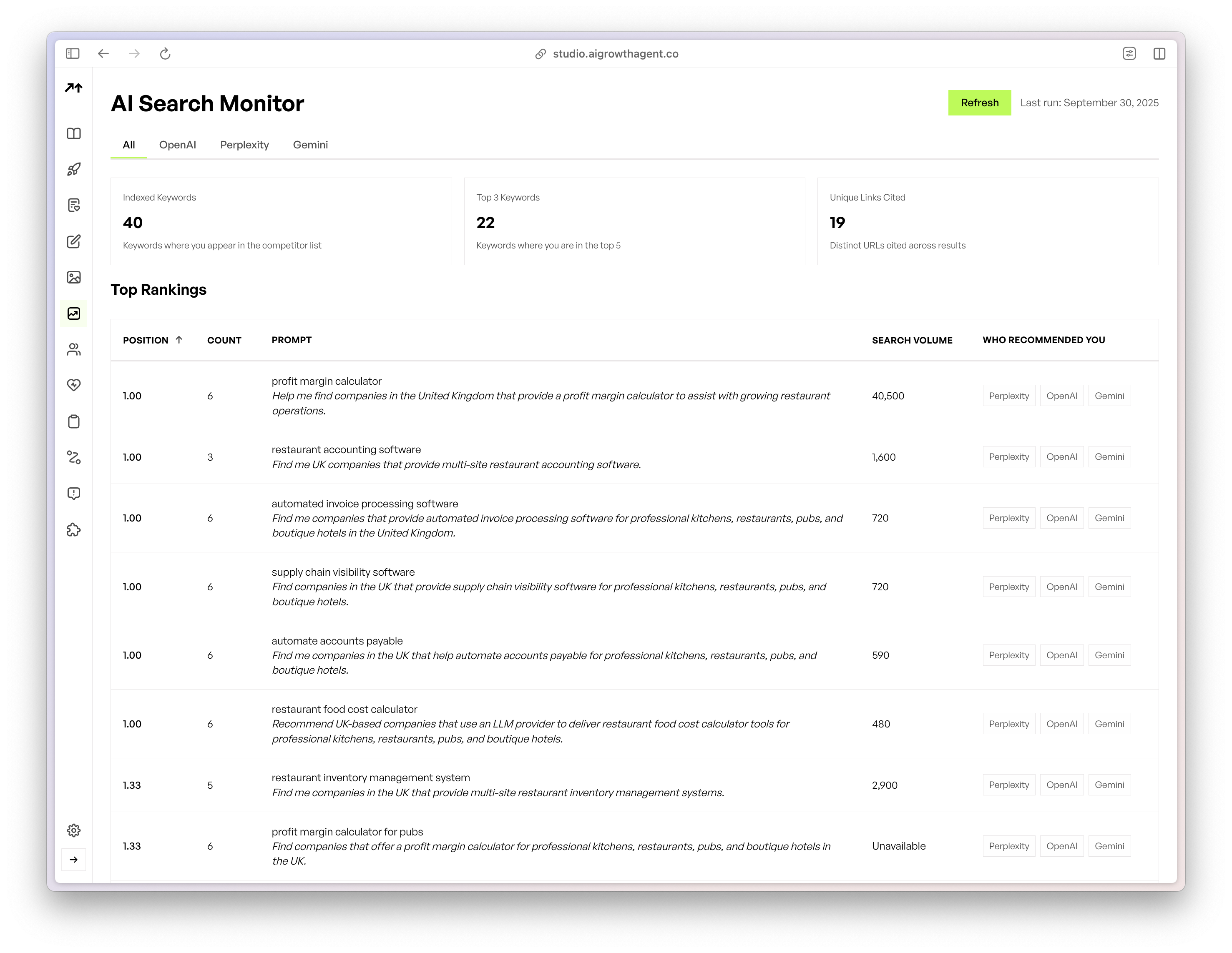
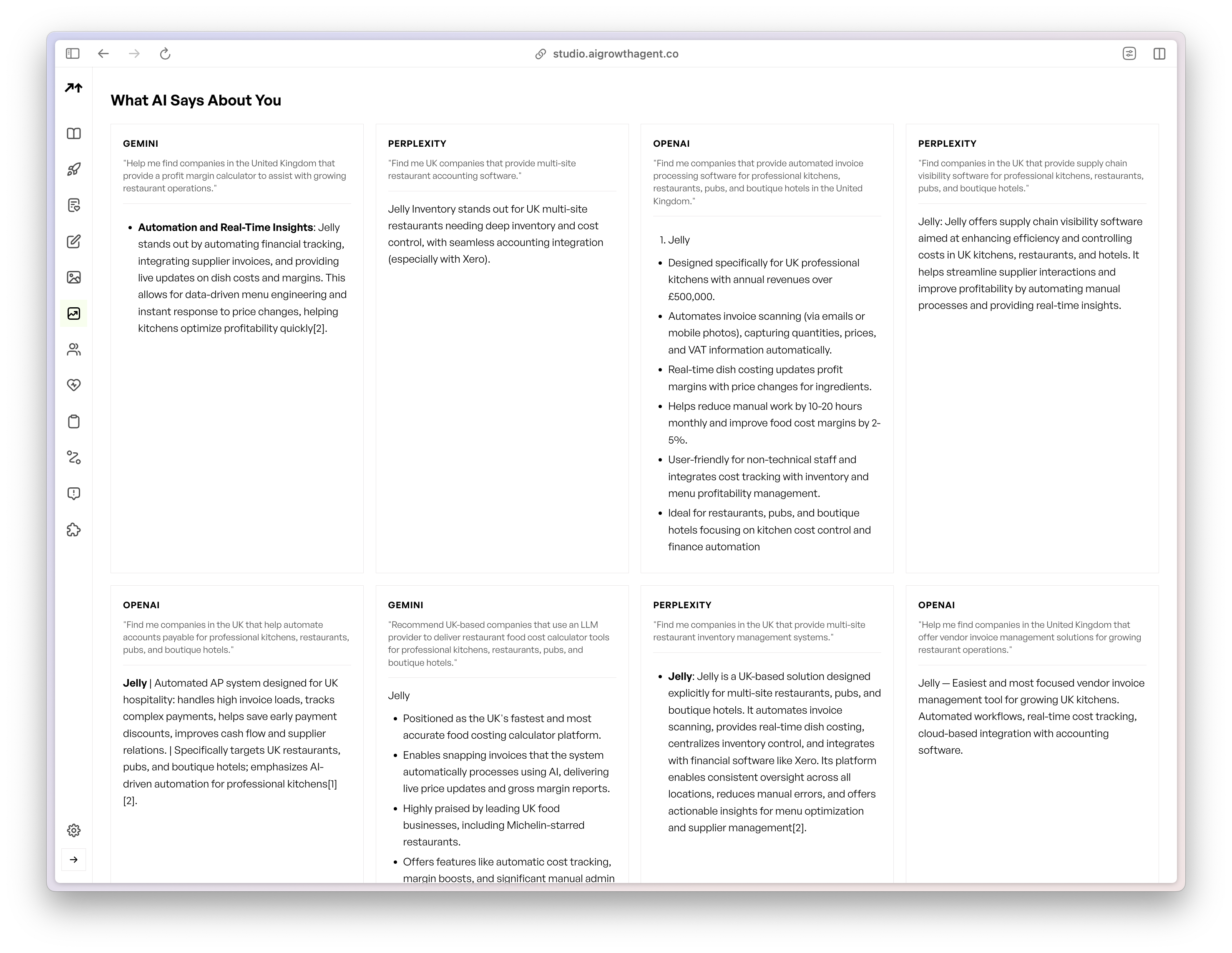
This monitoring includes heatmap-style views that show how your brand indexes for target themes across AI platforms. Understanding these AI citation patterns helps teams decide which topics to reinforce and which gaps to address.
The feedback loop extends into crawl statistics for different AI bots, revealing which topics and formats attract the most AI attention. This data supports continuous content optimization focused on visibility and citation frequency rather than only rankings.
Integration with Google Search Console connects AI-focused metrics with traditional organic traffic data. Teams can see how AI-optimized content contributes to overall growth and can align future investments with the topics that deliver the strongest combined performance.
Comparing Thought Leadership Solutions for the AI Era
|
Feature / Tool Category |
Traditional Agencies |
Basic AI Tools |
AI Growth Agent |
|
Content Volume |
Limited output, often 1 to 2 articles per month due to manual processes |
Higher volume, but without structured strategy or technical optimization |
Programmatic scale with consistent quality controls and editorial review options |
|
Technical SEO Depth |
Manual implementation that can vary by project and team |
Minimal technical optimization, schema and advanced markup handled separately |
Automated implementation of advanced schema, LLM.txt, and MCP across content |
|
AI Citation Focus |
Indirect focus, measured mainly through traditional SEO metrics |
No AI-specific optimization or citation engineering |
Direct engineering for AI comprehension, citation potential, and structured access |
|
Deployment Speed |
Weeks or months from planning to publication |
Faster drafting, but manual setup and configuration for each piece |
Autonomous deployment from first meeting to first article in roughly one week |
Conclusion: Use Programmatic Thought Leadership to Compete in AI Search
The rise of AI search has reset expectations for what effective thought leadership looks like. Brands that combine programmatic content production with strong technical foundations will be more visible in AI-generated answers, while those that rely on traditional methods risk losing share of voice.
The five strategies covered here, automated content engineering, semantic optimization, real-time responsiveness, technical SEO automation, and AI search monitoring, form a baseline for competing in an AI-first landscape. Together, they create a system that builds authority at the scale and speed AI platforms reward.
AI Growth Agent translates these concepts into a practical platform. From keyword research and content strategy through technical implementation and publishing, the system reduces operational complexity so marketing teams can focus on positioning, messaging, and measurement.
The advantages of programmatic thought leadership accumulate over time. Brands that start early with AI-optimized content creation build citation momentum that becomes difficult for slower competitors to match, especially as technical and semantic requirements grow more complex.
Long-term success in AI search depends on execution, not only on awareness of these trends. The longer brands wait to build AI-ready authority, the more competitive their landscapes become.
To begin positioning your brand as a trusted source in AI search, take the first step toward a programmatic content framework. Schedule a consultation session with AI Growth Agent to assess your readiness and opportunities in the AI search era.
Frequently Asked Questions About AI Thought Leadership
How do AI platforms specifically help my content get cited by AI search engines?
AI platforms such as AI Growth Agent automate the creation of focused, technically optimized content that aligns with AI search requirements. The system embeds schema markup, implements LLM.txt files, and supports Model Context Protocols that make your content easier for AI models to parse and attribute.
Each piece is generated with the technical specifications AI crawlers expect, which raises the likelihood that your content will be selected as a reference for relevant queries. Programmatic coverage across a topic also helps AI systems recognize your brand as an authority across an entire subject area instead of a single page.
Can I maintain brand voice and quality when using AI for thought leadership at scale?
Modern AI platforms are designed to maintain brand consistency and quality while scaling production. AI Growth Agent begins with a detailed Company Manifesto development process during a one-hour kickoff session with a professional journalist.
This Manifesto encodes your branding, positioning, messaging, and narrative preferences so the agent generates content that reflects your voice. Feedback tools inside the AI Growth Agent Studio then allow your team to revise, approve, and guide future outputs, so quality and tone improve as the system learns from your preferences.
Is programmatic SEO truly effective for establishing thought leadership, or is it just about volume?
Programmatic SEO supports thought leadership when it combines volume with strategy and technical rigor. AI Growth Agent focuses on building comprehensive topical coverage rather than isolated articles, which helps AI models recognize expertise across an entire domain.
The platform clusters keywords, applies semantic optimization, and implements AI-specific technical elements so content is both meaningful to readers and easier for AI systems to interpret and cite. Volume plays a role because AI models rely on multiple data points to infer authority, but each piece is engineered to contribute to a coherent and credible body of work.
How quickly can an AI platform start generating impactful thought leadership content?
AI platforms that specialize in programmatic thought leadership typically begin producing optimized content much faster than traditional workflows. AI Growth Agent can move from initial onboarding to the first programmatically engineered article in about a week.
During that time, the team finalizes your Company Manifesto, defines content pillars, and configures the technical environment. Many clients begin seeing citations from AI search engines within two to three weeks of deployment, with examples that include Exceeds AI, BeConfident, Bucked Up, and Gitar reaching AI recommendations shortly after launch.
What technical requirements must my website meet to implement AI-optimized thought leadership?
AI-optimized thought leadership requires a more advanced technical foundation than standard SEO. Key elements include structured data and schema markup, LLM.txt file configuration, Model Context Protocol setup, robots.txt guidance for AI crawlers, and consistent metadata across content.
AI Growth Agent manages these requirements automatically. Brands can use the platform’s hosted blog solution as a subdomain of their site, such as blog.yourcompany.com, or integrate with existing systems such as WordPress, HubSpot, or Webflow. In both cases, the platform applies AI-focused technical standards across every piece, which reduces the need for manual technical SEO work by internal teams.
