


Key Takeaways
- Brand-managed sources now drive 86% of AI citations in 2026, so AI search analytics have become a core marketing channel.
- AI search tools track citation heatmaps, bot crawls, and visibility across ChatGPT, Perplexity, and Google AI Overviews instead of keyword rankings.
- Most tools like Otterly AI, Peec AI, and Profound focus on monitoring and do not execute changes that improve citations.
- AI Growth Agent uniquely combines real-time monitoring, autonomous SEO execution, Google Search Console integration, and multi-tenant scalability.
- Schedule a demo with AI Growth Agent to build scalable AI search visibility with connected analytics and execution.
The 2026 AI Search Analytics Landscape for Marketers
AI search analytics now define how brands measure visibility across LLMs. Traditional SEO centered on keyword rankings and organic traffic, while AI search analytics focuses on citation frequency, brand mentions, and presence across AI platforms.
Listicles achieve 25% citation rates compared to 11% for standard blog content, which shows how content format shapes AI visibility. Core metrics include citation heatmaps across ChatGPT, Perplexity, and Gemini, bot crawl statistics that reveal AI indexing behavior, and share of voice that compares your visibility against competitors.
AI referral traffic converts at 4.4x higher rates than traditional organic search, so visibility tracking now ties directly to ROI. Most tools still stop at monitoring and do not provide programmatic execution that systematically improves citations. Schedule a demo to see if you’re a good fit for integrated analytics and execution.
Otterly AI: Accessible Multi-Platform Monitoring
Otterly AI gives marketers broad AI search coverage with a simple interface. The platform tracks visibility across ChatGPT, Perplexity, Google AI Overviews, and other engines with clear reporting. Otterly AI offers comprehensive coverage starting at $29 monthly with clear reporting, which makes it attractive for early-stage teams.
Features include multi-engine monitoring and straightforward dashboard visualization that surfaces basic trends. Strengths include wide platform coverage and an intuitive user experience that shortens onboarding time. Limitations include no programmatic execution and only light advanced analytics, so teams still handle changes manually.
Rankability targets teams that want deeper AI visibility tracking with workflow support. The platform tracks ChatGPT, Perplexity, Gemini, Claude, and more, then adds optimization recommendations and AI citation audits.
Rankability’s AI Analyzer costs $149 monthly for comprehensive monitoring, which positions it above basic tools. Both Otterly AI and Rankability focus on monitoring with some optimization guidance, yet they do not include the integrated execution engine that defines AI Growth Agent’s full-stack approach.
AI Growth Agent: Integrated Monitoring and Execution
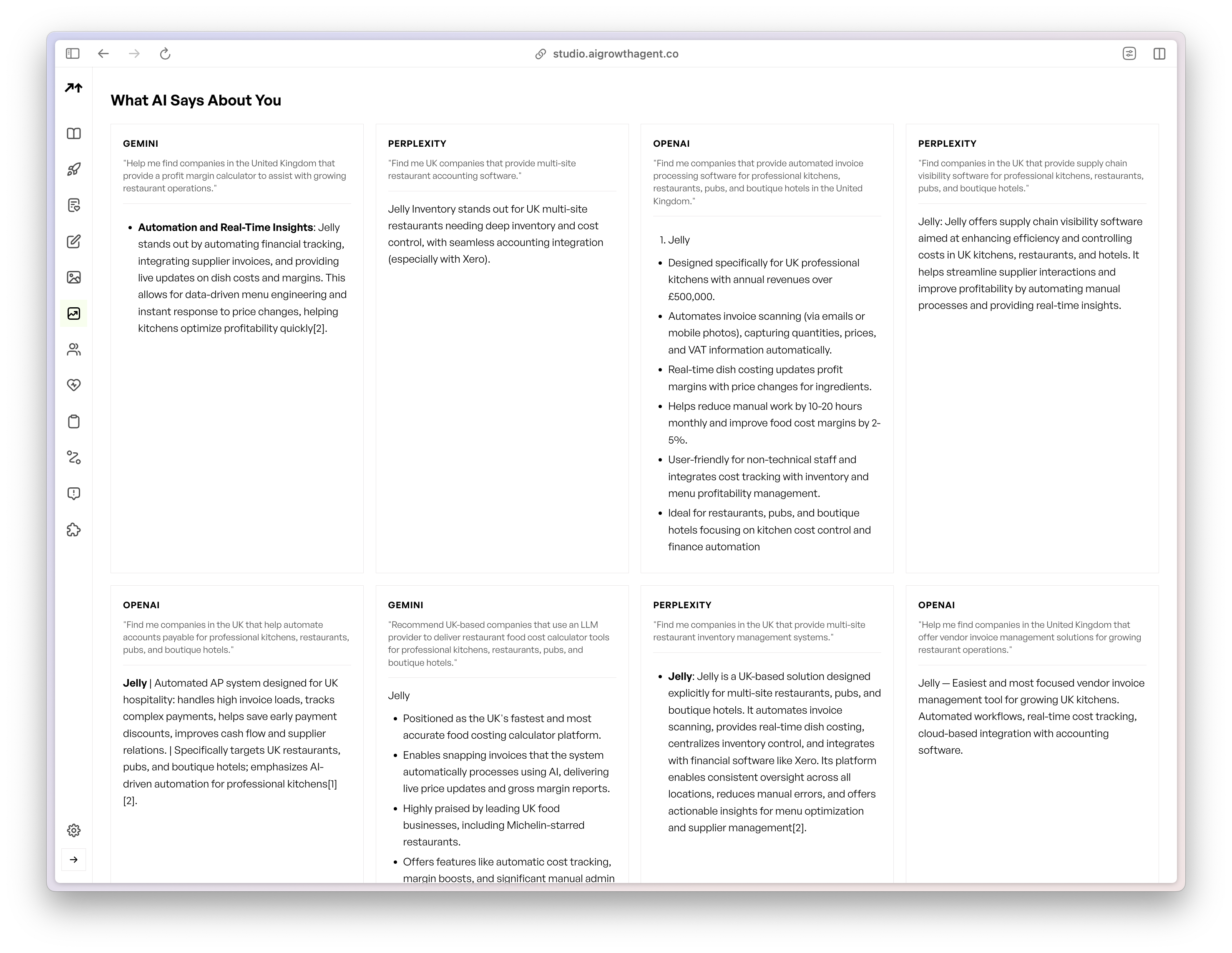
AI Growth Agent combines AI search monitoring with autonomous programmatic SEO execution in a single platform. The AI Search Monitor delivers real-time citation heatmaps across ChatGPT, Perplexity, and Gemini, showing which URLs drive AI visibility and capturing direct quotes from AI responses.
Key features include Google Search Console integration for traffic correlation, bot crawl statistics for ChatGPT and Perplexity indexing, and programmatic feedback loops through MCP and LLM.txt implementation. The platform supports multi-tenant deployment for portfolio companies and offers WordPress integration that fits into existing CMS workflows, with typical onboarding completed in one week.
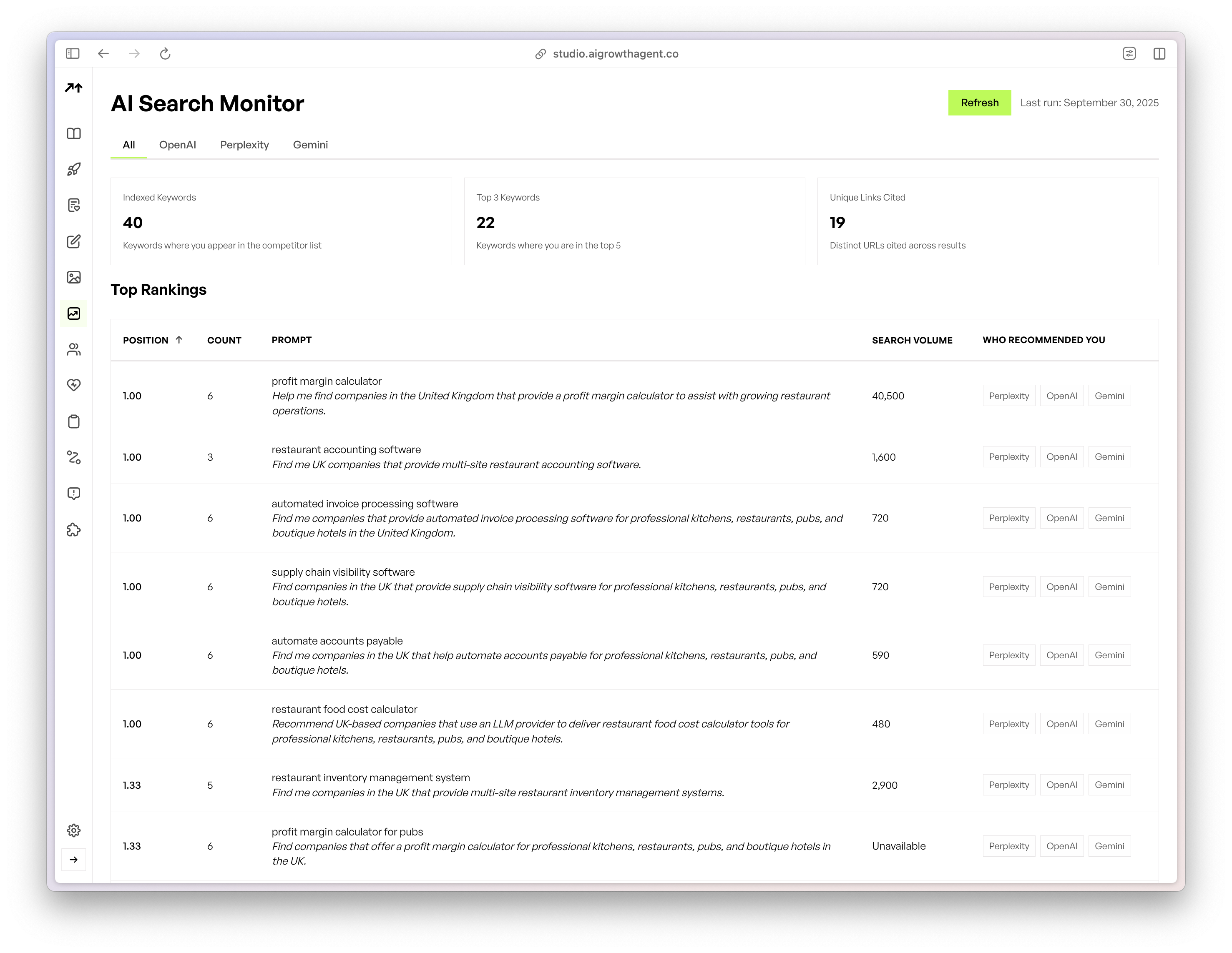
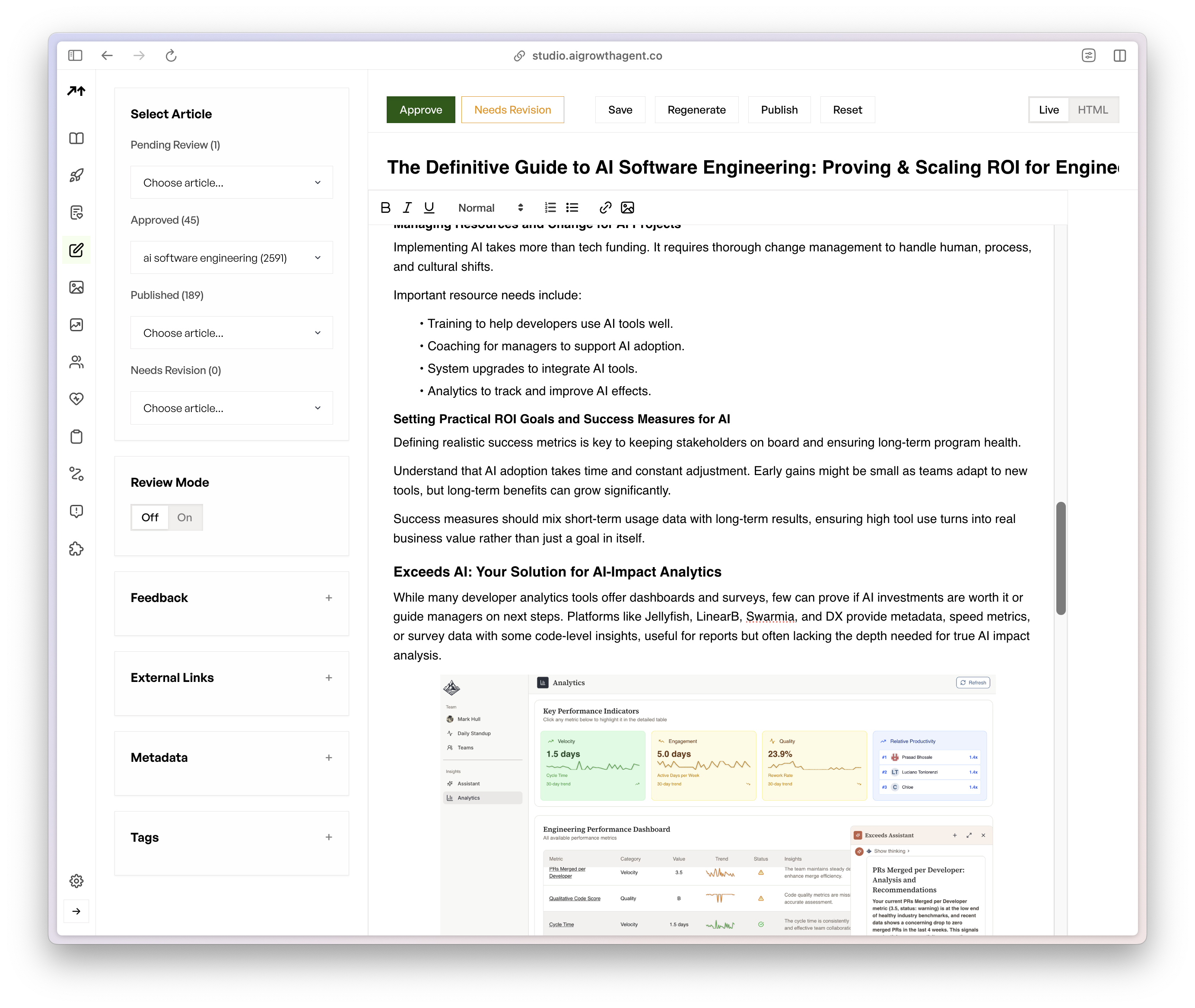
AI Growth Agent has documented execution results, such as Exceeds AI, gaining Perplexity citations within two weeks of launch. The platform focuses on premium brands and accepts clients selectively, which keeps support and execution quality high. Marketing VPs who need to scale authority across multiple properties gain a single system for analytics and execution. Schedule a demo to see if you’re a good fit.
Peec AI: Starter-Level AI Visibility Tracking
Peec AI gives teams a basic entry point into AI search analytics. The tool tracks LLM visibility with limited prompt research capabilities and focuses on ChatGPT and Perplexity monitoring. The platform does not include advanced heatmap visualization or any execution components, so teams still rely on manual changes. Peec AI maintains a 5/5 user rating with free trial availability, which lowers the barrier for initial experimentation.
Strengths include straightforward setup and cost-effective pricing around $105 monthly, which suits lean marketing teams. Limitations include no programmatic execution, shallow citation depth analysis, and no bot crawl statistics. Pricing starts at $99-105 per month with free trial options, which keeps risk low. Peec AI fits small marketing teams that only need basic visibility insights and do not yet require automated execution.
Profound: Enterprise LLM Answer Engine Insights
Profound serves enterprises that want detailed LLM insights and answer engine analytics. The platform tracks citations across major AI systems and includes ChatGPT shopping visibility tracking for commerce-focused brands.
Profound does not monitor traditional search engines and does not support prompt research, so the focus stays on LLM behavior. Profound maintains a 4.6/5 rating with enterprise-focused pricing at $99 monthly, which positions it as a mid-range enterprise option.
Strengths include robust enterprise reporting and detailed citation quality analysis that helps teams refine content strategy. Limitations include no search monitoring integration, no programmatic SEO execution, and limited scalability for multi-brand portfolios that need shared infrastructure.
Pricing begins at $99 per month and does not include a free trial, which suits teams that already have budget approval. A fintech client achieved 7x citation increases within 90 days using Profound, which shows its value for pure analytics. Profound fits large enterprises that want deep citation analytics without automation.
Otterly AI and Rankability: Monitoring-Focused Alternatives
Otterly AI and Rankability both address teams that want reliable AI search monitoring without automation. Otterly AI delivers multi-platform coverage across ChatGPT, Perplexity, Google AI Overviews, and more with user-friendly reports.
Otterly AI offers comprehensive coverage starting at $29 monthly with clear reporting, which makes it a popular starter tool. Features include multi-engine monitoring and simple dashboards that highlight where brands appear.
Rankability builds on this concept with tracking across ChatGPT, Perplexity, Gemini, Claude, and other engines, then adds optimization recommendations and workflows. Rankability’s AI Analyzer costs $149 monthly for comprehensive monitoring, which targets more advanced teams.
Both tools provide monitoring and some optimization guidance, but do not include autonomous execution, which keeps them distinct from AI Growth Agent’s full-stack model.
AI Search Analytics Tools: Side-by-Side Comparison Table
|
Tool |
Automation/Execution |
LLM Depth/Scalability |
Pricing/Onboarding |
|
AI Growth Agent |
Full programmatic SEO |
High/Multi-tenant |
Custom/1-week |
|
Peec AI |
None |
Basic/Medium |
$105/month |
|
Profound |
None |
Enterprise/High |
$99/month |
|
Otterly AI |
None |
Medium/Medium |
$29+/month |
|
Rankability |
Optimization recommendations |
Medium/Medium |
$149/month |
AI Growth Agent stands out as the only full-stack AI search analytics platform that pairs monitoring with autonomous execution. Competing tools provide visibility data and recommendations, while AI Growth Agent executes programmatic SEO that improves citations at scale. Schedule a demo to see if you’re a good fit for integrated AI search analytics and programmatic SEO execution.
Implementation Checklist for AI Search Analytics
Effective AI search analytics start with a clear technical foundation and measurable benchmarks. Teams first test LLM.txt and Model Context Protocol implementation so AI systems can index content directly and consistently.
Next, they establish citation frequency baselines using 30% appearance rates as minimum targets for core queries, which sets expectations for performance. Google Search Console integration then connects AI visibility with traffic and conversions, giving leaders a complete view of ROI.
WordPress integration keeps workflows familiar for content teams and reduces friction during rollout. Multi-platform monitoring across ChatGPT, Perplexity, and Gemini ensures that brands see the full picture instead of focusing on a single engine.
AI Growth Agent Studio centralizes analytics and execution, which allows teams to adjust content in real time based on citation performance. Schedule a demo to see if you’re a good fit for guided implementation and ongoing optimization.
Frequently Asked Questions (FAQ)
What are AI search analytics?
AI search analytics measure brand visibility and citations across Large Language Models such as ChatGPT, Perplexity, and Google AI Overviews. These analytics replace traditional SEO metrics like keyword rankings with citation frequency, brand mentions, visibility heatmaps, and bot crawl statistics.
Teams use these metrics to understand how AI platforms reference and surface their content. AI search analytics focus on brand authority and citation quality, supported by data showing that AI visitors convert at 4.4x higher rates than organic search visitors.
How do I track citations in Perplexity and ChatGPT?
Teams track citations in Perplexity and ChatGPT through specialized tools that query AI platforms with target keywords and log brand appearances. Effective tracking runs regular prompts across multiple AI engines, records citation position and context, and measures competitive share of voice.
Advanced tools generate citation heatmaps that show geographic and topical visibility patterns, which help teams prioritize content updates. Automated monitoring replaces manual prompt testing and saves hours of repetitive work. AI Growth Agent’s AI Search Monitor delivers real-time citation tracking with direct quote extraction and competitive analysis.
What are the best free AI search analytics tools?
AI Search Grader gives free visibility insights across ChatGPT, Mistral, and Llama models, which helps teams run initial assessments. SEO.com offers free AI Overview checking for Google AI visibility, while manual prompt testing across AI platforms still provides basic citation data.
Free tools rarely include comprehensive monitoring, competitive analysis, or execution features, so they work best for early research. Teams that need scalable AI search analytics with programmatic execution upgrade to AI Growth Agent for integrated monitoring and autonomous content updates.
How does AI Growth Agent compare to Peec AI?
AI Growth Agent delivers full-stack AI search analytics with programmatic SEO execution, while Peec AI focuses on basic monitoring. AI Growth Agent includes citation heatmaps, bot crawl statistics, Google Search Console integration, and autonomous content generation through programmatic SEO agents.
Peec AI tracks visibility but offers limited analytical depth and no automation. The core difference lies in execution, because AI Growth Agent actively improves citations with programmatic content creation, while Peec AI only reports on current performance.
What ROI timelines should I expect from AI search analytics?
Companies that adopt comprehensive AI search analytics often see early ROI from new AI citations and incremental organic traffic. Many programs record citation gains within two to three weeks for well-structured content, then build sustained visibility over several months of consistent programmatic execution.
AI referral traffic converts at much higher rates than traditional organic search, which accelerates payback periods. Results depend on pairing analytics with execution, since monitoring alone does not change how AI systems cite your brand.
How do AI search analytics differ from traditional SEO?
AI search analytics prioritize citation velocity and brand mentions instead of keyword rankings and raw traffic. Traditional SEO measures clicks, impressions, and SERP positions, while AI analytics track citation frequency, share of voice, and authority across AI platforms.
AI search rewards content recency and structural consistency that support LLM indexing, which contrasts with traditional SEO’s emphasis on backlinks and domain authority. This shift reflects how AI systems prefer authoritative, well-structured content that they can cite reliably.
Conclusion: Why AI Growth Agent Leads AI Search Execution
AI Growth Agent leads the 2026 AI search analytics market by pairing comprehensive monitoring with autonomous programmatic execution. Premium brands use the platform to gain durable visibility and measurable ROI across AI search channels.
Monitoring-only tools such as Peec AI and Profound provide useful insights, yet they stop short of automated execution. AI Growth Agent fills that gap with a connected analytics and execution engine that supports sustained AI search dominance. Schedule a demo to see if you’re a good fit for the leading AI search analytics and execution platform.
