


Key Takeaways
- AI search platforms like Google AI Overviews and ChatGPT reduce organic clicks by 34.5%, so brands need proactive AI search strategies.
- AI visibility tracking tools deliver diagnostics and competitive insights but do not execute on building AI citations.
- Programmatic SEO automates large-scale production of technically structured content with schema and MCP integration for enterprise growth.
- Hybrid strategies pair visibility monitoring for intelligence with programmatic execution for authority building at scale.
- AI Growth Agent delivers end-to-end autonomous programmatic SEO; schedule a demo to see if you’re a good fit for AI dominance.
Core Definitions for Enterprise AI Search
Enterprise AI search visibility refers to tools that track brand mentions, citations, and sentiment across AI-powered search engines. Leading platforms like Nightwatch provide real-time monitoring across Google AI Overviews, ChatGPT, Claude, and Perplexity, with visibility scores and competitive benchmarking inside dashboards.
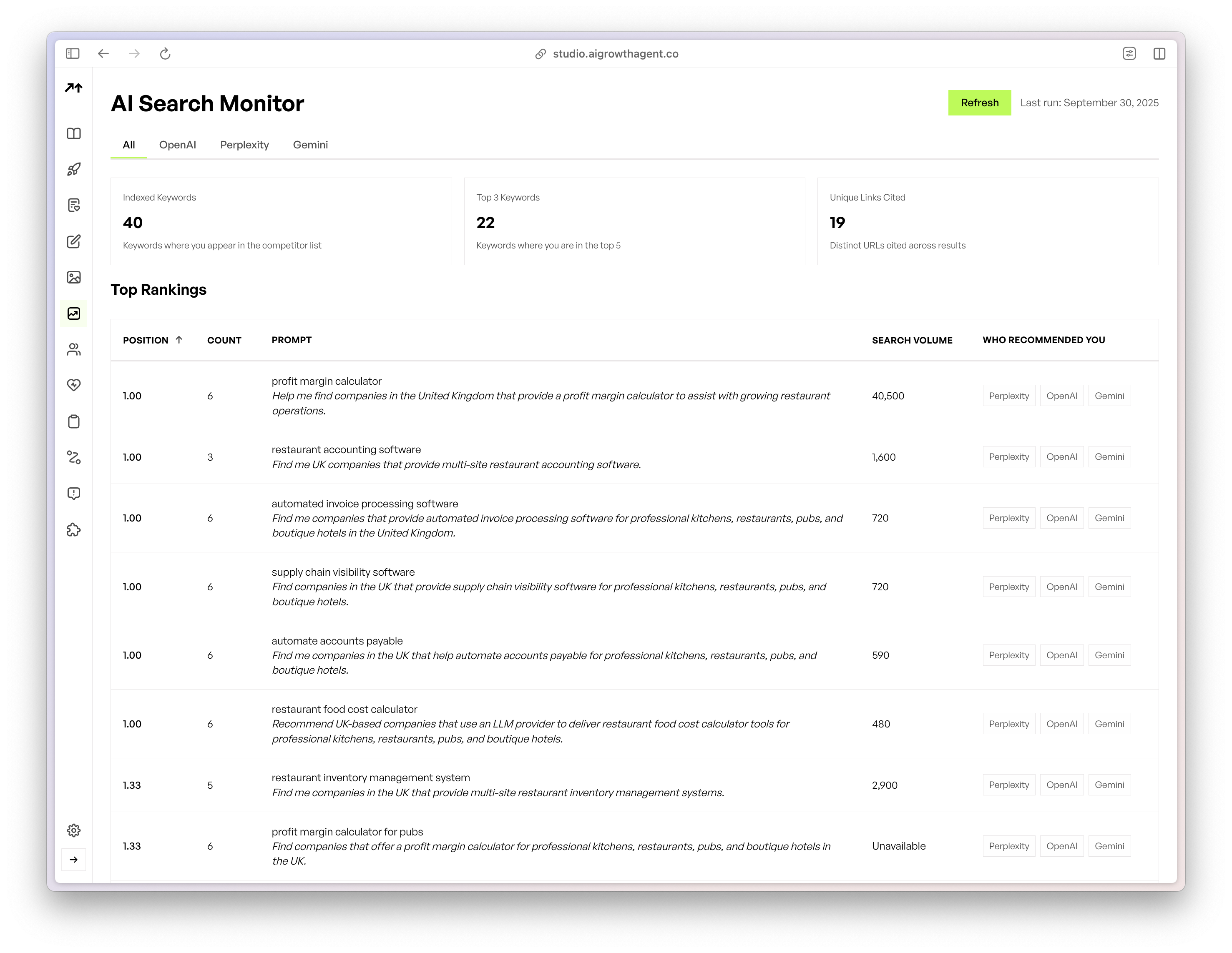
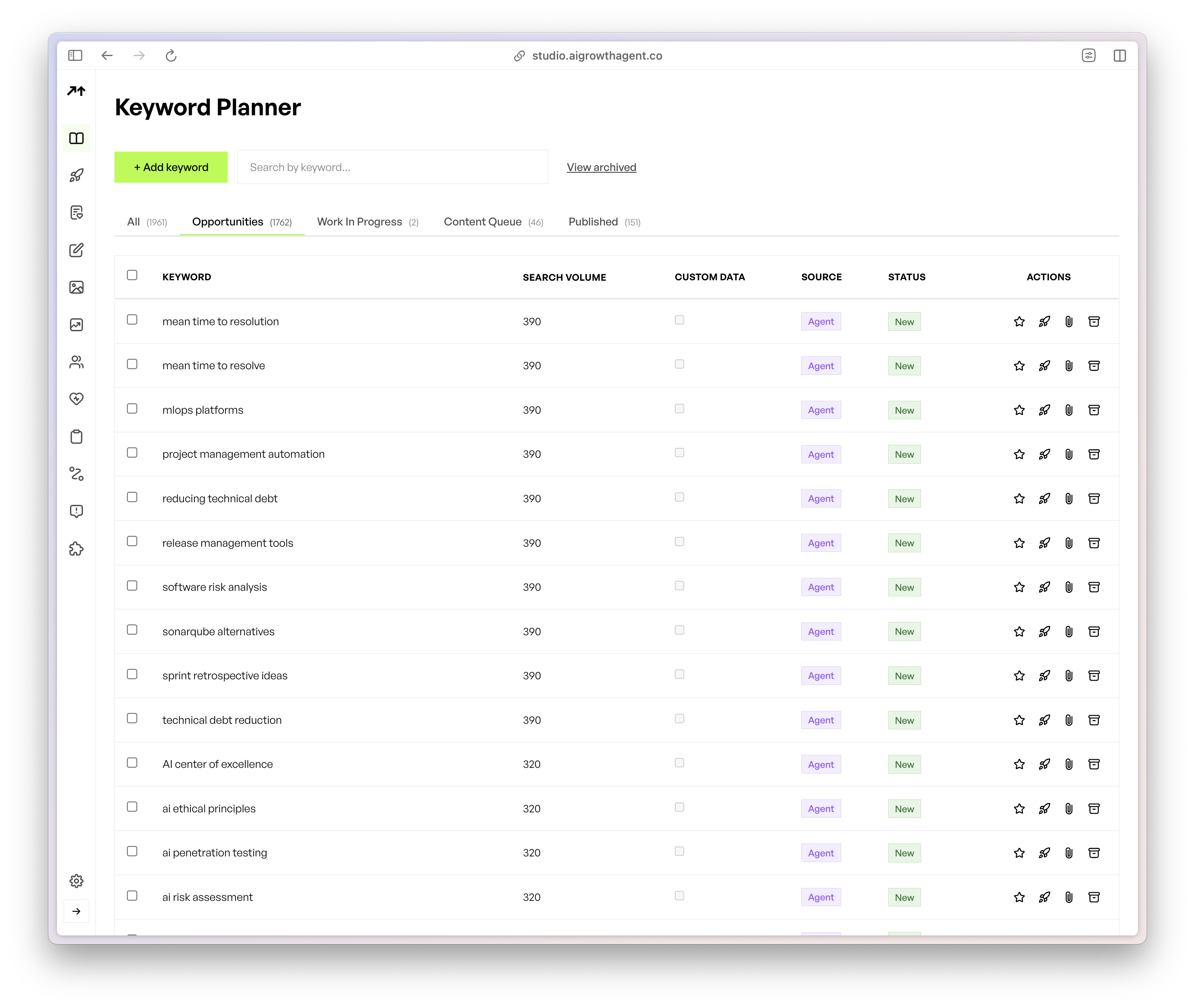
Programmatic SEO solutions automate the engineering, creation, and refinement of content architectures designed for AI citation. These platforms deploy autonomous agents that handle keyword clustering, schema implementation, and structured data, so brands can build authoritative content libraries at a speed manual teams cannot match.
|
Approach |
Primary Function |
Output |
Technical Depth |
|
AI Visibility Tracking |
Monitor and report |
Dashboards and alerts |
Analytics layer |
|
Programmatic SEO |
Engineer and publish |
Technically structured content assets |
Full-stack automation |
The 2026 landscape now centers on agentic AI systems that handle discovery, decisioning, and transactions. These systems require machine-readable information for AI recommendations. Modern strategies must move beyond monitoring and actively engineer structured data and authoritative content that AI systems prioritize.
Scaling AI Search Rankings With Execution, Not Just Monitoring
Ranking at scale in AI search depends on recognizing the gap between diagnostic tools and prescriptive execution. AI visibility tracking tools excel at identifying gaps and showing where competitors appear in AI responses while your brand does not. However, GEO software focuses on visibility scores and competitor benchmarking but lacks execution mechanisms.
Programmatic SEO closes this execution gap by automating creation of citation-worthy content. Manual content teams might produce 2 to 4 articles each month. Programmatic systems can engineer dozens of technically structured pieces each week, each with advanced schema markup and structured data that AI systems need for accurate indexing.
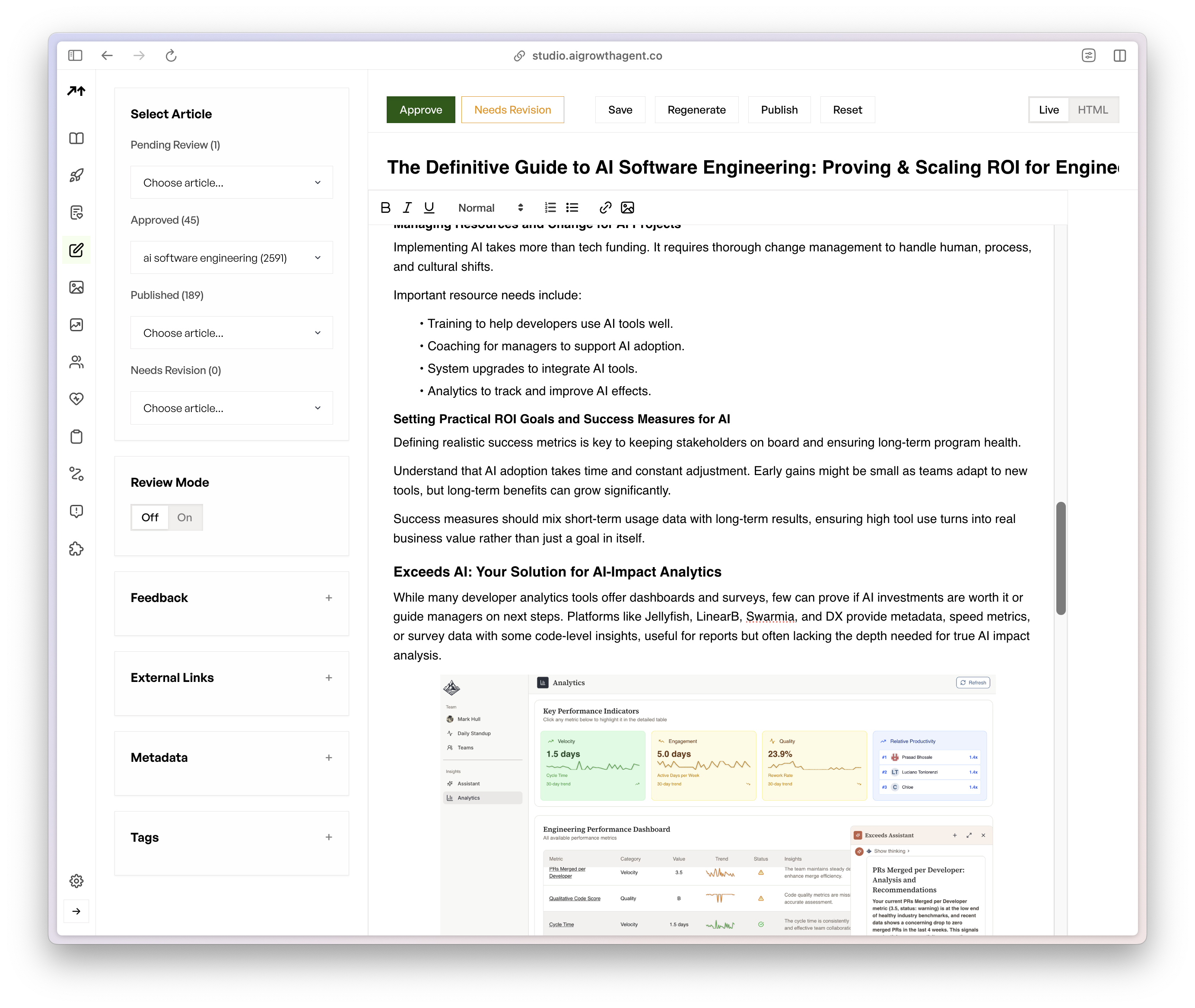
Schedule a demo to see if you’re a good fit for autonomous content engineering that scales beyond manual limitations.
AI Visibility Tools vs Programmatic SEO: Strategic Differences
AI visibility tracking and programmatic SEO serve different roles in an AI search strategy. AI visibility tools operate as sophisticated monitoring systems that provide intelligence about brand performance across AI platforms, then require separate execution strategies to fix identified gaps.
|
Capability |
AI Visibility Tools |
Programmatic SEO |
|
Automation Depth |
Automated tracking and reporting |
End-to-end content engineering |
|
Scalability |
Limited by prompt quotas |
High-volume content generation |
|
Technical Features |
Dashboards, alerts, analytics |
Schema, MCP, LLM.txt integration |
|
ROI Mechanism |
Insights for manual action |
Autonomous authority building |
Programmatic SEO platforms remove the execution bottleneck that visibility tools cannot address. Traditional agencies and manual approaches fail at the volume required for AI dominance, which creates a strategic gap that only autonomous content engineering can fill.
The technical gap between these approaches is significant. AI visibility tools provide reporting interfaces. Programmatic SEO platforms implement advanced infrastructure such as Model Context Protocol (MCP) integration, which allows AI search engines to interface directly with content databases for better understanding and more accurate citations.
Schedule a demo to see if you’re a good fit for programmatic SEO automation that removes manual execution bottlenecks.
Top 5 Enterprise AI Search and Programmatic SEO Solutions
|
Tool |
Type |
Key Strength |
Primary Weakness |
Pricing |
|
Nightwatch |
AI Visibility |
Real-time ChatGPT and Perplexity tracking |
Monitoring only, no content creation |
$99+/month |
|
Profound AI |
AI Visibility |
Enterprise CDN insights across 10+ engines |
Weekly refresh cycles |
$399/month |
|
Jasper |
Content AI |
AI writing assistance |
No technical SEO or schema integration |
$59+/month |
|
Traditional Agencies |
Manual pSEO |
Custom strategy development |
Slow execution, high cost |
$5,000+/month |
|
AI Growth Agent |
Autonomous pSEO |
End-to-end MCP and multi-tenant automation |
Premium brands only |
Demo required |
Leading AI visibility tools like Profound offer enterprise-scale monitoring from $99/month, tracking ChatGPT, Perplexity, Gemini, and Google AI Overviews, yet they still require separate content creation workflows to close visibility gaps.
AI Growth Agent differentiates itself by combining visibility monitoring with autonomous content engineering. The platform’s Manifesto-driven approach protects brand consistency, while its programmatic agents handle technical refinement, schema implementation, and direct publishing, which monitoring-only tools cannot match.
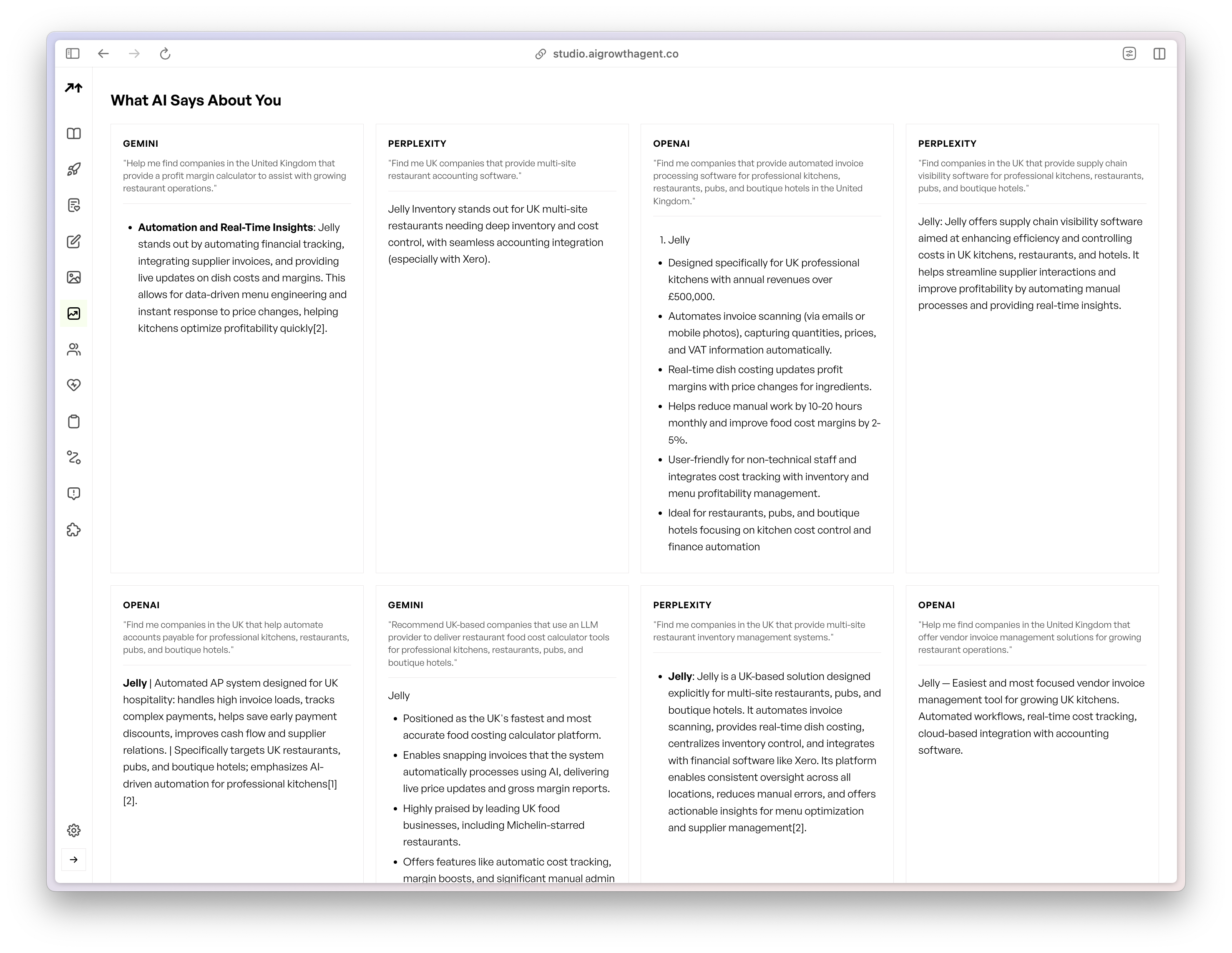
The multi-tenant capability creates a major advantage for enterprise portfolios. Private equity firms and venture capital portfolios can run parallel programmatic SEO campaigns across multiple brands from a single interface. Each brand keeps a unique voice and keyword strategy while sharing a unified technical infrastructure.
Schedule a demo to see if you’re a good fit for autonomous programmatic SEO that scales beyond traditional limitations.
Enterprise Use Cases and Implementation Paths
Real-world implementations highlight the strategic edge of programmatic SEO over visibility monitoring alone. Gitar.ai reached #1 citations for “self-healing pipelines” in ChatGPT within two months through systematic programmatic content deployment. Bucked Up secured top positioning for “best protein soda” across multiple AI platforms using similar methods.
Implementation workflows differ sharply between solution types.
AI Visibility Tools Implementation:
- Configure tracking prompts and competitor benchmarks
- Set up dashboard monitoring and alert systems
- Analyze visibility gaps and competitive positioning
- Create separate content strategies to address findings
Programmatic SEO Implementation:
- Develop a Company Manifesto and program agents
- Run automated keyword research and content strategy generation
- Deploy technical infrastructure with schema integration
- Launch autonomous content engineering and publishing workflows
The hybrid roadmap uses both approaches together. Teams deploy AI visibility monitoring for competitive intelligence and then implement programmatic SEO for execution. This combination delivers diagnostic insights while building the authoritative content base that AI systems need for consistent citations.
Practical Strategies to Rank on AI Platforms
Ranking on AI platforms depends on how agentic AI systems evaluate and recommend content based on structured data and topical authority. The strongest strategies combine technical refinement with high publishing velocity, which gives programmatic SEO a clear advantage over manual methods.
Key ranking factors for AI platforms include content recency, structural consistency, and citation-worthy depth. AI systems favor sources that provide comprehensive, technically structured answers to user questions. Programmatic approaches gain a durable edge by maintaining consistent publishing schedules while ensuring every piece meets strict technical standards.
Schedule a consultation session to see if you’re a good fit for strategies that build AI platform authority through systematic content deployment.
Pros, Cons, and the 2026 Verdict
|
Approach |
Pros |
Cons |
|
AI Visibility Tools |
Fast implementation, competitive insights, real-time monitoring |
Reactive approach, separate execution, limited by quotas |
|
Programmatic SEO |
Scalable authority building, technical automation, consistent output |
Requires strategic foundation, higher initial complexity |
The 2026 verdict favors programmatic SEO for enterprise AI dominance. Agentic AI systems now demand machine-readable content and structured data at scale, which monitoring tools cannot supply but programmatic platforms deliver autonomously.
AI Growth Agent operates as a fully autonomous MCP-integrated solution that combines visibility monitoring with end-to-end content engineering. This integrated model removes the execution gap that separates diagnostic tools from results-driven platforms.
Schedule a demo to see if you’re a good fit for the premier autonomous programmatic SEO platform built for AI dominance.
FAQ
What is the fundamental difference between programmatic SEO and AI visibility tracking?
Programmatic SEO builds authoritative content architectures through automated engineering, writing, and technical refinement. AI visibility tracking monitors brand mentions and citations across AI platforms but requires separate execution strategies to close identified gaps. Visibility tools act as diagnostic instruments, while programmatic SEO functions as the treatment that actually builds authority.
How does AI Growth Agent differ from traditional agencies and AI writing tools?
AI Growth Agent delivers end-to-end autonomous content engineering, from strategy development through technical publishing. Traditional agencies rely on manual “craftsman” models that cannot reach the velocity required for AI dominance. Basic AI writing tools like Jasper output unstructured text without technical SEO integration, schema markup, or automated publishing workflows. AI Growth Agent manages the complete technical pipeline autonomously.
What are realistic timelines for achieving AI search citations?
Programmatic SEO often delivers initial AI citations within 2 to 8 weeks, depending on domain authority and content velocity. Gitar.ai reached #1 positioning for “self-healing pipelines” in ChatGPT within two months. Bucked Up secured top citations for “best protein soda” in three weeks. Manual approaches frequently require 3 to 6 months for similar results because of slower production cycles.
What are the best practices for hybrid AI visibility and programmatic SEO strategies?
Teams should deploy AI visibility monitoring for competitive intelligence and gap analysis, then use programmatic SEO for systematic content creation. Visibility tools highlight high-opportunity keywords and competitor weaknesses. Programmatic platforms then build the authoritative content foundation. This combination delivers diagnostic insights and consistent execution velocity that manual strategies cannot match.
What are the key steps for evaluating programmatic SEO platforms?
Teams should evaluate technical integration capabilities, automation depth, and multi-tenant scalability. Strong platforms provide end-to-end workflows that include strategy development, content engineering, schema implementation, and direct publishing. Buyers should also consider onboarding speed, brand voice consistency, and capacity for enterprise-scale content requirements. Scheduling demos helps confirm platform fit for specific technical and strategic needs.
Conclusion: Why Programmatic SEO Wins in 2026
Programmatic SEO delivers decisive advantages for 2026 AI authority building through autonomous content engineering at enterprise scale. AI visibility tools still provide valuable monitoring, yet only programmatic platforms execute the systematic content creation required for consistent AI citations and recommendations.
Schedule a demo to see if you’re a good fit for the premier autonomous programmatic SEO platform designed for AI dominance.
