


Key Takeaways
- AI search in 2026 favors concise, definitive answers over long ranked lists, so brands need content that can be quoted directly inside AI responses.
- Traditional, manual SEO alone cannot keep pace with the volume, recency, and structure that AI search engines now expect from authoritative sources.
- Technical foundations such as clean site architecture, structured data, and semantic HTML now play a larger role in how AI systems interpret and cite your content.
- Brand authority increasingly depends on helpful, expert content that appears consistently across channels and earns validation from trusted third-party sites.
- AI Growth Agent provides a programmatic way to create and maintain this authority at scale; to see how it works in practice, schedule a demo.
The Shrinking Digital Footprint: Why Traditional SEO Fails in AI Search
AI’s New Rules: From Ranked Lists to Direct Answers
AI search engines such as ChatGPT, Google AI Overviews, and Perplexity now aim to provide direct, authoritative answers. They select and synthesize sources instead of showing long lists of blue links. Position one in traditional search no longer guarantees that a brand becomes the cited source inside AI answers.
The Proliferation Problem: Why Brands Are Becoming Invisible
Content volume on the internet grows faster than any human team can manage. AI systems generate and remix text at massive scale, which dilutes older authority signals. Without focused, programmatic publishing, a brand’s content can slip below the surface of this expanding index and receive fewer citations in AI responses.
Manual Efforts vs. AI Velocity: A Losing Battle
Human-only teams that publish a few articles each month struggle to keep pace with AI’s expectations for depth, coverage, and recency. AI search engines favor sources that cover many related topics consistently and update information in near real time. Limited output makes it difficult to reach the critical mass needed for broad AI visibility.
The Cost of Inaction: Competitors Get Cited
AI systems still need answers, even if your content is thin or outdated. When they do not find enough clear, structured material from your brand, they rely on competitors that invest in modern content architectures. Over time, those competitors begin to define the language, positioning, and recommendations users see across AI interfaces.
The Solution: Engineering an Authoritative Content Architecture for AI Citation
AI Trust Signals Now Go Beyond Backlinks
AI search engines evaluate authority through a mix of structure, clarity, and coverage. Well-organized pages, consistent terminology, and strong entity definitions help models understand what your brand does and when to surface it. Backlinks still matter, but they now act as one of many signals instead of the primary indicator of trust.
Technical Imperatives: Structuring Content for AI Understanding
Semantic HTML and structured data give AI systems a clear map of your content. Logical heading hierarchies, descriptive title tags, and schema for entities, articles, organizations, and authors all improve how models parse and attribute information. Clean site architecture and fast, stable pages further increase the likelihood that content is crawled, indexed, and reused.
Zero-click AI summaries now function as a major discovery surface. Content that includes concise definitions, direct Q&A sections, and clearly scoped paragraphs can be quoted more easily inside AI answers while still pointing back to your brand.
Content for Credibility: H-E-E-A-T and External Validation
Helpful, experience-based, expert content builds stronger authority than thin summaries. Articles that include practical detail, original examples, and clear guidance signal helpfulness, experience, expertise, authoritativeness, and trustworthiness. Cross-channel consistency and mentions on respected industry sites reinforce these signals and help AI systems treat your brand as a reliable source.
AI Growth Agent: The Programmatic Solution for AI Authority
Replacing Manual Limits with Programmatic SEO
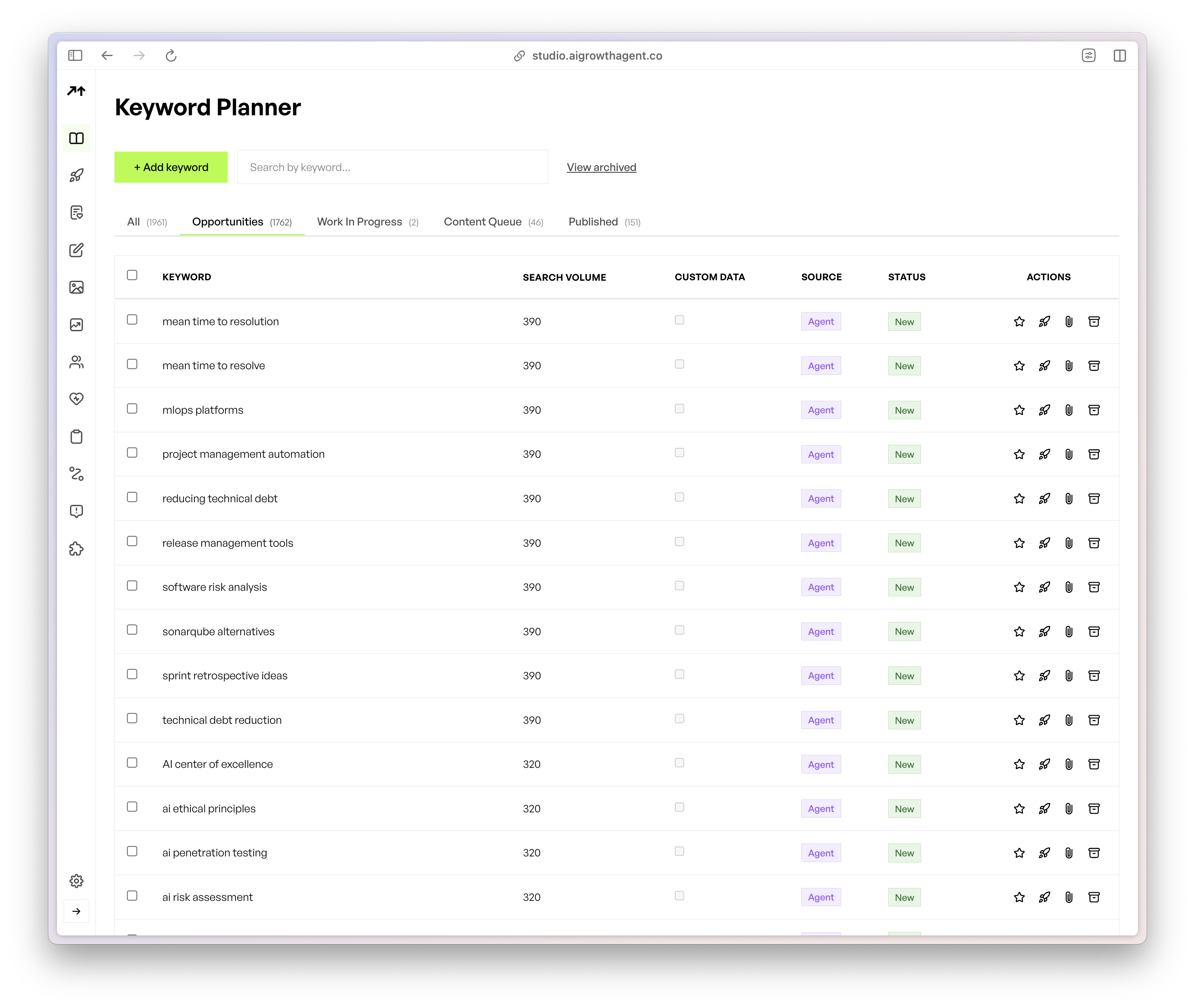
AI Growth Agent uses Programmatic SEO to automate the full content lifecycle. The platform handles keyword research, clustering, content generation, and on-page optimization in one workflow. Marketing teams gain a way to publish high-quality articles at the scale needed for AI visibility without sacrificing relevance or brand voice.
Scale, Velocity, and Technical Excellence in One System
Engineered for volume: The agent publishes structured, topic-specific content at programmatic speed, so brands can cover entire topic clusters instead of isolated keywords. Frequent updates keep material fresh for AI models that prioritize recent, comprehensive sources.
Autonomous technical optimization: Each piece ships with rich schema markup, clean metadata, and optimized media. Support for advanced files such as LLM.txt and a blog-level Model Context Protocol gives AI engines a direct, structured view into your content library.
Multi-tenant deployment for portfolios: Enterprises, private equity firms, and venture portfolios can run multiple content agents from a single interface. Each agent follows its own manifesto, keyword strategy, and tone while publishing to separate domains or subdomains.
To see how a programmatic content architecture could work for your brand, book a consultation with AI Growth Agent.
Beyond Generation: The Authority Engine at Work
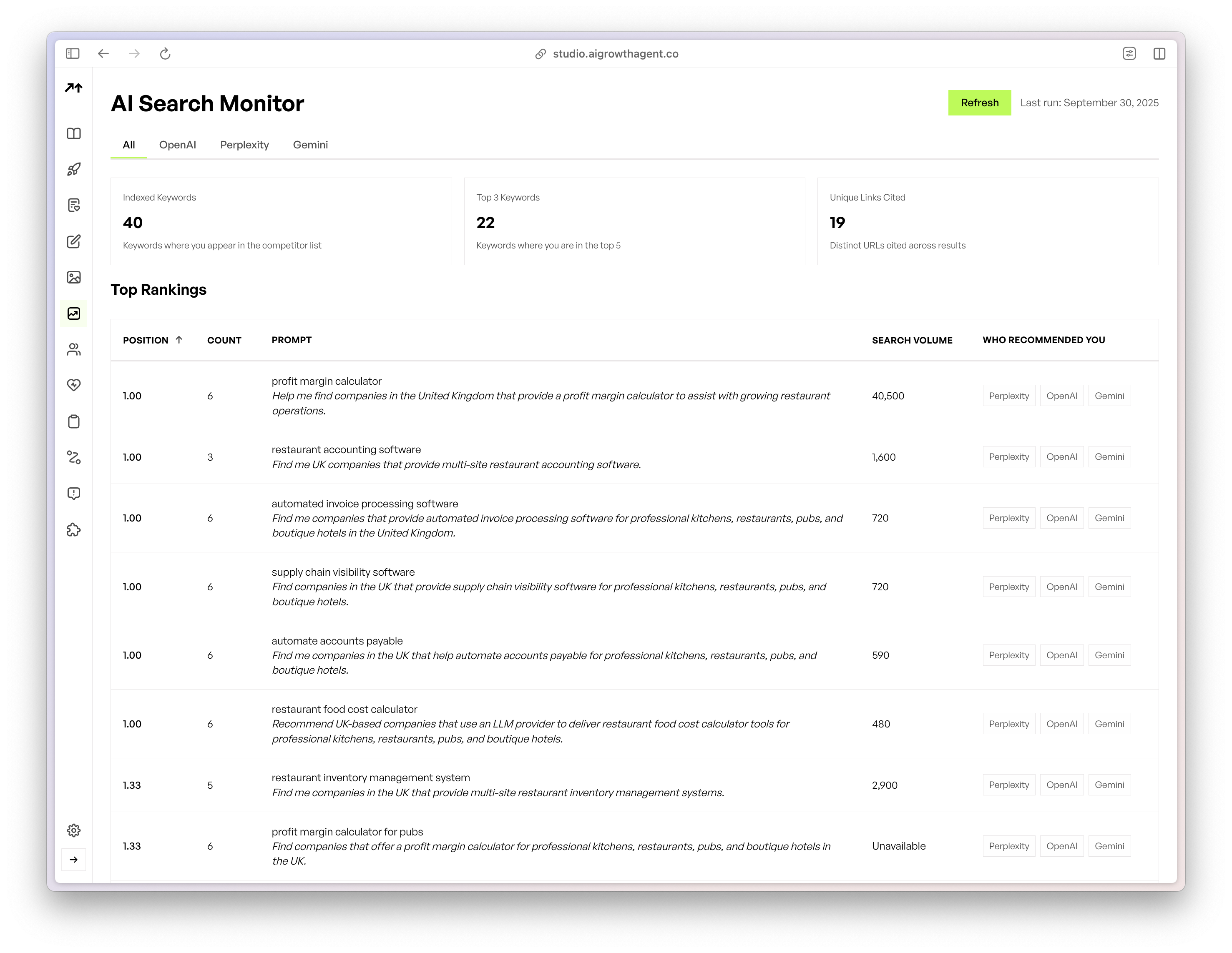
AI Search Monitor and feedback loop: AI Growth Agent tracks how content appears across ChatGPT, Gemini, and Perplexity. Teams can see which URLs drive AI visibility, how target keywords index, and where models cite the brand directly.
Real-time content injection and data-to-content automation: The agent can turn live data, proprietary research, or breaking news into optimized articles in minutes. Brands can react quickly to emerging topics and capture search and AI demand before competitors respond.
Proven Success: Brands Winning AI Citations
Exceeds: Became a recommended alternative in Perplexity within two weeks, achieved visibility in Google AI Overview for core keywords within three weeks, and now appears in ChatGPT, Google AI Overview or Gemini, and Perplexity for queries about AI performance review tools for engineers.
BeConfident: Reached immediate indexation after programmatic publishing and soon appeared as a leading app in Brazil for learning English through Google AI Overview or Gemini.
Bucked Up: Gained ChatGPT citations as a top protein soda brand in under a month and holds the leading citation position for the query “best protein soda.”
Gitar: Established category ownership for AI-powered CI/CD automation in less than two months and now appears as a top-cited tool across Google AI Overview or Gemini, ChatGPT, and Perplexity.
To apply similar programmatic strategies to your portfolio, schedule a consultation with AI Growth Agent.
Comparison: AI Growth Agent vs. Traditional Approaches
|
Capability |
Manual SEO/Traditional Agencies |
AI Growth Agent |
|
Content Volume |
Constrained by manual processes and labor limits |
Programmatic velocity for large volumes of targeted content |
|
Technical SEO Depth |
Relies on periodic, manual optimization |
Built-in schema, metadata, LLM.txt, and MCP for AI clarity |
|
AI Citation Potential |
Depends mainly on classic ranking signals |
Designed around AI visibility and precise citation |
|
Velocity |
Slows as scope and topics expand |
Autonomous workflows and real-time content injection |
|
Cost Model |
Often tied to billable hours and manual deliverables |
Technology platform that scales without linear headcount costs |
Frequently Asked Questions (FAQ)
How do AI search engines determine credibility beyond traditional backlinks?
AI systems look at how clearly content explains a topic, how often it appears across channels, and whether trusted third parties reference it. Detailed, helpful articles that show real-world experience and expertise tend to earn stronger trust than brief, generic summaries.
What technical elements matter most for AI search engine citation?
Clean site architecture, semantic HTML, and structured data all play key roles. Schema for entities, articles, and authors supports reliable snippet extraction, while modern files such as LLM.txt and Model Context Protocols create direct, structured access to your content for AI tools.
How has the definition of brand authority changed with AI search?
Brand authority now centers on being selected as the definitive answer inside AI-generated responses. Consistent messaging, comprehensive coverage of core topics, and a clear content footprint across the web help AI engines treat a brand as the primary source on a subject.
Why are traditional SEO tools and agencies often insufficient for AI authority?
Many legacy approaches were built for page-one rankings, not for AI-generated answers. Limited content volume, slower production cycles, and lighter technical integration make it difficult to supply the structured, up-to-date material that AI search engines increasingly expect.
Conclusion: Build an Authority Architecture for 2026 AI Search
AI-powered search now shapes how users discover brands across channels, from chat interfaces to search overviews. Marketing leaders who rely on slow, manual content strategies risk losing visibility as AI-generated answers become the default way people gather information.
AI Growth Agent offers a programmatic system to design, publish, and optimize content architectures that match modern AI expectations. The platform combines topic strategy, content generation, technical SEO, and AI monitoring into a single workflow so your brand can become the cited source across leading AI tools.
To position your company as the definitive answer in 2026 AI search, schedule a demo with AI Growth Agent.
