


Key takeaways
- AI search experiences in tools like ChatGPT, Google AI Overviews, and Perplexity rely on structured, authoritative content, which makes scalable content systems essential for SaaS visibility.
- Programmatic SEO and automated content engineering help SaaS teams cover long-tail and lower-competition queries at a scale that manual content production cannot match.
- Advanced technical SEO, including schema, metadata, LLM-focused files, and protocols like MCP, improves how AI systems understand, index, and cite your content.
- Multi-tenant content deployment and real-time content injection allow larger SaaS organizations and portfolios to manage complex ecosystems and react quickly to new topics.
- AI Growth Agent provides an autonomous programmatic SEO system that supports these strategies while aligning content with each brand’s positioning and voice.
Schedule a consultation session to see how AI Growth Agent can support your content strategy.
1. Prioritize Programmatic SEO for Scalable Coverage in AI Search
The shift from manual, “craftsman” SEO to programmatic SEO (pSEO) represents a major change in how effective brands approach content strategy. AI search tools reward velocity, depth, and structural consistency, qualities that manual content creation rarely delivers at the required scale.
Traditional SEO relies on manual, individualized content creation for a small set of high-competition keywords, whereas programmatic SEO uses template-driven, automated processes to create hundreds or thousands of pages targeting long-tail and lower-competition queries. This distinction matters for SaaS companies that want broad market coverage in the AI search era.
Programmatic SEO enables teams to create thousands of technically optimized pages that address long-tail and lower-competition queries. This approach provides wider coverage than traditional SEO models that focus on a few flagship pieces. Many agencies can produce one or two strong articles per month, but they typically lack the engineering capacity to generate and maintain the volume of structured content needed to stand out in AI search.
AI Growth Agent operates as a dedicated programmatic SEO agent that autonomously builds high-authority content architectures. The pSEO Content Agent removes technical friction so brands can publish large volumes of structured, high-quality content that manual approaches struggle to match. From deep keyword clustering to schema implementation and direct publishing, the agent helps brands appear as reliable sources that AI tools can cite within their categories.
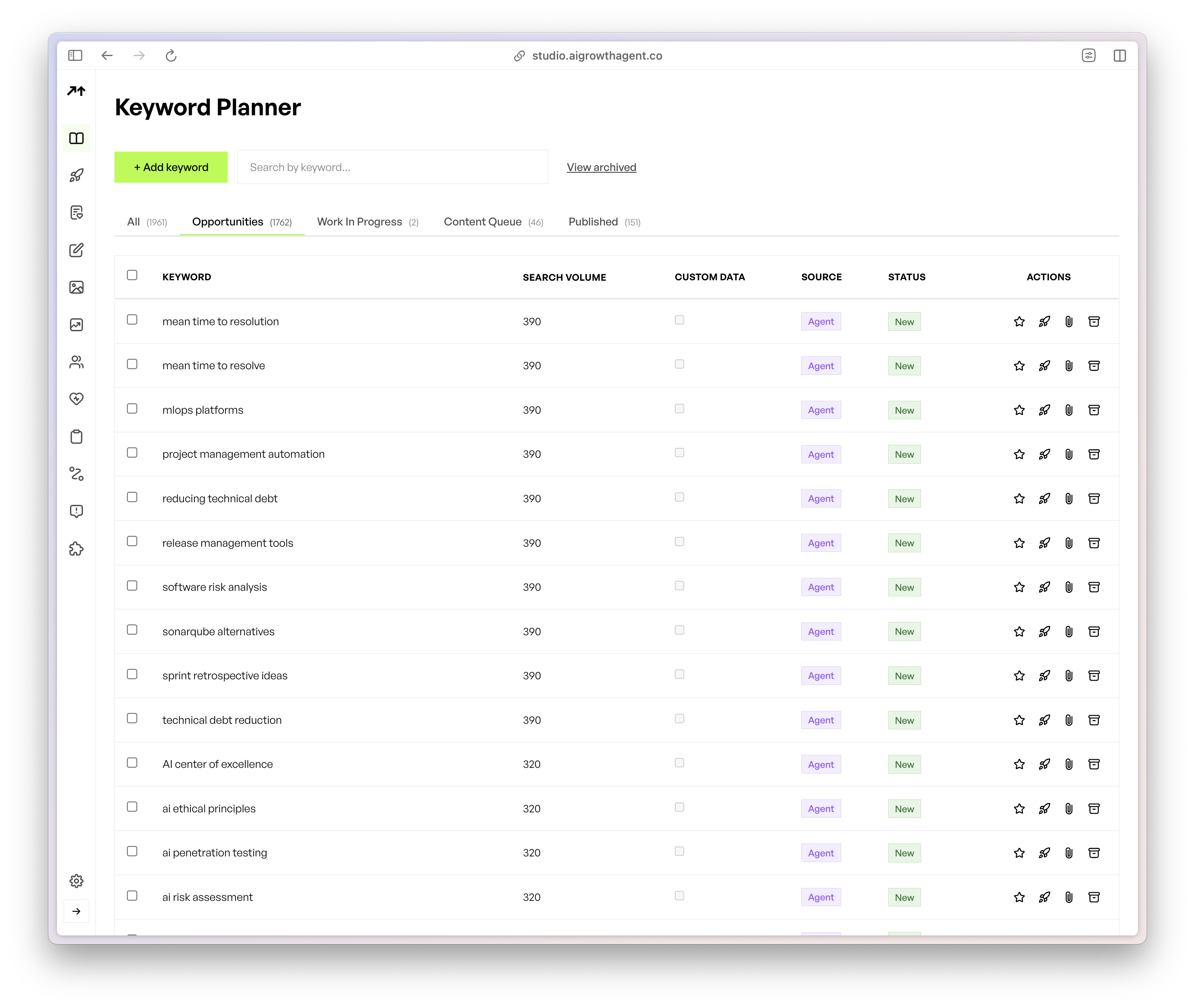
Actionable takeaway: Evaluate the scalability of your current content strategy and the breadth of search queries you cover. If you publish fewer than 10–15 pieces of optimized content each month, you are likely losing ground to competitors that use programmatic methods to increase coverage and update velocity.
2. Integrate Advanced Technical SEO for Stronger AI Indexing
AI search tools need more than well-written articles. They depend on structured, technically sound data that helps models interpret and reuse your content. The difference between being overlooked and being cited often comes from the technical design of your content architecture.
Important technical elements for AI indexing include advanced schema markup, optimized metadata, LLM.txt files, and protocols that let AI tools interface directly with your content structures and databases. Many basic AI writing tools output unstructured text and leave marketing teams to handle technical formatting, which can be difficult without engineering support.
AI Growth Agent programmatically decorates every post with advanced technical SEO, including rich schema markup, metadata, and a blog implementation of the Model Context Protocol (MCP). This protocol helps AI tools interface with your blog’s database and understand your content’s structure, topics, and authority, which can improve your chances of being cited in AI overviews and answers.
The autonomous system also implements supporting technical elements such as optimized robots.txt, structured data, and image tags with appropriate metadata that speak clearly to AI crawlers. Each piece of content is engineered for AI discoverability and citation potential as well as human readability.
AI Growth Agent includes an AI Search Monitor that tracks how your content performs across target keywords and AI search surfaces. This view helps teams understand which topics, formats, and pages earn visibility in AI-powered experiences and where to allocate additional content effort.
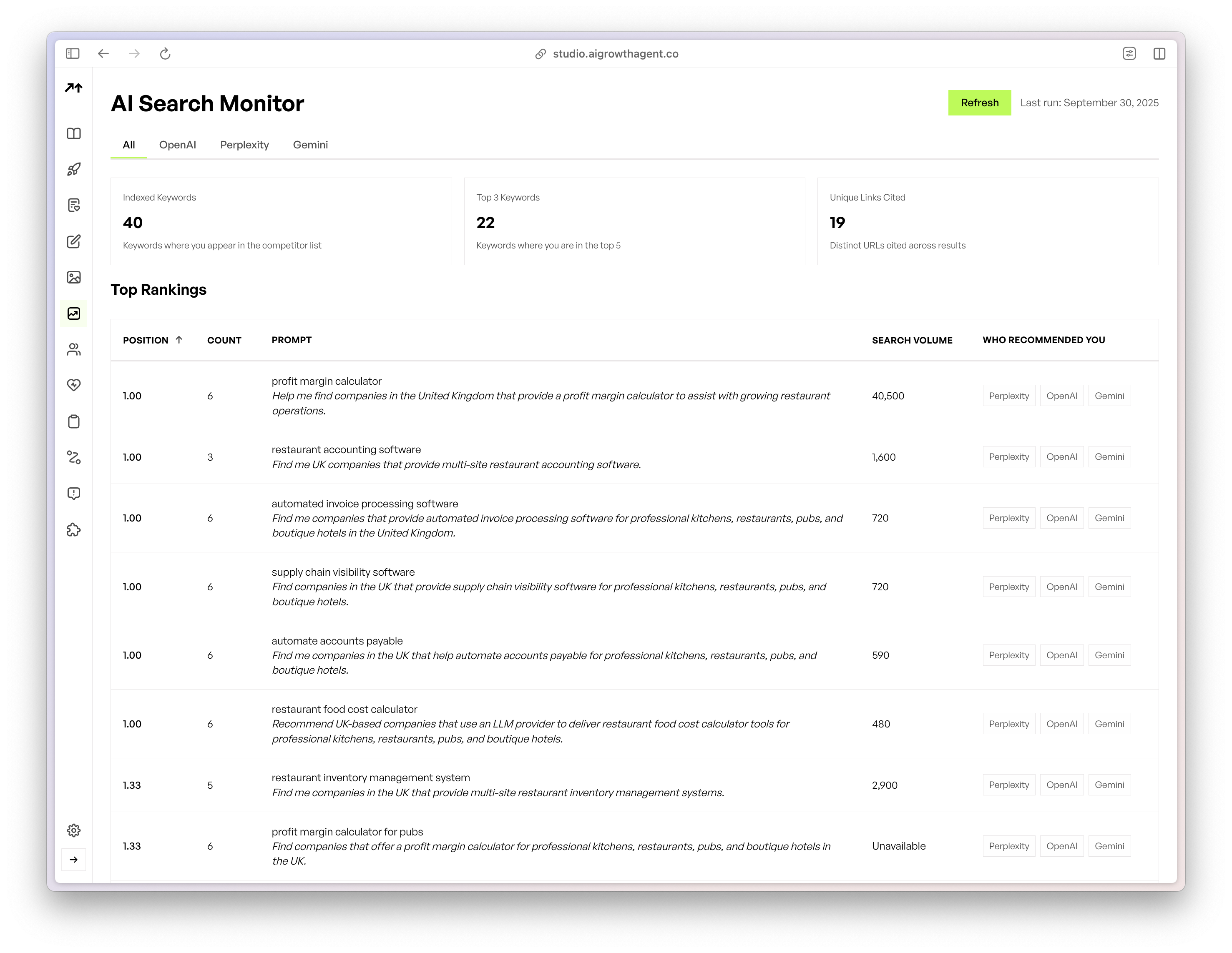
The AI Search Monitor also highlights how tools such as ChatGPT, Gemini, and Perplexity describe your brand and whether they reference your owned content.
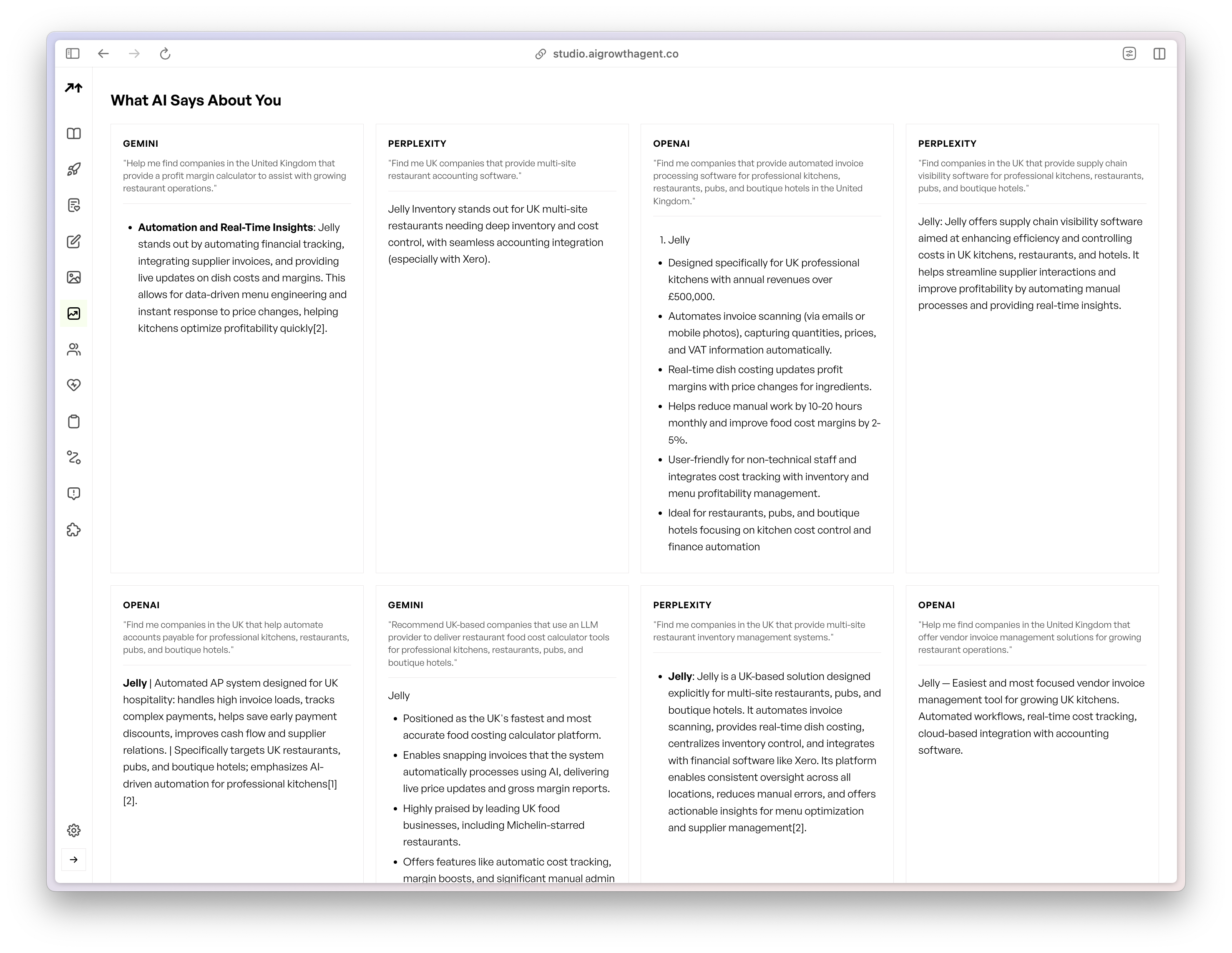
To see how your content can be structured for AI citations, schedule a demo with AI Growth Agent.
Actionable takeaway: Audit your content’s technical structure for LLM readability as well as human readability. If articles lack schema, consistent metadata, and machine-friendly organization, your content may not offer the clarity AI search systems need to index and surface it reliably.
3. Adopt an Autonomous Content Engineering Lifecycle
Brands that build an end-to-end autonomous content system will be better positioned for AI search. This type of system covers keyword research, strategy, drafting, review, technical optimization, and publishing in one coordinated workflow. Manual pipelines often introduce bottlenecks and delays that limit content volume and consistency over time.
Programmatic SEO uses templates and structured data to scale content production across long-tail and variant queries. An autonomous content engineering lifecycle extends this concept by combining strategy, research, drafting, and technical implementation in a single system rather than a series of disconnected steps.
AI Growth Agent’s pSEO Content Agent autonomously manages the full content engineering lifecycle and keeps content aligned with your brand. The process begins with a guided onboarding session, where a professional journalist works with your team to build a Company Manifesto that captures positioning, messaging, differentiation, and tone. This Manifesto becomes the reference that informs all future content.
After configuration, the agent develops briefs and strategy, runs research across your Manifesto and vetted web sources, drafts content ranging from short tactical pieces to longer pillar articles, and runs fact-checking protocols to validate key claims. The system then decorates each post with advanced technical SEO, including schema and optimized metadata, and prepares it for publishing.
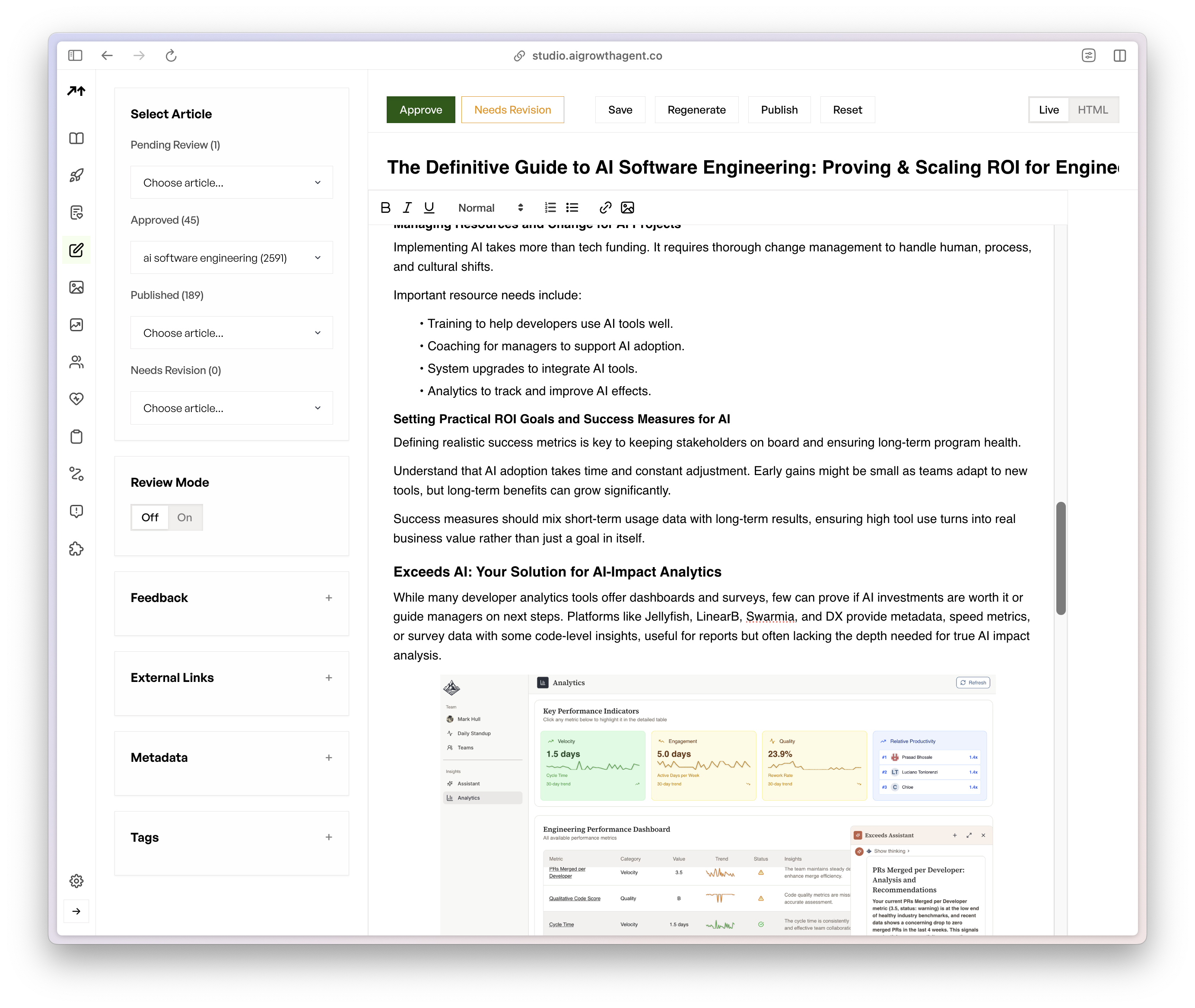
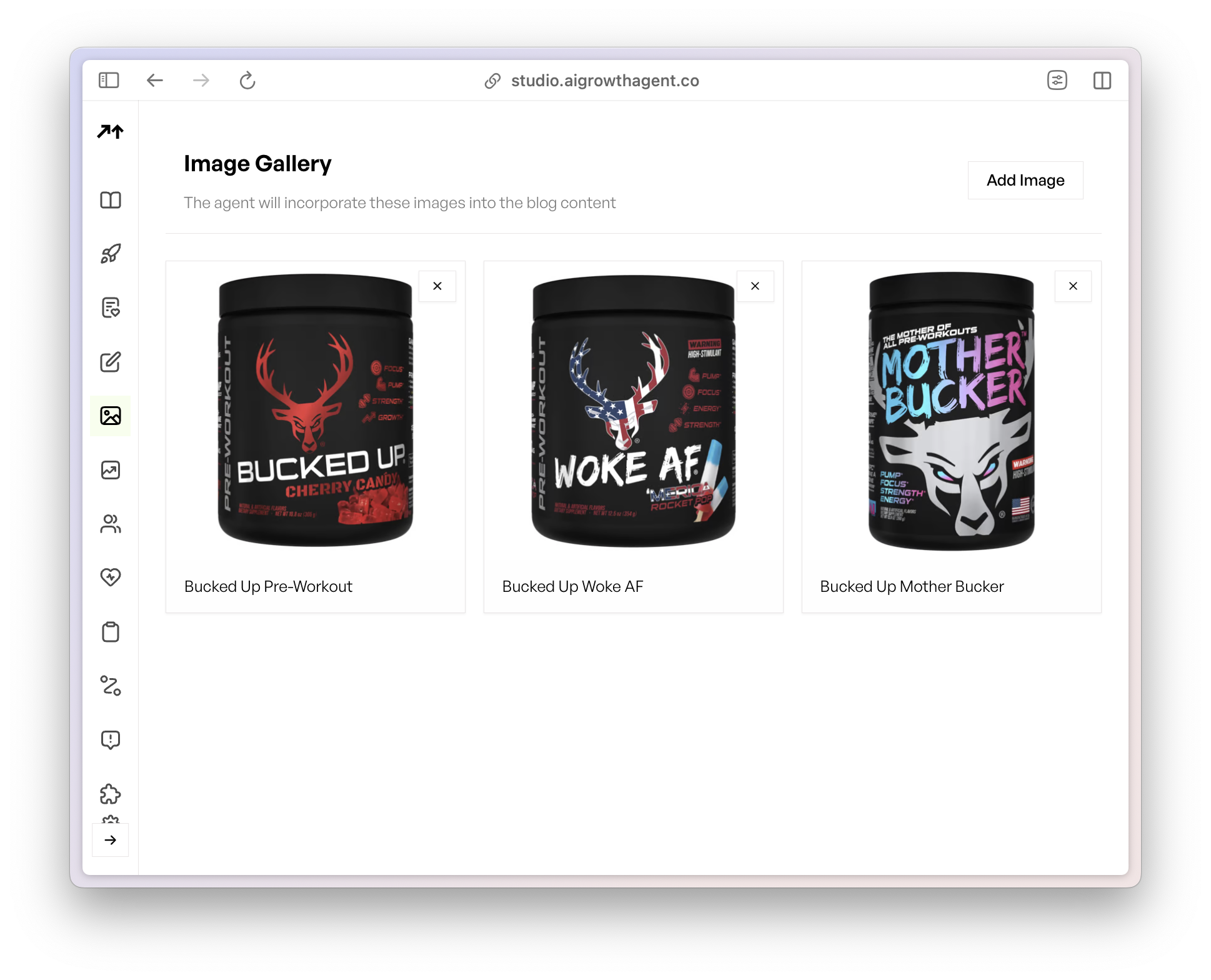
Teams can also supply visual assets so that content incorporates images in a natural, consistent way that supports key messages.
Actionable takeaway: Map your current content workflow and identify where teams spend time on manual research, drafting, formatting, and publishing. If more than 20 percent of effort goes into technical preparation and repetitive production tasks, an autonomous content engineering system can likely reduce that overhead and free capacity for strategy.
4. Use Multi-Tenant Deployment for Complex Content Ecosystems
Enterprises, private equity portfolios, and multi-brand organizations often manage content across many domains, product lines, or regions. Separate teams and tools for each property can lead to duplicated work, inconsistent standards, and limited programmatic reach.
AI Growth Agent offers multi-tenant programmatic deployment so you can run several Programmatic SEO Content Agents from one interface. Each agent maintains its own Manifesto, keyword strategy, and brand voice while publishing to distinct domains or subdomains. A small central team can coordinate a multi-brand pSEO strategy while still respecting each brand’s unique positioning.
Actionable takeaway: If your organization manages multiple brands or product lines, evaluate whether a shared, multi-tenant pSEO platform could reduce duplicated effort and improve consistency across your portfolio. Estimating the time and cost of running separate content operations will clarify the potential efficiency gains.
5. Implement Real-Time Programmatic Content Injection for Agility
The AI search environment changes quickly as new topics and data sources emerge. Brands that respond rapidly with relevant, optimized content can capture search demand from breaking news, changing regulations, or new competitor moves.
Programmatic SEO supports this responsiveness by using automation and proactive data analysis to power continuous site optimization. This approach helps teams act on new information without waiting for lengthy manual production cycles.
AI Growth Agent’s real-time programmatic content injection capabilities help brands stay current. Teams can share a link to a trending news article, product update, or report, and the agent generates an SEO-optimized article that reflects the brand’s perspective and connects the topic to relevant search demand. Database-to-content automation can also transform proprietary data into custom, SEO-rich articles that turn internal assets into search-friendly resources.
The AI Search Monitor described earlier provides feedback on how these timely pieces perform in AI search and where further coverage may be useful.
Actionable takeaway: Measure how long it currently takes your team to move from a new topic idea to a published, optimized article. If the cycle typically exceeds 24–48 hours, introducing real-time programmatic content injection can help you capture more timely search opportunities and AI visibility.
Comparison: AI Growth Agent vs. Other Solutions
|
Feature/Solution |
AI Growth Agent (Programmatic SEO) |
Traditional SEO Agencies |
Basic AI Content Tools (e.g., ChatGPT) |
|
Content Velocity |
Very high; daily or hourly |
Manual; about 1–2 articles per month |
Instant text drafts |
|
Technical SEO |
Autonomous; advanced schema, LLM.txt, MCP |
Manual; basic schema |
User-dependent; raw text |
|
Scalability |
High; multi-tenant deployment |
Limited by headcount |
Limited; requires manual strategy and structure |
|
Content Quality |
Structured for authority; aligned with brand and fact-checked |
Bespoke; deep research |
Unstructured; generic |
Frequently Asked Questions (FAQ) about Automated Content Creation and AI Search
What is the main difference between programmatic SEO and traditional SEO for SaaS?
Programmatic SEO uses automated, template-based processes to generate content at scale across many long-tail keywords and page variations. Traditional SEO focuses on manual, in-depth content for a smaller set of highly competitive keywords. Traditional methods help build authority for core topics, while programmatic SEO extends coverage and supports the broader visibility needed for AI search.
Why are current AI content tools insufficient for dominating AI search?
Many general-purpose AI content tools create unstructured text and do not manage strategy, keyword clustering, schema markup, or publishing. Users still need to design the information architecture, handle technical SEO, and ensure consistency across large volumes of content. For AI search, these missing layers limit how well models can understand, trust, and reuse the content.
How does AI Growth Agent ensure content quality and brand voice at scale?
AI Growth Agent starts with a detailed onboarding session where a professional journalist works with your team to create a Company Manifesto. This document defines your positioning, key messages, terminology, and tone. The autonomous content agent uses this reference to guide topic selection, structure, and language so that large volumes of content stay aligned with your brand.
Can AI Growth Agent integrate with my existing CMS?
AI Growth Agent supports integrations with select CMS platforms, including WordPress and HubSpot. Many clients choose the hosted option for operational simplicity and consistent performance. Teams that prefer self-hosting can work with AI Growth Agent to set up workflows that respect their technical SEO and infrastructure requirements.
What is the Model Context Protocol (MCP) and why is it important for AI search?
The Model Context Protocol (MCP) is AI Growth Agent’s framework that allows AI tools to interface more directly with your blog’s database and content structure. By exposing structured context about your posts, categories, and relationships, MCP helps large language models better interpret and reference your material, which can improve the likelihood and accuracy of citations in AI-powered experiences.
Conclusion: Build an AI-Ready Content Engine with Programmatic SEO
AI-driven search is changing how users discover and evaluate SaaS products, and it places new demands on content systems. Manual content creation alone rarely delivers the volume, structure, and technical precision needed for strong AI visibility.
SaaS companies that adapt by using programmatic SEO and autonomous content engineering will be better equipped to cover more queries, respond to trends, and present clear, machine-readable information. Prioritizing programmatic SEO, strengthening technical optimization, building an autonomous lifecycle, supporting multi-tenant deployment, and using real-time content injection together form a practical roadmap for competing in AI search.
AI Growth Agent provides an autonomous programmatic SEO platform that helps brands implement these strategies in a consistent, scalable way. The system combines content engineering, technical SEO, and monitoring so your brand can appear more often as a credible source in AI-driven answers.
