


AI-powered search engines and chatbots now play a central role in how audiences encounter your brand. At the same time, AI-generated content volume is exploding, which compresses your brand’s visible footprint online and makes it harder to stand out.
Publishing infrequently, even with high-quality content, rarely shifts performance. Traditional agencies, internal teams, and generic AI tools were not built for this environment. They are often too slow, manual, and shallow to keep pace with AI search.
A new category has emerged: automated thought leadership content tools designed specifically for AI visibility and citation. What we’ll explore in this article:
- AI search engines and chatbots now shape how buyers discover brands, so content must be optimized for both humans and large language models (LLMs).
- Publishing one or two strong blog posts a month is no longer enough. Quality daily publishing is becoming the baseline for maintaining visibility and authority.
- Traditional agencies, internal teams, and generic AI tools struggle to deliver the needed volume, technical quality, and AI search alignment.
- Advanced automated thought leadership content tools use specialized AI agents, technical SEO, and AI search optimization to produce authoritative, AI-readable content at scale.
- AI Growth Agent is an autonomous content platform that combines keyword research, content creation, technical AI SEO, and AI search monitoring in a single system.
- Marketing leaders evaluating tools should focus on authority, technical capabilities, brand voice integration, and clear ROI from AI and organic search performance.
The Problem: Why Marketing Leaders Are Losing the AI Search Battle
The Shrinking Digital Footprint: Overcoming AI-Generated Content Saturation
Every day, millions of new pages are generated by AI. Many are derivative and still compete with your content for attention and indexation. High-volume AI content can quickly become repetitive and formulaic, which undermines audience engagement and brand distinctiveness. Generic, low-depth outputs erode perceived value over time.
As more brands deploy basic AI to publish near-identical posts on the same topics, the signal-to-noise ratio drops. The web fills with similar titles, outlines, and recommendations. In this environment, even strong content struggles to stand out unless it is clearly more authoritative and technically easier for AI systems to understand and reuse.
The challenge extends beyond audience fatigue. As LLMs become a primary discovery interface, your visibility increasingly depends on whether AI systems view your content as credible enough to cite. Over-reliance on generic AI can create lifeless, off-brand, emotionally flat content that neither humans nor AI systems treat as authoritative. If your material does not read like it comes from a real expert with a distinct point of view, it becomes easy for both people and machines to overlook.
There is also a human cost. Automation that focuses only on “more content, cheaper” raises real concerns about creative job displacement, especially when used to push out low-quality work. This approach ignores the strategic, creative, and editorial value of marketing teams. Leaders are caught between pressure to scale and the risk of diluting both their brand and their team culture.
The New Baseline: Quality Daily Publishing for LLM Relevance
In the era of AI search, volume is a requirement, not a bonus. LLMs favor sources that are current, deep, and consistent. When AI tools answer a question, they are more likely to draw from sources that:
- Publish fresh, in-depth content on a regular cadence
- Cover a topic comprehensively across a wide range of related queries
- Demonstrate sustained expertise in a defined category over time
This makes the old model of using the blog as a periodic campaign asset obsolete. Publishing one or two long posts a month, even if they are excellent, is not enough to train AI systems that your brand is the definitive authority in your niche. Quality daily publishing has become the new baseline.
If you are not shipping expert-level content every day that aligns with your buyers’ questions, you effectively leave the narrative to competitors who are. They become the sources AI systems see most often, and therefore the brands those systems are more likely to surface and cite.
The bar is higher for premium brands. Your audience expects depth, nuance, and a clear strategic view, not content that reads like a quick, generic AI draft. At the same time, building and managing a human team large enough to sustain this output is rarely realistic. The only practical path is automation that is engineered specifically for quality, technical optimization, and AI search alignment.
The Inadequacy of Traditional Content Solutions in the AI Era
Traditional SEO Agencies: Slow, Costly, and Hard to Scale
Classic SEO and content agencies are built on billable hours. They can produce thoughtful, well-researched articles, but they struggle to match the velocity now required to compete in AI search. A typical engagement may deliver four to eight articles a month, which is a small footprint in an AI-driven content environment.
Even strong editorial teams run into process bottlenecks across strategy, research, writing, editing, technical optimization, and publishing. Manual workflows also limit the ability to react quickly to breaking topics and emerging trends. By the time an agency has drafted and approved a post on a news event, the AI search opportunity may already have passed.
Internal Marketing Teams: Overloaded and Under-Resourced for AI SEO
Internal teams usually understand the brand and market best, but they are responsible for many priorities at once, including campaigns, product launches, sales enablement, events, reporting, and stakeholder communication. Asking these teams to also run a daily schedule of authoritative, AI-ready content is rarely feasible.
Technical AI SEO adds further complexity. Beyond traditional tactics like title optimization and internal links, AI search requires:
- Advanced schema and structured data that clarify entities, relationships, and topical authority
- Clean, crawlable formats and machine-readable signals such as LLM.txt and structured model context
- Ongoing monitoring of how AI search engines cite and sometimes misinterpret your content
Building and maintaining this system in-house requires significant engineering expertise and constant iteration. Most marketing teams lack both the time and the specialized skills to design and sustain that infrastructure.
Generic AI Tools: Low Depth, High Oversight, Limited Strategy
Generic AI tools are flexible, but they are not a content strategy. They still require you to do the work of:
- Selecting the right keywords and topics
- Maintaining brand voice consistency and narrative cohesion
- Fact-checking, editing, and enriching drafts for real depth
- Formatting, structuring, and publishing content in a technically optimized way
Without these layers, AI-generated text often feels shallow and derivative. AI text that lacks depth, originality, and personal insight is treated as commodity content rather than real thought leadership. Simply prompting a chatbot for a long blog post is not an enterprise-ready approach.
Quality control is another serious issue. AI models can confidently generate inaccurate or inconsistent information, especially on complex or niche topics. When automation runs without systematic oversight, brands face content quality failures, accuracy issues, and potential search penalties at scale.
Most generic tools also lack integrated features for advanced technical SEO, AI search performance monitoring, or AI citation tracking. They can speed up drafting, but they do not solve the broader strategic challenge of becoming the canonical source AI search engines trust.
The Solution: Advanced Automated Thought Leadership Content Tools for AI Search
Defining Next-Generation Content Automation for AI Visibility and Citation
To compete in AI search, brands need more than basic AI assistance. They need a coordinated system of specialized AI agents that manage the entire content lifecycle, from keyword intelligence through drafting, optimization, publishing, and performance tracking, all aligned with how modern AI search engines work.
This requires a shift from traditional SEO optimization to AI search optimization. AI search optimization guidance explains that classic SEO tactics alone are no longer sufficient and that new content structures, conversational formats, and strong data integrity are needed so LLMs can access accurate, trustworthy information.
Next-generation automated thought leadership content tools are built specifically for this reality. They combine:
- Autonomous agents that own and execute distinct parts of the content engine
- Technical frameworks such as LLM.txt and model context protocols that make content more machine-readable
- Feedback loops that track AI search performance and refine strategy over time
The outcome is not AI writing in isolation. It is an AI-native content infrastructure that positions your brand as a trusted source in its category for both users and AI systems.
Key Capabilities of Advanced Automated Thought Leadership Content Tools
1. Scalable, High-Quality Content Generation for AI-First Brands
Modern platforms must generate large volumes of expert-level content without sacrificing quality. When generative AI is combined with strong strategic inputs, it can support scalable, dynamic content creation aligned with changing demand. This scale only works when it is guided by competitive analysis, structured keyword strategies, and continuous optimization against performance data. The core challenge is turning raw generation into a disciplined, always-on thought leadership engine.
2. Technical SEO Integration Designed for AI Indexing
In AI search, technical details carry significant weight. AI-focused SEO best practices emphasize accessible crawl settings, clean content formats, and site structures that help AI crawlers ingest and interpret material effectively. Leading platforms embed these practices into every workflow so each article is automatically published with the right schema, metadata, and machine-readable signals.
3. AI Citation Optimization to Earn Trust and Authority
Being indexed is only the starting point. Brands also need to be cited. Analysis of AI search engines shows that accurate, clearly sourced content is essential for trust and discoverability in AI-driven environments, where systems favor transparent authority signals and verifiable sources. This calls for content that answers questions definitively, is clearly attributable to your brand, and is structured in ways that make it easy for AI tools to quote and link.
4. Dynamic Adaptation to AI Search Trends with Predictive Analytics
Search behavior and AI responses change continuously. Automation and predictive analytics help marketers anticipate search trends, track emerging questions, and adapt content strategies quickly. Effective tools use these insights to keep keyword plans and editorial priorities current, rather than relying on a static annual content calendar.
If your current stack does not provide this mix of autonomous generation, technical rigor, AI citation optimization, and adaptive intelligence, it is not yet aligned with AI-era needs. To evaluate where you stand, you can schedule a consultation session for automated thought leadership content tools and benchmark your current capabilities.
AI Growth Agent: Automated Thought Leadership Content for AI Search
AI Growth Agent is designed to help companies establish clear authority in their category and increase the chances of being cited and recommended by AI search engines. It is not an agency or a simple prompt tool. It is an autonomous content platform that uses specialized AI agents to replicate and scale the core functions of a content team.
The Autonomous Advantage: Agent-Powered End-to-End Content Engine
AI Growth Agent orchestrates a set of specialized agents, each responsible for a critical phase of your content operation:
- White-glove onboarding and Company Manifesto. Every engagement begins with a one-hour deep-dive session with a professional journalist. This conversation is distilled into a Company Manifesto, a living document that defines your positioning, narrative, and voice. Every agent uses this Manifesto as its source of truth for consistency and alignment.
- Keyword Deep Research Agent. This agent ingests your Manifesto and analyzes tens of thousands of search queries to find the highest-value opportunities in your domain. Within about 24 hours, it produces a comprehensive keyword strategy organized by themes and categories, which becomes the roadmap for your content engine.
- Core Content Agent. After the strategy is approved, this agent manages the content lifecycle, including briefing, research, drafting, fact-checking, and technical optimization. It consolidates a large amount of traditional agency work into a shorter timeline while maintaining quality standards.
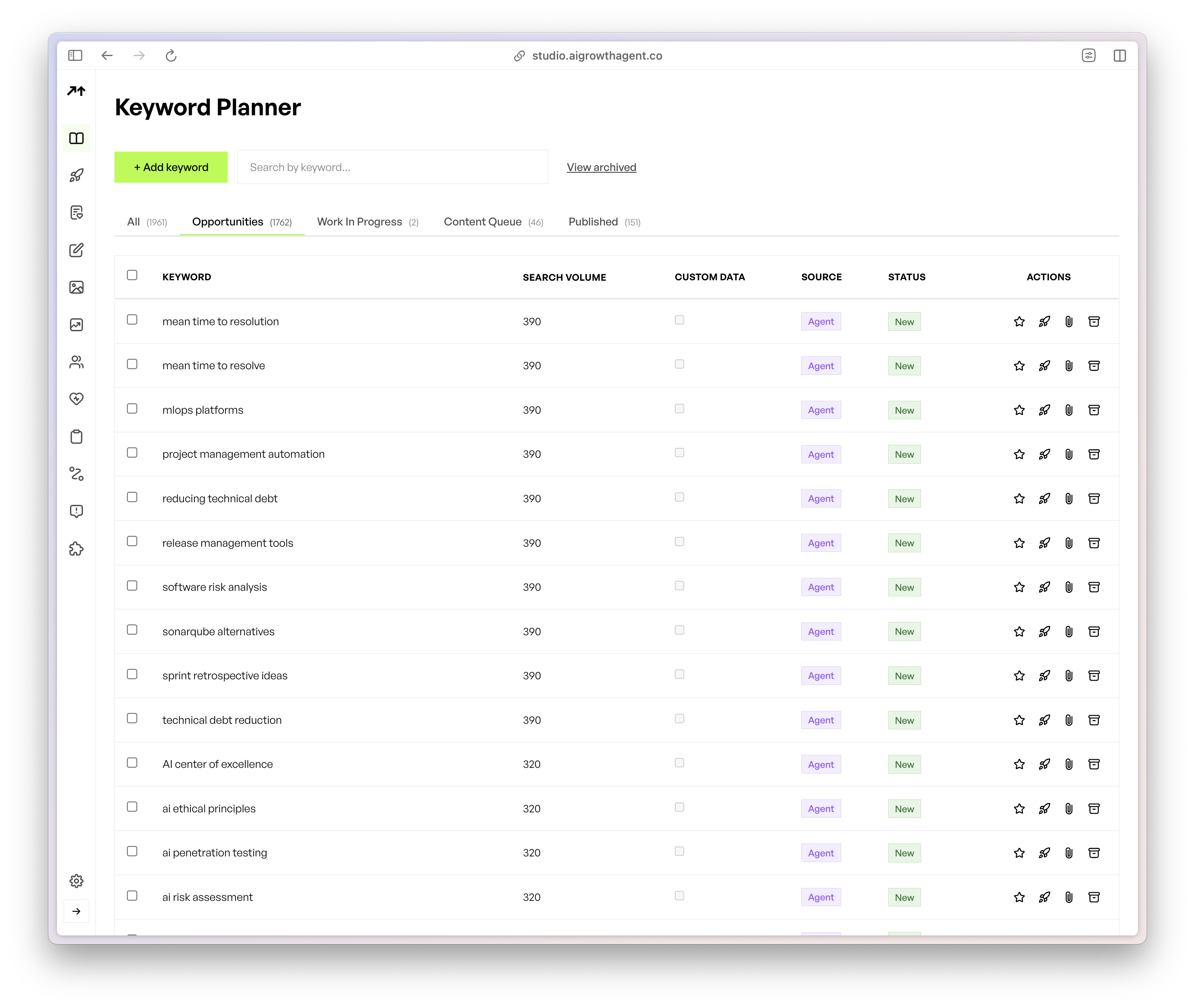
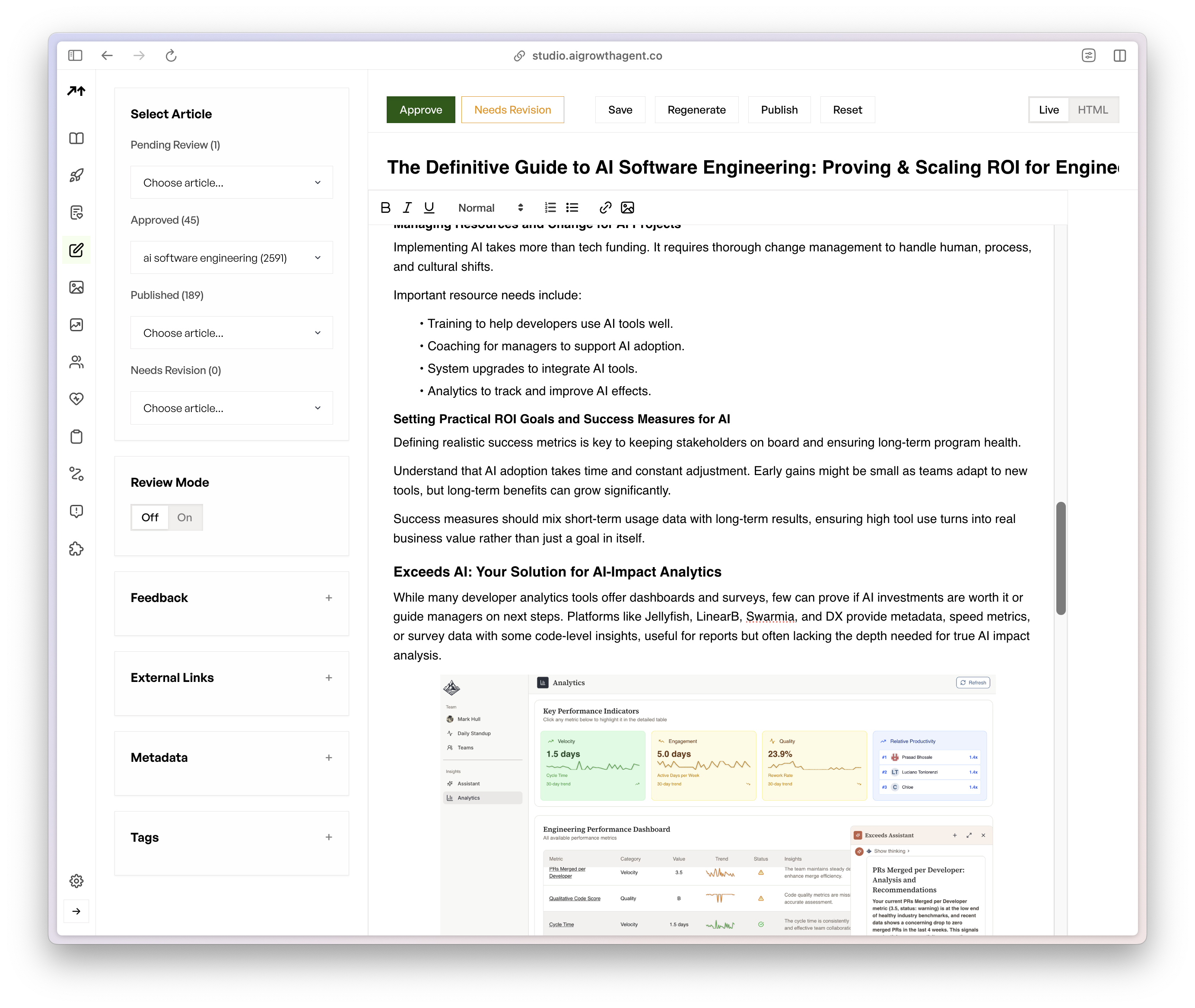
From there, the AI Growth Agent Studio gives you transparency and control. You can review and edit drafts until you are ready to enable auto-publish.
This setup frees your internal team to focus on positioning, campaigns, and cross-functional strategy while AI Growth Agent manages the operational workload.
Technical Capabilities for AI Indexing and Machine Readability
AI Growth Agent’s technical stack is built for AI search. Every article is automatically published to an optimized blog, hosted on a subdomain such as blog.yourcompany.com, that visually matches your existing site and includes advanced technical SEO.
Two capabilities are central to this approach:
- Advanced LLM.txt. The platform generates and maintains an advanced LLM.txt file that communicates your content inventory and usage guidelines to AI crawlers. This helps AI systems understand what you offer and how it is structured.
- Model Context Protocol (MCP) for blogs. AI Growth Agent implements a blog MCP that allows AI search engines to interact directly with your blog and query its content with more precision, which increases the likelihood that your material appears in AI-generated answers.
These components, combined with rich schema, clean HTML, optimized metadata, and intelligent image placement, help ensure that your content is both discoverable and understandable for AI search tools.
Beyond Content: Real-Time AI Search Monitoring and Performance
Publishing content is only one part of success. You also need visibility into how AI search engines are using your content and the ability to adjust based on those insights.
The AI Growth Agent Search Monitor and Performance Agent closes this loop by:
- Tracking how you index for target keywords across major AI tools, shown in an intuitive heatmap
- Surfacing direct quotes and citations of your content within AI-generated answers
- Identifying which URLs and topics drive the highest AI visibility
- Monitoring bots that crawl your pages and highlighting which articles they index most often
- Integrating with Google Search Console to show organic traffic, impressions, and clicks generated by AI Growth Agent content
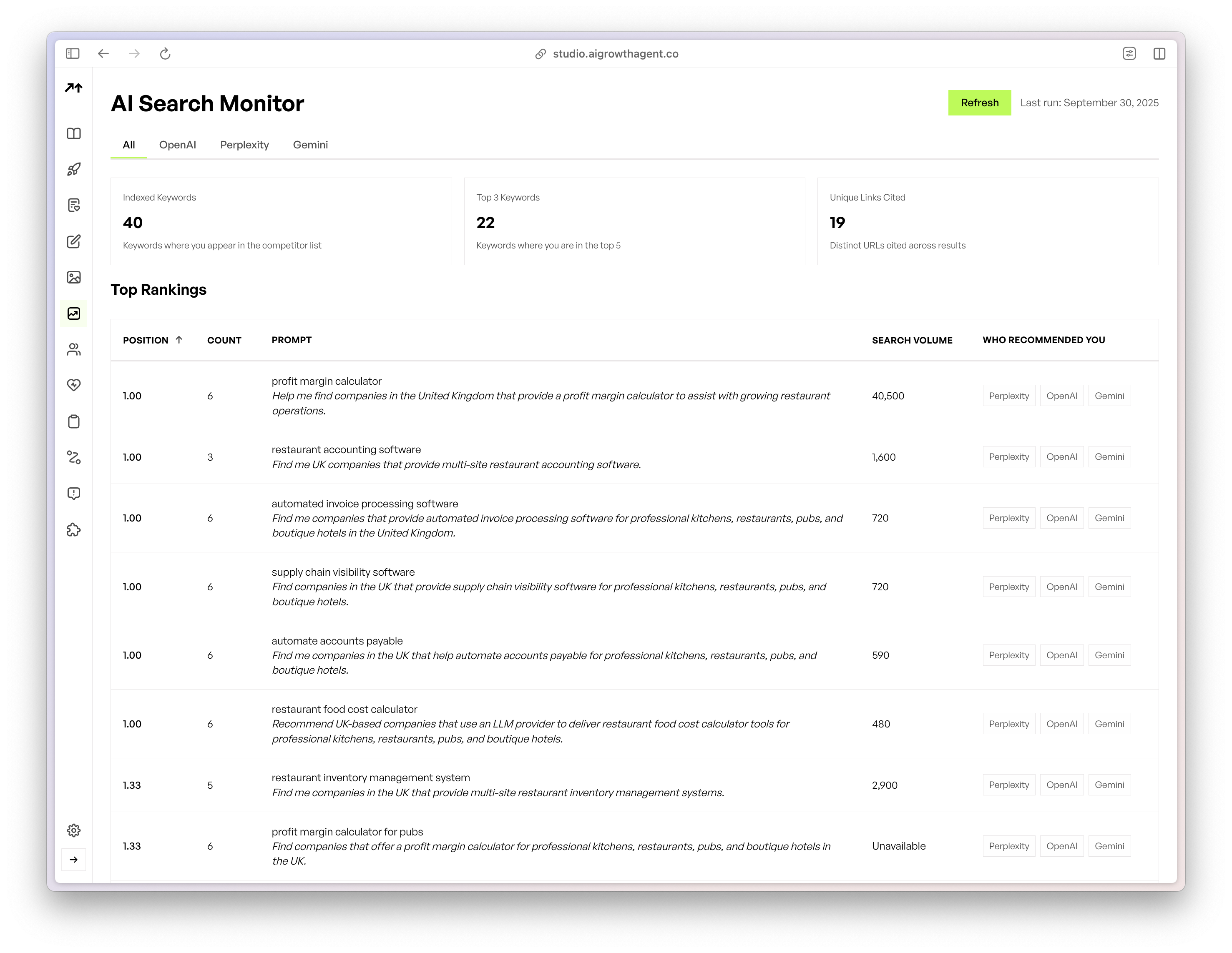
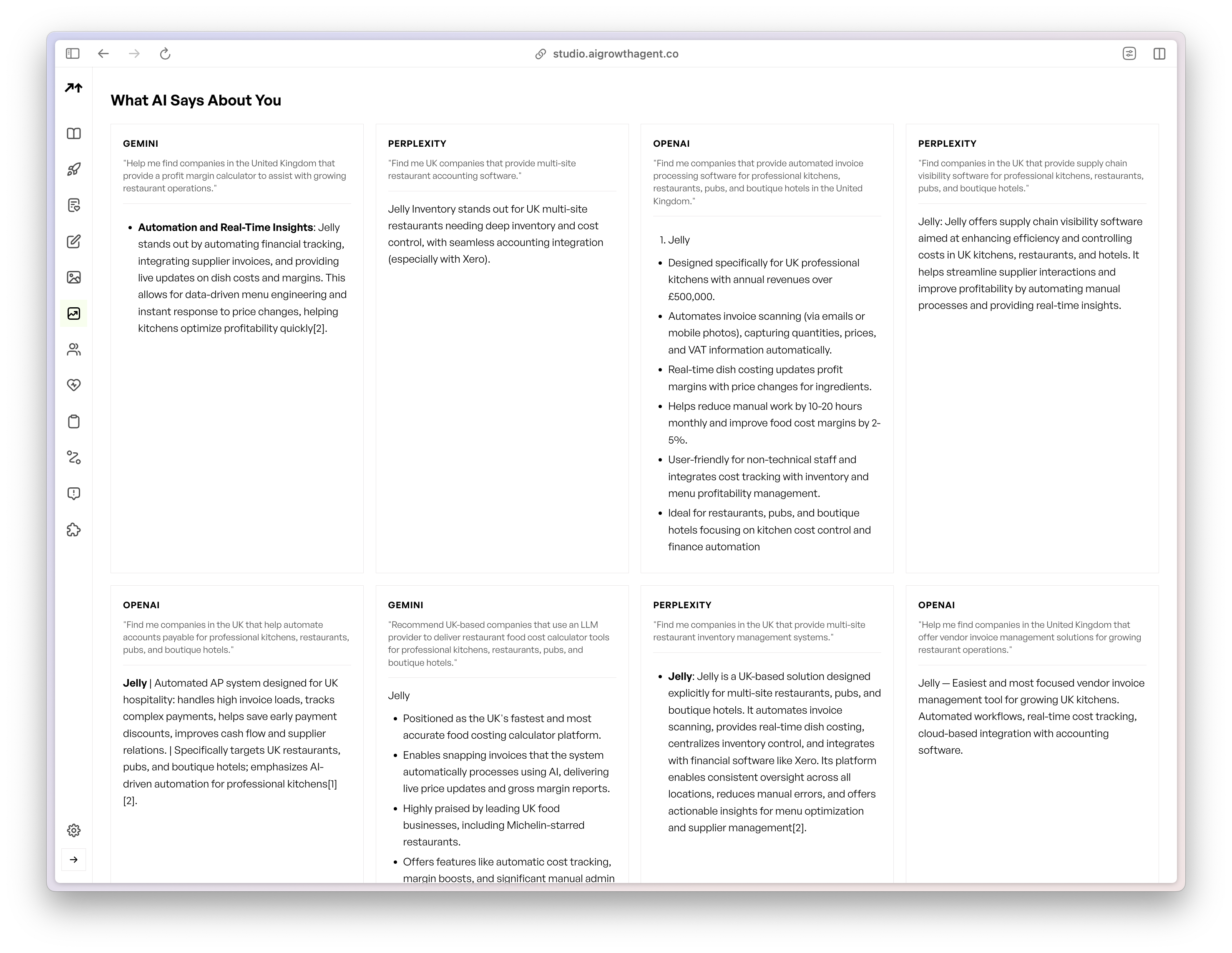
This creates a single command center, the AI Growth Agent Studio, where marketing leaders can understand, steer, and scale their AI search footprint.
To see how this works in practice, you can schedule a demo of AI Growth Agent’s platform and review whether your brand is a strong fit.
Choosing the Right Automated Thought Leadership Content Tools: Key Considerations
Prioritizing Quality and Authority Over Generic Output
Not all automation produces meaningful thought leadership. The key question for marketing leaders is whether a platform helps create authoritative content or simply increases word count. Search guidance emphasizes that unique, helpful, and satisfying content for both searchers and loyal readers is central to AI-era success, and that originality, depth, and usefulness are decisive factors where E-E-A-T (Experience, Expertise, Authoritativeness, Trustworthiness) shapes sustained visibility.
Tools that only rewrite what already ranks are unlikely to make your brand the canonical source. Instead, you need systems that:
- Integrate your proprietary insights, data, and perspectives
- Generate context-rich content that is genuinely helpful rather than keyword-stuffed
- Present your brand as the expert voice behind each explanation and recommendation
AI Growth Agent is structured for this outcome. The Company Manifesto and agent orchestration are designed to weave your unique narrative into content consistently, while research and fact-checking workflows help avoid thin outputs that are common with basic AI tools.
Comparison Table: Automated Content Tool Capabilities
|
Tool / Provider |
AI Search Optimization (LLM.txt, MCP, schema) |
End-to-End Content Lifecycle (Strategy → Publish) |
Real-Time AI Visibility and Performance Reporting |
|
Generic AI Tools |
Limited to basic SEO prompts, no native LLM.txt or MCP, manual setup required |
Drafting only, strategy, editing, technical SEO, and publishing handled manually by your team |
No direct insight into how AI search engines index or cite your content |
|
Traditional Agencies |
Conventional SEO best practices, rarely implement AI-specific assets like LLM.txt or MCP |
Strategy and writing covered but heavily human-dependent, with limited scalability and speed |
Reporting focused on classic SEO metrics, minimal or no AI search citation monitoring |
|
AI Growth Agent |
Built-in advanced LLM.txt, blog Model Context Protocol, rich schema, and machine-readable optimization by default |
Autonomous agents handle keyword research, drafting, technical SEO, and publishing to an optimized blog |
Dedicated AI Search Monitor visualizes citations, keyword indexing, and competitor comparisons across major AI engines |
Customization and Authentic Brand Voice Integration
Many premium brands worry about sounding the same as everyone else using AI tools. That concern is well-founded. Reviews of AI-driven marketing highlight that generic AI usage often produces content without authentic brand voice or emotional resonance, which can erode trust and weaken brand equity.
Any automated thought leadership platform you adopt should be able to:
- Absorb complex brand narratives and editorial standards, not just high-level tone descriptors
- Embed your value propositions throughout the content, not simply include branding elements at the end
- Learn from ongoing feedback so outputs become more accurate and on-brand over time
AI Growth Agent uses a Manifesto-driven architecture and an interactive Studio to support this. The onboarding process translates your brand story into structures that agents can execute against, so content aligns with your narrative at scale.
Advanced Technical SEO for Effective AI Indexing
AI search optimization is highly technical. Best practices for AI-era SEO emphasize accessible crawl settings, consistent content formats, and site structures that support AI crawlers at scale so LLMs can ingest, interpret, and reuse your content effectively.
When you evaluate tools, it helps to ask:
- Does the platform automatically generate and maintain advanced schema for every post?
- Does it provide or integrate an LLM.txt file configured for my content architecture?
- Can it deploy Model Context Protocol or comparable mechanisms to clarify content for AI systems?
- Does it guarantee clean HTML or Markdown and handle image metadata for both user experience and machine understanding?
AI Growth Agent addresses these needs by offering a technically optimized, branded blog solution. This reduces CMS and engineering friction that often slows or weakens SEO efforts.
Demonstrating Clear ROI: AI Visibility and Organic Growth Metrics
Marketing leaders need clear ROI from content investments. That requires visibility into both traditional search metrics and AI search performance. Platforms that stop at creation and do not provide robust reporting make it difficult to know what is working.
AI Growth Agent connects these data points through:
- Direct integration with Google Search Console for organic traffic, impressions, and clicks
- AI search visibility dashboards that show citations and keyword indexing across major AI tools
- URL-level and topic-level reporting so you can see which themes drive authority and visibility
If your current stack cannot show how your content performs in AI search, an upgrade is worth considering. You can schedule a demo of AI Growth Agent’s platform to see these metrics in a live environment.
Frequently Asked Questions (FAQ)
How do automated thought leadership content tools ensure credibility and accuracy when AI is prone to hallucinations?
Credibility depends on how the system is designed. Robust automated thought leadership platforms include dedicated research and fact-checking stages instead of relying on a single prompt-and-publish workflow. In practice, that means:
- Agents are instructed to cross-reference multiple reputable sources before making factual claims.
- Content is drafted against a Company Manifesto that sets clear boundaries around what the brand should and should not say.
- Fact-checking passes are built into the pipeline to resolve contradictions or unsupported assertions.
- Human oversight, especially during onboarding and early stages, allows your team to refine and correct outputs.
AI Growth Agent follows this approach. The Core Content Agent performs structured research and validation, and the Studio provides a clear view into every piece of content before or after publication, supporting accuracy and alignment.
Can AI-generated thought leadership content rank in AI search when E-E-A-T is so important?
AI-generated content can perform well in AI search if the underlying system prioritizes expertise, depth, and originality rather than surface-level optimization. AI search favors content that demonstrates experience, expertise, authoritativeness, and trustworthiness. Platforms that combine structured research, proprietary brand insight, and technical SEO can help meet these expectations.
In practice, this requires:
- Covering topics with depth, including concrete examples and clear frameworks.
- Making your brand’s perspective explicit and consistent throughout the article.
- Structuring content in question-and-answer and problem-solution formats that map to AI search behavior.
- Providing clear signals of expertise within the content, such as specific methods, frameworks, or case-based insights.
AI Growth Agent is designed to make content comprehensive and relevant in your niche so that when AI systems assemble answers, your material has a higher chance of being included.
Will automated thought leadership content tools replace my internal marketing or SEO team?
Used correctly, these tools should support and extend your team rather than replace it. Automation is most valuable when it removes manual, repeatable production work so marketers can focus on strategy, creativity, and collaboration.
With a platform like AI Growth Agent handling keyword research, drafting, technical SEO, and publishing, your team can:
- Spend more time refining positioning and narrative instead of managing templates and handoffs.
- Develop higher-impact campaigns that draw on a growing content library.
- Collaborate more closely with product, sales, and leadership to align content with business priorities.
- Use AI search and performance analytics to guide future strategy and investments.
Automation becomes the engine room for production while your team leads on direction and differentiation.
How does AI Growth Agent handle image optimization and placement for AI search?
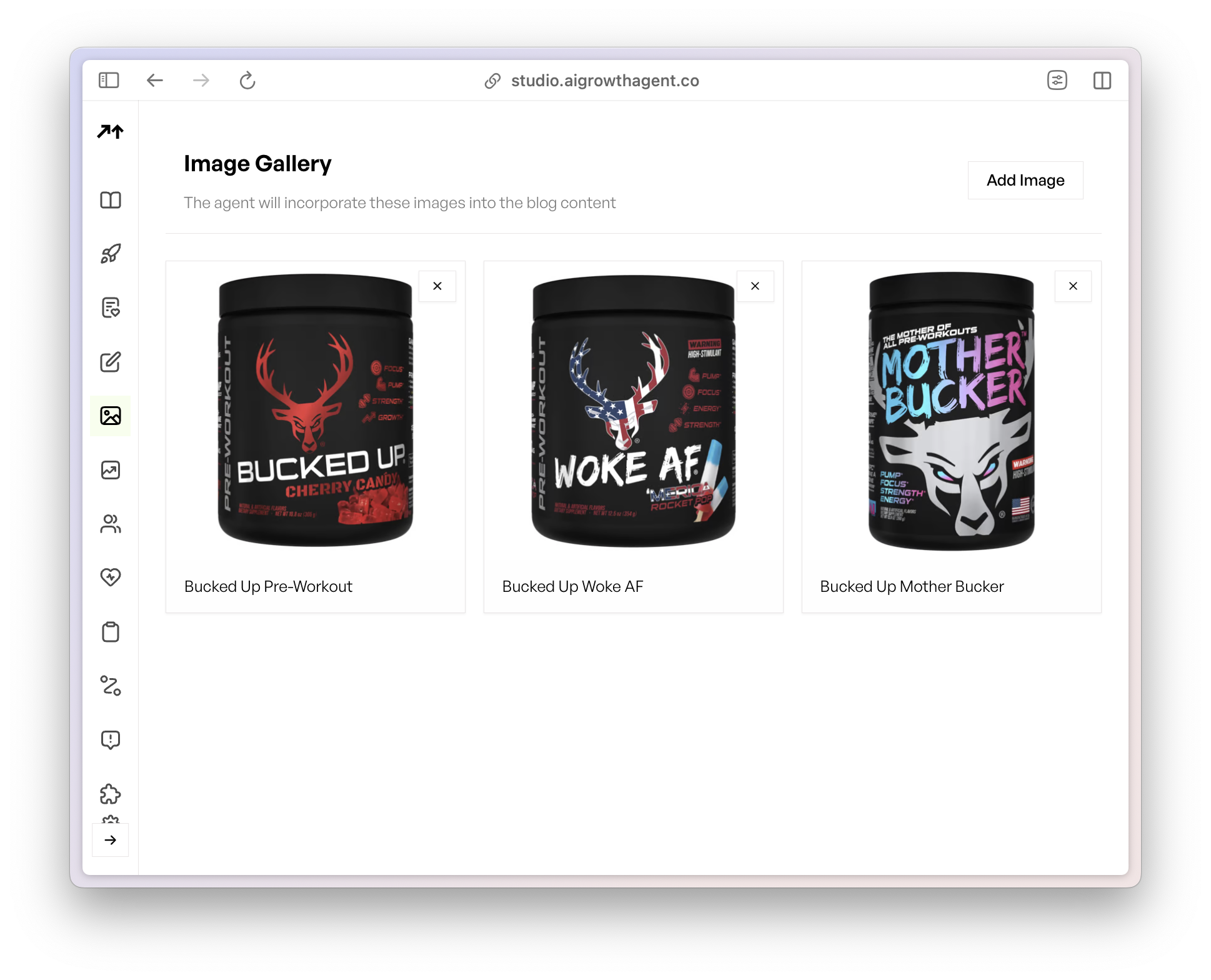
Images matter for both audience engagement and machine understanding. AI Growth Agent includes intelligent image handling as part of the workflow. In the Studio, you can upload a gallery of product screenshots and brand assets or generate new visuals through integrated AI tools.
As the Core Content Agent writes, it:
- Selects contextually relevant images for each article.
- Places them at points in the content that support the narrative.
- Embeds optimized alt text, titles, and metadata to support accessibility and image SEO.
This approach helps visuals strengthen user experience and provide structured data points that AI search engines can use to interpret content accurately.
Is AI Growth Agent suitable for multi-brand portfolios or just single brands?
AI Growth Agent is designed to support both single brands and complex portfolios. The platform allows you to run multiple distinct Content Agents in parallel, each with its own Manifesto, keyword strategy, voice, and editorial approach. These agents can publish to the same blog or to different properties, all managed from a single Studio interface.
This setup works well for private equity firms, venture studios, and enterprises with multiple product lines. A small central team can orchestrate a multi-brand content strategy at scale without fragmenting tools or processes, while still maintaining clear separation of narratives and positioning where needed.
Conclusion: Build Sustainable Authority with Automated Thought Leadership Content Tools
AI search has changed the rules of digital competition. Content now serves as a training signal for AI systems as much as a direct communication channel with buyers. To keep pace, marketing leaders must publish high-quality, technically optimized, authoritative content at a scale that traditional approaches rarely achieve, and do so in a way that AI search engines can understand and cite.
Automated thought leadership content tools built for AI search are becoming essential for defending and growing category leadership. In a landscape where competitors can quickly deploy basic AI content, the differentiator is how you use automation, not whether you use it. The goal is to build a structured, end-to-end platform that amplifies your expertise instead of relying on shallow shortcuts.
AI Growth Agent offers an autonomous content platform that spans onboarding, multi-agent orchestration, advanced technical optimization, and real-time AI search monitoring. For established brands with strong foundations, it provides a way to scale presence and authority within their category.
To evaluate whether this approach fits your strategy, you can schedule a consultation session for AI Growth Agent’s platform and explore how an autonomous content engine could support your long-term competitive position.
