


Key Takeaways
- AI systems such as ChatGPT, Google AI Overviews, and Perplexity now sit between buyers and brands, so B2B visibility depends on being cited and summarized accurately by these systems, not only on ranking for keywords. AI-powered tools are now central to B2B discovery and evaluation.
- Programmatic SEO and answer-engine-ready content give marketing teams the scale, structure, and recency signals that AI models use to select trusted sources in zero-click and AI-mediated search environments. Answer Engine Optimization (AEO) has become a core B2B tactic.
- First-party data, privacy-first strategies, and human-led brand voice now work together with AI to deliver personalized experiences, while authentic, expert perspectives differentiate brands from generic synthetic content. Trust in AI use is emerging as a key driver of brand equity.
- Marketing leaders benefit from measurement that includes AI citations, AI share of voice, and opportunity-level revenue impact, since AI assistants often resolve queries without clicks. Zero-click behavior and AI assistants are reshaping SEO economics.
- AI Growth Agent provides an autonomous Programmatic SEO platform that engineers structured, AI-ready content at scale and tracks AI visibility, helping B2B teams improve discoverability and revenue impact from AI search. Schedule a demo with AI Growth Agent.
The New Reality: B2B Marketing in an AI-Dominated Search Landscape
The Imperative of AI Discoverability: From Keywords to Citation
AI agents now handle research, comparison, and shortlisting across many B2B buying cycles before humans review options. AI tools are becoming active intermediaries in B2B purchases, which means brands must optimize for machine interpretation as carefully as for human readers.
AI-generated content volume grows every day, so static or low-volume content strategies lose relative visibility. Gartner projects that most B2B buying will be mediated by AI agents by 2028, which turns AI discoverability into a near-term priority.
Search is shifting toward Generative Engine Optimization and Answer Engine Optimization, where systems favor sources with clear structure, recency, expertise signals, and machine-readable markup. Structured, credible information now influences which brands AI cites.
Learn how to make your brand citeable by AI systems. Schedule a consultation session with AI Growth Agent.
Trend 1: Programmatic Velocity and Structured Content for AI Citation
The Demand for High-Velocity, Answer-Engine-Ready Content
Content that directly answers specific questions in a structured, scannable format now performs best in AI-driven and zero-click search. Answer-engine-ready content is becoming a core visibility driver, and AEO requires content designed for easy ingestion and summarization by LLMs.
AI models reward consistent structure, topical depth, and recent updates. A schedule of one or two handcrafted posts per month rarely creates enough coverage or freshness signals to compete with machine-scale publishing.
Why Traditional Methods Struggle With AI Requirements
Most SEO agencies follow a manual production model that delivers quality articles but lacks the engineering depth needed for Programmatic SEO. Manual workflows rarely keep pace with the volume of structured data, internal links, and technical elements such as schema markup, robots rules, and LLM.txt files needed for AI-first discovery.
General AI writing tools output text but not fully engineered pages. Strategy, information architecture, schema, and publishing still depend on internal teams, which limits scale and consistency.
AI Growth Agent: Autonomous Content Engineering for AI
AI Growth Agent’s Programmatic SEO Content Agent engineers complete pages, not just drafts. Content ships with an advanced schema, LLM.txt, and a blog Model Context Protocol that lets AI systems interface with your content set directly and interpret it with clarity.
The agent produces unique, brand-aligned pages at programmatic velocity, filling coverage gaps that manual methods leave open and strengthening signals that matter for AI citation.
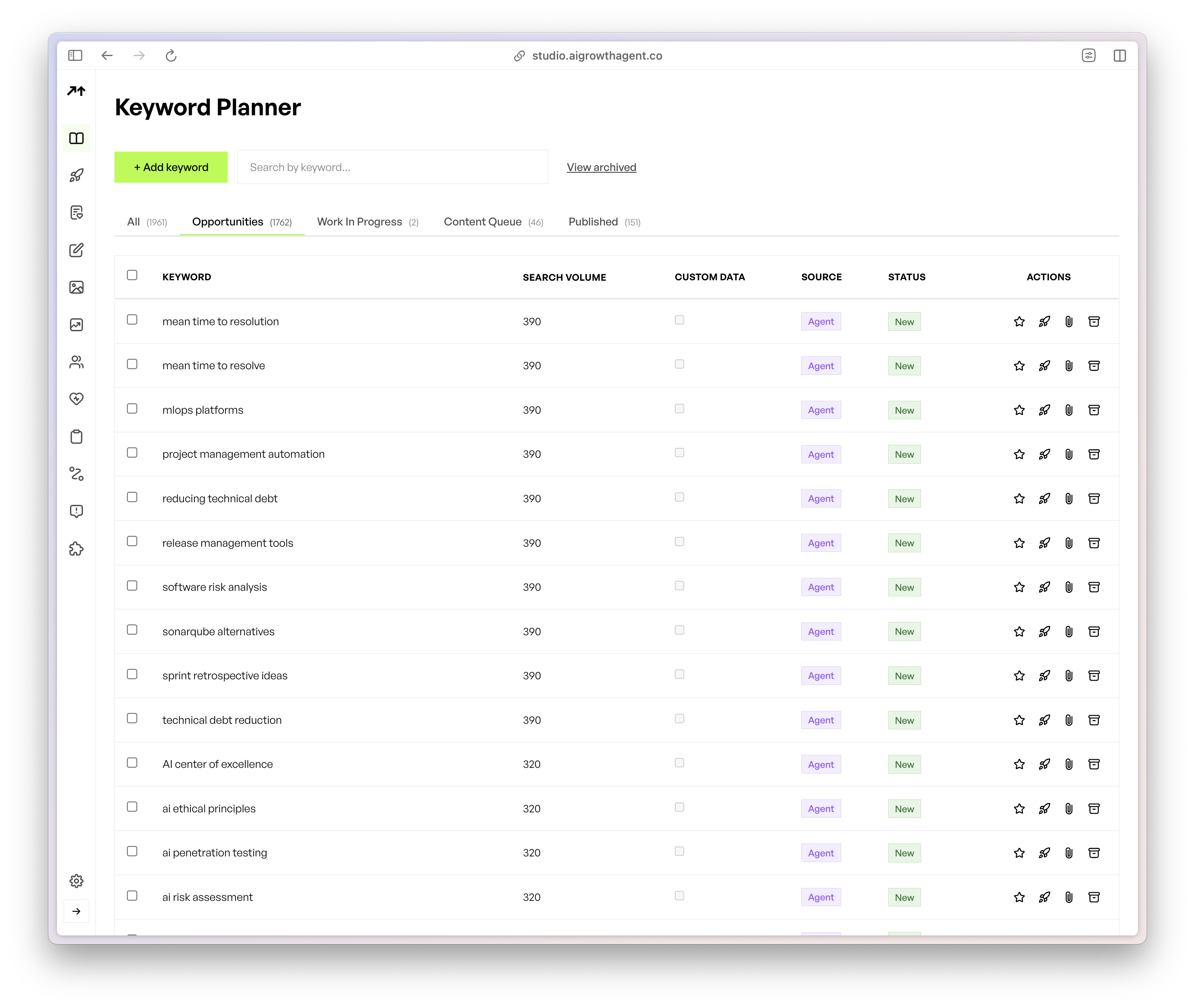
See how programmatic content can support your search strategy. Schedule a demo of Programmatic SEO with AI Growth Agent.
Trend 2: The Primacy of First-Party Data and AI-Driven Personalization
Privacy-First, Data-Driven Marketing in 2026
Privacy rules and cookie deprecation are pushing B2B teams toward strategies grounded in consented, first-party data. 2026 is emerging as a year where account-informed, privacy-first marketing outperforms broad reach, and enterprises face pressure to unify data silos for better personalization.
Brands that convert proprietary data into content assets build an advantage that generic AI cannot easily copy, since those insights reflect unique customer behavior, product performance, or market context.
AI-Powered Personalization and Micro-Content Structures
AI now supports personalization at the level of accounts, buying groups, and specific intents. Hyper-personalized and intent-based programs are scaling through AI, while micro-landing pages and narrow content clusters help capture long-tail, AI-shaped queries.
AI Growth Agent’s Data-to-Content Automation
AI Growth Agent turns structured databases and offline records into targeted, search-ready content. Database-to-Content Automation and Real-Time Programmatic SEO Content Injection convert items such as product catalogs or recommendation sets into indexable pages that align with specific intents and segments.
One client example converted a food recommendation database into individual SEO articles for each list, turning static entries into a searchable pSEO asset without manual drafting.
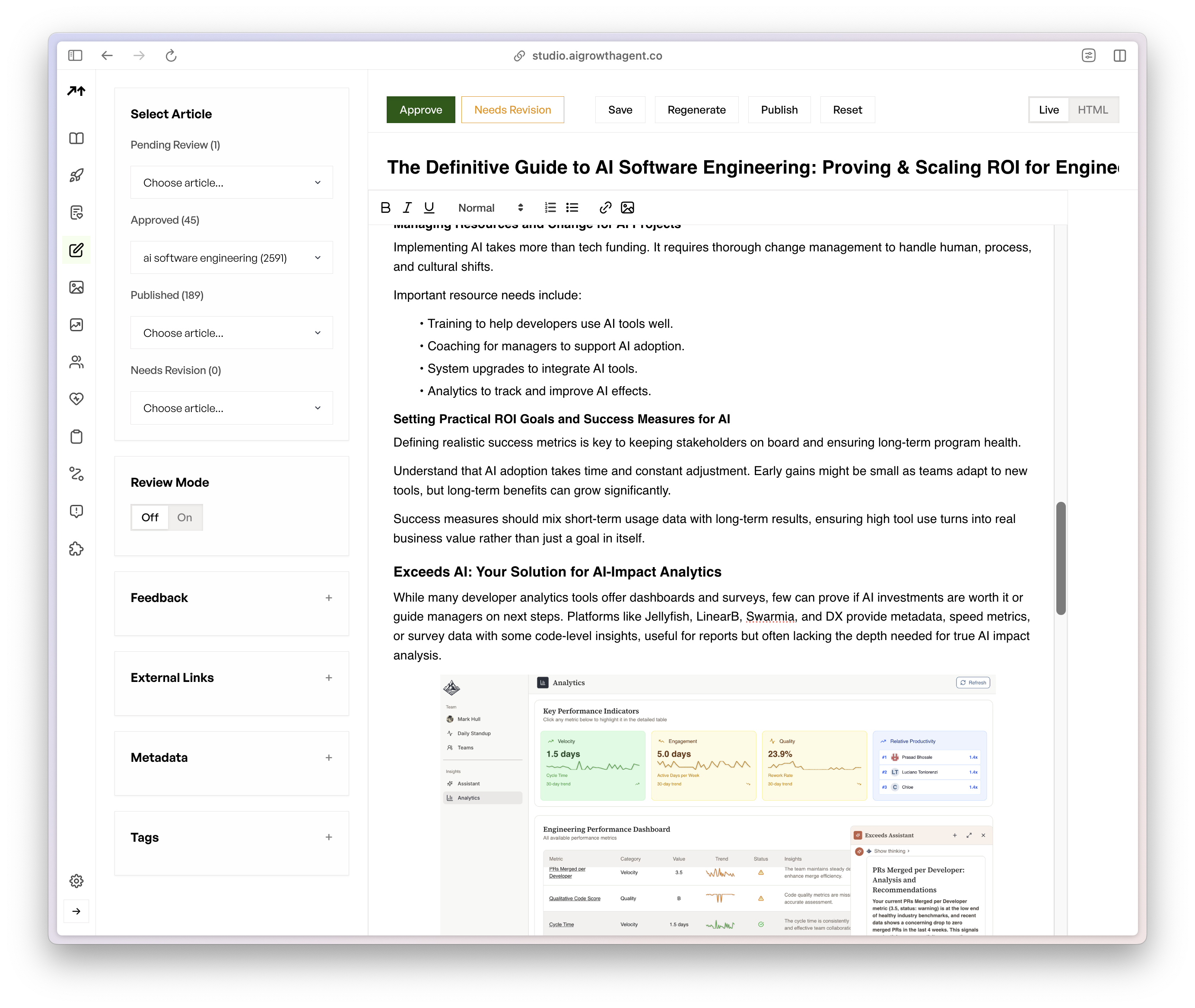
Activate proprietary data as differentiated content. Explore AI Growth Agent’s data-to-content capabilities.
Trend 3: Building Trust and Authenticity in a Synthetic World
Demand for Human-First Content
Audiences now encounter high volumes of auto-generated content and respond more strongly to expertise, original insights, and clear points of view. Buyers value human-first content that shows real experience, and distinct positions and subject-matter depth now serve as key differentiators.
Trust in how brands use AI is also emerging as part of overall brand equity. Transparency and responsible AI practices influence audience confidence.
Human-AI Collaboration and Brand Voice
Marketing teams continue to own positioning, narrative, and ethics, while AI supports research and execution. Human marketers remain central for strategy and context, with AI as a supporting assistant.
AI Growth Agent’s Approach to Authenticity
AI Growth Agent begins with a detailed onboarding process led by a professional journalist who documents your brand’s manifesto, narrative, and voice. These inputs guide the agent’s content decisions.
The AI Growth Agent Studio keeps humans in the loop. Teams review drafts, provide feedback, and refine preferences over time so that programmatic output stays aligned with tone and quality standards.
Maintain a clear brand voice while scaling content production. See how AI Growth Agent preserves your unique voice.
Trend 4: Unified Revenue Operations and Outcome-Based Measurement
Aligning Marketing, Sales, and Customer Success
Revenue teams are moving toward shared metrics and systems that connect marketing influence with sales and customer outcomes. Predictions for B2B point to deeper alignment across these functions, and teams are emphasizing opportunity-level metrics such as role coverage and meeting conversion.
Measuring AI Discoverability in a Zero-Click World
AI assistants and rich search results often answer questions without sending a click to any site. Zero-click interactions reduce organic click-through but still shape perception and demand.
Marketing leaders now track AI citations, AI share of voice, and branded search lift alongside traditional traffic and conversion metrics.
AI Growth Agent’s AI Search Monitor and Feedback Loop
AI Growth Agent’s AI Search Monitor surfaces how often and how well your brand appears in AI responses across supported platforms. The module ties this view to Google Search Console data to show changes in organic visibility and traffic.
Teams see which keywords index well in AI contexts, which assets drive citations, and where content gaps remain.
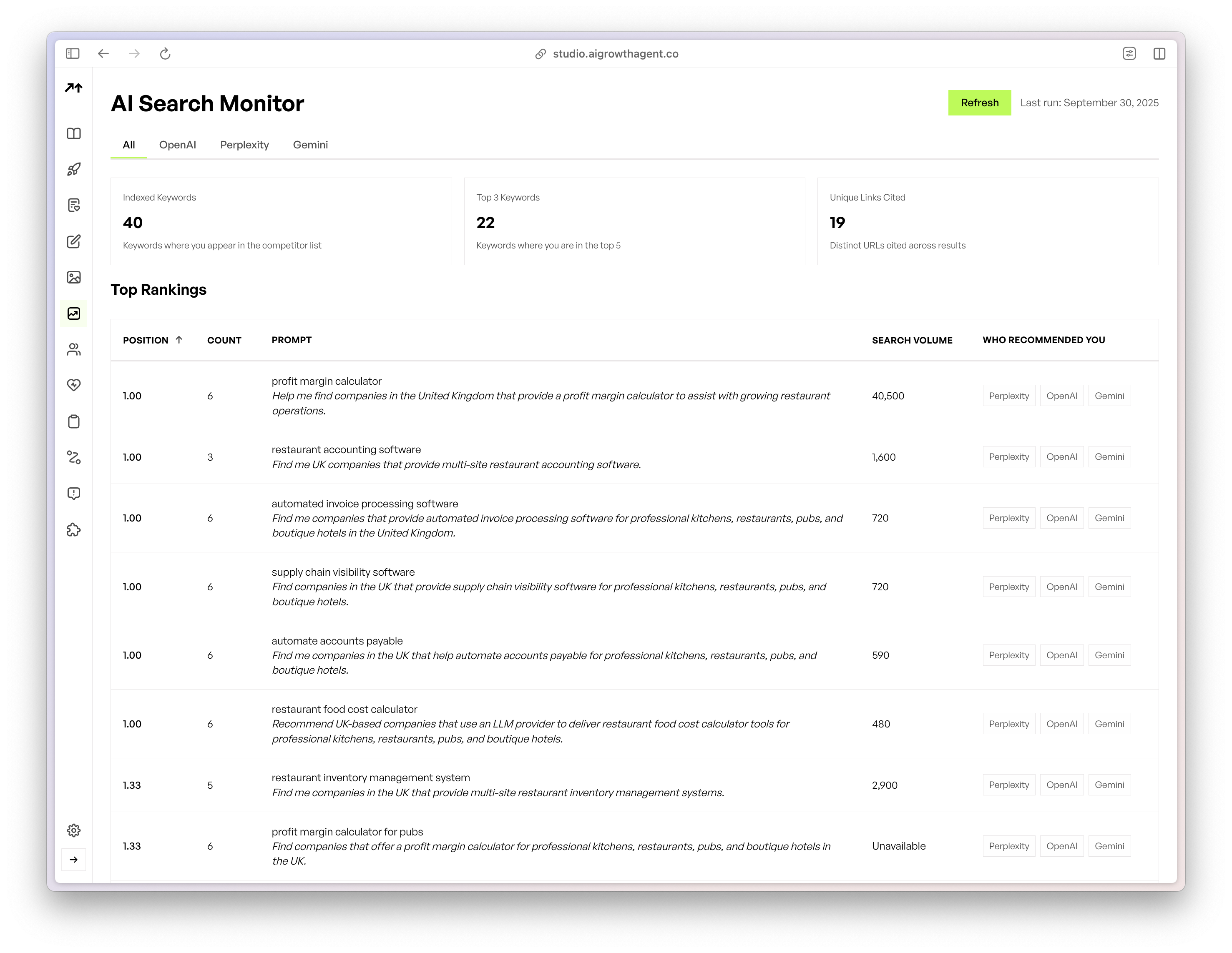
Track AI visibility with clear metrics. Request a demo of AI Growth Agent’s AI Search Monitor.
Programmatic SEO for AI Discoverability: A Comparative View
Comparison Table: AI Growth Agent vs. Traditional Methods
|
Capability |
AI Growth Agent |
Traditional SEO Agencies |
Self-Service AI Tools |
|
Content velocity |
Automated, programmatic publishing |
Limited by manual production |
Fast drafts, manual deployment |
|
Technical depth |
Built-in schema, LLM.txt, MCP |
Basic on-page optimization |
Text output, light formatting |
|
AI discoverability |
Structured for AI citation and parsing |
Primarily keyword-focused |
Unstructured, requires extra work |
|
Scale and automation |
Multi-tenant, multi-brand operations |
Constrained by team size |
Requires a separate strategy and QA |
AI Growth Agent’s multi-tenant deployment allows agencies and multi-brand organizations to run parallel content programs from a single interface while applying shared best practices and governance.
Compare programmatic and manual approaches for your team. Schedule a demo with AI Growth Agent.
Implications for Marketing Leaders: Updating Your AI Search Strategy for 2026
Marketing leaders gain an advantage by reshaping content and measurement around AI search behavior. Investment in AEO and programmatic publishing now supports long-term visibility.
Teams benefit from:
- Structured, schema-rich content that AI systems can parse and cite confidently. Clear authority signals increase the chance of inclusion in AI answers.
- First-party data pipelines that feed both personalization and differentiated content. Robust data strategies support targeting and measurement.
- Human-led strategy that sets direction, voice, and ethics while AI manages execution at scale. Balanced human-AI collaboration improves performance.
Align your 2026 plan with AI search behavior. Book a strategy session with AI Growth Agent.
Frequently Asked Questions (FAQ) on AI-Dominated B2B Marketing
How will AI change B2B content marketing in 2026?
AI shifts B2B content marketing from pure keyword SEO toward Answer Engine Optimization and Generative Engine Optimization. Content needs a clear structure, concise answers, and technical markup so models can summarize and cite it reliably. Programmatic content frameworks help teams meet the required volume and consistency.
Why is programmatic SEO critical for B2B brands in an AI search environment?
AI systems favor sources that demonstrate sustained topical depth and consistent authority signals. Programmatic SEO builds dense content architectures around priority topics, with internal links and schema that clarify relationships. This approach makes it more likely that AI assistants select your content across a wide range of related questions.
What kind of ROI can I expect from optimizing for AI discoverability?
Brands that optimize for AI discoverability often see more citations in AI answers, stronger branded search trends, and higher-quality inbound opportunities from informed buyers. These gains typically show up as improved organic contribution to the pipeline rather than only higher raw traffic.
Will AI replace human B2B marketers by 2026?
AI is changing tasks, not removing the need for human marketers. Human teams still define positioning, messaging strategy, creative direction, and ethical standards, while AI supports research, drafting, and optimization. Organizations that combine human judgment with AI-assisted execution usually see the best results.
How do I measure success in AI-mediated search environments?
Effective measurement includes AI citations and share of voice, changes in branded search volume, contribution of organic and AI-influenced touchpoints to pipeline, and engagement quality by segment. Tracking these indicators alongside traditional traffic and conversion metrics gives a clearer picture of AI’s role in revenue.
Conclusion: Secure Your Brand’s Authority in the AI Era
B2B marketing in 2026 depends on how well brands surface in AI-mediated journeys, not only in classic search listings. Programmatic velocity, structured content, strong first-party data, authentic human perspectives, and outcome-based measurement now work together as one system.
Manual-only content programs struggle to provide the coverage, technical depth, and freshness that AI models expect from authoritative sources. Teams that adopt programmatic approaches and AI-aware measurement place themselves where buyers and their AI assistants look first.
AI Growth Agent supports this shift with autonomous Programmatic SEO, database-to-content automation, and AI visibility analytics. These capabilities help B2B organizations build structured authority and monitor how AI systems represent their brand.
Review how your content appears in AI results and plan your next steps. Book a strategy session with AI Growth Agent today.
