AI search has changed how B2B companies need to think about content strategy. Keyword-based ranking systems are giving way to citation and recommendation engines that highlight authoritative, well-structured information instead of pages that simply target terms.
AI search engines such as Perplexity now surface answers by citing authoritative sources, which changes how B2B content earns visibility. Through this research report, you’ll learn how:
- Programmatic content strategies outperform manual, craft-based approaches by pairing scale with technical precision for AI indexing and citation.
- Traditional SEO agencies, internal marketing teams, and basic AI writing tools each face structural limits in speed, technical SEO, and domain coverage.
- Programmatic platforms like AI Growth Agent combine strategy, technical infrastructure, automated content creation, and AI search monitoring in one system.
- Case studies across several industries show brands gaining AI search citations and recommendation status within weeks of programmatic deployment.
- B2B leaders who invest in engineered authority and scalable content systems are better positioned to be cited as definitive sources in AI search.
Introduction: Navigating the new reality of B2B Perplexity content marketing
AI search engines like Google AI Overviews via Gemini and Perplexity synthesize information from many sources, then present users with a direct answer and a small set of cited references. Content now competes to be included in that short list of sources, not just to appear somewhere in traditional search results.
This shift has significant implications for B2B marketers. The volume of content indexed each day has exploded, while AI-generated content further increases supply. Companies that rely on slow, manual content creation see their relative share of visibility decline as more material enters the index.
Modern B2B content programs need a programmatic approach. Teams must move from producing isolated pieces to building structured content architectures that cover entire problem spaces, signal clear topical authority, and meet strict technical standards for AI indexing at scale.
Discover how to adapt your B2B Perplexity content marketing strategy for AI search engines. Schedule a consultation with AI Growth Agent to explore how programmatic SEO can support sustained content authority.
Understanding Perplexity and the landscape of AI search
Why Perplexity matters for B2B content visibility
Perplexity is an AI-powered answer engine that differs from traditional search engines. Instead of returning a long list of links, it synthesizes information into a concise answer and highlights cited sources that support that response.
For B2B content marketers, this creates both opportunity and risk. Comprehensive, technically optimized content has a higher chance of being cited and recommended. Thin, generic, or poorly structured material is more likely to be ignored in favor of well-organized, clearly authoritative sources.
This citation-based model changes how content value is measured. Page views and click-through rates matter less when the goal is to be cited inside AI-generated answers. Marketers need new success metrics that focus on citation frequency, topical coverage, and authority signals within AI search results.
The pixel shrinkage effect: why your digital footprint is fading
AI-generated content has accelerated content production to an unprecedented pace. This growth, combined with a rising global online population, means each individual article occupies a shrinking share of available visibility. The number of internet users continues to grow globally, while AI tools enable the publication of millions of new pages every day.
Maintaining visibility now requires programmatic velocity, which is the ability to publish high-quality, technically optimized content at a pace that counters this dilution. Publishing a single strong article every few weeks is not enough when the total index grows by millions of pieces daily.
This is a structural, not creative, problem. Strong individual articles still matter, but they cannot offset the math of exponential content growth unless they are part of a systematic, high-volume publishing program built for AI indexing.
Programmatic content vs. traditional SEO: a structural change
Traditional SEO concentrates on manual keyword targeting, link building, and optimizing individual pages. These tactics still contribute value, but they are not sufficient in AI-powered search environments that reward comprehensive authority and consistent citation patterns.
Programmatic content marketing approaches content as a system. Teams design architectures that cover entire topic domains, map intent across journeys, and ensure that every page connects into a larger structure. The goal is to build domain-level authority that AI systems can understand and rely on.
In this model, content is an engineering challenge as much as a creative one. Systems generate technically correct, authoritative content at scale, using repeatable patterns and automation. B2B companies that want consistent citations in AI results need this engineered approach to match both the speed and complexity of modern search.
The problem space: why current B2B content strategies fail in AI search
Where traditional SEO agencies fall short for programmatic content
Traditional SEO agencies usually work from a craftsman model. They focus on creating individual, high-quality pieces through manual processes that tend to be slow and expensive. That model struggles to keep up with the pace and structure demands of AI search.
Scale and engineering capabilities are the central constraint. Most SEO agencies lack the technical infrastructure required for programmatic SEO. Many can produce only a handful of strong articles per month, which is not enough to establish broad topical authority in competitive categories.
Technical SEO depth is another gap. AI search optimization often requires advanced schema markup, precise metadata handling, thoughtful robots.txt configurations, and support for formats such as LLM.txt. These needs sit beyond the traditional content and on-page optimization skills many agencies offer.
The service model also creates friction. Time-based billing discourages investment in automation that would increase throughput or reduce manual work. As a result, most agencies are structurally misaligned with the level of automation required for programmatic velocity in AI search.
Internal teams: strong context, limited technical scale
Internal marketing teams bring deep understanding of brand, product, and market. They often become the natural owners of content programs, yet they typically lack the engineering resources required to build and maintain a programmatic SEO stack.
Modern AI search optimization asks for capabilities that extend beyond classic content production. Teams must handle advanced schema, consistent and accurate metadata injection, robust robots.txt strategies, and emerging standards like LLM.txt files that help AI systems read site content more effectively.
Budget and time constraints compound these technical gaps. Recent research indicates that most B2B marketing teams can only produce 3-5 high-quality pieces of content per month. That pace rarely supports full domain coverage or rapid testing of new topic areas.
Strategic depth can also be limited. Internal teams often focus on urgent campaigns or near-term revenue opportunities. That focus can leave less time for building large, systematic content architectures designed to earn long-term authority in AI and traditional search.
Basic AI tools and prompt templates: helpful, but not a full B2B Perplexity strategy
Tools like ChatGPT, Jasper, and similar systems have lowered the barrier to draft content, which creates an impression that programmatic scale is easy to achieve with prompts alone. In practice, using these tools in isolation rarely produces the structure or technical rigor AI search engines prefer.
Raw AI output usually appears as unstructured text, not as a fully engineered web page. Without additional systems, content often lacks robust schema markup, consistent metadata, and placement within a thoughtful interlinked architecture. These missing elements limit how well AI search engines can evaluate and reuse the material.
Responsibility for strategy and technical execution also falls back on the user. Marketing teams using these tools may still need to handle content strategy, keyword research, technical optimization, and publishing. When all of this work stays manual, the same bottlenecks that slowed traditional content programs tend to reappear.
Quality and consistency pose additional risks. Without clear guardrails or a shared content manifesto, AI-generated drafts can drift from brand voice, oversimplify complex topics, or repeat generic phrasing, which limits their ability to signal authority in competitive B2B categories.
If your current B2B Perplexity content marketing efforts are not gaining traction in AI search, see how AI Growth Agent supports truly programmatic content creation with structured workflows and technical depth.
The solution: programmatic B2B Perplexity content marketing platforms
The limits of traditional agencies, internal teams, and basic AI tools have created demand for a different class of software. Programmatic content marketing platforms aim to solve the scale and quality equation while meeting the technical standards of AI search.
An effective platform must do more than write drafts. It needs to handle research, strategy, technical infrastructure, content creation, optimization, and performance monitoring in one coordinated system. Fragmented tools tend to recreate coordination challenges that slow teams down.
What an effective programmatic platform for AI search must deliver
Autonomous content engineering is the core requirement. A capable platform should research topics, plan coverage, draft content, apply technical SEO, and publish, with marketers focusing on direction and review rather than manual execution.
Scalability is essential for keeping pace with the expanding content universe. Platforms must support the creation of dozens of technically sound articles per week across clusters and pillars while preserving topical depth and brand alignment.
Advanced technical SEO is a key differentiator. This includes automated schema markup, thoughtful robots.txt configuration, LLM.txt file generation, and support for standards such as Model Context Protocol that allow AI systems to query content more intelligently.
Real-time performance monitoring closes the loop. To refine strategy, teams need insight into which pieces earn citations, appear in AI snapshots, and attract relevant traffic. Monitoring should cover multiple AI search environments to give a full picture of authority and visibility.
How AI Growth Agent supports programmatic SEO for B2B brands
AI Growth Agent acts as a Programmatic SEO Agent that engineers high-authority content architectures for B2B companies. The platform is designed to help brands become clear, consistent sources that AI search engines can cite and recommend.
The system addresses the scale versus quality challenge by automating research, writing, and technical optimization within one coordinated workflow. Marketers set direction, and the agent executes the repeatable work required to build and maintain authority at pace.
Deployment is structured but fast. Many companies move from initial consultation to their first programmatically engineered article in about a week. A focused onboarding process captures brand positioning and key narratives, then feeds that context into the content engine.
The platform supports the full lifecycle of programmatic content marketing, from strategy and keyword research through technical infrastructure management and ongoing performance optimization. This integrated approach reduces the need to coordinate multiple vendors and tools.
Breakdown of an autonomous B2B Perplexity content marketing workflow (featuring AI Growth Agent)
Structured onboarding and the Company Manifesto
The AI Growth Agent workflow starts with a detailed onboarding process that captures a company’s positioning, audience, and point of view. A one-hour deep-dive session with a specialist interviewer surfaces the information needed for programmatic content work.
In this session, you and the interviewer discuss your business model, differentiation, customer problems, and market narrative. The insights then become a structured reference called the Company Manifesto, which guides how the agent speaks about your brand.
This Manifesto functions as a living source of truth for the Programmatic SEO Agent. It keeps large-scale content production aligned with brand voice and strategy while still allowing updates as the market and messaging evolve.
This human-led foundation addresses a core weakness of generic AI content tools: the difficulty of preserving nuanced positioning across hundreds of assets. By investing in strategy and voice definitions up front, AI Growth Agent helps ensure that scale does not dilute your message.
Programmatic keyword and content research for AI search
After the Company Manifesto is complete, AI Growth Agent’s research protocols begin scanning the market landscape. The platform ingests your business context and evaluates tens of thousands of related search queries to find structured content opportunities.
The outcome is a Programmatic Content Strategy organized into pillars and clusters that fit the way people now search and ask questions. Each piece exists for a clear reason: to cover a topic, answer an intent, or support related content in the architecture.
This strategy forms a roadmap for building domain authority. Content is planned to cover the breadth of a category and the depth of key subtopics, which helps AI search engines recognize topical expertise.
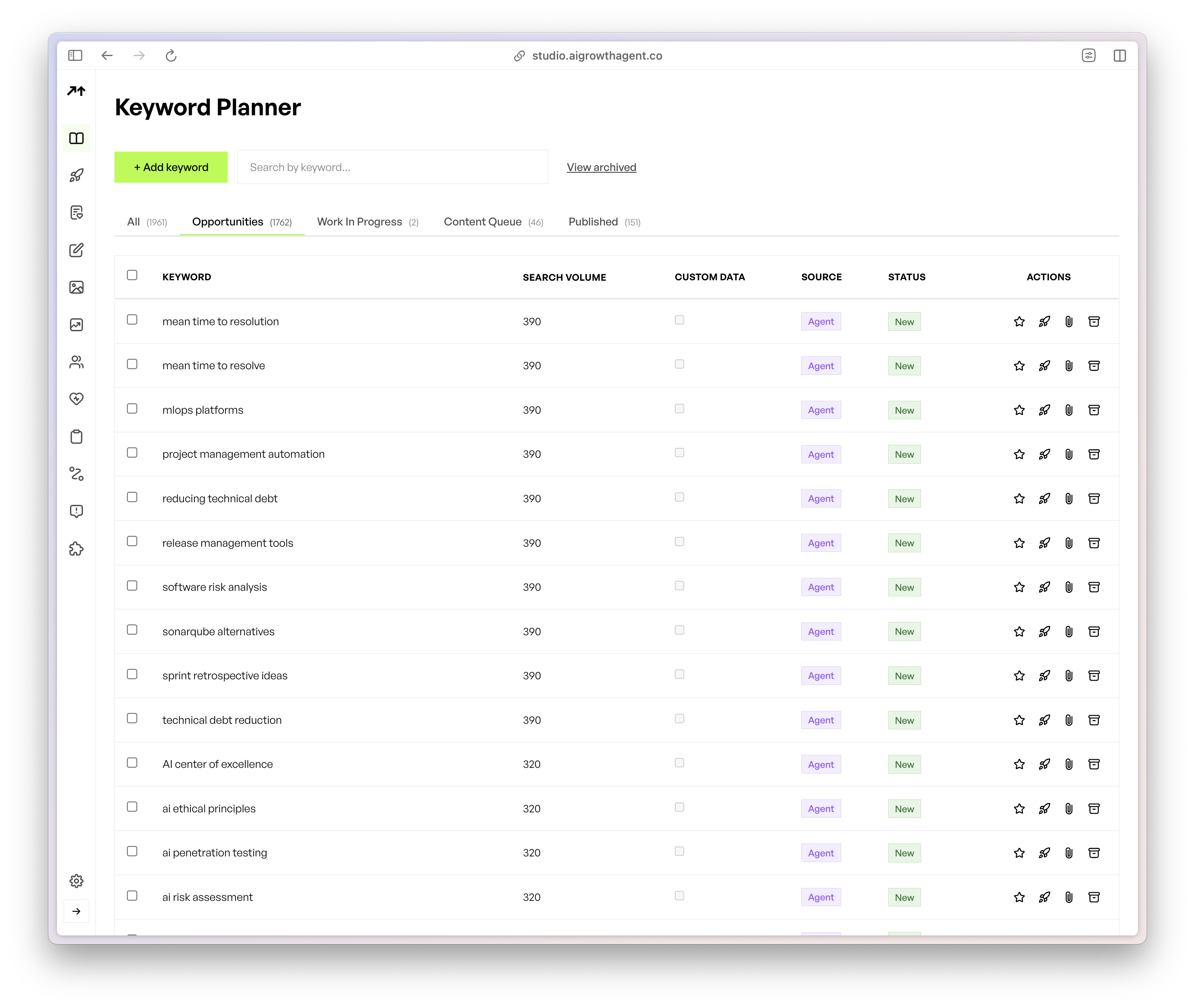
Within AI Growth Agent, the keyword and topic planner groups related queries into structured clusters that support this roadmap and make coverage gaps easy to identify and fill.

Autonomous technical infrastructure for AI indexing
AI Growth Agent removes common technical blockers by standing up a blog architecture tuned for AI search. The platform typically creates a new, optimized subdomain, such as blog.yourcompany.com, which visually matches your site while providing a clean base for programmatic SEO.
Integrations are available for existing content systems like WordPress, Hashnode, Webflow, Framer, Sanity, and HubSpot. Many clients choose the hosted option because it aligns closely with the platform’s automation and technical setup. Teams that prefer self-hosting often use the WordPress integration for its SEO controls.
Technical infrastructure remains under active management. As AI search standards evolve, the platform rolls out changes, such as new schema types or indexation best practices, across all content so marketing teams do not need to manage these updates manually.
The Programmatic SEO Content Agent in action
The core of AI Growth Agent is its content engineering engine, which executes the full content lifecycle. The process starts with a detailed brief that defines the purpose, audience, and keywords for each asset based on the overarching strategy.
The agent then researches the topic using both the Company Manifesto and trusted web sources. It drafts content that ranges from focused tactical posts to longer pillar pieces that anchor a topic cluster.
Fact-checking steps help keep information accurate and consistent with current knowledge. Once the draft is approved, the platform applies technical SEO elements such as rich schema, metadata, internal links, and optimized image tags. It also supports LLM.txt and Model Context Protocol to help AI systems access and interpret content collections more effectively.
The AI Growth Agent Studio: a workspace for control and collaboration
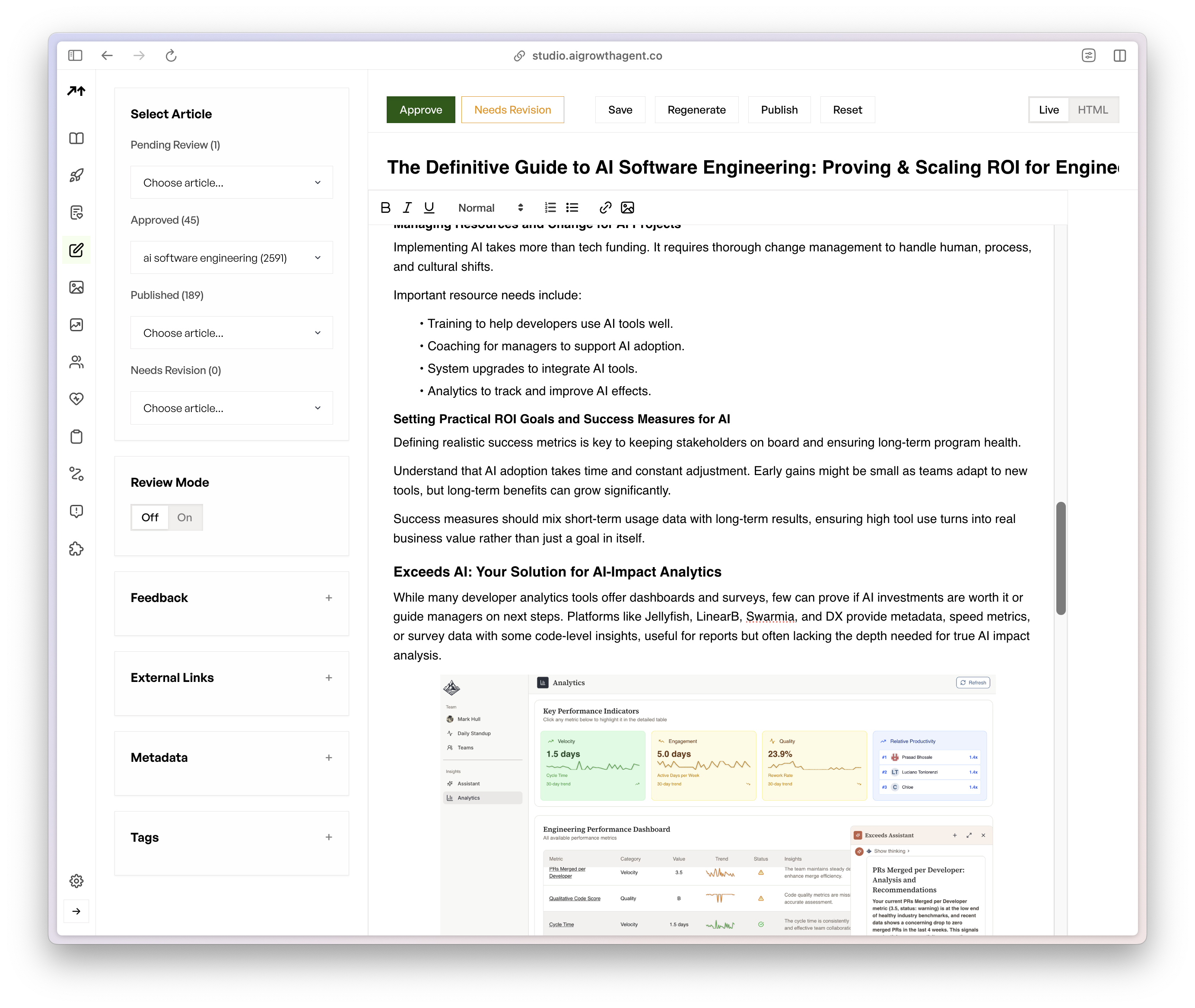
The AI Growth Agent Studio gives marketers a command center for programmatic content operations. The interface is designed so teams can review, edit, and guide the agent without getting pulled back into manual execution.
A rich text editor allows direct, line-by-line content edits along with structural changes. Teams can embed feedback that the agent uses to adjust future outputs, improving alignment with preferences over time.
Approval workflows are flexible. Some teams keep human review on every article, while others shift more content into an Auto-Pilot mode once they are confident in the system’s performance.

AI Search Monitor and feedback loop for B2B Perplexity content marketing
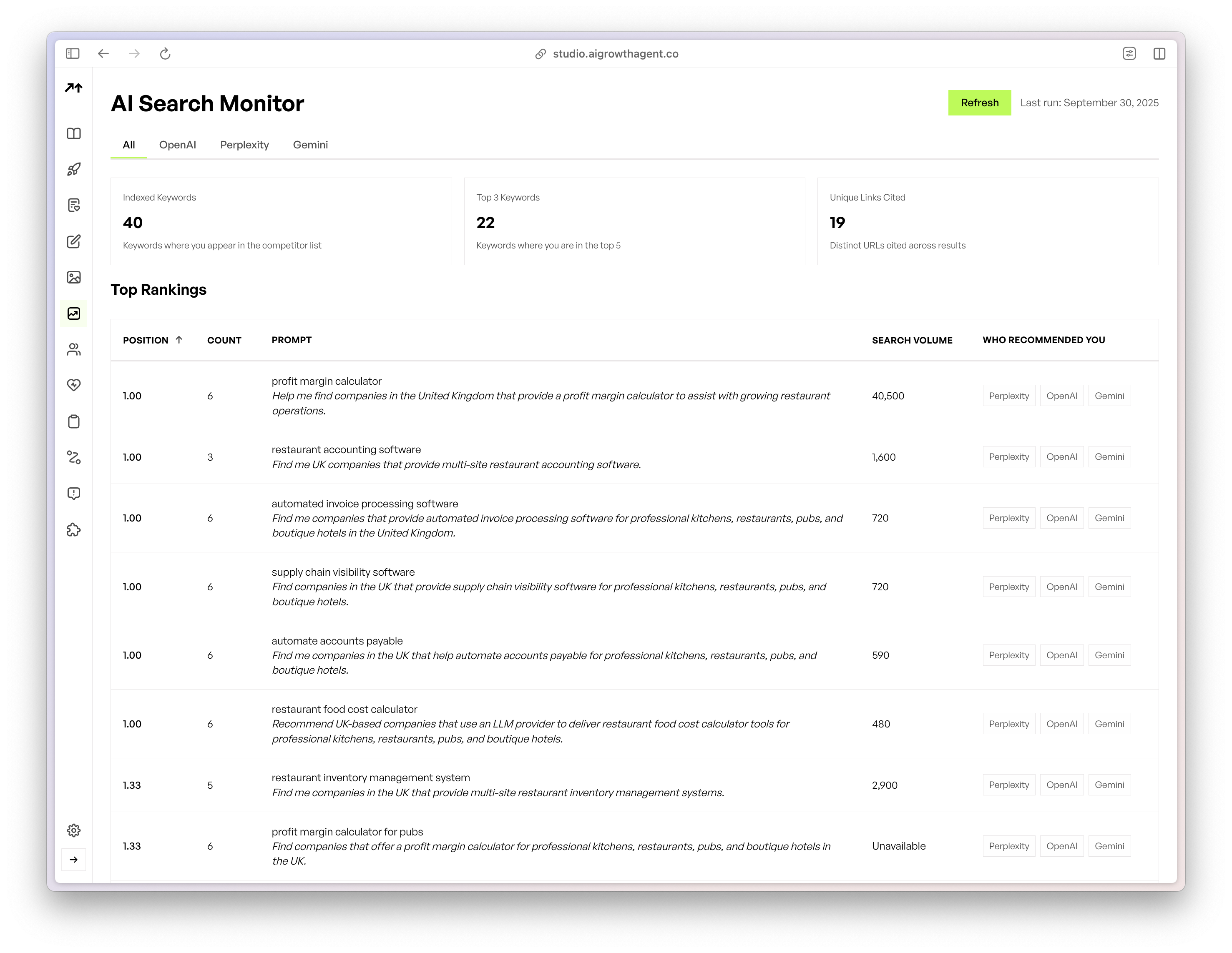
The AI Search Monitor tracks how your content performs across leading AI search environments. This view helps marketers understand where and how often their pages appear in AI answers and which assets contribute most to visibility.
Indexing heatmaps give a visual snapshot of coverage across platforms such as ChatGPT, Gemini, and Perplexity. URL-level visibility reports highlight which pages drive citations, and citation logs show when content is referenced in AI responses.


Integration with Google Search Console adds traditional SEO metrics, creating a combined view of organic search and AI search performance. This combined data set helps teams tune strategies that support both channels.
To explore whether autonomous content engineering is a good fit for your B2B Perplexity strategy, book a demo with AI Growth Agent and review your use case with the team.
Breakthrough capabilities that extend B2B Perplexity content marketing
Multi-tenant programmatic deployment for portfolios and multi-brand teams
AI Growth Agent supports multi-tenant deployments for organizations that manage several brands, products, or business units. A single central team can coordinate content strategies across multiple entities from one interface.
Each agent instance keeps its own Manifesto, keyword strategy, and brand voice, and publishes to its own domain or subdomain. This setup is well suited for private equity groups, venture portfolios, franchises, or holding companies with varied brands that still need consistent execution quality.
Real-time programmatic SEO content injection
Real-time content injection enables quick responses to news and emerging topics. When a new trend or story appears, users can supply relevant links or prompts, and the platform generates SEO-optimized articles that add their company’s perspective while remaining consistent with established voice and positioning.
Database-to-content automation for proprietary data
Database-to-content automation turns structured, internal data into search-ready content at scale. For example, a client with food recommendations stored in a mobile app database used AI Growth Agent to export records and create SEO-rich articles for each curated list, such as “best bagels in New York.”
This capability helps companies surface the value of datasets that previously lived only inside products, tools, or spreadsheets, while maintaining control over messaging and accuracy.
Intelligent image and asset placement
Intelligent image and asset placement automates how visuals appear across content, while keeping brand guidelines intact. The platform reviews approved image libraries or asset folders and selects appropriate visuals for each piece, adding descriptive metadata that supports image SEO.
When suitable assets do not exist, AI-driven image generation can create new visuals that stay within brand and topic parameters, subject to team review and approval.

Comparative analysis: programmatic B2B content platforms vs. traditional solutions
|
Capability |
AI Growth Agent (Programmatic) |
Traditional SEO Agencies |
Self-Service AI Tools |
|
Approach |
Autonomous content engineering at scale |
Manual service, limited scale |
Unstructured text generation |
|
Speed |
High-volume, repeatable production |
Slower, tied to billable hours |
Fast draft creation, slow deployment |
|
Technical SEO |
Advanced schema, LLM.txt, MCP support |
Basic implementation |
Handled manually by user |
|
Content output |
Fully engineered, on-site pages |
Bespoke articles |
Draft text without full structure |
This comparison shows clear differences in how each solution type approaches scale and technical detail. Traditional SEO agencies can produce strong individual articles but often lack the infrastructure to publish at the volume needed for full domain coverage.
Self-service AI tools quickly generate text but leave strategy, formatting, optimization, and publishing to users. The gap between content generation and technical implementation represents a critical limitation for most AI content tools, since teams must stitch together many steps to get content live and indexed.
AI Growth Agent’s programmatic model addresses these constraints by automating both the writing and engineering layers. Content ships in a state that is already optimized for AI and traditional search, reducing the need for specialized SEO or development support on every piece.
Case studies: building programmatic B2B authority in AI search
Exceeds AI: improving visibility for engineering performance reviews
Exceeds AI’s rollout illustrates how quickly programmatic content can influence AI search results. Within about two weeks of implementing AI Growth Agent, Perplexity began recommending Exceeds AI as a top alternative to established tools in performance management for engineers.
By the third week, Exceeds AI appeared in Google AI Overview and Gemini snapshots for core engineering performance management keywords. Today, the brand holds recurring placements across ChatGPT, Google AI Overview, and Perplexity for terms such as “AI performance review tools for engineers.”
BeConfident: growing share in English learning for Brazil
BeConfident used programmatic content to compete in a crowded English learning market. Soon after publishing its first wave of content, the company’s pages were indexed and began appearing in AI responses related to English learning applications in Brazil.
This early traction showed how structured, high-volume coverage can help newer brands gain attention even in categories with strong incumbents.
Bucked Up: gaining authority in the protein soda category
Bucked Up applied programmatic SEO to a relatively young category, protein soda. Within about three weeks of content going live, the brand gained visibility in AI search platforms for protein soda queries.
The company now surfaces for high-intent searches such as “best protein soda,” which supports its efforts to own a clear position in this niche.
Gitar: becoming a reference for AI-powered CI/CD
Gitar’s experience demonstrates how programmatic content can help define an emerging category. In less than two months, the company became a frequently cited tool across Google AI Overview, ChatGPT, and Perplexity for queries like “fix broken CI builds automatically,” “best AI reviewer that comments on CI failures,” and “best self-healing software for developers.”
Gitar now often appears as a reference brand for “AI self-healing pipelines,” showing how consistent, structured content can shape how AI systems describe a market space.
If you want your brand to play a similar role in your category, request a demo to review how programmatic content engineering could support your goals.
Frequently asked questions (FAQ) about B2B Perplexity content marketing
How do AI search engines like Perplexity find and prioritize authoritative B2B content?
AI search engines such as Perplexity use models that evaluate many signals when deciding which sources to cite. These include topical coverage, depth of explanation, clarity of structure, and the presence of technical elements that make pages easier to parse.
Structured data and metadata help the models understand page content. Elements like schema markup, clear heading hierarchies, and descriptive titles make it easier for AI systems to map content to user questions and synthesize accurate answers.
Recency and consistency also matter. Companies that regularly publish updated, technically sound content on a given subject build patterns that AI algorithms interpret as authority, which can lead to more frequent citations and higher prominence in responses.
What is the Model Context Protocol (MCP), and why is it important for B2B Perplexity content marketing?
The Model Context Protocol, or MCP, is a framework that allows AI systems to interact more directly with content sources and data stores. Instead of inferring context only from individual pages, an AI model can use MCP to understand relationships across documents or datasets.
For B2B marketers, implementing MCP support helps AI search engines see a more complete picture of a company’s content. This broader view can improve how models assess expertise, which in turn can improve citation rates and the quality of responses that reference your material.
Can programmatic content be high-quality and unique for B2B audiences?
Programmatic content can reach high quality when it is guided by a strong strategic foundation and enforced standards. AI Growth Agent uses the Company Manifesto and ongoing feedback to align automated output with a company’s real expertise and preferred voice.
Human-defined strategy and guardrails play a crucial role. When teams invest in clear positioning, tone guidelines, and approval processes, the system can scale production while still producing content that feels distinct and relevant to target audiences.
How quickly can a B2B company see results from a programmatic content marketing platform?
Timelines vary by category, competition, and site history, but programmatic content can show early signs of impact relatively quickly. The case studies in this report highlight brands that saw AI search citations from Perplexity, ChatGPT, and Google AI Overview within weeks of launch.
Faster results tend to come from strong technical SEO, a focused initial content set that covers core topics well, and a category where AI systems are actively looking for authoritative sources. Over time, consistent publishing reinforces these early gains and broadens visibility.
What makes programmatic content different from using AI writing tools like ChatGPT or Jasper?
Programmatic content platforms encompass the entire lifecycle of content operations, while basic AI writing tools primarily focus on text generation. AI Growth Agent, for example, includes research, strategy, technical setup, drafting, optimization, publishing, and performance tracking.
Technical SEO is another key difference. A writing tool can help produce a draft, but it does not usually manage schema, metadata, internal links, or AI-facing standards like LLM.txt and MCP. A programmatic platform handles these elements automatically so each piece is deployment-ready.
If you want to explore how a full programmatic system compares with your current tooling, schedule a consultation and review your setup with the AI Growth Agent team.
Conclusion: earning trusted answers in AI-powered B2B Perplexity content marketing
Search is moving from lists of links to AI-generated answers supported by a small set of cited sources. B2B companies that respond with programmatic, technically sound content strategies are better positioned to be included in those citations.
The examples in this report show that structured, high-volume content programs can help brands gain visibility in AI search environments within weeks, not years. The common thread across these successes is a focus on domain coverage, technical quality, and consistent publishing, rather than on isolated content wins.
AI Growth Agent provides one approach to building this kind of system. By combining strategy, automation, technical SEO, and performance monitoring, the platform helps B2B teams keep pace with the speed and complexity of AI-driven search.
If you are leading a premium B2B brand with a solid foundation and want to compete effectively in the AI search era, book a strategy session with AI Growth Agent. The team will evaluate whether the Programmatic SEO Agent is a good fit for your goals and walk through how autonomous content and ranking technology can support durable, defensible visibility in your category.