


Key Takeaways
- AI search engines such as ChatGPT, Google AI Overviews, and Perplexity now influence how B2B buyers discover vendors, so visibility inside their answers matters as much as traditional rankings.
- Lead teams are shifting from high marketing qualified lead volume to sales-accepted lead velocity driven by real-time signals, which rewards precise, intent-rich content over broad campaigns.
- Programmatic SEO gives B2B companies a way to cover thousands of long-tail, problem-focused queries with structured, entity-rich content that AI systems can summarize and cite.
- Autonomous content agents, technical automation, and AI search monitoring now form a single workflow, from keyword discovery to content deployment to AI citation tracking.
- AI Growth Agent provides an autonomous programmatic SEO system for B2B teams, and you can see it in practice by booking a demo.
The New Landscape: AI Search and the Evolution of B2B Lead Generation
B2B lead generation now favors narrow, intent-led programs over broad volume plays. Many teams focus on narrow-cast strategies that prioritize sales-accepted lead velocity, not raw MQL counts.
AI search tools have changed how buyers research solutions. Business users rely on systems that synthesize answers instead of opening multiple tabs, so brands need content that appears directly in those synthesized responses.
Effective content in 2026 answers specific, long-tail, problem-oriented questions in depth. Teams that address these queries clearly and completely increase the odds that AI systems select and cite their pages.
Programmatic SEO gives B2B companies a way to match AI-era scale without sacrificing structure or clarity, so they can earn consistent AI citations and qualified traffic from many related searches.
Foundational Shifts: Key Trends Redefining B2B Lead Generation in 2026
Signal-Layered Qualification Replaces MQL Volume
B2B teams now favor sales-accepted lead velocity supported by real-time signals. This approach values speed to relevance and fit over list size.
Modern scoring blends behavioral intent, firmographic fit, and technographic changes. Adaptive models that combine CRM, firmographic, and behavioral data help teams trigger outreach at high-intent moments.
AI Agents Compress Speed-to-Lead
AI has moved from simple assistance to autonomous agents that run core lead workflows. Systems now handle research, enrichment, and routing in seconds, which sets new expectations for response time.
AI agents also support content and sales teams. They coach representatives, draft tailored replies, and analyze conversations, feeding insights back into targeting and messaging.
Zero-Click Experiences Capture Intent Earlier
AI search and conversational interfaces enable lead capture before a user reaches a landing page. Interactive snippets, chatbots, and inline tools capture intent without traditional forms, which changes how teams collect and qualify demand.
Interactive tools now outperform static assets for both engagement and data depth. ROI calculators, maturity assessments, and value calculators surface richer first-party signals that feed programmatic lead routing.
Programmatic SEO: The Engine for Authority and Lead Generation in AI Search
Programmatic SEO automates content creation, optimization, and publication at scale so brands can appear across thousands of relevant search queries with consistent structure and quality.
Manual SEO cannot keep up with AI search velocity and coverage needs. AI discovery engines favor content that is easy to summarize and cite algorithmically, which requires both technical optimization and breadth.
Effective programmatic SEO combines keyword clustering, schema markup, and entity optimization. High-quality structured data and entity-focused content give AI systems clear hooks for citation.
AI Growth Agent provides a programmatic SEO agent that designs and deploys these content architectures so B2B companies can build measurable authority across their category.
|
Strategy Type |
Content Velocity |
AI Citation Rate |
Authority Building |
|
Traditional SEO (Manual) |
Slow |
Low |
Slow and fragmented |
|
Basic AI Writing Tools |
Moderate |
Low |
Incidental |
|
AI Growth Agent (Programmatic SEO) |
Very high |
High |
Fast and systematic |
Schedule a demo to review AI Growth Agent’s programmatic SEO workflow and lead generation impact.
The AI Growth Agent Solution: Autonomous Content Engineering for B2B Authority
AI Growth Agent automates the full programmatic SEO lifecycle, from intake and research to publishing and AI search monitoring, so teams can scale content without adding large headcount or complex tooling.
White-Glove Onboarding and the Company Manifesto
A one-hour kickoff with a journalist gathers details on your business, positioning, and narrative. The team converts this into a Company Manifesto that encodes voice, guardrails, and key messages for the Programmatic SEO Agent.
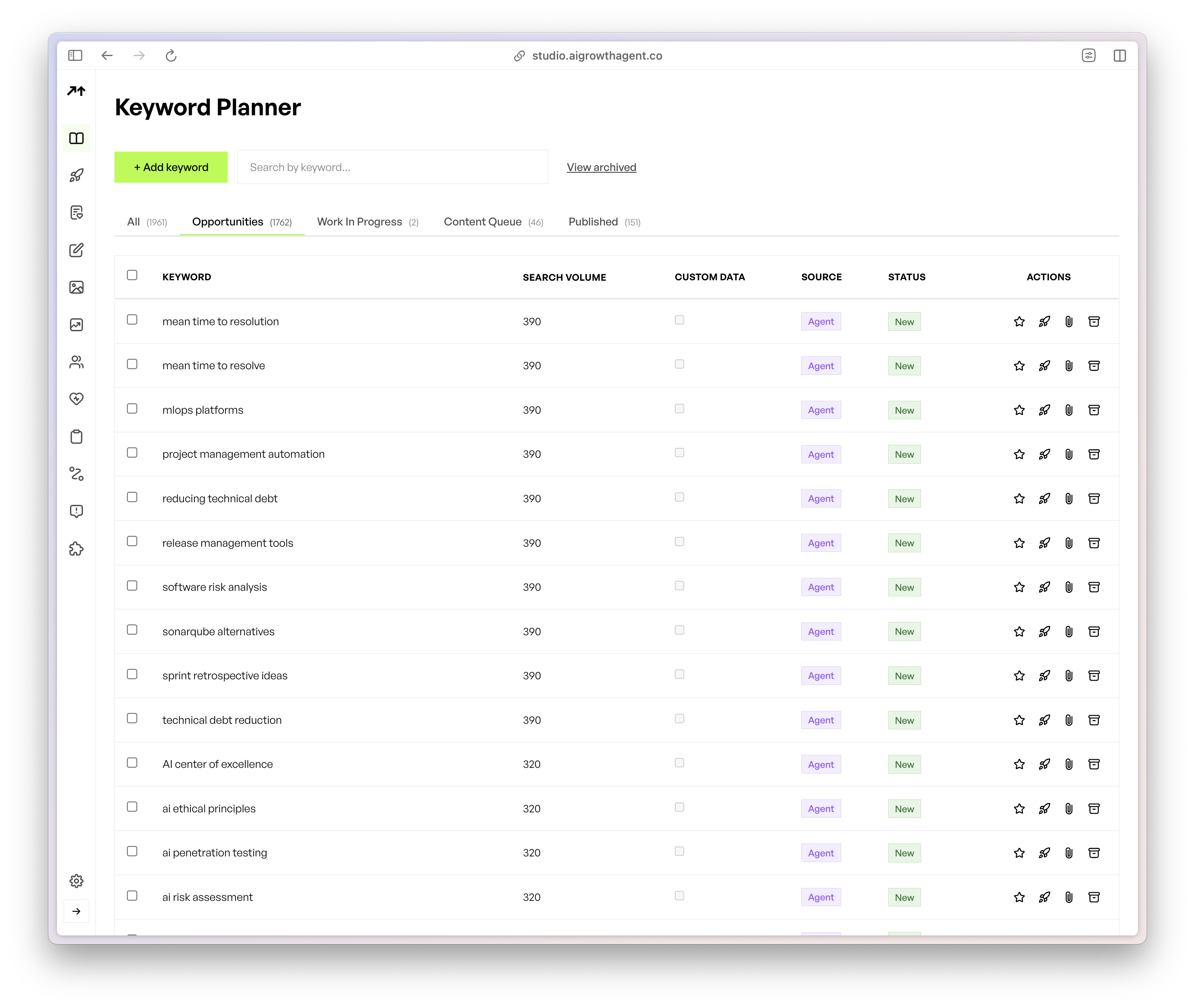
Programmatic Keyword and Content Research
After the Manifesto, the agent scans your context and evaluates tens of thousands of relevant queries. It produces a Programmatic Content Strategy organized into pillars and clusters that align with modern, query-driven search behavior.
Autonomous Technical Infrastructure
AI Growth Agent sets up an optimized blog as a subdomain of the client site, aligned with existing branding. This environment uses a clean, pSEO-ready architecture that supports high-velocity publishing and structured data.
The Programmatic SEO Content Agent
Once the keyword plan is approved, the Content Agent manages strategy, research, drafting, fact-checking, and technical optimization. Each article includes schema markup, metadata, and image optimization, plus implementations such as LLM.txt and a blog Model Context Protocol that allow AI systems to interface directly with the content database.
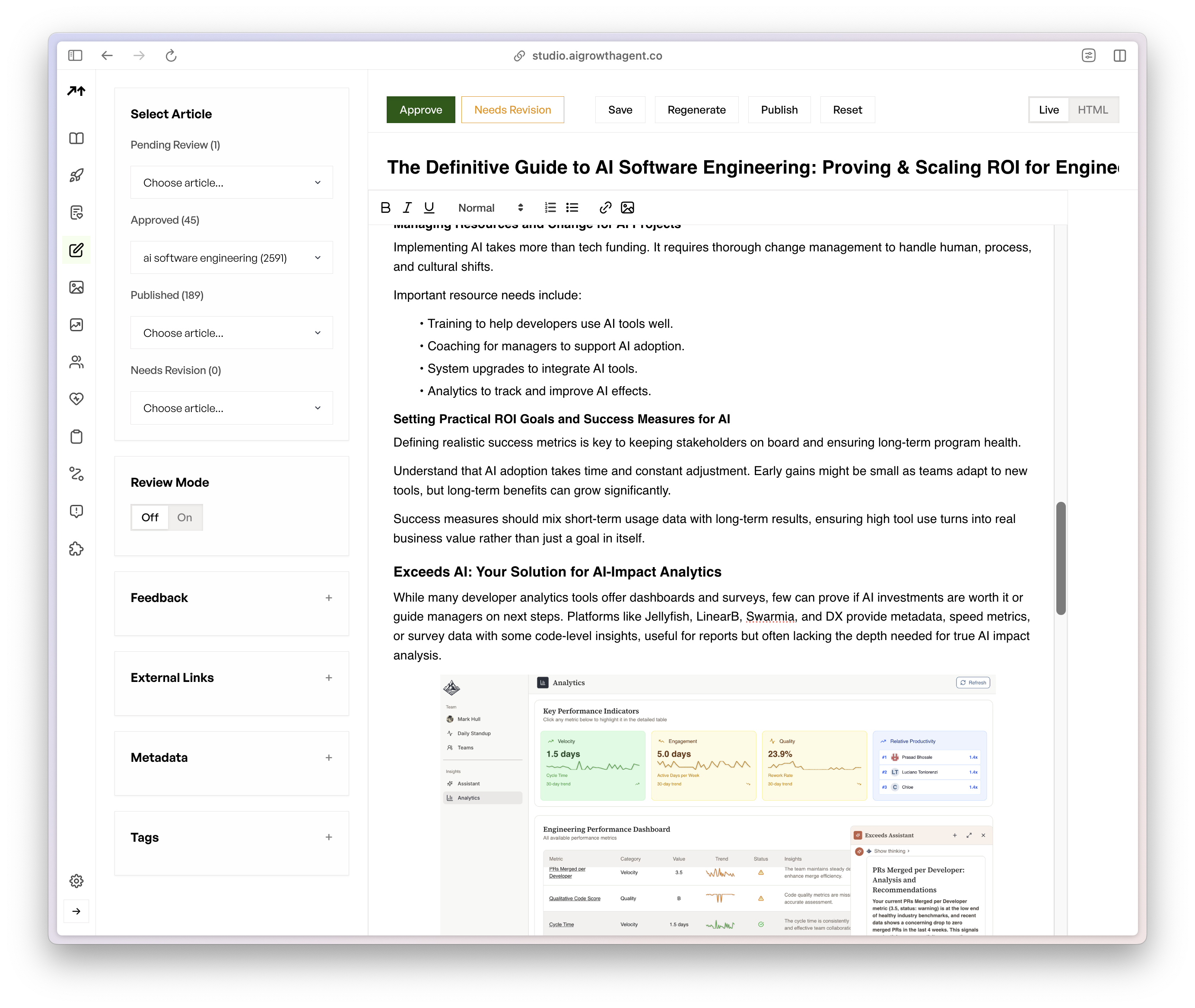
The AI Growth Agent Studio
Clients use the Studio interface to review drafts, edit content, give feedback to the agent, approve or reject posts, and use Auto-Pilot mode for fully autonomous publishing.
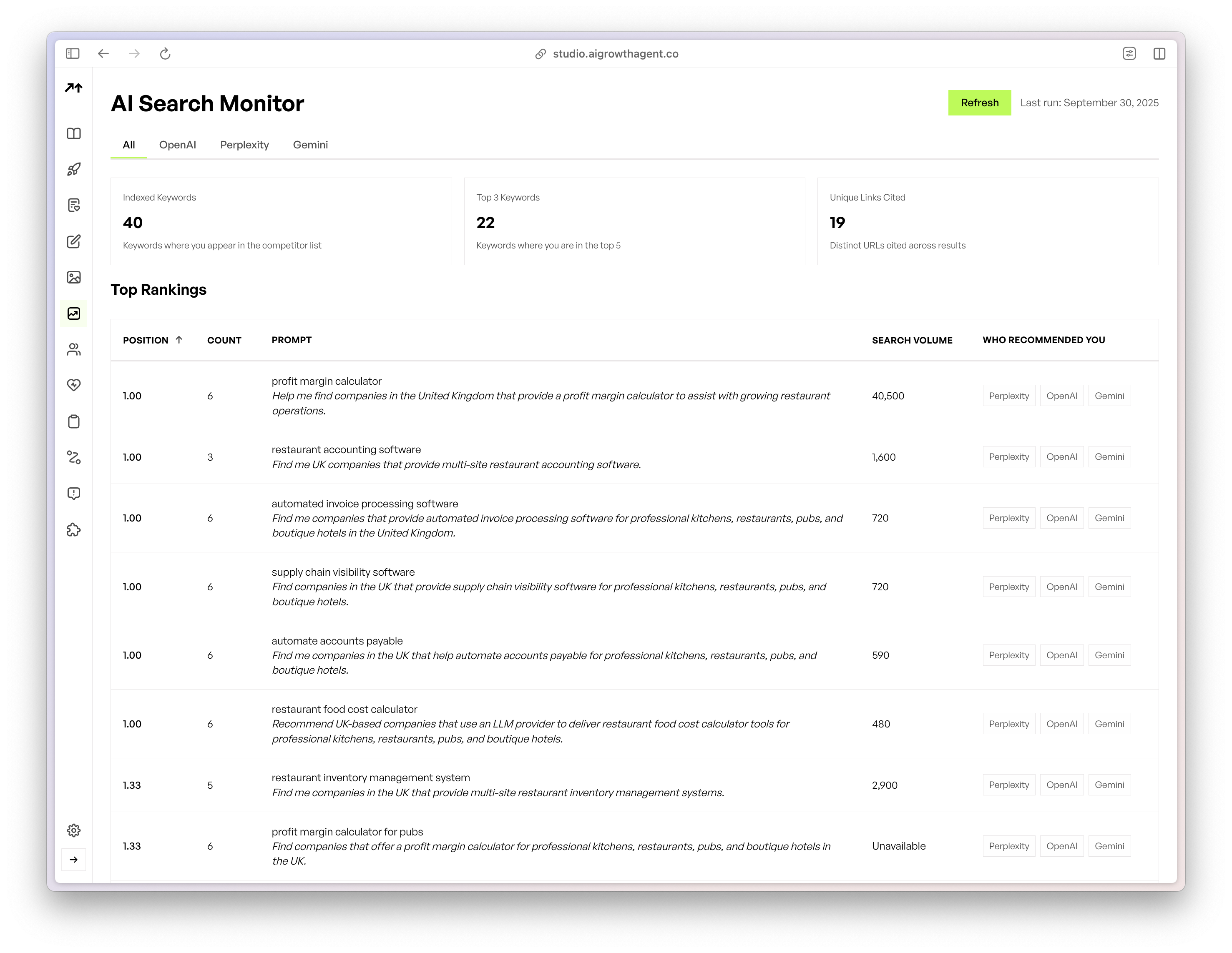
AI Search Monitor and Feedback Loop
The platform tracks indexing across ChatGPT, Gemini, and Perplexity, monitors URL visibility and citations, and aggregates crawl and traffic data, including Google Search Console integration.
Breakthrough Capabilities for Programmatic SEO Lead Generation
Multi-Tenant Programmatic Deployment
AI Growth Agent supports private equity firms, venture portfolios, and multi-product enterprises with separate agents under one interface. Each agent has its own Manifesto, keyword strategy, and brand voice, and can publish to different domains or subdomains.
Real-Time Programmatic Content Injection
The platform can generate and publish content on trending news with a brand-specific angle, which helps capture search interest around breaking topics while they are still emerging.
Database-to-Content Automation
Structured and proprietary data sets can be converted into SEO articles, turning offline or in-app information into indexable assets. One client with food recommendations inside a non-indexed app exported data so the agent could create SEO-focused lists such as “best bagels in New York.”
Intelligent Image and Asset Placement
The agent selects, places, and optimizes visuals, and can create new images inside the Studio with appropriate metadata so that assets contribute to search performance.
Competitive Landscape: A New Approach to Programmatic SEO
Compared with SEO Agencies
Traditional agencies often rely on manual workflows that limit velocity. AI Growth Agent operates as a content technology platform that focuses on engineered authority at scale instead of hour-based services.
Compared with Self-Service AI Content Tools
Generic AI writing tools usually stop at draft creation and still require manual work for strategy, CMS integration, and technical optimization. They rarely deliver a cohesive, schema-optimized architecture across thousands of pages.
Compared with AI Search Monitors
Monitoring tools highlight gaps but do not execute. AI Growth Agent functions as both monitor and execution engine, creating and optimizing content based on real AI search signals.
Conclusion: Competing in the 2026 AI Search Era
B2B lead generation in 2026 depends on how well brands align content with AI search behavior and programmatic SEO. Companies that delay these changes risk losing visibility as AI-generated answers become the primary entry point for research.
AI Growth Agent offers an autonomous programmatic SEO platform that helps established brands build structured authority while keeping content quality high and consistent.
AI systems now process large volumes of questions about every industry and solution. Book a strategy session to assess fit and review how AI Growth Agent’s autonomous content and ranking technology can support your position in AI search.
Frequently Asked Questions
What is B2B programmatic SEO lead generation?
B2B programmatic SEO lead generation uses automation to research keywords, generate structured content, and publish optimized pages at scale so that ideal buyers discover you through AI search engines and traditional search. Instead of producing a few manual blog posts each month, programmatic SEO builds an entire architecture of interlinked, schema-rich pages designed to capture and convert demand from thousands of problem-focused queries.
How is programmatic SEO different from traditional SEO for B2B?
Traditional SEO is largely manual: teams research topics, draft posts, and optimize pages one at a time. Programmatic SEO treats content as a system. It clusters related queries, designs templates, injects structured data, and automates publishing across hundreds or thousands of URLs. For B2B teams, this means broader coverage of niche use cases, better alignment with AI search behavior, and a higher volume of qualified organic opportunities without a proportional increase in headcount.
Why does programmatic SEO matter more in the 2026 AI search landscape?
AI search engines like ChatGPT, Google AI Overviews, and Perplexity favor content that is easy to summarize, attribute, and trust at scale. That requires consistent structure, clear entities, and sufficient breadth across a category. Programmatic SEO is the most reliable way to deliver that depth and consistency, increasing the odds that your brand is the one cited and recommended inside AI-generated answers instead of a competitor.
Which B2B companies are a good fit for AI Growth Agent?
AI Growth Agent is best suited for established, premium B2B brands that already have a solid product, clear positioning, and a functional website but lack the internal capacity to build a large, technically sophisticated content architecture. Marketing leaders who need to prove organic growth, gain AI search visibility, and scale content without hiring a large team typically see the most value.
How quickly can a B2B team see results from AI Growth Agent?
Most teams go from kickoff to their first programmatically engineered article in about a week. Early AI search visibility often appears within the first few weeks as new content is indexed and begins to earn citations. Over time, as more pages are published and interlinked, the compound effect of programmatic SEO tends to drive increasing organic traffic, AI mentions, and qualified lead volume.
Does AI Growth Agent replace our existing marketing or SEO team?
AI Growth Agent is designed to augment and extend your existing team, not replace your strategic capabilities. The platform automates research, content engineering, technical SEO, and monitoring, while your team continues to guide positioning, approvals, and integration with broader campaigns. Many clients use AI Growth Agent as their programmatic execution layer while internal teams focus on messaging, campaigns, and conversion optimization.
How does AI Growth Agent support multi-product or portfolio companies?
Multi-tenant deployment allows you to run separate Programmatic SEO Agents for each brand, product line, or portfolio company from a single interface. Each agent has its own Manifesto, keyword universe, and content strategy, publishing to distinct domains or subdomains while sharing one central control panel for oversight and reporting.
How can we evaluate whether AI Growth Agent is right for our 2026 lead generation goals?
The most effective way to evaluate fit is to compare your current content footprint with the coverage and structure required for AI search. Schedule a consultation or demo to review your existing strategy, see the Programmatic SEO Agent in action, and quantify the potential impact on B2B lead generation in your category.
