Key Takeaways
- AI search in 2026 favors content that is structured, accurate, and easily quotable, not just keyword-dense articles.
- General-purpose AI tools like ChatGPT and Claude help teams research and draft quickly, but they need complementary SEO and governance workflows.
- SEO optimization platforms and enterprise writing assistants improve ranking potential and brand consistency, yet still depend on human strategy and manual publishing.
- All-in-one content operating systems connect planning, creation, and reporting, helping marketing leaders tie AI-generated content to revenue and lifecycle metrics.
- Marketing leaders who want an autonomous programmatic SEO engine can use AI Growth Agent; schedule a demo to see how it supports AI search authority.
Introduction & Relevance: Navigating the AI-First Content Landscape
AI-first search experiences in tools like ChatGPT, Google AI Overviews, and Perplexity now mediate how buyers discover brands. Content needs to be technically structured so AI systems can understand, summarize, and cite it as a trusted source.
Manual content workflows and basic writing tools often cannot keep pace with this environment. Advanced AI platforms and programmatic SEO agents are emerging to handle research, drafting, optimization, and publishing at scale. AI Growth Agent is one of these systems, designed to engineer content architectures that are easier for AI search to interpret and reference.
Schedule a consultation session with AI Growth Agent to review how your current content stack supports AI search visibility.
1. Build a Strong Content Foundation with Conversational AI
ChatGPT and Claude serve as core drafting and research tools for many marketing teams. ChatGPT offers flexible conversation, ideation, and Custom GPTs that encode brand voice, tone, and guidelines into reusable agents for different roles.
Claude provides long-context understanding, conservative reasoning, and brand-sensitive content generation. This combination suits complex articles, product documentation, and thought leadership that depend on nuance and larger document sets.
These tools help with tasks such as research synthesis, outline creation, and first drafts. They still require editorial review, fact checking, and additional SEO tooling to meet the technical standards needed for consistent AI search citation.
2. Improve Search Performance with AI SEO Optimization Platforms
Surfer SEO and Scalenut help bridge the gap between AI-generated drafts and content that competes in search results. Surfer SEO focuses on content scoring, keyword and entity coverage, and SERP-aligned structures that help articles answer common queries more completely.
Scalenut combines SEO analysis, topic planning, and AI-assisted drafting in a single workflow. Its real-time SERP snapshots, scoring, and one-click optimization support faster iteration on article quality.
These platforms typically assist with:
- Identifying keywords, entities, and related questions to target
- Building outlines that mirror high-performing results
- Scoring and refining drafts for on-page SEO factors
They still depend on human inputs for strategy, prioritization, and publishing. They do not operate as fully autonomous SEO systems.
Learn how AI Growth Agent combines programmatic SEO with content generation to support AI citation potential across large content portfolios.
3. Maintain Brand Consistency with Enterprise AI Writing Assistants
Jasper and Writer.com focus on scaling content while maintaining brand voice and compliance. Jasper offers marketing templates, reusable brand voice profiles, and multi-channel campaign support, which helps teams coordinate messaging across blogs, ads, and social content.
Jasper has been piloted or used by brands such as Airbnb, Intel, Zoom, and Verizon, reflecting its fit for enterprise content operations. It layers SEO checks and grammar tools on top of generation, using Brand Voice technology trained on existing content.
Writer.com supports teams with shared style guides, workflows, and governance. Centralized controls allow legal, product, and brand leaders to define boundaries while keeping production moving.
These assistants are useful for large teams that need consistent, policy-compliant content. They still require separate systems or processes for deep keyword research, schema markup, and automated publishing.
4. Coordinate the Content Lifecycle with All-in-One Platforms
Narrato and HubSpot AI act as content operating systems that bring planning, creation, and performance into one environment.
Narrato offers content calendars, briefs, AI-assisted writing, and optimization tools, which reduces handoffs between strategy, writing, and editing teams.
HubSpot AI is embedded in a CRM and marketing hub, so teams can connect AI-generated emails, blogs, and social posts directly to contact, funnel, and revenue data.
These platforms help leaders see which topics, formats, and channels contribute to pipeline. They still rely on humans for program design and do not usually conduct autonomous research, clustering, or large-scale technical SEO implementation.
5. Build AI Search Authority with Programmatic SEO Agents
Programmatic SEO agents focus on engineering content systems rather than only assisting individual writers. AI Growth Agent is one of these tools, designed to plan, generate, optimize, and publish content across large keyword spaces with minimal manual intervention.
AI Growth Agent provides capabilities such as:
- Autonomous content engineering: Creates, optimizes, and publishes articles at scale, using keyword clustering, internal linking, and schema markup to support search understanding.
- Model Context Protocol (MCP): Implements a blog-level protocol that lets AI systems interpret a site’s structure and content more clearly.
- Multi-tenant deployment: Manages separate programmatic SEO agents for multiple brands or product lines from one interface, each aligned to a specific manifesto and voice.
- Real-time content activation: Responds to emerging topics by generating SEO-aware articles around relevant news and trends.
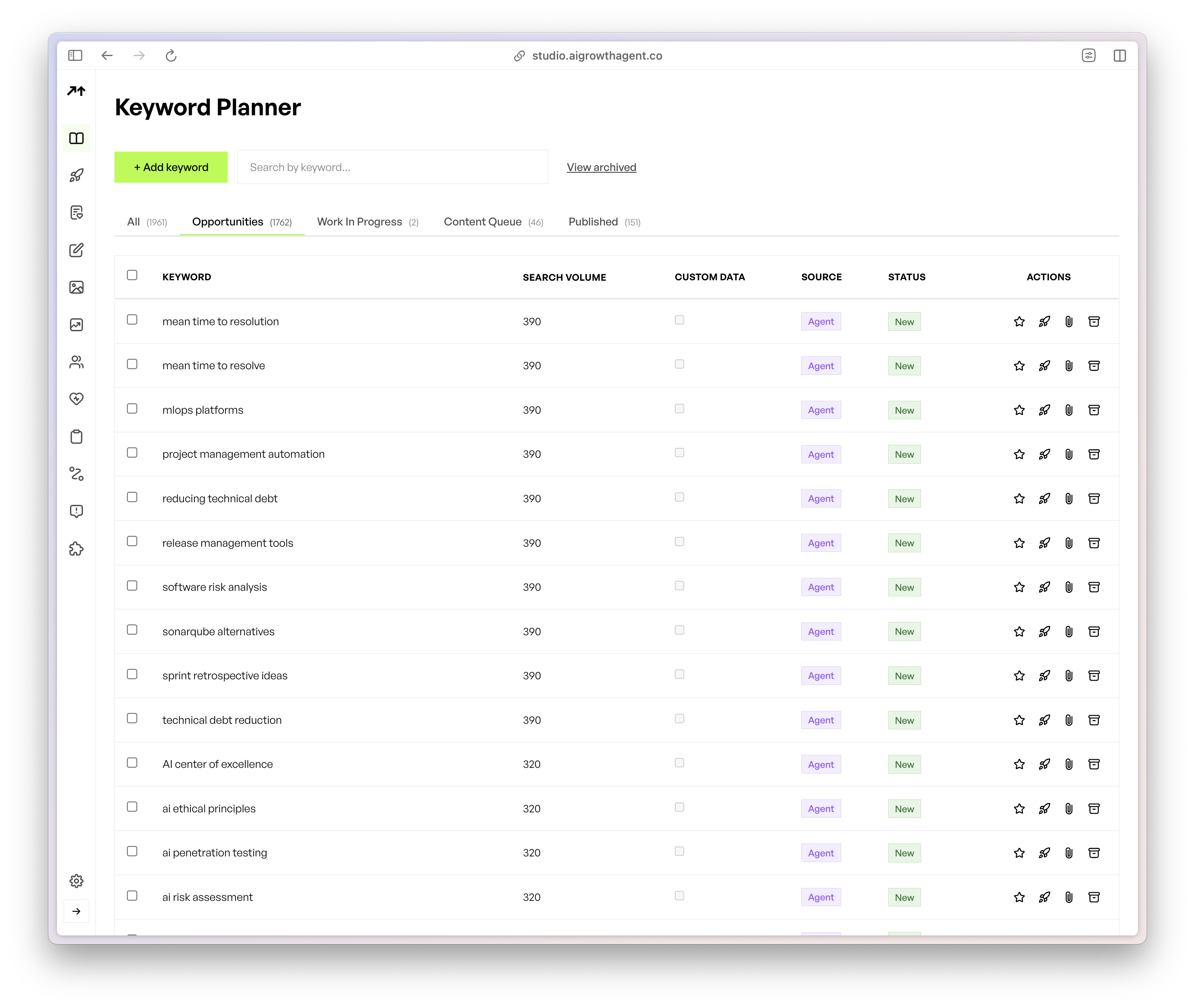
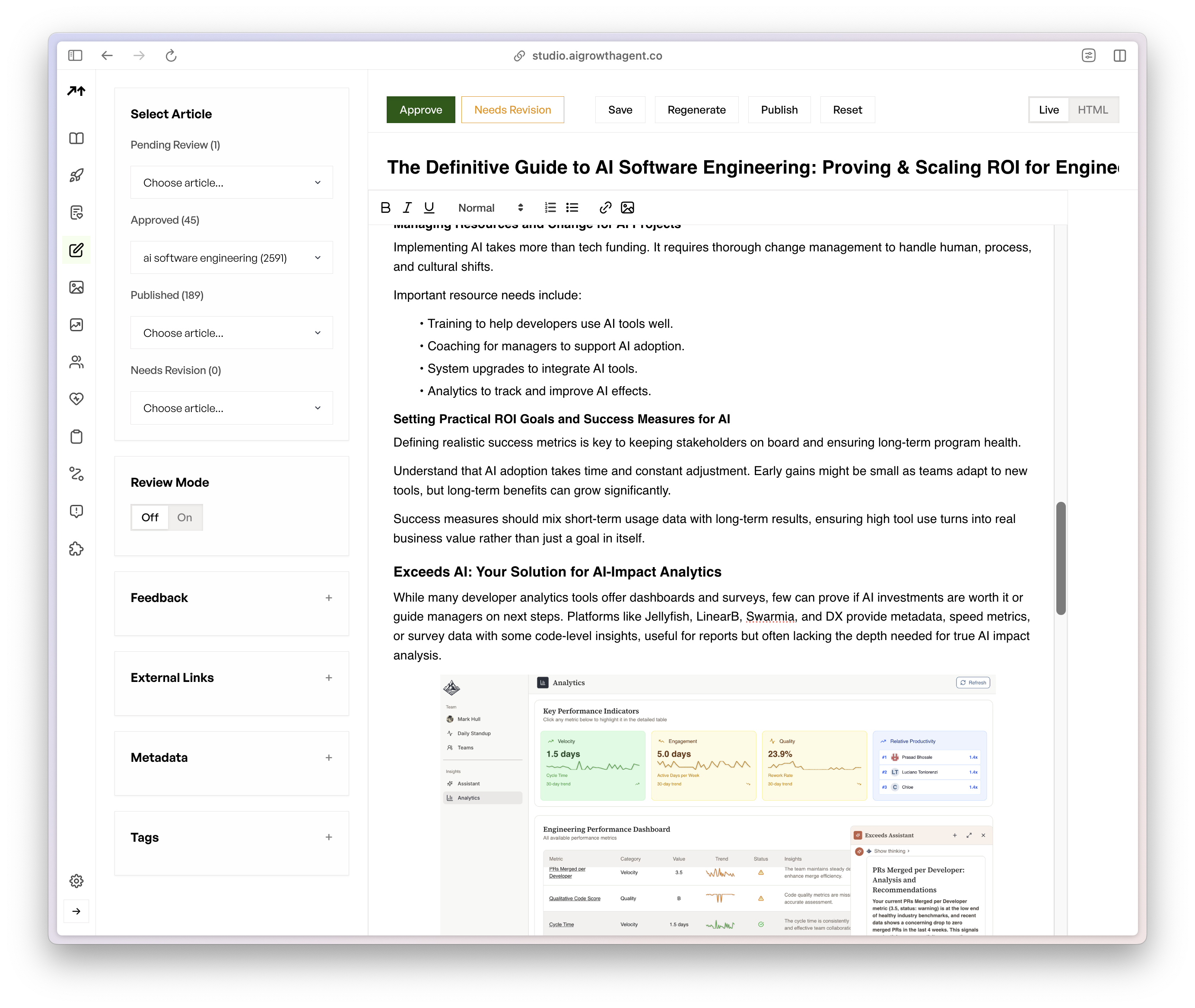
These capabilities are designed to support consistent coverage of a category, which can help AI search engines treat a site as an authoritative source across related queries.
Schedule a demo to evaluate whether AI Growth Agent fits your SEO and content roadmap.
Comparison: Top AI Content Creation Tools for Marketing Leaders
|
Tool Category |
Content Generation |
Technical SEO |
Autonomous Publishing |
AI Citation Optimization |
|
ChatGPT / Claude |
High |
Medium |
Low |
Low |
|
Surfer SEO / Scalenut |
Medium |
High |
Low |
Low |
|
Jasper / Writer.com |
High |
Medium |
Low |
None |
|
AI Growth Agent |
High |
High |
High |
High |
Conclusion: Turn AI Content Tools into a Coordinated Search Strategy
AI-first search has shifted the focus from isolated content pieces to comprehensive content systems. General AI writers, SEO optimizers, enterprise assistants, and operating platforms each solve part of the problem, but they often leave gaps in strategy, technical implementation, and publishing speed.
Programmatic SEO agents such as AI Growth Agent aim to fill these gaps by coordinating research, drafting, optimization, and distribution into one engine. Marketing leaders who align these tools with clear topics, revenue goals, and measurement frameworks will be better positioned as AI search continues to shape how buyers find and evaluate solutions.
Schedule a demo with AI Growth Agent to explore how a programmatic approach can support your content and SEO performance in 2026.
Frequently Asked Questions
How do AI content tools handle brand voice and consistency?
Advanced AI platforms use brand voice profiles, style guides, and example content to generate more consistent copy. Tools like Jasper and Writer.com can store tone, terminology, and formatting preferences so different teams produce similar outputs. AI Growth Agent adds a Company Manifesto during onboarding so its programmatic agents align with positioning and voice while still applying technical SEO best practices.
How can AI-generated content be authoritative for AI search engines?
Authoritative AI content depends on accurate information, structured markup, and clear connections between related pages. It benefits from schema, internal linking, reliable sourcing, and regular updates, not just fluent text. AI Growth Agent supports this by combining its Model Context Protocol implementation with automated technical optimization so AI systems can better parse the relationships across a site.
How can marketing leaders measure ROI on AI content tools?
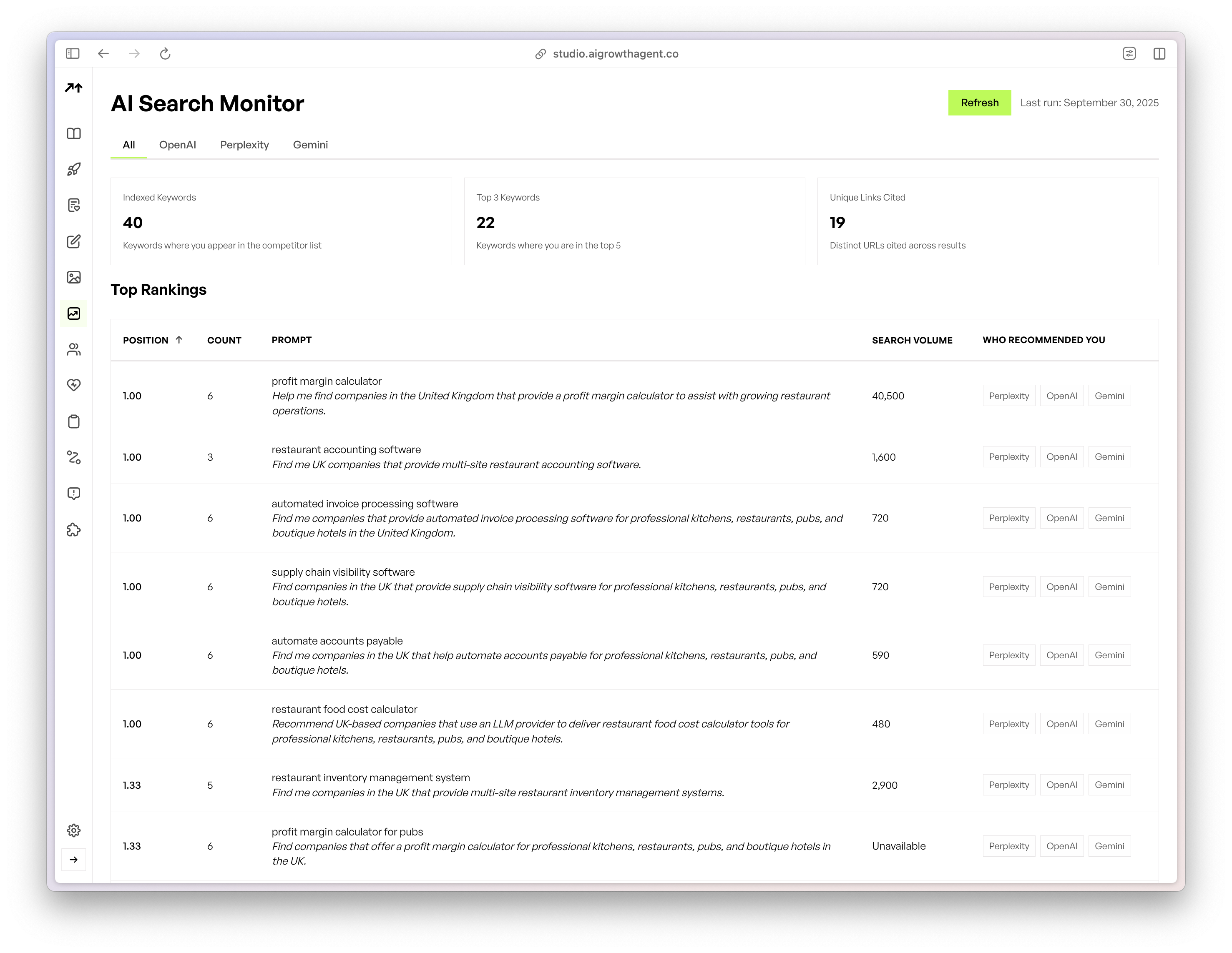
ROI assessment now includes both traditional metrics and AI-specific visibility. Teams still track organic traffic, conversions, and assisted revenue, but they also pay attention to how often their content appears in AI overviews and conversational answers. AI Growth Agent offers AI Search Monitoring that surfaces citation and visibility signals across tools like ChatGPT, Gemini, and Perplexity.