Best AI Platform for Long-Form Content: Guide

Explore AI Summary

AI-powered search and answer engines now mediate how buyers research solutions. Marketing leaders know that their long-form content must be technically sound, structurally organized, and citation-ready to stay visible. Here’s what you will learn in this article so you can pick the best AI platform for long-form content:

  1. High-volume generic AI content makes it harder for brands to stand out, which increases the value of content architectures that use schema markup, metadata, and clear topic hierarchies.
  2. AI Growth Agent focuses on programmatic SEO and end-to-end content engineering, from keyword research and strategy through drafting, optimization, and publication.
  3. Claude 3.5 Sonnet and GPT-4 Turbo excel at context, research synthesis, and brand voice, but they require additional systems and workflows for technical SEO and scaling.
  4. Jasper AI and Writesonic support faster drafting and basic SEO guidance, yet still depend on manual work for schema, metadata, and advanced AI search readiness.
  5. Marketing leaders who want durable category authority benefit most from solutions that combine brand-safe content creation with programmatic technical optimization at scale.

The AI Advantage: Why Long-Form Content Needs Advanced Solutions

AI-driven search now shapes most digital discovery. Google’s AI Overviews, powered by Gemini, now appear in over 70% of search results, while ChatGPT handles billions of queries monthly, and Perplexity has become a common research tool for professionals. This shift means long-form content must not only rank in traditional search, but it must also earn citations and recommendations from AI systems.

Content volume has increased faster than content quality. Marketing leaders see their digital footprint contract as AI tools flood the web with similar articles. Over 60% of online content is now AI-generated, which raises the bar for technical quality and structural clarity. Only content with strong architecture, clear topical depth, and reliable sourcing tends to stand out.

Traditional content strategies, whether agency-based or supported by basic AI writers, seldom address this full requirement. Marketing executives now need systems that create complete content frameworks, not just articles.

Those frameworks include schema markup, metadata, internal linking, and the infrastructure that makes pages easier for AI search engines to understand, cite, and trust. Brands that do not invest in this level of long-form authority may see competitors define how AI systems describe their categories.

1. AI Growth Agent: A Programmatic SEO Solution for Long-Form Content

AI Growth Agent gives premium and growth-focused brands a programmatic system for long-form content. It operates as a programmatic SEO platform that plans, drafts, and optimizes content architectures from strategy through publication. The focus is on building a technical and editorial foundation that improves how AI search engines recognize and cite your content.

The process begins with a structured onboarding session led by a professional journalist. In about an hour, the team documents your business model, positioning, and narrative into a Company Manifesto. This reference guide shapes topic selection, tone, and messaging so that programmatic long-form content remains aligned with your brand and growth goals.

Key AI Growth Agent Features For Long-Form Content

AI Growth Agent treats long-form content as an integrated workflow across research, drafting, optimization, and monitoring.

  1. Autonomous keyword and content research: The system analyzes thousands of search queries, then organizes opportunities into pillars and clusters. Each proposed article maps to specific demand signals in both traditional and AI-powered search.
  2. Technical blog architecture and schema: AI Growth Agent can deploy an optimized blog as a subdomain that visually matches your main site while giving you a clean technical environment for programmatic SEO. The platform includes advanced schema markup, metadata optimization, LLM.txt files, and Model Context Protocol (MCP) hooks so AI agents can better interpret and reference your content.
  3. End-to-end content agent: A dedicated content agent manages the lifecycle for each piece, from strategy and research to drafting, fact-checking, and technical optimization. Articles are structured to increase AI citation potential through clear headings, internal linking, and structured data.
  4. AI Search Monitor and performance analytics: The platform tracks how AI systems surface and describe your brand and compares that to competitors. Teams can see which pages earn citations in AI tools and where additional content or optimization is needed.
  5. AI Growth Agent Studio for control: The Studio interface gives teams direct editing access, tools to provide feedback to the agent, and controls for approvals. An Auto-Pilot mode allows more autonomous operation after the system learns brand preferences and guardrails.

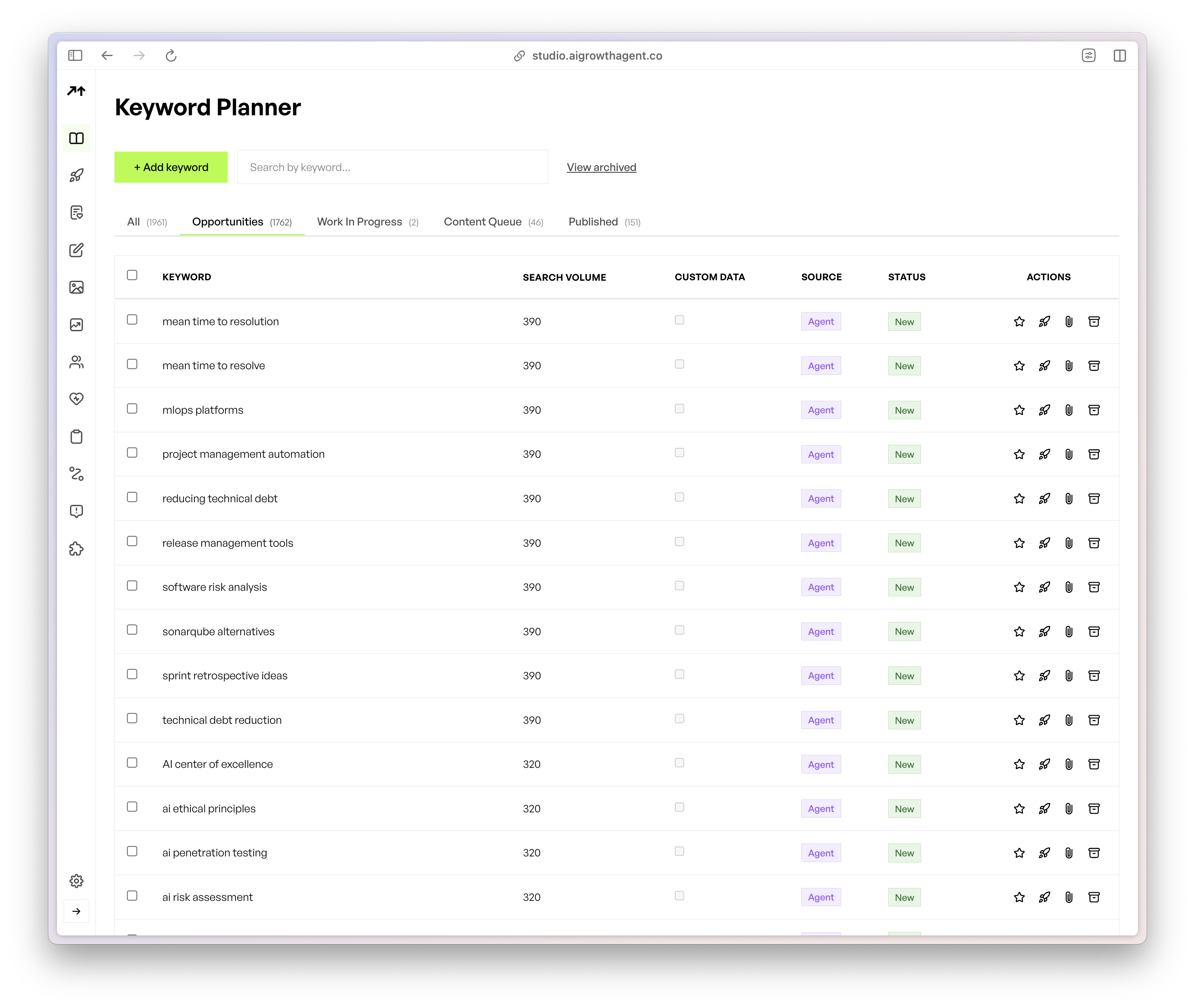
The Keyword Planner view gives marketing leaders a clear roadmap of which long-form topics and clusters to prioritize first.

AI Growth Agent Keyword Planner Screenshot

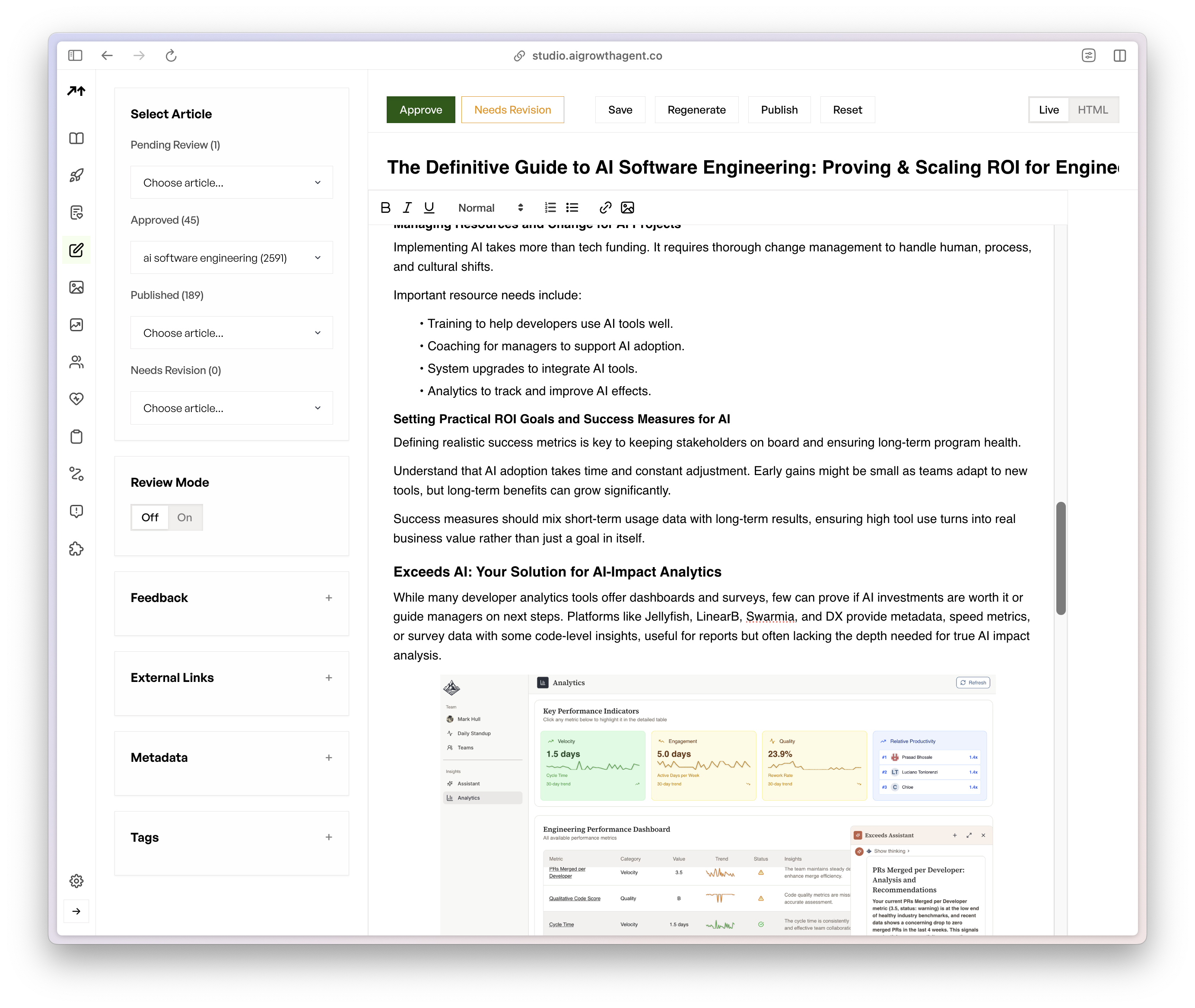
The Rich Text Content Editor lets teams refine drafts, add context, and ensure compliance before publishing to production environments.

AI Growth Agent Rich Text Content Editor

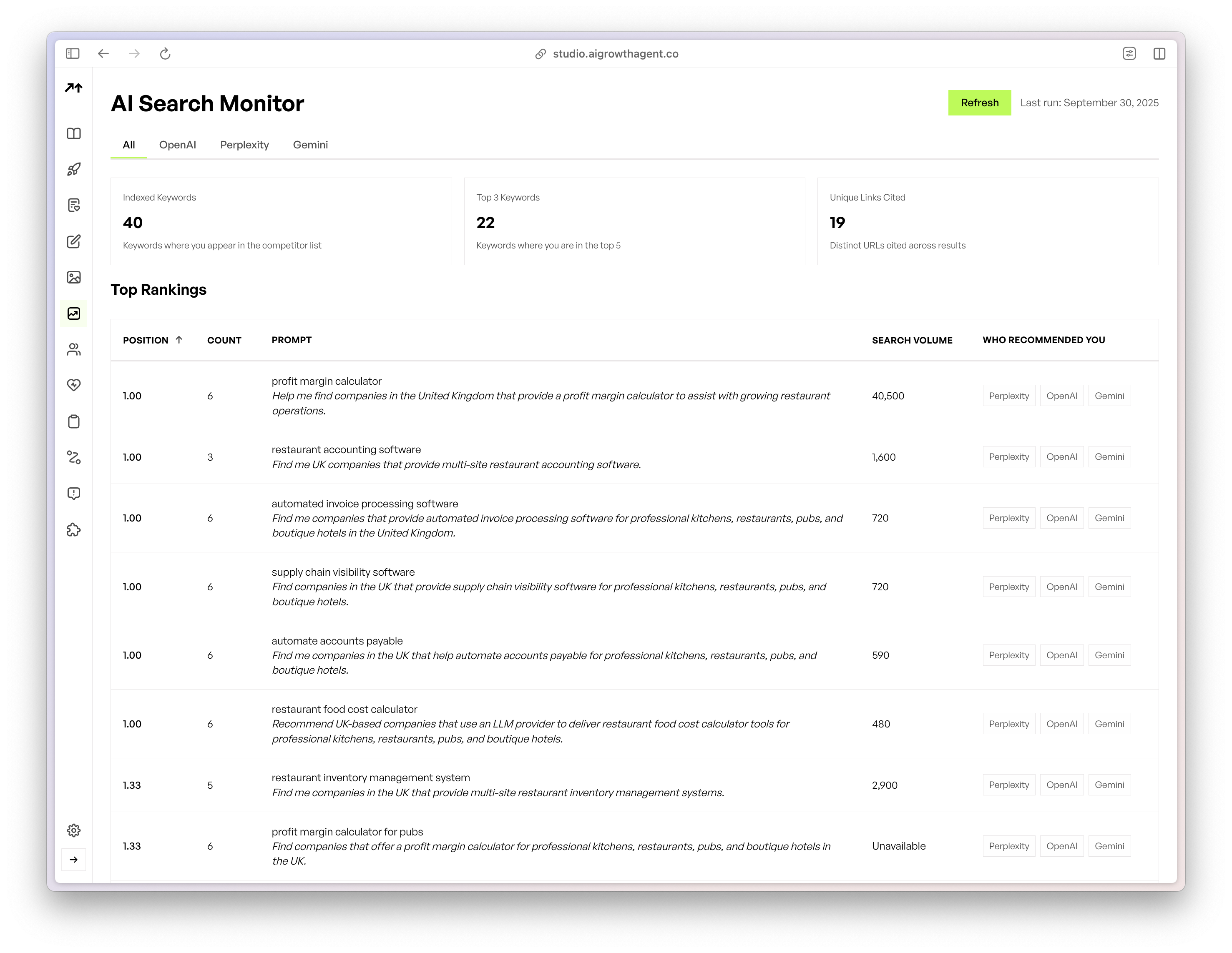
The AI Search Monitor surfaces how tools like ChatGPT, Gemini, and Perplexity talk about your brand so you can close gaps in category coverage and authority.

Screenshot of AI Growth Agent AI Search Monitor

Screenshot of AI Search Monitor where you can see what AI is saying about you across ChatGPT, Gemini, and Perplexity

Marketing teams can also supply brand visuals, product screenshots, and diagrams for the agent to embed into long-form content where relevant.

Provide the agent with images to naturally incorporate into your content.

Where AI Growth Agent Stands Out For Marketing Leaders

AI Growth Agent adds value where marketing teams need both scale and governance.

  1. Multi-Tenant Programmatic Deployment: Enterprise teams and portfolio companies can manage multiple brands from one interface while keeping each brand’s voice, strategy, and objectives distinct.
  2. Real-Time Programmatic SEO Content Injection: Content leads can request long-form pieces around emerging topics or breaking news and receive SEO-optimized drafts quickly enough to capture short-lived demand.
  3. Database-to-Content Automation: Proprietary data from internal tools, SaaS products, or research can be converted into structured, search-optimized content assets that support thought leadership and category authority.

Marketing leaders who want to evaluate AI Growth Agent for their content operations can schedule a demo to see if they are a good fit and review how programmatic SEO could work within their stack.

2. Claude 3.5 Sonnet and GPT-4 Turbo: AI Models with Strong Contextual Understanding

Claude 3.5 Sonnet serves marketing teams that need careful brand voice control in long-form content. Anthropic’s model is known for nuanced language, creative writing strength, and the ability to maintain tone across longer pieces, which suits brands with defined positioning and personality.

The model handles contextual nuance well and can apply it across formats such as blog posts, white papers, and email sequences. Marketing leaders use Claude to adapt messaging for different audience segments while aiming to preserve a consistent voice. This helps brands that prioritize tone and narrative coherence alongside subject-matter depth.

Claude 3.5 Sonnet also performs well when converting dense source material into detailed long-form content. Teams can feed research, transcripts, or technical documents into the model and receive structured drafts that balance factual accuracy and narrative flow.

Likewise, GPT-4 Turbo from OpenAI offers broad knowledge coverage and strong semantic understanding, which makes it effective for long-form content across many industries. Its training data and reasoning capabilities help it connect concepts across sources and produce detailed explanations suitable for technical and executive audiences.

Marketing teams rely on GPT-4 Turbo for complex content such as technical guides, implementation playbooks, or in-depth comparison articles. The model responds well to detailed prompts, can follow multi-step instructions, and often produces structured outlines or full articles that cover multiple subtopics in a single piece.

OpenAI’s API ecosystem also gives organizations flexibility. Development teams can integrate GPT-4 Turbo into existing marketing technology, build content pipelines, and automate portions of research, drafting, or quality checks.

But Claude and GPT-4 Turbo still require a separate layer for technical SEO. Schema markup, metadata optimization, XML sitemaps, and structured internal linking must be built and maintained outside the model.

They do not include autonomous research pipelines, blog architecture deployment, or programmatic scaling by default, so teams that need those capabilities often use AI Growth Agent instead.

3. Jasper AI: High-Volume Content Generation for Marketing Teams

Jasper AI focuses on helping marketing teams produce content at a higher volume with shared templates and brand guidelines. The platform offers workflows, collaboration tools, and prompt frameworks that make it easier for non-technical team members to participate in content creation.

The main strength lies in its marketing-centric interface. Templates for blog posts, ad copy, email campaigns, and social updates guide users through prompt setup and keep content aligned to brand voice settings. This structure can help distributed teams maintain a baseline level of consistency across creators and channels.

Jasper also integrates with several content management and marketing platforms. These integrations simplify drafting, review, and publishing workflows by reducing manual copy-paste steps and centralizing approvals.

The platform still outputs unstructured text that requires additional work to reach a high technical SEO standard. Teams must conduct their own keyword research, build content architectures, implement schema markup, configure metadata, and manage internal linking strategies. Jasper can speed up first drafts, yet it does not provide the programmatic research, technical implementation, or AI search monitoring that systems like AI Growth Agent include.

Marketing leaders who choose Jasper typically plan for a separate investment in SEO operations. They either staff internal SEO expertise or partner with specialized platforms to handle the technical side of long-form authority building.

4. Writesonic: AI for Scalable Content Creation with SEO Integration

Writesonic offers a content platform that blends AI writing features with basic SEO guidance. It aims to support marketing teams that need help with topic ideas, on-page optimization hints, and long-form draft creation in a single interface.

The SEO tools in Writesonic assist users in matching content to specific queries. Features such as keyword suggestions and optimization prompts help writers include relevant phrases and structure content for better search performance without deep SEO knowledge.

Writesonic also includes planning and analytics features. Teams can use these tools to organize content calendars and review basic performance signals to refine future topics or updates.

The SEO support remains more tactical than programmatic. Writesonic does not manage schema markup at scale, deploy dedicated blog infrastructures, or automatically build topic clusters around a category strategy. Advanced technical optimization, AI search readiness, and AI citation tracking still require additional tools or manual processes.

Marketing leaders who want to compete for category leadership in an AI-dominated search environment often view Writesonic as a drafting aid rather than a complete system. They still need a broader solution to engineer content architectures and technical foundations that AI systems can easily interpret and reference.

How Programmatic SEO Extends Your Long-Form Content Strategy

AI-first search has created conditions where manual content creation and basic AI tools struggle to keep pace. Long-form authority now depends on a complete content system that reaches from strategy and research through drafting, optimization, and distribution.

AI Growth Agent addresses this requirement with a programmatic SEO approach that combines research automation, technical infrastructure, and content operations in one environment. The platform supports both traditional search visibility and AI search readiness by structuring content and metadata for machine understanding.

Capabilities such as Multi-Tenant Programmatic Deployment, Real-Time Content Injection, and Database-to-Content Automation give enterprise teams ways to scale without sacrificing governance. These features help central teams support multiple brands, products, or regions while maintaining clarity over what is being published and why.

Marketing leaders who want to see how programmatic SEO could fit into their strategy can schedule a consultation session to see if they are a good fit for AI Growth Agent’s approach to long-form content.

Frequently Asked Questions

How does AI differentiate truly authoritative long-form content from generic content?

AI search engines evaluate content authority through a wider range of signals than traditional keyword-focused ranking. Modern systems analyze technical structure, schema markup, citation patterns, and the credibility of referenced sources when deciding which content to surface.

The surrounding technical infrastructure has a strong influence on authority. Pages with advanced schema markup, well-structured metadata, and machine-readable signals that support direct AI interaction tend to be easier for AI systems to interpret. Content that shows expertise through detailed analysis, original insights, and thorough coverage of related subtopics usually scores higher than short, repetitive, or shallow articles.

Content architecture also matters. AI systems favor sites where pages sit inside clear information hierarchies, where internal links show topic relationships, and where coverage is consistent across a library. Programmatic approaches that engineer an entire content ecosystem, rather than isolated articles, often achieve stronger authority in AI-driven results.

Can AI accurately capture and replicate a specific brand’s voice in long-form articles?

Advanced AI systems can capture brand voice effectively when they receive detailed guidance and enough examples. Brand manifestos that document positioning, audience perspectives, and communication objectives give these systems a strong starting point. AI Growth Agent uses a Company Manifesto for this purpose so the content agent can apply brand context consistently.

The best results appear when AI has access to a variety of brand materials. Executive thought leadership, sales decks, marketing campaigns, customer stories, and competitive positioning all help the system understand how the brand speaks and what it stands for. With that depth of input, AI can adapt tone for different formats while still reflecting the same underlying personality.

Brand voice accuracy improves over time when teams provide structured feedback. Platforms that include learning loops and editorial controls allow marketers to refine guidelines, correct edge cases, and steadily close the gap between AI-generated content and their ideal brand expression.

What technical SEO elements are critical for AI-generated long-form content to rank in AI search?

AI search engines prioritize long-form content that pairs strong editorial quality with robust technical optimization. Critical elements include advanced schema markup that clarifies entities and relationships, metadata that accurately describes each page, and machine-readable signals that support AI tools.

Clear content structure is also important. Logical heading hierarchies, internal links that map topic relationships, and well-organized clusters help AI systems understand where each article fits inside a broader narrative. Image optimization, descriptive alt text, and semantic HTML further improve machine understanding.

Technical performance still plays a role. Page speed, mobile responsiveness, and overall site architecture influence how often AI surfaces content. Brands that pair strong content with a fast, stable, and well-structured site are better positioned than those that publish high-quality articles on slow or fragmented infrastructure. Programmatic SEO platforms like AI Growth Agent address these technical factors alongside content creation to support stronger AI search performance.

Is it possible to scale long-form content generation across multiple brands using a single AI solution?

Multi-brand organizations can scale long-form content through platforms that support multi-tenant architectures. This setup allows central teams to manage strategy, oversight, and reporting from one environment while keeping each brand’s content, voice, and objectives separate.

Implementations from AI Growth Agent, for example, let each brand maintain its own Company Manifesto, keyword map, and content plan. Separate content agents can then operate in parallel for each brand, while leadership monitors performance and risk from a unified Studio view.

How quickly can AI generate long-form content in response to real-time events or data?

Modern AI content systems can move from prompt to long-form draft in minutes once the necessary context is available. This speed allows brands to respond to breaking news, regulatory changes, or emerging industry debates with substantive articles instead of short social updates alone.

Effective real-time response depends on pre-work. Systems that already understand a brand’s positioning, audience, and approved framing can adapt new information without diluting the narrative. AI Growth Agent’s Real-Time Programmatic SEO Content Injection uses this foundation to create long-form pieces that match existing pillars and clusters while targeting emerging queries.

Real-time content capabilities reach full value when they connect directly to publishing and optimization workflows. Platforms that handle generation, schema markup, metadata, and publication together enable brands to move quickly without sacrificing technical quality or governance.

See AI Growth Agent In Action: Schedule a Demo

The landscape for long-form content now favors brands that combine strong editorial standards with programmatic technical execution. Marketing leaders that rely only on manual workflows or basic AI tools often see diminishing visibility as AI search systems prioritize more structured and authoritative sources.

AI Growth Agent provides a programmatic SEO layer that supports research, technical optimization, and AI citation monitoring in one environment. Features such as Multi-Tenant Programmatic Deployment, Real-Time Content Injection, and Database-to-Content Automation help teams scale content operations while maintaining quality and control.

Marketing leaders who want to explore this approach can schedule a demo with AI Growth Agent to see if they are a good fit and evaluate how the platform could support their long-form content strategy.

Publish content that ranks in AI search

START RANKING NOW