


Key Takeaways
- AI search systems such as Google AI Overviews, ChatGPT, and Perplexity now surface direct answers, so enterprises need structured, machine-readable content at scale to stay visible.
- Traditional SEO tactics and manual agency workflows cannot keep pace with the volume, recency, and technical precision required for AI citations.
- Effective enterprise platforms combine programmatic SEO automation, advanced technical SEO for AI, and AI-specific analytics that track citations and answer-box visibility.
- Different tools solve different parts of the problem, from content enrichment and quality scoring to AI-native CMS capabilities, but most still rely on manual execution.
- AI Growth Agent provides end-to-end programmatic SEO automation for enterprises, with fast deployment and a clear path to AI citations; schedule a demo to see if it fits your needs.
The New Reality of AI Search: Why Traditional SEO Falls Short
AI search engines now rely on semantic understanding and answer generation instead of simple keyword matching. Systems like ChatGPT, Perplexity, and Google AI Overviews pull from a small set of structured, trusted sources and present those answers directly to users.
Enterprise visibility depends on programmatic content velocity and consistent technical quality. Publishing a few manual articles per month cannot compete with the scale of AI-generated content. Brands that do not invest in structured, programmatic content risk losing their presence in AI answer surfaces.
Legacy SEO solutions struggle in this environment. Agencies rely on manual production, internal teams often lack programmatic SEO expertise, and basic AI writing tools output unstructured copy rather than fully engineered pages. Competitors that define their category with programmatic authority content become the default references for AI models.
Key Criteria for Evaluating Enterprise AI Search Optimization Platforms
Enterprise teams need clear evaluation criteria to select an AI search optimization platform that will support long-term visibility and measurable results.
Programmatic SEO Automation and Scale
Platforms should generate, optimize, and publish structured content with minimal manual effort. Full lifecycle automation, from keyword selection to publishing, is the foundation for sustainable content velocity.
Advanced Technical SEO for AI
Robust support for schema, LLM.txt, Model Context Protocol, and AI-first site architectures improves machine readability. Enterprise platforms benefit from proprietary technical features that increase the likelihood of AI citations.
Content Authority and AI Citation Focus
Impact should be measured through AI visibility, answer-box presence, and direct citations in AI responses, not only web rankings. Strong platforms track citations and visibility across tools such as ChatGPT, Google AI Overviews, and Perplexity.
Integration, Flexibility, and Scalability
APIs and native integrations with CMS, CRM, and analytics platforms support multi-brand and multi-region deployments. This flexibility allows enterprises to adapt as AI ranking signals change.
Speed of Value Realization
Enterprises gain an advantage when platforms deliver optimized content and first AI citations within weeks. Short onboarding and minimal engineering requirements reduce time to value.
AI-Specific Reporting and Analytics
Dashboards that track AI answer-box inclusion, citation frequency, and AI crawler activity give teams clear feedback loops. These metrics help refine content strategy for AI search rather than only traditional SERPs.
Teams that want to assess programmatic SEO automation for AI visibility can book a demo with AI Growth Agent.
Competitor Landscape: AI Search Optimization Platforms for Enterprises
Different platform categories support AI search visibility in different ways. Most address one layer of the stack rather than end-to-end automation.
Adobe LLM Optimizer: Content Enrichment for LLMs
Adobe LLM Optimizer focuses on improving how existing content is consumed and cited by AI systems. It analyzes gaps, restructures content, and updates metadata to improve machine readability. Native integration with Adobe Experience Manager and Adobe Commerce makes it a strong fit for organizations already using the Adobe ecosystem.
Content Intelligence Platforms: SEO Analysis and Quality Scoring
Platforms such as Conductor, BrightEdge, and Acrolinx emphasize analysis and quality control. They provide semantic analysis, recommendations, and style guidance for large content libraries while integrating with major CMS platforms. These tools help standardize content quality but still rely on teams to execute changes at scale.
AI-Native CMSs: Integrated AI and Structured Delivery
Contentstack and similar AI-enabled CMS platforms embed AI across content workflows. They support structured content models, metadata generation, and automation that improve AI discoverability. Enterprises often pair these CMSs with additional tools for AI citation tracking and programmatic SEO.
Headless CMS Architectures: Flexible Foundations for AI
Headless CMS options such as Strapi and dotCMS provide flexible, API-first content delivery. They enable custom stacks that combine CMS, AI enrichment, and analytics, but they require significant engineering resources to match the technical coverage of dedicated AI search optimization platforms.
AI-Enhanced Website Builders and Specialized Integrations
Website builders like Elementor and integrations such as Sitefinity with Azure AI Search show how AI can enhance content creation and on-site discovery. These solutions work well for smaller teams and internal search but rarely offer the programmatic scale or AI citation focus that large enterprises require.
AI Growth Agent: Programmatic SEO Automation for AI Search
AI Growth Agent focuses specifically on helping enterprises become trusted sources for AI systems. The platform automates technical SEO and content creation so brands can expand structured coverage across entire categories without expanding headcount at the same pace.
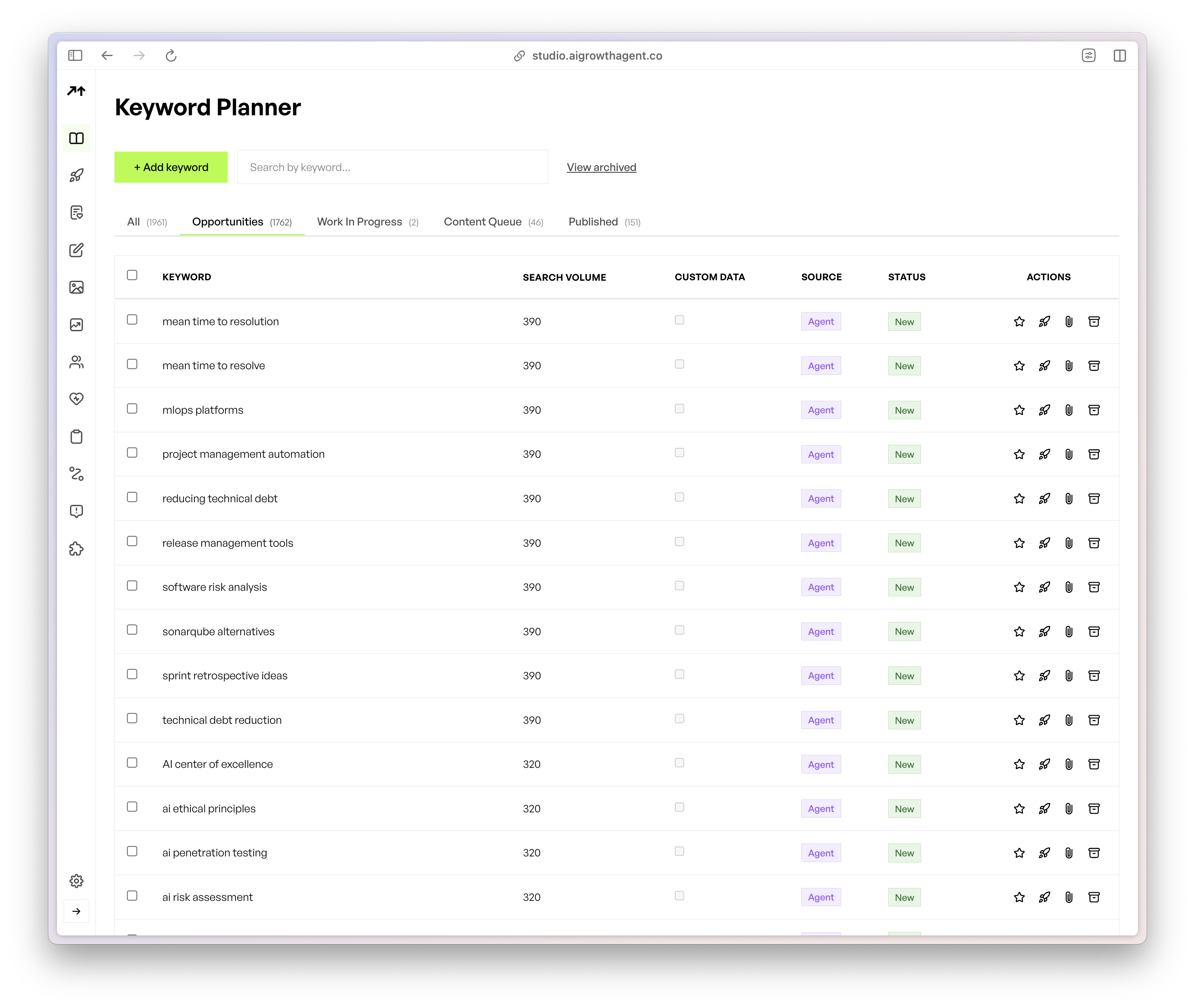
Teams typically move from kickoff to their first programmatically engineered article in about a week. The system then expands coverage with a consistent technical structure aimed at AI indexers and answer engines.
Multi-Tenant Programmatic Deployment
AI Growth Agent supports multiple brands, product lines, or portfolio companies from a single control panel. Each agent instance can use its own manifesto, keyword set, and voice while targeting separate domains or subdomains. This structure suits private equity firms, venture studios, and multi-brand enterprises that want shared infrastructure without shared messaging.
Real-Time Programmatic Content Injection
The platform can generate optimized articles in near real time for trending topics or breaking news. Teams pass a relevant source link, and the agent produces content that reflects the brand position while respecting technical SEO standards, which helps capture emerging search demand quickly.
Database-to-Content Automation
AI Growth Agent can convert structured data from products, locations, or usage logs into large content architectures. The platform ingests databases and publishes optimized pages that expose this information in a way AI systems can understand and cite.
Intelligent Image and Asset Placement
The system selects and embeds relevant visuals, handles alt text and metadata, and places images where they support both user comprehension and search performance. Teams can upload asset libraries and let the agent manage placement and optimization.
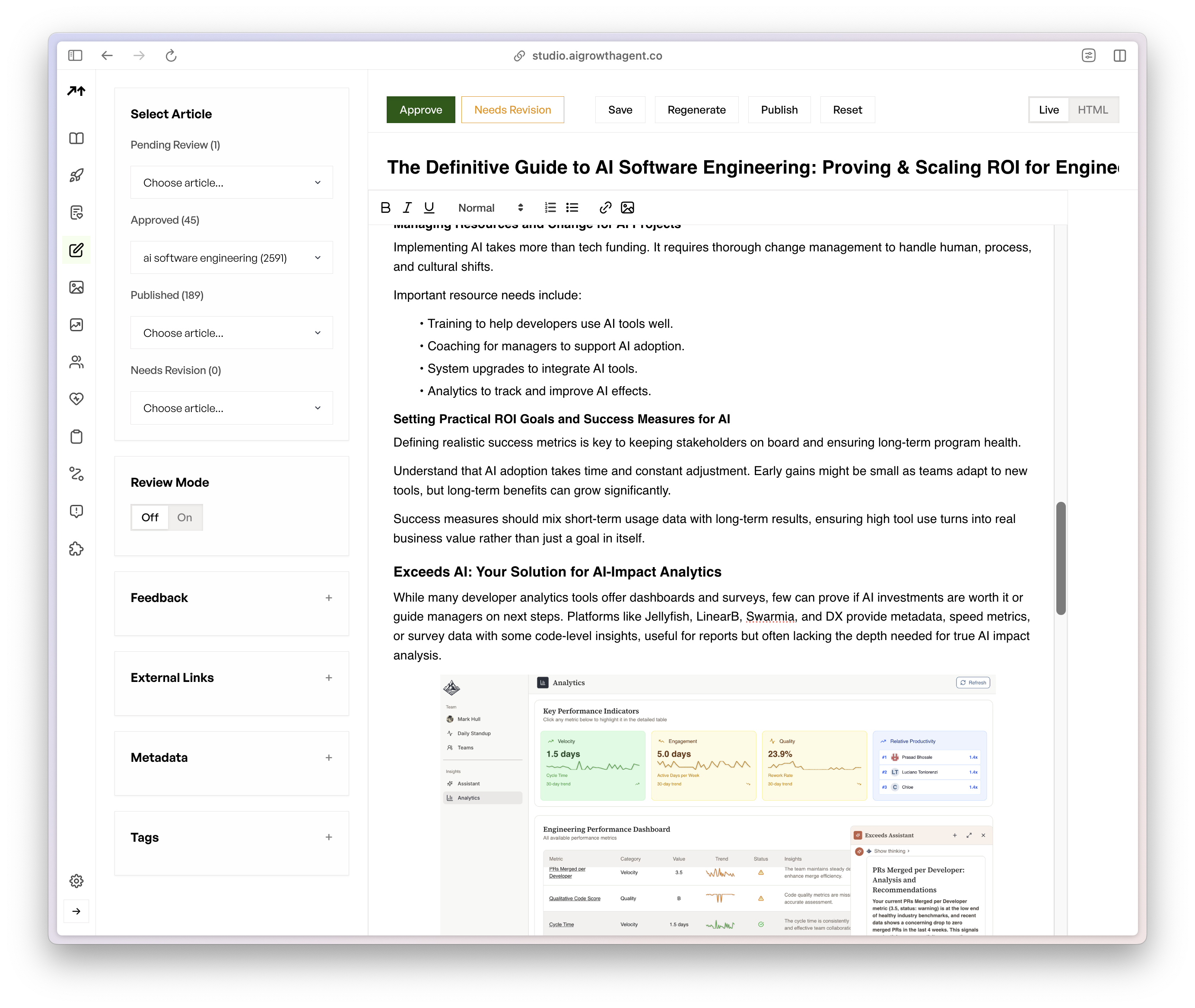
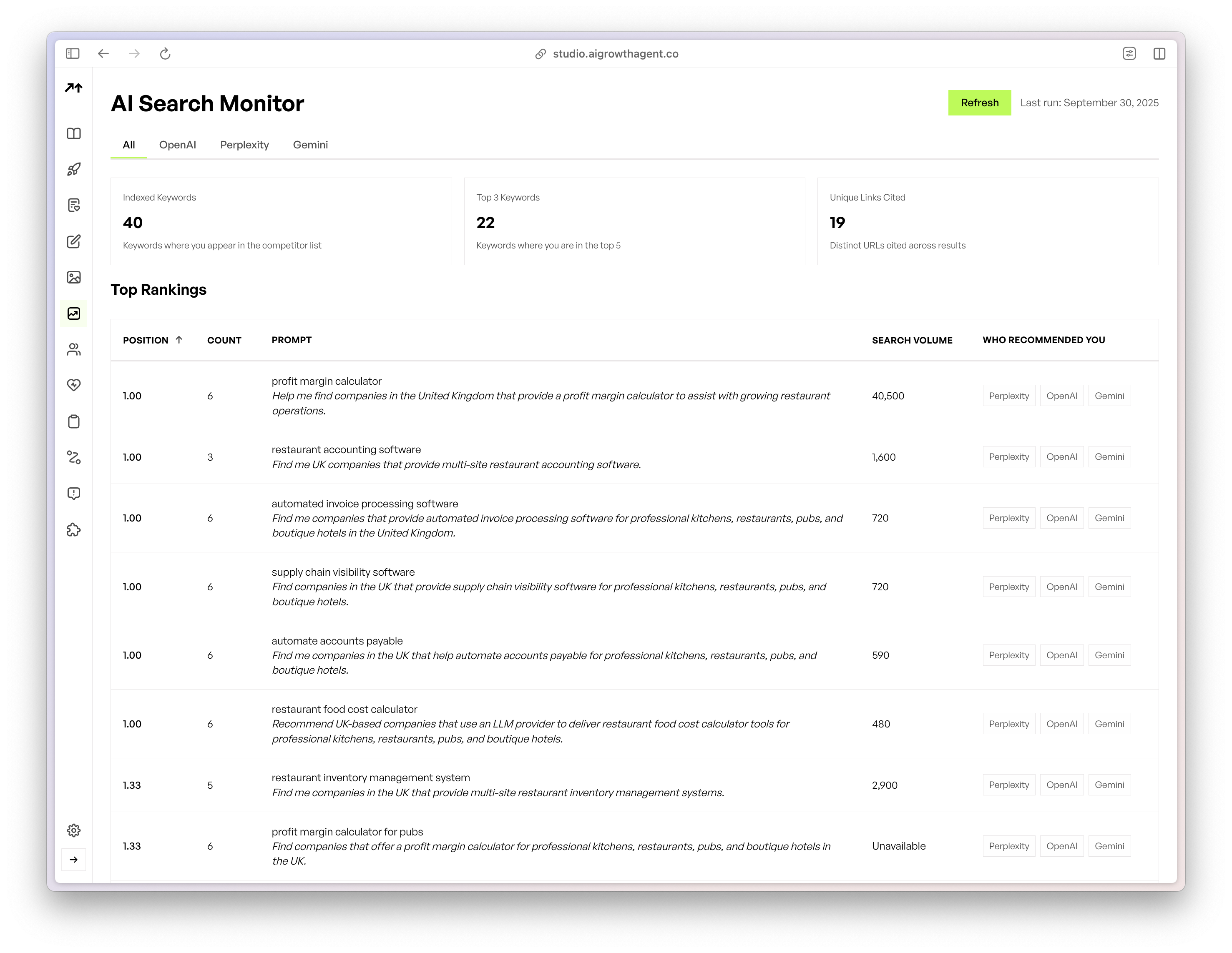
The core objective is to position clients as reliable sources that AI systems reference consistently across queries and platforms. Enterprises that want to evaluate this approach can schedule a demo with AI Growth Agent.
Side-by-Side Comparison: AI Growth Agent vs. Other Platform Types
AI Search Optimization Platform Capabilities Comparison
|
Feature/Criteria |
AI Growth Agent |
Adobe LLM Optimizer |
Content Intelligence Platforms |
AI-Native CMS |
|
Autonomous Content Generation and Publishing |
End-to-end automation |
Content updates with one-click publishing |
Drafting and recommendations |
Generation within the CMS |
|
Advanced Technical SEO for AI |
Automated schema, LLM.txt, and MCP |
Metadata and entity enrichment |
Partial coverage via integrations |
Structured content models |
|
Programmatic SEO Scale |
large scale through autonomous agents |
Focus on enriching existing content |
Moderate scale, depends on team capacity |
High within CMS limits |
|
AI Citation Tracking and Reporting |
Granular AI-bot and answer-box tracking |
Reports for AI search performance |
Varies by platform |
Evolving AI visibility metrics |
|
Multi-Brand and Multi-Tenant Support |
Native multi-agent management |
Primarily single-instance |
Varies by vendor |
Possible with configuration |
|
Time to First Optimized Content |
About one week |
Depends on the implementation project |
Weeks of setup and manual work |
Weeks for modeling and generation |
|
Primary Focus |
Programmatic SEO and AI citations |
Content enrichment for LLMs |
SEO and content quality insights |
Content management with AI support |
AI Growth Agent stands out by providing automation across the full programmatic SEO workflow, while many alternatives focus on analysis, enrichment, or content management.
Why Enterprise Marketing Leaders Choose AI Growth Agent
Marketing leaders often weigh manual agency support against self-service tools. AI Growth Agent offers a third option, combining automation with technical depth so teams can focus on strategy and messaging rather than production logistics.
Client examples highlight this pattern of impact:
- Exceeds AI gained Perplexity recommendations within two weeks and began appearing in Google AI Overviews for core keywords within three weeks.
- BeConfident earned visibility in Google AI Overviews as a leading English-learning app in Brazil within weeks, in a competitive field with established brands.
- Bucked Up secured top citation positions for “best protein soda” queries in ChatGPT within a few weeks of launch.
- Gitar became a frequently cited option for AI-powered CI/CD automation across Google AI Overviews, ChatGPT, and Perplexity in under two months.
Enterprises that want a similar structured, measurable progress can request a demo of AI Growth Agent.
Frequently Asked Questions About AI Search Optimization
What is the biggest difference between SEO and AEO (Answer Engine Optimization)?
AEO focuses on content that AI systems can interpret unambiguously and present as direct answers. It requires structured data, clear entities, and a rich schema. Traditional SEO focuses more on human-readable pages and ranking positions, while AEO pushes teams to design content for both people and machines at the same time.
Can enterprises achieve AI search visibility with an existing CMS?
Most CMS platforms can host AI-optimized content, but they rarely provide automated schema injection, entity modeling, or programmatic generation by default. Enterprises typically pair their CMS with a specialized platform like AI Growth Agent that handles technical structure and scale while integrating with their current site.
How quickly can content start appearing in AI answers?
Results vary by market and competition, but organizations using AI Growth Agent often see citations in tools like Perplexity and Google AI Overviews within weeks of launch. Automated technical optimization and consistent publishing cadence help shorten this timeline compared with manual approaches.
Which KPIs matter most for AI search optimization?
Key metrics include presence in AI answer boxes, direct citations in AI responses, AI visibility for priority keywords, and activity from AI crawlers. AI Growth Agent tracks these indicators down to the URL and query level so teams can see which assets drive AI visibility.
Conclusion: Secure Enterprise Authority in the AI Search Era
Programmatic SEO automation has become a core requirement for enterprises that want durable visibility across AI search experiences. Manual content production and basic AI writing tools do not offer the scale or technical rigor needed for consistent citations.
AI Growth Agent gives marketing and growth teams an automated engine for structured, AI-ready content and detailed visibility into how AI systems use that content. Enterprises that want to strengthen their position in AI search can schedule a demo with AI Growth Agent and evaluate whether the platform aligns with their growth goals.
