Written by: Mariana Fonseca, Editorial Team, AI Growth Agent | Last updated: August 20, 2026
Key Takeaways for Enterprise CMOs
- 68% of U.S. Google searches now end without a click, so AI answer visibility matters more than blue-link rankings for enterprise brands.
- Legacy SEO platforms like BrightEdge, Semrush, and Ahrefs monitor AI visibility but cannot autonomously produce, publish, or self-heal the content that earns citations.
- AI Growth Agent is the only platform in this group that maps queries, generates authoritative content, provisions agentic SEO infrastructure, and tracks per-article bot interactions in one engine.
- Enterprise brands using AI Growth Agent see an average 12,000+ additional AI citations, 100,000+ bot visits, and 20%+ impression lift within the first twelve weeks.
- Enterprise teams that want execution instead of dashboards can book a kickoff and have their first article live within a week.
How LLMO Changes Enterprise Search Strategy
Large language model optimization (LLMO) is the practice of writing and structuring content so AI surfaces such as ChatGPT, Perplexity, Google AI Mode, and Claude find it, trust it, and cite it. Traditional SEO targets ranked links, while LLMO works in natural language and operates at the memory and retrieval layer at the same time. A 2026 comparison published by The First Ranker defines the win condition for LLMO as the model knowing and recommending the brand, not just ranking a page. For enterprise brands, this shift requires authoritative, structured, citable content at scale instead of passive dashboard monitoring.
How These 7 AI SEO Platforms Were Chosen
The seven platforms below were evaluated against four pillars that determine whether a tool can actually move the needle on AI answer visibility in 2026.
- Search Intelligence: Ability to map a brand’s full universe of seed terms and long-tail queries from real-time data, not a capped prompt set.
- AI Analytics: Brand value and consumer behavior across the full journey, from external AI-tool queries through content consumption and sentiment.
- Bot Tracking: Visibility into every bot interaction, including AI training agents and citation crawlers, not just traditional search crawlers.
- AI Ranking: Measurement of order of mention and citation context inside AI-generated answers, the new leaderboard replacing static SERP positions.
Each platform was also assessed on automation level, scalability, onboarding complexity, integration ecosystem, and whether it produces living content or functions as a monitoring-only rearview mirror.
Snapshot of the Platforms Compared
The seven platforms span three categories. First, legacy enterprise SEO suites that have added AI monitoring layers: BrightEdge, seoClarity, Conductor, Ahrefs, and Semrush. Second, a technical crawl and log-file specialist that has expanded into AI bot visibility: Botify. Third, a purpose-built headless marketing engine designed for narrative control in AI search: AI Growth Agent.
BrightEdge: Enterprise SEO Suite With AI Reporting
BrightEdge is one of the longest-standing enterprise SEO platforms, built around a large proprietary data set of keyword rankings, content performance signals, and competitive benchmarks. Its 2025 and 2026 product updates added generative engine optimization reporting and AI Overview tracking to its core suite.
- AI Overview citation monitoring across target keyword sets
- Content recommendations powered by its DataCube index
- Automated page-level SEO recommendations and workflow integrations
- Executive reporting dashboards with share-of-voice comparisons
BrightEdge’s strength lies in its depth of traditional SERP data and its established integrations with enterprise CMS and analytics platforms. Forrester’s 2025 Wave report notes that leading enterprise SEO platforms now extend well beyond keyword tracking, incorporating AI-powered content optimization and workflow automation, and BrightEdge fits that description for teams already invested in its ecosystem.
Its limitation is structural. BrightEdge monitors and recommends but does not produce, publish, or self-heal content. The gap between insight and execution remains the client’s problem. Bot tracking at the per-article level and incremental visibility reporting isolated from pre-existing brand authority are not native capabilities.
BrightEdge operates on enterprise contract pricing and suits large in-house SEO teams with dedicated content and engineering resources that need a data layer to inform existing production workflows.
seoClarity: AI-First Research and Guidance Layer
seoClarity positions itself as an AI-first enterprise SEO platform, with its Clarity Grid data set and a research assistant called Sia built on top of it. Its 2026 feature set includes AI Overview impact analysis, content briefs, and rank tracking across traditional and generative surfaces.
- AI Overview appearance tracking and CTR impact analysis
- Sia AI assistant for content brief generation and optimization guidance
- Rank tracking across traditional SERP and AI-generated answer surfaces
- Integration with Google Search Console and major CMS platforms
seoClarity’s research infrastructure helps teams understand competitive positioning across a large keyword universe. seoClarity research reports AI Overviews appearing for about 4% of queries in one study and 30% of U.S. desktop keywords (as of September 2025) in its impact study, and its platform surfaces that data at scale.
Like BrightEdge, seoClarity focuses on monitoring and guidance. Content production, publishing, schema provisioning, and bot-level citation tracking sit outside its scope. The four pillars of Search Intelligence, AI Analytics, Bot Tracking, and AI Ranking are partially addressed but not unified into a single action loop. Teams still need a separate content operation to act on what seoClarity surfaces.
seoClarity uses enterprise contract pricing and fits organizations with mature SEO teams that need sophisticated data tooling and are comfortable managing content production separately.
Ready to move beyond monitoring dashboards? See how AI Growth Agent turns insights into published, cited content in your first week.
Conductor: Workflow and Revenue Attribution Layer
Conductor is an enterprise content intelligence and SEO platform that acquired the Searchlight product line and later expanded into AI search measurement. Its 2026 positioning centers on connecting content performance to revenue and on providing AEO and GEO benchmarks for enterprise marketing teams.
- AEO and GEO benchmarking across target query sets
- Content performance attribution tied to pipeline and revenue signals
- Workflow tools for content briefs, approvals, and publishing coordination
- AI search visibility reporting alongside traditional rank tracking
Conductor’s 2026 AEO/GEO Benchmarks Report found that 94% of CMOs plan to increase their AI visibility investment this year, which reflects the urgency Conductor addresses in its market positioning. Its workflow tools help teams coordinate content production across multiple stakeholders.
Conductor’s content production capabilities focus on coordination, not autonomous generation. It helps teams manage the process of creating content but does not replace the writers, editors, and engineers needed to produce and publish it. AI referral traffic tracking and per-article bot citation data are not core features. For CMOs who want to eliminate agency dependencies rather than coordinate them, Conductor adds a layer without removing the underlying stack.
Conductor operates on enterprise contract pricing and suits organizations with established content teams that need governance and measurement across a complex stakeholder structure.
Botify: Technical SEO and AI Crawler Intelligence
Botify is a technical SEO platform built around log-file analysis, crawl data, and rendering intelligence. Its core differentiation is visibility into how search bots interact with a site, including crawl budget allocation, JavaScript rendering gaps, and indexation efficiency. Its 2025 and 2026 updates added AI bot tracking to its log-file analysis suite.
- Log-file analysis covering traditional and AI crawler behavior
- Crawl budget optimization and rendering gap identification
- AI bot visit tracking including GPTBot and PerplexityBot activity
- Integration with enterprise CMS and data warehouse platforms
Botify’s technical depth gives large sites with complex rendering environments visibility that other platforms often miss. As of May 2026, 23% of the top 10,000 websites block at least one of GPTBot, ClaudeBot, PerplexityBot, or Google-Extended via robots.txt, a finding that log-file analysis reveals clearly.
Botify does not produce content, manage publishing, or provide the Search Intelligence and AI Ranking pillars in a unified workflow. It serves as a diagnostic tool for technical teams, not a narrative control engine for marketing leaders. The gap between a Botify audit and a published, cited article remains substantial and requires separate resources to close.
Botify operates on enterprise contract pricing and fits large technical SEO teams managing complex site architectures that need deep crawl and log-file intelligence.
Semrush: Broad Data Platform With AI Visibility Index
Semrush is a widely adopted SEO data platform with a suite covering keyword research, competitive intelligence, backlink analysis, content optimization, and, as of 2026, AI visibility tracking through its AI Visibility Toolkit.
- AI Visibility Toolkit tracking citation patterns across ChatGPT, Gemini, AI Overviews, and Claude
- Keyword research and competitive intelligence across traditional SERP
- Content optimization recommendations and topic clustering
- Backlink analysis and brand monitoring
Semrush’s AI Visibility Toolkit analyzes 126 million AI search prompts in its 2026 AI Visibility Index to identify citation patterns, and Semrush’s 2026 AI Visibility Index found that organizations fully integrating SEO and AI visibility into a single workflow reported 81% increased traffic or leads from AI platforms, compared to 36% for organizations managing them separately. The data infrastructure is substantial.
Semrush monitors AI visibility but does not produce the content that creates it. Its content tools assist with optimization and briefs but do not autonomously generate, publish, or self-heal authoritative articles at scale. Bot tracking at the per-article level, incremental visibility reporting, and agentic technical SEO infrastructure sit outside the platform. For CMOs who want to move from measurement to narrative control, Semrush surfaces the problem without solving it.
Semrush offers tiered subscription pricing with an enterprise tier and suits marketing teams that need broad data coverage across traditional and AI search surfaces while relying on separate resources for content production and publishing.
Stop measuring the gap. Start closing it with content that earns AI citations from day one.
Ahrefs: Competitive and Backlink Intelligence With AI Signals
Ahrefs is a competitive intelligence and backlink analysis platform that expanded into content research, keyword tracking, and, in 2026, AI search visibility monitoring. Its data set remains one of the largest in the industry for backlink and organic search signals.
- Backlink analysis and domain authority intelligence
- Keyword research and organic traffic estimation
- Content gap analysis and topic research tools
- AI Overview citation tracking for monitored keyword sets
An Ahrefs study of 863,000 keywords found that only 38% of pages cited in Google AI Overviews also ranked in the top 10 for the same query as of February 2026, down from 76% seven months earlier. Ahrefs surfaces this kind of structural insight effectively, and its competitive intelligence remains a reference standard for enterprise SEO teams.
Ahrefs functions as a data and research platform. It does not produce content, manage publishing, provision schema, or track bot interactions at the article level. The four pillars of AI search success require action, not only observation, and Ahrefs stops at observation. Teams using Ahrefs for AI search strategy still need a full content and publishing operation to act on what the data reveals.
Ahrefs operates on tiered subscription pricing with an enterprise option and suits SEO and content strategy teams that need deep competitive and backlink intelligence as one input into a broader production workflow.
AI Growth Agent: Autonomous Engine for AI Narrative Control
AI Growth Agent is the only platform in this comparison built from the ground up as a headless marketing engine for narrative control in AI search. While every other platform on this list monitors, recommends, or assists, AI Growth Agent maps, produces, publishes, and self-heals, replacing the agency stack with one autonomous engine.
- Full universe mapping across hundreds of seed terms and long-tail queries using real-time Google and ChatGPT data as the objective function
- Autonomous content generation through a multi-agent orchestration across OpenAI, Anthropic, Gemini, Grok, Perplexity, Exa, and Firecrawl, with anti-hallucination cascades and primary-source validation at every stage
- Site setup within the first week, styled to match the client’s brand, connected via reverse proxy rewrite with no dependency on an existing agency or engineering team
- Full agentic technical SEO stack out of the box: Blog MCP, llms.txt and llms-full.txt, OpenAI discovery and Agent Card guidance via /.well-known/, natural language query parameters, Markdown served to agent crawlers, rich schema suite, automated web stories, instant indexing, autoredirects, and 404 tracking
- Per-article bot tracking covering traditional crawlers and AI citation agents including the bot ChatGPT uses to cite sources
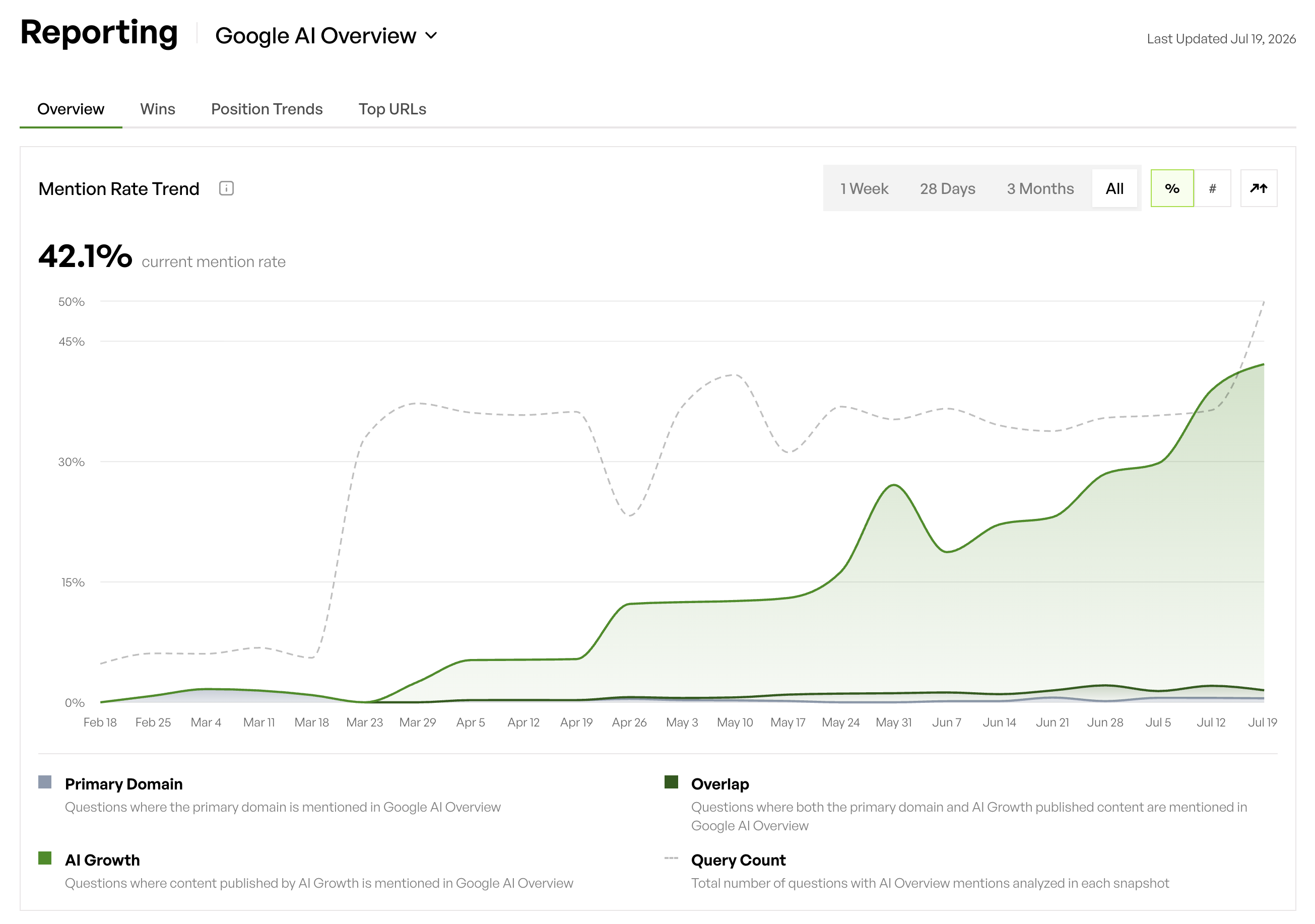
- Incremental visibility reporting that isolates what AI Growth Agent generated, week over week, cross-referenced against Google Search Console and bot traffic data
- Living, self-healing content that updates automatically so the brand’s narrative does not decay between publishing cycles
- Flat-fee pricing with no per-article charges, credit limits, or per-prompt billing
AI Growth Agent addresses all four pillars in a single engine. Search Intelligence maps the full competitive landscape weekly, refreshing 3,000+ searches to keep the universe current. AI Analytics tracks brand value and consumer behavior across the full journey. Bot Tracking surfaces every crawl, citation, and training sweep at the article level. AI Ranking monitors order of mention and citation context inside AI-generated answers and tracks how that position evolves against the content plan.
The results across the first twelve weeks of a standard engagement match the gains detailed earlier, with the first article live within a week of kickoff and content indexing in as little as ten days. Breadless, a healthy fast-casual franchise, reached a 30x lift in Google Search Console impressions over six months and ChatGPT citations of eatbreadless.com exceeding 45,000 per month. Leva Sleep became the most mentioned adjustable bed retailer in Canada, with ChatGPT citing its content over 10,000 times per month and $40,000 to $50,000 in deals closed in under three weeks from buyers who discovered the brand through AI Growth Agent content.
The only integration step required from the client is the reverse proxy rewrite that connects the blog to a subdirectory under their domain. No technical team is needed. No agency RFP. No year-long ramp. The engine handles everything else, and the client owns the site and all content outright.
Side-by-Side Comparison of AI SEO Platforms
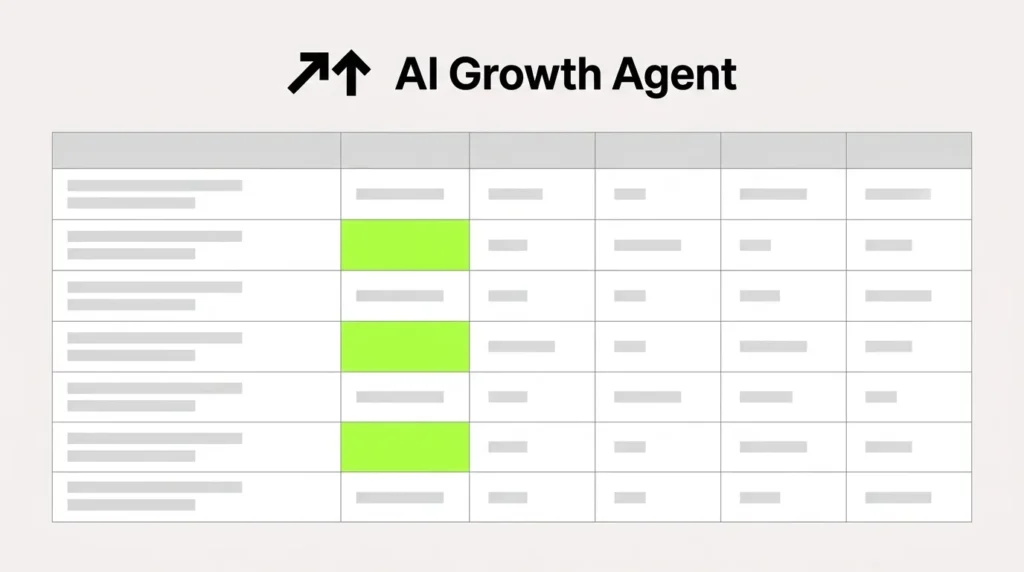
The table below highlights a clear split between six monitoring and guidance platforms and one autonomous execution engine. Pay attention to automation level, onboarding complexity, and cost structure to see how AI Growth Agent differs from legacy tools.
| Platform | Automation Level | Scalability | Customization | Integration Ecosystem | Analytics and Monitoring | Security and Compliance | Onboarding Complexity | Cost Profile |
|---|---|---|---|---|---|---|---|---|
| BrightEdge | Recommendations only | High (large keyword sets) | Moderate (dashboard configuration) | CMS, GA4, enterprise BI | SERP and AI Overview monitoring | Enterprise-grade | High (dedicated onboarding) | Enterprise contract |
| seoClarity | AI-assisted briefs, no publishing | High (Clarity Grid data set) | Moderate | GSC, CMS, analytics platforms | SERP, AI Overview, CTR impact | Enterprise-grade | High | Enterprise contract |
| Conductor | Workflow coordination, no autonomous publishing | High (multi-stakeholder workflows) | Moderate | CMS, analytics, revenue platforms | AEO/GEO benchmarks, pipeline attribution | Enterprise-grade | High | Enterprise contract |
| Botify | Diagnostic only | High (large site crawl capacity) | Low (log-file and crawl focus) | Data warehouse, CMS, GSC | Log-file, AI bot tracking, crawl budget | Enterprise-grade | High (technical setup) | Enterprise contract |
| Semrush | Data and optimization guidance, no publishing | High (126M+ prompts analyzed) | Moderate | GA4, GSC, CMS, HubSpot | AI Visibility Toolkit, SERP, backlinks | SOC 2 (enterprise tier) | Moderate | Tiered subscription |
| Ahrefs | Data and research only | High (large backlink index) | Low | GSC, limited CMS | SERP, AI Overview citation tracking | Enterprise-grade | Moderate | Tiered subscription |
| AI Growth Agent | Fully autonomous: maps, generates, publishes, self-heals | High (up to ~500 articles/month per client; 1,600+ query universes) | High (manifesto, style memories, legal disclaimers, anti-hallucination steering) | Reverse proxy, GSC, GA4 with UTM, multi-provider AI stack | Four pillars: Search Intelligence, AI Analytics, Bot Tracking, AI Ranking; incremental visibility reporting | Claim validation, legal disclaimer support, primary-source priority | Low (first article live within one week; reverse proxy is the only client integration step) | Flat fee, no per-article or per-prompt billing |
The six legacy platforms share a common structural ceiling as monitoring and guidance tools. They tell a CMO where the brand stands, which queries it is missing, and what content might help. The execution gap, the distance between a dashboard insight and a published, cited, self-healing article, remains the client’s responsibility and requires a separate content team, agency, or engineering resource to close. Many marketing leaders report challenges in measuring their brand’s visibility within AI-generated answers and say they lack the tools needed to track relevant metrics across AI platforms. Monitoring platforms widen that gap by surfacing more data without providing the mechanism to act on it.
B2B companies with high AI citation rates have experienced faster sales cycles and higher deal sizes in recent analyses. The value of narrative control is measurable. Enterprise CMOs need to decide whether their current tool stack produces that control or merely reports on its absence.
How to Evaluate AI SEO Platforms Before You Buy
Enterprise marketing leaders can use the following checklist before selecting a platform.
- Does the platform produce and publish content, or only recommend it?
- Does it track bot interactions at the per-article level, including AI citation crawlers?
- Does it report incremental visibility isolated from pre-existing brand authority?
- Does it provision agentic technical SEO infrastructure, including MCP endpoints, llms.txt, and agent discovery, without requiring an engineering team?
- Does it map the full universe of seed terms and long-tail queries, or cap coverage at a fixed prompt count?
- Does it self-heal content over time, or does published content decay without manual intervention?
- Does the client own the site and all content outright, with no agency dependency?
- Is pricing a flat fee, or does cost scale with prompt count, article volume, or data access?
AI Growth Agent requires only a reverse proxy rewrite to connect the blog to a subdirectory under the client’s domain. No technical team is needed on the client side. Every package includes the full agentic and traditional technical SEO stack, and the first article is live within one week of kickoff.
FAQ
What is the difference between LLMO and traditional SEO for enterprise brands in 2026?
Traditional SEO targets ranked links on a results page and measures success by click-through rate and page position. Large language model optimization targets the AI surfaces that now answer queries directly, including ChatGPT, Perplexity, Google AI Mode, and Claude, and measures success by citation frequency, order of mention, and brand recommendation rate inside generated answers. The underlying content work overlaps significantly, but the surfaces, signals, and measurement frameworks are distinct. For enterprise brands, a page ranked seventh can still be cited by AI while a second-ranked page may be ignored entirely, so traditional rank tracking is an incomplete proxy for actual visibility in 2026.
Why are monitoring-only platforms insufficient for narrative control in AI search?
Monitoring platforms surface where a brand is missing from AI answers and stop there. They do not produce the content that earns citations, provision the technical infrastructure that AI crawlers require, or self-heal published content as the world changes. The gap between a monitoring insight and a cited, authoritative article requires a content team, a technical SEO operation, a publishing workflow, and ongoing maintenance, none of which a monitoring platform provides. For CMOs accountable to a CEO for AI search results, a platform that identifies the problem without solving it adds cost without adding visibility. Narrative control requires execution, not observation.
How quickly can an enterprise brand expect to see measurable results from AI search optimization?
AI Growth Agent clients see the citation and bot visit gains detailed earlier within the first twelve weeks, with the first article typically live within one week of kickoff. Content has indexed in as little as ten days, so movement appears early even though the standard pilot engagement runs three months because indexing timelines vary by industry. Breadless achieved the 30x impression lift mentioned in the platform overview. Leva Sleep closed the deals referenced earlier within three weeks of launch. Jota saw a 190%+ traffic increase from generated content over three months.
What does headless marketing mean in practice for an enterprise CMO?
Headless marketing separates the brand’s curated main site from the engine that builds its presence in AI search. The brand keeps its existing marketing pages and design. AI Growth Agent stands up a fully optimized blog the brand owns, connected through a reverse proxy rewrite, and runs the engine behind it autonomously. The CMO’s team gives feedback in plain language. The engine maps the universe, produces authoritative content, provisions all technical and agentic SEO infrastructure, tracks bot interactions, and reports incremental visibility week over week. No agency RFP, no engineering team, and no year-long ramp are required. The internal team needs no technical skill because the engine handles everything from schema to self-healing content updates.
How does AI Growth Agent prove that visibility gains are attributable to its work rather than pre-existing brand authority?
AI Growth Agent publishes into a separate environment and reports incremental visibility, isolating exactly what it generated week over week. Bot analytics track every bot that touches the blog, including the specific crawler ChatGPT uses to cite sources. Google Search Console serves as an independent audit. The reporting cross-references bot traffic, Search Console impressions, and citation data that no single monitoring tool brings together. Clients who measure best capture source at the conversion moment and consistently see a lift in organic leads after starting, with AI-referred sessions converting to demo requests at rates well above standard organic traffic benchmarks.
Conclusion: From Rearview Mirrors to a Steering Wheel
The six legacy platforms reviewed here function as rearview mirrors. They show enterprise CMOs where the brand has been and where it is missing from AI answers. The execution gap between that insight and a published, cited, self-healing article remains the client’s problem, requiring a separate agency, content team, or engineering resource to close. In a market where zero-click searches dominate (as noted earlier) and AI Mode has crossed one billion monthly users, a rearview mirror does not qualify as a strategy.
AI Growth Agent acts as the steering wheel. It maps the full universe of seed terms and long-tail queries, produces authoritative living content, stands up an owned site in one week, provisions the complete agentic and traditional technical SEO stack without requiring a technical team, and reports the incremental visibility it generates week over week. The brands cited in AI search this year are training the next generation of models with their own narrative. The brands that wait are training those models with whatever happens to be sitting on the open web.
Your competitors are training tomorrow’s AI models with their narrative today. Book your kickoff and publish your first article within a week.