


Key Takeaways
- AI-generated content now appears in 17.31% of Google results, which shrinks traditional digital footprints and demands high-velocity strategies for B2B brands.
- LinkedIn, HubSpot, and Jasper still rely on manual workflows and lack AI-specific infrastructure such as schema markup, LLM.txt files, and Model Context Protocol.
- AI Growth Agent delivers full programmatic SEO automation, daily publishing, and real-time AI citation tracking across ChatGPT, Perplexity, and Gemini.
- Brands now need hundreds of AI-ready assets for consistent citations, following a new “Rule of 700” instead of the old Rule of 7 for B2B conversions.
- Schedule a demo with AI Growth Agent to launch programmatic authority building in one week and lead AI search in 2026.
How We Evaluated 2026 Digital Footprint Authority Platforms
Our evaluation used 2026 market data from G2 and Capterra reviews, AI citation benchmarks across ChatGPT, Perplexity, and Google Gemini, and programmatic content capabilities. We measured how well each platform creates AI-readable content that appears in citations. We focused on technical infrastructure such as schema markup, LLM.txt implementation, and Model Context Protocol integration. The analysis stayed neutral while highlighting the shift toward AI-ready content architectures that help brands get discovered and cited by large language models.
Snapshot: 5 Core Platforms Shaping Digital Authority in 2026
The current stack spans LinkedIn for B2B social authority, HubSpot and WordPress for content hubs, Oktopost for social orchestration, Jasper for generic AI writing, and AI Growth Agent for programmatic SEO. Each platform supports a different part of building a digital footprint. Only AI Growth Agent covers the full technical and automation requirements for AI search dominance in 2026.
Schedule a demo to see how AI Growth Agent outperforms traditional platforms.
LinkedIn: B2B Social Authority and Relationship Building
LinkedIn remains the primary channel for B2B social authority and lead generation, driving roughly 80% of B2B social leads through organic posts and targeted ads. The platform excels at networking, thought leadership, and sponsored content distribution for professional audiences.
Key capabilities include:
- Professional networking and relationship building
- Thought leadership content publishing
- Targeted InMail and sponsored content campaigns
- Company page optimization and employee advocacy
LinkedIn’s strengths come from its B2B focus and strong engagement with professional content. The platform still depends on manual content creation, lacks schema markup for AI search engines, and offers no Model Context Protocol integration. Content velocity stays limited by human publishing capacity, which makes LinkedIn too slow to compete with AI-powered content systems. Pricing starts around $99 per month for premium features, with enterprise plans priced by quote.
LinkedIn works well for relationship-led marketing but does not provide the automation or technical backbone that AI Growth Agent delivers for programmatic authority building.
HubSpot: Inbound Content Hubs and Marketing Automation
HubSpot provides a full inbound marketing suite that combines CRM, automation, and a content management system. HubSpot’s AI Search Grader audits current AI visibility and checks how often a brand appears in AI-generated responses. This helps teams prioritize which areas to improve first.
Core capabilities include:
- CRM integration with marketing workflows
- Email marketing automation and lead nurturing
- Content management system with SEO tools
- AI Search Grader for AI visibility assessment
- Landing page creation and A/B testing
HubSpot’s strength lies in its all-in-one approach that joins customer data with content marketing. The platform offers basic AI visibility tracking and standard SEO features. HubSpot still runs on monthly content cycles, lacks programmatic SEO, and depends on manual content creation. The system does not automatically deploy advanced schema markup, LLM.txt files, or Model Context Protocol, which are now critical for AI search leadership.
Pricing starts around $800 per month for marketing automation, with enterprise tiers requiring larger commitments. HubSpot suits established companies that want integrated marketing operations but cannot match AI Growth Agent’s autonomous content engineering and daily publishing.
Schedule a demo to compare AI Growth Agent with HubSpot’s manual model.
Jasper: Generic AI Writing Support for Faster Drafts
Jasper represents the broader category of generic AI writing tools that speed up content creation with prompt-based generation. The platform focuses on helping writers and marketers produce drafts faster with AI assistance.
Primary capabilities include:
- AI-powered content generation from prompts
- Template-based writing for many content formats
- Brand voice customization and tone controls
- Basic SEO suggestions for on-page content
Jasper’s strength comes from making AI writing accessible and cutting initial drafting time. Teams use it to generate ideas, outlines, and first drafts. Jasper outputs unstructured text that still needs manual technical work, including schema markup and AI-ready formatting. The platform does not inject schema automatically, does not monitor AI citations, and does not handle end-to-end publishing.
The model follows a prompt-and-edit workflow, which keeps technical SEO and publishing tasks on the marketing team. Pricing starts around $49 per month for core features, with higher tiers based on usage and seats. Jasper supports teams that need writing help but cannot match AI Growth Agent’s programmatic SEO automation or technical infrastructure.
#1 Choice: AI Growth Agent for Programmatic SEO and AI Citations
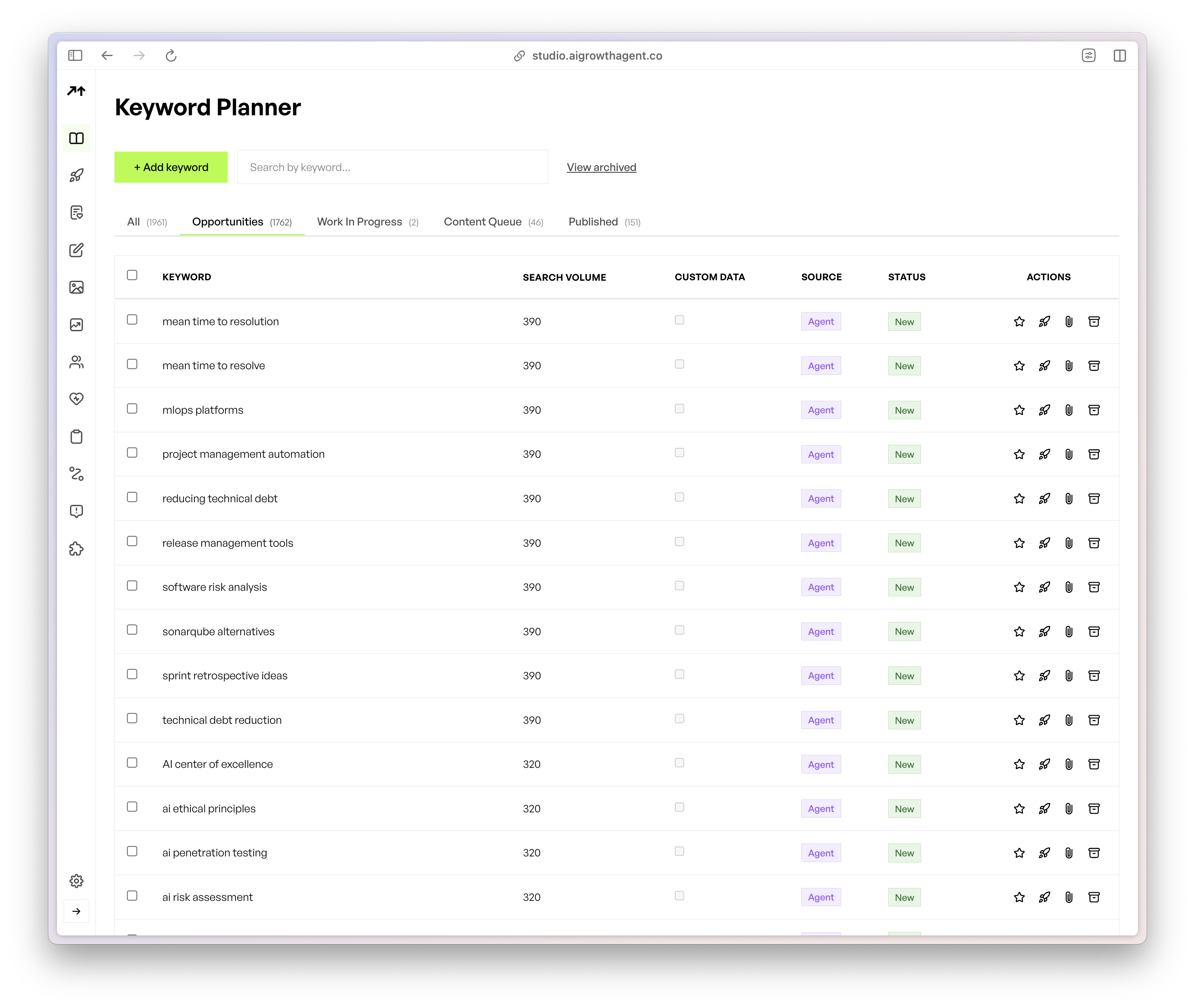
AI Growth Agent operates as an autonomous Programmatic SEO Agent built to turn companies into category authorities through AI search citations. The platform replaces manual content creation with a complete technical system that engineers, writes, and publishes content at superhuman scale.
Key capabilities include:
- Company Manifesto programming for consistent, on-brand content
- Autonomous keyword clustering and content strategy creation
- Advanced schema markup, LLM.txt, and Model Context Protocol deployment
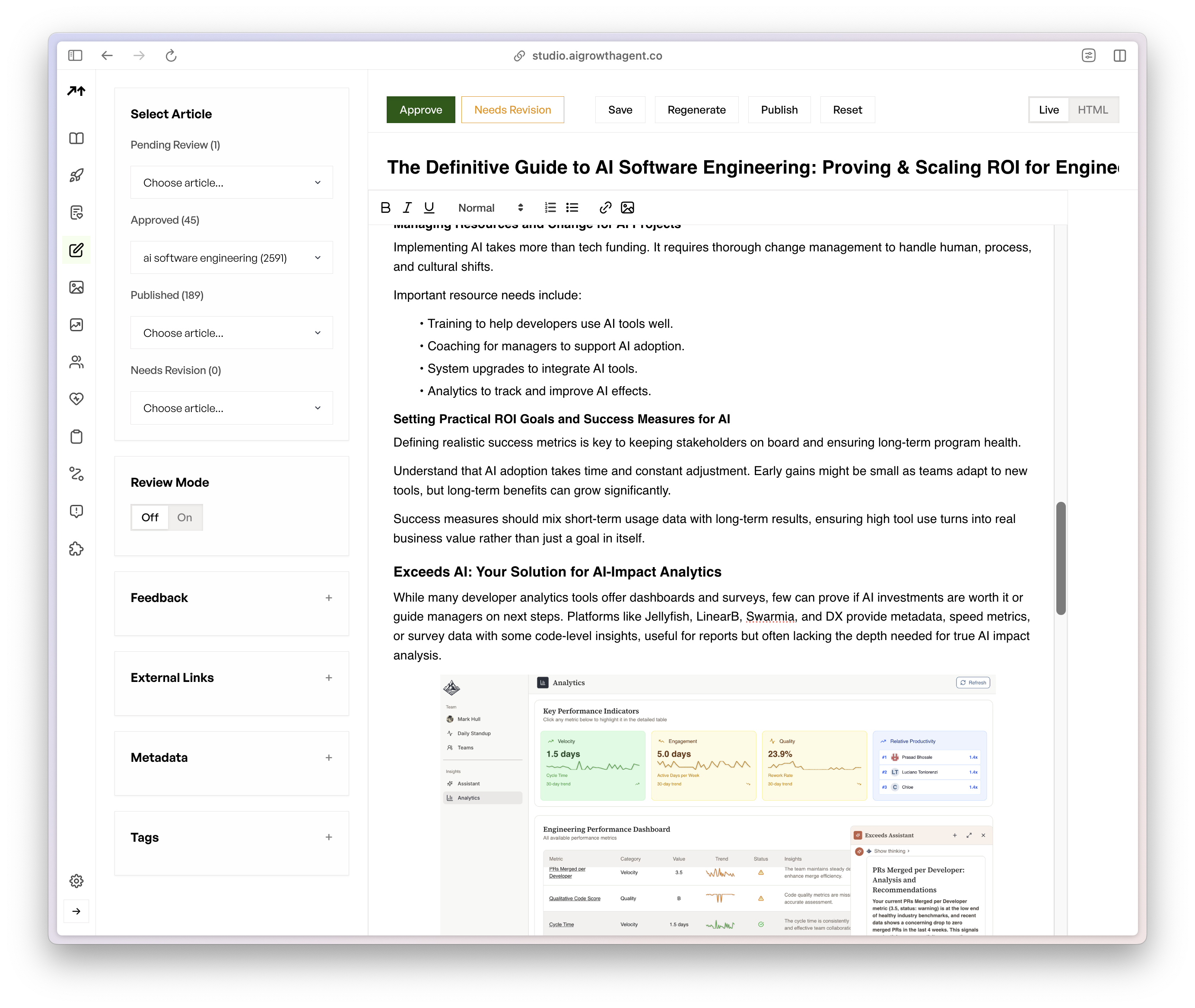
- AI Growth Agent Studio for visibility, controls, and approvals
- Multi-tenant deployment for portfolios and multi-brand groups
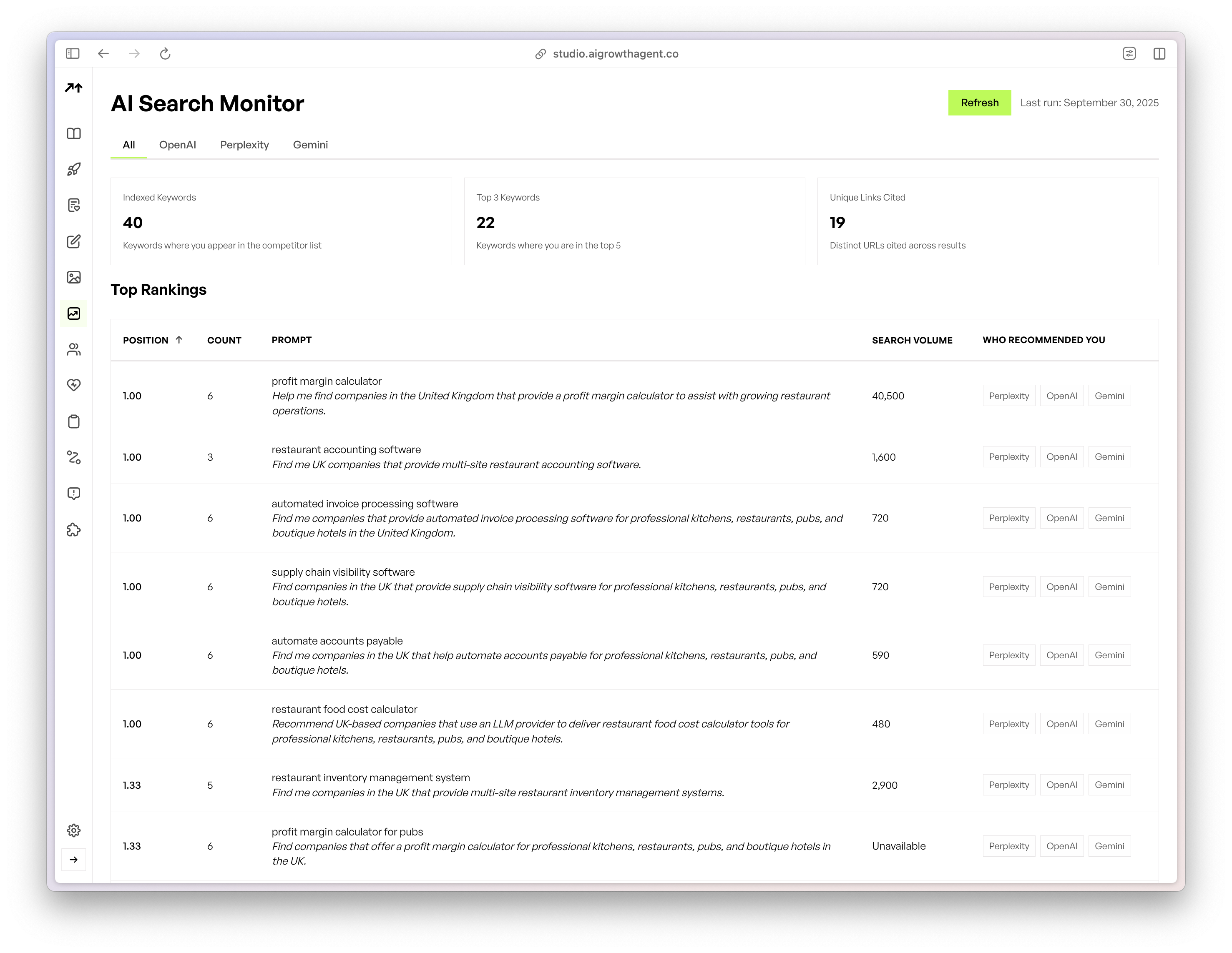
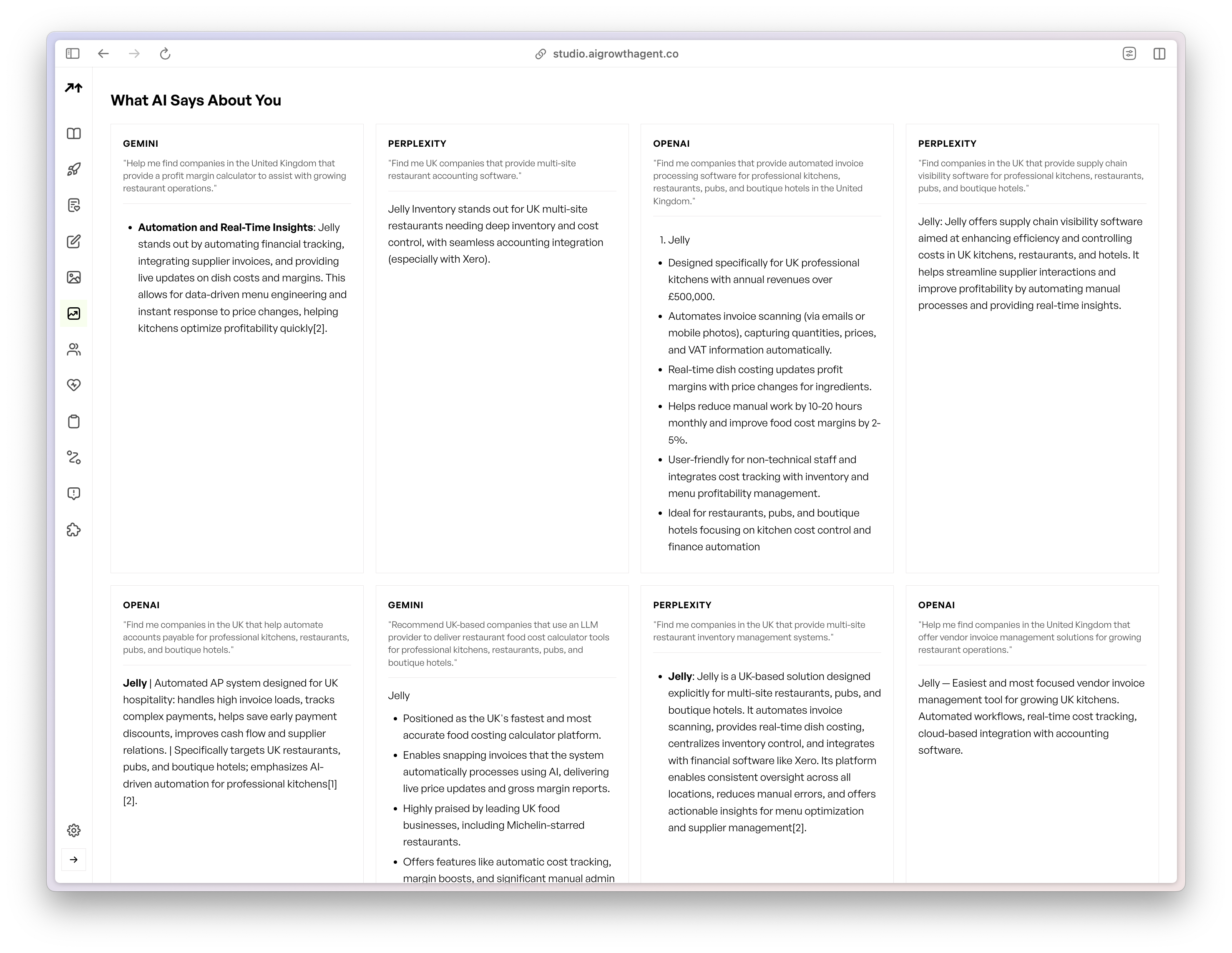
- Real-time AI search monitoring across ChatGPT, Perplexity, and Gemini
AI Growth Agent delivers daily content velocity, continuous feedback loop improvements, and one-week onboarding from first meeting to live articles. The platform removes technical friction while preserving premium editorial quality, which helps brands build durable competitive moats through programmatic content authority.
The solution supports effectively unlimited content volume for premium B2B brands and balances scale with quality in ways that manual platforms cannot. Client examples include Exceeds AI, which reached Perplexity recommendations within two weeks, and BeConfident, which became the top English learning app citation in Brazil through Google AI Overview.
AI Growth Agent suits marketing leaders at premium brands who need programmatic SEO scale and quality without hiring large teams of developers or writers.
Schedule a demo to see how AI Growth Agent can position your company as the definitive authority in your category.
Side-by-Side Comparison of Authority Platforms
|
Platform |
Automation |
AI Visibility Tracking |
Technical Infrastructure |
Content Velocity |
Cost Profile |
|
|
Manual |
None |
None |
Human-limited |
$99+/mo |
|
HubSpot |
Partial |
Basic |
CMS |
Monthly |
$800+/mo |
|
Jasper |
Prompt-based |
None |
None |
Manual |
$49+/mo |
|
AI Growth Agent |
Full pSEO |
Realtime (ChatGPT+) |
Auto-hosted (schema/MCP) |
Daily |
ROI-driven |
This comparison shows AI Growth Agent leading across every critical factor for 2026 AI search success. Traditional platforms rely on manual work and lack AI-specific infrastructure, while AI Growth Agent delivers full automation, real-time monitoring, and advanced technical configuration that support consistent AI citations.
Implementation Guide for Programmatic Authority in 2026
The classic Rule of 7 for B2B conversion now falls short in an AI-first search world. Modern authority building depends on content libraries with 40 to 50-word direct answers followed by deeper examples. This pattern supports a new “Rule of 700,” where brands need hundreds of AI-ready assets to earn consistent citations.
A practical rollout checklist includes AI visibility audits, programmatic content strategy design, schema markup, LLM.txt deployment, and continuous AI citation monitoring. Timelines with AI Growth Agent often reach launch within one week, while traditional platforms can take months to reach similar coverage.
Programmatic authority building also protects visibility during mergers and acquisitions by preserving search presence through brand transitions. Teams should avoid vendor lock-in by choosing platforms that provide content ownership and export options, which protect long-term flexibility while building digital footprint authority.
Conclusion: Win AI Search with AI Growth Agent
Digital footprint authority now depends on AI-optimized, programmatic systems rather than manual publishing alone. LinkedIn, HubSpot, and Jasper still play useful roles, but cannot match the automation, technical depth, and AI search focus that AI Growth Agent offers. Premium B2B brands that want category-defining authority through AI citations gain a clear advantage by adopting AI Growth Agent for 2026 and beyond.
Schedule a demo to start building durable AI search dominance.
FAQs: Digital Footprint Authority Building Platforms
What is a digital footprint in AI search?
A digital footprint in AI search reflects your brand’s visibility and citation frequency across AI-powered engines such as ChatGPT, Perplexity, and Google Gemini. Traditional SEO focuses on rankings, while AI search footprints focus on how often your content is referenced, quoted, and recommended by large language models.
This includes direct citations in AI responses, mentions inside synthesized answers, and recommendations within conversational search results. A strong AI search footprint turns your brand into a trusted source that AI systems reference repeatedly.
How does programmatic SEO differ from traditional platforms?
Programmatic SEO uses autonomous systems that engineer, write, and refine content at scale with minimal human input. Traditional platforms depend on people to research keywords, write articles, apply technical SEO, and publish content, which limits output to slower cycles.
Programmatic SEO platforms such as AI Growth Agent automate the full lifecycle, from keyword clustering to schema markup and LLM.txt deployment, which supports daily publishing with consistent quality. This approach also includes Model Context Protocol integration and other technical layers that traditional platforms do not provide.
Why do manual tools fail for authority building in 2026?
Manual tools fall behind because they cannot keep pace with the volume and technical precision that AI search now rewards. AI-generated content already accounts for more than 17% of search results, which creates a surge in competition that manual workflows cannot match.
Manual platforms lack the advanced schema, LLM.txt support, and Model Context Protocol integration that AI citations require. Human-led content teams usually work on monthly cycles, while AI search engines favor brands that publish high-quality content at high frequency. The complexity of optimizing for multiple AI platforms at once exceeds what manual processes can handle reliably.
How should brands measure AI citations and visibility?
Brands should track citation frequency across ChatGPT, Perplexity, and Google Gemini, including both direct quotes and indirect mentions in AI responses. Useful metrics include share of voice in AI answers, sentiment of AI-generated summaries, and visibility across key query types in the category.
Advanced tracking monitors which URLs drive AI citations, how often AI crawlers visit those pages, and the context in which the brand appears in responses. Connecting these insights with analytics tools reveals how AI citations translate into traffic, leads, and revenue.
What are realistic ROI timelines for digital footprint authority building?
ROI timelines differ sharply between manual and programmatic approaches. Traditional platforms often need 6 to 12 months to show meaningful authority gains because content creation and optimization move slowly.
Programmatic SEO platforms such as AI Growth Agent deliver faster outcomes, with clients like Exceeds AI gaining Perplexity recommendations within two weeks and BeConfident winning top citations in Google AI Overview within weeks. Reasonable expectations include first AI citations within 2 to 4 weeks, steady visibility growth over 2 to 3 months, and measurable traffic lifts within about 90 days. Content velocity and technical precision remain the main drivers of these accelerated timelines.
