


Key Takeaways
- AI-powered search engines now favor programmatic content systems over manual calendars for B2B visibility in 2026.
- AI Growth Agent focuses on autonomous SEO engineering, schema markup, and AI citation tracking to build durable authority.
- Monday.com, Asana, and Airtable excel at workflows and customization but do not support programmatic SEO at scale.
- Teams should evaluate automation depth, HubSpot and Teams integrations, and AI search optimization features before choosing a platform.
- Schedule a demo with AI Growth Agent to build scalable content authority for your B2B organization.
How We Evaluated B2B Content Calendar Platforms
Our evaluation combines top-ranking SERP analysis, G2 and Capterra user reviews, and Gartner 2026 technology reports. We ran hands-on demos and weighted B2B requirements such as complex approvals, multi-channel publishing, and AI-era search performance.
We prioritized programmatic publishing speed over manual grid management. Modern content marketing now rewards automated authority building instead of traditional scheduling alone.
Snapshot of Leading B2B Content Calendar Tools
These platforms stand out for B2B content calendar and operations management:
- AI Growth Agent – Autonomous programmatic SEO agent that produces schema-optimized content at scale
- Monday.com – Visual work management platform with flexible automation
- Asana – Project management with advanced workflow automation
- Airtable – Customizable database platform for structured content organization
- StoryChief – Content operations platform focused on distribution
- CoSchedule – Marketing suite with AI-supported content planning
- Notion – All-in-one workspace for content collaboration
- Hootsuite – Social media management with calendar features
Schedule a demo to see if AI Growth Agent fits your team and compare these tools against your specific B2B content goals.
AI Growth Agent: Programmatic AI Authority for B2B Teams
#1: AI Growth Agent (Best for Programmatic AI Authority)
AI Growth Agent turns content calendar management into autonomous programmatic SEO. The platform engineers authority-focused content architectures that increase AI search citations instead of simply scheduling posts.
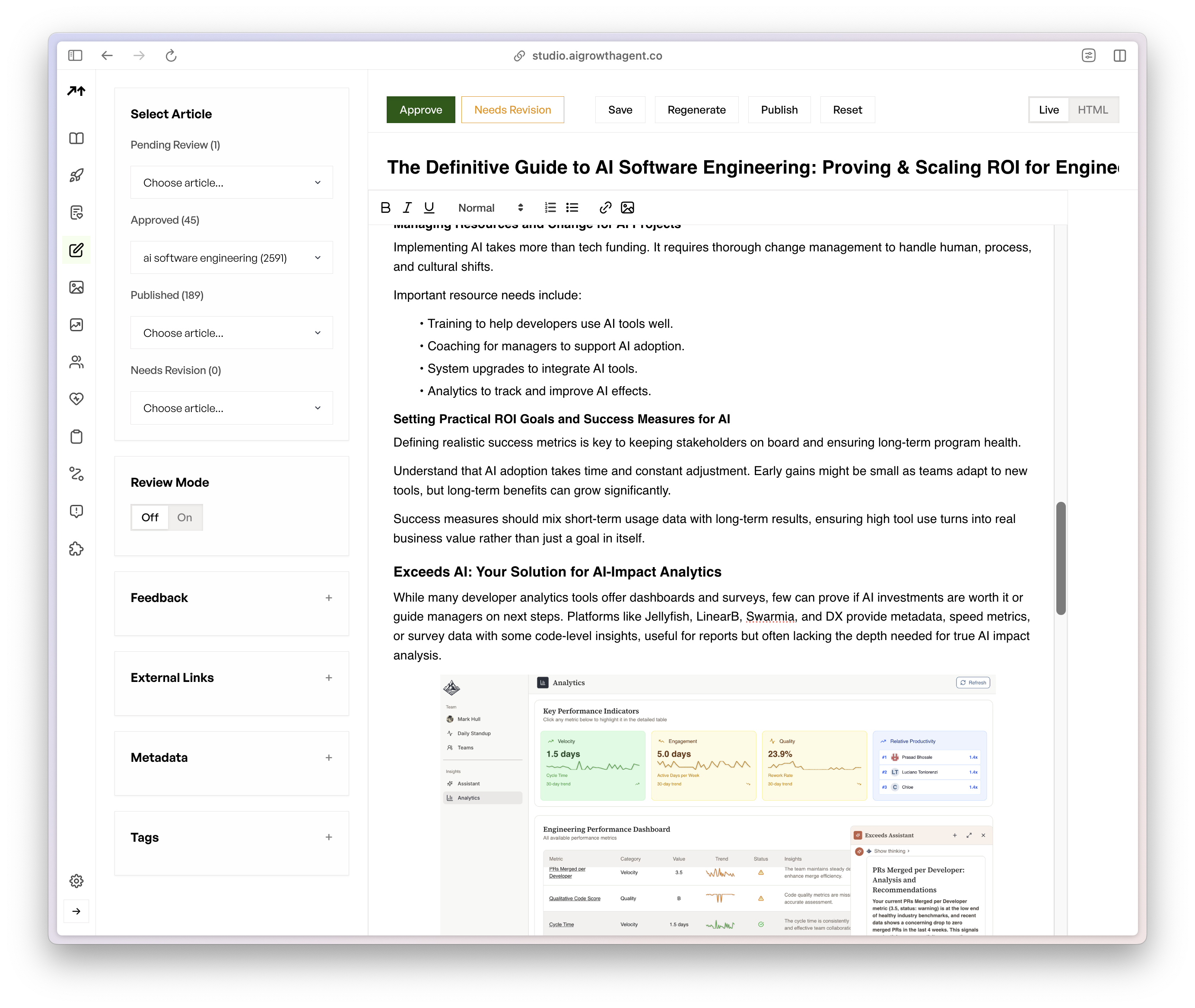
Key Features:
- Manifesto programming that encodes brand voice and positioning for content generation
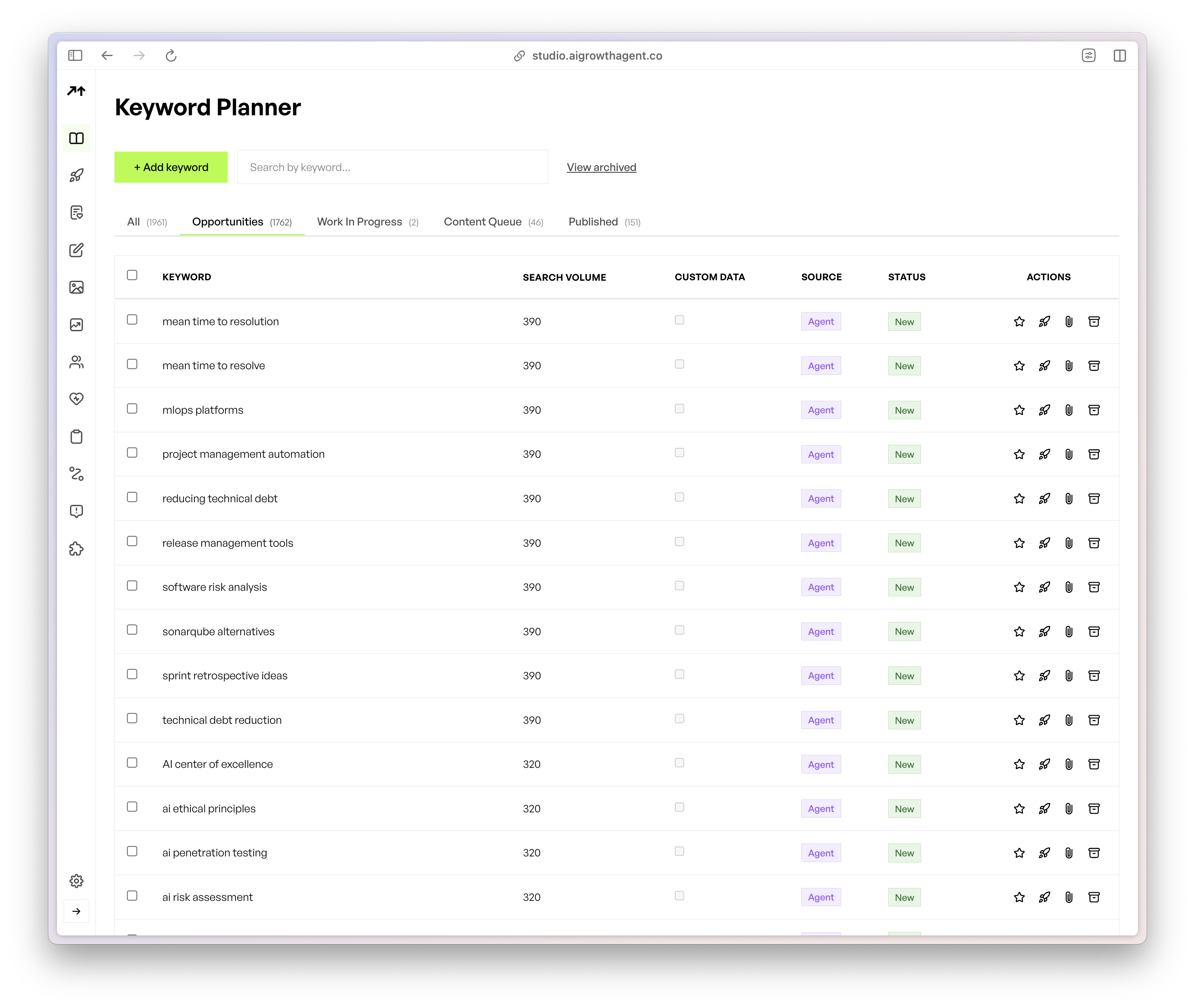
- Automated keyword clustering and content strategy development for entire topic areas
- Schema markup, MCP, and LLM.txt injection that support AI search visibility
- AI Growth Agent Studio dashboard for operational control and performance tracking
- Multi-tenant deployment suitable for agencies and portfolio companies
- Integrations with WordPress, Hashnode, Webflow, Framer, Sanity, and HubSpot
- One-week onboarding that includes consultation with a professional journalist
Strengths: Tracks AI citations across ChatGPT, Perplexity, and Google AI Overviews. Supports daily publication of long-form, technically structured content. Removes engineering friction from programmatic SEO execution.
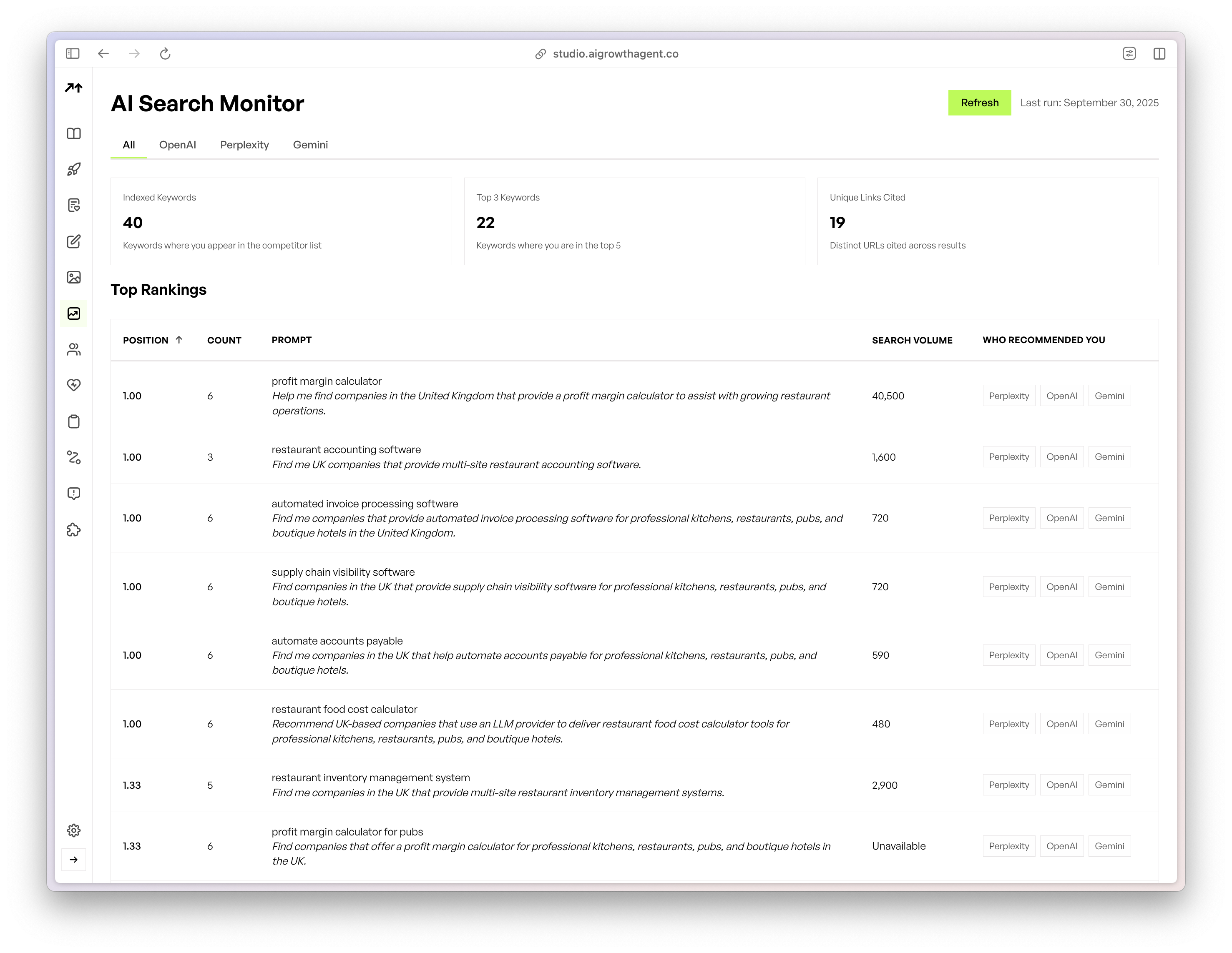
Limitations: Premium solution tailored to established brands that already have a baseline SEO presence.
Pricing: Custom pricing aligned with ROI targets and required content volume.
Ideal For: B2B marketing leaders who need high-volume authority building and reliable AI search visibility.
Schedule a demo to see if AI Growth Agent fits your team and experience autonomous content engineering in practice.
Monday.com: Visual Content Workflows With Flexible Automation
Monday.com (Best for Flexibility)
Monday.com delivers visual work management with customizable workflows for content planning. The interface supports collaborative calendar management and offers strong automation for routine tasks.
Key Features:
- Visual drag-and-drop content calendar interface
- More than 200 integrations, including HubSpot and Microsoft Teams
- No-code automation recipes that streamline recurring workflows
- Multiple views such as Kanban, Gantt, and calendar
- Real-time collaboration and structured approval workflows
Strengths: Highly customizable interface, clear visual organization, and a broad integration ecosystem.
Limitations: No programmatic SEO capabilities, no AI search optimization features, and automation caps on lower-tier plans.
Pricing: Starts at $8 per user per month for the Basic plan, with Standard at $10 per user per month.
Ideal For: Teams that value visual workflow management and collaboration more than technical SEO automation.
Asana: Automation-First Content Operations
Asana (Best for Automation)
Asana provides advanced automation through its AI Studio, which supports natural language workflow creation and unlimited automations on paid tiers. The platform reduces manual work by coordinating tasks across teams and projects.
Key Features:
- AI-powered workflow automation using natural language commands
- Advanced branching and cross-project triggers for complex flows
- More than 400 integrations, including Microsoft Teams and HubSpot
- Real-time cross-project reporting and analytics
- Dependency management for complex content workflows
Strengths: Robust automation, extensive integration support, and strong reporting capabilities.
Limitations: No programmatic SEO features and no AI search optimization tooling.
Pricing: Free tier available, Premium at $10.99 per user per month, Business at $24.99 per user per month.
Ideal For: Teams that need sophisticated workflow automation but do not require automated content generation.
Airtable: Database-Driven Content Calendars
Airtable (Best for Customization)
Airtable blends database structure with calendar management and supports deep customization for content tracking. Many teams use it as a flexible backbone for complex content operations.
Key Features:
- Database-driven content calendar with fully custom fields
- Multiple view types, including Grid, Calendar, Kanban, and Gallery
- Advanced filtering and sorting for large content inventories
- API access that supports custom integrations and workflows
- Collaborative editing and in-record commenting
Strengths: Extensive customization, powerful database capabilities, and flexible data organization.
Limitations: Requires manual SEO work, offers no automated content generation, and presents a learning curve for advanced setups.
Pricing: Free tier available, Plus at $10 per user per month, Pro at $20 per user per month.
Ideal For: Data-driven teams that need database-style content management and custom structures.
StoryChief: Multi-Channel Content Distribution
StoryChief (Best for Content Distribution)
StoryChief focuses on content operations with strong multi-channel distribution. The platform simplifies creation, approvals, and publishing for marketing teams that ship content across many destinations.
Key Features:
- Automated multi-channel content distribution
- Built-in content editor with on-page SEO guidance
- Approval workflow management for stakeholders
- Analytics and performance tracking dashboards
- Integrations with WordPress, HubSpot, and social platforms
Strengths: Strong distribution capabilities, integrated writing tools, and clear approval workflows.
Limitations: Limited AI authority building and no true programmatic SEO features.
Pricing: Starts at $20 per month for the Startup plan, with Growth at $60 per month.
Ideal For: Content teams that prioritize multi-channel distribution and structured approvals.
Schedule a demo to see if AI Growth Agent fits your team and compare programmatic capabilities against distribution-focused tools.
Programmatic vs Manual Calendars: What Changes in 2026
AI search has disrupted traditional content calendar models. Agentic AI adoption is rising, with 28% of B2B marketers testing AI agents, while AI-ready content structures now require precise tagging and schema markup for visibility.
Manual calendars handle logistics such as when and where to publish. Programmatic agents build authority by engineering content that AI search engines can cite and recommend. Calendars organize existing content, while agents design and ship entire content architectures.
Microsoft Teams integrations support collaborative approvals, but HubSpot’s Teams integration centers on meeting sync instead of SEO. Long-form B2B content now depends on technical infrastructure that traditional calendar tools do not provide.
2026 research highlights scalability through AI-driven production, with traditional content teams projected to create less than one-third of B2B content by late 2026. GenAI systems will handle the remaining volume for speed and reach.
Side-by-Side Comparison for B2B Buyers
|
Tool |
Automation Level |
AI-SEO Tech |
Integrations/Onboarding |
|
AI Growth Agent |
High – Programmatic |
Schema, LLM.txt, Citations |
WordPress, HubSpot, etc. / 1 week / Custom |
|
Monday.com |
Medium – Visual |
Low – No pSEO |
200+ / 2 weeks / $8+/user |
|
Asana |
High – Rule-based |
Low – No pSEO |
400+ / 1 week / $10.99+/user |
|
Airtable |
Medium – Custom |
Manual SEO only |
API-driven / 2 weeks / $10+/user |
Horizontal tools deliver flexibility but do not solve authority building in AI search. AI Growth Agent combines programmatic execution with technical SEO, which helps B2B teams create durable advantages through automated content engineering.
Schedule a demo to see if AI Growth Agent fits your team and move from simple scheduling to engineered content authority.
Implementation Checklist and Common Questions
Evaluation Checklist:
- Define your monthly content volume requirement.
- Decide whether you need AI search citation monitoring.
- Confirm whether HubSpot and Microsoft Teams integrations are mandatory.
- Assess your current technical SEO capabilities.
- Clarify how much you value programmatic scale versus manual control.
Programmatic SEO for Content Calendars
Programmatic SEO automates the content lifecycle from keyword research through technical setup and publishing. Traditional calendars schedule manually written content, while programmatic systems generate, refine, and publish content automatically using strategic rules and AI insights.
AI Growth Agent vs Asana for B2B Content
Asana focuses on workflow automation and task management but does not handle content generation or SEO. AI Growth Agent autonomously creates, structures, and publishes content while tracking AI search citations. Asana organizes existing work, and AI Growth Agent engineers content authority.
Free Content Calendar Options for B2B Teams
Free tools such as Trello, Notion, and entry-level Asana plans support basic scheduling. These tools lack advanced automation, deep integrations, and SEO features required for competitive B2B content. They work as starting points but cannot support long-term AI search performance.
Speed of AI-Generated Content Citations
Well-structured content with schema markup and LLM.txt can appear in AI search results within a few days. Sustained authority and recurring citations require continuous programmatic production and technical upkeep that manual methods rarely maintain.
Essential Microsoft Teams Integrations
Valuable Teams integrations include calendar sync for deadlines, channel notifications for approvals, and meeting recording sync for content briefs. Advanced setups also trigger automated workflows and support real-time collaboration on content assets inside Teams.
Schedule a demo to see if AI Growth Agent fits your team and review programmatic content calendar options in detail.
Conclusion: Turning Calendars Into Authority Engines
AI Growth Agent stands out as a leading option for B2B teams that need programmatic content authority in the 2026 AI search environment. Traditional tools still handle scheduling and collaboration well, but autonomous agents now provide the technical SEO and publishing speed required for durable advantage.
Schedule a demo to see if AI Growth Agent fits your team and upgrade your content calendar from a scheduling grid to an authority-building engine.
