


Key Takeaways
- Early-stage startups in 2026 should prioritize free tools like HubSpot CRM, Google Analytics 4, and Hotjar for lean growth stacks under $100 per month with quick setup.
- Combine CRM tools such as HubSpot, analytics platforms like GA4, and automation through Zapier to manage lead flow and make data-backed decisions without developer support.
- SEO platforms such as SEMrush and Ahrefs drive organic growth, while Buffer and Brevo support social media and multi-channel communication efficiently.
- Limit your first stack to 2–3 tools, validate them on free tiers, and measure 30–90 day ROI to prevent overload and protect efficiency.
- Scale content authority programmatically with AI Growth Agent to win AI search visibility beyond what traditional tools can deliver.
How We Chose These Startup Growth Tools
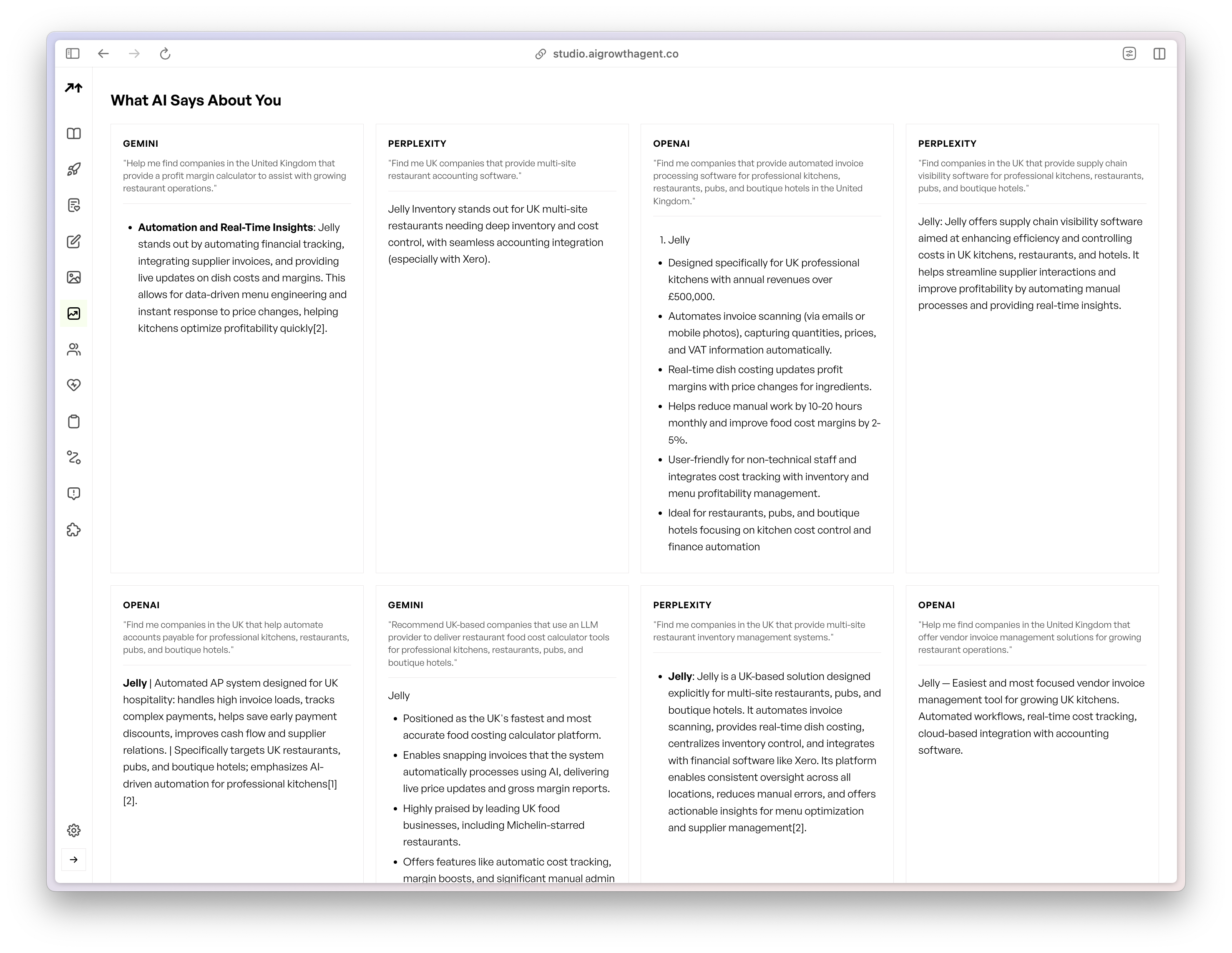
Our team reviewed more than 50 growth marketing platforms using 2026 benchmarks, Reddit discussions from r/GrowthHacking and r/SaaS, and G2 user reviews. We focused on tools with strong free tiers, setup times under one hour, and documented 10x performance gains for teams of fewer than 10 people. SEO and organic search deliver 748% ROI for thought leadership campaigns, so content-focused tools play a central role in bootstrapped growth plans.
CRM & Automation Picks That Keep Startup Lead Flow Simple
HubSpot
HubSpot offers an all-in-one CRM and marketing automation platform with a freemium model and 4.4/5 rating. The 2026 release adds AI-powered workflows that score leads automatically and trigger personalized email sequences.
Pros: Comprehensive free tier, visual workflow builder, integrated email marketing
Cons: Limited contacts on free plan, learning curve for advanced features
Pricing: Free forever / $20 per month Starter
Best for: Startups that want unified lead management and nurturing
ActiveCampaign
ActiveCampaign provides marketing automation tailored to eCommerce startups starting at $29 per month. The platform stands out for behavioral triggers and detailed customer journey mapping.
Pros: Advanced automation, strong deliverability, CRM integration
Cons: No free tier, complex for beginners
Pricing: $29 per month
Best for: E-commerce startups with complex customer journeys
Reddit users frequently praise HubSpot for ease of use, with one founder sharing, “Switched from Salesforce to HubSpot and our team productivity doubled overnight.” Schedule a demo to see if you are a good fit for automating your lead qualification process.
Analytics & CRO Tools That Support Confident Decisions
Google Analytics 4
Google Analytics 4 includes event-based tracking, cross-platform measurement, and AI-powered predictive metrics for purchase probability and churn. The 2026 updates improve AI predictions and expand audience-building options.
Pros: Completely free, predictive analytics, deep Google ecosystem integration
Cons: Steep learning curve, complex interface
Pricing: Free
Best for: Any startup that needs comprehensive web analytics
Hotjar
Hotjar provides heatmaps and session recordings with a freemium model and 4.3/5 rating. The platform reveals user behavior and highlights conversion bottlenecks on key pages.
Pros: Clear visual insights, quick setup, affordable pricing
Cons: Limited sessions on free plan, basic reporting
Pricing: Freemium / $32 per month
Best for: Improving website conversion rates
Case studies show that startups using combined analytics and CRO tools achieve 81% higher ROI compared to single-tool approaches. Schedule a demo to see if you are a good fit for comprehensive growth tracking.
SEO & Content Platforms That Drive Organic Growth
SEMrush
SEMrush offers combined SEO and PPC capabilities starting at $129 per month with a 4.5/5 rating. The 2026 AI Copilot feature sends daily improvement suggestions and recommends automated workflows.
Pros: Deep keyword research, competitor analysis, content improvement tools
Cons: Higher price point, overwhelming for beginners
Pricing: $129 per month
Best for: Startups that treat organic search as a primary growth channel
Ahrefs
Ahrefs focuses on backlink and keyword analysis starting at $99 per month with a 4.6/5 rating. The platform shines for competitive research and content gap analysis.
Pros: Large backlink database, reliable keyword difficulty scores, powerful content explorer
Cons: Expensive for early-stage teams, limited free features
Pricing: $99 per month
Best for: Content-led startups that need strong competitive intelligence
Reddit founders often report that “SEMrush helped us identify 10x more keyword opportunities than free tools combined.” The higher subscription cost often pays off for teams committed to organic growth.
Social Media & Operations Tools That Save Time
Buffer
Buffer supports multi-platform scheduling, a content calendar, AI caption assistance, analytics, and a browser extension. The 2026 release improves AI content suggestions and adds richer analytics.
Pros: Simple interface, support for multiple platforms, AI help for captions
Cons: Limited free posts, basic analytics on lower tiers
Pricing: Free / $6 per month
Best for: Maintaining a consistent social media presence
Zapier
Zapier connects your apps with no-code automation, so your growth stack works together without developer time. The platform supports more than 5,000 app integrations.
Pros: No coding required, broad integration library, strong time savings
Cons: Limited free tasks, costs can rise with heavy usage
Pricing: Free tier / $19.99 per month
Best for: Automating repetitive work across tools
Lead Generation & Communication Platforms for Startups
Apollo
Apollo delivers sales intelligence and engagement with a freemium model and 4.8/5 rating. The platform combines prospecting, outbound email sequences, and light CRM features.
Pros: Large B2B database, email automation, CRM integration
Cons: Limited free credits, learning curve for advanced workflows
Pricing: Freemium / $49 per month
Best for: B2B startups that rely on outbound lead generation
Brevo
Brevo offers email, SMS, and chat in a single platform with a freemium model and 4.5/5 rating. Teams manage multi-channel communication from one dashboard.
Pros: Multi-channel messaging, generous free tier, automation workflows
Cons: Interface feels dated for some users, fewer advanced features
Pricing: Freemium / $25 per month
Best for: Startups that want unified customer communication
Schedule a demo to see if you are a good fit for scaling lead generation beyond manual outreach.
Free Growth Stack for Early-Stage Founders
Budget-conscious founders can assemble a complete growth stack using only free tools:
- Google Analytics 4: Full web analytics platform
- HubSpot Free CRM: Contact management and basic automation
- Mailchimp: Email marketing for up to 500 contacts
- Buffer Free: Social media scheduling for three channels
- Hotjar Free: Basic heatmaps and session recordings
This mix covers analytics, CRM, email, social media, and conversion insights without monthly spend. Free tiers provide enough functionality for bootstrapped startups before paid upgrades become necessary.
Side-by-Side Tool Comparison for Lean Stacks
|
Tool |
Automation Level |
AI Features |
Cost Under $100/mo |
|
HubSpot |
High |
Workflow AI, Lead Scoring |
Free / $20 |
|
Google Analytics 4 |
Medium |
Predictive Analytics |
Free |
|
SEMrush |
Medium |
AI Copilot |
No ($129) |
|
Zapier |
Very High |
Limited |
$19.99 |
Free tools give founders a strong starting point, and AI-powered automation becomes crucial once manual workflows hit capacity.
Curated Growth Stacks and Quick Implementation
Acquisition Stack (SEO + Social):
- Google Analytics 4 (tracking)
- SEMrush (keyword research)
- Buffer (social distribution)
- HubSpot (lead capture)
Retention Stack (Email + CRO):
- HubSpot (CRM and automation)
- Hotjar (user behavior analysis)
- Mailchimp (email campaigns)
- Zapier (workflow automation)
Use this implementation checklist: complete onboarding within 30 minutes per tool, connect integrations between platforms, and track 30-day ROI improvements. Prevent tool overload by starting with 2–3 core platforms. Startups often burn through cash on inefficient tactics without targeted go-to-market strategies, so a focused stack matters.
How AI Growth Agent Builds Startup Content Authority
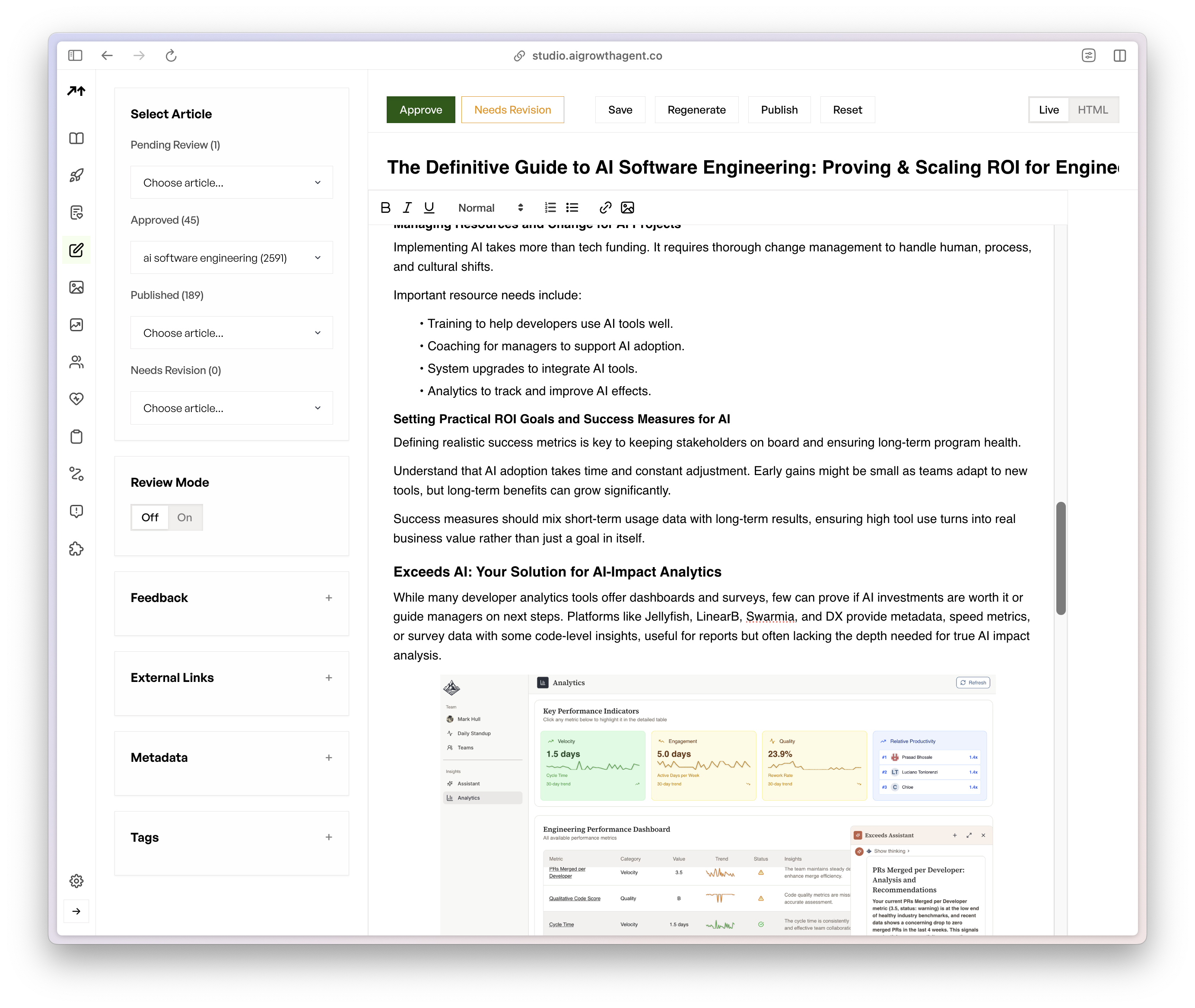
AI Growth Agent solves the 2026 challenge of scaling content authority, while traditional tools focus on single marketing functions. Our programmatic SEO agent designs complete content architectures, from keyword clustering and schema to direct publishing.
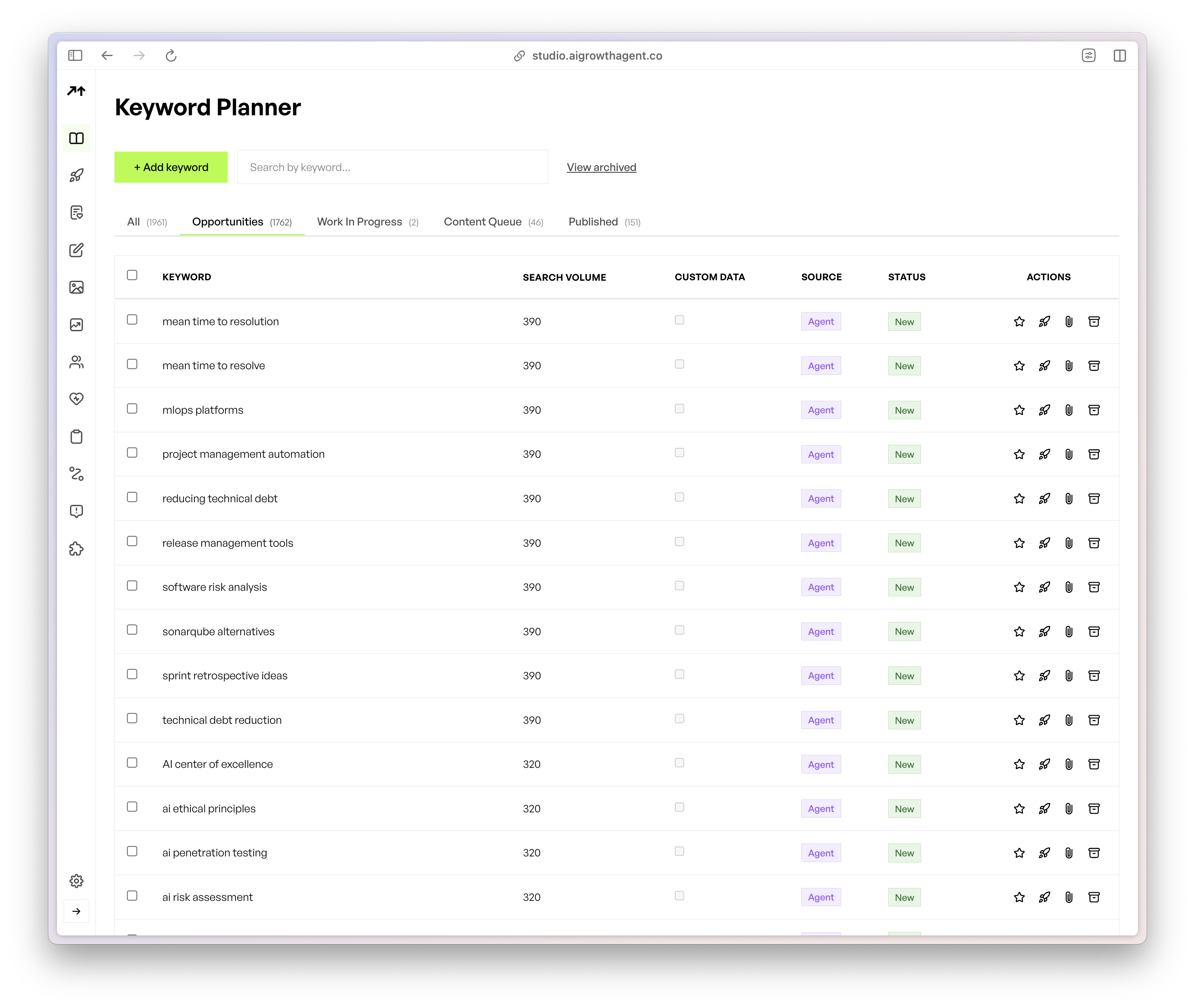
AI Growth Agent delivers end-to-end automation with advanced technical SEO, not just basic AI copy. The platform supports realtime content injection and multi-tenant deployment for portfolio companies. Success stories include helping Exceeds AI reach top Perplexity recommendations within two weeks and positioning Gitar as the leading authority for AI-powered CI/CD automation.
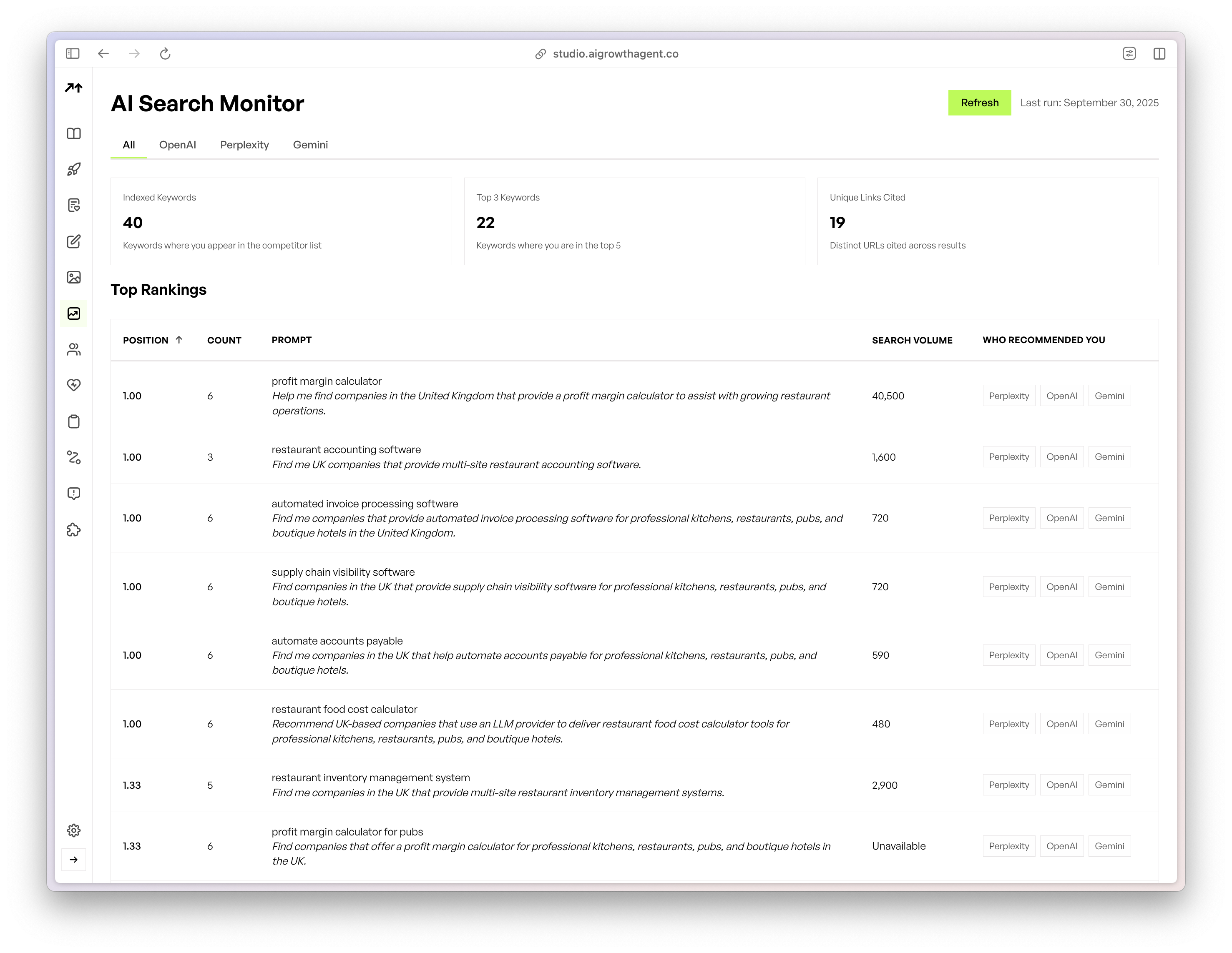
Startups that need to grow content authority without hiring developers or writers can rely on AI Growth Agent for autonomous programmatic SEO that traditional tools cannot match. Schedule a demo to see if you are a good fit for building a durable content advantage.
Frequently Asked Questions
What are the best free growth marketing tools for early-stage startups?
The most effective free tools include Google Analytics 4 for web analytics, HubSpot’s free CRM for contact management and basic automation, Mailchimp for email marketing up to 500 contacts, Buffer’s free tier for social scheduling, and Hotjar’s free plan for heatmaps. Together, these tools cover core growth functions without monthly costs and give bootstrapped startups a solid initial infrastructure.
Which SEO tools should startups prioritize on limited budgets?
Budget-conscious teams should start with Google Analytics 4 and Google Search Console for core SEO tracking. When a paid upgrade makes sense, SEMrush at $129 per month offers deep keyword research, competitor analysis, and AI Copilot for automated suggestions. Ahrefs at $99 per month excels at backlink analysis. For on-site improvements, tools like Hotjar reveal behavior patterns that guide SEO changes.
How can startups avoid growth tool overload while scaling?
Successful startups keep their first stack to 2–3 core tools that cover analytics, CRM, and one automation platform. Start with free tiers, then upgrade only after you see clear results. Choose tools that integrate well instead of isolated point solutions. Roll out one tool fully before adding another, and review usage regularly to remove anything redundant. Depth of use with a few tools beats shallow use across many.
What is the typical ROI timeline for growth marketing tools in startups?
Most growth tools begin showing results within 30–60 days, and stronger ROI usually appears after 90 days of consistent use. Email and CRM platforms often return value fastest, while SEO tools need three to six months for meaningful organic gains. Analytics tools provide instant visibility but require time before insights translate into improvements. Automation platforms such as Zapier create immediate time savings that compound over time.
Should early-stage startups invest in paid tools or rely on free options?
Founders should start with free tools to build processes and confirm which channels work. Then they can upgrade selectively once they see clear ROI. Paid tools make sense when free limits block growth, such as contact caps in CRMs or missing features in analytics. Prioritize investment in the channel that drives the most growth. For example, invest in SEMrush if SEO brings most traffic, or upgrade Mailchimp first if email delivers the highest conversions.
Conclusion: Build a Lean Stack and Scale Content Authority
Early-stage startups in 2026 must balance tight budgets with the need for reliable growth infrastructure. The tools in this guide support that balance, from free starter stacks to premium platforms with measurable ROI. Thoughtful selection, clean implementation, and gradual scaling based on results matter more than tool count.
Individual tools handle specific tasks, but long-term advantage comes from programmatic content authority that positions your startup as the go-to source in your category. Schedule a demo to see if you are a good fit for autonomous content scaling that traditional growth stacks cannot match.
