


Written by: Mariana Fonseca, Editorial Team, AI Growth Agent
Key Takeaways
-
Most teams already use marketing automation, but the real advantage in 2026 comes from visibility in zero-click search, AI Overviews, and generative AI answers.
-
Traditional platforms like HubSpot and Marketo handle post-click automation well but do not shape what AI models say about your brand before anyone visits your site.
-
AI add-ons and e-commerce tools improve workflows yet stay constrained by prompt caps, static content, and no way to map or influence the full buyer search universe.
-
Enterprise suites add complex capabilities with high cost and long timelines, while still delivering no AI search visibility or incremental attribution reporting.
-
AI Growth Agent maps your complete search universe, produces living authoritative content, and delivers measurable AI citations, so you can see how your narrative shows up in AI environments.
Quick Selection Matrix: Choosing a Platform for Zero-Click Discovery
The table below compares platform categories across six criteria. Pricing transparency reflects whether total cost of ownership stays predictable without hidden implementation or per-prompt fees. AI search visibility reflects whether the platform actively shapes how generative AI systems cite and recommend your brand.
|
Platform Category |
Best Fit |
AI Search Visibility |
Pricing Transparency |
|---|---|---|---|
|
Traditional campaign management (HubSpot, ActiveCampaign) |
SMB to mid-market CRM and email |
None |
Moderate, contact-based scaling adds cost |
|
AI-feature add-ons (Breeze, Semrush agents) |
Teams already on the parent platform |
Minimal, prompt caps limit universe |
Low, bundled into existing contracts |
|
E-commerce personalization (Klaviyo, Bloomreach) |
B2C retail and e-commerce |
None |
Moderate, MAU or contact-based |
|
Enterprise suites (Marketo, Salesforce Marketing Cloud) |
Large enterprise B2B with existing CRM |
None |
Low, list price covers fewer than 30% of total enterprise cost |
|
AI Growth Agent |
Mid-market to enterprise narrative control |
Full, maps entire search universe |
High, flat fee with no per-prompt or per-article charges |
1. Traditional Campaign Platforms That Stop at the Click
HubSpot, ActiveCampaign, and similar tools were built to automate email sequences, score leads, and route contacts through CRM workflows. They still perform those tasks well. Automated emails generate 320% more revenue than non-automated campaigns, and platforms in this category support that reliably.
The structural gap sits before the click. Traditional campaign management assumes a buyer who clicks an ad, lands on a page, and enters a nurture flow. That journey erodes as search becomes increasingly zero-click and generative AI answers resolve intent before a user reaches a brand’s domain. A platform tuned for post-click nurture has no way to shape what an AI model says about your brand before the visit.
HubSpot Enterprise mid-market B2B deployments carry a significant three-year TCO trajectory. Teams then add content agencies, SEO tools, and AI monitoring subscriptions to cover gaps the platform never aimed to solve. Each gap forces another subscription, another integration, another vendor relationship. That pattern defines tool sprawl.
2. AI Add-ons That Automate Workflows Without Narrative Control
Some vendors now bolt AI features onto existing platforms to close these gaps. HubSpot’s Breeze, Semrush’s content agents, and similar features represent a real step forward in workflow automation. HubSpot’s Breeze AI suite delivers content generation, data enrichment, and automated workflows integrated with its CRM and Marketing Hub. The capability is real, yet the ceiling remains structural.
These tools still rely on the user to supply prompts. They only generate content for queries the marketing team already knows to ask about, not for the hundreds of adjacent searches happening in the zero-click environment described earlier. Only 1 in 3 marketers can activate the data they already collect, with just 24% having achieved personalization at scale, and prompt-capped tools deepen that activation gap.
These platforms also lack a living content layer. Content generated inside them gets published once and then ignored. It does not self-heal when a rule changes, does not refresh when a competitor moves, and does not track whether a GPTBot has crawled and cited it. Narrative control requires more than content generation. It needs a system that maps, produces, publishes, monitors, and updates content on a continuous cycle.
3. E-commerce Personalization Platforms Misaligned With B2B Discovery
Klaviyo offers predictive analytics such as expected next order date and churn risk scoring. Bloomreach’s Loomi AI activates personalization in real time using first-party behavioral and product data. For B2C retail, these capabilities deliver strong performance.
B2B mid-market and enterprise teams face a different reality. Behavioral flow optimization assumes frequent, transactional interactions. B2B buying committees move slowly, involve multiple stakeholders, and build trust through authoritative content instead of abandoned-cart triggers. Neither Klaviyo nor Bloomreach tracks whether your brand appears in a ChatGPT answer about your category, monitors bot traffic from AI training agents, or produces the long-form content that earns those citations.
4. Enterprise Suites With Costly, Slow Implementations
Salesforce Marketing Cloud and Adobe Marketo Engage serve large enterprises with complex ABM requirements and deep CRM dependencies. Their capabilities run broad and deep. Their cost and implementation timelines do the same.
Salesforce Marketing Cloud carries substantial monthly fees plus heavy implementation work. Enterprise marketing automation contracts often extend far beyond list prices once implementation partner fees, parallel-run costs, and premium support tiers enter the picture. Enterprise-scale platform migrations typically require 6 to 12 months (or more).
That investment still produces no AI search visibility. A brand that completes a Marketo implementation in month nine gains no mechanism for appearing in generative AI answers, no living content layer, and no incremental visibility reporting that separates platform impact from existing brand equity.
5. AI Growth Agent: Owning Your Entire Search Universe
AI Growth Agent focuses on the problem the other four categories cannot solve. It makes your brand the answer where buyers now discover solutions, before they click, before they visit your site, and before they enter any nurture flow.
The engine starts with a Company Manifesto, a comprehensive brand document created through a journalist-led interview and ingestion of existing materials. This Manifesto forms the differentiation layer that generic content tools cannot match. Every article the engine produces draws from brand-approved documentation rather than only from a model’s training data.
From the Manifesto, AI Growth Agent builds a Content Topology, which maps the brand’s search universe. It begins with 9–15 seed terms and 300–400 derived prompts, refreshed weekly from real-time Google and ChatGPT data. Mature clients reach search universes of more than 1,500 queries. Prompt count never affects billing.
Content stays alive over time. When a rule changes, a CTA updates, or a competitor moves, the engine syncs and refreshes affected articles automatically overnight. A proprietary WordPress plugin manages the technical infrastructure that makes AI visibility measurable. It tracks bot traffic from AI training agents, implements Model Context Protocol for Blog and Web, and deploys advanced robots.txt and sitemap.xml configurations that guide crawler behavior. Full schema coverage, including article, FAQ, local business, organization, author, and product schemas, ensures AI systems can parse and cite content accurately, all out of the box with no technical work required from the client.
Incremental visibility reporting isolates exactly what AI Growth Agent generated versus what the brand already had. It tracks this week over week across Google rankings, Google AI Overviews, ChatGPT citations, bot traffic via the WordPress plugin, and impressions via Google Search Console. This unified approach, which maps, produces, publishes, and measures in one engine, separates AI Growth Agent from the bolt-on and post-click tools described earlier.
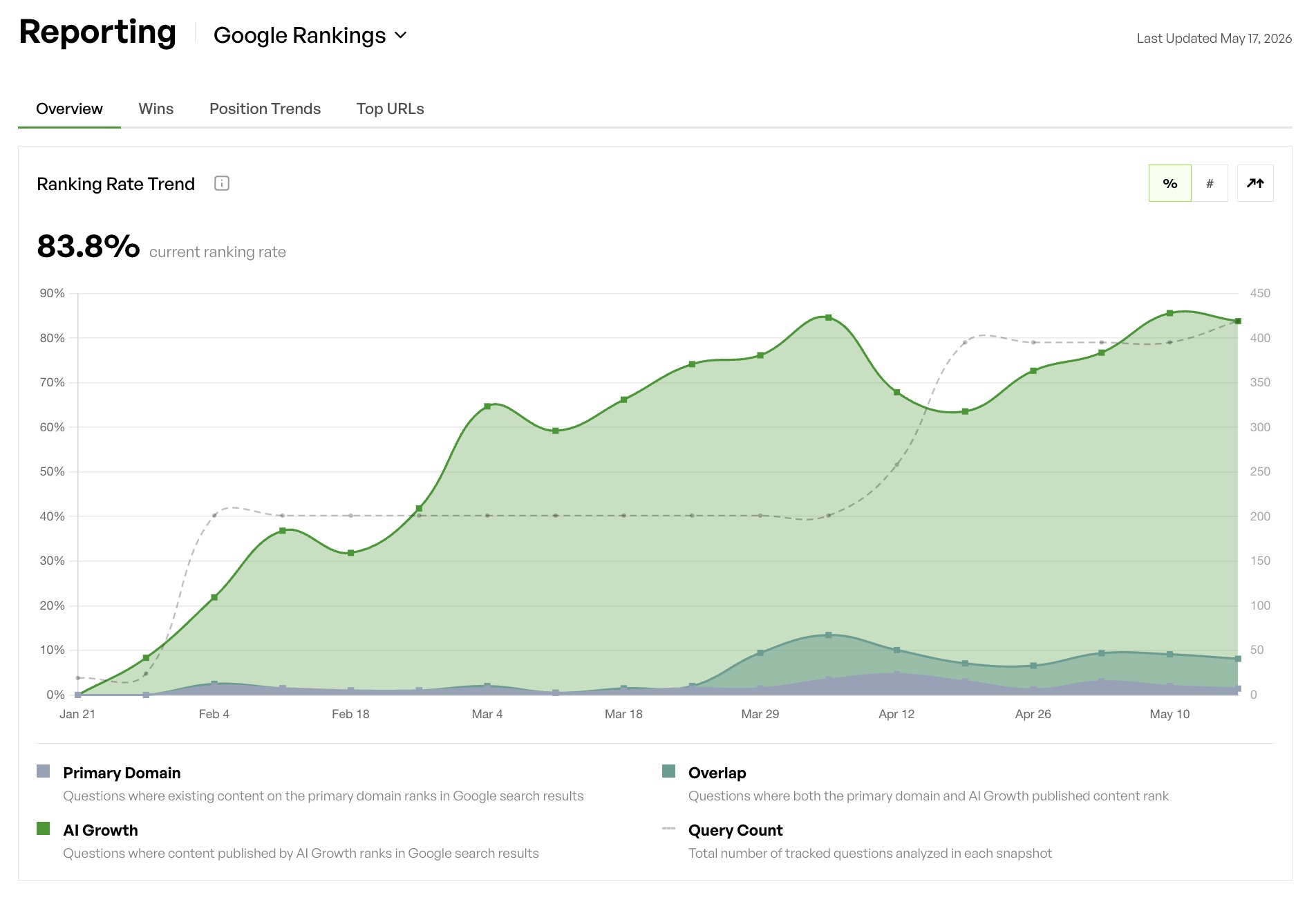
Across the first three months, clients average more than 12,000 additional AI citations and mentions, over 100,000 additional bot visits, and a lift of more than 20% in impressions in Google Search Console. Leva Sleep closed $40,000–$50,000 in sales within three weeks from buyers who discovered the brand through AI Growth Agent content. Jelly became the top cited solution for “Restaurant Inventory Management in the UK” on ChatGPT. Exceeds.ai moved from invisible to consistently recommended by Perplexity and ChatGPT, with more than 55% of total traffic sourced from AI Growth Agent content.
Pricing uses a flat fee with no per-prompt or per-article charges, and clients own all content produced.
See how AI Growth Agent would map your search universe in a live session.
How to Measure True ROI in 2026
Marketing automation delivers an average ROI of $5.44 for every dollar spent, with 76% of companies seeing positive returns within 12 months. Top-quartile programs can achieve even higher returns.
Those benchmarks focus on traditional automation outcomes such as MQL volume, email revenue, and pipeline velocity. They ignore the compounding value of organic search visibility, which keeps working after spend stops and builds authority that paid media cannot match.
The metrics that matter in 2026 extend beyond opens and conversions. Bot traffic from AI training agents, including GPTBot, signals that models ingest your content for future citation. Appearance rate in Google AI Overviews and ChatGPT answers measures narrative control in the zero-click environment. Impressions growth in Google Search Console confirms that new content indexes and expands the brand’s discoverable surface area. Incremental visibility reporting, which separates platform contribution from pre-existing brand equity, provides the only honest measure of platform ROI.
Many marketers name ROI measurement as a top challenge and a critical metric. A platform that cannot separate its contribution from baseline visibility asks you to accept results on faith. AI Growth Agent’s four-pillar data infrastructure, Search Intelligence, AI Analytics, Bot Tracking, and AI Ranking, makes that separation explicit every week.
Review the four-pillar visibility dashboard with your team in a guided walkthrough.
Frequently Asked Questions
How does an AI-native autonomous engine differ from traditional marketing automation?
Traditional marketing automation platforms manage contact databases, trigger email sequences, score leads, and route prospects through CRM workflows. They operate on data the team already has and campaigns the team already designed. An AI-native autonomous engine like AI Growth Agent maps the full universe of queries buyers use to discover solutions in your category, produces authoritative content targeting those queries at scale, publishes it to a technically optimized blog the brand owns, and monitors whether AI systems cite and recommend the brand. The distinction sits between automating existing operations and building compounding organic visibility that works without ongoing spend or manual input.
How long does implementation take, and when do results appear?
Enterprise suites like Salesforce Marketing Cloud and Marketo Engage often require several months for full implementation, and earlier we noted that enterprise implementations frequently stretch beyond six months. That timeline delays any visibility gains by half a year or more. AI Growth Agent runs on a different schedule. The first article can go live within one week of kickoff, and content has indexed in as little as two weeks. The standard engagement runs as a three-month pilot, because indexing timelines vary by industry and search universe size. Clients typically see measurable impressions lift, bot traffic increases, and AI citation growth within the first 28 days.
Which pricing models should mid-market and enterprise teams treat with caution?
Contact-based pricing penalizes list growth. Event-based pricing penalizes product-led growth. Prompt-based pricing penalizes teams that want full visibility into their search universe. Hidden costs in enterprise platform contracts, including implementation fees, premium support tiers, and integration maintenance, can raise total cost of ownership far beyond published list prices. AI Growth Agent charges a flat fee with no per-prompt or per-article charges, so expanding your visible search universe carries no extra cost, and clients own all content produced.
How does AI search visibility differ from traditional SEO in 2026?
Traditional SEO focuses on ranked positions on a static search results page. AI search visibility determines whether your brand appears in generative answers from ChatGPT, Google AI Overviews, Perplexity, and similar systems, often before a user sees a list of links. These answers have no fixed position. Citation frequency, order of mention, and context of recommendation now act as ranking signals. Brands that do not actively produce authoritative, technically sound content at scale leave their narrative to outdated training data, competitor content, or hallucinations. AI Growth Agent tracks citation rates, order of appearance, and bot traffic from AI training agents as primary visibility metrics.
Can AI Growth Agent work alongside an existing marketing automation platform?
Yes. AI Growth Agent stands up a top-of-funnel blog connected to the brand’s domain through a reverse proxy rewrite or subdomain. It does not alter the brand’s existing site, CRM, or marketing automation workflows. The blog functions as a separate, owned property that feeds organic discovery and AI citations at the top of the funnel, while existing platforms handle lead nurturing and conversion downstream. Clients who measure most effectively connect UTM parameters from AI Growth Agent content to their existing analytics and CRM to track the organic leads that follow.
Conclusion: Turning Automation Into AI Narrative Control
The marketing automation category in 2026 splits into two clear groups. The first group automates what happens after a buyer finds you, including email sequences, lead scoring, CRM routing, and behavioral personalization. Those capabilities carry real value, and the platforms delivering them are mature and well documented.
The second group determines whether a buyer finds you at all in a zero-click, generative AI environment. That group currently has one serious entrant, AI Growth Agent.
Paid media stops the moment spend stops. Agency retainers create assets the agency often controls. Monitoring tools reveal a capped slice of the market you already thought to ask about. None of these approaches compound, self-heal, or map your full search universe while producing living authoritative content at scale and proving incremental visibility week over week in a single engine the brand owns outright.
Mid-market and enterprise teams that must show results to leadership within 30 days, without adding headcount or deepening agency dependency, now have a clear path. The engine already exists. Your search universe is ready to be mapped.
Request a tailored search universe mapping and see your category through AI Growth Agent’s lens.


