


Key Takeaways
- AI search engines like ChatGPT and Perplexity now reward brands that unify monitoring and autonomous execution in 2026.
- AI Growth Agent leads with end-to-end programmatic SEO, real-time AI search monitoring, autonomous publishing, and technical standards like LLM.txt.
- Profound excels at monitoring across 10+ AI engines but stops at insights, while RankYak offers semi-autonomous blogging for SMBs.
- No-code tools like Gumloop and AirOps still need manual setup, and traditional platforms like Semrush cannot match AI-scale automation.
- Premium brands earn AI citations in 2–3 weeks with AI Growth Agent, so schedule a demo to start building programmatic authority today.
Why Unified Monitoring and Execution Wins in 2026
AI search now rewards recency, depth, and consistent structure across your content. AI engines process millions of prompts daily, which creates a constant stream of citation opportunities for prepared brands. Most teams still treat monitoring and execution as separate workflows, which creates costly gaps.
Monitoring-first tools like Profound excel at tracking brand mentions across 10+ AI engines, yet they stop short of autonomous execution. Workflow builders like Gumloop and AirOps depend on manual configuration between alerts and publishing. This fragmented approach slows teams and blocks the programmatic velocity required for AI search authority.
Unified monitoring and execution delivers measurable gains. Companies that adopt end-to-end programmatic SEO achieve 11,900% organic traffic growth within 6 months. AI Overview presence can grow by 79% with 300% increases in non-brand traffic. Autonomous execution removes manual bottlenecks between insight and action.
Modern automation addresses quality concerns with strong guardrails. Advanced programmatic SEO agents use company manifestos and iterative feedback loops to keep content on-brand while still moving fast. Teams now decide which platform delivers both precise monitoring and reliable execution, not whether automation belongs in their stack.
AI Growth Agent: End-to-End Programmatic SEO Engine
AI Growth Agent operates as a dedicated Programmatic SEO Agent for marketing leaders who want clear authority in AI search results. The platform combines AI search monitoring with full content lifecycle automation.
Key Features:
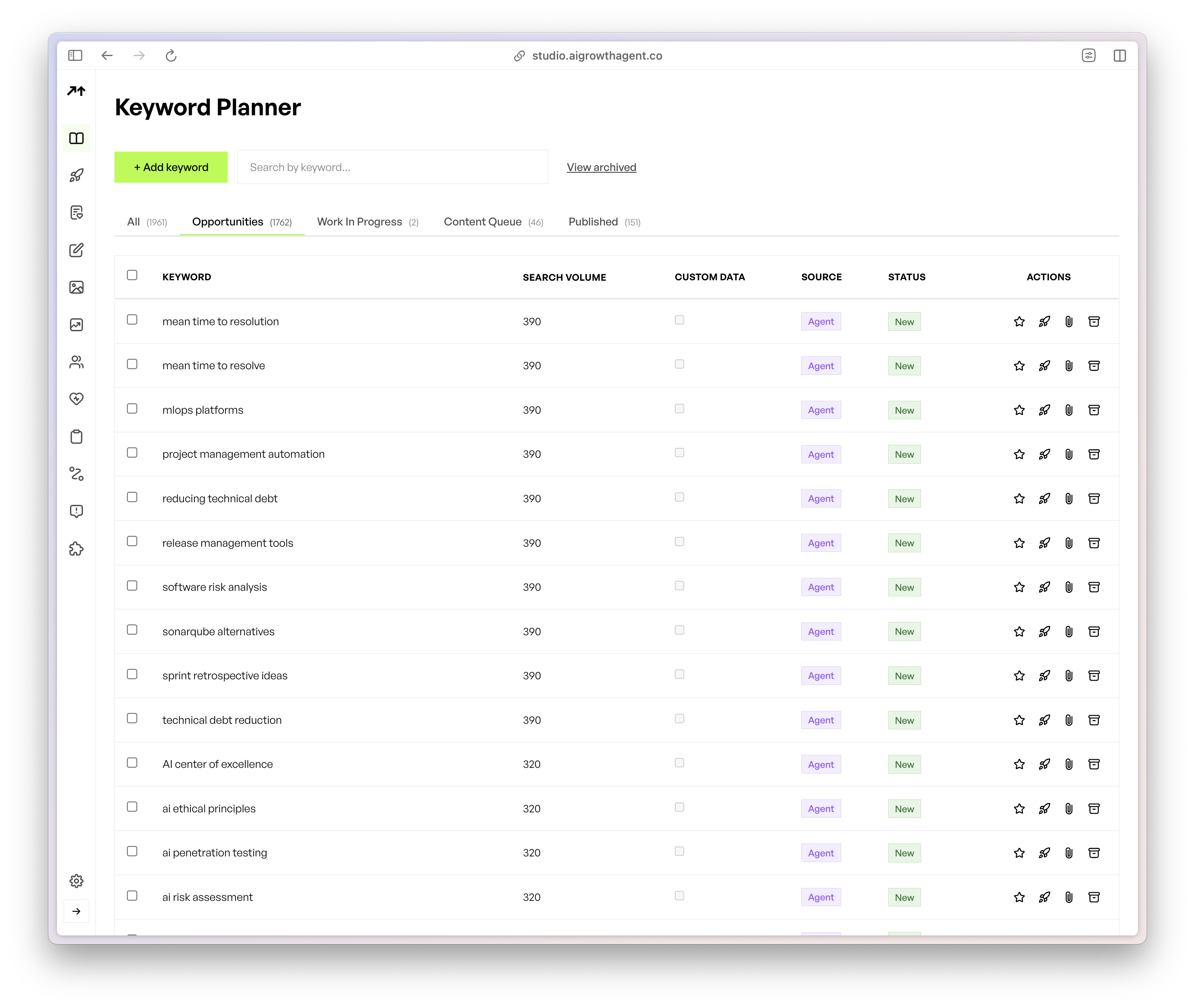
- Company Manifesto onboarding that programs agent behavior for consistent brand voice
- Autonomous keyword clustering and programmatic content strategy creation
- Advanced technical setup including schema markup, LLM.txt, and Model Context Protocol
- AI Search Monitor with real-time heatmaps across ChatGPT, Perplexity, and Google AI Overviews
- Autonomous content publishing with iterative feedback loops
- Multi-tenant deployment for portfolio companies and enterprise brands
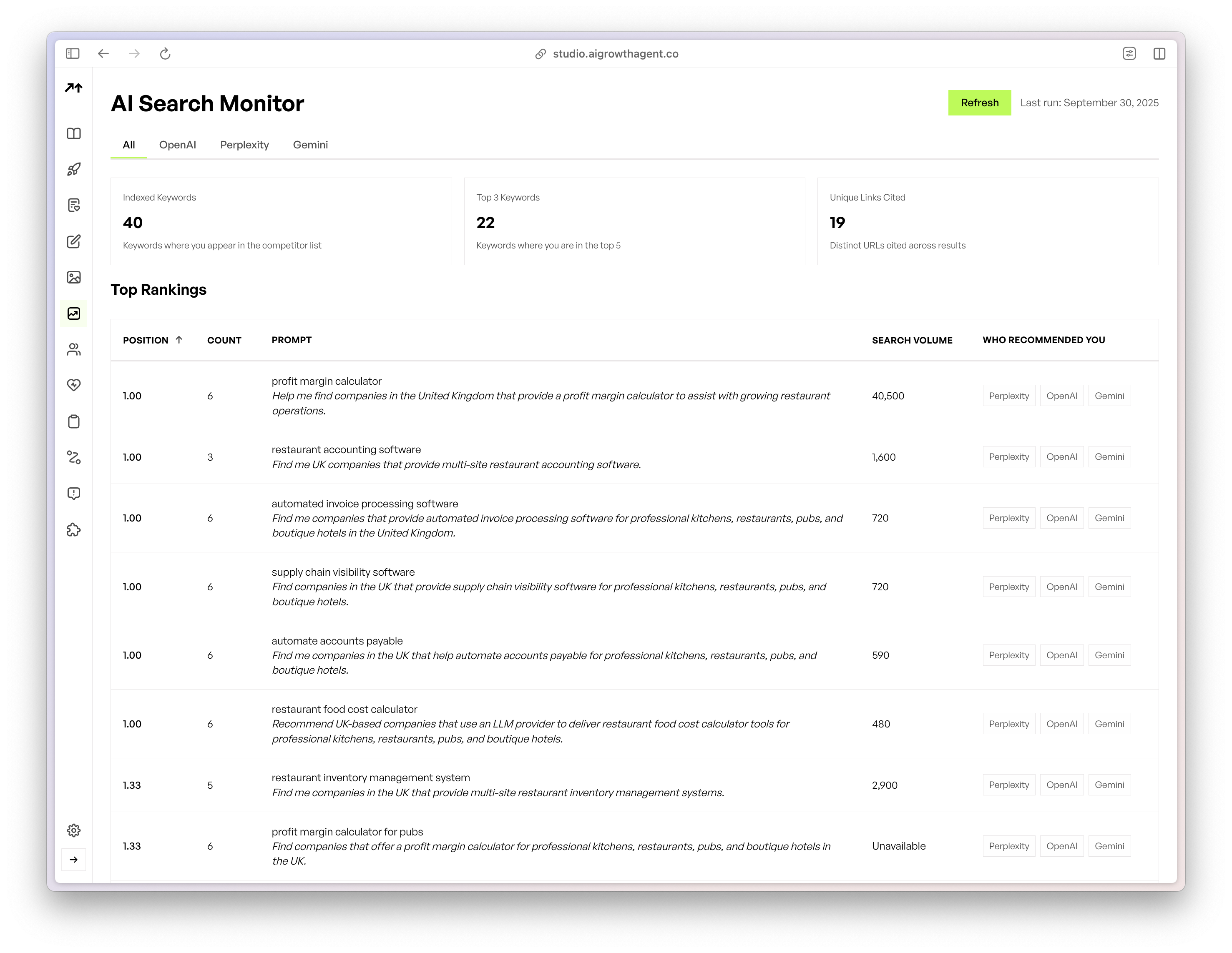
Strengths: AI Growth Agent delivers scale and strong ROI. Case studies show brands earning AI engine citations within 2–3 weeks. Gitar became the top-cited tool for AI-powered CI/CD automation in under two months. Autonomous execution removes the manual work that slows other platforms.
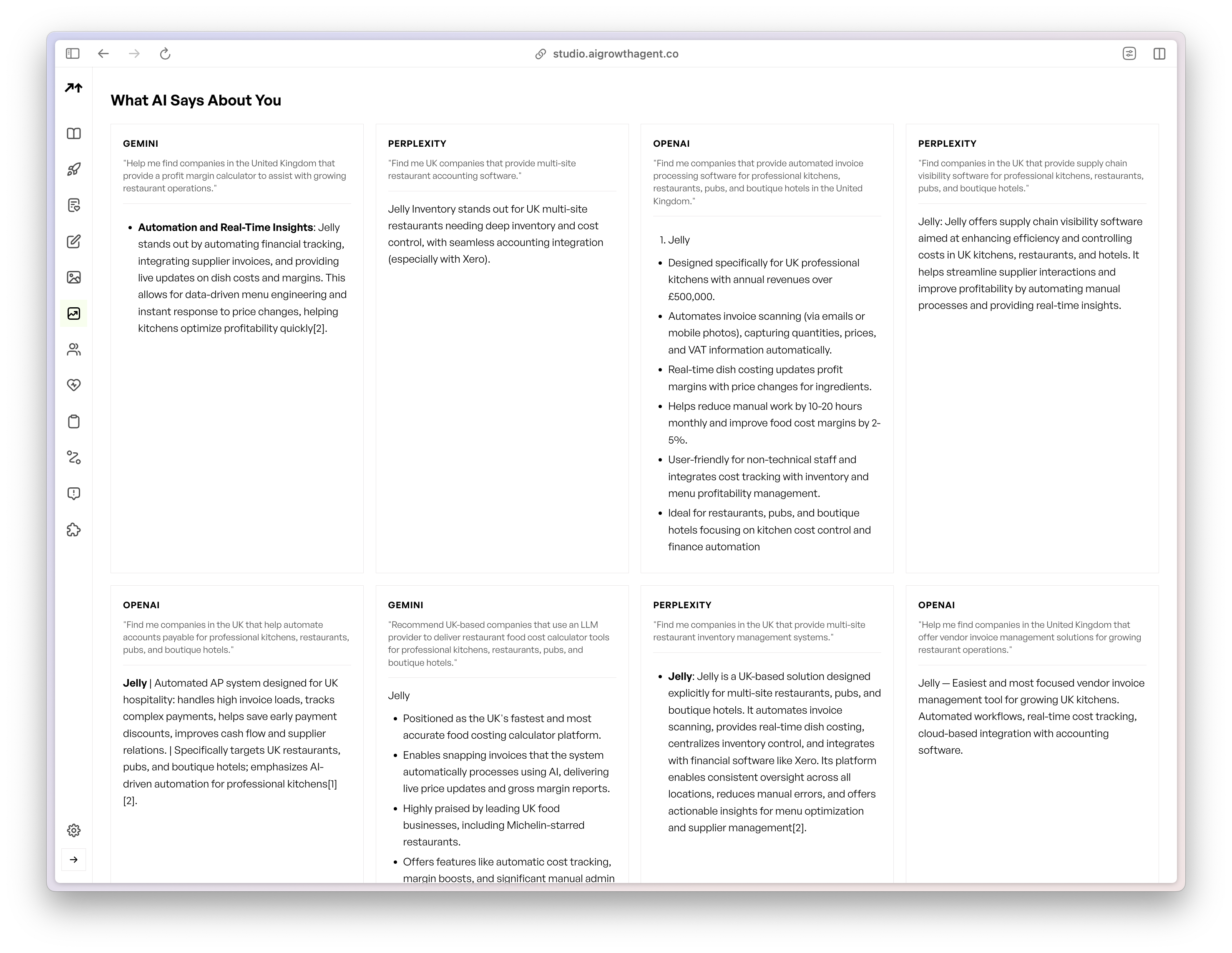
Limitations: The team selectively works with premium brands that already have solid technical foundations. The platform does not function as a repair tool for sites with deep technical SEO problems.
Ideal Fit: Marketing VPs and CMOs at premium SaaS, tech, and ecommerce brands who want authority through AI search citations. The platform suits companies that need multi-brand deployment or database-to-content automation.
Pricing: Enterprise-focused with custom pricing based on scope and multi-tenant needs.
Schedule a demo to see if you are a good fit for this programmatic SEO agent.
Profound: AI Search Monitoring Without Execution
Profound focuses on AI search monitoring and gives teams deep visibility across major AI engines, yet it does not execute content changes. The platform tracks direct consumer interfaces of AI search engines like ChatGPT, Perplexity, and Google AI Overviews, capturing real-time RAG results with live web data and citations.
Key Features:
- Real-time monitoring across 10+ AI engines with instant citation alerts
- AI Citation Intelligence that analyzes 240 million ChatGPT citations
- Automated content gap analysis from 130+ million real user conversations
- Support for 20+ languages
Strengths: Monitoring depth with competitive benchmarking and content recommendations. Strong enterprise positioning with detailed dashboards and sentiment analysis.
Limitations: No autonomous execution for programmatic scale. Pricing starts at $99 per month, which can feel high for monitoring alone.
Ideal Fit: Large enterprises that want robust AI search monitoring and already have internal teams to handle content execution.
Pricing: $99 per month up to several thousand monthly for enterprise features.
RankYak: Automated Blogging for SMBs
RankYak presents itself as a hands-off blogging automation platform. It offers end-to-end SEO automation, including keyword monitoring, rank tracking, AI content generation, optimization suggestions, and automated publishing to WordPress or custom CMS integrations.
Key Features:
- Continuous monitoring of AI search performance across Google SGE and Perplexity
- Autonomous content updates when performance drops or new opportunities appear
- Programmatic SEO agents with publishing pipelines
- WordPress and custom CMS integrations
Strengths: G2 rates RankYak 4.8/5 for end-to-end automation and highlights its smooth monitoring-to-publishing flow. The platform handles full-lifecycle management better than many fragmented stacks.
Limitations: Technical implementation and multi-tenant support feel lighter than enterprise-grade programmatic SEO agents.
Ideal Fit: Small to medium businesses that want automated blogging plus basic AI search monitoring.
Pricing: Subscription plans with tiers based on publishing volume.
Gumloop and AirOps: No-Code SEO Workflows
Gumloop and AirOps provide no-code workflow automation for SEO teams that want flexibility. Gumloop focuses on no-code SEO workflows that combine monitoring, content creation, and multi-platform publishing. AirOps offers SEO workflows from competitor analysis and keyword monitoring to AI content generation, internal linking, and one-click CMS publishing.
Key Features:
- Zapier-style triggers that turn monitoring data into AI content pipelines
- Custom workflows with A/B testing and scheduled publishing
- Google Analytics and Search Console integrations
- Template-based automation for content improvements
Strengths: Gumloop scores 4.6/5 for flexibility, while AirOps scores 4.4/5 for content generation in G2. Both work well for teams that want to design their own flows.
Limitations: Limited depth in AI search monitoring and a heavier focus on traditional SEO with semi-autonomous execution.
Ideal Fit: Technical teams comfortable building workflows and managing automation manually.
Pricing: Usage-based pricing with free tiers and enterprise options.
Semrush and Ahrefs: Manual-First SEO Suites
Semrush and Ahrefs remain broad SEO platforms with some AI search integrations, yet they still rely on manual execution. Both provide extensive monitoring across traditional and AI search engines.
Strengths: Wide feature coverage, strong brand recognition, and rich training resources.
Limitations: Manual workflows that cannot reach programmatic scale. No fully autonomous execution.
Ideal Fit: Traditional SEO teams that focus on manual optimization and reporting.
Pricing: Monthly subscriptions from $99 to more than $499 for enterprise tiers.
Side-by-Side Platform Comparison
|
Feature |
AI Growth Agent |
Profound |
RankYak |
Gumloop/AirOps |
|
Automation Level |
Fully Autonomous Content Execution |
Monitoring Only |
Semi-Autonomous |
User-Configured |
|
AI Search Monitoring |
Advanced Heatmaps |
Comprehensive |
Basic Coverage |
Limited |
|
Content Execution |
End-to-End |
None |
Automated Publishing |
Template-Based |
|
Technical Standards |
LLM.txt, MCP, Schema |
Basic Schema |
Standard SEO |
Basic Implementation |
|
Multi-Tenant Support |
Advanced |
Enterprise Only |
Limited |
None |
This comparison shows a clear hierarchy where execution capabilities outperform monitoring-only tools in the AI era. Profound diagnoses issues, while AI Growth Agent supplies the autonomous engine that builds programmatic authority.
Schedule a demo to see if you are a good fit for this comprehensive solution.
Implementation Steps and Evaluation Checklist
Successful automated SEO programs start with clear technical requirements and business goals. AI Growth Agent’s onboarding illustrates this approach, moving from initial consultation to first published article within one week. Traditional agencies often need months to reach the same milestone.
Technical Requirements: Your domain needs strong technical SEO basics. Advanced programmatic SEO agents depend on clean site architecture, accurate DNS configuration, and a compatible content management system.
Evaluation Checklist:
- Monthly content volume targets, such as 10+ articles or 100+ for enterprise scale
- AI citation goals and timelines, such as first citations within 2–3 weeks
- Team size and technical skills for platform oversight
- A multi-brand or portfolio company needs
- Required integrations with your current marketing stack
Pilot programs help teams validate impact before full rollout. Omniful.ai launched 180+ programmatic pages and saw organic traffic within 30 days, which highlights the speed possible with well-implemented agents.
Budget planning should compare platform costs with manual alternatives. Enterprise programmatic SEO agents require investment, yet hiring writers, SEO specialists, and developers often costs more and delivers slower outcomes.
FAQ
What is a programmatic SEO agent, and how does it differ from traditional SEO tools?
A programmatic SEO agent is an autonomous system that manages the full content lifecycle from keyword research through publishing. Traditional SEO tools surface data and recommendations, then wait for humans to act. Programmatic SEO agents use AI to research, write, refine, and publish content at scale. They also apply technical standards like schema markup, LLM.txt files, and Model Context Protocol so AI search engines can index content accurately. Autonomous execution, not manual follow-through, creates the main difference.
How does Profound compare to tools that offer both monitoring and execution?
Profound delivers deep AI search monitoring across 10+ engines with detailed citation analysis and competitive benchmarks. The platform does not execute changes, so teams still need separate tools or manual workflows. Platforms that combine monitoring and execution, such as AI Growth Agent, close the gap between insight and action and support programmatic velocity. Teams choose between pure diagnostics and full automation.
Are there free alternatives for automated SEO monitoring and execution?
Free options cover basic SEO monitoring through Google Search Console and limited content automation through tools like ChatGPT. These setups lack the integration and control needed for programmatic scale. They also require heavy manual configuration, rarely track AI search behavior, and cannot manage end-to-end workflows on their own. Specialized platforms deliver stronger ROI for enterprise-level programmatic SEO.
What timeline should I expect for AI engine citations from programmatic SEO?
Well-configured programmatic SEO agents often secure first AI engine citations within 2–3 weeks after publication. Companies like Exceeds AI appeared in Perplexity recommendations within 2 weeks and in Google AI Overview snapshots within 3 weeks. Actual timelines depend on content quality, technical setup, domain authority, and competition. Consistent programmatic publishing compounds authority, as seen with Gitar reaching top citations across several AI engines within 2 months.
How do programmatic SEO agents compare to traditional agencies or tools like Jasper?
Traditional agencies rely on manual production, usually shipping 1–2 articles per month at a high cost and with limited AI search focus. Tools like Jasper help individual writers but still require manual strategy, technical work, and publishing. Programmatic SEO agents combine strategy, content creation, technical optimization, and autonomous publishing in one system. This structure delivers speed and consistency that manual models cannot match, while guardrails preserve quality.
What security and quality controls exist for autonomous content generation?
Advanced programmatic SEO agents use several control layers. Company manifestos define brand voice and positioning. Iterative feedback loops learn from human edits. Fact-checking protocols validate accuracy. Approval workflows protect sensitive topics. Security features include review dashboards, editing tools, and flexible modes that switch between autonomous and manual approval. These controls maintain brand standards while still supporting high publishing velocity.
Conclusion: Why AI Growth Agent Leads This Category
The analysis positions AI Growth Agent as the leading choice for marketing leaders who want unified monitoring and execution. Monitoring-only tools like Profound still help, yet the AI search landscape now rewards programmatic velocity that only end-to-end automation can provide. Stitched-together stacks create friction and slow the scale needed for AI search dominance.
Premium brands that want clear authority through programmatic SEO benefit from autonomous execution that earns AI citations within weeks instead of months of manual work. Schedule a demo to see if you are a good fit for this programmatic SEO agent and join the companies already leading AI search results.
