Top 5 Technical Capabilities Your SEO Content Tools Need

Explore AI Summary

Key takeaways from this article:

  1. AI-first search experiences on platforms like Google AI Overviews, Perplexity, and Gemini are changing how brands are discovered, which makes scalable, technically sound content a core requirement.
  2. Manual SEO workflows and basic AI text generators cannot keep pace with content velocity or technical demands in 2025, especially for brands that need consistent AI citations.
  3. Five capabilities now define effective SEO content tools: autonomous content architecture, programmatic keyword research, end-to-end technical SEO automation, multi-tenant deployment with database-to-content automation, and AI search monitoring.
  4. Programmatic SEO platforms such as AI Growth Agent apply these capabilities across the full content lifecycle, from keyword discovery and technical setup to publishing and AI performance feedback.
  5. Marketing leaders who adopt programmatic, AI-aware SEO systems can expand their digital footprint, while those who rely on legacy tactics risk losing visibility to competitors.

The New Reality of SEO Content Tools in 2025

AI-powered search platforms are now primary discovery channels, so SEO is shifting from manual optimization to programmatic content engineering. Ranking no longer depends only on hand-built pages and basic keyword targeting. It depends on producing structured, technically correct content at scale that large language models can easily interpret and cite.

Content volume is increasing rapidly as more organizations deploy AI tools. Your brand’s share of overall online content can shrink if you keep using slow, manual workflows. Content strategies that felt effective in 2020 often cannot compete with systems that publish optimized pages programmatically and continuously.

Brands that do not publish enough clear, authoritative content give AI platforms little to reference. In those cases, AI responses are more likely to cite competitors. Technical sophistication and content velocity now act as core requirements, not optional enhancements.

#1: Autonomous Content Architecture Engineering with Proprietary AI Model Context Protocols (MCP)

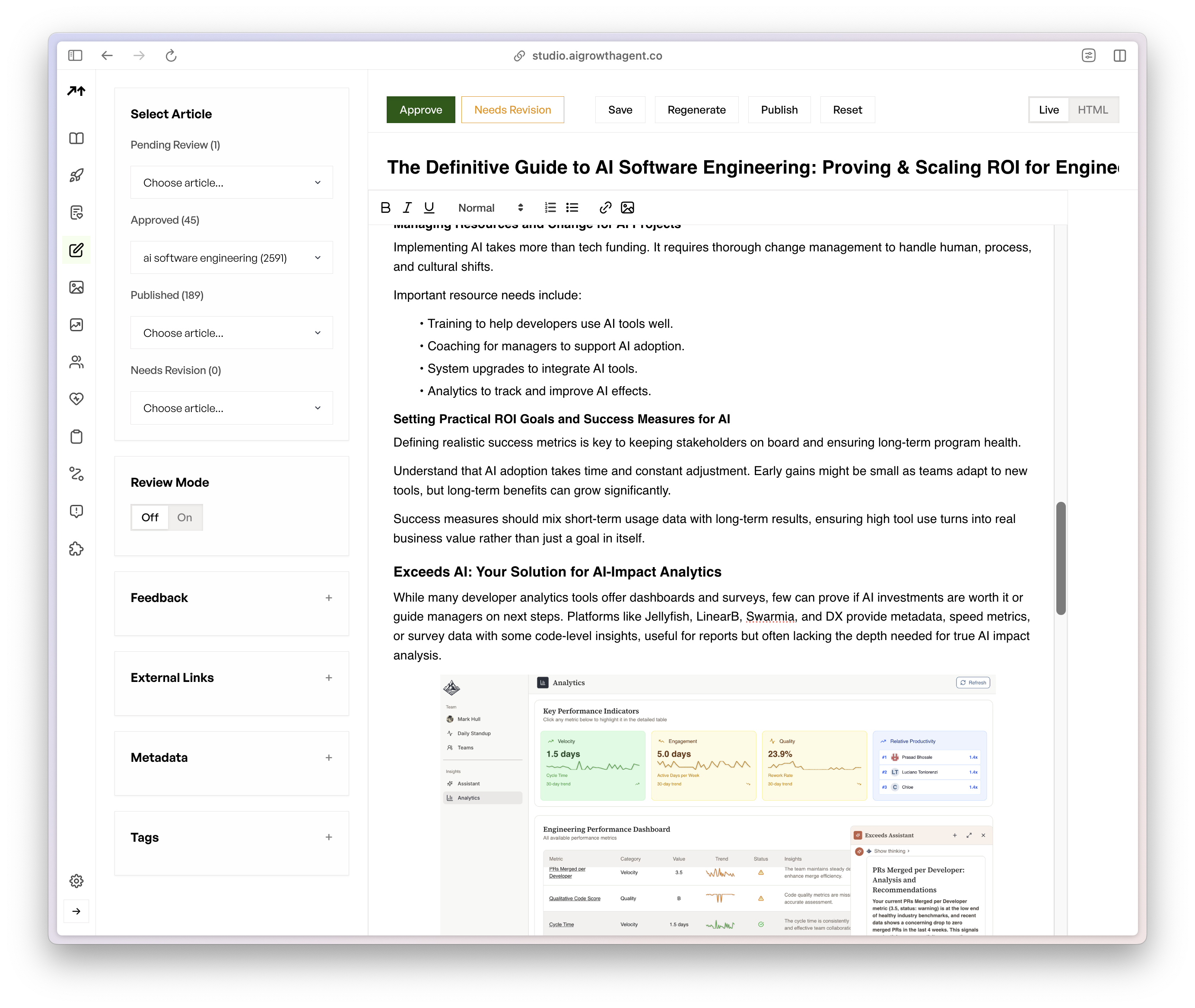
Modern SEO content tools need to move beyond single-article generation and handle autonomous engineering of structured, optimized pages at scale. This pattern lets brands produce a large volume of helpful, technically consistent content without expanding headcount in the same proportion. AI Growth Agent supports this approach with its Model Context Protocol (MCP).

Autonomous content architecture engineering replaces one-off content production with system design. The platform can plan and create entire content clusters that include elements such as schema markup, metadata, internal linking patterns, and on-page SEO structures, all aligned to a shared strategy.

The technical bar for this kind of system is high. AI-powered programmatic SEO tools leverage NLP and machine learning to generate human-like content, optimize keywords, predict search trends, and automatically generate structured data, FAQ schemas, and meta tags, reducing manual labor while improving search rankings. Many tools, however, focus only on text output and leave key implementation work to manual teams.

AI Growth Agent’s Model Context Protocol (MCP) narrows that gap by letting AI systems interface directly with your content structures and database. This setup helps AI platforms interpret your content more accurately and increases the chance that responses from Google AI Overviews, Perplexity, and similar systems reference your brand.

AI Growth Agent Rich Text Content Editor

Why it Matters

Autonomous engineering lets marketing teams resolve the usual tradeoff between scale and consistency. Structured architectures give AI search platforms clearer signals about your topics, expertise, and internal authority, which supports better inclusion and citation in AI-generated answers.

Actionable Takeaway

Prioritize SEO content tools that handle the full technical lifecycle for each page, including schema, metadata, and internal linking, rather than platforms that only provide draft copy. Favor tools that include integrations and protocols built to help AI search systems parse and reference your content.

Explore how AI Growth Agent’s autonomous content engineering supports structured, scalable SEO content by scheduling a demo.

#2: Programmatic Keyword Research and Real-Time Content Injection for Micro-Niche Authority

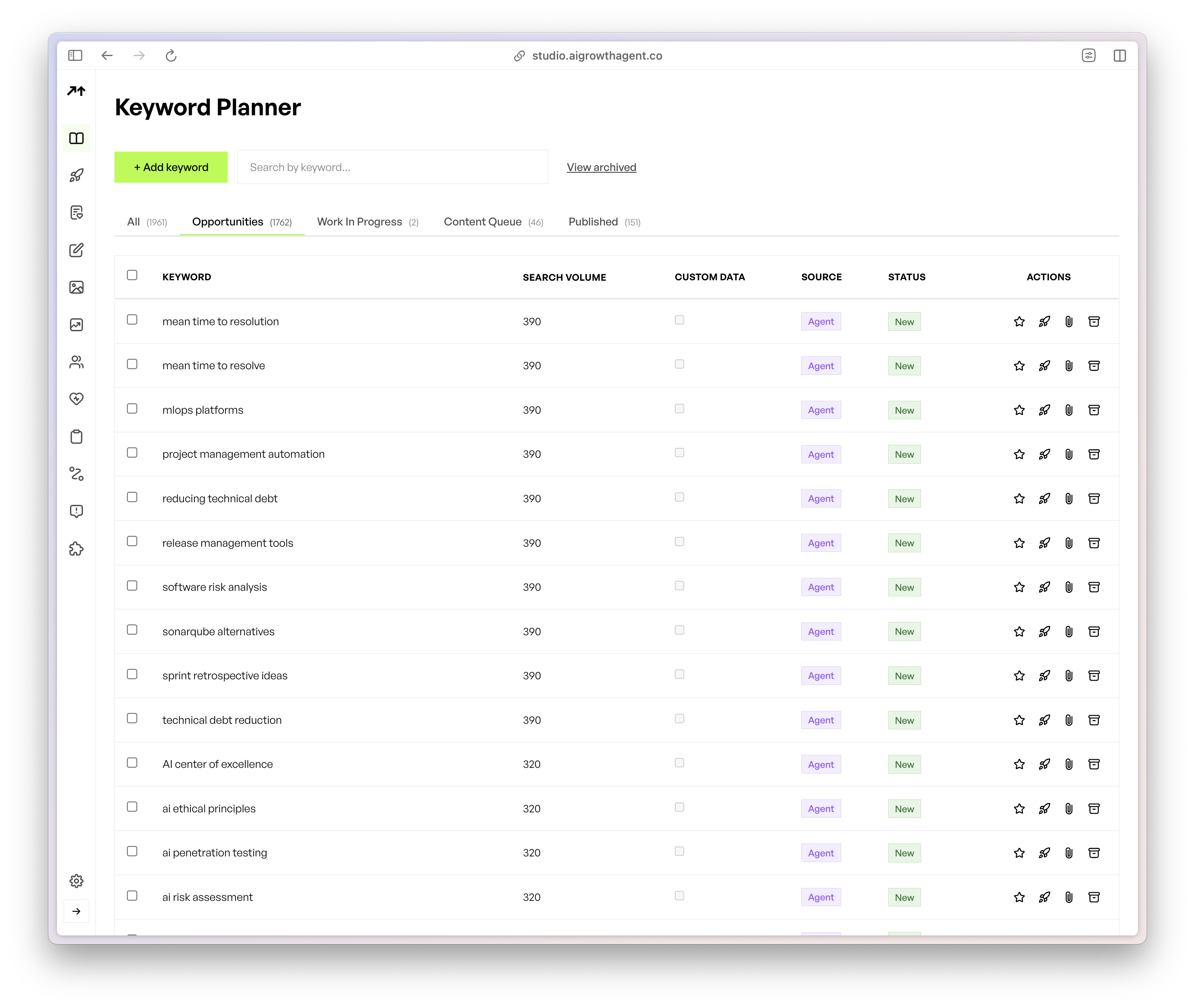
Effective SEO tools now need programmatic keyword research that can uncover long-tail and micro-niche topics at scale. When paired with real-time content creation, this capability lets brands capture emerging search demand quickly, instead of reacting weeks or months later.

Conventional keyword research workflows usually run on monthly or quarterly cycles, with manual reviews and content calendars. In an AI search environment where topics shift quickly, this rhythm can miss short-lived but valuable opportunities. Advanced programmatic SEO platforms feature centralized content hubs for organizing keywords, content templates, and metadata in connected workspaces, enabling structured content generation at scale with unified data governance.

Real-time content injection builds on this foundation. When a news event or industry shift appears, tools like AI Growth Agent can generate and prepare aligned content in minutes. This approach lets teams publish while interest is highest, instead of waiting for the next planning cycle.

The underlying system depends on continuous keyword discovery, trend analysis, and automated brief creation. Programmatic SEO workflow includes large-scale keyword identification, template design for content generation, tool-based automation of content creation and publishing, and continuous dynamic content optimization, requiring structured human involvement at strategy and quality assurance stages.

Brands that apply programmatic research and rapid content injection often capture traffic around timely topics while competitors still draft proposals or build briefs. Over time, this pace can expand topical coverage and authority across many micro-niches.

AI Growth Agent Keyword Planner Screenshot

Why it Matters

Programmatic keyword research with real-time publishing keeps your brand present in fast-moving conversations and builds depth across specific, intent-rich queries. This pattern helps your content appear relevant to both traditional search engines and AI-driven engines that prioritize comprehensive topic coverage.

Actionable Takeaway

Look for SEO platforms that can ingest large keyword sets, cluster them automatically, adapt to new data, and generate content quickly, all while maintaining a consistent brand voice. This combination supports both scale and relevance for micro-niche topics.

#3: End-to-End Technical SEO Automation, Including LLM.txt and Schema Markup

AI search systems need clear technical signals to interpret and reference your content. End-to-end technical SEO automation, including schema markup, LLM.txt files, and structured internal links, gives those systems the context they require at scale. AI Growth Agent’s Model Context Protocol is designed to support that level of clarity for AI indexing and retrieval. AI-powered programmatic SEO tools automatically generate structured data, FAQ schemas, and meta tags, reducing manual labor while improving search rankings.

Technical optimization for AI search goes beyond traditional elements like titles and meta descriptions. AI models benefit from robust structured data, clear guidance files such as LLM.txt, and internal link structures that explain how your content pieces relate and which ones carry the most authority.

LLM.txt files provide instructions for AI crawlers about which sections of your site hold key information, how to interpret it, and how to handle context. Combined with detailed schema markup, these files can improve how often and how accurately AI systems surface your content.

Automation is essential because managing these elements by hand across hundreds or thousands of pages is rarely practical. AI-powered SEO automation within platforms uses custom agents to automate repetitive tasks including summaries, metadata creation, and internal linking, reducing manual intervention across the technical SEO lifecycle. Without automation, many technical SEO efforts stall at the planning stage or remain partially implemented.

AI Growth Agent includes a dedicated blog Model Context Protocol (MCP) that lets AI search platforms read your blog’s structure more directly. This protocol improves how AI systems map topics, understand relationships, and decide which URLs to reference.

Why it Matters

Strong technical foundations increase your visibility in AI search results. Even well-written content can remain underused if AI systems cannot parse technical signals clearly, which reduces the chance of being cited in AI-generated responses.

Actionable Takeaway

Choose SEO tools that embed schema, LLM.txt guidance, and internal linking patterns into every page by default. This approach minimizes manual work and makes your site more readable for AI systems as they crawl and assemble answers.

Schedule a demo to see how AI Growth Agent automates technical SEO and supports stronger visibility in AI search outputs.

#4: Multi-Tenant Programmatic Deployment and Database-to-Content Automation

Organizations that manage multiple brands or product lines benefit from multi-tenant programmatic SEO tools that centralize control while preserving distinct brand voices. Database-to-content automation then extends this capability by turning internal, structured data into search-friendly content at scale. API-ready architecture enables direct integration between database systems and CMS tools such as Webflow and WordPress, facilitating programmatic page building and automated updates while maintaining brand consistency across multi-tenant deployments.

Multi-tenant deployment in AI Growth Agent allows teams to run separate Programmatic SEO Content Agents from one interface. Each agent can maintain its own manifesto, keyword plan, and tone, while sharing the same underlying infrastructure and automation capabilities.

This model gives a central team clear oversight and governance without forcing every brand or region into identical messaging. It also reduces the number of tools and workflows required to run a complex content operation.

Database-to-content automation adds another layer of value. Many companies hold rich data in internal systems that search engines cannot access directly. AI Growth Agent can use that structured data to generate optimized articles and landing pages, turning information that was previously locked in spreadsheets or databases into pSEO assets. Leading tools enable bulk SEO content generation through structured datasets with custom templates for headings, meta tags, and internal links, supporting integration with Google Sheets and Airtable for seamless data-to-content automation.

Brands that apply this pattern can publish hundreds or thousands of pages grounded in their own data sets, while competitors still prepare content item by item.

Supporting this approach requires robust APIs, data mapping, and content generation logic that can adapt templates to varied data without losing quality. These capabilities often distinguish enterprise-ready platforms from basic point solutions.

Why it Matters

Multi-tenant deployment and database-to-content automation allow large or data-rich organizations to scale content without sacrificing consistency or control. They help convert proprietary information into assets that users and AI systems can discover and reference.

Actionable Takeaway

Evaluate SEO platforms based on their ability to manage multiple brands within one environment and to connect directly to structured data sources. These capabilities support long-term content scalability and more efficient use of internal data.

#5: AI Search Monitoring and Feedback Loops for Continuous Citation Growth

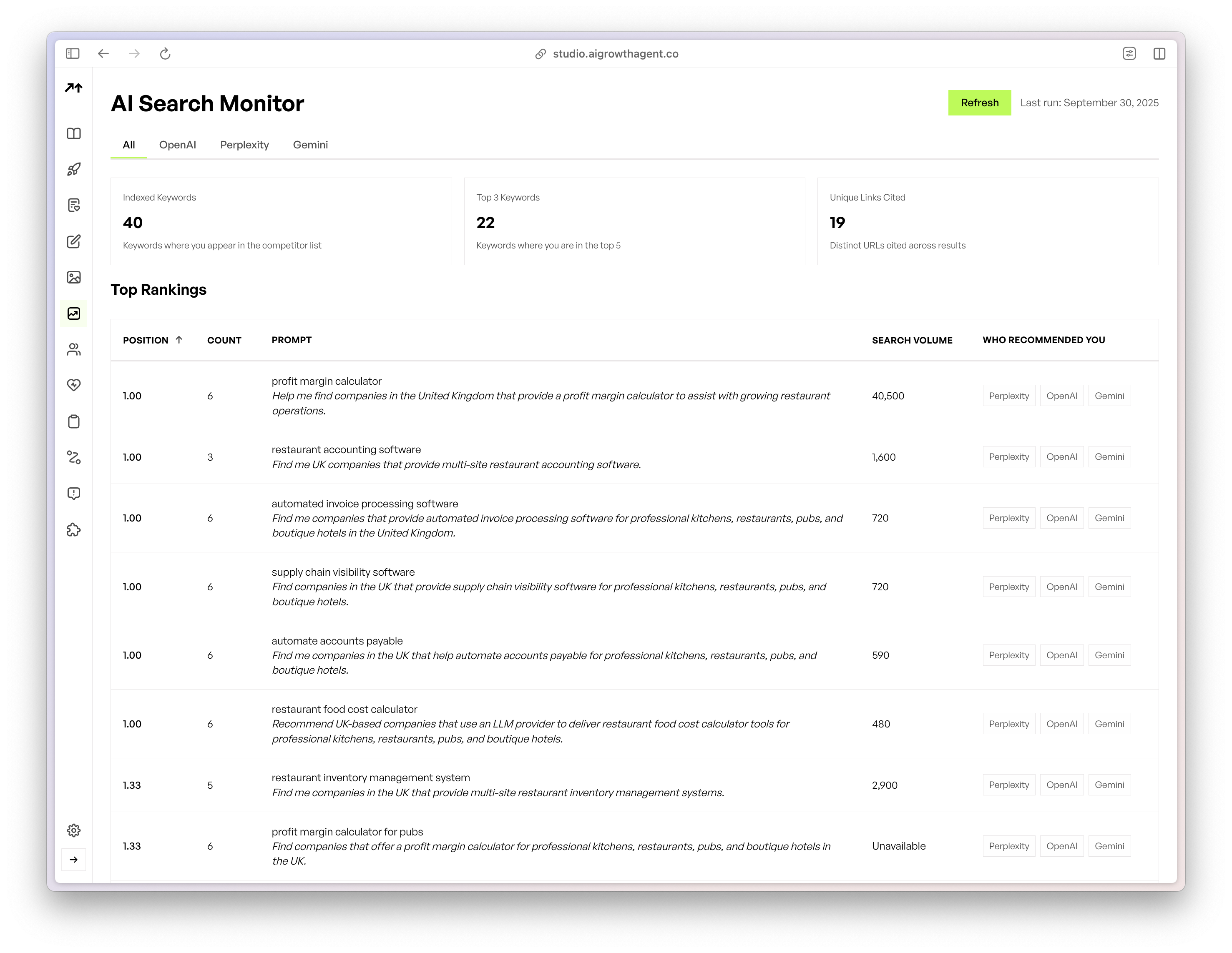
SEO content tools now need built-in AI search monitoring so teams can see how often and where AI platforms reference their content. This visibility makes it possible to adjust strategies based on real performance, not just assumptions from traditional search metrics. AI Growth Agent includes an AI Search Monitor to support this type of feedback loop.

Standard analytics tools tend to focus on impressions, clicks, and rankings in classic search results. Those signals still matter, but they do not show how your content appears inside AI-generated responses, where more users now find answers.

AI search monitoring tracks where your pages appear in AI outputs, which URLs drive those appearances, and how your brand is cited in context. This view can highlight pages that influence AI systems even if they do not drive the most traditional search traffic.

Feedback from AI search performance is especially important because best practices in this area are still emerging. Teams can test new content structures and technical configurations, then use AI citation data to refine what works best for their topics and audiences.

AI Growth Agent’s AI Search Monitor provides several types of insight, including:

  1. Heatmaps that show keyword indexing across Google AI Overviews and Perplexity
  2. URL-level performance analytics for AI citations
  3. Direct quotes and references to your content within AI-generated answers
  4. Monitoring of AI crawler activity to show how often systems revisit your content
Screenshot of AI Growth Agent AI Search Monitor
Screenshot of AI Search Monitor where you can see what AI is saying about you across ChatGPT, Gemini, and Perplexity

Why it Matters

Clear AI search metrics let marketers understand how their content performs in AI experiences, not just on traditional results pages. That insight supports better content planning, technical refinement, and prioritization of updates.

Actionable Takeaway

Favor SEO tools that monitor AI platforms directly and expose citation data in a structured way. These insights can guide content refreshes, new topics, and technical fine-tuning aimed at sustained, compounding authority.

Book a demo of AI Growth Agent to see how AI search monitoring can guide your content and technical strategy.

Comparison: AI Growth Agent vs. Traditional Approaches

Programmatic SEO platforms and manual approaches serve the same goal but operate very differently. The table below outlines how AI Growth Agent compares with traditional SEO agencies and self-service AI tools across key capabilities.

Capability

AI Growth Agent

Traditional SEO Agencies

Self-Service AI Tools

Autonomous Content Engineering

Full lifecycle automation

Manual execution

Text generation only

Programmatic Keyword Research

Automated and dynamic

Manual or limited

Manual input

End-to-End Technical SEO

Automated and advanced

Manual or limited

Manual integration

Multi-Tenant Deployment

Available

Not available

Not available

AI Search Monitoring

Integrated

Limited or third-party

Not available

This comparison highlights that manual agencies and basic AI tools often struggle with the level of automation and integration required for AI-focused SEO at scale. AI Growth Agent operates as a programmatic SEO platform that engineers content systems, which shifts content strategy from individual tasks to an ongoing, automated process.

Frequently Asked Questions (FAQ) about SEO Content Tools

What is programmatic SEO and how is it different from traditional SEO?

Programmatic SEO uses templates and structured data to create many optimized pages quickly, often focused on long-tail and micro-niche keywords. Traditional SEO relies more on manual work for each page, from research through writing and optimization.

The key distinction is how each approach handles scale. Traditional SEO treats every page as a custom project, which can limit the total number of topics covered. Programmatic SEO focuses on patterns, builds templates for those patterns, and then varies keywords and data inputs across many versions.

This model lets businesses cover a much wider set of queries, especially in long-tail spaces where manual content production would be too slow or expensive.

Can generic AI content tools achieve programmatic SEO at scale?

Generic AI content tools are not enough to deliver full programmatic SEO at scale. They typically produce unstructured text and expect users to handle keyword clustering, schema, internal links, and publishing workflows separately.

Teams that rely solely on generic tools still need to manage strategy, research, formatting, implementation, and quality assurance by hand. The result is often a collection of drafts that require significant additional effort before they are ready for search or AI discovery.

Programmatic SEO platforms automate more of the lifecycle, including keyword clustering, template creation, structured data, metadata, and publication. They also support AI-specific optimizations and governance that general-purpose text tools do not cover.

Strategic intelligence is another difference. Programmatic platforms can analyze large keyword sets, identify themes, and maintain brand voice across many pieces in ways that basic tools cannot manage without extensive manual oversight.

How do AI-powered SEO content tools impact ROI?

AI-powered programmatic SEO tools can improve ROI by lowering the marginal cost of each new page, expanding organic reach, and strengthening brand visibility in both traditional and AI search results.

Most of the effort in programmatic SEO goes into initial design and setup, such as building templates and systems. Once those are in place, the cost of producing additional content decreases because the process runs through automation rather than repeated manual work.

Revenue gains often come from capturing many smaller keyword opportunities that add up over time. Long-tail and micro-niche queries may bring modest traffic per page, but programmatic systems can target hundreds or thousands of these queries in parallel.

As AI search platforms grow in influence, brands that appear frequently in AI answers gain additional exposure without paying for each impression or click. Investment in AI-aware SEO tools supports that type of compounding benefit.

What role does human oversight play in AI-driven programmatic SEO?

Human oversight remains important in AI-driven programmatic SEO, especially for strategy, brand voice, and quality control. Automation handles the bulk of repetitive work, but people still guide what the system should do and how content should feel.

Marketers and subject matter experts define positioning, messaging guidelines, and thresholds for quality. They determine which keyword sets to pursue and how templates should present information to users.

Editors and strategists also review outputs, particularly early in a program, to confirm that content matches user intent and brand standards. Over time, this oversight can shift toward spot checks and strategic adjustments as systems learn and improve.

Without such oversight, large-scale automation can generate content that feels generic or misaligned with brand goals. The most effective implementations combine automation with clear human direction.

Provide the agent with images to naturally incorporate into your content.

How should marketing leaders evaluate SEO content tools for 2025?

Marketing leaders can evaluate SEO tools by focusing on five core needs: autonomous content architecture engineering, programmatic keyword research, technical SEO automation, multi-tenant support, and AI search monitoring.

Technical depth, scalability, and integration capabilities should sit at the center of any assessment. Tools that only generate text but lack technical SEO or publishing automation often introduce manual gaps that limit results.

Organizational structure should also influence the decision. Multi-brand companies or teams with valuable internal data tend to benefit most from platforms that support multi-tenant operations and database integrations.

Time to value is another consideration. Systems that require long custom builds or heavy engineering support can slow adoption. Tools designed for faster deployment and autonomous operation usually offer quicker impact.

Conclusion: Programmatic SEO as the Next Stage of Content Operations

AI-first search experiences place new demands on SEO content tools. Brands that rely on older, manual methods risk losing share of voice as AI platforms favor sites with structured, extensive, and clearly signaled content.

The capabilities covered in this article, autonomous content architecture, programmatic keyword research, technical SEO automation, multi-tenant deployment, and AI search monitoring, have become baseline requirements for competitive SEO programs in 2025.

The shift toward programmatic SEO can also change how teams think about scale and cost. Programmatic SEO achieves scalability by targeting micro-niches and generating content variations at scale, with automation reducing cost per page and enabling small teams to achieve enterprise-level output. Organizations that move early on these methods can build advantages that compound over time.

Execution quality remains important. Programmatic SEO can generate numerous pages automatically but carries failure risk without proper implementation; many penalized sites lacked differentiation, indicating success requires unique data assets and structured content variation. Results depend on pairing strong platforms with thoughtful strategy and oversight.

AI Growth Agent focuses on these requirements by combining technical automation with programmatic content engineering. Client examples include companies gaining early AI citations and improved visibility in AI Overviews after launching structured content at scale.

The current phase of AI search still allows room for new leaders to establish authority. Brands that use programmatic, AI-aware SEO systems now will be better positioned as AI platforms continue to shape discovery and decision journeys.

Schedule a demo of AI Growth Agent to see how programmatic SEO automation can support your content strategy and help position your brand as a trusted resource in AI search.

Publish content that ranks in AI search

START RANKING NOW