


The relationship between brands and search engines has shifted. Traditional SEO relied on keyword optimization, backlinks, and technical site health to win positions on search engine results pages (SERPs). Visibility on page one translated directly into traffic and conversions.
Google still follows this model, but the model does not fully apply to AI-powered search engines like Perplexity. What you’ll learn in this research report:
- AI search platforms like Perplexity now answer queries with synthesized, cited responses, reducing reliance on traditional blue-link search results.
- Perplexity selects sources based on precision, depth, recency, and verifiability, not just keyword rankings or backlink profiles.
- Google rankings and Perplexity citations only partially overlap, so strong SEO performance in Google does not guarantee visibility in AI search.
- Brands that succeed on Perplexity use structured, expert-level content and technical architectures that support live web retrieval and AI comprehension.
- Programmatic content engineering at scale is increasingly necessary to meet the volume, quality, and technical standards required for AI citations.
- Case studies from Exceeds AI, BeConfident, Bucked Up, and Gitar show that smaller or emerging brands can earn prominent AI citations within weeks.
- AI Growth Agent provides an autonomous Programmatic SEO Agent and AI Search Monitor that help brands plan, produce, and track content built for AI search platforms, including Perplexity.
Introduction: The Perplexity AI Revolution for Brands
Beyond Traditional SEO: Why Perplexity Demands a New Approach to Ranking
Perplexity does not rank sites using a traditional SERP model. It selects highly relevant sources, often outside the Google top 10, to cite inside AI-generated answers. Brands now compete for citations inside responses, not just positions on a results page. This change calls for a different optimization strategy.
Perplexity evaluates content based on accuracy, depth, and contextual relevance to a specific query. It does not simply favor the largest domain or the page with the most backlinks. It looks for sources that deliver precise, verifiable, and complete answers. That approach opens space for brands that may not lead in traditional rankings but can publish focused, expert content.
Marketing leaders need to reframe their success metrics. Domain authority, keyword rankings, and SERP positions become secondary to citation frequency, answer relevance, and content precision. Brands that rely only on legacy SEO tactics face a growing risk of invisibility in AI-driven search.
Perplexity’s Live Web Retrieval: The Importance of Immediate Discoverability
Perplexity relies on live web retrieval. Perplexity performs a fresh web search for each query, so content must be public and easily discoverable. This real-time method reduces dependence on long indexing cycles and favors content that is both current and accessible.
This architecture creates clear tradeoffs. New content can earn citations quickly, but only if it is crawlable, indexable, and technically clean. Pages hidden behind paywalls, complex navigation, or restrictive settings are far less likely to appear in Perplexity’s source set.
Perplexity’s retrieval pipeline accesses the live web to assemble answers nearly in real time, prioritizing up-to-date, easily retrievable content. Brands benefit when their content is both high quality and technically optimized. That includes clear information architecture, schema markup, and metadata that allow AI systems to recognize, parse, and reuse key information.
Technical requirements now extend beyond standard SEO. Content needs clear answer sections, structured data, and explicit topic clusters that help AI understand relationships across pages. Manual workflows struggle to meet this standard at scale, so many brands will require programmatic content engineering to keep pace.
Deconstructing Perplexity’s Citation Logic: What Drives Brand Visibility?
Brands need to understand how Perplexity selects and cites sources. Traditional search engines display a list of pages ranked by relevance and authority. Perplexity instead synthesizes content from multiple pages into a single answer and includes citations next to specific claims. Those citations follow recognizable patterns that brands can intentionally support.
Perplexity pulls mainly from Bing, and sometimes Google, giving preference to content that is helpful, trustworthy, and easy to understand. Traditional search performance still matters, but it is only one part of the picture. Citation selection draws on a broader set of signals.
Perplexity appears to prioritize content precision, completeness, diversity of sources, and verifiability. It favors specific, actionable explanations over broad overviews. That creates room for brands that address detailed questions within their niche with clear, expert answers.
Key Characteristics of Top-Cited Brands on Perplexity
Precision, relevance, and verifiability as the basis for AI citations
Every Perplexity response includes explicit, clickable citations, which makes accuracy and verifiability central to source selection. Brands need to publish content that contains correct, clearly sourced information. Perplexity rewards precise answers more than broad, attention-grabbing headlines.
Frequently cited brands share several traits. Their content includes concrete data, specific examples, and clear explanations, not vague generalities. They document their methods and reference original sources when making claims. This style requires more rigor than typical marketing content.
Verifiability also implies clear expertise. Perplexity seems to prefer domains that consistently publish accurate, in-depth information within a focused area. Brands that try to cover unrelated topics with thin content will struggle to build the trust needed for regular citations.
Structured answer formatting that supports AI comprehension
Clear, structured answers to likely questions increase the chance of earning citations. Structure here means more than readable paragraphs. It includes how information is segmented and labeled so AI can detect and reuse it.
Successful brands plan pages around the questions their audience and AI systems are likely to ask. They use descriptive headings, logical sequences, and explicit answer sections. This organization helps Perplexity quickly locate and extract the right passage for a query.
Technical markup supports this structure. Schema, topic clustering, and relationship hints inside the content help AI understand how ideas connect. Implementing and maintaining this level of structure often requires close coordination between content teams and technical specialists.
Authoritative content depth that goes past surface-level information
Content complexity tends to be higher for Perplexity than for Bing, which makes detailed, expert-level writing advantageous. Depth becomes a differentiator.
Brands that earn repeated citations usually publish content that demonstrates real subject-matter expertise. That content may include technical walkthroughs, detailed case studies, original research, or careful analysis of trends. Shallow summaries tend to underperform.
Maintaining this standard at scale is difficult. Brands must invest in expert contributors and systems that help them cover a topic comprehensively while preserving quality. Programmatic content engineering can support this by standardizing structure and technical details so human experts can focus on insight and accuracy.
Source diversity and nontraditional authority as opportunities
Perplexity and ChatGPT often cite pages with relatively few referring domains instead of highly linked pages, which points to authority signals that differ from Google’s. Brands without dominant backlink profiles can still compete.
Perplexity appears to value a mix of sources in its answers. It does not simply repeat the same high-authority domains. That approach opens room for specialized experts that can contribute unique perspectives, proprietary data, or niche insight.
Roughly 10% of links cited by Perplexity receive no Google traffic, which highlights Perplexity’s ability to surface overlooked but relevant sources. Niche brands can therefore gain outsized visibility if they publish focused, high-value content, even with modest traditional SEO performance.
Recency and stability as a dual signal of quality
Websites that are 10–15 years old are frequently cited, which shows that Perplexity values both recency and long-term stability. Age alone does not decide outcomes, but a long publishing history seems to support credibility.
Newer brands can still compete if they focus on timely, relevant topics and publish consistently. They can gain an edge in emerging areas where older sites have not yet built deep coverage. The key is sustained quality over time, not isolated posts.
This balance between recency and stability also affects content planning. Pages should offer lasting value yet remain current. That goal requires periodic updates, evergreen structures, and a roadmap for how topics will evolve.
Data-Backed Insights: How Brands Are Currently Ranking on Perplexity AI
The Google ranking disconnect and new visibility frontiers
Recent research highlights a loose connection between Google rankings and AI citations. Perplexity’s live retrieval setup means its citations align more closely with search rankings than other LLMs, but median domain overlap with Google still sits around 25–30%. Many highly ranked Google domains do not appear as primary AI sources.
This partial overlap means brands cannot assume that strong organic rankings translate into AI visibility. A site may rank first on Google for a keyword yet never appear in Perplexity answers for related questions. Another site with modest Google positions might become Perplexity’s main citation for the same topic.
Success with Perplexity does not always correlate with Google rankings, which limits the usefulness of traditional SERP-tracking tools for AI search. Brands need new monitoring methods and metrics that reflect AI behavior.
Measurement strategies therefore must evolve. Teams should track citation frequency, answer prominence, and thematic coverage across AI platforms. That shift calls for tools that can query AI systems at scale, capture where and how brands appear, and link those patterns back to content assets.
Case studies: Brands optimizing for Perplexity AI with AI Growth Agent
Real-world examples clarify how AI search optimization works in practice. AI Growth Agent clients have used programmatic content engineering to earn citations and recommendations on Perplexity and other AI platforms.
Exceeds AI: Establishing authority in a competitive segment
Exceeds AI, a performance review platform for engineers, used AI Growth Agent to implement a structured, programmatic content strategy. Within two weeks, Perplexity began recommending Exceeds AI as the top alternative to key competitors. Within three weeks, Exceeds AI appeared in Google AI Overview and Gemini snapshots for core keywords. The brand now shows up across ChatGPT, Google AI Overview and Gemini, and Perplexity as a leading source for “AI performance review tools for engineers.”
This outcome came from content that directly addressed engineering performance review problems with depth and clarity. Exceeds AI did not rely on outspending incumbents on traditional SEO. Instead, it focused on technically optimized content designed for AI ingestion and citation.
BeConfident: Competing against established language-learning platforms
BeConfident, an English learning platform that operates through WhatsApp, needed to stand out against large players such as Duolingo and Busuu. With AI Growth Agent’s programmatic approach, BeConfident achieved rapid indexing after each content release. Within weeks, Google AI Overview and Gemini began recommending BeConfident as the number one app in Brazil to learn English.
This case shows how focused AI search optimization can help smaller brands perform alongside global leaders. Localized, expert content aimed at a specific demographic created a path to AI authority that might have taken years through SEO alone.
Bucked Up: Building category presence in sports nutrition
Bucked Up, a sports nutrition brand, used AI-optimized content to position a new product line. Within three weeks of publishing, ChatGPT cited Bucked Up as a top protein soda brand. The brand now appears as a key citation for the high-intent query “best protein soda” in AI search results.
This example shows how targeted content that explains product categories, ingredients, and use cases can help brands earn citations for high-intent searches and build early category presence.
Gitar: Defining an emerging AI infrastructure category
Gitar.ai has quickly become a reference brand for AI-powered CI/CD automation. In less than two months, it built strong visibility across Google AI Overview and Gemini, ChatGPT, and Perplexity for queries such as “fix broken CI builds automatically,” “best AI reviewer that comments on CI failures,” and “best self-healing software for developers.” Gitar now often appears as the top cited tool for “AI self-healing pipelines.”
This case highlights how brands can help define new technology categories by aligning content with emerging problem statements and designing it for AI platforms from the start.
Strategic Implications for Brands: Optimizing for Perplexity AI at Scale
Shifting marketing focus from keyword rankings to AI citation engineering
AI search requires a new strategic focus. Marketing teams need to optimize for how AI systems read, interpret, and cite content rather than only how search engines rank pages.
Content planning should start with AI-oriented briefs. Those briefs define target questions, desired citation scenarios, and required depth. They include structures for answer sections, topic clusters, and verifiable sources. Editorial calendars then map out how to cover a domain’s questions thoroughly over time.
Measurement frameworks also need updating. Traditional SEO dashboards highlight keyword rankings and organic traffic. AI-focused dashboards should surface citation frequency across platforms, coverage of priority topics, and prominence within AI answers.
Resource plans must reflect the complexity of AI-optimized content. Teams need access to subject-matter experts, technical SEO specialists, and tools that support structured authoring at scale. Many organizations will benefit from working with partners who specialize in AI search optimization.
The technical content infrastructure needed for AI indexing
AI search performance depends on more than strong writing. Brands need technical infrastructure that helps AI systems discover, parse, and reuse their content efficiently.
That infrastructure includes advanced metadata, schema, and AI-specific files. LLM.txt files, Model Context Protocol (MCP) implementations, and detailed schema markup give AI platforms clear signals about content topics, relationships, and authority. These elements usually require engineering involvement.
Site architecture must also support AI discovery patterns. Content needs to remain publicly accessible and easy to find through logical navigation, strong internal linking, and clean crawl paths. Barriers such as complex JavaScript rendering or deep nested structures can reduce AI access.
At meaningful scale, manual implementation becomes difficult to maintain. Brands that want to build topic authority across hundreds of pages will likely need automation and templates that keep technical standards consistent.
The programmatic velocity advantage for AI search authority
Topic authority in AI search depends on both depth and volume. Perplexity tends to favor complex, expert-level content, and it also benefits from broad coverage of related questions.
Manual content production rarely keeps pace with this requirement. Creating dozens or hundreds of expert articles, each with high technical quality, can exceed the capacity of traditional teams. Brands risk falling behind if they cannot publish at the speed their market demands.
Programmatic content engineering addresses this challenge. Automated systems can manage schema, internal linking, metadata, and structural standards while human experts focus on insight and accuracy. That combination improves both speed and consistency.
Brands that move quickly across an entire topic space can create defensible positions in AI search. Once AI systems recognize a site as a comprehensive, reliable source on a subject, competitors face a higher bar to displace it.
AI Growth Agent: A Solution for Brands Ranking on Perplexity
AI Growth Agent focuses on the technical and operational demands of AI search optimization. The platform uses an autonomous Programmatic SEO Agent to help brands earn citations and recommendations from AI systems such as Perplexity, ChatGPT, and Google AI Overview.
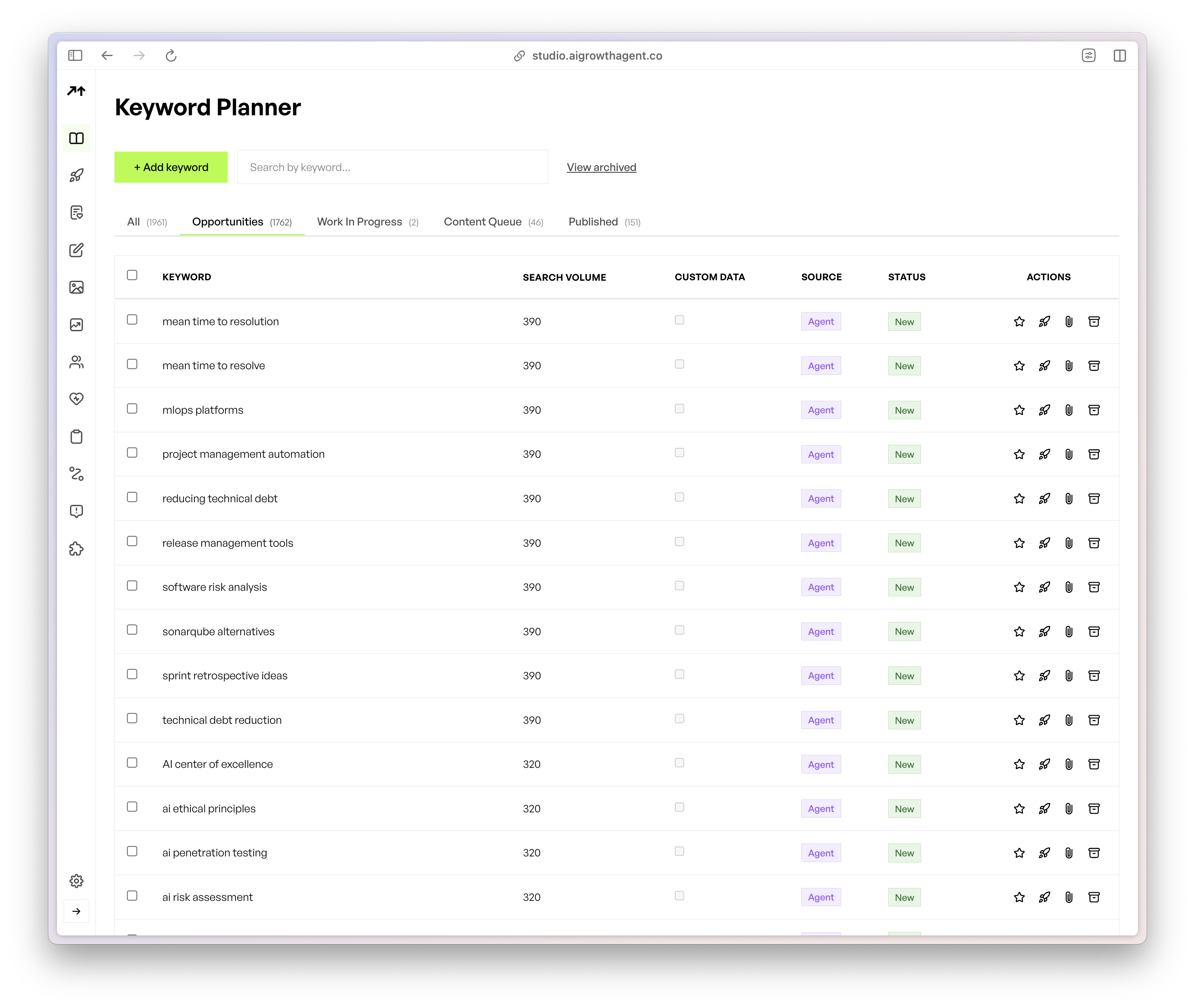
The platform’s process starts with a strategy that reflects AI search patterns. AI Growth Agent designs content architectures for AI consumption, citation, and recommendation, not only for traditional SEO metrics.
Autonomous content engineering for AI citation
AI Growth Agent’s Programmatic SEO Agent manages the full content lifecycle. It supports strategy, drafting, technical optimization, and publishing so that each piece of content aligns with AI citation requirements.
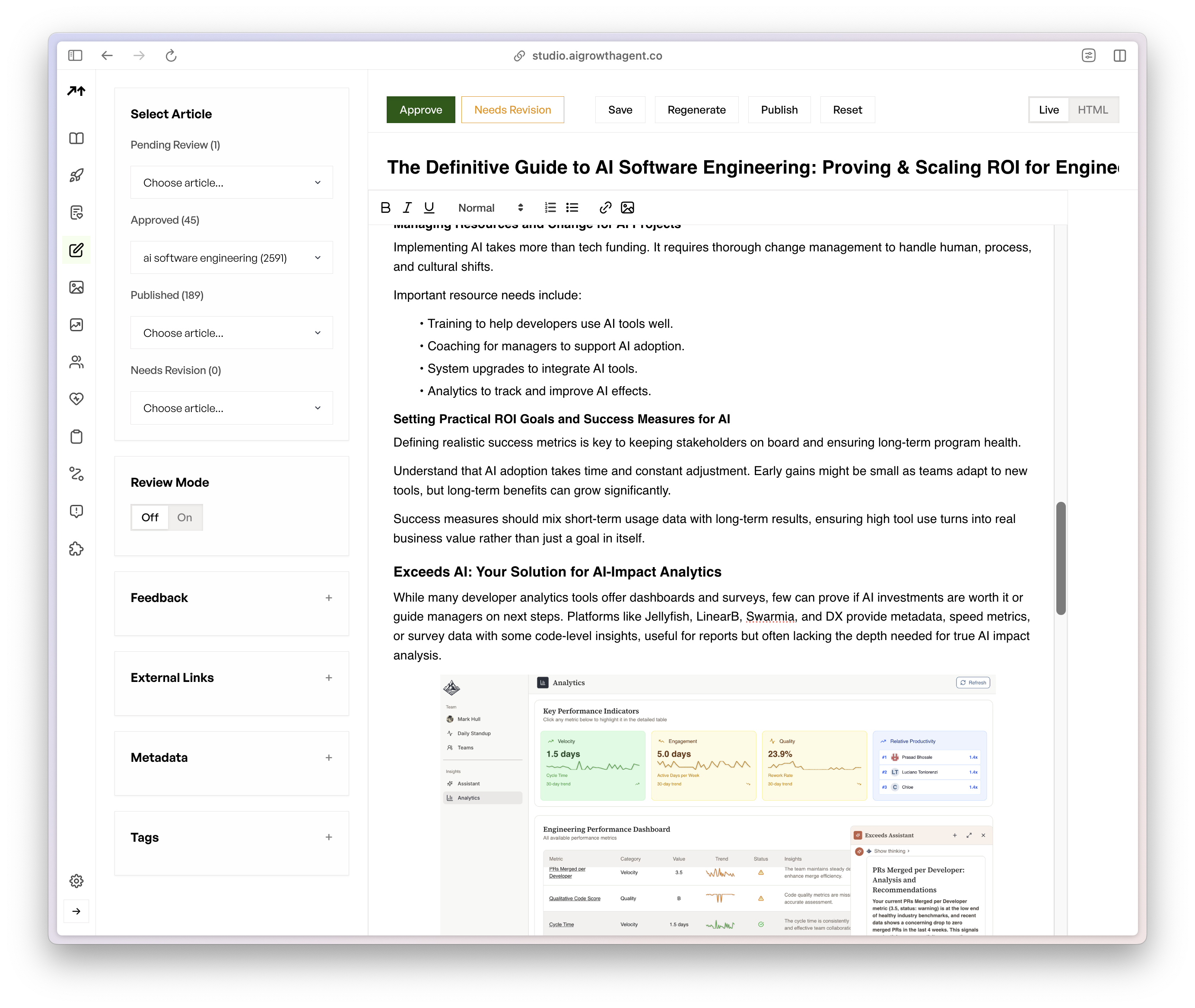
The system applies advanced technical SEO elements automatically. It adds schema markup, optimizes metadata, and configures blog Model Context Protocol (MCP) connections. MCP helps AI search engines interact with content repositories and understand relationships among articles.
Each article includes structured answers, clear topic clusters, broad question coverage, and source references that support verification. This design improves both discoverability and extractability for AI platforms.
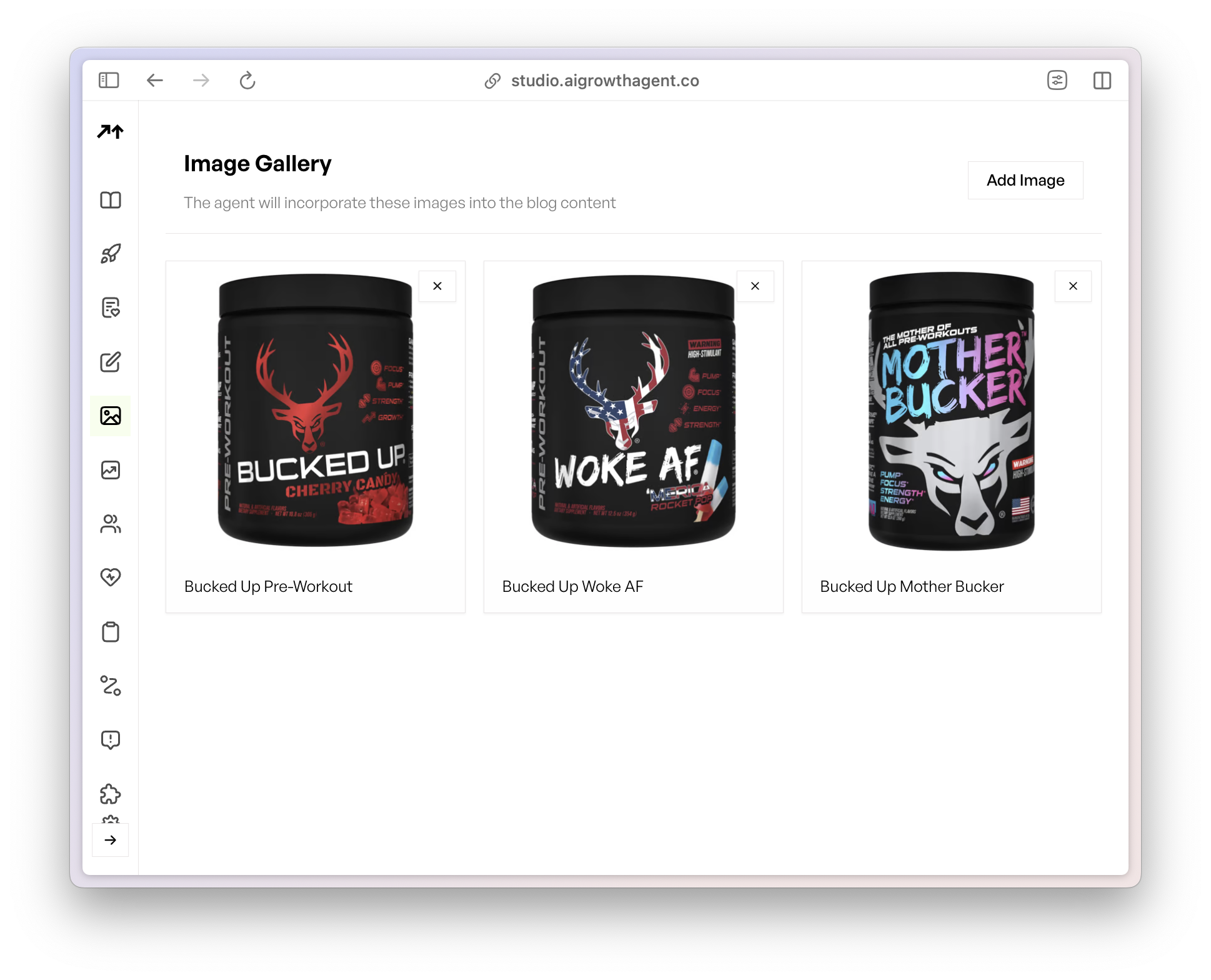
The autonomous approach reduces the need for manual oversight of technical details. Performance feedback loops then guide ongoing improvements to content structure and topic coverage so that citation rates can increase over time.
Real-time AI search monitoring: Tracking your brand’s Perplexity visibility
AI Growth Agent includes analytics focused on AI search performance. The AI Search Monitor tracks citations and visibility across ChatGPT, Gemini, and Perplexity in real time, giving teams insight into how content appears in AI answers.
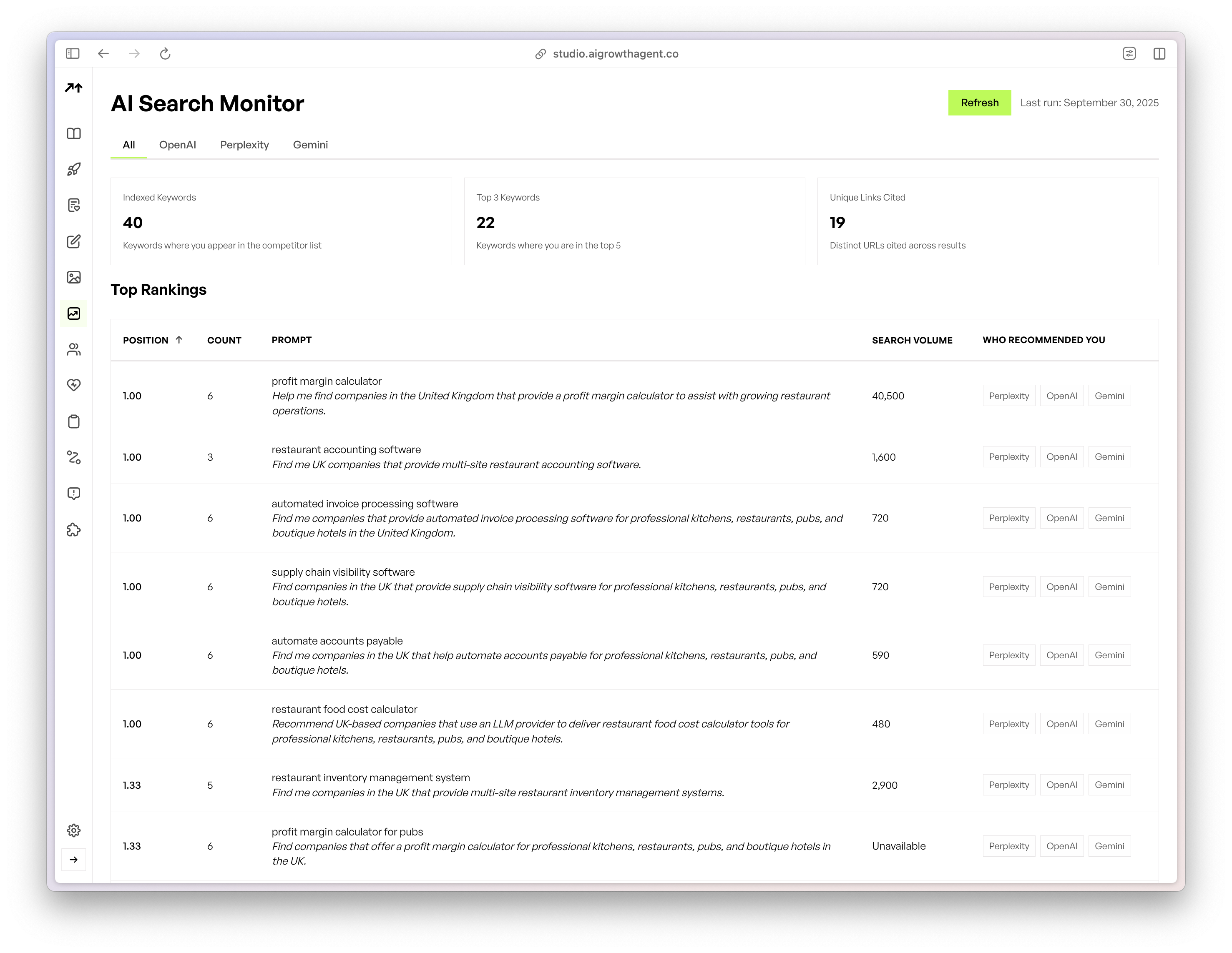
The monitor shows which pages drive citations, how AI systems quote brand content, and how often different platforms crawl and reference the site. Teams can identify winning patterns and topics that need more depth.
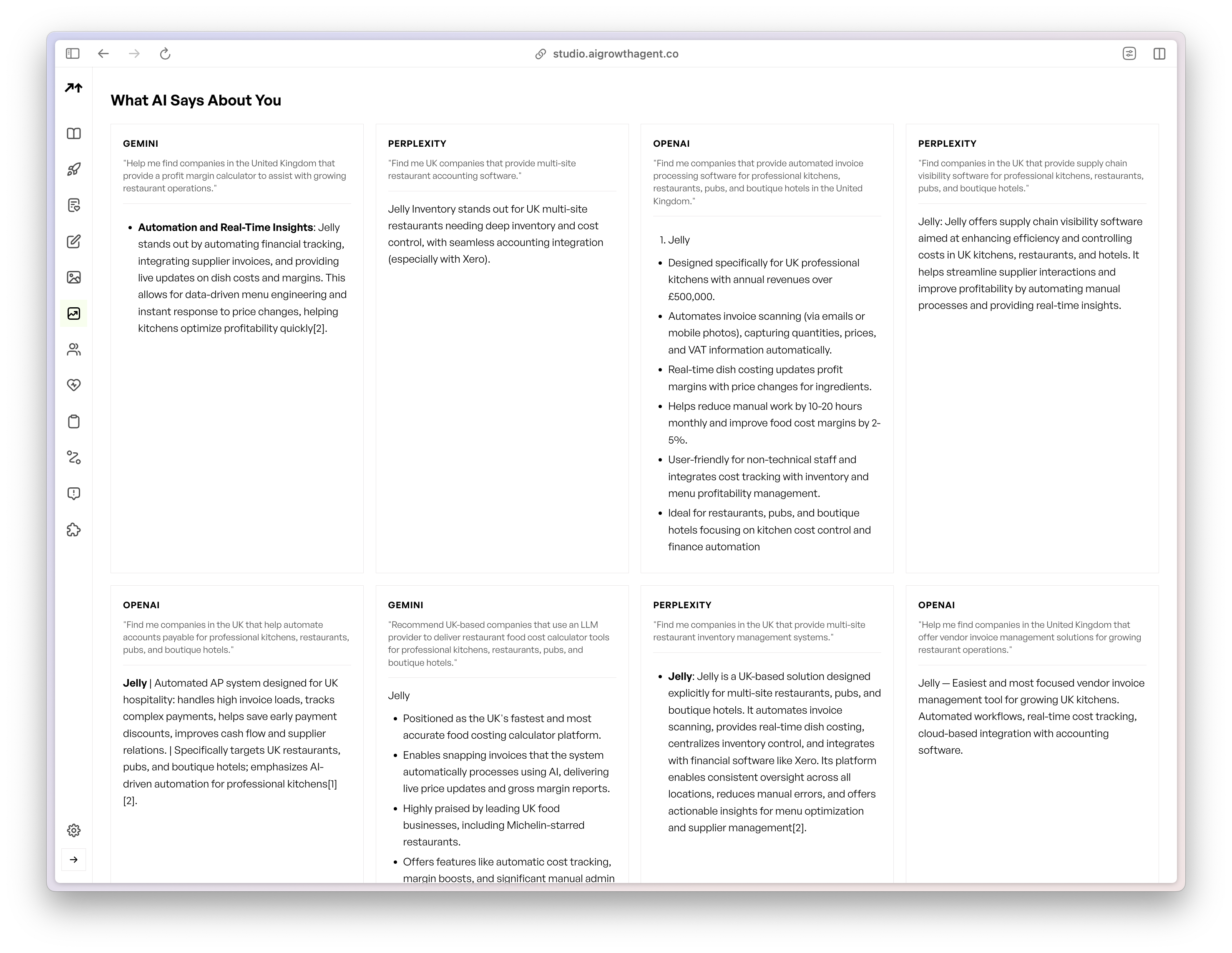
Heatmaps visualize indexing and citation strength across keywords and AI platforms. Integration with Google Search Console connects AI visibility with traffic and conversion outcomes, which supports more informed content investment decisions.
Achieving authority and efficiency on Perplexity
The combination of autonomous content engineering and AI-focused analytics helps brands build topic authority more efficiently. Many AI Growth Agent clients see early signs of AI visibility within weeks, with broader authority strengthening over time.
Automation reduces coordination overhead between writers, SEO specialists, and web teams. Content creation shifts toward expertise and relevance, while the platform manages technical compliance and structure.
Multi-tenant features allow complex organizations to manage several brands or product lines within one environment. Each brand maintains its own voice and strategy while benefiting from shared infrastructure and monitoring.
Frequently Asked Questions for Brands Ranking on Perplexity
Is high Google ranking enough to guarantee my brand is cited by Perplexity?
High Google ranking does not guarantee Perplexity citations. Research indicates that domain overlap between Google rankings and Perplexity citations often sits near 25–30 percent. Perplexity relies on authority signals that differ from backlinks and domain metrics. It emphasizes content precision, relevance to the question, and verifiable expertise. Brands need AI-specific strategies that prioritize structured answers, content depth, and robust technical architecture.
How does Perplexity’s citation model specifically affect content production for brands?
Perplexity’s citation model requires brands to design content around specific questions and clear evidence. Pages should provide precise, verifiable answers with visible sourcing and structured formatting. The platform favors detailed, expert-level coverage, so brands must commit more resources to subject-matter work. Content also needs clear hierarchies, answer blocks, and broad question coverage, all supported by technical optimization that ensures immediate discoverability.
What role do advanced technical SEO elements play in Perplexity visibility for brands?
Advanced technical SEO elements play a central role in Perplexity visibility. Comprehensive schema markup clarifies what each page covers and how topics relate. LLM.txt files and Model Context Protocols (MCP) help AI systems understand and query site content. Navigation and crawl paths must be clean so AI crawlers can move through the site without friction. Metadata, topic clustering, and authority signals in the code base provide additional context that improves AI comprehension.
What is a realistic timeline for brands to see results for Perplexity citations?
Brands that adopt structured, AI-focused optimization often begin seeing initial Perplexity citations within two to three weeks, depending on crawl frequency and competition. Broader authority usually develops over several months as content depth and internal linking expand. Programmatic content engineering can shorten timelines by accelerating topic coverage and standardizing technical quality across many pages at once.
Why are traditional SEO agencies and AI writing tools inadequate for sustained Perplexity ranking?
Traditional SEO agencies often rely on manual workflows and limited monthly output. That model struggles to match the scale and technical precision required for sustained AI search performance. Many AI writing tools produce unstructured text that lacks schema, answer blocks, and the metadata AI systems need. Internal teams then face the burden of adding strategy, structure, and technical optimization manually. Sustained Perplexity performance usually requires programmatic systems that integrate strategy, expert content, and technical implementation.
Conclusion: Securing Your Brand’s Authority in AI Search
This research shows that Perplexity AI has reshaped how brands earn digital visibility and authority. Traditional SEO remains important, but it is not sufficient for consistent citations on AI platforms. Perplexity’s focus on precision, verifiability, and content depth introduces new requirements that many current strategies do not address.
The case studies from Exceeds AI, BeConfident, Bucked Up, and Gitar illustrate what AI-focused strategies can deliver. These brands invested in content architectures designed for AI, robust technical optimization, and programmatic approaches that support coverage and consistency.
Brands that rely only on older SEO playbooks risk fading from view as AI search grows. Advanced schema, MCP, and structured content frameworks now form part of the core marketing stack. Managing these elements at scale usually demands automated systems rather than isolated manual fixes.
AI Growth Agent offers one approach to this challenge. Its autonomous Programmatic SEO Agent and AI Search Monitor help brands plan content, meet technical standards, and measure AI visibility. The client outcomes summarized in this report show how those capabilities can translate into measurable authority.
The competitive environment is evolving quickly. Early adopters that build AI search authority now are likely to maintain that lead as AI platforms mature. Marketing leaders responsible for visibility and growth can respond by investing in AI-specific strategies and infrastructure.
Brands that take a structured, programmatic approach to AI search can secure stronger positions in Perplexity and other AI platforms. Those positions will influence how customers discover, compare, and select solutions in the coming years. Book a strategy session with AI Growth Agent to explore how your brand can build and protect its authority in Perplexity AI search results.
