


Last updated: February 2, 2026
Key Takeaways
- ChatGPT breaks at enterprise scale because of manual workflows, unstructured output, and missing technical SEO like schema markup and LLM.txt.
- Programmatic SEO agents automate the full content lifecycle, from keyword clustering to AI search optimization, and deliver faster, higher quality output.
- ChatGPT’s main gaps include scalability bottlenecks, weak quality control, missing technical SEO, and no ROI tracking for AI search.
- AI Growth Agent delivers outcomes like top ChatGPT citations within weeks through autonomous execution, brand consistency, and real-time monitoring.
- Programmatic SEO with AI Growth Agent helps brands dominate AI search and scale content marketing efficiently.
Where ChatGPT Breaks for Enterprise Content Teams
Enterprise content marketing success depends on scalability, quality control, technical SEO, and measurable ROI. ChatGPT falls short on each dimension when compared with modern content marketing systems.
Scalability Limitations: ChatGPT relies on manual prompting, which creates a hard ceiling on output. Each article needs its own prompts, reviews, revisions, and formatting. Significant shadow AI adoption shows how little centralized control and governance exist inside enterprises, so ChatGPT cannot support coordinated, multi-team content programs.
Quality Control Gaps: ChatGPT produces generic content without built-in brand context or fact-checking. ChatGPT output cannot be copyrighted, which exposes content to competitor reuse. Privacy concerns also push teams toward expensive enterprise plans that many stakeholders cannot access.
Technical SEO Deficiencies: ChatGPT outputs plain text and ignores critical technical SEO. It does not create schema markup, structured metadata, or LLM.txt files. AI search engines favor structured, trustworthy content for citations, which ChatGPT alone cannot prepare at enterprise scale.
ROI Measurement Failures: AI summaries cut click-through rates by 46.7%, so traffic alone no longer reflects content performance. ChatGPT offers no way to track AI citations, answer inclusion, or visibility inside AI search experiences.
These gaps conflict with established content frameworks. The 70/20/10 rule assigns 70% of resources to proven core efforts, yet ChatGPT cannot reliably produce the consistent, technically sound content needed for that core layer.
ChatGPT vs Programmatic SEO Agents: A Direct Comparison
Strategic Context: ChatGPT writes in a vacuum and defaults to generic answers. Programmatic SEO agents like AI Growth Agent ingest company manifestos and brand guidelines so every article supports positioning and messaging. Traditional agencies add strategy but cannot keep pace with current content volume demands.
Data Integration and Velocity: ChatGPT needs manual data pasted into each prompt, which slows teams down. AI Growth Agent connects to internal databases and proprietary sources, then injects that data into content and automates publishing. Platforms like Tofu HQ support ABM and multi-channel orchestration, but AI Growth Agent focuses on technical content execution at scale.
Technical Infrastructure: ChatGPT returns unstructured text with no technical SEO. AI Growth Agent automatically adds schema markup, LLM.txt files, and Model Context Protocol integration, which are now core requirements for AI search visibility. AI search visibility depends on structured, machine-readable data for agentic crawlers.
Quality Assurance: ChatGPT has no built-in fact-checking or brand guardrails. AI Growth Agent runs automated fact verification, enforces brand voice, and improves through feedback loops. Traditional agencies deliver strong quality but cannot match the publishing speed of programmatic systems.
ROI Tracking: ChatGPT offers no analytics for AI search performance. AI Growth Agent tracks AI visibility, citation frequency, and traffic attribution across platforms. Structured AI visibility strategies can drive 340% growth in AI-sourced traffic when paired with robust measurement.
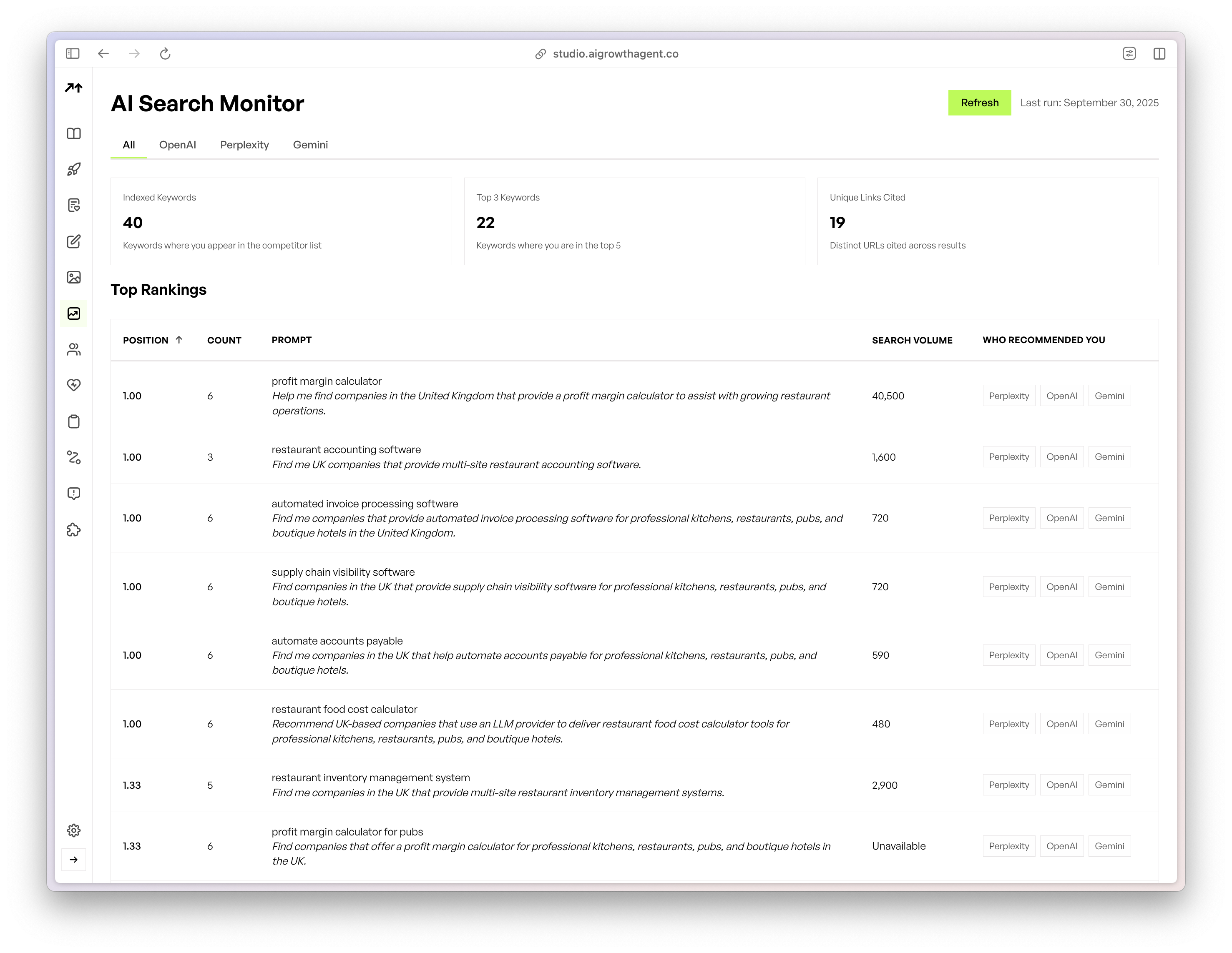
Autonomous Operation: ChatGPT needs constant human prompting and formatting. AI Growth Agent runs autonomously after setup, learns preferences, and executes complete content strategies without daily manual effort.
Schedule a demo to compare AI Growth Agent with your current ChatGPT-based workflows across these dimensions.
How AI Growth Agent Delivers Programmatic SEO at Scale
Programmatic SEO shifts content from manual writing to autonomous content engineering. Unlike agencies, internal teams, or basic AI tools, programmatic agents manage the full lifecycle without human bottlenecks.
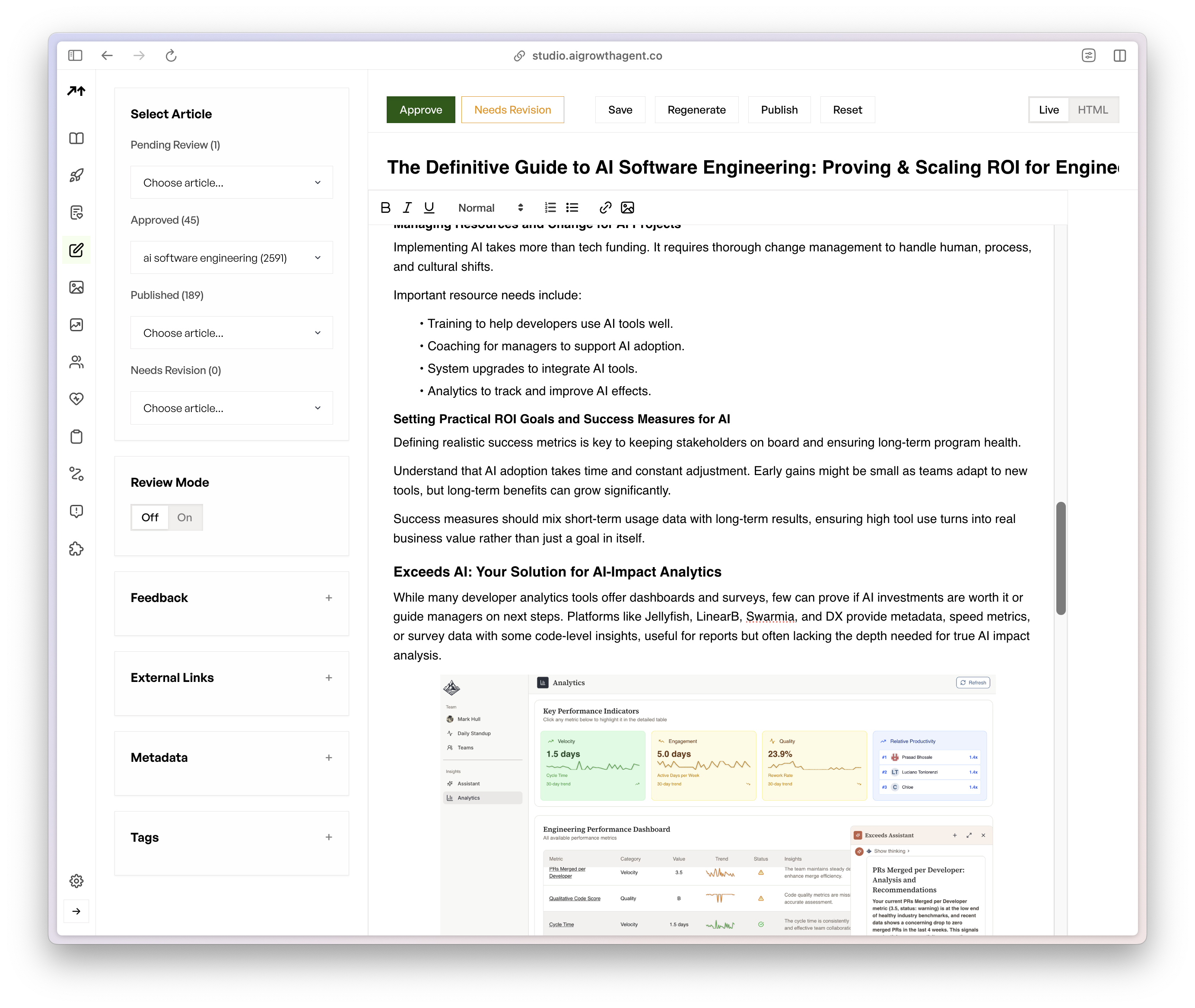
Core Capabilities: AI Growth Agent loads company manifestos for strategic alignment, runs autonomous keyword clustering and research, and applies advanced technical SEO such as schema markup and LLM.txt. It then publishes directly into optimized blog structures. The platform also monitors AI search in real time and tracks citations across ChatGPT, Perplexity, and other AI tools.
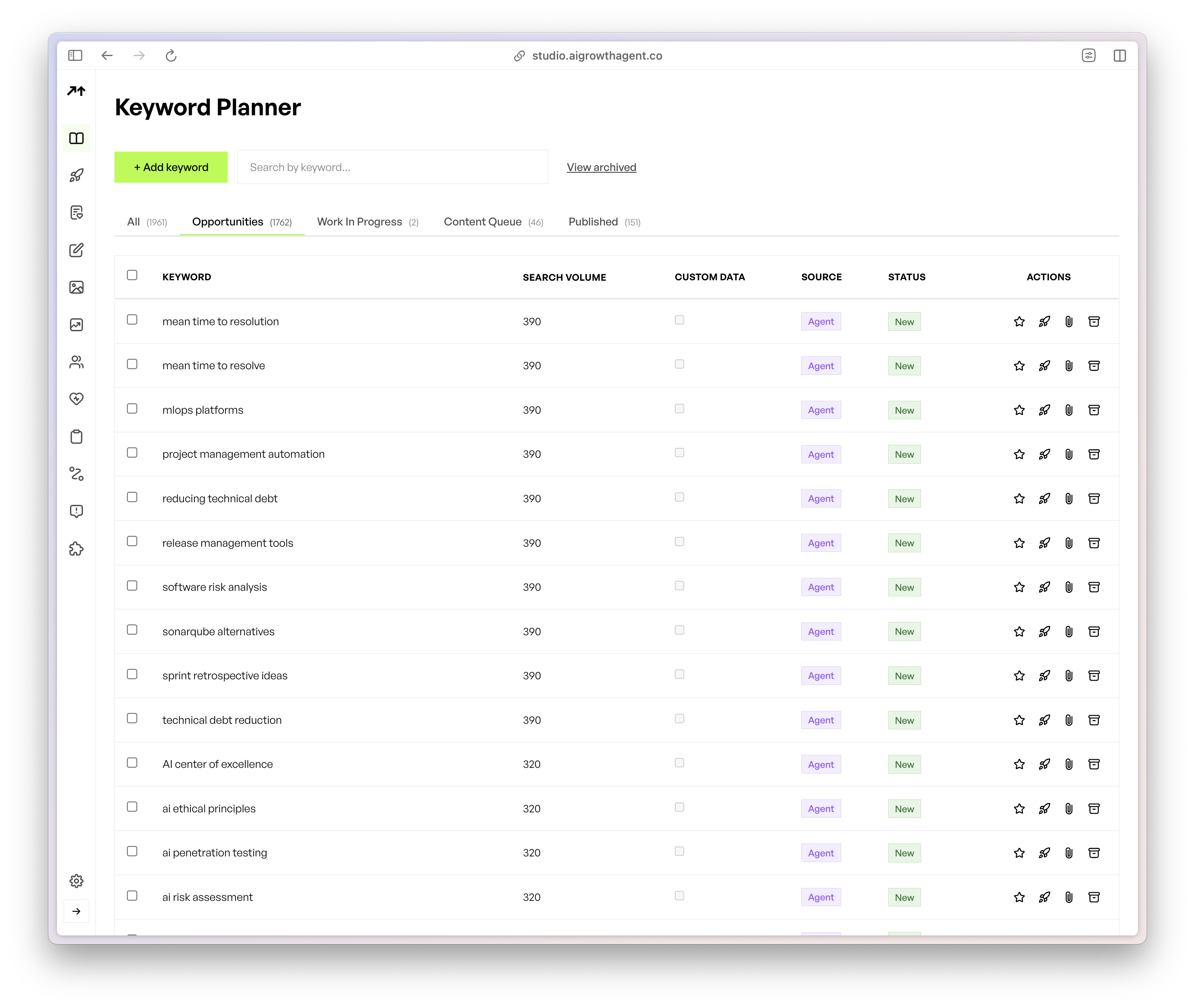
Proven Results: AI Growth Agent has surpassed Perplexity recommendations within two weeks and earned ChatGPT citations within three weeks for clients. Bucked Up became the top cited protein soda brand in ChatGPT within three weeks of programmatic publishing. BeConfident reached the leading English learning app position in Google AI Overviews for Brazilian audiences.
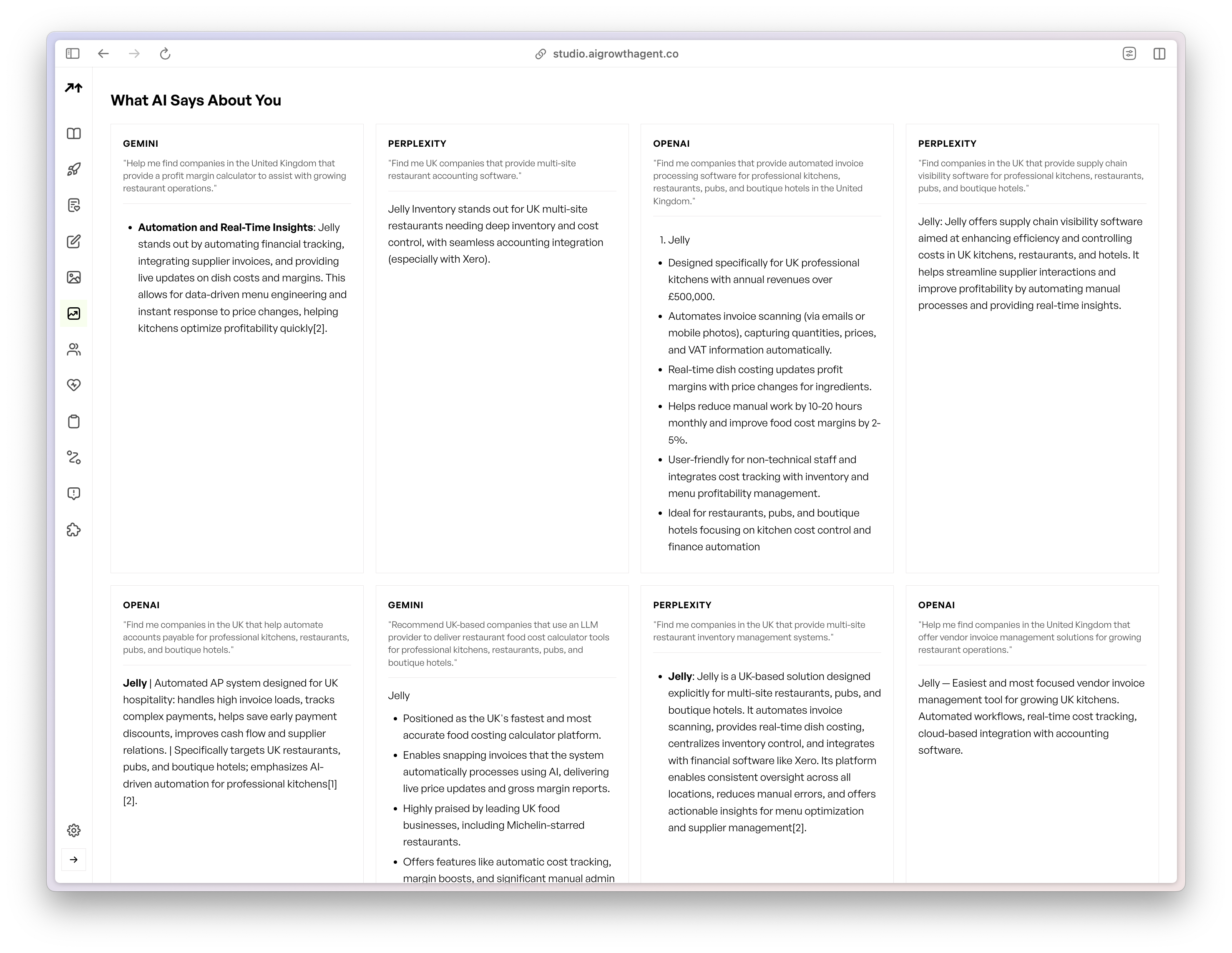
Technical Advantages: AI Growth Agent supports multi-tenant deployments for portfolios, real-time content from trending topics, and database-to-content automation that converts proprietary data into SEO assets. Sources cited by ChatGPT see average traffic lifts of 44%, which highlights the value of AI citation optimization.
Competitive Differentiation: Many content platforms focus on planning and campaign management. AI Growth Agent focuses on end-to-end technical execution. It outpaces agencies on speed while preserving quality through automated fact-checking and strict brand controls.
How to Choose a Programmatic SEO Agent for Your Enterprise
Enterprise content leaders need a structured way to evaluate programmatic SEO. The 70/20/10 rule offers a useful baseline with 70% core, 20% new, and 10% experimental efforts.
Evaluation Steps: Start by mapping current content gaps and manual bottlenecks. Next, require autonomous execution that removes day-to-day human dependencies. Then, prioritize AI citation optimization and automated technical SEO. Finally, insist on performance tracking across both traditional search and AI search platforms.
Framework Application: Programmatic SEO agents power the 70% core layer through high-velocity publishing. They support the 20% innovation layer with real-time content sourced from market shifts. They also enable the 10% experimental layer with advanced capabilities such as Model Context Protocol integration.
Strategic Recommendation: Programmatic SEO agents now represent the only scalable path to enterprise content success in AI search environments. Manual approaches, including ChatGPT prompting, agency-only models, or internal teams, cannot match the required technical depth and publishing speed for AI citation dominance.
Schedule a consultation session to assess your readiness for programmatic SEO and AI search competition.
Frequently Asked Questions
Can ChatGPT Handle Enterprise SEO?
ChatGPT cannot meet full enterprise SEO requirements. It does not implement schema markup, generate LLM.txt files, or support Model Context Protocol, which now form the technical base for AI search visibility. ChatGPT also introduces privacy risks for sensitive data, which forces teams toward costly enterprise plans. Manual prompting further slows production and blocks the content velocity modern SEO needs. AI Growth Agent automates these technical tasks while maintaining enterprise-grade security and compliance.
What Is the 70/20/10 Rule for AI Content?
The 70/20/10 rule divides content resources into three buckets. Teams invest 70% in proven core efforts such as consistent publishing and SEO-focused content, 20% in new opportunities like emerging formats, and 10% in experimental initiatives such as advanced AI workflows.
For AI content, the 70% layer should focus on reliable, high-quality content that builds authority. The 20% layer can test new engagement formats, and the 10% layer can explore cutting-edge technical implementations. ChatGPT cannot support the 70% foundation at scale because of manual workflows, while programmatic SEO agents can deliver that volume autonomously.
How Do You Measure AI Content Impact?
AI content impact requires new metrics that extend beyond pageviews. Teams need to track AI citation frequency, visibility across ChatGPT, Gemini, and Perplexity, and traffic from AI search surfaces. Key indicators include Answer Inclusion Rate, Brand Citation Frequency, and an AI Visibility Score across platforms. AI-optimized content can achieve 340% growth in AI-sourced traffic and 71% traffic increases from Perplexity features. AI Growth Agent Studio tracks these metrics, including real-time citations and crawl activity from AI search engines.
What Is the 30% Rule in AI?
The 30% rule advises teams to cap AI-generated content at 30% of total output to protect quality and authenticity. This guideline assumes basic AI tools without strong quality controls. It keeps humans in charge of strategy and oversight while using AI for support tasks.
Programmatic SEO agents change this equation. With built-in fact-checking, brand enforcement, and strategic context, they can safely exceed that 30% threshold while maintaining quality. Autonomous quality assurance matters more than a fixed percentage limit.
Why Do Traditional SEO Agencies Struggle with AI Search?
Traditional SEO agencies rely on manual processes that cannot reach the publishing speed AI search rewards. Many agencies lack the infrastructure to roll out advanced schema, LLM.txt files, and Model Context Protocol across large sites.
Their focus often remains on classic ranking factors instead of AI citation optimization and answer engine visibility. Human-heavy workflows also create bottlenecks that block programmatic publishing. Programmatic SEO agents remove these constraints with autonomous technical execution and continuous optimization.
Conclusion: Win AI Search with AI Growth Agent
ChatGPT alone cannot scale enterprise content marketing because it lacks technical infrastructure, autonomous execution, and deep strategic context. AI search now favors structured, trustworthy, and frequently updated content that manual workflows cannot deliver at scale.
AI Growth Agent gives enterprises a path to AI search leadership through autonomous content engineering, full technical SEO coverage, and real-time performance tracking across major AI platforms. Schedule a demo to see if you are a fit for programmatic SEO leadership in your market.
