


Executive summary
- AI search engines such as ChatGPT, Gemini, and Perplexity update quickly, so SEO partnerships now require fast, transparent communication and tight feedback loops.
- Traditional agency models that rely on monthly reports, static decks, and slow approvals create blind spots, fragmented data, and shrinking visibility in AI-driven search.
- Programmatic SEO supported by a clear Company Manifesto, real-time reporting, and iterative feedback makes it easier to align strategy and maintain topical authority.
- AI Growth Agent builds these communication and feedback loops into its platform, so marketing leaders can plan, publish, monitor, and improve content from a single system.
- Brands that adopt this model can scale content more reliably, measure ROI from AI search, and maintain consistent visibility across emerging AI assistants.
The Problem: Why Traditional SEO Agency Communication Fails in the AI Search Era
The emergence of AI-powered search engines has exposed critical weaknesses in traditional SEO agency communication models. What once worked for manual keyword targeting and monthly reporting cycles now creates blind spots that can cost brands their competitive edge in AI search results. The rapid pace of AI search evolution demands constant recalibration and transparent strategy discussions. Traditional agency structures rarely meet these requirements.
Misaligned Expectations & Outdated Strategies
The foundation of effective SEO partnerships is strategic alignment. Yet misaligned expectations and unclear target personas remain common communication breakdowns with SEO agencies. In the AI search era, these gaps become more costly because AI engines prioritize consistent, authoritative content that maps closely to specific user intents.
Many agencies still rely on periodic check-ins and static strategy documents. This structure does not match the dynamic nature of AI search algorithms, which continually update how they interpret authority and relevance. When agencies and clients do not share a clear view of buyer personas or content objectives, the content often lacks the focused authority that AI search engines reward with citations and recommendations.
The impact becomes visible in AI search results. Brands without clear strategic direction publish content that fails to build topical authority, which reduces visibility across ChatGPT responses, Google AI Overviews, and Perplexity recommendations. Without regular communication to maintain alignment, agencies may chase keyword opportunities that do not support the client’s core business objectives or that attract audiences that do not convert.
The “Black Box” Effect: Lack of Transparency & Data Silos
A frequent frustration in traditional SEO agency relationships is limited visibility into performance data and decision-making. Inadequate reporting on results creates barriers to understanding campaign effectiveness, especially when agencies control access to key metrics.
Manual reporting systems often delay or filter insights that clients need for timely decisions. In an AI search environment, where performance can shift quickly due to algorithm updates or new competitor content, these delays become strategic risks. Clients need direct visibility into how content performs across AI search engines, which pages drive citations, and how their authority compares with competitors.
The black box effect also appears in proprietary tools and processes that clients cannot access. This dependence slows decision-making when urgent optimization opportunities arise, such as a trending topic that could bring meaningful search volume. Communication lags between agency and client in these moments often result in missed opportunities.
Marketing teams that want to eliminate the black box effect and gain clearer visibility into AI search performance can schedule a consultation session to review AI Growth Agent’s real-time reporting.
Slow Feedback Loops & Stagnant Content Velocity
Content production and optimization speed has become a significant competitive factor in AI search. Traditional agency communication models still depend on slow, manual workflows. Manual processes often slow decision-making and reporting, creating bottlenecks that prevent rapid campaign optimization.
Weekly or bi-weekly calls can feel thorough but often introduce delays in updating content strategy. By the time feedback reaches the content team and changes go live, search trends or market conditions may have moved on. This lag is especially harmful in competitive niches where being early with a topic often shapes long-term authority.
Content approval processes create additional friction. Many agencies share drafts via email or basic project management tools, which can stretch review cycles over days or weeks. During that time, more agile competitors can capture emerging keyword opportunities and establish authority that is difficult to displace later.
Email-based communication also scatters feedback across threads and stakeholders. This fragmentation makes it harder to enforce consistent quality standards at scale. Without a centralized feedback system, agency teams may rely on outdated brand guidance or conflicting direction from different decision-makers, which leads to inconsistent content that weakens topical authority.
The Shrinking Digital Footprint: Losing Authority to AI
These communication issues contribute to a serious trend for many brands: a shrinking digital footprint in AI search results. As AI-generated content floods the web, brands without strong communication and feedback systems see their authoritative voice diluted or absent from AI responses.
Agencies that operate with limited client feedback and slow strategic alignment often struggle to produce enough high-quality content to sustain authority in AI search engines. Traditional methods cannot keep pace with the high-volume, AI-driven content environment that now defines search competition.
This situation can create a cycle. Poor communication produces weaker content, weaker content underperforms in AI search, reduced visibility undermines authority, and the brand then finds it harder to compete for attention in future results. Brands that lack clear communication and feedback mechanisms with their SEO partners risk becoming invisible to the AI indexers that now guide discovery.
The Solution: Engineering Communication & Feedback into Programmatic SEO Strategy
Modern SEO partnerships work best when communication and feedback are built into the way content is planned, created, and optimized. Instead of treating communication as an add-on, leading teams design transparency and continuous feedback directly into their programmatic SEO strategies. This approach turns communication into a core part of performance management.
Establishing a Single Source of Truth: The Company Manifesto for AI Search
Effective SEO communication starts with a strategic document that guides every content decision. Programmatic marketing teams benefit from clearly defined roles and strategic frameworks that keep execution aligned across initiatives.
A Company Manifesto for AI search extends beyond standard brand guidelines. It defines content authority standards, audience segments, competitive positioning, and technical optimization rules. This reference reduces the misaligned expectations and unclear personas that affect many agency relationships.
The manifesto approach helps each content asset support a clear goal of building topical authority in AI search results. Documented content guardrails, preferred citation types, and brand voice details narrow interpretation gaps that often lead to inconsistent quality or off-strategy topics.
This single source of truth becomes particularly valuable for programmatic SEO, where teams publish high volumes of content. When content systems can reference a detailed manifesto, they maintain brand consistency and strategic focus across hundreds or thousands of pages.
Standardized & Real-time Reporting: Performance Dashboards for AI Search
Modern SEO partnerships need reporting that covers performance across AI search engines as well as traditional Google rankings. Enterprise teams deploy unified data platforms that enable communication and rapid optimization based on real-time insights.
Effective AI search reporting consolidates data from multiple discovery channels. Clients benefit from seeing how content performs across ChatGPT, Google’s Gemini AI Overviews, Perplexity, and other AI-driven platforms. This broader view supports optimization decisions that reflect the full AI search landscape.
Real-time dashboards remove many of the delays that characterize traditional reporting. Instead of waiting for weekly or monthly summaries, stakeholders can check current performance and adjust strategy when trends or competitor moves appear. This level of transparency supports more collaborative optimization and builds trust on both sides.
Standardized reporting formats and metrics also matter. When each reporting cycle uses consistent definitions and structures, teams can recognize trends more easily and hold more productive strategy discussions without confusion about how data is calculated.
Iterative Learning & AI-Powered Feedback Mechanisms
Advanced communication systems use continuous learning to improve content performance over time. These systems combine client feedback with performance data to create feedback loops. Data-driven iteration enables continuous measurement and optimization, creating feedback loops that support stronger results.
Iterative learning tools analyze patterns in client feedback to identify preferences and inform future content. When clients favor particular structures, citation styles, or SEO practices, the system can apply these choices automatically. This shift reduces repetitive feedback and raises overall quality.
AI-powered feedback mechanisms can also surface optimization options that manual analysis might miss. By comparing feedback with live performance across AI search engines, these tools highlight changes that improve both client satisfaction and search metrics.
Learning-focused systems increase communication efficiency over time. As they better understand client preferences and performance patterns, they can anticipate needs and address risks earlier, moving the relationship from reactive adjustments to more proactive planning.
Marketing teams that want to use intelligent feedback systems that learn and improve over time can schedule a demo to see how AI Growth Agent supports iterative optimization.
AI Growth Agent: Programmatic SEO Built for Clear Communication
AI Growth Agent embeds communication and feedback directly into its programmatic content workflows. Communication is not treated as a separate layer. Instead, transparency and continuous feedback are part of how the platform researches, drafts, optimizes, and publishes content.
The platform addresses common communication challenges in SEO partnerships through five integrated capabilities.
- White-glove onboarding and Company Manifesto creation: Each partnership begins with a comprehensive strategy session that produces a detailed Company Manifesto. This document serves as the core strategic reference for programmatic content, which supports consistent brand voice and focus across large content libraries.
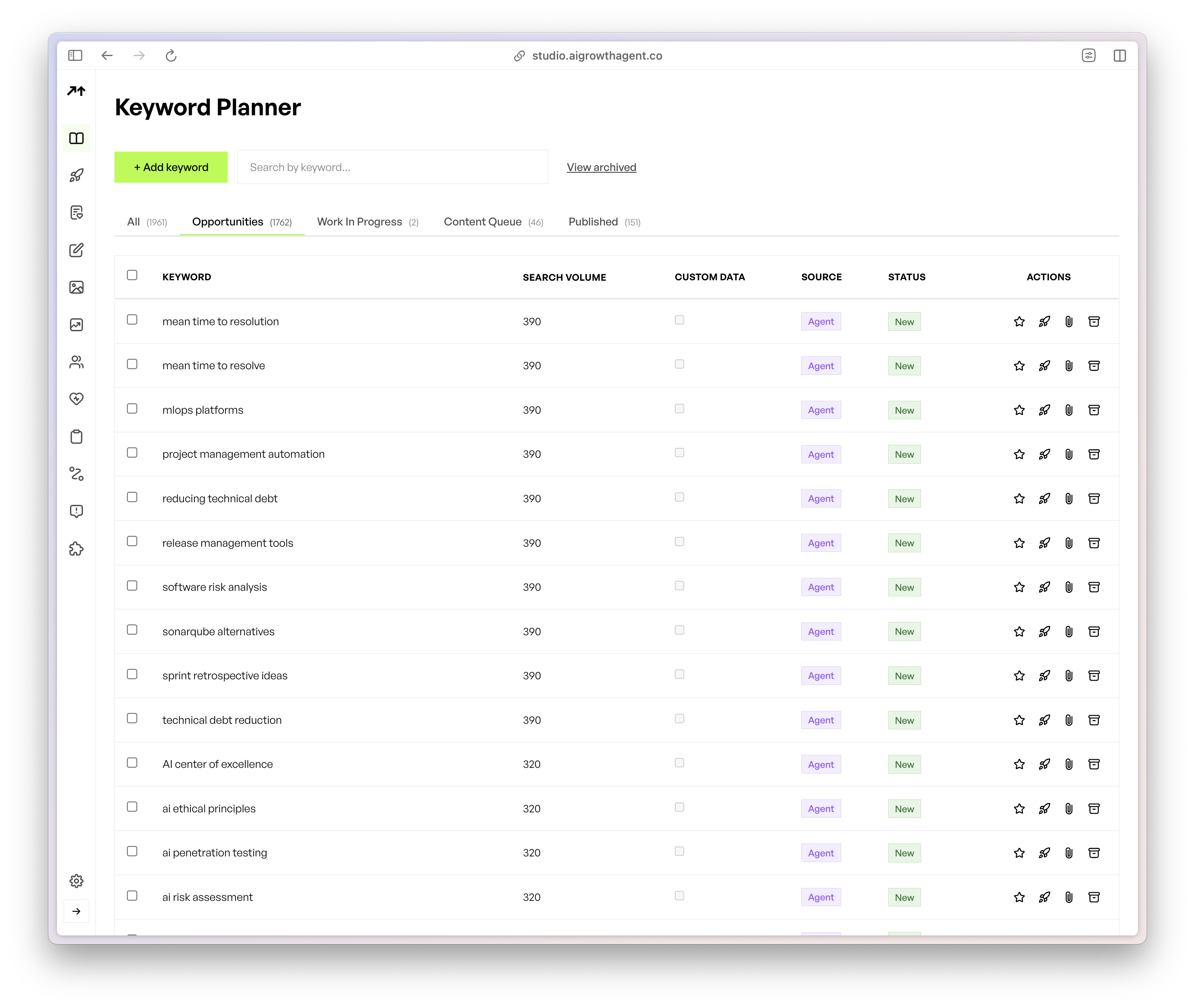
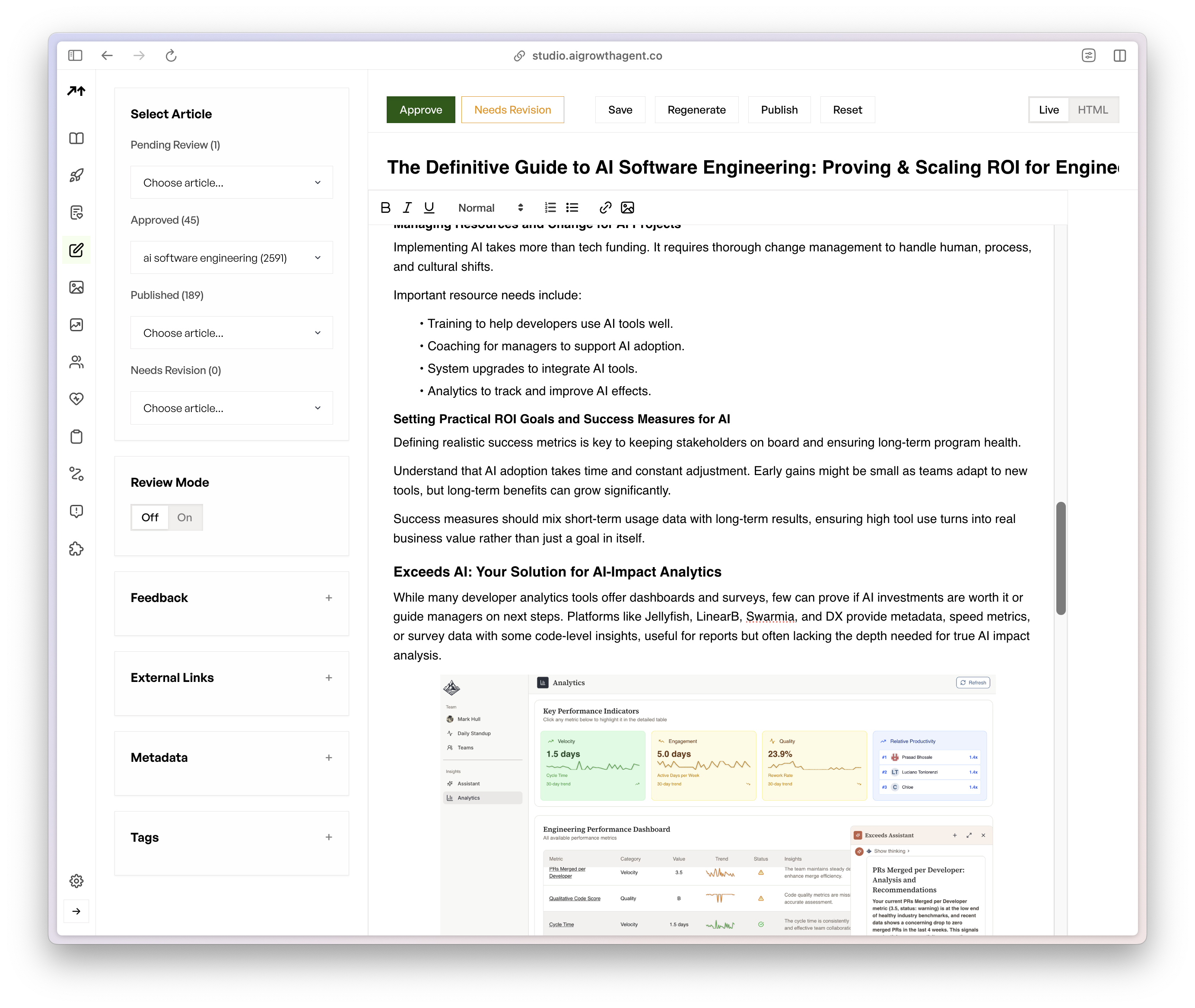
- AI Growth Agent Studio: The centralized control interface provides visibility into content creation and makes feedback simple. Clients can approve content, leave structured comments, and set optimization rules in one place, which reduces email chains and delays.
- AI Search Monitor and feedback loop: Real-time performance tracking across ChatGPT, Gemini, Perplexity, and traditional search engines provides an immediate view of content effectiveness. Transparent reporting supports ongoing collaboration and improvement based on clear metrics.
- Programmatic keyword and content research: Automated research workflows keep strategy aligned while sustaining content velocity. Shared roadmaps give clear visibility into upcoming content and optimization priorities, reducing uncertainty common in traditional agency models.
- Autonomous technical infrastructure: Automated publishing and technical optimization remove many coordination bottlenecks that slow SEO execution. Structured content processes help address coordination gaps between technical and content teams and reduce communication friction.
Marketing leaders who want SEO partnership communication that supports programmatic scale and AI search performance can schedule a consultation session with AI Growth Agent to review their current approach.
How AI Growth Agent Improves Trust and ROI in AI Search
Moving from a traditional SEO agency relationship to a programmatic SEO model requires more than new tools. It involves rethinking how transparency, collaboration, and performance measurement work inside the content system. AI Growth Agent approaches each of these areas with purpose-built technical solutions.
Beyond Manual Reporting: Real-time AI Search Intelligence
Traditional SEO reporting often misses key dynamics of AI search, which limits the value of reporting for strategy. Manual reporting systems rarely provide enough visibility into campaign effectiveness, especially when results change quickly across AI platforms.
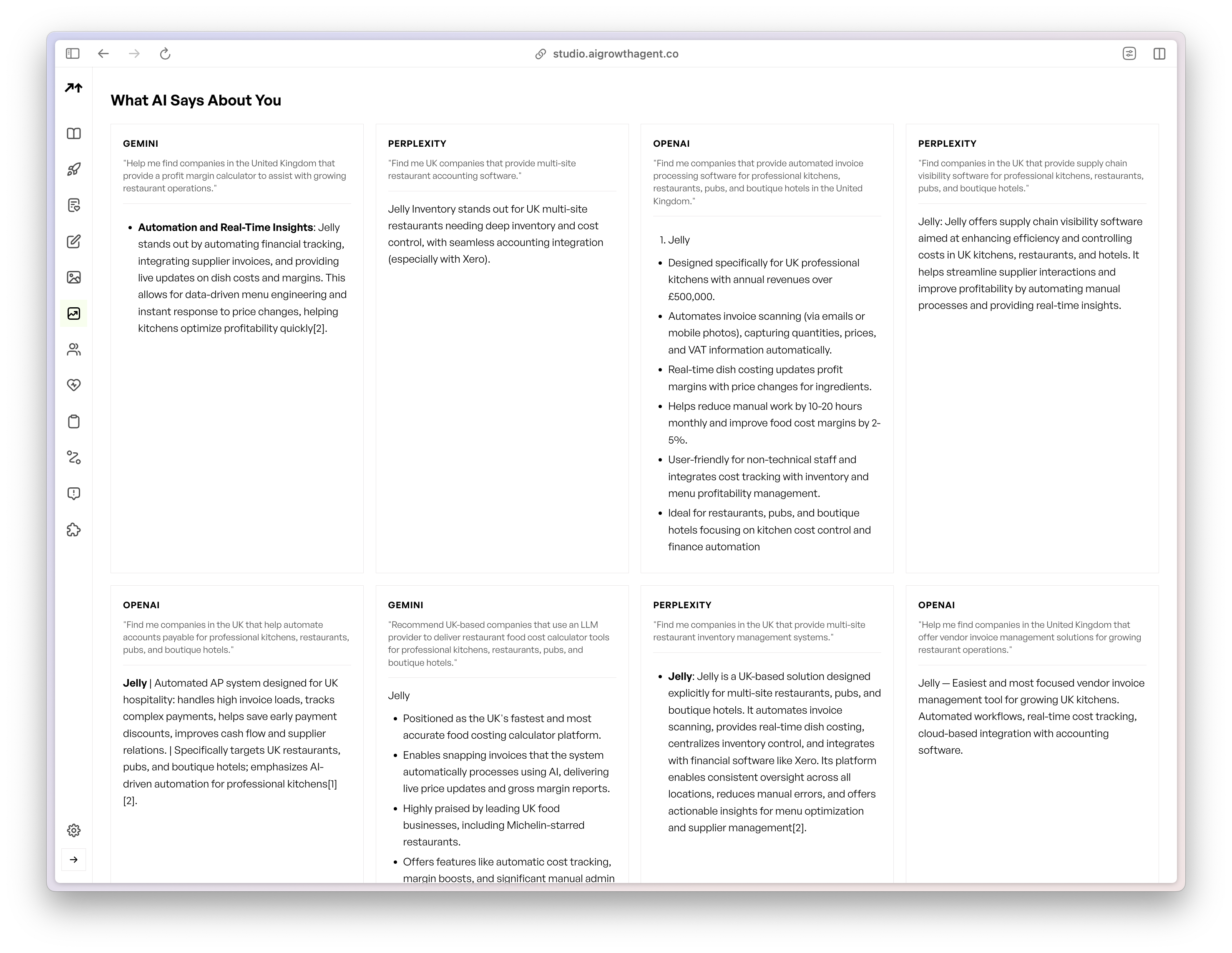
The AI Growth Agent Studio includes an AI Search Monitor that tracks performance across major AI search engines in real time. Clients see citations and mentions in ChatGPT, Gemini AI Overviews, Perplexity, and traditional Google search in a single dashboard.
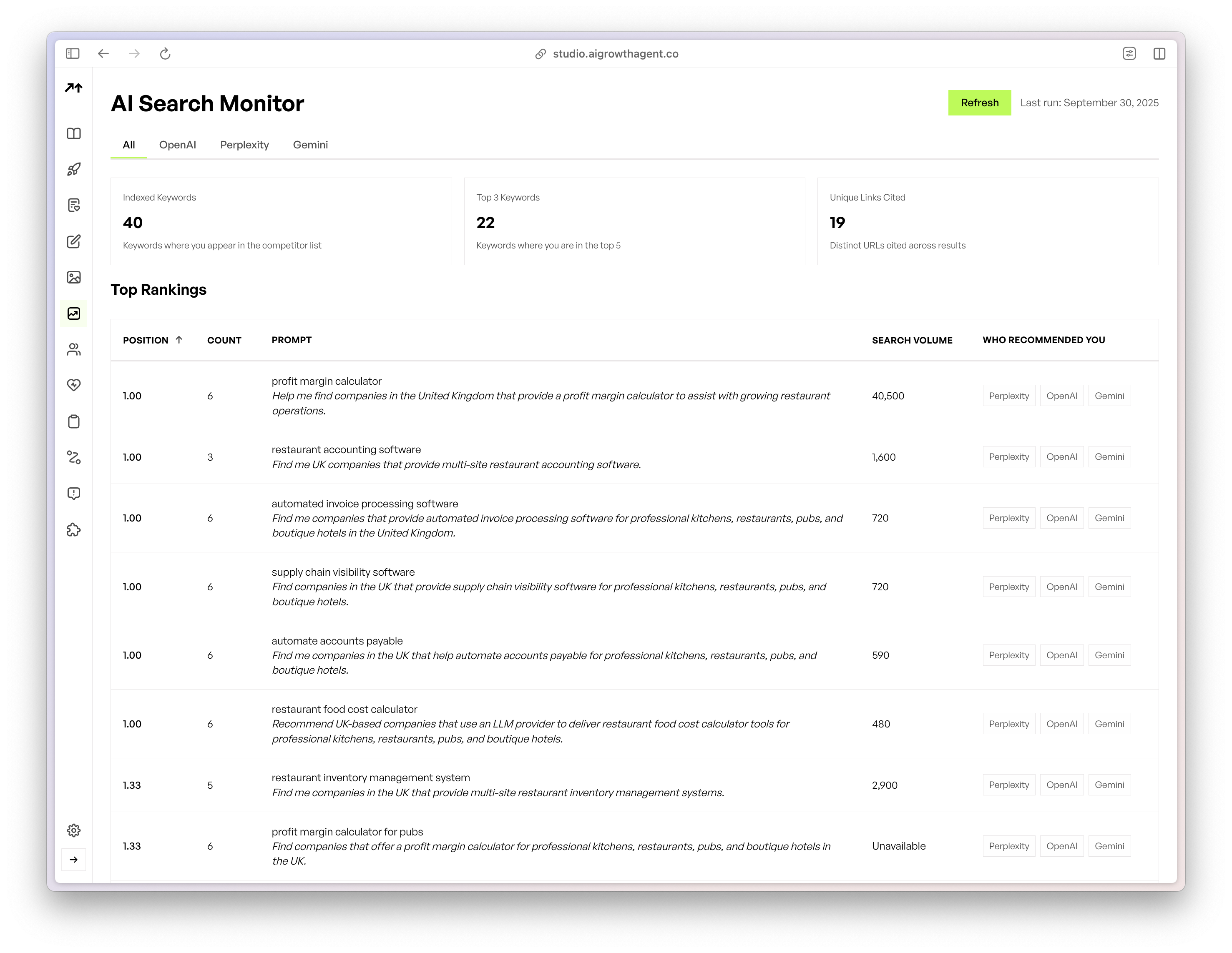
This view highlights patterns that typical reports overlook. Clients can see which content formats attract the most AI citations, which topics signal strong authority, and how domain strength compares with competitors across AI assistants.
Real-time monitoring also reduces delays in response. When performance changes or new opportunities appear, the team can react quickly. Fast detection is particularly valuable around timely topics where early coverage can support lasting authority.
Collaborative Content Engineering: Your Agent, Your Rules
Programmatic SEO communication works best when clients can give precise input without slowing content velocity. Alignment with the marketing funnel benefits from ongoing communication and strategic review to ensure content matches user intent at each stage.
The AI Growth Agent Studio supports collaborative content engineering with structured feedback tools. Clients can comment on content structure, tone, technical details, and strategy focus. These preferences then turn into rules that guide future content.
The Company Manifesto anchors this work by defining the strategic direction. The agent then adapts execution based on performance data and ongoing feedback, which helps maintain brand consistency while still adjusting to new opportunities and market changes.
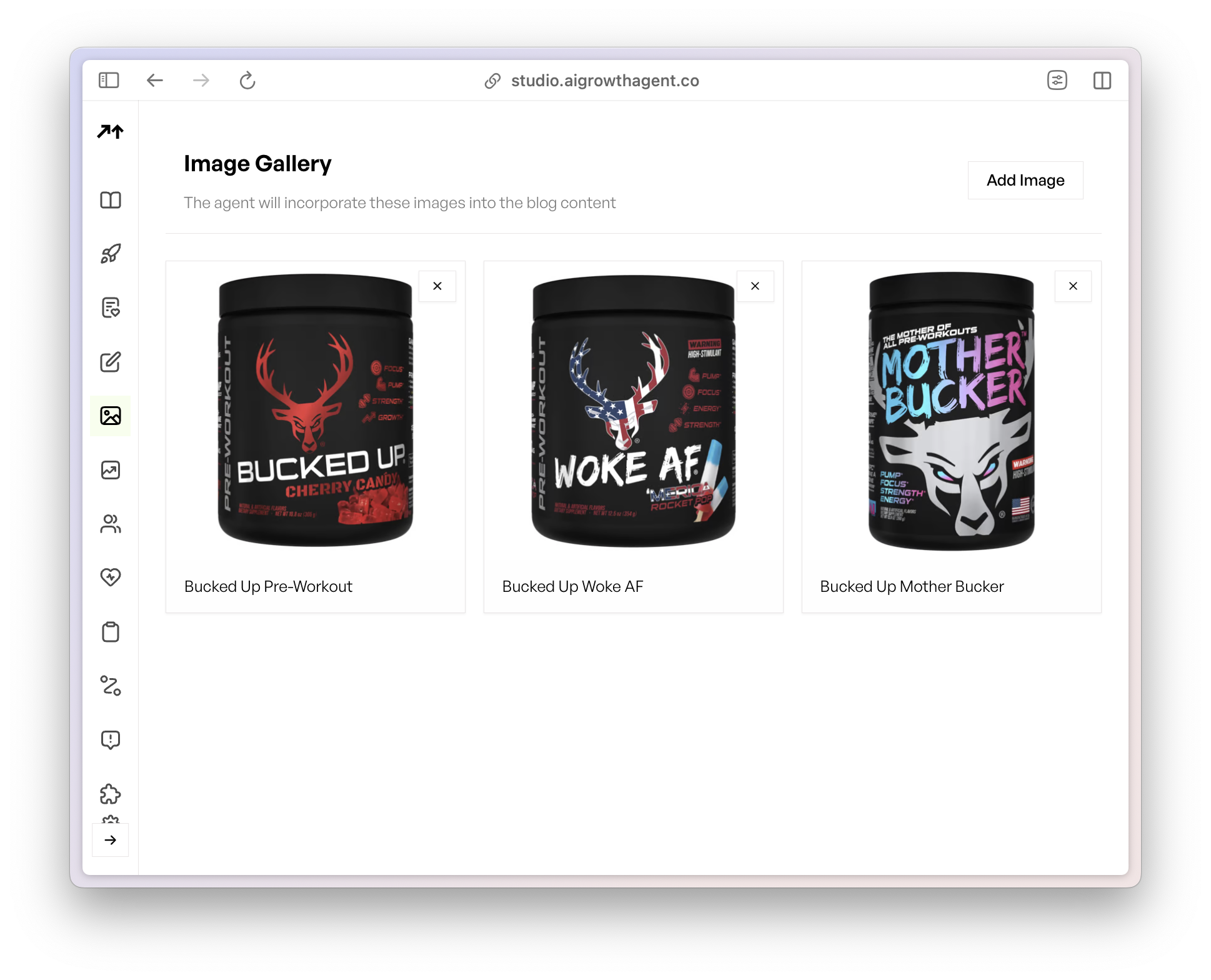
Clients can also supply images and other assets that the agent incorporates into content, which keeps visual elements aligned with brand standards.
Direct feedback channels reduce interpretation gaps that often appear in traditional agencies. When clients can clearly state preferences for content creation and optimization, the output aligns more closely with business goals and supports stronger AI search authority.
Programmatic Velocity with Quality Assurance: The Feedback-Driven Content Engine
Maintaining quality at programmatic scale requires systems that catch issues before they affect performance. Effective feedback enables fast iteration in response to analytics or competitive changes, which supports ongoing optimization.
AI Growth Agent’s content engine uses several quality checks informed by client feedback and performance data. Each piece goes through strategy development, research, drafting, fact-checking, and technical optimization before publication.
Because feedback feeds into the system, quality improves over time. As the agent learns which patterns perform best and which stylistic choices clients prefer, it applies those lessons to new content. This learning curve reduces repeated edits and raises the baseline quality.
This approach also addresses content velocity bottlenecks common in manual workflows. Manual publishing and limited coordination often create bottlenecks that slow optimization. AI Growth Agent’s autonomous systems keep quality high while allowing content production to reach the scale needed for competitive AI search.
Multi-Tenant Programmatic Deployment: Centralized Control, Distributed Authority
Many enterprise organizations manage several brands or business units that need distinct SEO strategies with shared oversight. Structured workflows and well-defined roles support management of complex programmatic initiatives.
AI Growth Agent’s multi-tenant deployment lets marketing leaders oversee multiple programmatic SEO strategies from one interface. Each agent instance has its own Company Manifesto, keyword plan, and optimization settings, but all share infrastructure and reporting.
This structure simplifies communication compared to coordinating multiple agencies and tools. Leaders can view performance, risks, and opportunities across brands in one place while still maintaining separate strategies.
At the same time, individual business units keep strategic control over their own content. They benefit from shared insights and technical resources while still pursuing goals that match their specific markets.
Comparison: Traditional SEO Agency vs. AI Growth Agent for Communication & Feedback in AI Search
The gap between traditional SEO agency communication and AI Growth Agent’s programmatic model extends beyond tooling. It reflects different assumptions about transparency, collaboration, and alignment.
|
Feature/Aspect |
Traditional SEO Agency |
AI Growth Agent |
|
Strategic alignment |
Ad-hoc meetings and disconnected documents with expectations that are often misaligned and buyer personas that remain unclear |
Company Manifesto and shared programmatic strategy that create a stable foundation with clearly defined buyer personas |
|
Transparency of performance |
Manual reports and limited access to raw data with reporting that often fails to meet stakeholder expectations |
AI Search Monitor with real-time citation tracking and GSC integration that supports data-driven insight and continuous optimization |
|
Feedback loop speed |
Weekly or bi-weekly calls and email threads that slow decisions because of manual processes |
Iterative learning in Studio with direct agent feedback that supports faster changes in response to analytics |
|
Content output scalability |
Output limited by human bandwidth and inconsistent quality, with manual publishing that creates bottlenecks and coordination issues |
Autonomous agent that produces consistent, structured content at scale through automation and systematized workflows |
Frequently Asked Questions about AI Growth Agent’s AI SEO Communication
How does AI Growth Agent ensure communication clarity for complex AI search strategies?
AI Growth Agent establishes clarity through its Company Manifesto process, which becomes the strategic foundation for programmatic content creation. During white-glove onboarding, the team conducts a focused strategy session with a professional journalist to capture business positioning, target audiences, competitive context, and AI search objectives. This manifesto guides every content decision and reduces the misalignment that affects many agency relationships.
After onboarding, the AI Growth Agent Studio maintains transparency with real-time dashboards showing performance across ChatGPT, Gemini, Perplexity, and traditional search engines. Users can see which articles drive AI citations, how domain authority compares with competitors, and which optimization tactics produce the best results. This visibility reduces the black box effect common in traditional reporting.
The Studio also provides structured feedback channels. Clients can specify preferences for tone, technical priorities, and focus areas, and the system learns from this input over time. That learning reduces repeated feedback, while still keeping quality and alignment high.
What kind of feedback can I provide to the AI Growth Agent, and how does it learn?
AI Growth Agent accepts a wide range of feedback through the Studio interface. Clients can comment on content structure, format, brand voice, messaging, technical SEO choices, keyword priorities, and competitive positioning. They can also flag content types or topics that generate stronger AI search authority for their business.
The system analyzes feedback patterns alongside content performance across AI search engines. When clients consistently favor specific approaches, the agent incorporates those preferences into future content. It also tracks which preferences correlate with better visibility and citation rates in AI search.
Over time, this process allows the agent to anticipate preferences and align content more closely with strategic goals. The relationship moves from one-off corrections to ongoing, proactive optimization.
How does AI Growth Agent’s transparent reporting improve on traditional SEO agency practices?
Many traditional reports provide summary metrics without exposing the underlying drivers of performance. AI Growth Agent takes a different approach by giving clients access to real-time, underlying data across AI and traditional search platforms through its integrated dashboards.
The AI Search Monitor tracks citations in ChatGPT, Google AI Overviews, Perplexity recommendations, and standard search rankings. This view shows which articles and topics drive the most AI visibility, how citation rates evolve, and how a domain’s authority trends against competitors.
Transparency also extends to the content workflow. Clients can track keyword research, strategy outlines, technical implementations, and publishing schedules directly in Studio. This access reduces uncertainty and dependency, so decisions are made on complete data rather than partial summaries.
Can AI Growth Agent integrate with my existing CMS for content management and feedback?
AI Growth Agent offers flexible integration options to work with existing infrastructure while supporting programmatic SEO performance. The platform supports direct integrations with CMS platforms such as WordPress, Hashnode, Webflow, Framer, Sanity, and HubSpot, which allows publishing within current workflows.
Many clients choose the hosted solution because it provides consistent technical optimization and tight integration with feedback and monitoring tools. This option creates an optimized subdomain, such as blog.yourcompany.com, that matches the main site design while giving programmatic SEO a strong technical base.
Clients who prefer self-hosting often use WordPress, where advanced integrations support schema markup, metadata optimization, and AI-focused features such as LLM.txt and Model Context Protocol. These elements help AI search engines interface more effectively with the content database and support higher citation rates.
What specific metrics does AI Growth Agent provide to demonstrate ROI from its communication and programmatic efforts?
AI Growth Agent tracks ROI across both traditional search and AI search outcomes. Organic traffic growth is monitored through Google Search Console integration, which connects programmatic content output with measurable traffic and conversion trends.
AI search metrics extend this view by tracking citations in ChatGPT, Google AI Overviews, Perplexity, and other AI-driven discovery tools. These metrics include direct quotes of content, visibility on target keywords across assistants, and authority trends that signal growing influence in a given market.
The platform also measures content velocity, technical implementation status, and feedback loop efficiency. Clients can see how specific feedback or process changes influence performance, making it easier to connect communication quality with business results.
Conclusion: Build AI Search Leadership with Programmatic Communication & AI Growth Agent
The shift to AI search has made communication and feedback central to SEO success. Manual reporting cycles and fragmented conversations no longer provide enough speed or visibility for competitive AI optimization. Brands that do not update their communication models risk ceding authority to more adaptive competitors.
AI Growth Agent responds to these challenges by embedding feedback loops, real-time performance tracking, and strategic alignment into a programmatic content system. The platform addresses misaligned expectations, slow approvals, and limited visibility while supporting the content volume and quality required for AI search.
Marketing leaders who adopt programmatic communication and feedback systems position their brands for more durable visibility across ChatGPT, Gemini, Perplexity, and other AI platforms. Transparent reporting, iterative learning, and shared strategy foundations create compounding benefits that are difficult to achieve through manual workflows.
Teams that want transparent, data-driven communication to support AI search performance can schedule a demo with AI Growth Agent to explore how programmatic SEO can fit their growth plans.
