


Key Takeaways
- AI search tools like ChatGPT, Google AI Overviews, and Perplexity now act as primary discovery channels, so brands need consistent, accurate mentions across these systems.
- Inconsistent brand mentions create fragmented narratives and confusion for customers, which makes it easier for competitors with stronger content strategies to gain visibility.
- Programmatic SEO that combines structured data, topic coverage, and steady publishing volume gives large language models clearer signals for brand citations.
- Traditional SEO workflows and simple AI writing tools often lack the technical depth, speed, and structure that AI search platforms now reward.
- AI Growth Agent delivers programmatic SEO, technical automation, and AI search monitoring, and you can schedule a demo to see how it supports consistent brand mentions across AI search.
The Shrinking Digital Footprint: Inconsistent Brand Mentions as a Major Problem in AI Search
The AI Content Deluge
AI tools now generate enormous volumes of content every day, which raises the level of digital noise for every category. Brands that do not publish structured, high-quality content at comparable speed risk losing visibility as the overall content pool grows. A smaller footprint in that pool makes it harder for AI systems to detect, understand, and cite the brand.
Inconsistency Creates Fragmented Brand Narratives
Inconsistent brand mentions across AI platforms lead to fragmented narratives for potential customers. Different systems may surface different facts, benefits, or messages about the same brand, depending on which data and sources each one has seen.
These gaps and contradictions reduce trust and open space for competitors that send clearer and more consistent signals to AI systems. Brands with structured, programmatic content strategies then shape how the category is described in AI responses.
Traditional SEO Has Limited Reach Into AI Search
Standard SEO tactics focus on rankings in web search results, not on how large language models assemble answers. Many legacy workflows move too slowly and do not include the depth of schema, internal linking, and crawl guidance that AI search now uses as signals. As a result, brands can have strong traditional SEO while still being underrepresented in AI responses.
Competitive Risk Grows When Signals Are Weak
Weak or sparse brand signals push AI systems toward competitors with richer content architectures. Those competitors become the entities cited in answers, their positioning appears in explanations and recommendations, and their names become associated with core category concepts. Over time, this shifts category perception in their favor.
The Programmatic Solution: Engineering Consistent Brand Mentions for AI Citation
Programmatic Velocity Sets the New Baseline
AI search now expects brands to maintain a continuous flow of relevant, well-structured content. Brands that want frequent citations need consistent publishing calendars, coverage of key topics and questions, and technical formats that are easy for AI crawlers to parse.
Programmatic content systems help teams reach this baseline by turning repeatable research, drafting, and optimization steps into software-driven workflows.
Consistent Signals Build Recognizable Authority
Brands build authority in AI search by pairing frequent publication with predictable structure. Clear topic clustering, internal linking, and repeated associations between brand names and target concepts make it easier for AI models to infer expertise and relevance.
This type of consistency gives models more confidence when selecting which brands to reference in answers, comparison lists, or recommendation sections.
Context, Sentiment, and Co-occurrence Matter
AI systems assess more than simple mention counts. They evaluate the surrounding context, sentiment, and related entities that appear with a brand. Positive, in-depth coverage that connects the brand to specific use cases, audiences, and outcomes carries more weight than short promotional blurbs.
Programmatic strategies aim to place the brand in informative content where it naturally co-occurs with authoritative topics, products, and experts across multiple domains.
Structured Data Guides AI Understanding
Structured data acts as a bridge between human-readable pages and machine parsing. Schema markup, LLM.txt files, and well-organized sitemaps help crawlers recognize entities, relationships, and key facts with greater precision. This clarity supports more accurate and more frequent brand citations in AI answers.
Brands that invest in comprehensive technical implementation typically see stronger representation when AI systems look for authoritative sources on a topic.
AI Growth Agent: Programmatic Support for Consistent Brand Mentions in AI Search
Autonomous Technical Infrastructure for AI Indexing
AI Growth Agent reduces the engineering effort required to earn consistent AI citations. The platform deploys optimized blog architectures that are designed for AI indexing, including elements such as LLM.txt files and a blog Model Context Protocol that allows AI systems to understand how content is organized.
This infrastructure gives large language models clearer access to your content library, which supports more accurate entity recognition and citation behavior.
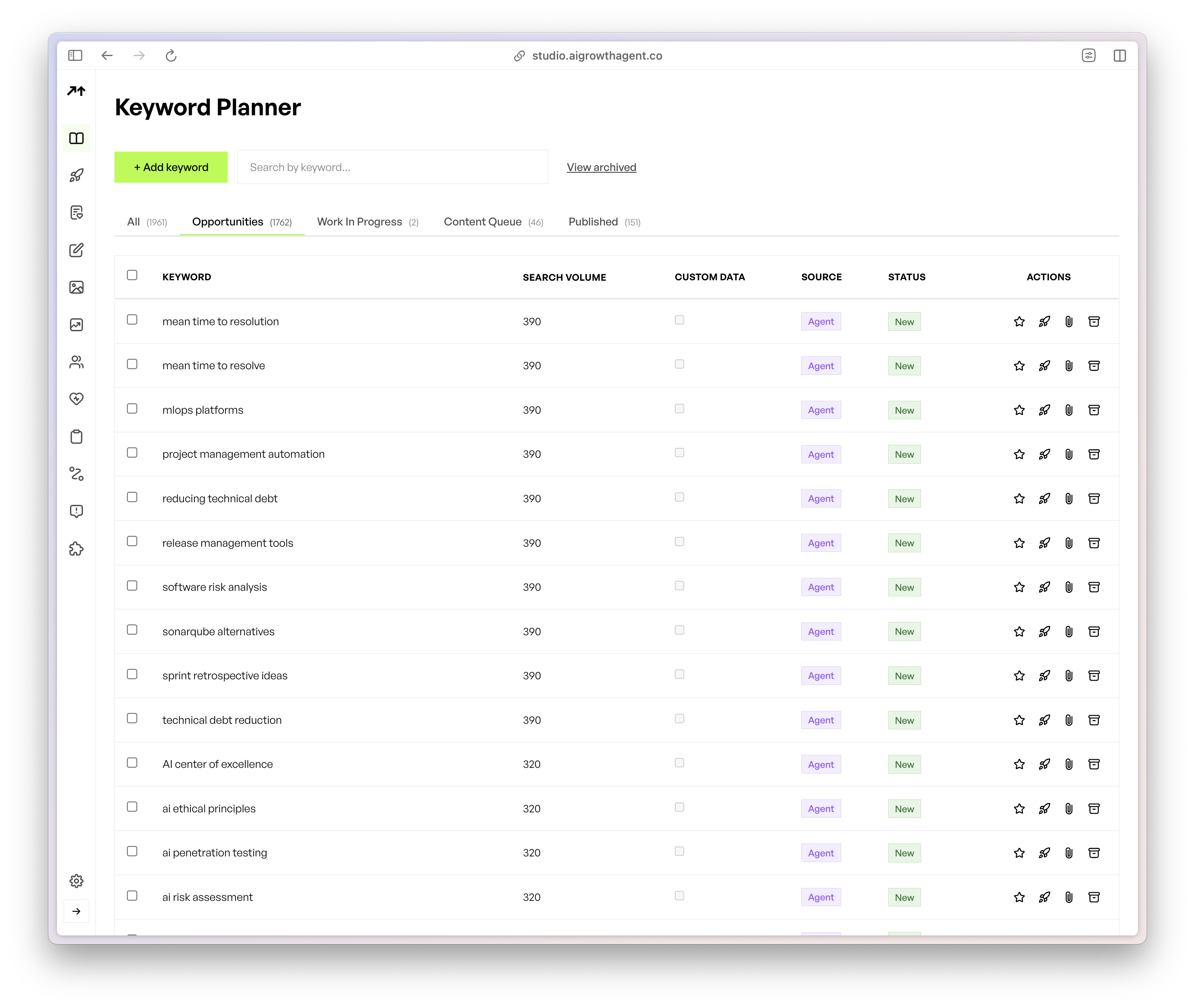
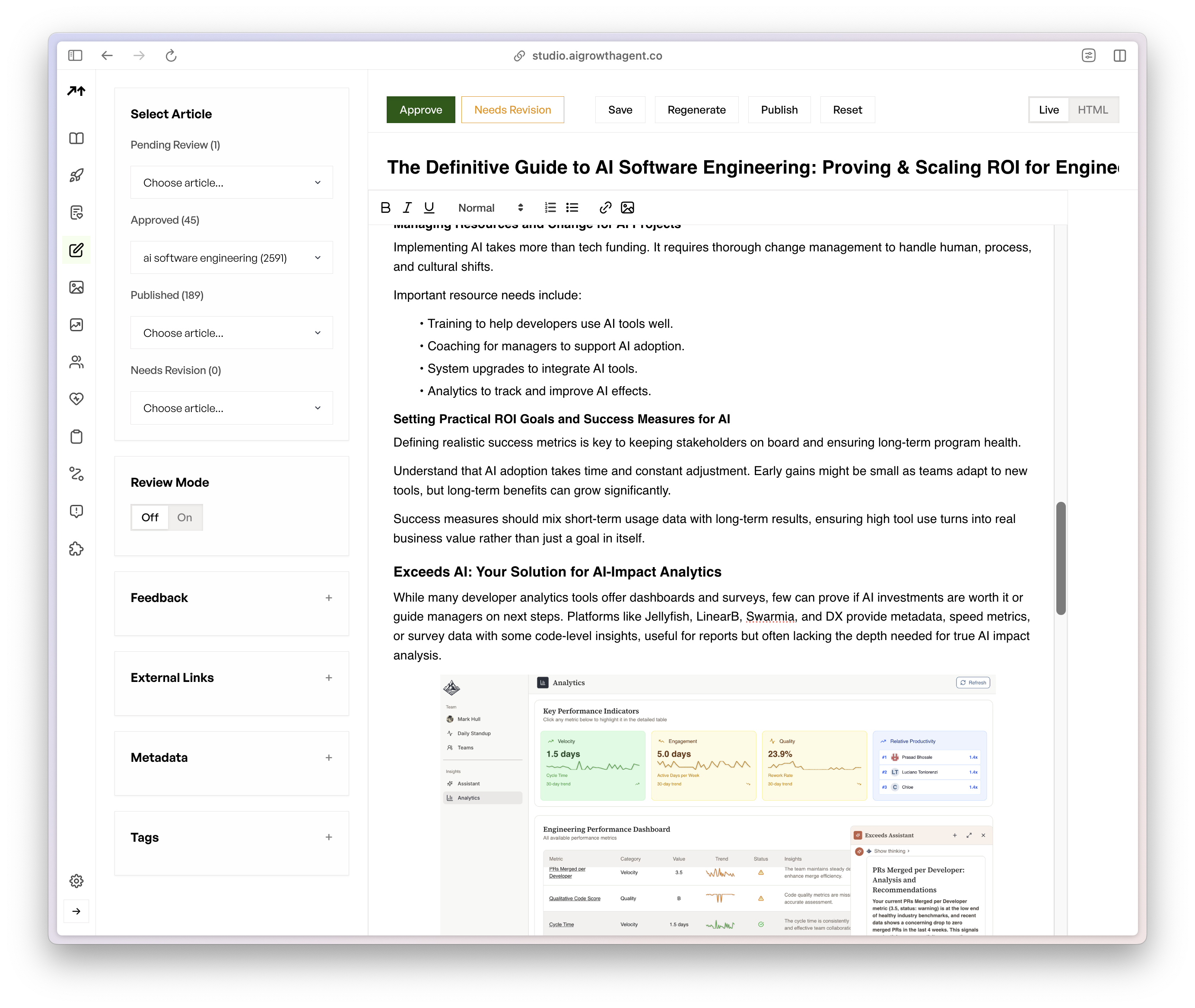
Programmatic SEO Content Agent
The Programmatic SEO Content Agent manages the content lifecycle from strategy through optimization. It creates briefs, performs research that aligns with your positioning and credible sources, and generates long-form articles built for both readers and AI crawlers.
The system also applies advanced technical SEO features, including rich schema, internal links, and optimized metadata. These elements help AI platforms interpret each piece of content and connect it to the right topics and entities.
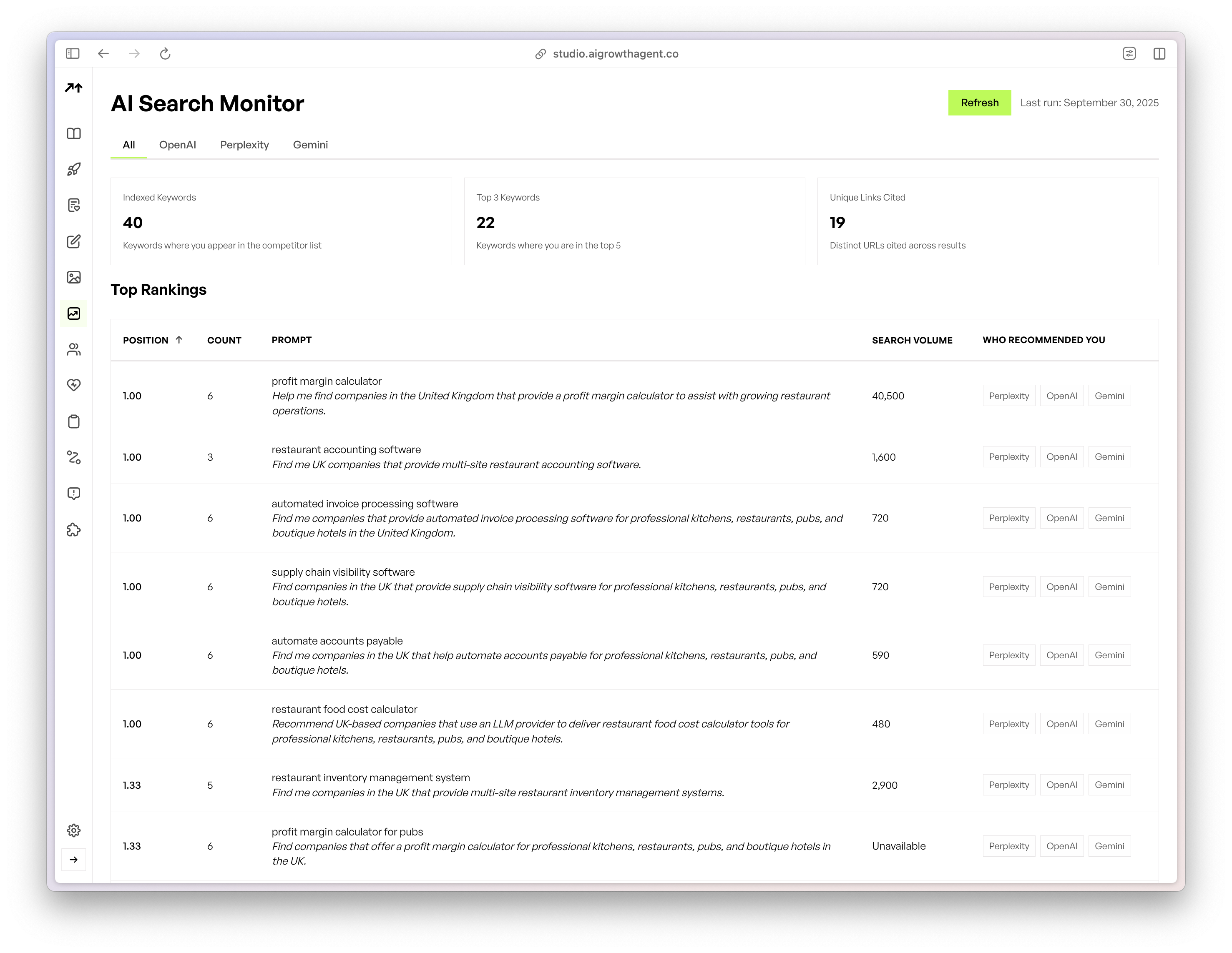
AI Search Monitor and Feedback Loop
The AI Growth Agent Studio tracks how your brand appears across ChatGPT, Google AI Overviews, and Perplexity. The dashboard highlights URLs that drive AI visibility, shows direct quotes and citations from AI answers, and reports crawl activity.
These insights create a feedback loop so teams can adjust topics, structure, and technical settings based on real AI search behavior.
Multi-Tenant Programmatic Deployment for Portfolios
Enterprise marketers often manage several brands with different voices and strategies. AI Growth Agent supports multi-tenant deployment, so teams can run parallel Programmatic SEO Content Agents from one interface.
Each brand instance maintains its own tone, keyword plan, and publishing rules, while still benefiting from shared technical infrastructure and monitoring.
Why Traditional Solutions Struggle To Deliver Consistent AI Brand Mentions
|
Feature |
AI Growth Agent |
SEO Agencies |
AI Content Tools |
|
Content Scale |
High, software-driven publishing capacity |
Limited by team size and workflows |
Depends on users and processes |
|
Technical Optimization |
Automated schema, LLM.txt, and MCP setup |
Varies by expertise and toolset |
Often focused on copy, not full stack |
|
AI Search Visibility |
Built to support direct AI citation |
May target AI visibility as an add-on |
Visibility impact varies by platform |
|
Content Velocity |
Supports frequent, ongoing publishing |
Constrained by capacity and budgets |
Requires extra systems for scheduling |
Many traditional approaches were designed for web search rather than AI-generated answers. Manual content production, partial schema coverage, and limited crawl guidance often cannot match the volume and clarity that AI search engines now expect. AI Growth Agent addresses these gaps with a programmatic model that combines scale, structure, and monitoring in one system.
Schedule a consultation with AI Growth Agent to review how your current content and technical setup align with AI search requirements.
Frequently Asked Questions About Consistent Brand Mentions in AI Search
How do AI search engines decide which brands to mention?
AI search engines weigh factors such as content frequency, authority of the sources, topical relevance, and clarity of entity data when selecting brands to mention in responses.
Which factors most influence consistent brand mentions across platforms?
Key drivers include domain authority, content depth and recency, structured data implementation, and stable associations between your brand and specific topics across many indexed pages.
Beyond backlinks, what signals do LLMs use to judge brand authority?
Large language models look at mention patterns, co-occurrence with trusted entities, sentiment of coverage, and freshness of information in addition to link-based metrics.
How can I track my brand’s mentions in AI search engines?
Teams can monitor brand presence by checking citations, keyword visibility, and quoted passages across AI platforms, or by using tools like AI Growth Agent Studio that centralize these signals.
What role does structured data play in AI search visibility?
Structured data gives AI crawlers explicit information about entities, relationships, and attributes, which improves recognition accuracy and increases the likelihood of precise brand citations.
Conclusion: Secure Your Brand’s Position in AI Search
AI-driven search has become a core channel for discovery, evaluation, and recommendation. Brands that show up inconsistently across these systems face growing competitive risk, while those with clear, programmatic content strategies build more stable visibility.
AI Growth Agent provides a practical path to that stability through autonomous content engineering, technical optimization, and AI search monitoring. The result is a more consistent and measurable presence across major AI platforms.
Schedule a consultation session with AI Growth Agent to evaluate your current AI search footprint and explore how programmatic SEO can strengthen your brand’s authority in 2026.
