AI assistants such as ChatGPT, Gemini, and Perplexity now sit between your audience and your website. This comparison is written for CMOs, VPs, and Directors who already use tools like Semrush, Ahrefs, or BuzzSumo and want to understand how these tools fit alongside autonomous content platforms that focus on AI search.
If you are actively evaluating your stack or planning a 2025 content intelligence platform comparison project, use this guide to clarify the role of analytics tools and the point at which an autonomous execution engine becomes necessary.
- AI search is changing how customers discover brands and how content is evaluated and cited.
- Most content intelligence platforms provide strong analytics but do not execute daily, AI-ready publishing at scale.
- This guide outlines key evaluation criteria for AI-ready content intelligence platforms in an AI search environment.
- It compares analytics tools, content ideation platforms, customer intelligence platforms, and autonomous content platforms.
- It explains how AI Growth Agent uses autonomous agents, AI search optimization, and automated publishing to build durable authority.
- It helps enterprise marketing leaders decide where analytics should stop and where autonomous execution should begin.
The AI Search Transformation: Why Traditional CIPs Are Not Enough
For the last decade, SEO centered on blue links and ten-result SERPs. Teams identified keywords, created optimized pages, and built authority through backlinks. Tools evolved around this model with rank trackers, backlink analyzers, SERP scrapers, and site audit platforms becoming standard.
That environment is changing. AI assistants and chat-based search experiences increasingly sit between your audience and your website. Instead of a list of links, users see synthesized answers pulled from the web and from proprietary models. If your content is not being cited, summarized, and recommended inside those AI responses, your brand has limited presence in this new discovery layer.
Three shifts are driving this transformation:
- AI intermediates the relationship between user and brand. Users are asking ChatGPT, Gemini, and Perplexity in addition to traditional search engines, and these systems decide which brands are authoritative enough to quote.
- AI is multiplying content volume daily. As AI-generated content floods the web, your existing content footprint occupies a smaller share of the overall landscape. Static, low-frequency content strategies lose relevance quickly.
- Quality daily publishing has become baseline. To stay visible to large language models, you need a sustained cadence of in-depth, accurate, and current content across your key topics, often at a daily publishing rhythm.
Traditional solutions were not designed for this environment:
- SEO agencies are constrained by people and billable hours. They can produce a limited number of strong assets but cannot match the required scale and speed without significant cost increases.
- Internal teams understand your brand deeply but are already at capacity. Expecting them to operate as a 24/7 content newsroom, technical SEO team, and AI search specialist group at once is difficult to sustain.
- Basic AI tools and prompt templates generate content but do not provide an end-to-end, AI-search-optimized system. They still require human strategy, editing, quality assurance, technical SEO, and CMS implementation, which creates fragmented workflows and variable quality.
Even with solid content and capable tools, brand share of voice inside AI search responses can decline over time. Competing effectively in this environment requires more than dashboards and keyword lists. It calls for an autonomous platform that combines content intelligence, daily execution, and AI-native technical SEO in one system.
To evaluate how close your current stack is to that standard, it helps to define what AI-ready really means for a content intelligence platform.
Key Evaluation Criteria for AI-Ready Content Intelligence Platforms
Evaluating content intelligence platforms in the AI search era is no longer only about better analytics. Platform decisions now influence whether AI systems cite or overlook your brand. Effective criteria should extend beyond dashboards into execution, automation, and AI-native optimization.
Use the following dimensions to evaluate any CIP for AI readiness.
1. Content generation and authority
Many CIPs help you decide what to publish. Fewer create that content, and fewer still produce authoritative, accurate, brand-aligned narratives at scale.
- The platform should generate long-form, high-quality content that can stand on its own as thought leadership.
- The platform should incorporate your proprietary point of view, data, and stories rather than relying only on generic web-sourced text.
- The platform should support a publishing volume, often daily, that can move the needle on authority for AI search.
2. Native AI search optimization (LLM.txt, MCP, semantics)
Traditional SEO optimization focuses on titles, meta descriptions, and structured data. AI search introduces new layers of configuration and signaling.
- LLM.txt files signal to AI models what content exists and how to interpret it.
- Model Context Protocol (MCP) or similar interfaces allow AI agents to access and query your content directly.
- Deep semantic structuring helps content surface as the best answer for complex, multi-step queries.
Any CIP positioned as AI-ready should support these capabilities directly or integrate closely with a platform that does.
3. End-to-end workflow automation
Data without execution remains a report, not a solution. For AI-era marketing teams, the priority is to maximize how much of the content lifecycle the platform can own autonomously.
- Keyword research and topic clustering
- Brief creation and outline design
- Drafting, fact-checking, and editing
- Technical SEO and AI search optimization
- Publishing to your CMS or hosted blog
The less human intervention required between insight and a published article, the more time your team has for strategy and experimentation.
4. Enterprise scalability and multi-brand management
Many premium brands manage portfolios that span multiple products, regions, or companies. Your CIP should support this structure without adding linear headcount.
- High-volume publishing across hundreds or thousands of keywords
- Multiple brands or lines of business with distinct voices and strategies
- Central oversight with flexibility for local teams
Evaluate whether the platform can run parallel content strategies for multiple brands while preserving governance and consistency.
5. Advanced analytics and reporting, including AI search visibility
Traditional metrics such as organic traffic, rankings, and backlinks remain important. In an AI-first world, additional visibility metrics are required.
- Frequency and context of brand citations by AI assistants
- Heatmaps of large language model indexing across ChatGPT, Gemini, Perplexity, and similar systems
- Article-level insight into which content drives AI visibility and downstream conversions
6. Automated technical SEO
Execution quality must remain consistently high across a growing content library.
- Standard SEO elements such as titles, meta descriptions, schema, and internal linking
- AI-era files such as robots.txt, LLM.txt, and MCP endpoints
- Reliable implementation across large archives of content
Manual technical implementation at scale is difficult to maintain. The platform should embed technical SEO and AI-search-specific configuration directly into its publishing process.
With these criteria in place, we can look at how major CIP categories compare and where they leave gaps that autonomous platforms such as AI Growth Agent are designed to address.
Leading Content Intelligence Platforms: A Deep Dive for AI Search
Foundational analytics and competitive intelligence (for example, Semrush, Ahrefs, Similarweb)
Tools such as Semrush, Ahrefs, and Similarweb form the backbone of many enterprise SEO stacks. They excel at clarifying the landscape: who ranks for which queries, how competitors acquire traffic, and where content gaps exist.
Platforms such as Semrush and Ahrefs provide robust competitive intelligence across traffic, keywords, backlink profiles, and digital market share, while Similarweb offers broad market-wide digital analytics for cross-channel benchmarking.
Strengths
- Deep keyword and SERP analysis across large query sets
- Backlink profiles, content gap analysis, and rank tracking
- Market share and category-level visibility
- Site audit capabilities with technical SEO recommendations
Limitations for AI search
- Analytics-driven focus that informs strategy but does not create or publish content
- Manual and resource-intensive implementation of technical SEO suggestions
- No native automation of emerging AI search artifacts such as LLM.txt or direct MCP integrations
- Assumption that a human team or agency will convert insights into AI-optimized content
Semrush and Ahrefs highlight where opportunity exists, but they do not act on it. They work well as inputs to an autonomous content system, but they do not replace one.
Content performance and ideation (for example, BuzzSumo)
BuzzSumo and similar platforms specialize in identifying what resonates across social networks and publishers. They offer valuable input for ideation and performance benchmarking.
BuzzSumo focuses on content intelligence by surfacing high-engagement topics, headlines, and creators based on shareability and social performance data.
Enterprise marketers rely on BuzzSumo for deep social analytics, especially around Facebook content, and for data-driven content topic suggestions that guide planning and outreach.
Strengths
- Identification of trending topics and formats with strong viral potential
- Engagement analysis across social networks and publishers
- Support for prioritizing topics likely to resonate with human audiences
Limitations for AI search
- Primary focus on human-centric engagement metrics rather than AI-centric visibility
- No autonomous generation of long-form, authoritative content
- Limited direct integration with AI writing tools or AI search optimization workflows
BuzzSumo serves as a useful radar for the topics people discuss. AI search, however, requires consistent publication of definitive, well-structured answers to those topics.
Customer intelligence platforms (for example, SAS Customer Intelligence 360, Amperity AmpIQ, Dataforce)
Customer intelligence platforms sit adjacent to content intelligence. They focus on unifying data from marketing, sales, and behavioral sources to drive personalization and targeting strategies.
Solutions like SAS Customer Intelligence 360, Amperity AmpIQ, and Dataforce aggregate cross-channel data and apply AI and machine learning to segmentation, journey mapping, and market or competitor tracking.
Strengths
- Advanced audience segmentation and personalization
- Predictive analytics for customer lifetime value and retention
- Campaign measurement and ROI attribution
- Real-time alerts for competitive or market shifts, especially with tools such as Dataforce
Limitations for AI search
- Indirect impact on content, since they inform who to target rather than creating content automatically
- Implementation complexity and integration requirements for enterprises with many data sources
- No native support for AI search artifacts such as LLM.txt, MCP, or automated technical SEO
Customer intelligence is important for smarter targeting and personalization. On its own, it does not publish a blog post or build an AI-optimized knowledge base for your category.
Autonomous content platforms (for example, AI Growth Agent)
Autonomous content platforms form a distinct category. Rather than stopping at analysis, they act on data by researching, writing, optimizing, and publishing content with limited human input.
AI Growth Agent is built for this environment. It deploys a system of orchestrated AI agents that mirror and scale the work of a content agency without tying output to billable hours. From keyword strategy to technical SEO to AI search optimization, it functions as an always-on content organization rather than a single-purpose tool.
Strengths
- Full lifecycle automation that covers research, ideation, drafting, editing, and publishing
- Native AI search optimization that includes advanced LLM.txt and Model Context Protocol implementation
- Hosted, technically optimized blog deployment that matches your brand and reduces engineering overhead
- Parallel agent deployment so multiple brands or business lines can run distinct content strategies simultaneously
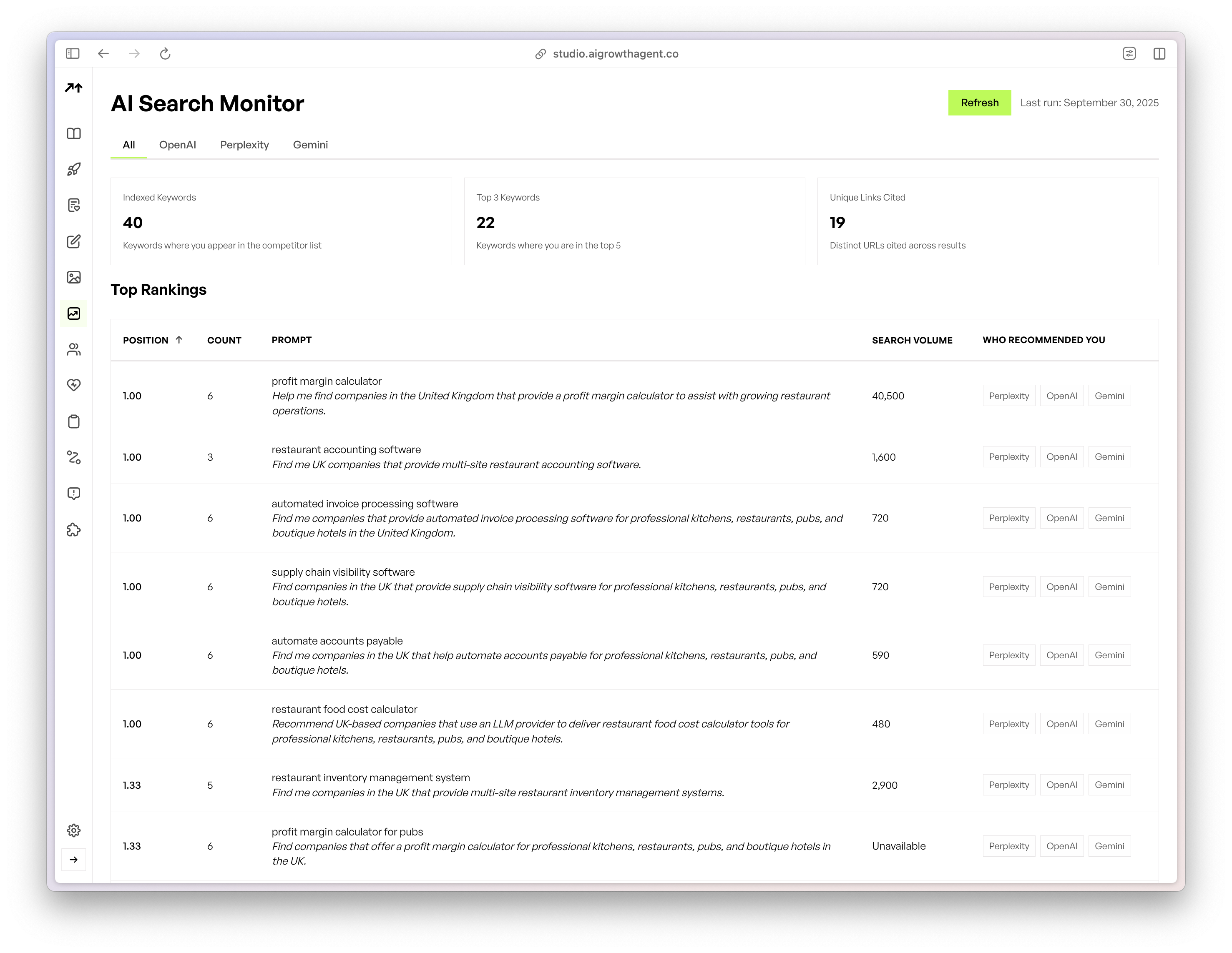
- AI Search Monitor that tracks citations and indexing across leading large language models
Limitations
- Designed for brands with a stable technical SEO foundation, not as a primary tool for repairing heavily broken sites
- Works best as the primary execution engine, complemented but not replaced by existing analytics tools
Where analytics-focused CIPs stop at recommendations, AI Growth Agent continues through execution and ongoing optimization.
Content Intelligence Platform Comparison Table: Features and AI Readiness
The table below provides a high-level comparison of leading content intelligence platform categories and their readiness for AI search in 2025.
A comparative look at leading content intelligence platforms and their capabilities for AI search in 2025.
|
Platform / Category |
Core focus |
AI content generation |
AI search optimization (LLM.txt / MCP) |
|
Semrush / Ahrefs (analytics and competitive) |
SEO, keyword research, competitive analysis |
No |
Limited / indirect |
|
BuzzSumo (content ideation and performance) |
Content ideation, social performance |
No |
Limited / indirect |
|
Customer intelligence platforms |
Customer data, segmentation, personalization |
No |
Indirect |
|
AI Growth Agent (autonomous content) |
Autonomous content, AI authority, AI search visibility |
Yes |
Native (LLM.txt, MCP) |
Tools like Ahrefs and BuzzSumo are valuable for analytics, ideation, and technical SEO insights, but they operate as planning platforms rather than autonomous content engines for AI search.
For most enterprises, a strong stack combines these strengths. Existing analytical CIPs remain important, but they benefit from being connected to a platform that can execute continuously on the opportunities they surface.
AI Growth Agent: An Autonomous Approach to AI Search Authority
AI Growth Agent is an autonomous content platform designed to help your brand become a consistent, credible source that AI search engines recognize and cite. It deploys specialized AI agents to support companies that want to lead their category.
Instead of relying on manual workflows, AI Growth Agent replaces traditional content processes with a system of autonomous agents configured to handle each step of the content lifecycle, with quality control and brand alignment integrated into the process.
The following sections outline how this works end-to-end.
White-glove onboarding and the Company Manifesto
The process starts with a one-hour kickoff session led by a professional journalist. This session explores your business, positioning, and narrative in depth. From that conversation, AI Growth Agent creates a Company Manifesto, a structured reference that encodes your brand voice and perspective.
The Manifesto guides every subsequent article so that AI-generated content aligns with your brand and reinforces the story you want AI search engines to understand.
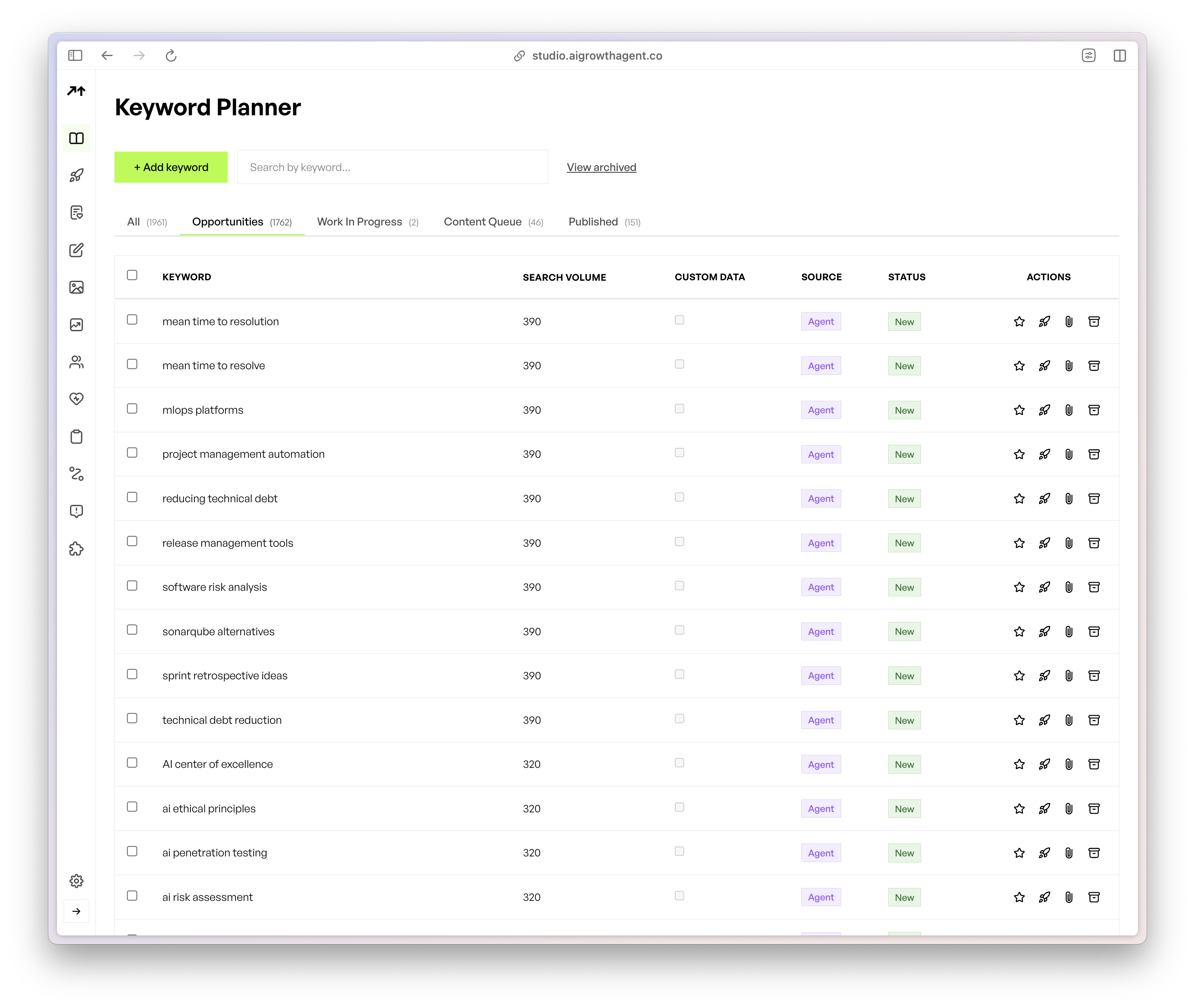
Keyword Deep Research Agent
After onboarding, the Keyword Deep Research Agent activates. It evaluates tens of thousands of relevant search queries and topics in your domain. Within roughly 24 hours, it delivers a structured keyword strategy organized into categories and themes.
This strategy is designed to fit your brand positioning and support a sustained, often daily publishing cadence.

Autonomous blog deployment
AI Growth Agent reduces operational friction by standing up a dedicated, optimized blog as a subdomain such as blog.yourcompany.com that matches your existing site design. This hosted environment is configured for strong technical SEO and AI search optimization out of the box, with schema markup, controlled robots.txt, LLM.txt files, and Model Context Protocol endpoints so AI agents can query your content directly.
For brands on existing CMS platforms such as WordPress or HubSpot, AI Growth Agent can integrate directly. The hosted blog option is recommended for performance and implementation speed, but the platform still delivers content and enhancements if you remain on your current CMS.
The Core Content Agent
The Core Content Agent is the center of AI Growth Agent’s system. This specialized agent executes the content lifecycle at scale.
- Strategy and briefing: generates a detailed brief for each keyword or topic cluster.
- Research: synthesizes information from your Manifesto and credible web sources.
- Drafting: writes comprehensive articles ranging from tactical how-to pieces to in-depth pillar content.
- Fact-checking and refinement: validates key claims and refines the narrative.
- Technical engineering: decorates posts with schema markup, metadata, optimized images, and AI-specific files such as LLM.txt and MCP definitions.
The output is content that consistently reflects your narrative and value propositions across each piece.

The Studio: your command center
All activity is visible and controllable from AI Growth Agent Studio. In this interface, your team can manage quality, timing, and feedback.
- Review drafts, add edits, and provide guidance
- Approve or auto-approve content for publishing
- Monitor the content queue and publishing calendar
Over time, the agent learns from your feedback and improves. Many teams move toward a model where they are comfortable with fully autonomous publishing on defined topics.
AI Search Monitor and Performance Agent
AI Growth Agent’s AI Search Monitor tracks how your content performs in AI-driven environments and in traditional search.
- Frequency with which large language models such as ChatGPT, Gemini, and Perplexity index and cite your content
- URLs and articles that drive the strongest AI visibility
- Comparative AI search footprint versus competitors on critical queries
- Bots crawling your content and how often they do so
By connecting with Google Search Console, the platform links AI visibility to standard SEO metrics such as organic traffic and clicks.


Parallel agents and real-time content capabilities
AI Growth Agent includes capabilities that are especially useful for enterprises with multiple brands and fast-moving topics.
- Parallel agent deployment: AI Growth Agent can run multiple content agents in parallel for multi-brand enterprises or portfolios, each with its own Manifesto and strategy, all managed from a single interface.
- Real-time content generation: when your team provides a link to breaking news, AI Growth Agent can draft a timely response in your voice to capture emerging search demand.
- Custom data integration: proprietary datasets can be transformed into SEO-focused article series with unique perspectives.
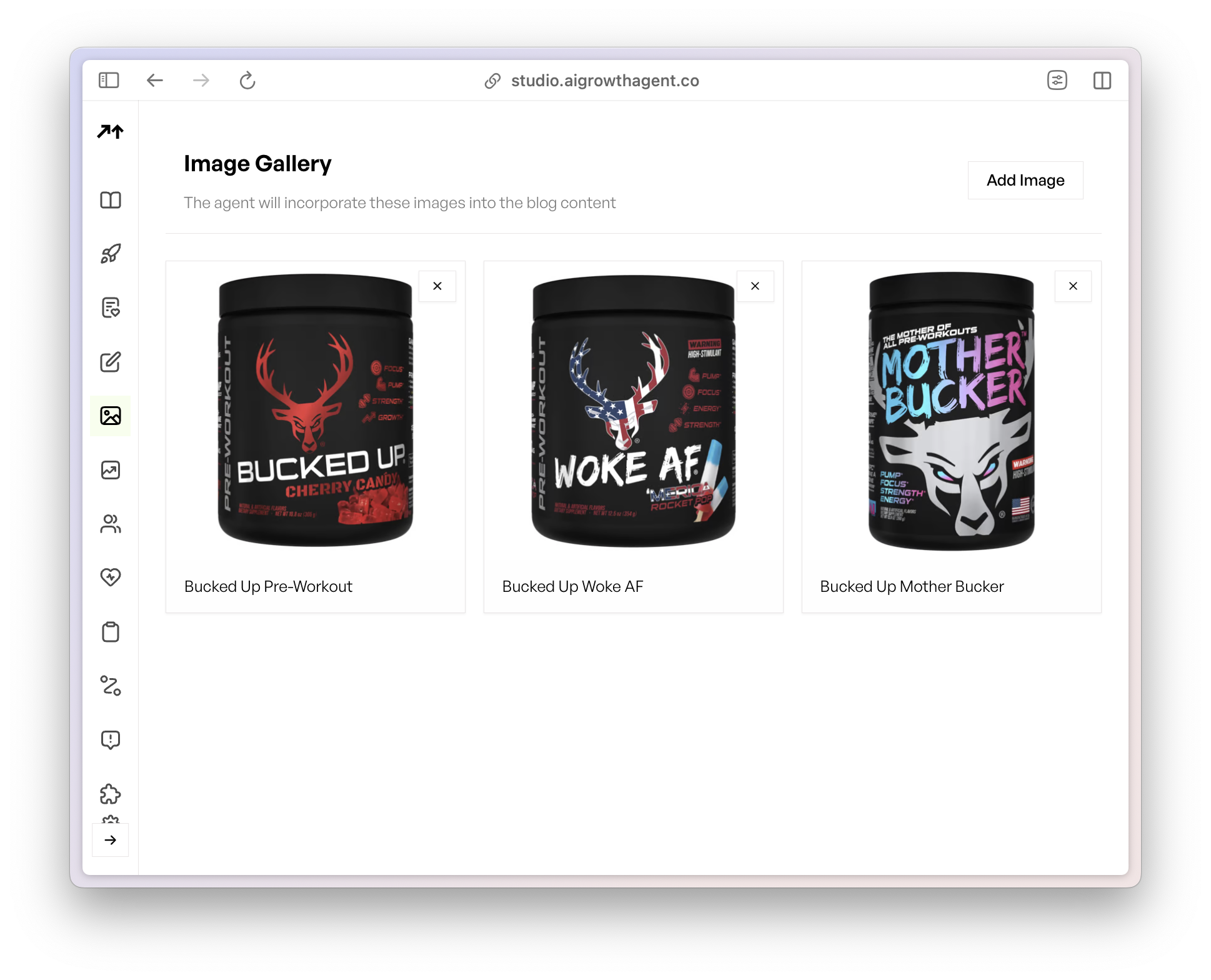
- Intelligent image placement: your brand images can be uploaded so the platform automatically inserts and optimizes visuals within posts.

Together, these features create a scalable system that produces high-quality, AI-optimized content at a volume and consistency that is difficult to achieve with manual workflows.
Frequently Asked Questions (FAQ)
1. How do traditional CIPs such as Semrush or Ahrefs differ from an autonomous content platform like AI Growth Agent?
Traditional CIPs such as Semrush or Ahrefs operate primarily as analytics and research tools. They help you understand keyword opportunities, competitor performance, and technical SEO issues, but they require your team or an agency to transform those insights into content.
AI Growth Agent functions as an autonomous content platform. It handles keyword research, content strategy, drafting, technical SEO, AI-specific optimization with elements such as LLM.txt and Model Context Protocol, and publishing to a technically optimized blog, while still giving your team control through the Studio.
2. Can AI Growth Agent integrate with my existing CMS or marketing stack?
Yes. AI Growth Agent can integrate with popular CMS platforms such as WordPress, HubSpot, Webflow, Framer, and Sanity. Many clients choose the hosted blog option, deployed as a subdomain that matches the main site design. The hosted implementation is engineered for strong technical SEO and AI search readiness and helps remove development bottlenecks. If you remain on your existing CMS, AI Growth Agent still delivers content and enhancements, although the hosted blog provides the most controlled setup.
3. What kind of ROI can I expect from investing in an autonomous content platform for AI search?
Return on investment generally comes from three areas:
- Increased organic and AI-driven visibility: daily publishing expands your footprint in both traditional and AI search environments.
- More qualified leads: as AI search engines surface your content, high-intent visitors are more likely to encounter your brand.
- Operational leverage: a scalable system can reduce the need for large content teams or agency retainers while maintaining or increasing publication volume.
AI Growth Agent’s AI Search Monitor and Google Search Console integration make results measurable by showing growth in AI citations, organic traffic, and clicks tied to content produced by the platform.
4. Will the content still sound like our brand, or will it feel generic and AI-written?
The Company Manifesto captures your brand voice, positioning, and value propositions during onboarding. This reference ensures that content aligns with your identity. Within the Studio, you can review outputs and share feedback. Over time, the agent adapts to your preferences and produces content that reflects your internal perspective rather than generic AI output.
5. Is AI Growth Agent a replacement for my SEO agency or content team?
AI Growth Agent replaces much of the execution layer typically handled by agencies and large content teams, allowing internal marketers to focus on strategy, positioning, and experimentation. Some brands fully replace their SEO agency with AI Growth Agent, while others retain agencies for higher-level strategy and use the platform for daily publishing and optimization, which reduces reliance on manual production.
Conclusion: Selecting the Right Content Intelligence Platform for AI Search
AI search is turning content into a durable competitive asset. Brands that AI systems recognize and cite as authoritative will gain a structural advantage in discovery and trust. Building that position requires more than keyword research and dashboards. It requires an engine that ships technically sound content at a consistent, high-frequency cadence.
Analytics-first content intelligence platforms such as Semrush, Ahrefs, BuzzSumo, and customer intelligence tools remain important for understanding demand, audiences, and competitors. On their own, they do not convert insights into an AI-optimized content library without placing significant pressure on your team.
AI Growth Agent addresses this execution gap. As an autonomous content platform, it combines research, brand-aligned writing, technical SEO, and AI-native optimization in a continuous system that works to build authority and visibility in AI search.
For brands with a strong foundation and a goal of leading their category, now is a logical moment to update the definition of a content intelligence platform and include autonomous execution as a core requirement.