


Key Takeaways
- AI search and zero-click experiences reduce clicks to websites, so traditional metrics like sessions and rankings no longer capture the full impact of content.
- Integrated content automation and ROI tracking connect content activity to revenue, pipeline velocity, and customer acquisition cost, making budget conversations more objective.
- Marketing leaders who centralize data and adopt AI-era KPIs, including AI citations and information gain, gain clearer insight into content performance across complex journeys.
- Programmatic SEO and continuous feedback loops help teams scale high-quality content while steadily improving attribution accuracy and return on investment.
- AI Growth Agent provides an autonomous content and ROI tracking platform built for AI search, and marketing leaders can schedule a demo to see if it fits their content and measurement needs.
The Problem with Traditional Content Marketing ROI in the AI Search Era
Marketing leaders in 2026 face mounting pressure to prove revenue impact as budgets move toward channels with clear attribution, a pattern detailed in this analysis on the ROI reckoning facing CMOs. Standard SEO dashboards built around sessions, rankings, and bounce rate tell only part of the story when AI systems answer many queries directly.
AI search now rewards brands that contribute distinct information and expertise, and effective measurement reflects that shift. A modern framework tracks brand citations inside AI answers, information gain, AI answer share of voice, and attributed revenue from those interactions, an approach outlined in this overview of CMO-focused SEO metrics for the AI search era.
Data silos, misaligned definitions between Sales and Marketing, and weak UTM governance still distort reporting and make ROI harder to prove, as described in this discussion of cross-team measurement challenges for marketing leaders. Complex omnichannel journeys and incomplete attribution further complicate content performance evaluation, a trend explored in this breakdown of digital marketing ROI measurement in 2026 across channels and touchpoints.
The Cost of Unproven ROI: Losing Budget and Influence
Teams that cannot connect content to revenue often see budgets reduced, and this budget contraction decreases brand visibility in both search and AI-assisted discovery, a pattern described in this analysis of marketing spend under scrutiny when ROI is unclear. With many marketers still struggling to measure return accurately, leaders who can present credible ROI numbers gain an advantage in internal planning and investment decisions, a point reinforced in this review of ROI measurement challenges facing modern teams.
The Solution: Content Marketing Automation with Integrated ROI Tracking
Content marketing automation with built-in measurement helps teams meet demand for more content while maintaining quality and traceability. Instead of scattered tools for research, writing, publishing, and reporting, a unified platform links content planning, production, and analytics to the same data model.
Integrated systems treat measurement as a core feature, not an add-on. Content performance flows directly into dashboards that show how assets influence awareness, pipeline creation, and revenue, closing the loop between creation and commercial outcomes.
Why Integrated Measurement Matters for AI-Era Content
Accurate ROI requires a clear link between content activity, cost, and outcomes. Content should contribute to lower customer acquisition cost and faster pipeline velocity, a principle described in this playbook for CMO-level SEO measurement focused on business outcomes.
Search-optimized and content-led programs can deliver strong long-term returns when tracked correctly, as shown in this overview of technology marketing ROI potential where long-term content efforts have produced significant gains. The website remains the central hub for content, conversion, and data collection, as detailed in this explanation of website ROI for modern organizations and why it still anchors digital strategy, so automation and analytics must treat it as the primary system of record.
Key Components of Effective Content Marketing Automation ROI Tracking in 2026
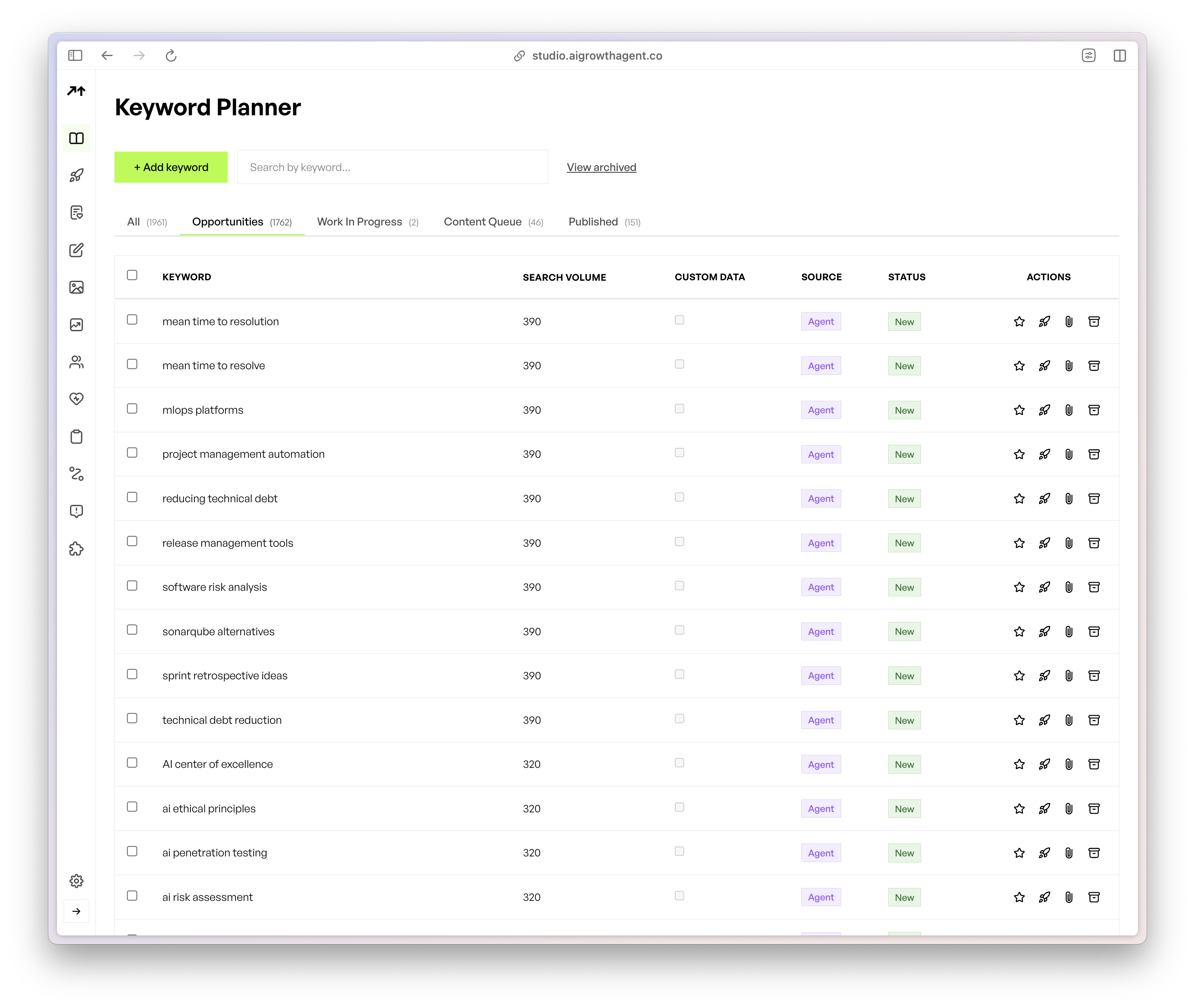
Effective ROI tracking focuses on business impact rather than surface-level activity. Modern platforms layer financial metrics, AI visibility metrics, and engagement data to show how content performs across search, AI systems, and the sales process.
Beyond Vanity Metrics: Focusing on Business Impact
Teams benefit from shifting emphasis from volume metrics, such as publishing cadence and raw traffic, to value metrics such as revenue contribution and high-intent leads tied to specific topic clusters, an approach described in this guide for CMOs on meaningful SEO metrics aligned with pipeline and revenue. Content should be evaluated on leads generated, sales influenced, retention impact, and cost savings, a framework outlined in this overview of content ROI measurement for marketing teams.
Forward-looking content programs track AI share of voice, keyword velocity, organic revenue, assisted conversions, and a content efficiency ratio that measures revenue per content dollar, an approach summarized in this metric set for AI-first SEO programs that blends leading and lagging indicators.
AI Search-Specific ROI Metrics Marketing Leaders Must Track
AI search introduces a new set of visibility metrics. Marketing teams now monitor brand citations within AI responses, information gain that reflects how content improves model knowledge, and AI answer share of voice across assistants such as ChatGPT, Gemini, and Perplexity. These metrics show whether content is shaping how AI systems describe a category and recommend solutions.
Overcoming Attribution Challenges for Accurate Content ROI
Attribution complexity still blocks clear ROI measurement, but better data practices can recover a large share of lost insight, as described in this breakdown of how improved tracking can reclaim missing attribution through first-party data and server-side methods. Advanced platforms apply consistent tagging, multi-touch attribution models, and CRM integration so that content influence on pipeline stages and revenue becomes visible instead of anecdotal.
The Role of Centralized Data Platforms in Marketing Intelligence
Centralized marketing intelligence improves decision-making and reporting. Aggregating and standardizing data across channels, campaigns, and tools supports accurate ROI analysis and more confident planning, a practice described in this resource on unified marketing data for better ROI reporting.
Comparison: Traditional vs. AI-Era Automated Content ROI Tracking
|
Feature |
Traditional Content ROI |
AI-Era Automated ROI |
|
Primary Metrics |
Sessions, Page Views, Rankings |
AI Citations, Organic Revenue, Pipeline Velocity |
|
Attribution Focus |
Last-click, Top-of-Funnel |
Multi-touch, Pipeline Acceleration |
|
Content Scale |
Manual, Limited |
Automated, High Volume |
|
Budget Justification |
Volume-based Reporting |
Revenue-attributable Reporting |
Marketing leaders who want a practical view of AI-era ROI tracking can book a demo of AI Growth Agent to see integrated measurement in action.
Implementing Content Marketing Automation for Measurable Results: The AI Growth Agent Approach
Implementation works best when strategy, measurement, and operations align. Clear objectives, defined KPIs, and shared definitions between Sales and Marketing keep automation focused on outcomes rather than activity.
Strategic Alignment: Defining Goals and KPIs for Content ROI
Effective teams set specific goals that include target audience, success metric, numeric target, and time frame, a planning approach detailed in this guide to proving content ROI with measurable objectives. KPIs then align directly with those objectives, such as qualified leads or engaged accounts, rather than surface-level interactions, a practice outlined in this overview of data-driven content marketing for modern teams.
The Role of a Programmatic SEO Agent
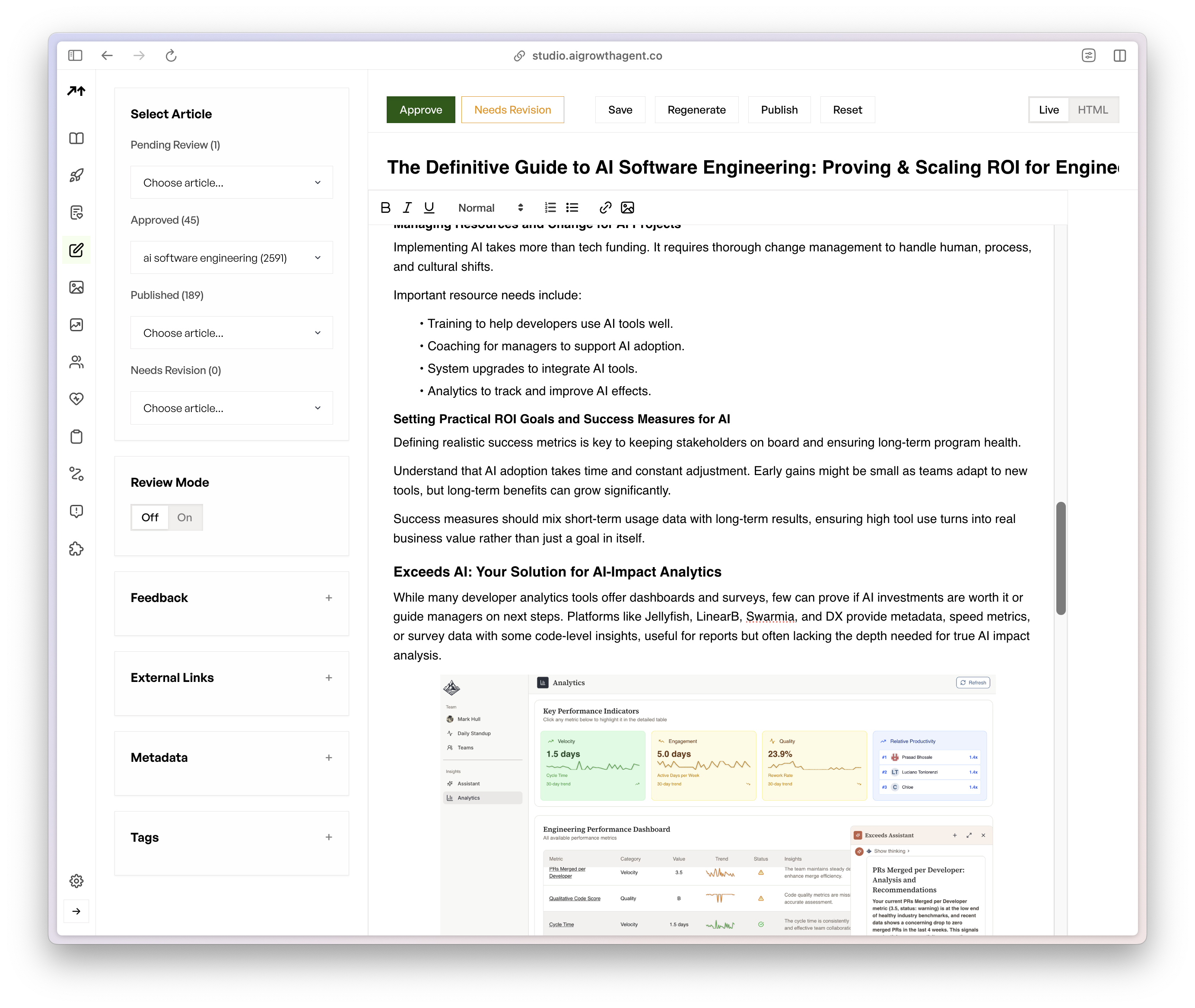
AI Growth Agent operates as a programmatic SEO agent that designs and publishes structured content architectures for a given category. The platform combines strategic planning, draft creation, and optimization with built-in ROI tracking so every content asset ties back to specific goals.
Its AI Search Monitor tracks brand citations, keyword velocity, and AI visibility across assistants such as ChatGPT, Gemini, and Perplexity while connecting that activity to revenue through integrations like Google Search Console.
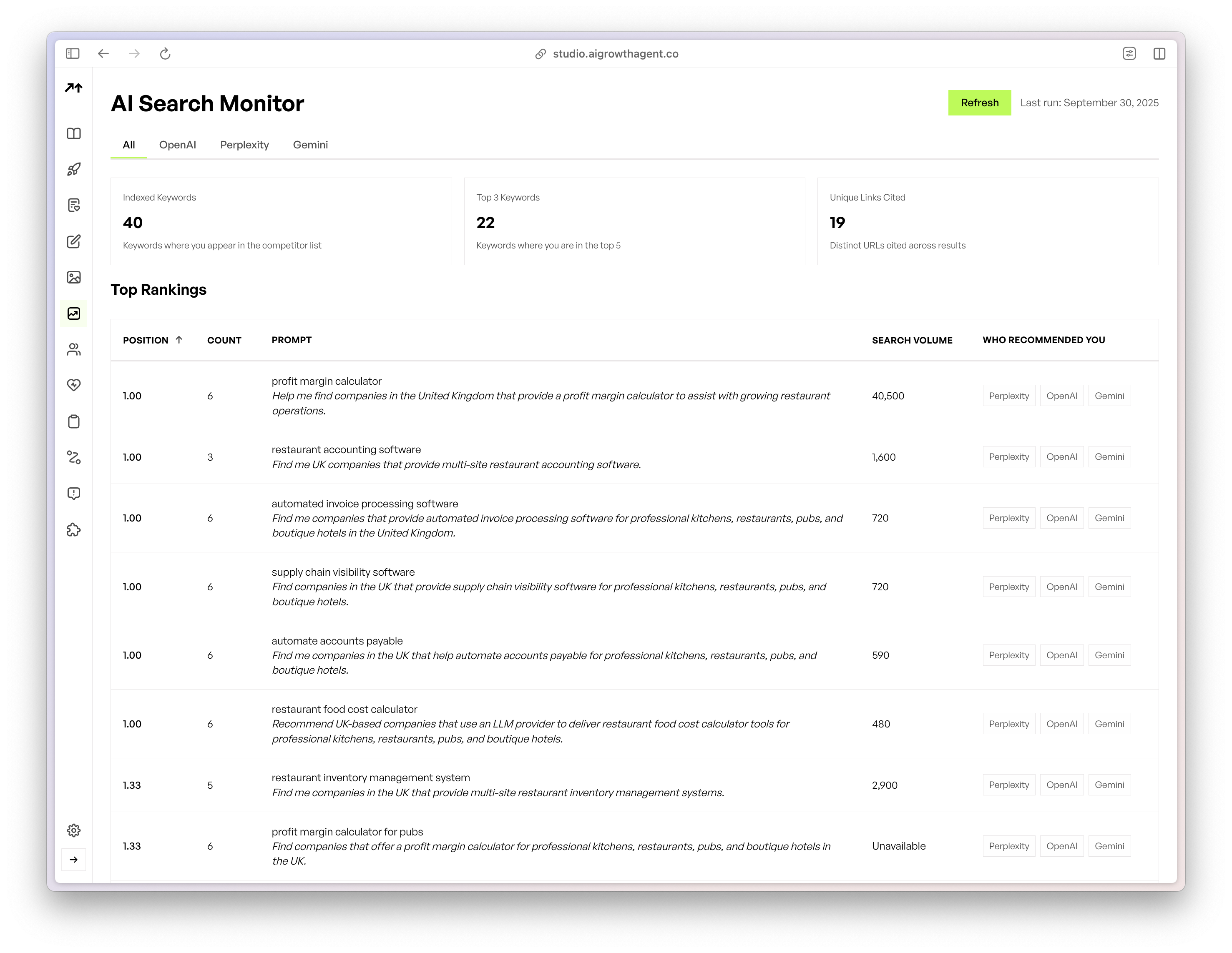
Continuous Optimization and Feedback Loops for Improved Content ROI
Ongoing measurement and iteration steadily improve content effectiveness over time, a process described in this overview of data-driven optimization cycles for marketing programs. AI Growth Agent analyzes which topics, formats, and pages earn AI citations and revenue, then feeds those insights back into the content roadmap so each new campaign benefits from previous data.
Frequently Asked Questions (FAQ) about Content Marketing Automation and ROI
How does content marketing automation improve ROI tracking in the era of AI search?
Automation platforms with integrated analytics make it possible to scale content, optimize for AI citations, and monitor AI-specific metrics such as share of voice and brand mentions. AI Growth Agent goes further by connecting ChatGPT and Google AI Overview visibility to pipeline and revenue data so marketing leaders can see how content influences business results and customer acquisition costs.
What new metrics should marketing leaders track to prove content ROI in an AI-driven landscape?
Leaders benefit from tracking AI share of voice across assistants, keyword velocity in AI results, brand citations in model responses, information gain, and attributed revenue for each content cluster. AI Growth Agent’s AI Search Monitor consolidates these metrics so teams can see which assets are shaping AI answers and contributing to commercial outcomes.
How does AI Growth Agent help marketing leaders demonstrate content ROI?
AI Growth Agent builds and manages content architectures optimized for AI search, then measures their performance through integrated tracking. The platform monitors AI citations, search visibility, and revenue signals, giving marketing leaders concrete evidence of how content supports brand visibility, pipeline creation, and sales.
Conclusion: The Future of Content Marketing ROI is Automated and Trackable
AI-driven search and increased executive scrutiny have raised the standard for content performance reporting. Traditional dashboards that focus on clicks and rankings no longer provide enough evidence to defend or grow budgets in 2026.
Content marketing automation with robust ROI tracking gives marketing leaders a practical way to meet these expectations. Scalable production, AI-focused optimization, and integrated analytics combine to show how content shapes awareness, supports sales, and contributes to revenue, a necessity in an environment where AI-generated content is widespread and performance must be proven, as outlined in this perspective on ROI for CMOs in an AI-heavy landscape with intense competition.
AI Growth Agent is designed for brands that want to compete in AI search with clear, defensible ROI. Leaders who want to evaluate this approach can schedule a demo with AI Growth Agent to review autonomous content, AI visibility tracking, and revenue-focused reporting.
