


Key takeaways from this article:
- AI search engines now prioritize entities, context, and authority over simple keyword matching, so content strategies must align with how large language models understand information.
- Programmatic content velocity, supported by AI agents, helps brands publish consistent, in-depth coverage across entire topic clusters instead of relying on slow, manual production.
- Advanced technical SEO, including structured data, LLM-specific files, and modern protocols, improves how AI systems index, interpret, and cite your content.
- AI-native monitoring, including tracking citations across tools like ChatGPT, Gemini, and Perplexity, creates feedback loops that guide ongoing optimization.
- Expert-level content that resolves full user journeys in a single experience increases both human engagement and the likelihood of being cited by AI systems.
- AI Growth Agent provides an AI agent-powered content platform that supports these strategies at scale, from research and drafting to technical implementation and monitoring.
The relationship between businesses and search engines has shifted from simple keyword targeting to complex semantic understanding. Traditional SEO once focused on keyword density and backlink volume. AI search engines now evaluate content through programmatic velocity, semantic coverage, and technical readiness that most manual workflows cannot sustain.
Marketing leaders who delay adaptation risk losing visibility as competitors adopt AI agent-powered platforms to build durable authority. This shift requires a reworked content strategy that moves from one-off manual creation toward programmatic authority building. Brands now need systems that can scale high-quality, technically sound content across entire knowledge areas to keep pace with AI-generated material published every day.
1. Prioritize Entity-First Content Architectures for AI Citation
AI search engines now parse content through entity recognition and relationships rather than isolated keywords. These systems focus on people, organizations, products, concepts, and how they connect, which changes how content should be planned and structured.
An entity-first content architecture defines and contextualizes the core entities in your market. Instead of writing around a single keyword, leading brands build interconnected resources around:
- Primary entities, such as core products, services, and customer segments
- Supporting concepts, such as use cases, workflows, and related problems
- Contextual signals, such as industries, geographies, and roles
This approach creates a content ecosystem that clarifies the knowledge graph around your expertise. AI systems can then identify consistent coverage, logical connections, and depth of understanding, which supports higher citation potential.
AI Growth Agent operationalizes entity-first architecture through its Programmatic SEO Agent. Instead of publishing isolated articles, the platform builds clusters of content that reinforce each other and position your brand as a reliable source on complete topic families within your industry.
2. Implement Strategic Programmatic Content Velocity for Recency and Depth
Content performance in the AI search era depends on both scale and quality. Programmatic content velocity describes a model where brands use AI agents to produce frequent, comprehensive content without sacrificing accuracy or structure.
Publishing one or two articles per month rarely covers enough surface area for AI systems to recognize consistent topical authority. AI search engines tend to favor content that is:
- Recently updated, with signals of ongoing maintenance
- Comprehensive, covering related subtopics and use cases
- Consistent, with regular publication across a clear topic map
Manual workflows struggle to keep up with these demands. An AI agent-powered content platform helps close this gap by automating research, drafting, and optimization across full keyword and entity clusters.
AI Growth Agent uses its Programmatic SEO Agent to research, write, fact-check, and technically optimize content across entire topic networks. The system supports:
- Automated keyword and entity clustering for full topical coverage
- Draft creation that reflects your brand guidelines and manifesto
- Built-in technical SEO so each piece is ready for AI indexing
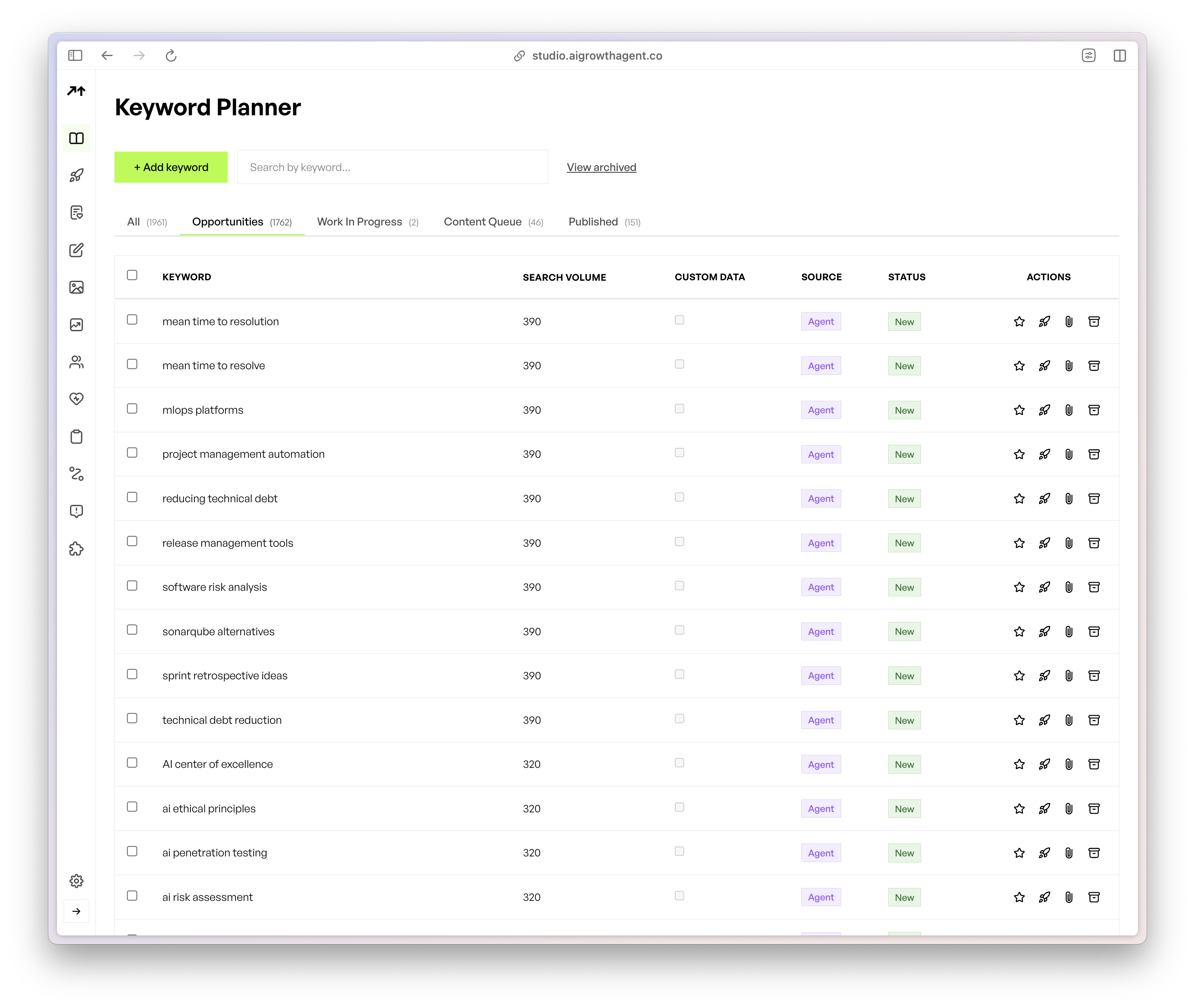
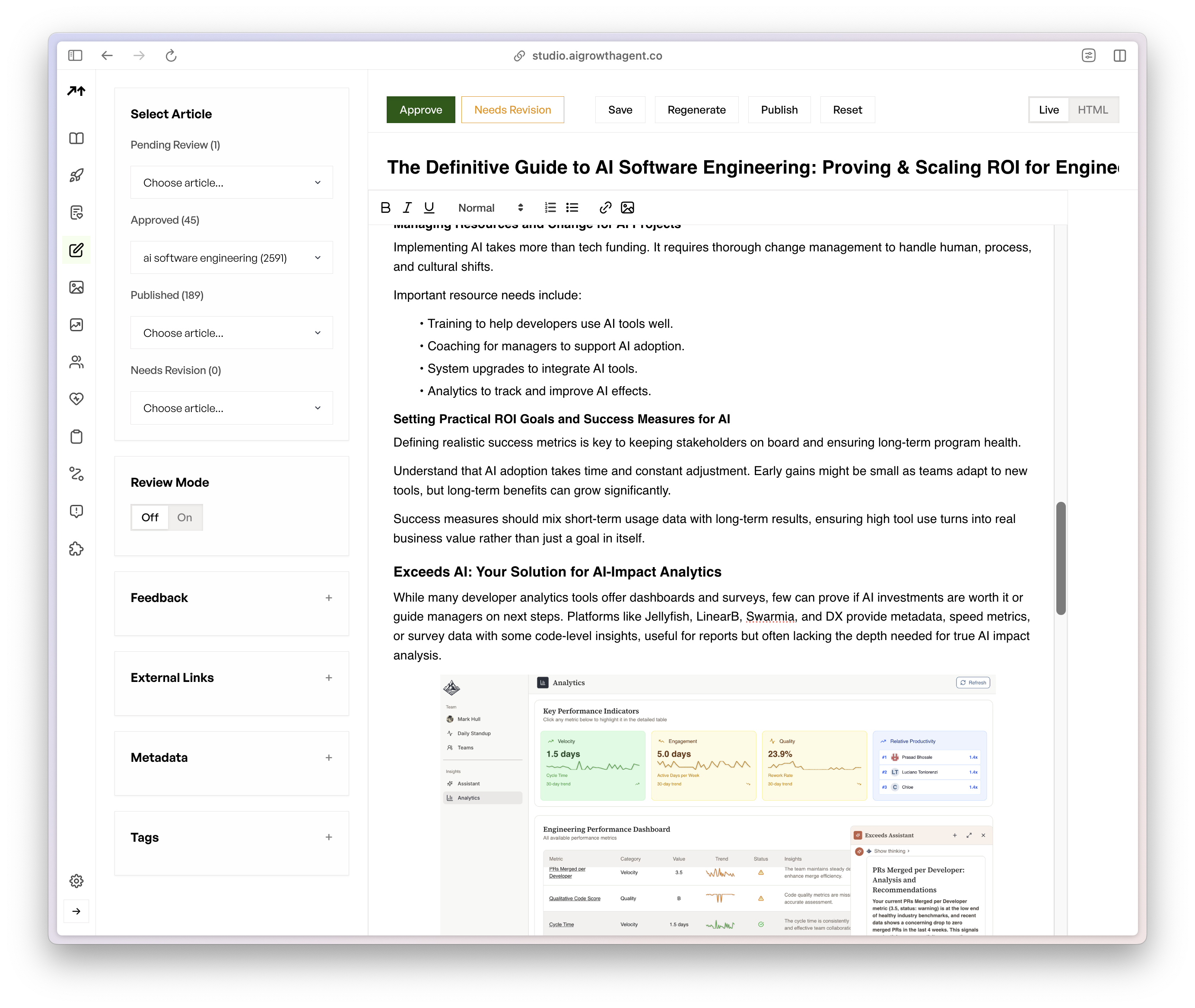
This level of programmatic velocity keeps your brand present across relevant queries and topical variations. Over time, this helps AI systems associate your brand with a wider share of questions and scenarios in your domain.
Brands that want to compete across full topic clusters benefit from a platform designed for sustained programmatic output. Learn how AI Growth Agent delivers programmatic content velocity.
3. Master Technical SEO for AI Indexing and Understanding
Technical SEO for AI search extends beyond traditional concerns like crawlability, sitemaps, and page speed. AI systems require structured signals that describe what your content covers, how it is organized, and why it should be trusted.
Modern AI-aware technical implementation often includes:
- Comprehensive schema markup that reflects entities, authors, organizations, and content types
- Structured relationships between pages that clarify topic clusters and hierarchies
- Files and interfaces designed for large language models, such as LLM.txt and Model Context Protocol (MCP) configurations, so AI tools can understand and retrieve your content more directly
Internal linking also plays a larger role. Well-planned linking structures help AI systems map how concepts relate to each other across your site. This creates a navigable knowledge graph that reinforces your topical authority.
AI Growth Agent automates much of this technical work. The platform applies advanced schema markup to each piece, supports LLM.txt and MCP where appropriate, and builds internal linking patterns that highlight logical topic groups. This helps AI engines process your content in a format that aligns with how they evaluate authority and relevance.
4. Use AI-Powered Monitoring and Feedback Loops for Iterative Authority Building
AI search performance depends on continuous measurement and refinement. Monitoring how AI systems surface and cite your content provides direct feedback on which strategies are working and where coverage gaps remain.
Effective AI search monitoring typically includes:
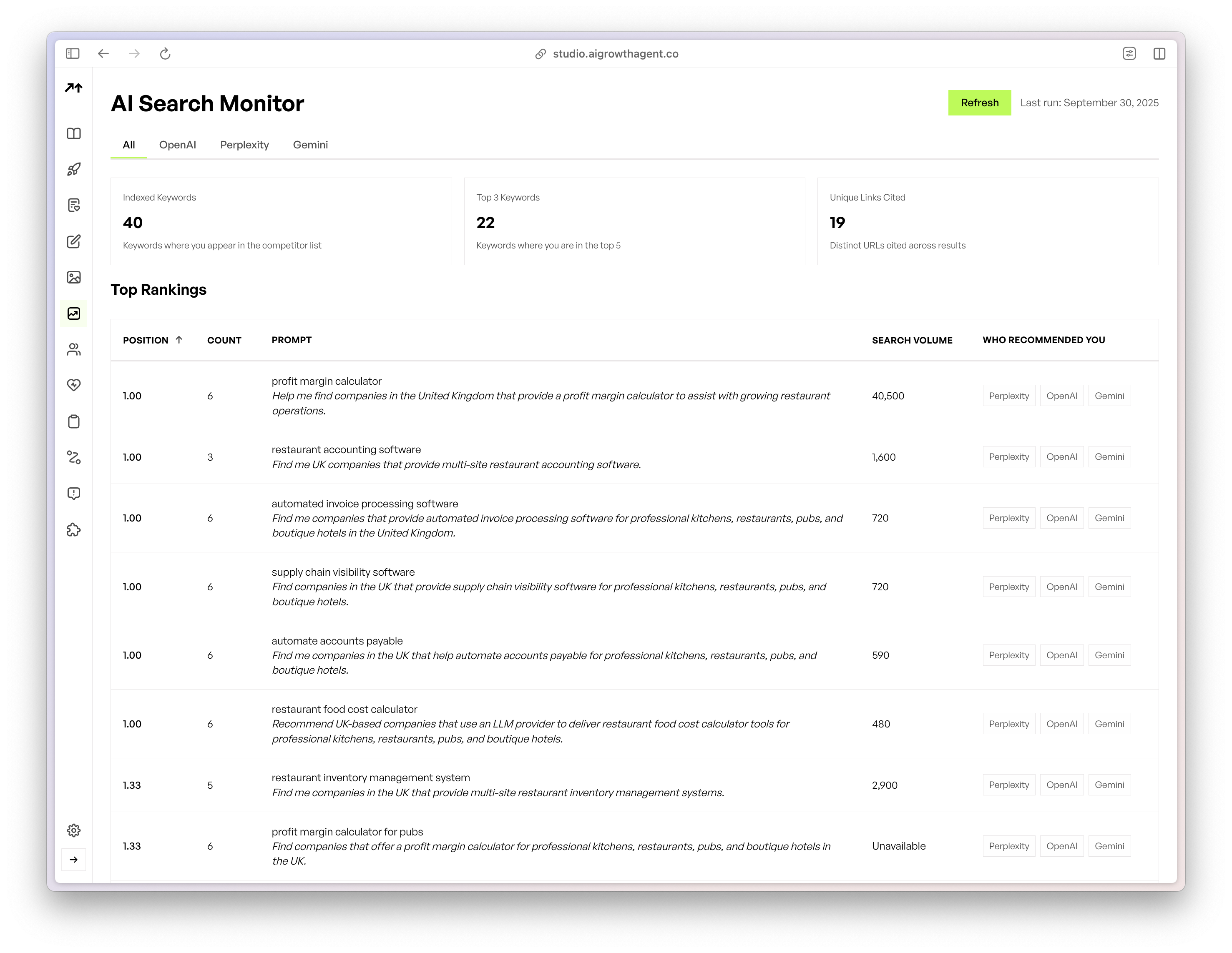
- Tracking how often your brand is cited or recommended in tools like ChatGPT, Google AI Overviews via Gemini, and Perplexity
- Observing which topics, formats, or page types attract the most AI citations
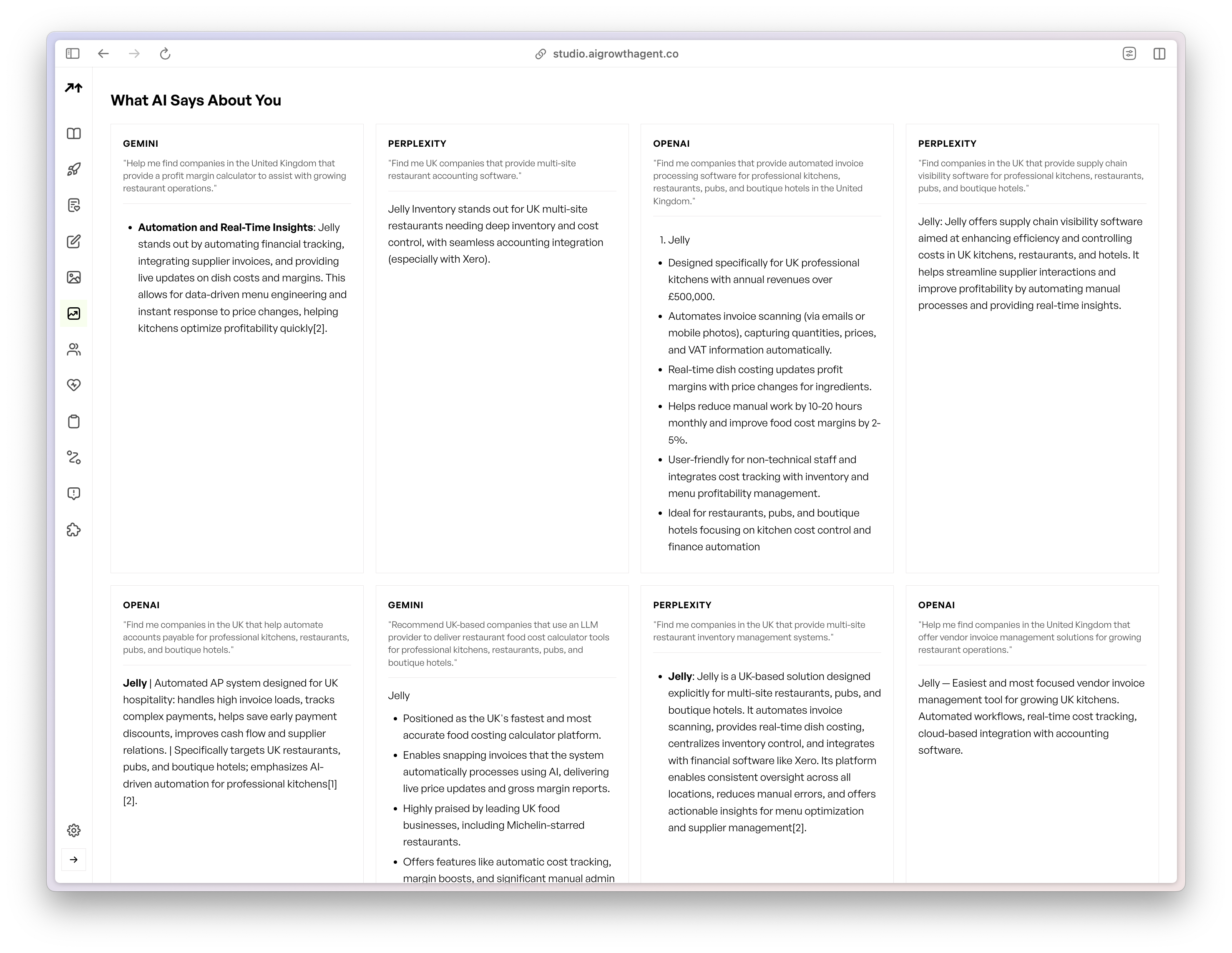
- Reviewing how AI systems summarize or reference your content to catch misinterpretations or missing context
- Connecting AI citation activity with metrics from tools such as Google Search Console and analytics platforms to understand traffic and conversion impact
These insights support a feedback loop. Teams can refine content briefs, adjust entity coverage, update internal linking, or expand successful formats based on real-world AI behavior.
AI Growth Agent provides this level of visibility through AI Growth Agent Studio. The platform surfaces real-time citation tracking across major AI tools and monitors competitor visibility for the same topics. This gives marketing leaders a clearer view of where they are gaining or losing AI share of voice.
5. Foster Expertise Depth and User Journey Completion
AI systems increasingly favor content that reflects clear expertise and helps users complete their full journey in one place. This means moving beyond surface-level answers and building resources that address context, follow-up questions, and implementation details.
Content built for expertise depth typically:
- Explains not only what to do, but why specific approaches matter
- Addresses variations by industry, role, or use case
- Covers common objections, risks, and decision criteria
- Links to related resources that extend the journey when needed
User journey completion focuses on reducing the number of separate sources a person needs to consult. Articles, guides, and resource hubs should anticipate likely next questions and either answer them directly or provide clear paths to related coverage.
AI agent-powered platforms support this goal through structured research and content planning. AI Growth Agent uses a Company Manifesto system to encode your brand’s expertise, terminology, and point of view. That context shapes every piece of content so it reflects both subject matter depth and consistent brand voice.
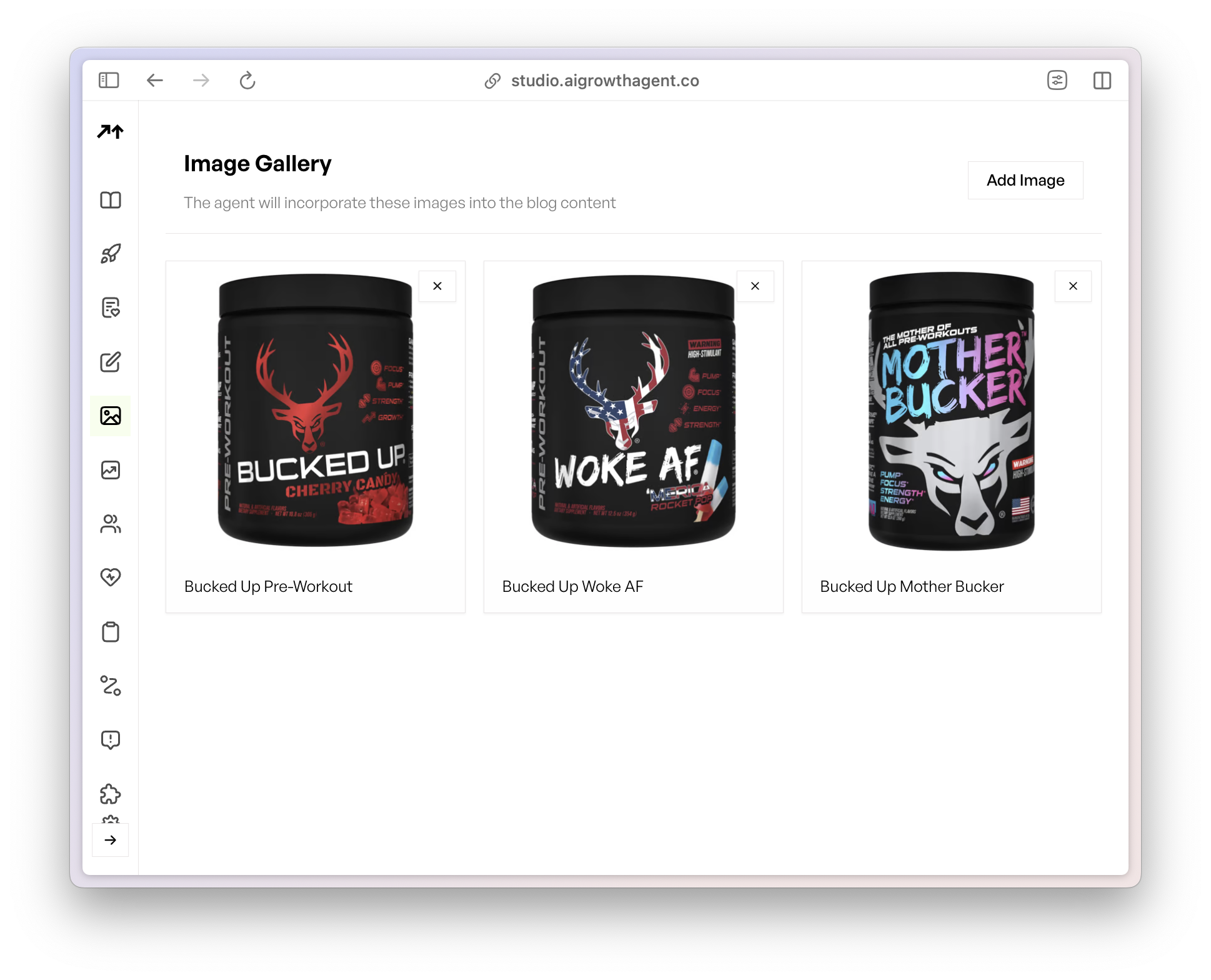
This combination of structured expertise and AI support helps produce content that both users and AI systems recognize as comprehensive and reliable.
Frequently Asked Questions about AI Agent-Powered Content Platforms
How does an AI agent-powered content platform differ from other AI writing tools like ChatGPT?
An AI agent-powered content platform such as AI Growth Agent operates as a full Programmatic SEO solution rather than a standalone writing assistant.
The platform manages the content lifecycle end to end, including strategic keyword and entity research, brief creation, drafting, fact-checking, and technical SEO implementation such as schema markup, LLM.txt, and Model Context Protocol. It outputs fully engineered web-ready content rather than only text drafts, which reduces manual handoffs and supports faster deployment into AI search environments.
Will leveraging an AI agent-powered content platform lead to thin or low-value AI-generated content that could be penalized by search engines?
Modern AI agent-powered platforms are designed to avoid thin, low-value content. AI Growth Agent relies on detailed Company Manifestos and brand guidelines to align with your subject matter expertise, industry language, and positioning.
The platform focuses on depth, clarity, and user journey completion, so content provides full, practical answers instead of shallow summaries. This emphasis on usefulness and expertise reduces the risk of quality-related penalties and increases the likelihood that both search engines and AI tools view your content as a trusted reference.
How quickly can a brand typically see results in AI search visibility after implementing a content platform with AI agents?
Timelines vary by domain authority, competition, and publishing cadence, but brands that adopt programmatically optimized content often see early indicators within the first few weeks.
Many AI Growth Agent clients begin to appear in AI search experiences such as ChatGPT, Google AI Overviews via Gemini, and Perplexity for priority topics within two to three weeks of consistent publishing. These early signals usually grow as more entities and clusters are covered, technical integration matures, and feedback from AI monitoring informs additional optimization.
How do AI agent-powered content platforms ensure brand voice consistency across high-volume content production?
AI agent-powered platforms maintain brand voice through structured onboarding and continuous learning. AI Growth Agent uses a Company Manifesto to capture your brand’s language, positioning, audience definitions, and style preferences.
The platform references this document when generating every piece of content, then refines its understanding based on approvals, edits, and performance data. This process allows teams to scale content volume while keeping tone, terminology, and messaging aligned with the broader brand strategy.
Conclusion: Compete Effectively in the AI Search Era with AI Growth Agent
AI-powered search has introduced new requirements for how content is planned, produced, and maintained. Manual workflows and traditional SEO tactics provide an incomplete foundation for an environment where AI systems prioritize entities, relationships, and consistent topical coverage.
Marketing leaders who adopt AI agent-powered content platforms can build stronger authority across their core topics. By combining entity-first architectures, programmatic content velocity, advanced technical SEO, continuous monitoring, and expertise-driven content, brands create a structure that aligns with how AI search engines evaluate and recommend information.
AI Growth Agent supports this approach by automating key components of modern content operations while keeping brand control and quality at the center. The platform enables teams to scale content that is technically sound, contextually rich, and aligned with user needs.
Brands that want to strengthen their position in AI search can benefit from a focused assessment of their current content, technical setup, and monitoring practices. Schedule a consultation session or demo today to see if AI Growth Agent is the right fit for your organization and to explore how an AI agent-powered content platform can support your next stage of growth in the AI search landscape.
