


Key Takeaways
- AI search traffic surged 527% YoY, so tracking brand visibility across ChatGPT, Perplexity, and Google AI Overviews is now essential for 2026 competitiveness.
- Track Share of Voice (SOV), citation frequency, and sentiment score to benchmark positioning and manage brand reputation with clear baselines.
- Follow the 7-step system from manual prompts and GA4 setup through API automation and content improvement loops for complete monitoring.
- Compare tools like AI Growth Agent, Semrush, and Profound, and prioritize full automation for scalable enterprise needs instead of manual methods.
- AI Growth Agent delivers real-time heatmaps, content improvement workflows, and proven results, so schedule a demo today to strengthen AI visibility.
Why AI Visibility Tracking Matters in 2026
Your digital footprint shrinks daily as AI multiplies content volume exponentially. Eighty-five percent of brand citations now come from third-party sources rather than owned domains, so programmatic tracking is critical for maintaining a competitive share of voice. Without systematic monitoring, competitors shape your category narrative while you stay invisible to AI indexers.
|
Metric |
Definition/Formula |
Why Track |
|
Share of Voice (SOV) |
Your citations/total citations × 100 |
Competitive positioning benchmark |
|
Citation Frequency |
Brand mentions per query set |
Authority measurement |
|
Sentiment Score |
Positive/negative/neutral ratio |
Reputation management |
7-Step System to Track Brand Visibility Across AI Search Engines
1. Manual Prompt Testing
Start with standardized scripts for ChatGPT, Perplexity, and Gemini that follow Chain-of-Thought prompting techniques that instruct AI to “think step-by-step” for logical brand analysis. Use consistent queries such as “What are the best [category] tools?” and “Compare [your brand] vs competitors” to create a repeatable baseline.
2. GA4 Referral Analytics Setup
Configure Google Analytics 4 to track referral traffic from AI engines as a distinct source. Create custom segments for ChatGPT, Perplexity, and AI Overview traffic so you can measure conversions and revenue impact from AI search visitors.
3. Free Tool Implementation
Deploy multiple Google Alerts variations and use Gumloop’s free plan for custom brand monitoring workflows to establish baseline tracking without budget pressure. Combine these alerts with a simple spreadsheet log to capture early patterns in citations and mentions.
4. Dashboard Construction
Build dashboards in Google Sheets or Looker that aggregate manual checks, referral data, and alert notifications into a single visibility report. Include SOV calculations, citation counts by engine, and sentiment summaries so stakeholders can scan performance quickly.
5. Paid Tool Integration
Add enterprise solutions such as Semrush AI Visibility Toolkit or Profound to automate citation tracking across multiple engines. Use their historical trend analysis to compare your brand’s visibility curve against key competitors over time.
6. API Automation
Develop custom scripts that connect AI engine APIs directly to your dashboard for real-time mention extraction. Include automated sentiment scoring and categorization so your team can review high-impact mentions without manual sorting.
7. Content Improvement Loop
Use visibility data to spot citation gaps and then update content to increase AI inclusion rates. Focus on pages already cited by LLMs and trusted third-party sources for entity associations, then expand related content clusters to reinforce those signals.
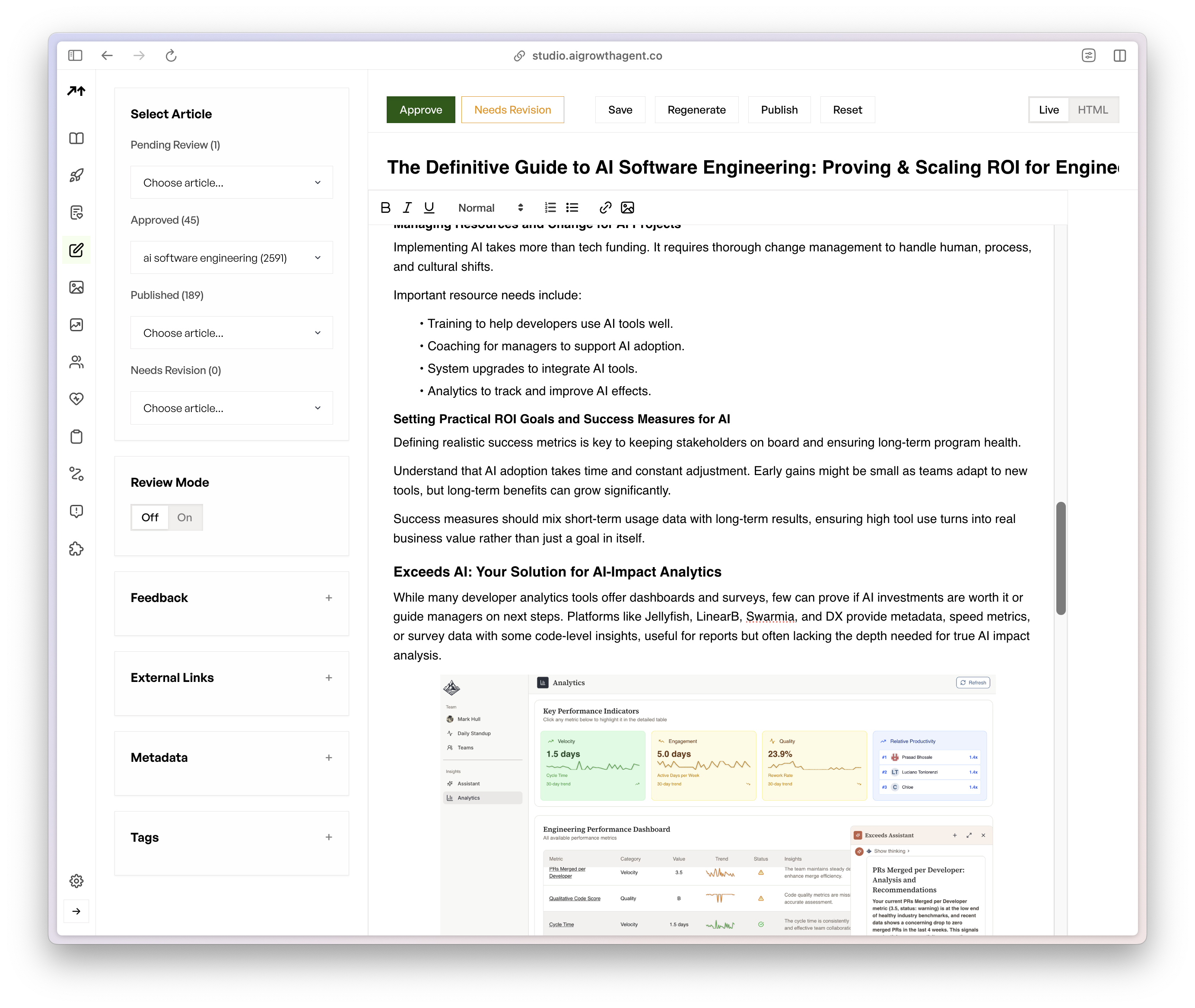
Top 10 AI Visibility Tools for 2026: Comparison Table
|
Tool |
Key Features/Engines |
Pricing/Automation |
Ideal For |
|
AI Growth Agent |
Heatmaps, real-time citations, ChatGPT/Perplexity/Gemini, Studio integration |
Custom pricing, full automation |
Scalable enterprises needing end-to-end solutions |
|
Semrush AI Visibility |
AI Overviews, ChatGPT tracking, unified visibility score |
Add-on pricing, automated alerts |
SEO teams with existing Semrush workflows |
|
Profound |
Citation provenance engine, SOC 2 compliance |
Enterprise pricing, client-side mimicry |
Enterprise reputation defense |
|
Peec AI |
ChatGPT, Perplexity, AI Overviews, monitoring |
$95/month, automated tracking |
Budget-conscious teams needing core features |
Programmatic AI visibility tools create consistent, reliable tracking, while manual methods often create operational chaos. AI visibility platforms track brand mentions, links, and presence in AI-generated answers across ChatGPT, Gemini, Perplexity, and Google AI Overviews and add automated competitor benchmarking plus historical trend analysis. AI Growth Agent stands out by combining autonomous monitoring with authority-building features through integrated content improvement workflows and real-time feedback loops.
Free and Low-Cost AI Visibility Trackers
Budget-conscious teams can use Google Sheets with manual prompt templates, Ahrefs Brand Radar tracking mentions in ChatGPT, Perplexity, Gemini, and AI Overviews with a database of 150M+ queries, and open-source monitoring scripts. These free AI visibility tools provide basic citation tracking and simple alerts but lack deep automation, multi-engine coverage at scale, and robust competitive analysis.
Designing an AI Visibility Dashboard That Leaders Can Use
Create comprehensive dashboards in Looker or Google Sheets that pull citation data, SOV heatmaps, and automated alerts for mention spikes through API integrations. Connect Google Search Console data so you can compare AI visibility trends with organic traffic growth and conversion metrics. AI Growth Agent Studio offers “set-it-and-forget-it” dashboard automation with real-time ChatGPT citation tracking and crawl statistics already wired in.
From Manual Tracking to Programmatic Monitoring with AI Growth Agent
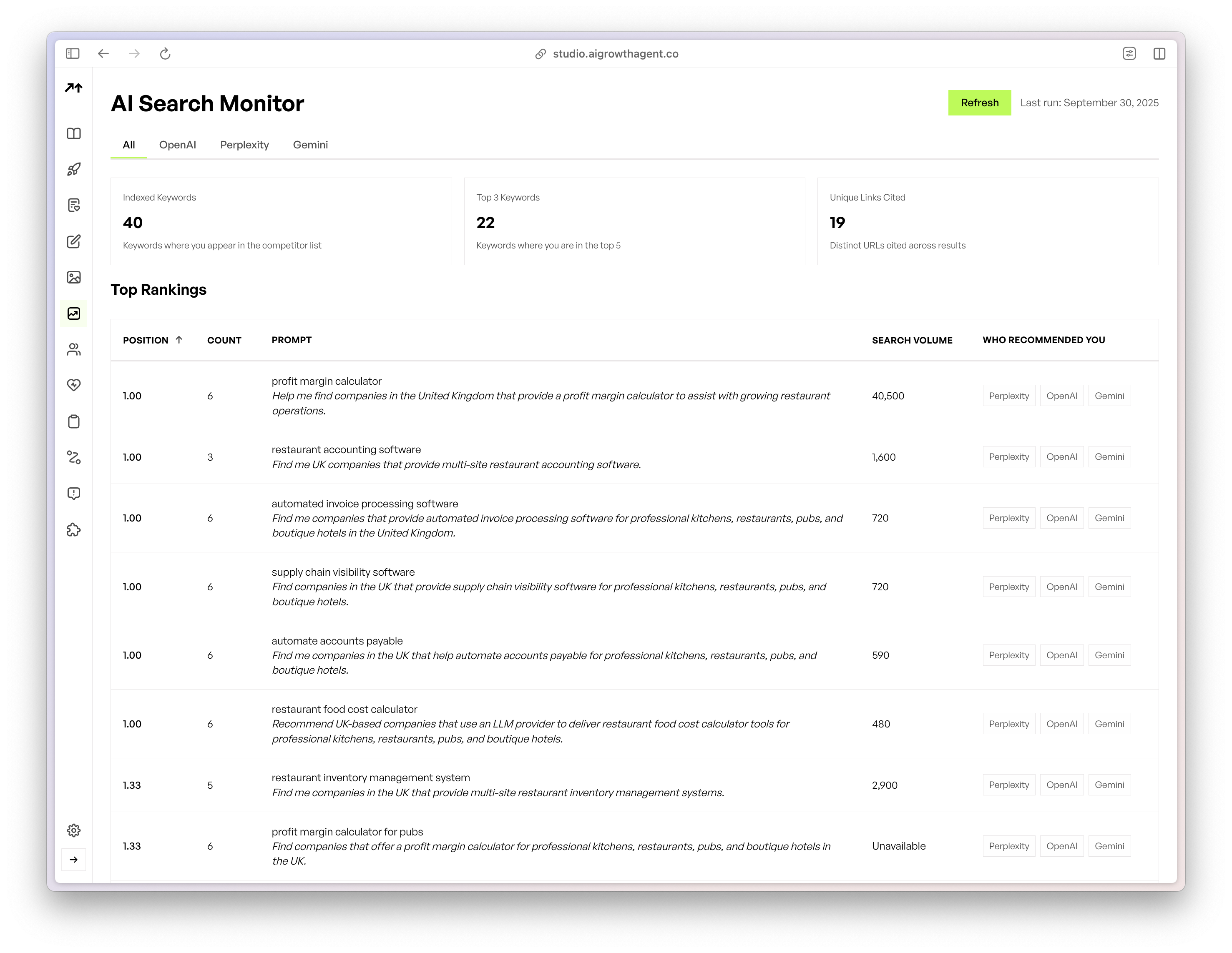
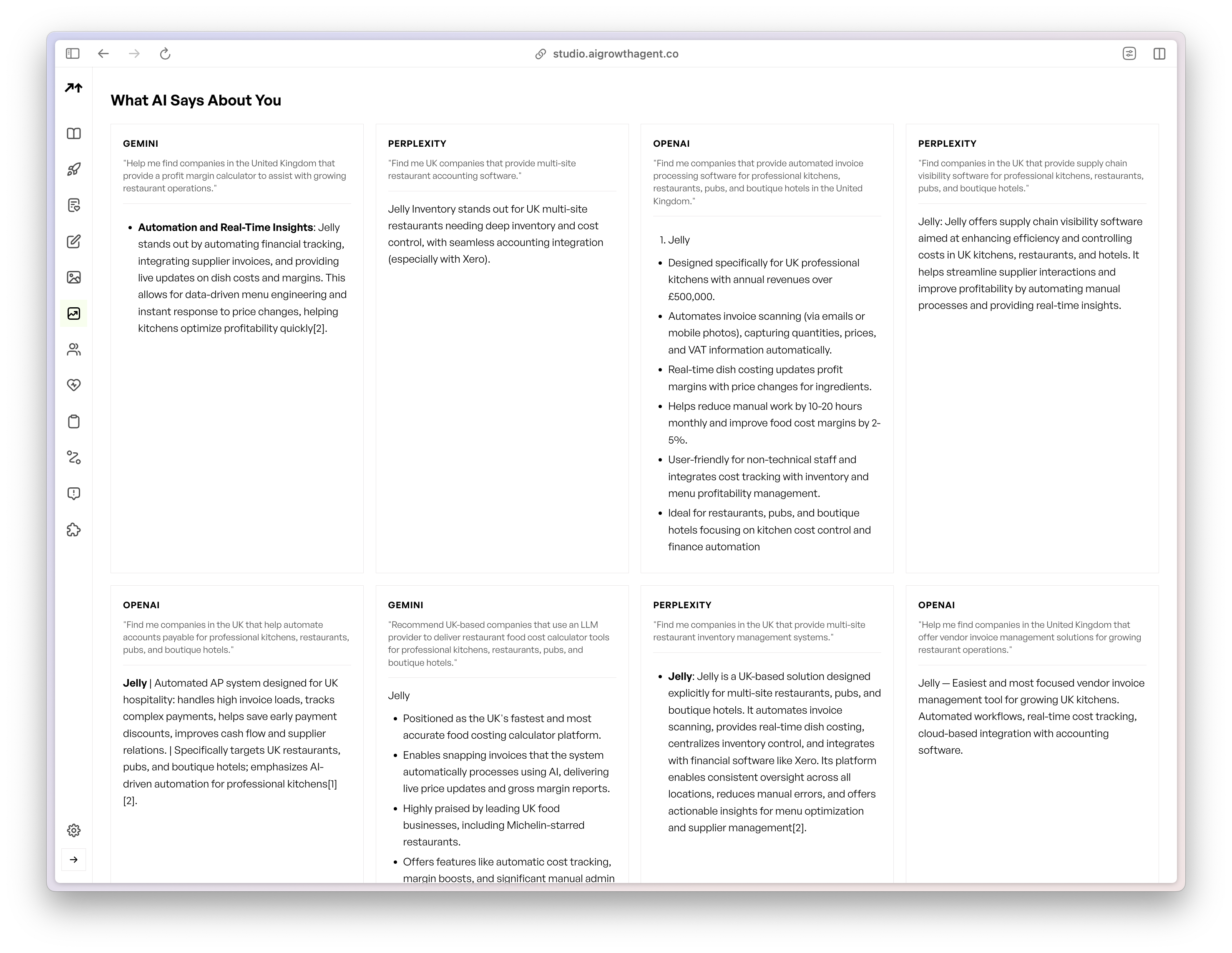
AI Growth Agent’s AI Search Monitor provides heatmaps that show keyword indexing across ChatGPT, Perplexity, and Gemini, along with URL-specific citation tracking and direct integration with Google Search Console. Competing tools often stop at diagnosis, while this platform combines monitoring with content improvement workflows that guide next steps. Success stories include Exceeds AI reaching top Perplexity recommendations in two weeks and Bucked Up earning the number one ChatGPT citation for “best protein soda.”
Schedule a consultation to see this integrated approach in action.
FAQ
What is the best free AI visibility tool?
Google Alerts combined with manual ChatGPT prompting provides basic free monitoring for brand mentions. For broader coverage and more structured workflows, Gumloop offers free monitoring flows and Ahrefs Brand Radar includes AI search monitoring as part of its SEO suite. Free tools still lack automation depth and competitive benchmarking, so they work best as a starting layer.
How do you measure share of voice in ChatGPT?
Measure SOV by dividing your brand citations by total category citations across a standardized query set, then multiplying by 100. Track this metric weekly using consistent prompts such as “What are the best [category] solutions?” and “Compare top [category] brands.” Automated tools improve accuracy by pulling from larger query databases and reducing sampling bias.
How does AI Growth Agent compare to Profound?
Profound focuses on enterprise reputation defense and detailed citation provenance tracking across AI engines. AI Growth Agent combines monitoring with content improvement and authority building, so teams can act on insights faster. AI Growth Agent also provides real-time heatmaps, automated content feedback loops, and integrated publishing capabilities that Profound does not include.
What are the key 2026 updates for AI visibility tracking?
Major platforms expanded AI search capabilities in 2026, with Google AI Overviews becoming standard, ChatGPT adding web search integration, and Perplexity launching enterprise-focused solutions. Tracking tools now support multi-engine monitoring, real-time citation alerts, and competitive SOV benchmarking across these expanded AI search interfaces. Teams that connect these insights to content planning gain a measurable visibility advantage.
What ROI timelines should I expect from AI visibility tracking?
Most brands see citation improvements within two to four weeks after launching systematic tracking and content updates. AI search visitors convert about 4.4 times better than traditional organic traffic, and 68% of marketers report higher ROI from SEO programs that integrate AI search data. Consistent monitoring and ongoing content improvement compound these gains over three to six months.
Conclusion: Turn AI Visibility into a Repeatable Growth Channel
Tracking brand visibility across multiple AI search engines works best when you combine monitoring tools, clear metrics, and repeatable content workflows. The 7-step system and tool comparison above give you a practical roadmap for leading AI search visibility in 2026.
Schedule a consultation to see this integrated approach in action.
