Written by: Mariana Fonseca, Editorial Team, AI Growth Agent
Key Takeaways
-
AI-powered search engines like ChatGPT and Google AI Overviews now drive a large share of discovery, so conversational search optimization (CSO) matters more than traditional keyword SEO.
-
CSO relies on natural language content, schema markup, topical clusters, and programmatic publishing speed to earn AI citations and recommendations.
-
Traditional SEO agencies and generic AI tools cannot match the required scale or technical depth, including LLM.txt and Model Context Protocol (MCP) integration.
-
AI Growth Agent delivers programmatic SEO that runs on its own and produces rapid results, with case studies showing citations in 2–3 weeks across platforms.
-
Book a live demo with AI Growth Agent to roll out CSO strategies and win AI search visibility.
How Conversational Search Optimization Aligns With User Intent
Conversational search optimization represents a clear break from traditional keyword-based SEO. Traditional search focuses on short, fragmented queries, while CSO targets the natural language patterns that AI systems prioritize. Google’s AI Mode shows only 9.2% overlap when the same query is tested three times, which highlights the value of broad topical coverage instead of single-keyword targeting.
CSO follows principles that match how AI models reason. Content uses natural language structures that mirror conversational queries. Entity optimization clarifies relationships between concepts. Structured data gives machines the context they need to interpret your content correctly.
AI Mode’s average session duration is 11 minutes, far longer than the 2–3 minutes for traditional Google search sessions, which shows that users engage more deeply with AI-generated responses that cite authoritative sources.
CSO content answers complete questions instead of chasing isolated keywords. AI systems synthesize information from many sources to deliver comprehensive answers. Topical authority and content depth, therefore, become primary ranking factors.
See how AI Growth Agent applies these CSO principles at scale to capture this evolving search behavior.
Why Traditional SEO and Generic AI Tools Fall Behind
Most traditional SEO agencies still use manual “craftsman” models that cannot reach the velocity AI search now rewards. They publish one or two articles each month, while AI systems favor brands that maintain full content ecosystems across a topic. Internal marketing teams rarely have the engineering capacity for programmatic schema, LLM.txt files, and MCP integration that AI systems now expect.
Generic AI content tools such as Jasper generate unstructured text without the technical foundation required for AI citations. These tools push strategy, schema injection, and publishing work back onto your team.
The result is content that looks acceptable to humans but lacks the structure AI systems need for confident recommendations. AI-referred traffic converts at 4.4 times the rate of traditional organic search, but only when content meets strict technical standards for authority and structure.
AI Growth Agent addresses this scale and complexity gap with programmatic SEO that runs autonomously. The agent engineers high-authority content architectures at a pace that manual teams cannot match. Our system removes technical friction so brands can build topical authority across entire categories.
Discover how our programmatic approach outpaces traditional SEO models.
Eight Core CSO Strategies for AI Search Engines
Effective conversational search optimization relies on eight core strategies that align with AI reasoning patterns.
1. Natural Language Structures: Content mirrors conversational query patterns, using complete sentences and contextual explanations instead of keyword-stuffed fragments. About 80% of consumers use AI summaries for at least 40% of their searches, so natural language content now drives visibility.
2. Schema Markup Implementation: Pages with properly implemented FAQ schema are 3.2 times more likely to appear in Google AI Overviews than similar pages without structured data. FAQPage, Organization, and Article schemas give AI systems the context they need for confident citations.
3. Topical Cluster Architecture: Comprehensive coverage of related subtopics builds the depth AI systems associate with authority. Programmatic SEO implementations often achieve 300–700% organic traffic growth in the first year by systematically covering topic variations.
4. Programmatic Velocity: About 15% of Google searches are entirely new each day. Automated content generation captures these emerging opportunities at a scale that manual teams cannot reach.
5. LLM.txt and MCP Integration: Advanced technical files and protocols allow AI systems to interface directly with your content database. This integration gives models precise clarity about your expertise, product catalog, and preferred answers.
6. Question-Based FAQ Optimization: About 78% of AI-generated answers include list formats, so FAQ structures significantly increase citation probability.
7. Entity Optimization: Clear relationships between your brand, products, and industry concepts help AI systems understand where you hold authority and when to cite you.
8. Recency Signals: Roughly 65% of AI bot hits target content published within the past year. Frequent publication keeps your content in the “fresh” pool that AI systems prefer.
The following comparison shows how AI Growth Agent’s technical depth and autonomous execution differ from common alternatives.
|
Solution |
Scale |
Tech Stack |
ROI Proof |
Autonomous? |
|---|---|---|---|---|
|
AI Growth Agent |
Unlimited/Multi-tenant |
Schema/MCP/Studio |
2–3w citations |
Yes |
|
SEO Agencies |
1–2 posts/month |
Manual processes |
6–12 months |
No |
|
Jasper/AI Tools |
Unstructured output |
Basic text generation |
No technical optimization |
No |
|
Profound/Monitors |
Diagnostic only |
Reporting tools |
No execution |
No |
Winning Visibility in Google AI Overviews
About 30% of US keywords now trigger an AI Overview, so brands that secure citations gain a major visibility edge. Brands cited in Google AI Overviews see 35% higher organic CTR and 91% higher paid CTR than uncited competitors on the same queries.
Content that wins AI Overview placement answers specific questions clearly and authoritatively. Pages in position one on the SERP have a 33.07% chance of citation, yet structured content with strong schema can earn citations from lower positions as well.
Technical Priorities for AI SEO in 2026
AI SEO in 2026 rewards technical sophistication more than sheer content volume. Nearly 70% of businesses report higher ROI after integrating AI into SEO and content workflows, but results depend on programmatic systems rather than ad hoc tool usage.
Modern AI SEO focuses on automated schema injection, entity relationship mapping, and real-time content tuning based on AI system feedback. Thought leadership SEO campaigns deliver a median 748% ROI with an average nine-month break-even when executed with AI-first strategies.
Best Practices for Conversational AI Search
Strong performance in conversational AI search starts with clear insight into user intent patterns and AI reasoning behavior. Momentic’s 2025 analysis found that ChatGPT users click an average of 1.4 external links per visit, compared to 0.6 for Google users, which shows higher engagement with cited sources.
Content should deliver complete, contextual answers that AI systems can safely extract and cite. This approach requires broad coverage of topic variations, explicit author attribution for expertise signals, and structured data that clarifies relationships and authority levels.
Programmatic SEO as the Engine of AI Visibility
Programmatic SEO provides the only practical way to reach the content velocity AI search now expects. Covering niche variations programmatically builds the topical authority AI models favor for long-tail recommendations.
Effective implementations target feature-specific, high-intent terms while preserving quality through automated schema and entity optimization. Well-executed programmatic SEO often produces 50–200% organic traffic growth within 12 months by covering topic variations that manual strategies miss.
GEO Strategies for Generative Engines
Generative Engine Optimization (GEO) focuses on content tailored for AI-powered search engines. GEO identifies “opportunity voids” or information gaps in AI Overviews for rising trends and fills them with data tables, definitions, or specs that LLMs use to build answers.
Effective GEO depends on real-time trend monitoring and rapid content deployment. Google Trends’ “Trending Now” dashboard refreshes every 10 minutes and surfaces many more emerging topics, which enables intraday SEO for competitive advantage.
Coordinated AI Search Optimization Across Platforms
AI search optimization brings together the technical and strategic elements needed for visibility across ChatGPT, Google AI Overviews, Perplexity, and similar platforms. As noted earlier, visitors from AI search deliver significantly higher value, so focused optimization becomes highly profitable.
Success requires platform-specific tactics that respect each system’s citation preferences and technical rules. A coordinated AI search strategy improves both visibility and conversion rates across the full AI ecosystem.
AI Growth Agent Workflow Blueprint
AI Growth Agent follows a six-step workflow that removes common implementation roadblocks and keeps CSO execution consistent.
Manifesto Onboarding: A one-hour data transfer session with our professional journalist programs your agent’s “brain” with your positioning and narrative. This foundation ensures every later asset reflects your voice and strategy.
Programmatic Research: With brand parameters set, the agent analyzes tens of thousands of relevant search queries and builds a content strategy organized into pillars and clusters. This research guides the technical setup.
Technical Infrastructure: The system then deploys an optimized blog architecture as a subdomain that visually matches your existing site and provides a clean base for programmatic SEO.
Content Engineering: The agent executes the full content lifecycle, including strategy, research, drafting, fact-checking, and technical optimization with advanced schema and LLM.txt.
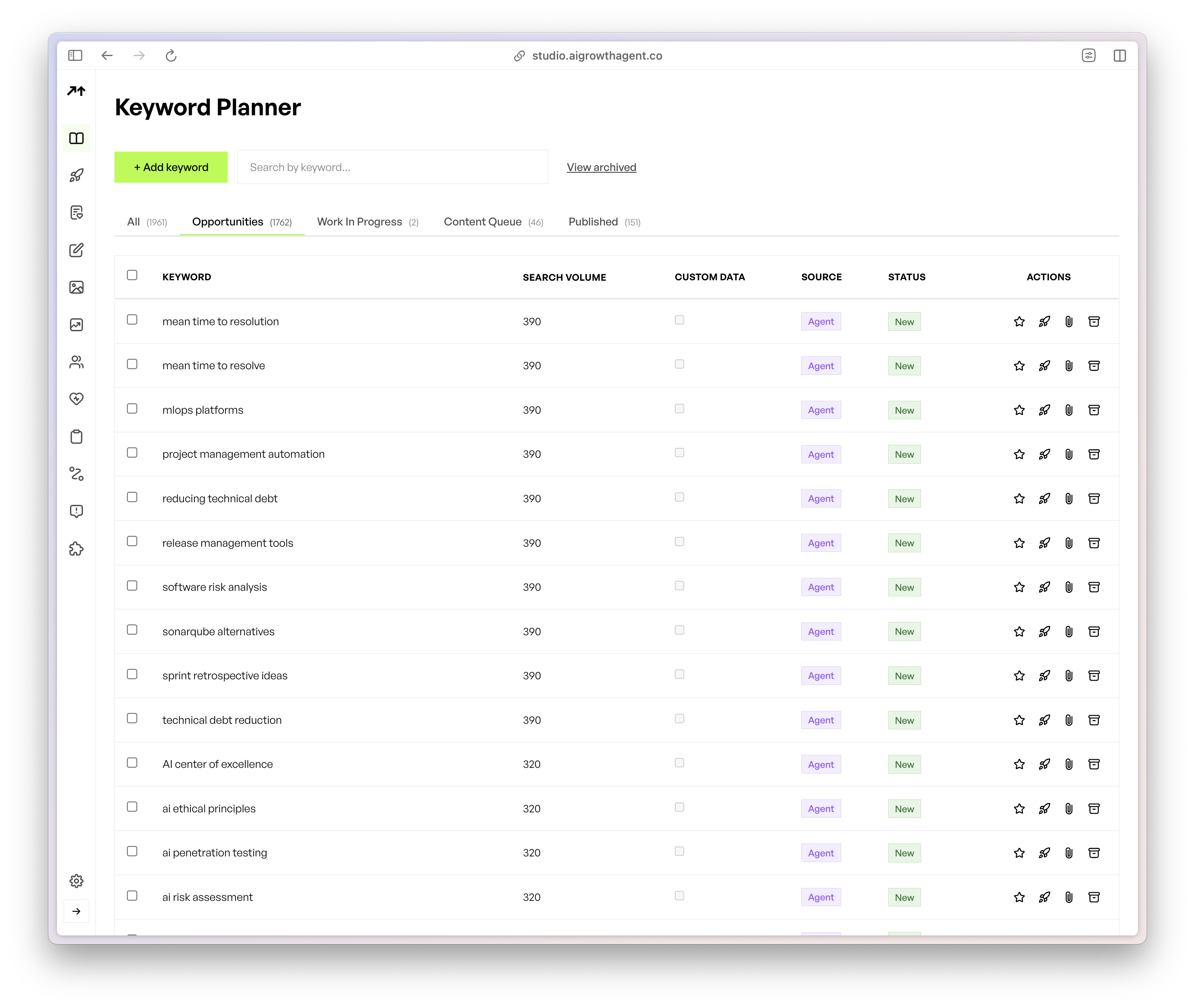
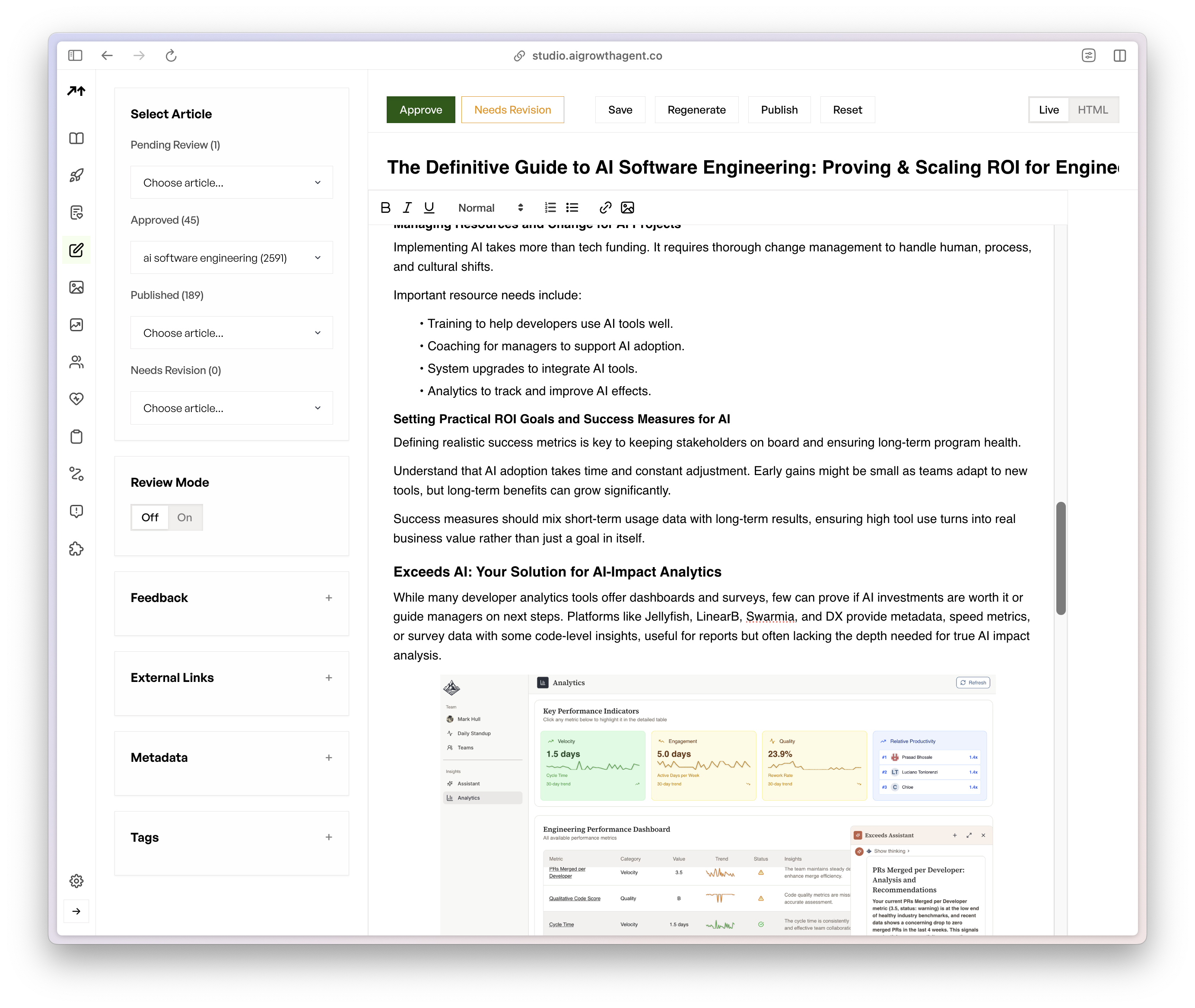
AI Growth Agent Studio: You manage everything through a programmatic SEO command center that supports direct edits, feedback, approvals, and progressive learning.
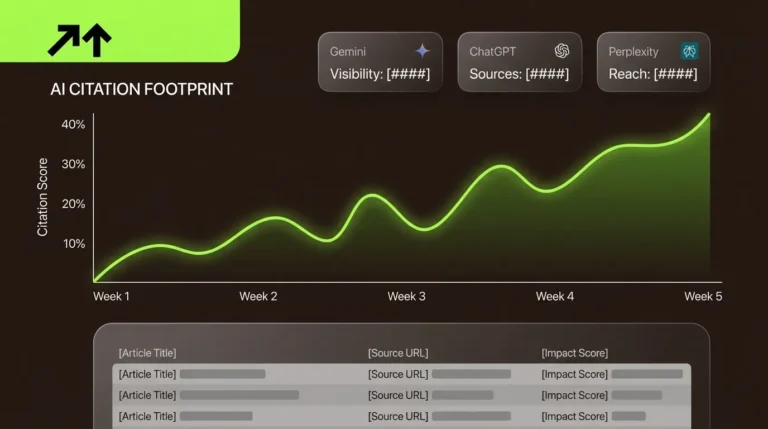
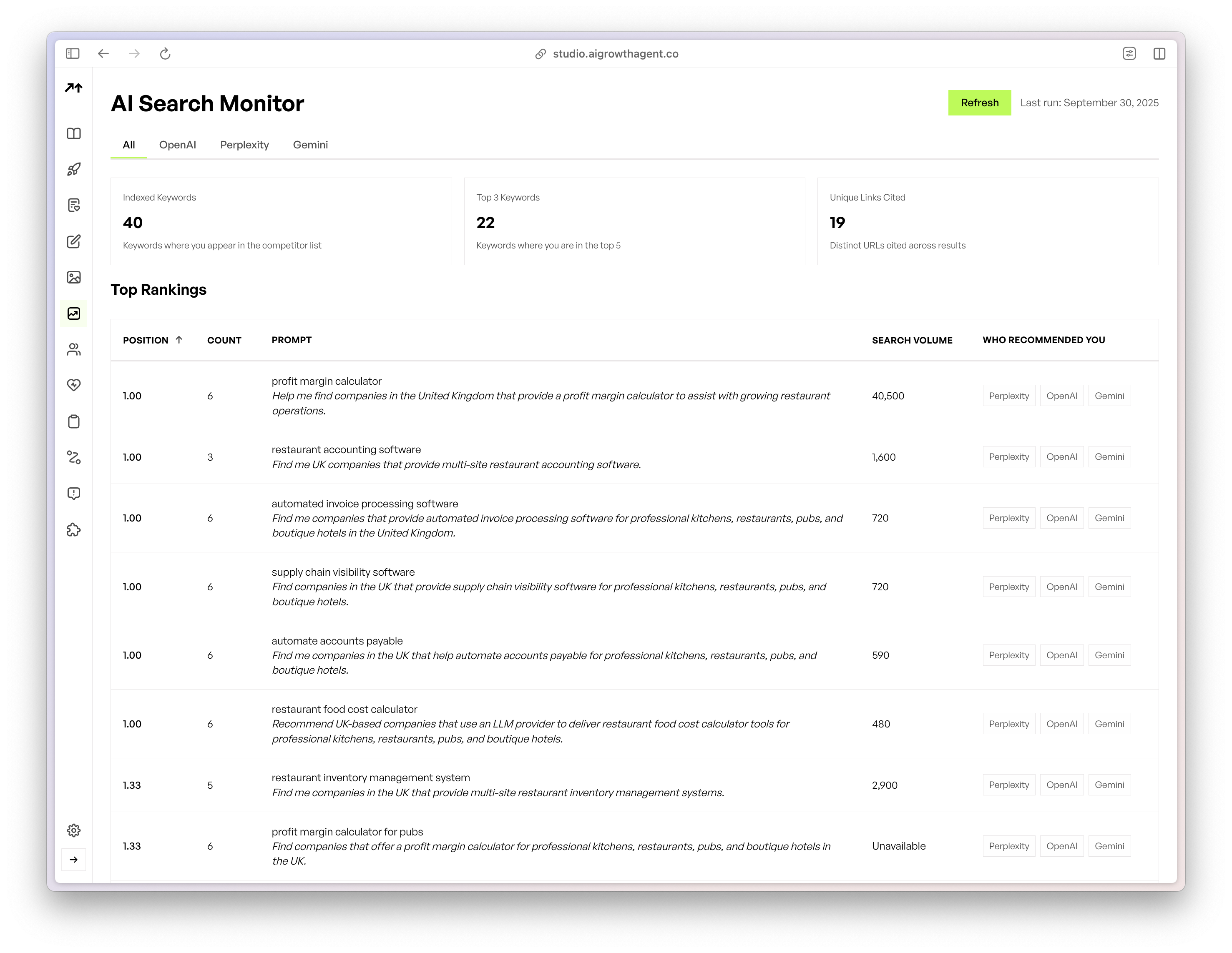
AI Search Monitoring: The platform tracks performance across ChatGPT, Gemini, and Perplexity, including keyword indexing, URL performance, and citation excerpts.
Most clients move from the first meeting through all six steps to their first programmatically engineered article within about a week. Explore how this workflow can reshape your content strategy.
Case Studies and ROI Outcomes
AI Growth Agent’s programmatic system delivers measurable gains across industries. Exceeds AI reached Perplexity’s top alternative recommendation within two weeks and appeared in Google AI Overview snapshots within three weeks. BeConfident became the top English learning app recommendation in Brazil through Google AI Overview within weeks of launch.
Bucked Up earned a ChatGPT citation as a leading protein soda brand within three weeks. Gitar became the reference brand for AI-powered CI/CD automation across Google AI Overview, ChatGPT, and Perplexity within two months. B2B SaaS companies report an average 702% SEO ROI with a seven-month break-even, and our programmatic approach often accelerates these timelines.
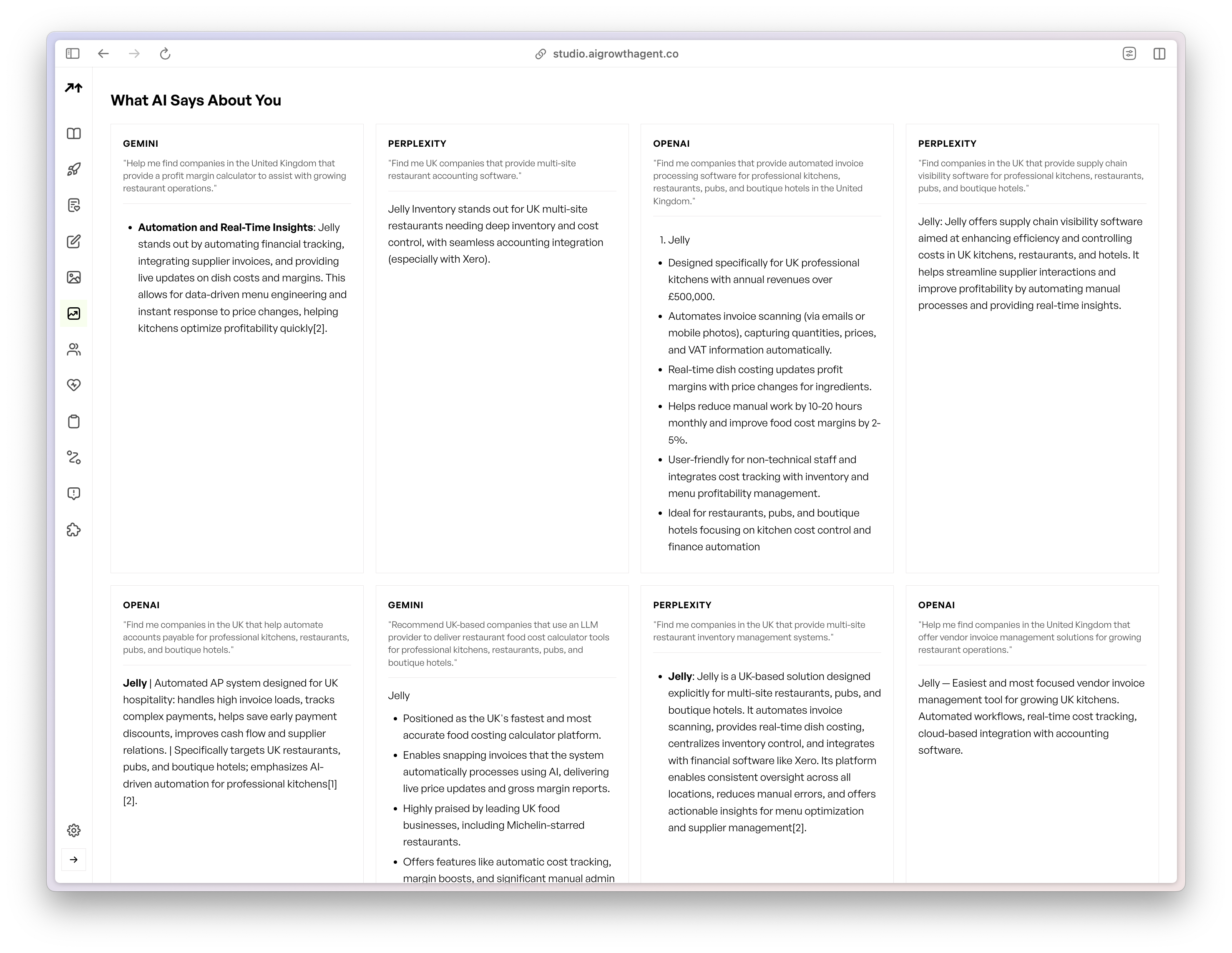
These outcomes highlight the strength of programmatic content engineering over manual methods. Ahrefs’ June 2025 study found that visitors from AI search platforms convert at 23 times the rate of traditional organic visitors, which makes AI citation optimization a decisive advantage.
Learn how to achieve similar results for your brand.
Implementation Roadmap and Common Challenges
Successful CSO programs require technical readiness and a commitment to programmatic methods. Teams often stumble when they try to scale manually, overlook technical requirements, or fail to maintain publishing velocity. Many sites see ranking lifts within 3–4 months, with 20–50% of organic traffic coming from programmatic pages when execution stays consistent.
Organizations that prioritize technical infrastructure and automated workflows reach AI search scale faster than those that rely on manual content creation.
Talk with our team about your readiness for programmatic CSO.
Frequently Asked Questions
What is conversational search optimization?
Conversational search optimization is the programmatic design of natural language content structures that help AI systems like ChatGPT, Google AI Overviews, and Perplexity confidently cite and recommend your brand. Unlike traditional SEO that targets keywords, CSO focuses on broad topical authority and technical alignment with AI reasoning patterns.
What is AI SEO for Google Overviews?
AI SEO for Google Overviews uses programmatic content optimization with advanced schema, entity relationships, and structured data so AI systems can understand and cite your content. AI Growth Agent handles these optimizations automatically through its Programmatic SEO Agent.
How do you optimize for Perplexity and Gemini?
Optimization for Perplexity and Gemini uses platform-specific technical elements such as LLM.txt files, Model Context Protocol integration, and a comprehensive FAQ schema. Each platform follows distinct citation preferences that require tailored content structures and entity strategies.
What is the best programmatic SEO solution for AI search?
AI Growth Agent acts as a Programmatic SEO Agent that engineers high-authority content architectures so companies become the definitive authority in their category and earn AI search citations. It combines automated content engineering, advanced schema, including the first blog MCP implementation, and real-time AI citation monitoring in AI Growth Agent Studio.
How long does it take to see results from conversational search optimization?
Well-executed CSO strategies often produce initial AI citations within 2–3 weeks and broader visibility gains within 3–6 months. Timelines depend on technical quality and content depth rather than manual tweaking.
Conclusion and Next Steps
Conversational search optimization now shapes the future of digital visibility as AI-powered search engines change how people discover information. The global SEO services market reached $74.9 billion in 2025 and is projected to hit $127.3 billion by 2030, yet only programmatic approaches can reach the scale of AI search rewards.
AI Growth Agent addresses this shift with Programmatic SEO automation that deploys a specialized Programmatic SEO Agent to handle engineering, writing, and technical optimization at a superhuman scale. Request a demo to see how our programmatic technology can position your brand as the definitive authority in its category.