


Key Takeaways
- AI search engines now shape brand discovery, so companies need structured, scalable content systems that AI models can easily index and cite.
- Programmatic SEO supports this shift by turning keyword data and site architecture into large volumes of consistent, technically optimized pages.
- Cuppa AI focuses on fast, flexible content production and SERP-focused SEO, which supports teams that want to scale editorial output efficiently.
- AI Growth Agent focuses on autonomous authority building for AI search, from technical setup to monitoring how models like ChatGPT, Gemini, and Perplexity reference your brand.
- Marketing leaders who want an end-to-end authority engine can book a demo with AI Growth Agent to see how programmatic SEO can support their 2026 growth goals.
The Evolving Landscape of AI Search: Why Programmatic SEO Is Imperative
AI-first search experiences in tools like ChatGPT, Gemini, and Perplexity now influence how people discover and compare brands. These systems summarize content, select key sources, and surface only a small number of sites as references.
Brand visibility shrinks when content is produced slowly or without structure. Publishing a few handcrafted posts each month no longer keeps pace with the volume, speed, and formatting that AI search favors.
Traditional SEO agencies and basic AI writers focus on page-level optimization. They often stop at generating text and simple on-page SEO, which leaves gaps in areas like structured data, schema coverage, and site-wide architecture for AI models.
Programmatic SEO addresses these gaps. It uses templates, data, and automation to create large, coherent content libraries that are technically consistent, schema-rich, and easier for AI systems to interpret and cite.
Schedule a consultation session with AI Growth Agent to explore a programmatic approach to AI search authority.
Cuppa AI: An AI Content and SEO Suite for Scalable Production
Cuppa AI operates as an all-in-one AI content and SEO platform. The product combines keyword strategy, content planning, and AI writing to help teams move from ideas to drafts at scale.
Core capabilities include automated keyword research and bulk content creation. The tool outputs blogs, social content, newsletters, and other marketing assets with built-in SEO suggestions and copywriting support.
Cuppa AI describes its programmatic SEO as a no-code system for generating hundreds or thousands of SEO pages. Users can rely on a power editor that supports grammar refinement, SEO tweaks, AI assistance, and AI image generation.
Research features draw from top-ranking pages, People Also Ask queries, real-time news, and Wikipedia entries. These inputs guide outlines and drafts so content reflects what already performs well in search.
Quality controls include options to work with writers and subject-matter experts. Reviews emphasize ease of use and speed but also note that human review remains important for accuracy and brand alignment.
AI Growth Agent: Programmatic SEO Built for AI Search Authority in 2026
AI Growth Agent focuses on one primary outcome, building durable authority in AI search. The platform functions as a Programmatic SEO Agent that designs, deploys, and maintains large-scale content architectures for brands that want to be cited and recommended by AI systems.
The workflow starts with detailed onboarding and a Company Manifesto, which captures positioning, audiences, and non-negotiable messages. The agent then runs programmatic keyword research, defines content clusters, and configures technical elements such as schema, metadata, LLM.txt files, and a blog-level Model Context Protocol (MCP) that exposes content structure to AI models.
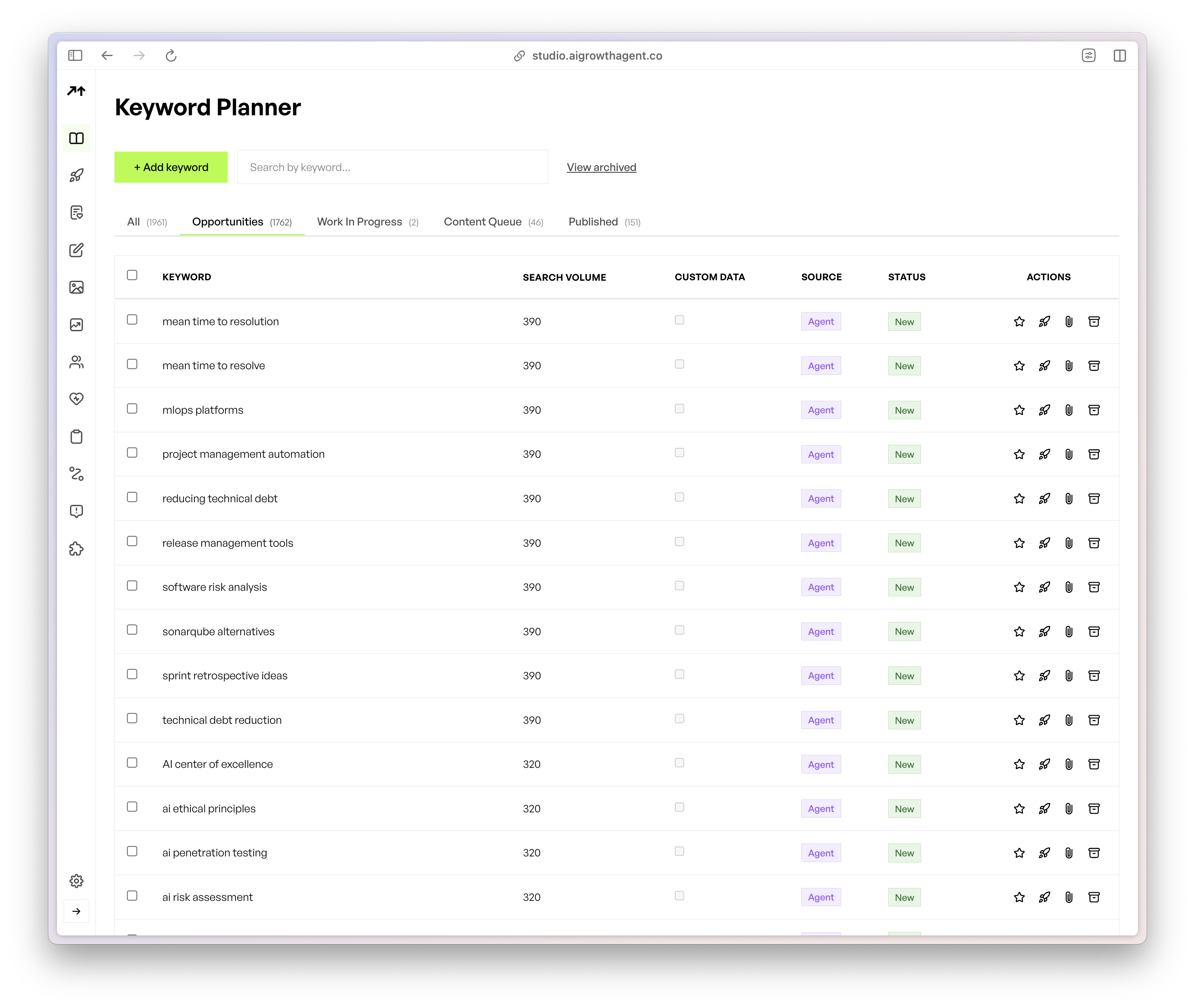
Multi-Tenant Programmatic Deployment supports enterprises that manage several brands or business units. Each brand runs its own Programmatic SEO Content Agent, with a distinct manifesto, strategy, and voice, all controlled from a single interface.
Real-Time Programmatic SEO Content Injection allows teams to respond quickly to emerging topics. The agent can generate and publish optimized pages around trending stories or new queries so brands capture attention while interest is highest.
Database-to-content automation converts internal datasets into structured articles or landing pages. Intelligent image and asset placement attaches relevant visuals and metadata so pages are more useful for both users and search systems.
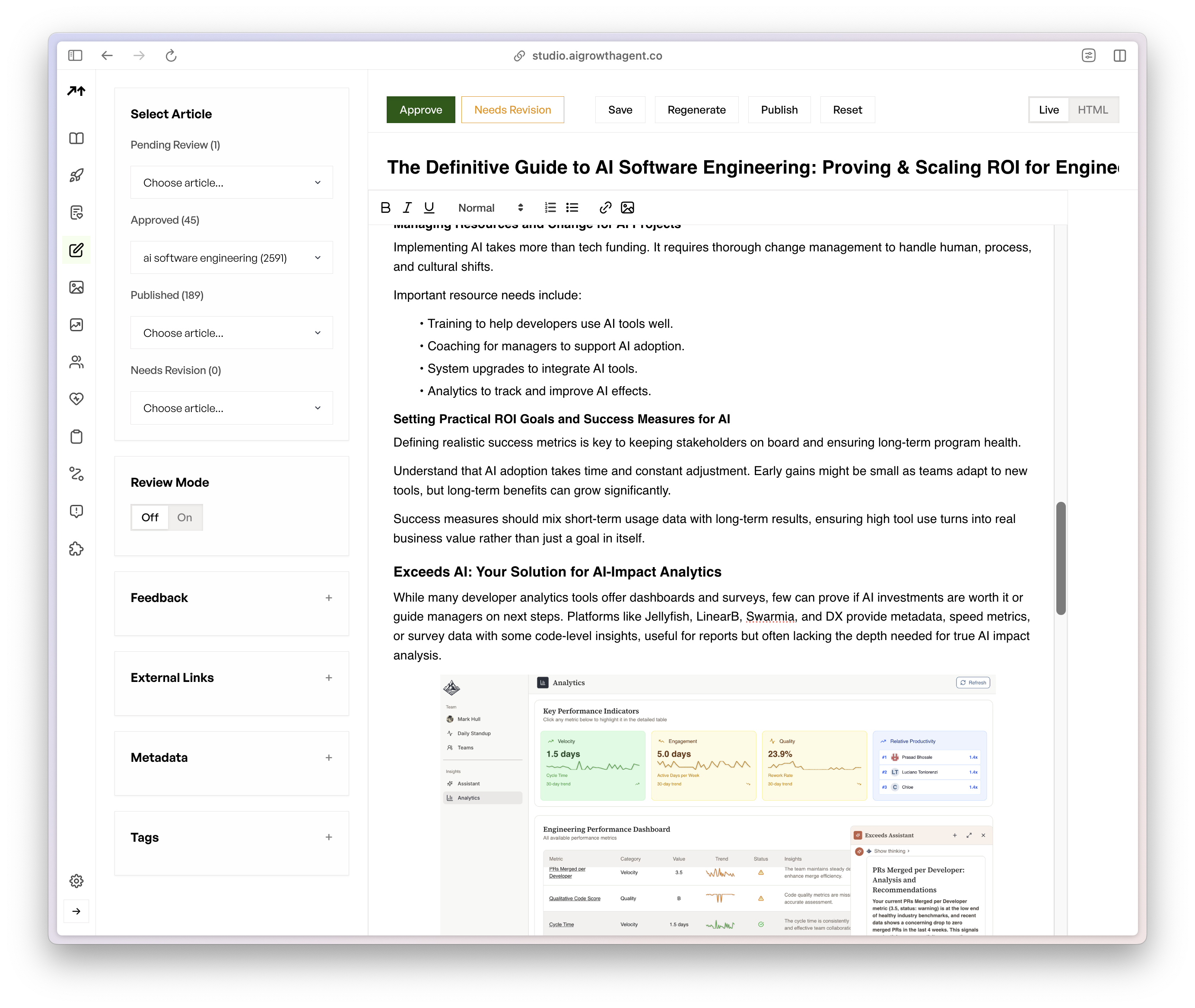
The AI Growth Agent Studio acts as a control center. Teams review drafts, adjust brand settings, and choose between collaborative and Auto-Pilot modes. The agent incorporates feedback so human involvement decreases as the system learns.
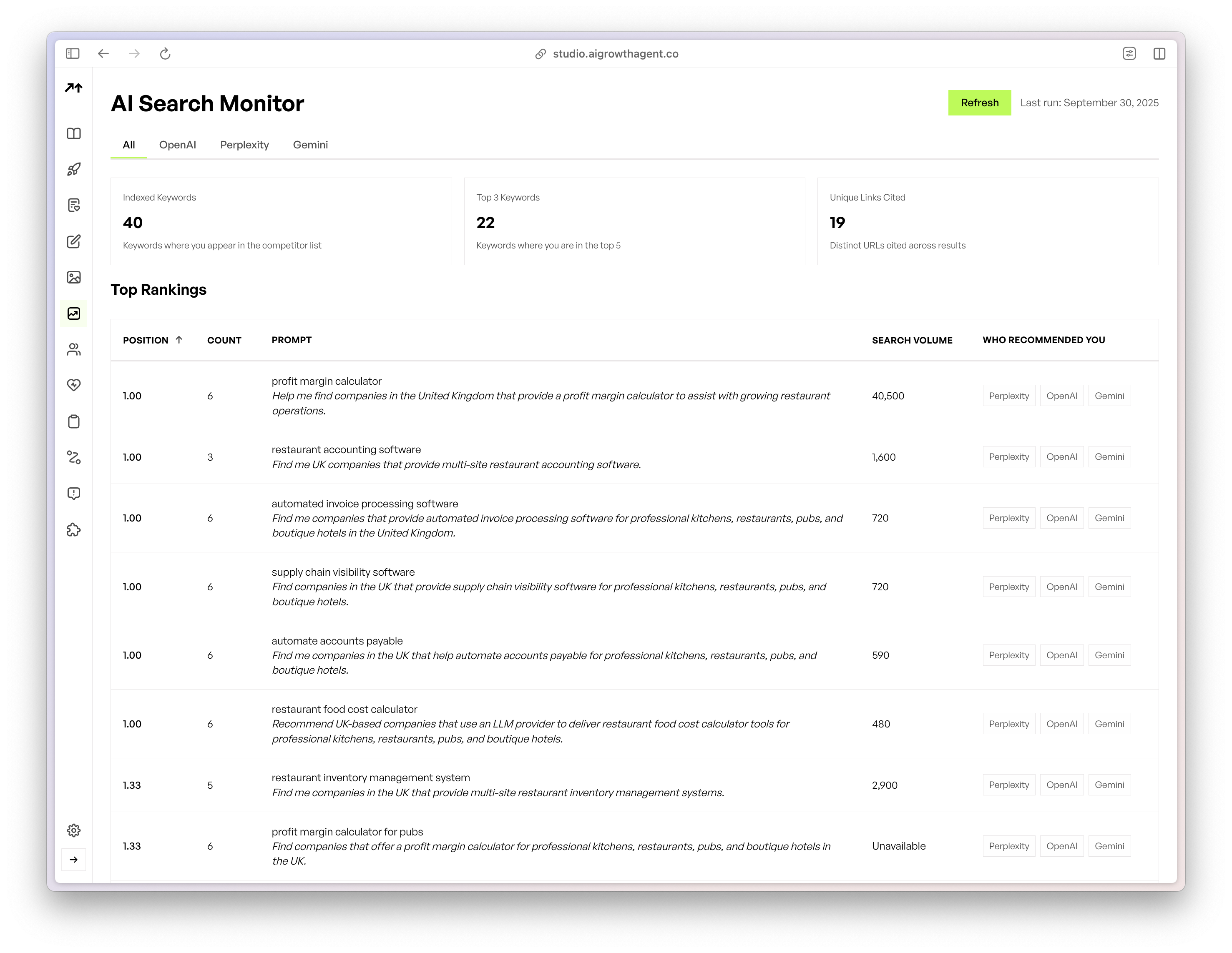
The integrated AI Search Monitor tracks performance across ChatGPT, Gemini, and Perplexity. Teams see which pages get cited, how often the brand appears in AI answers, and where gaps remain in coverage across target keywords.
Feature-by-Feature Comparison: Cuppa AI vs. AI Growth Agent
This table summarizes how each platform supports programmatic SEO and AI search visibility.
|
Feature/Criterion |
Cuppa AI |
AI Growth Agent |
|
Core offering |
AI content and SEO suite for efficient content creation and optimization |
Programmatic SEO Agent that designs and operates authority-focused content architectures |
|
Programmatic SEO |
No-code bulk page generation aligned with SERP data to scale content output |
End-to-end programmatic lifecycle, from research and templates to publishing, optimized for AI citation |
|
Technical SEO |
Automated titles and meta tags, on-page SEO editor, basic schema support |
Autonomous schema coverage, metadata, image tagging, and proprietary LLM.txt and Model Context Protocol |
|
Authority focus |
SERP analysis and EEAT support through expert content and on-page signals |
Company Manifesto-driven content, deep research, and structures engineered for AI recommendations |
|
Infrastructure |
Integrations with WordPress and other CMS tools via API, white-label options |
Autonomous blog architecture on an optimized subdomain, plus deep CMS integrations when needed |
|
Automation level |
High-volume content generation with collaboration and bulk actions |
Autonomous agent execution with Multi-Tenant Deployment and Auto-Pilot for continuous publishing |
|
AI search analytics |
Standard SEO dashboards and performance metrics |
Dedicated AI Search Monitor with visibility heatmaps, content citation tracking, and AI crawl insights |
|
Target user |
Agencies and teams focused on general content production and SEO efficiency |
Marketing leaders at brands that want clear authority in AI search within their category |
Beyond Content Generation: Structured Authority for AI Search
The main difference between the platforms centers on how deeply they address AI search requirements. Cuppa AI concentrates on SERP analysis and content optimization for traditional search engines. AI Growth Agent adds a data-structure layer, using LLM.txt and MCP to expose relationships among pages, entities, and topics so AI models can interpret and cite content more reliably.
True Autonomy vs. Assisted Scaling
Cuppa AI works best as a content accelerator that keeps humans in the loop for strategy and review. AI Growth Agent is built as an autonomous agent. The system can plan, draft, optimize, and publish within agreed guardrails, while feedback over time helps reduce the need for manual edits.
Strategic Focus: Efficiency vs. Category Leadership
Cuppa AI suits teams that prioritize faster production and broader keyword coverage. AI Growth Agent suits organizations that see AI search authority as a core strategic asset and want an always-on engine for earning citations.
Schedule a demo with AI Growth Agent to see how autonomous programmatic SEO could fit your roadmap.
Making the Strategic Choice: When Cuppa AI or AI Growth Agent Fits Best
Platform selection depends on your goals, timelines, and internal resources.
Cuppa AI is a strong fit if:
- Your team needs to scale blogs, landing pages, and social content across many campaigns.
- Your agency or in-house team wants content creation, editing, and basic SERP insights in a single tool.
- Your budget or workflow benefits from flexible model choices and using your own API keys.
- Your current priority is volume and coverage, not specialized engineering for AI model citations.
AI Growth Agent is a stronger option if:
- Your strategy depends on being cited by AI search engines such as ChatGPT, Google AI Overviews, and Perplexity.
- Your team needs an end-to-end programmatic SEO system that manages technical infrastructure and structured data.
- Your organization manages multiple brands or geographies and wants a unified framework for content authority.
- Your goal is to run a long-term pSEO engine that improves with limited ongoing manual effort.
The key question is whether you need faster content production or a system that engineers and maintains AI search authority with minimal day-to-day oversight.
Frequently Asked Questions about Programmatic SEO and AI Search Tools
How does AI Growth Agent’s Model Context Protocol differ from Cuppa AI’s content optimization?
Cuppa AI optimizes content around SERP insights and traditional ranking factors, which improves performance in standard search results. AI Growth Agent uses Model Context Protocol and LLM.txt to define how content is organized, relate topics and entities across the site, and present that structure in a format AI search tools can read, which increases clarity and citation potential.
Is Cuppa AI’s programmatic SEO as autonomous as AI Growth Agent?
Cuppa AI supports no-code bulk generation but still depends on users for strategy, keyword selection, and quality control. AI Growth Agent automates the full chain from strategy and templates to publishing. The agent learns from feedback and reduces the need for manual intervention over time.
Can either platform help track brand citations in AI search?
Cuppa AI reports on traditional SEO metrics like rankings and traffic. AI Growth Agent adds an AI Search Monitor that highlights where content appears in AI responses, which keywords drive visibility in ChatGPT, Gemini, and Perplexity, and how that presence changes over time.
Which tool works better for enterprises with multiple brands or product lines?
AI Growth Agent supports Multi-Tenant Programmatic Deployment so each brand or product line can run its own agent, strategy, and voice while sharing infrastructure. Cuppa AI supports agency workflows and team collaboration but does not center its design on autonomous multi-brand deployments.
What level of technical expertise is required to implement each platform?
Cuppa AI connects with WordPress, Google Docs, and other CMS platforms, which suits teams that already manage their own infrastructure. AI Growth Agent pairs automated infrastructure setup with guided onboarding so marketing teams can launch programmatic SEO without deep technical skills.
Book a strategy session with AI Growth Agent for tailored guidance on programmatic SEO and AI search authority.
Conclusion: Strengthen AI Search Presence with Programmatic SEO
AI-driven search will continue to influence how buyers evaluate brands in 2026. Success requires more than publishing more content, it depends on structured, technically sound architectures that AI systems can easily reference.
Cuppa AI helps teams move faster on content creation and traditional SEO. AI Growth Agent focuses on autonomous authority building for AI search, from technical setup to monitoring how often AI tools cite your brand.
Organizations that invest in programmatic SEO and AI-aware infrastructure now can shape how they appear in AI search results over the next several years. Schedule a demo with AI Growth Agent to explore how an AI-native programmatic SEO agent can support your category leadership goals.
