


Executive summary
- AI search is changing how people discover content, so programmatic SEO must support both high-volume and high-quality publishing.
- Effective programmatic SEO depends on customization across data, templates, variables, and technical SEO to earn citations from AI search engines.
- AI Growth Agent offers deeper data integration, template control, variable logic, and technical automation than generic tools or traditional agencies.
- Operational customization, including brand voice systems and publishing workflows, determines whether teams can scale without losing quality or consistency.
- Enterprise marketers can use this guide to evaluate programmatic SEO solutions and decide whether AI Growth Agent aligns with their brand and performance goals.
Why Programmatic SEO Customization is Critical for AI Search
Traditional content strategies struggle with the volume and technical precision AI search engines need to cite and recommend content. AI-powered tools such as ChatGPT, Google AI Overviews, and Perplexity are becoming primary discovery mechanisms. As they expand, many companies now compete with an exponentially growing volume of AI-generated content.
The fundamental challenge is clear. Manual content creation cannot keep pace with the velocity required to maintain visibility in AI search results. Marketing teams that publish one or two articles per month fall behind competitors that deploy hundreds of technically optimized, authoritative pages through programmatic systems.
Comprehensive programmatic SEO customization is not just a feature. It is a strategic requirement for maintaining brand fidelity while building authority at scale. Programmatic SEO uses standardized templates with dynamic elements that can be customized with variables to create unique page variations while maintaining consistent structure, and the depth of customization helps determine whether content earns AI citation or blends into the background.
AI Growth Agent focuses on targeted engineering for AI citation. Every customization decision is designed to help content stand out among the millions of pages competing for AI search attention. When AI systems need specific answers, this approach positions your company to provide them through tailored programmatic content.
To see how customization can change your content strategy, schedule a consultation session and review how AI Growth Agent can support authority in your category.
Core Programmatic SEO Customization: Data, Templates, and Variables
Data Customization: Fueling Programmatic Content Uniqueness
Content databases are the foundational customization layer, allowing enterprises to organize and structure proprietary data that dynamically populates into templates. The sophistication of data customization directly affects the uniqueness and authority potential of programmatic content.
Comparison: Data integration approaches
- Basic data integration. Most platforms offer limited field customization and accept generic inputs such as product names, locations, and basic descriptors. This approach generates content with minimal differentiation and creates pages that lack clear value for AI citation. Search engines and AI tools can often identify and deprioritize repetitive, low-value content.
- Advanced proprietary data customization with AI Growth Agent. AI Growth Agent supports deep integration with client-specific, proprietary datasets and databases. This includes Database-to-Content Automation that can extract value from previously non-indexed data sources such as mobile app databases. Real-time content injection supports dynamic updates based on trending topics, which helps content remain current and credible.
For example, AI Growth Agent worked with a food recommendation platform to extract its proprietary app database and generate custom, SEO-focused articles for each recommendation list, such as “best bagels in New York.” This approach turned previously offline data into programmatic SEO assets that improved AI search visibility.
Template Customization: Balancing Consistency and Dynamic Design
Template customization includes configurable SEO-optimized components such as H1 titles, introduction sections, key features, FAQs, tables, calls to action, and internal linking structures that can be tailored to brand voice. The depth of template flexibility affects whether programmatic content maintains brand consistency while still scaling effectively.
Comparison: Template flexibility
- Standardized templates. Basic platforms provide rigid template structures with limited customization options. This enables fast deployment but often leads to repetitive content patterns that fail to distinguish between brands or topics. Teams can use variable syntax such as {{ variables }} to accelerate content structure customization, but without more advanced logic these templates tend to produce content that lacks nuance and depth.
- Intelligent template engineering with AI Growth Agent. AI Growth Agent supports multi-tenant deployment capabilities, so teams can manage diverse brands from a single interface. Templates adapt content, structure, formatting, and technical SEO elements based on brand guidelines and content objectives. This structure supports unique, brand-specific, and SEO-optimized content across a wide range of pages and brands.
The template system at AI Growth Agent incorporates advanced schema markup and technical SEO elements directly into the layout. This approach helps every generated page meet high standards for AI indexing and structured data.
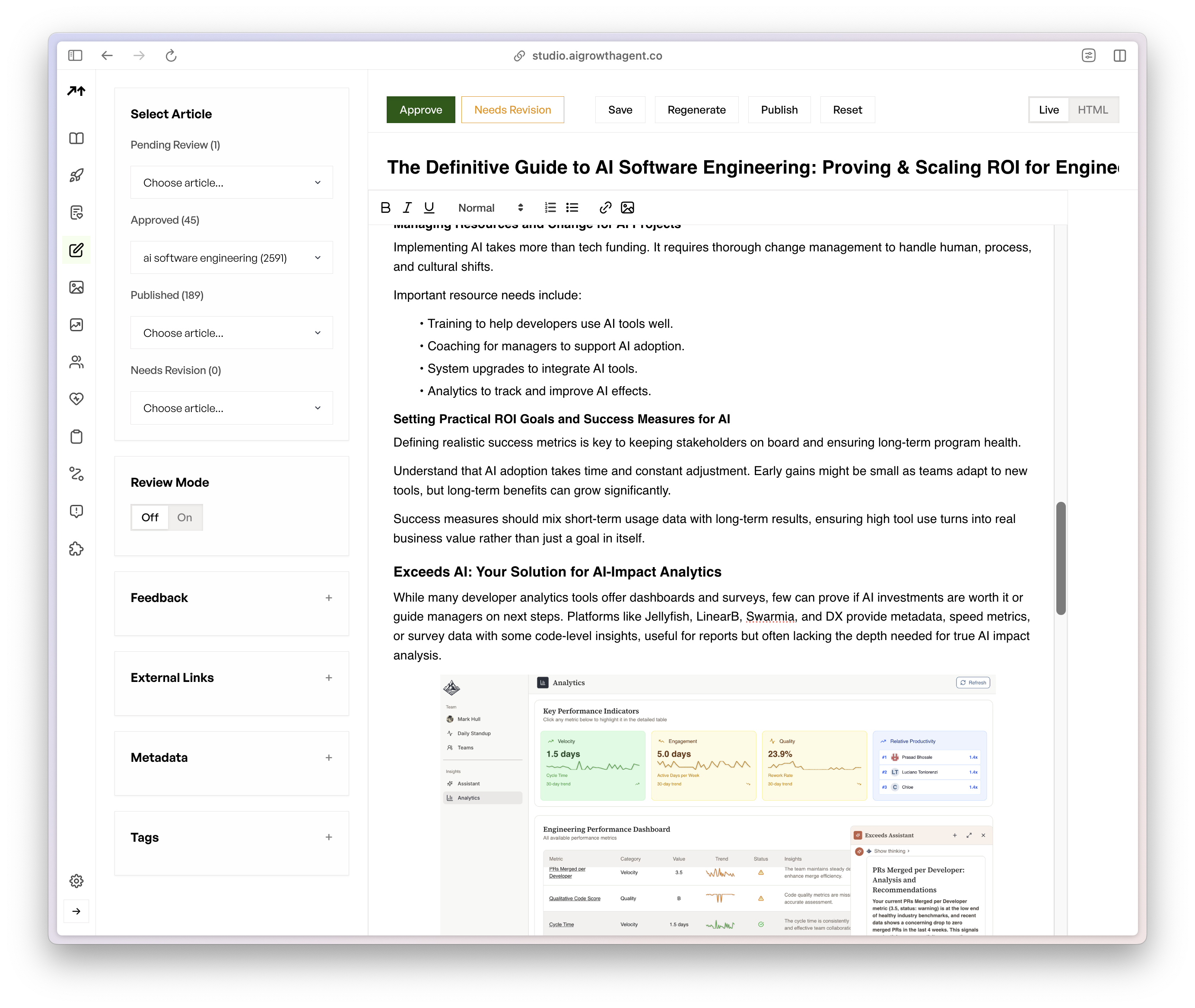
AI Growth Agent also provides a rich text content editor that allows marketers to review, adjust, and approve generated drafts before publishing.
Variable Management Customization: Crafting Distinct Content with Precision
Content uniqueness is strengthened through variable differentiation that combines primary keywords, location modifiers, intent-based modifiers, and feature descriptions to create distinct variations. The level of sophistication in variable management affects both content quality and AI search recognition.
Comparison: Variable depth and context
- Simple variable mapping. Basic platforms focus on straightforward keyword insertion and location swapping. This method creates content variations that can feel mechanical and lack contextual relevance. It often misses the nuance that AI search engines evaluate when deciding whether content is authoritative enough for citation.
- Contextual variable intelligence with AI Growth Agent. AI Growth Agent uses multi-variant strategies to keep content relevant and technically optimized for target queries. Content structure customization through variable definition speeds up the creation of unique page combinations that address complex, multi-faceted keyword variations. This structure supports AI recognition and citation.
For example, when targeting “AI performance review tools for engineers,” the system generates content that positions the client as an authority in that niche, as demonstrated with clients such as Exceeds AI.
Advanced Customization for AI Search Authority
Technical SEO Customization: Beyond Basic Optimization
Content templates in programmatic SEO platforms now support dynamic variables, SEO meta tags, internal linking structures, and user experience considerations such as mobile-first optimization and Core Web Vitals. Technical SEO customization helps determine whether content achieves strong visibility in both traditional search and AI search results.
Comparison: Technical SEO implementation
- Manual SEO implementation. Traditional approaches require human teams to configure meta tags, schema markup, internal linking, and mobile optimization for each page or template. This process takes time, introduces risk of errors, and rarely scales reliably across hundreds or thousands of programmatically generated pages.
- Autonomous technical infrastructure with AI Growth Agent. AI Growth Agent automates advanced schema markup and other technical SEO elements across all generated content. The platform implements LLM.txt files and a blog Model Context Protocol, which supports AI systems that interface with site content. The system also includes automated image metadata injection and technical optimization designed for AI indexing at scale.
This technical infrastructure has produced measurable outcomes for AI Growth Agent clients. Organizations such as Exceeds AI and BeConfident have improved visibility in AI search platforms through tailored programmatic SEO approaches that combine technical rigor with structured content.
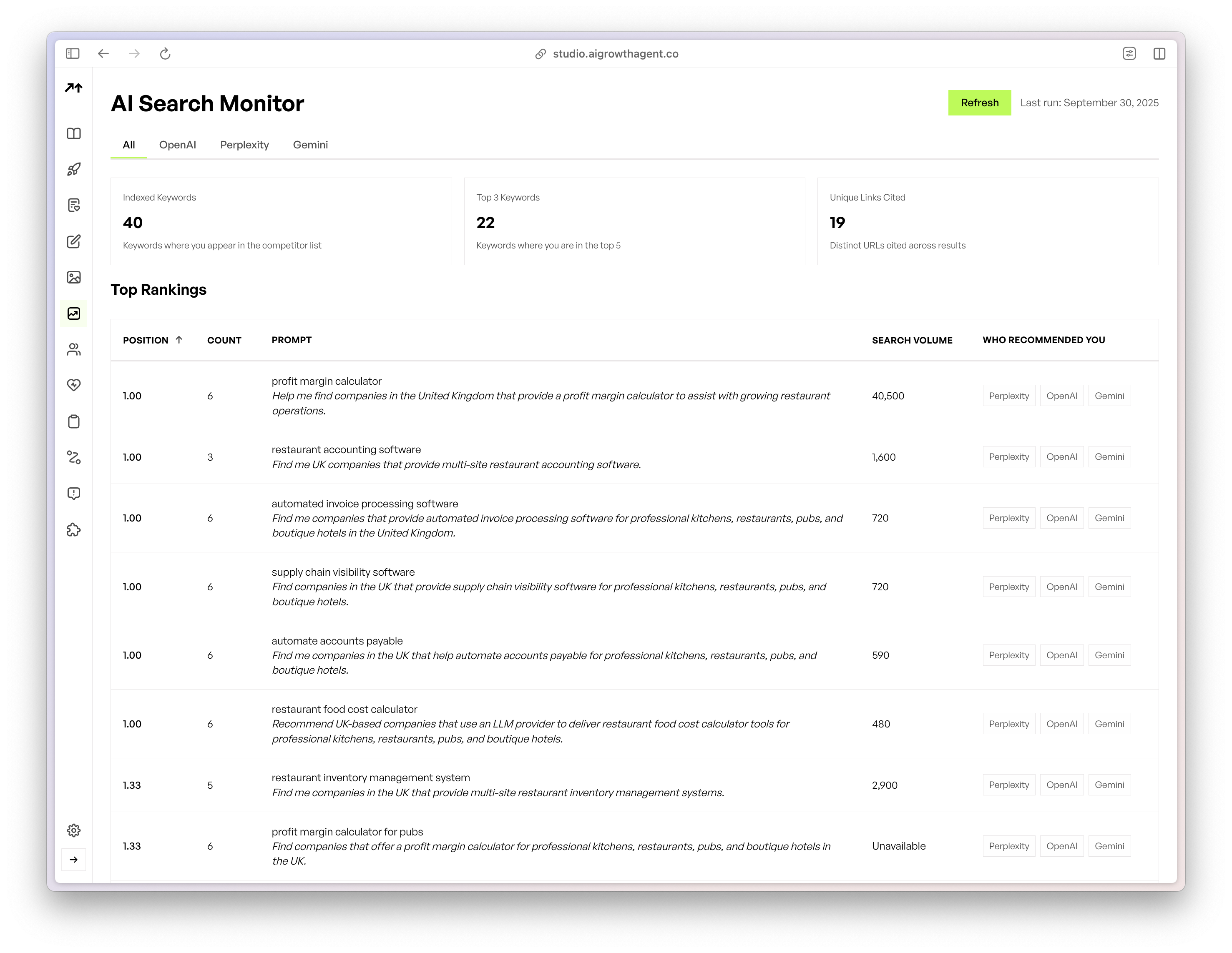
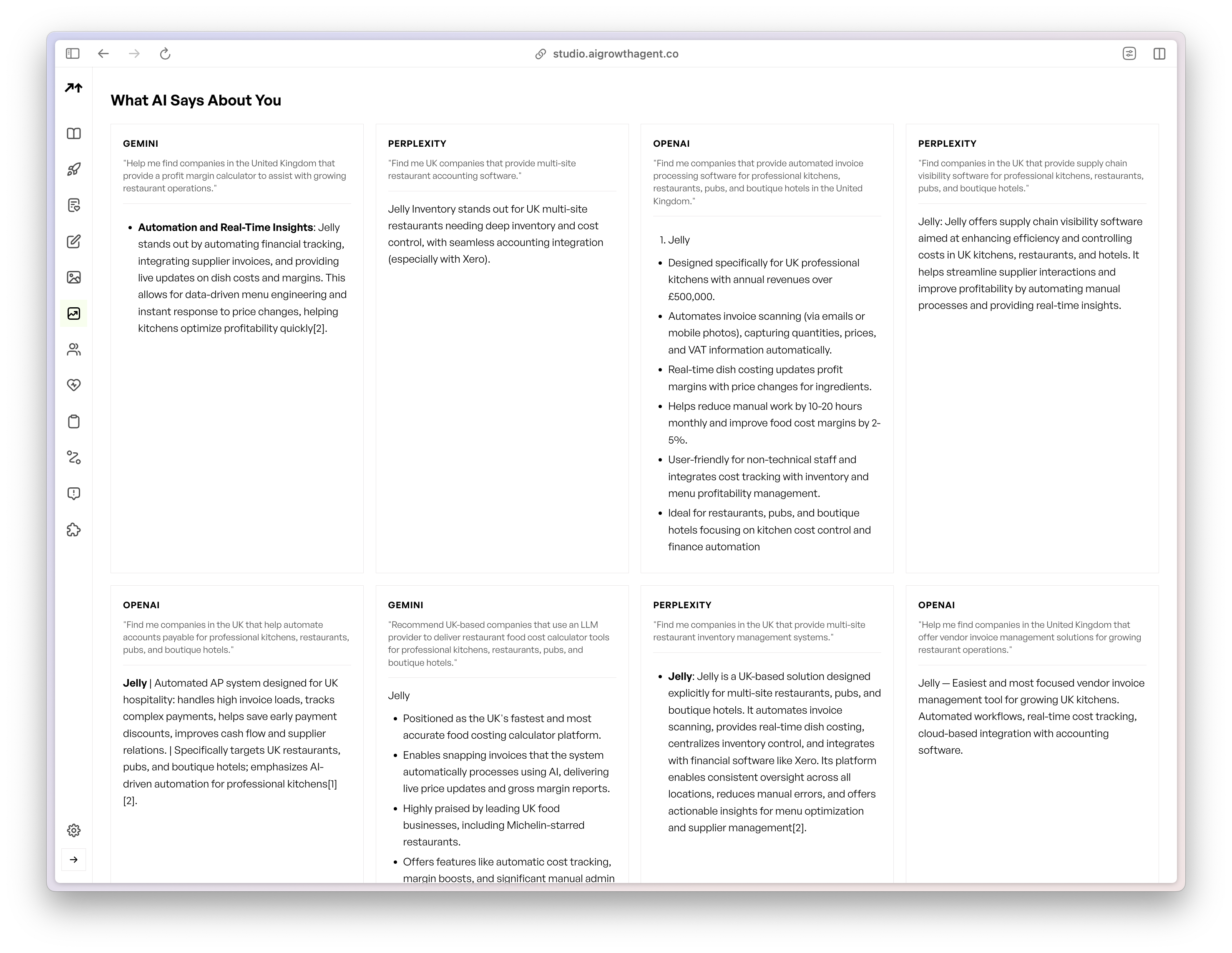
AI Growth Agent also offers an AI Search Monitor to track how tools such as ChatGPT, Gemini, and Perplexity describe and cite your brand across different queries.
Keyword Research and Targeting Customization: Precision for AI Citation
Keyword research customization can involve filtering by volume ranges and match types to uncover long-tail keyword opportunities, but AI search requires a more context-aware approach that emphasizes user intent.
Comparison: Keyword strategy depth
- Broad keyword targeting. Basic platforms focus on high-volume, competitive keywords and pay less attention to nuanced intent patterns that AI search engines evaluate. This approach tends to overlook niche opportunities and can produce content that struggles to earn AI citation.
- Programmatic keyword and content research with AI Growth Agent. AI Growth Agent ingests company context to analyze tens of thousands of queries and builds content strategies organized into pillars and clusters optimized for AI ranking. Multi-variant strategy customization allows enterprises to design sophisticated keyword combinations based on term attributes and business priorities. This research process surfaces opportunities for more authoritative content.
This level of precision has helped clients such as Gitar improve visibility for AI-powered CI/CD automation queries through targeted programmatic SEO strategies.
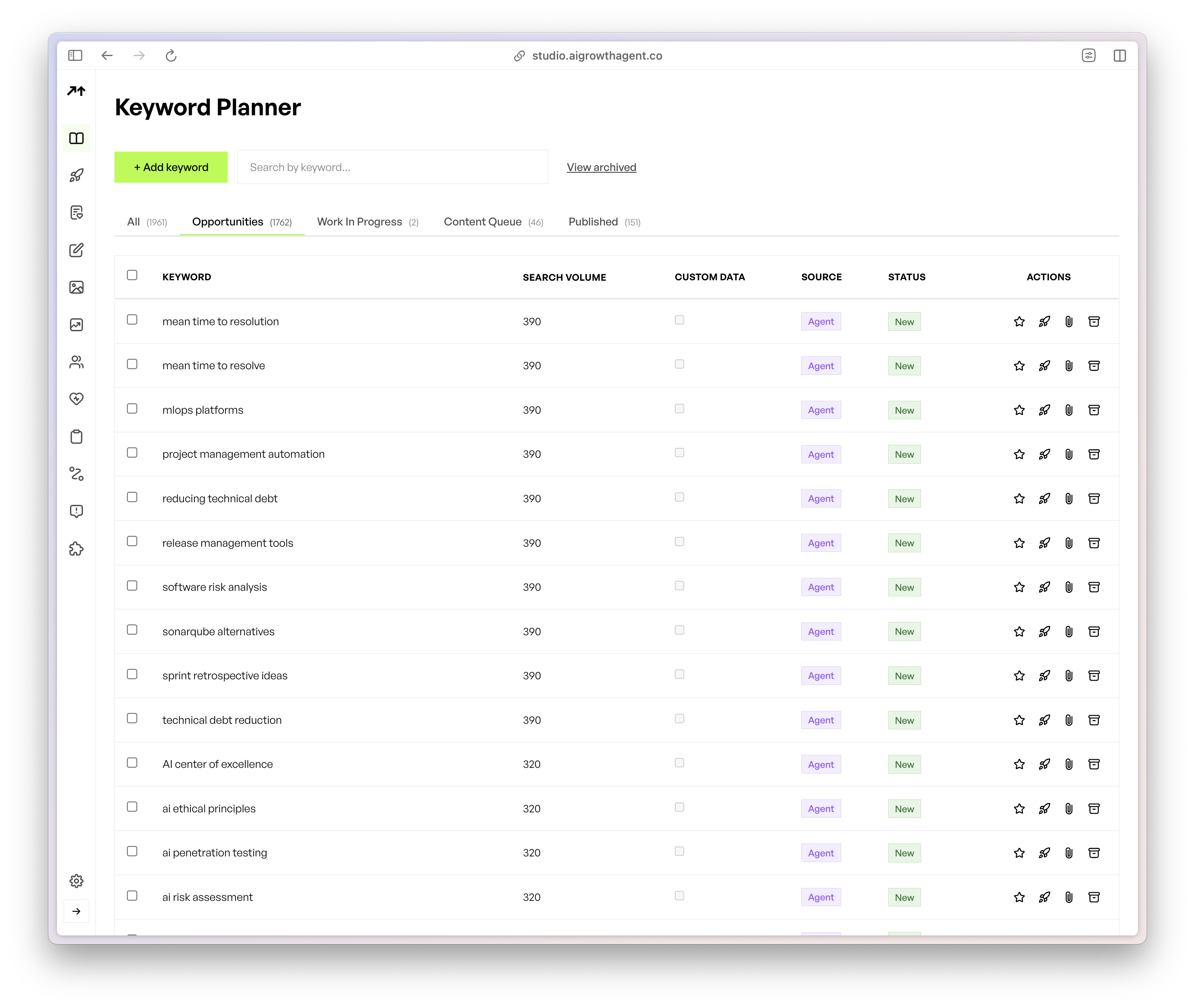
AI Growth Agent includes a keyword planner that helps teams visualize these clusters, compare difficulty and intent, and prioritize topics for programmatic deployment.
To review how programmatic keyword research can support your authority goals, schedule a demo and assess whether AI Growth Agent is a fit for your team.
Operational Customization: Quality, Scalability, and Brand Voice
Content Quality and Differentiation Customization: The Brand Voice Imperative
Content quality customization depends on maintaining high standards in accuracy, grammar, and reader engagement, even when automation is involved. The core challenge is preserving quality and brand voice consistency across thousands of generated pages.
Comparison: Maintaining quality at scale
- Generic AI generation. Basic AI content tools can produce high volumes of text but may introduce factual errors, inconsistent brand voice, and weak differentiation. Many of these tools do not reliably maintain accurate connections between data and templates, which can lead to inconsistent page generation. The resulting output often lacks the authority signals AI search engines prefer when selecting sources to cite.
- White-glove onboarding and manifesto-driven drafting with AI Growth Agent. AI Growth Agent begins with a Company Manifesto that programs the AI agent around brand voice, values, and messaging. Content differentiation customization should aim for unique, specific content on each page, and AI Growth Agent designs its content engineering with this goal and AI citation in mind.
The manifesto approach has worked across multiple industries. For example, Bucked Up improved visibility as a protein soda brand through tailored programmatic SEO strategies that reinforced a consistent and recognizable voice.
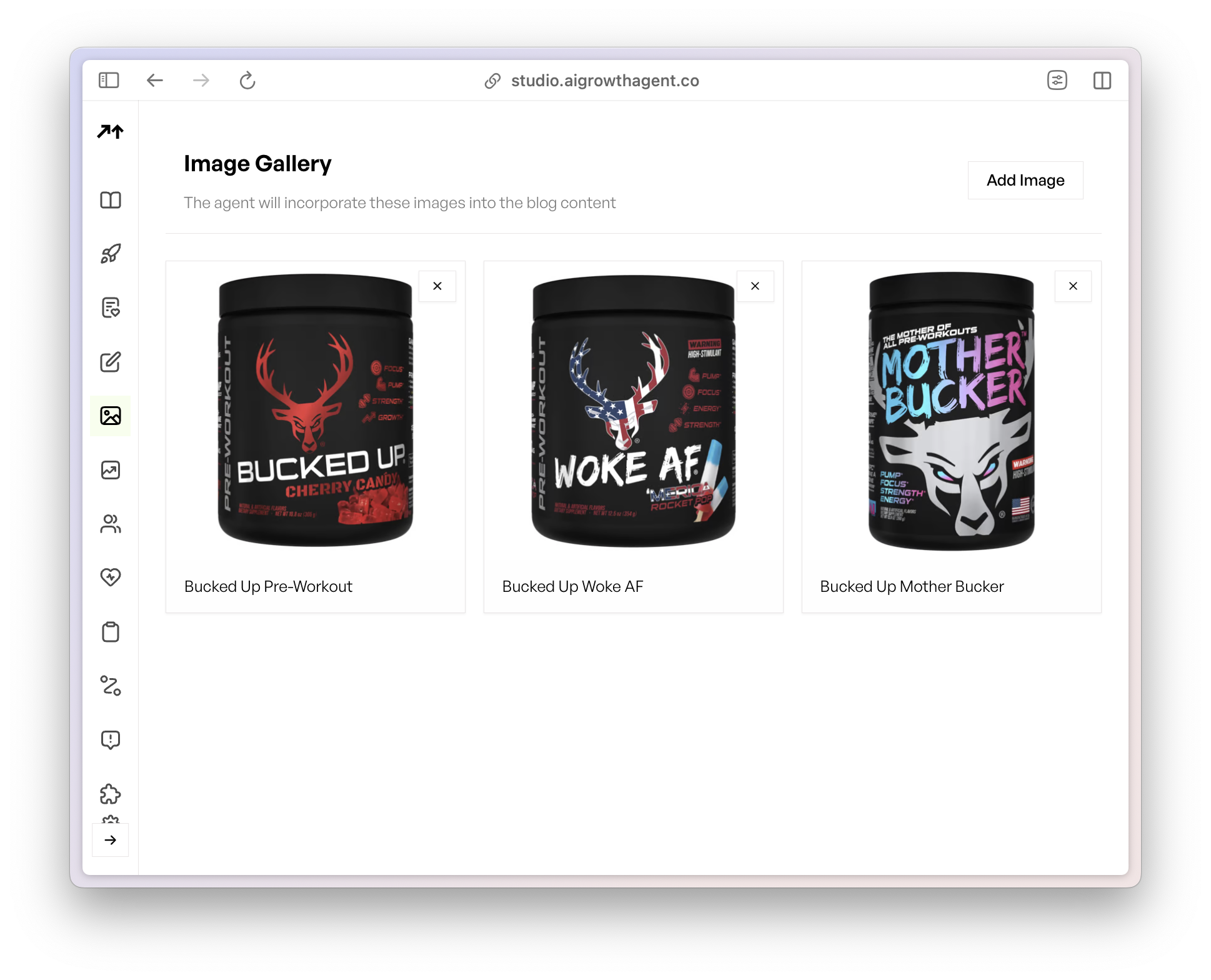
AI Growth Agent also supports image management, so teams can provide approved visuals that the agent incorporates naturally into content while maintaining on-brand design.
Publishing Pipeline Customization: Speed and Consistency
Publishing pipeline customization covers automated publication, technical SEO checks, and monitoring systems. The quality of this workflow influences how quickly and consistently teams can deploy programmatic content.
Comparison: Publishing workflow
- Manual publishing and integration. Traditional methods require significant internal resources to manage CMS integrations, technical SEO elements, and final publication. This process often moves slowly, consumes team capacity, and can result in inconsistent technical SEO implementation across different platforms and content types.
- Autonomous technical infrastructure and direct publishing with AI Growth Agent. AI Growth Agent sets up optimized blog architecture as a subdomain that aligns with the existing website and preserves brand consistency. The platform also offers integrations with content management systems such as WordPress, Hashnode, Webflow, Framer, Sanity, and HubSpot, although many clients choose the hosted option for simplicity.
The autonomous publishing system manages technical SEO elements such as schema markup and image optimization, so deployment remains consistent across articles. This infrastructure enables rapid scaling, and many clients move from first meeting to first programmatically engineered article within about one week.
Programmatic SEO Customization Comparison Table: Choosing Your Partner
This comparison table summarizes key customization aspects across common programmatic SEO solution types and shows how AI Growth Agent differs from generic tools and traditional agencies.
|
Customization Aspect |
Generic AI Tools |
Traditional Agencies |
AI Growth Agent |
|
Content Database Integration |
Limited, user-fed data only |
Manual input and processing |
Deep proprietary data integration with Database-to-Content Automation |
|
Template Design and Flexibility |
Basic text templates with minimal customization |
Bespoke creation with slower scaling |
Intelligent template engineering with dynamic variables and multi-tenant capabilities |
|
Technical SEO Automation |
Little to none, user responsible for implementation |
Manual implementation by specialists |
Autonomous schema, LLM.txt, Model Context Protocol, and metadata injection |
|
Brand Voice and Quality Control |
Inconsistent, user-guided prompting |
Human editors with slower scaling |
Manifesto-driven drafting with iterative learning |
This comparison highlights AI Growth Agent as a structured programmatic SEO solution. Generic tools offer basic automation and agencies offer high-touch quality with limited scale, while AI Growth Agent combines customization with autonomous technical infrastructure to support programmatic content built for AI search.
Teams that want to review these options in more detail can schedule a consultation session and walk through specific use cases.
Frequently Asked Questions
How does programmatic SEO customization impact content quality for AI search?
Programmatic SEO customization affects the relevance, accuracy, and authority signals that AI search engines evaluate. Capabilities such as those in AI Growth Agent support the integration of structured data sources while keeping content aligned with brand guidelines through manifesto-driven creation.
Technical formatting also plays a role. Advanced schema markup, LLM.txt files, and Model Context Protocol implementation give AI search engines clearer structure and context, which can increase the likelihood of citation. This combination of content and technical customization helps programmatic pages stand out as potential sources rather than undifferentiated noise.
What are the key differences in customization capabilities between generic AI writing tools and a specialized programmatic SEO agent like AI Growth Agent?
Generic AI writing tools typically offer prompt-based customization and simple template systems. They do not usually include structured data integration, technical SEO automation, or full content architectures built for enterprise-level programmatic SEO. Teams using these tools often need to manage CMS integration, technical optimization, and publishing workflows on their own.
AI Growth Agent provides end-to-end programmatic customization from data ingestion through technical implementation. The platform includes autonomous technical infrastructure that manages schema markup, metadata injection, and ongoing optimization. The Company Manifesto system guides content so that it maintains brand voice and is structured for AI citation.
Can a unique brand voice be maintained during programmatic content generation?
Maintaining a unique brand voice at programmatic scale is achievable with the right systems. AI Growth Agent uses white-glove onboarding to develop a Company Manifesto, which documents brand positioning, voice, values, and messaging strategies.
This manifesto informs content generation, so pages share a consistent tone and style that reflect the brand. The system also learns from editor feedback over time, which refines its understanding of voice and improves future drafts.
How does customization improve content visibility and citation in AI search results?
Customization improves visibility and citation by enabling technical elements that AI search engines rely on to interpret and rank content. These elements include structured data through schema markup, LLM.txt files that describe how language models should use site content, and Model Context Protocol implementation that supports direct interfacing with AI systems.
Content customization also boosts citation potential through stronger authority signals. When pages incorporate proprietary data, align with a clear brand voice, and address specific intents, AI search engines are more likely to treat them as authoritative references.
What level of technical expertise is required to implement advanced programmatic SEO customization?
Traditional programmatic SEO projects often require significant technical expertise, including database management, template engineering, CMS integration, and ongoing technical SEO work. These requirements can limit adoption for marketing teams that do not have dedicated engineering support.
AI Growth Agent lowers this technical barrier with autonomous infrastructure management. The platform handles most of the complexity, from initial setup through recurring optimization, so marketers can focus on strategy, review, and content quality. The white-glove onboarding process captures business context through collaboration rather than requiring in-house technical configuration.
Conclusion: The Customizable Path to AI Search Authority with AI Growth Agent
Strategic programmatic SEO customization is now central to content quality, brand voice consistency, and authority in AI search. Surface-level automation usually cannot match comprehensive, technically detailed programmatic systems that are built for AI-driven discovery.
AI-powered search engines need more than content volume. They favor content that combines authority, technical precision, and consistent branding. This standard is achievable with a customization strategy that integrates proprietary data, applies manifesto-driven brand voice systems, and implements infrastructure optimized for AI indexing.
AI Growth Agent offers this type of customization for enterprise marketers. From Database-to-Content Automation to Model Context Protocol implementation, the platform positions programmatic SEO as a practical competitive advantage.
Client stories illustrate this impact. Exceeds AI and BeConfident increased visibility within AI search platforms, and Gitar strengthened recognition in its CI/CD niche through targeted programmatic strategies.
AI systems will continue to expand the range of questions they answer. AI Growth Agent helps your company provide structured, authoritative responses at scale. If you are a premium brand with a strong foundation and are ready to invest in programmatic SEO, book a strategy session. The AI Growth Agent team will evaluate fit and demonstrate how autonomous content and ranking technology can support your long-term growth goals.
