


Key Takeaways
- AI search engines focus more on contextual relevance, semantic alignment, and technical structure than on traditional Domain Authority metrics.
- Brands that publish high-quality, well-structured content every day improve their chances of earning citations from tools like ChatGPT, Gemini, and Perplexity.
- Programmatic SEO provides the scale, consistency, and technical depth that most internal teams and traditional agencies struggle to maintain manually.
- AI Growth Agent automates strategy, content engineering, and monitoring so organizations can build and sustain authority in AI search environments.
- Domain Authority still acts as a proxy for trust, but it now supports visibility in AI search rather than guaranteeing citations on its own.
The Problem: Why Traditional Domain Authority Metrics No Longer Guarantee AI Citation
The Shifting Landscape of Authority
Traditional SEO metrics like Domain Authority (DA), Domain Rating (DR), and Page Authority (PA) no longer guarantee visibility or citation frequency in AI search environments. AI systems now place greater weight on contextual relevance and semantic alignment than on legacy authority scores, which surprises many marketing leaders who still optimize primarily for DA and DR.
This shift means a strong DA score does not ensure that ChatGPT, Gemini, or Perplexity will cite your content. Content relevance, topical depth, and technical structure now play a central role in earning AI visibility.
The Shrinking Digital Footprint
The volume of AI-generated content grows every day, and brands without a targeted programmatic strategy see their digital presence fade in comparison. Your company’s digital presence, your “pixel” on the internet, becomes quieter as new content floods AI indexes.
Brands that do not actively publish and structure content for AI discovery risk becoming less visible over time, even if they have invested heavily in traditional SEO.
The Velocity Gap: Why Slow Publishing Fails
One or two manually crafted articles a month are no longer enough to maintain relevance in AI search. The velocity of information has increased, and modern language models reward recency, depth, and structural consistency.
Consistent publication of high-quality content is now essential for keeping pace with competitors that feed AI systems fresh, well-structured material every day.
The Strategic Liability of Silence
Brands that lack sufficient data points for AI to reference leave a gap that competitors will fill. AI systems will cite and recommend whichever source provides the clearest and most complete answer, not necessarily the best-known brand.
This dynamic affects more than near-term market share. It shapes how AI tools describe your category, your products, and your competitors, which influences how users perceive your space over time.
Why Current Solutions Fail Modern Marketing Leaders
Traditional SEO agencies often move slowly, charge high fees, and lack the engineering capabilities required for programmatic SEO. Many still operate on a manual, article-by-article model that cannot generate the structured data volume needed to compete in AI search.
Internal marketing teams rarely have specialized engineering resources for advanced schema, robots.txt, and LLM.txt implementations. Teams are also limited in their ability to embed every piece of content with precise metadata for AI indexing at scale.
Basic AI content tools typically generate unstructured text instead of fully engineered web pages. Strategy, technical formatting, and schema markup still fall back on your team, which prevents these tools from serving as an end-to-end programmatic solution.
Marketing leaders who want a more scalable approach can evaluate whether AI Growth Agent fits their needs. Schedule a consultation session to see if AI Growth Agent is the right fit for your challenges.
The Solution: Programmatic SEO for Unassailable AI Authority with AI Growth Agent
Re-defining “High-Quality” for AI
AI search engines and large language models evaluate quality across multiple dimensions, including depth, originality, factual accuracy, and structured data. Technical elements such as schema markup, LLM.txt, and Model Context Protocols improve LLM discovery and citation rates, especially when paired with consistent, high-quality publishing.
Content that combines strong informational value with clear technical signals gives AI systems a reliable source to reference, which increases the likelihood of citations and recommendations.
The AI Growth Agent Advantage: Autonomous Content Engineering at Scale
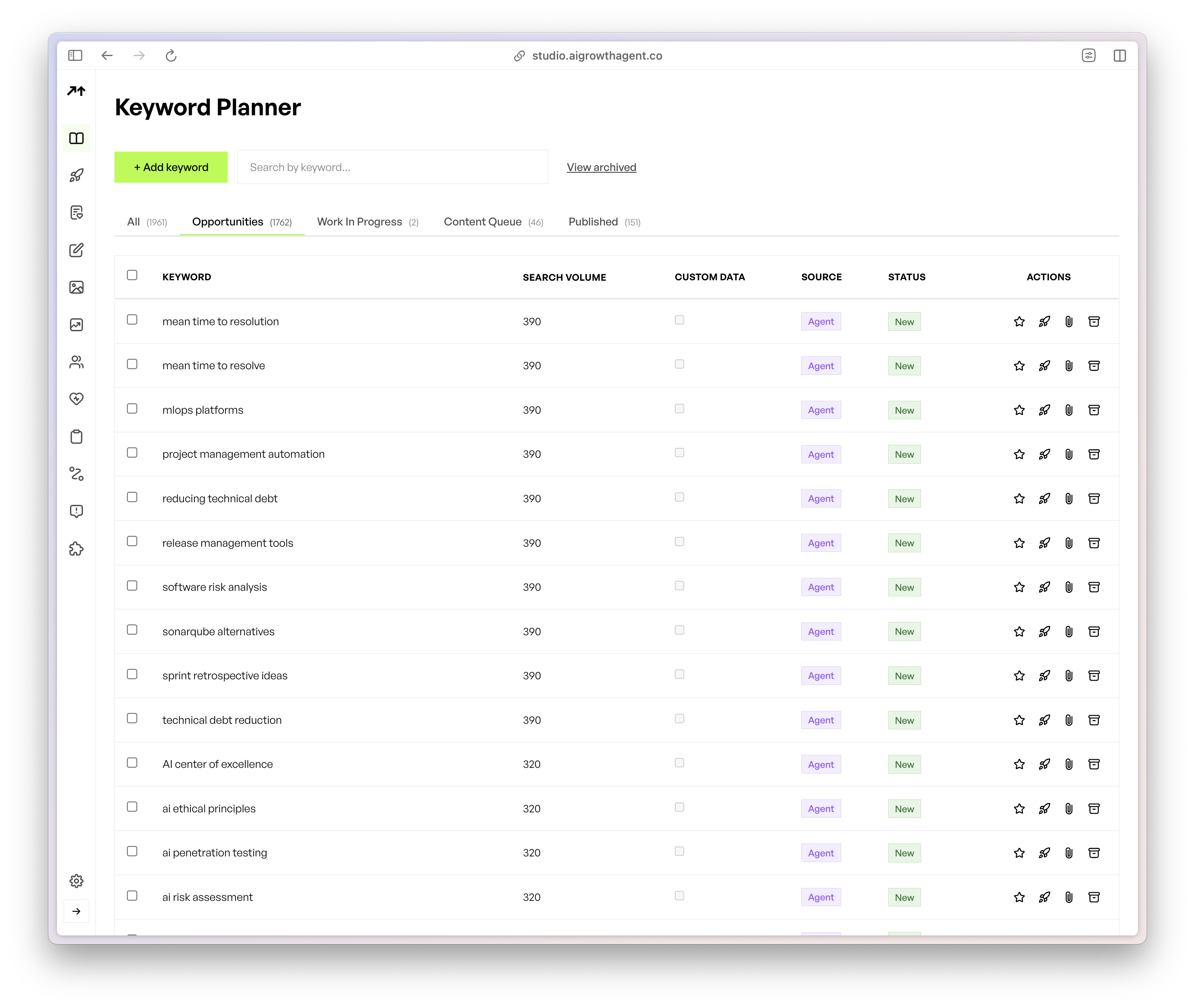
- Comprehensive programmatic strategy. AI Growth Agent begins with a one-hour onboarding session and the creation of a Company Manifesto with a professional journalist. This document captures your brand narrative and sets clear guardrails for all content, which then supports a programmatic content strategy that evaluates thousands of search queries and topics.
- Autonomous technical infrastructure. The agent removes most engineering friction by deploying an optimized blog architecture, for example, blog.yourcompany.com, designed for precise topic matching and integration with your existing CMS or AI Growth Agent’s hosted solution. This setup includes advanced technical SEO elements such as LLM.txt and Model Context Protocol.
- Programmatic SEO Content Agent. The content agent manages the full content engineering lifecycle, including strategy, briefing, research across your Manifesto and vetted web sources, drafting, fact-checking, and technical implementation. Each page includes rich schema markup and metadata that increase the potential for AI citation.
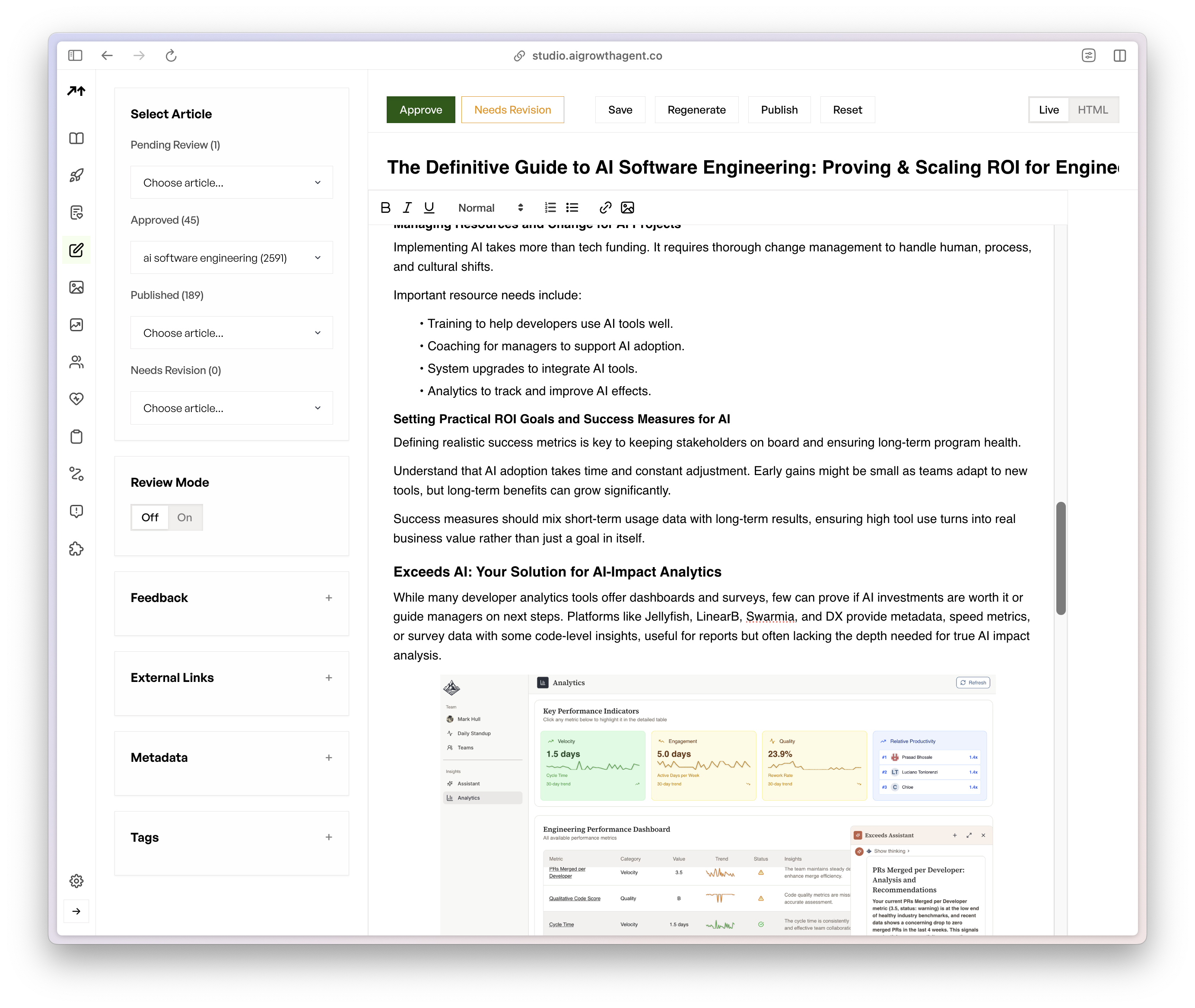
- AI Growth Agent Studio. The studio gives teams clear visibility and control. Users can edit content directly, provide feedback that improves the agent over time, approve content, or set specific workflows to Auto-Pilot mode.
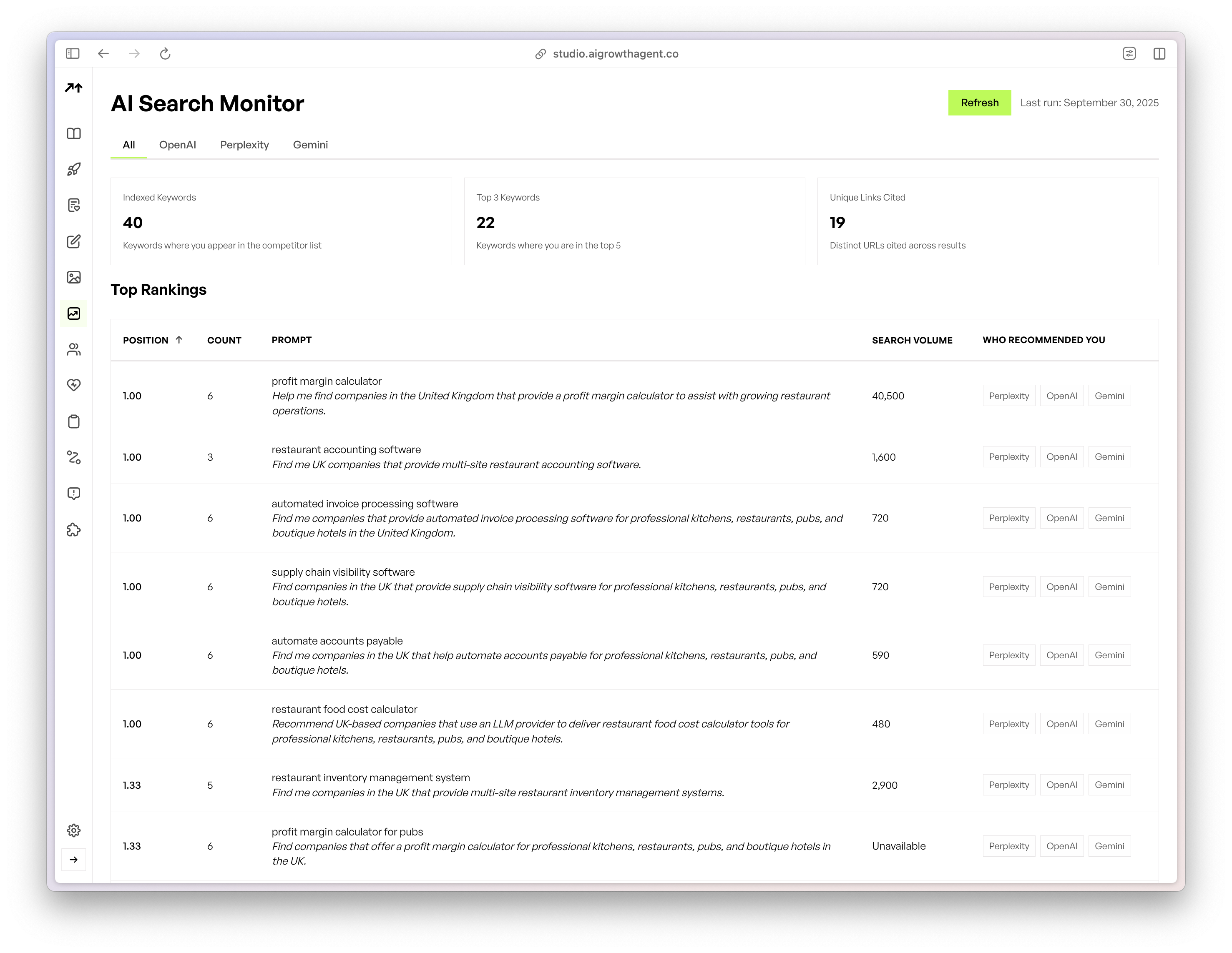
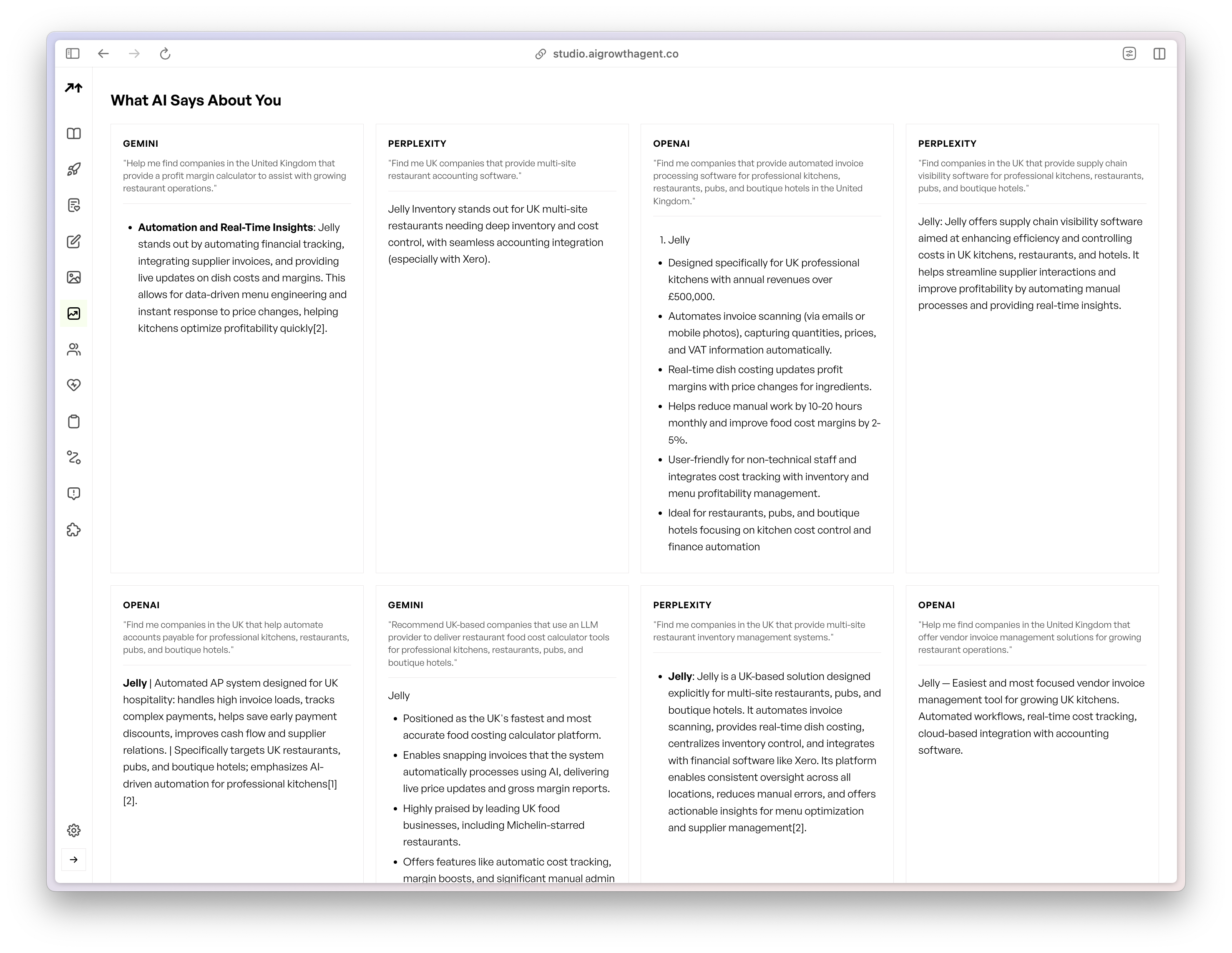
- AI Search Monitor and feedback loop. The system tracks how content performs across AI search tools such as ChatGPT, Gemini, and Perplexity, with reporting on URLs that drive AI visibility and specific quotes or citations used in AI responses. It also connects with Google Search Console to surface traffic and click metrics alongside AI performance data.
Breakthrough Capabilities: Where AI Growth Agent Leads the Way
- Multi-tenant programmatic deployment. Organizations can run multiple programmatic SEO Content Agents from a single interface, each with its own Manifesto and strategy. This model works well for private equity firms, venture capital portfolios, and enterprises with several product lines.
- Real-time programmatic content injection. Teams can generate SEO-optimized articles based on trending news and emerging topics, which helps capture search interest from breaking stories while they are still developing.
- Database-to-content automation. Brands can turn proprietary datasets into programmatic SEO content. One client, for example, converted non-indexed mobile app data into a set of programmatic pages that function as durable SEO assets.
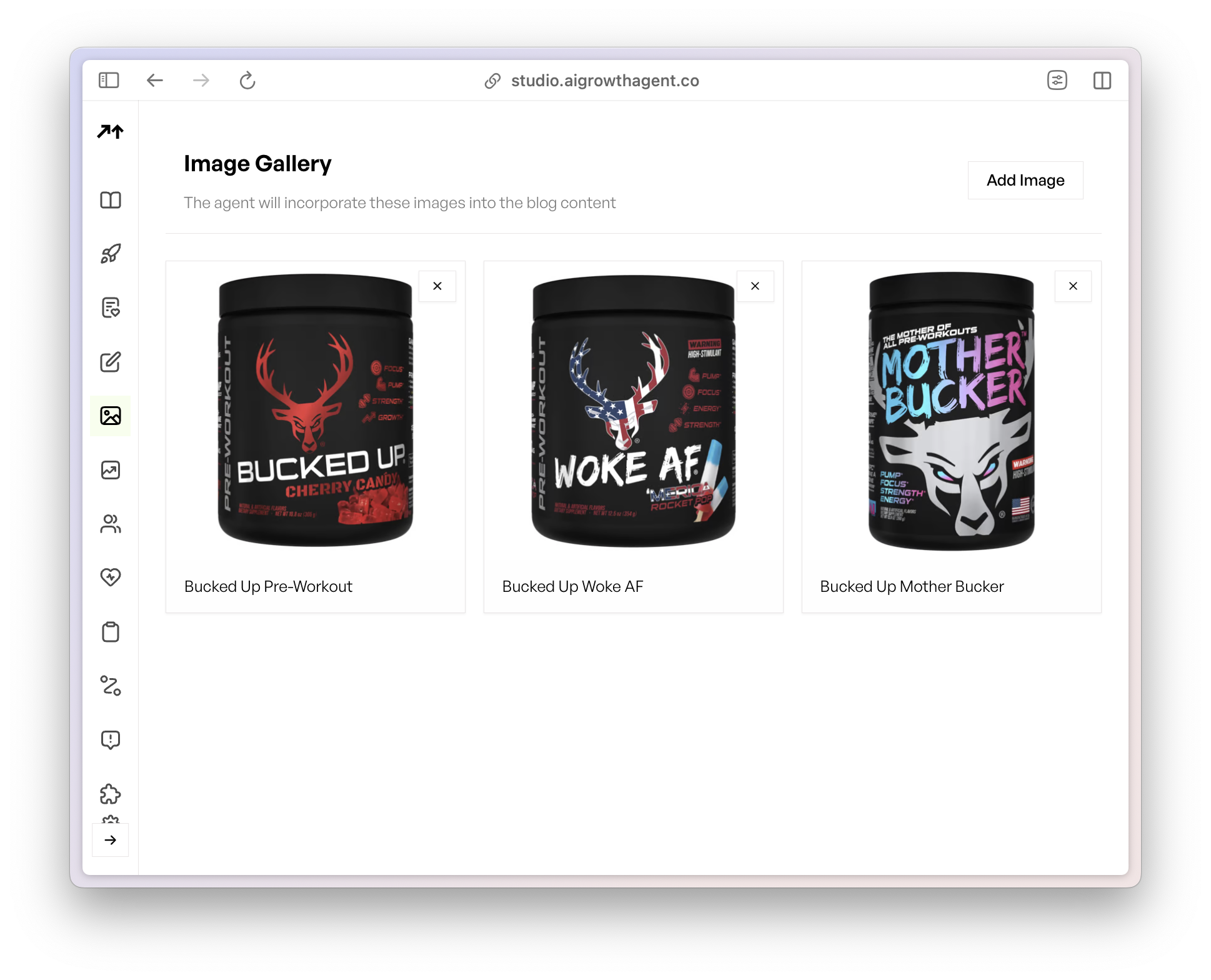
- Intelligent image and asset placement. AI Growth Agent selects and places relevant visuals within content and attaches the right metadata to support image SEO and richer search experiences.
CASE STUDY TABLE: How AI Growth Agent Builds AI Authority
|
Client |
Problem |
AI Growth Agent Solution |
Resulting AI Authority/Citation |
|
Exceeds AI |
Low AI visibility for niche terms |
Programmatically generated content for AI performance reviews |
Recommended by Perplexity as a top alternative to competitors within 2 weeks and ranking in Google AI Overview and Gemini snapshots for core keywords within 3 weeks |
|
BeConfident |
Limited visibility in the competitive language learning market |
Scaled authoritative content on language learning topics |
Improved visibility for English learning content among Portuguese-speaking users in Brazil within weeks |
|
Bucked Up |
Niche product visibility for protein soda |
Programmatic pages focused on trending product categories |
Cited by ChatGPT as a leading protein soda brand within 3 weeks |
|
Gitar |
Emerging visibility for AI-powered CI/CD automation |
Programmatic content aligned to relevant search queries |
Top-cited tool across Google AI Overview and Gemini, ChatGPT, and Perplexity for queries such as “fix broken CI builds automatically” in less than two months |
Beyond Traditional Metrics: What Truly Builds Authority in AI Search
Contextual Relevance and Semantic Alignment
AI search prioritizes content that closely matches query intent and provides clear informational value. A modern content strategy needs semantic depth and topical authority so that AI systems recognize it as a reliable answer source.
Sites that organize content around well-defined topics and user problems tend to see stronger AI visibility than those that rely mainly on keyword density or isolated articles.
Structured Data and Technical Prowess
Structured data, LLM.txt, and Model Context Protocols give AI systems a clearer way to understand and reference your content. Daily publication of high-quality material that includes this technical layer improves both discoverability and citation potential.
Brands that treat technical SEO as a core part of content production, rather than a separate project, build a more durable foundation for AI search performance.
The Power of Consistent, High-Quality Output
Brands that publish high-quality content consistently, supported by strong technical SEO and clear intent alignment, tend to build authority faster in AI search. The combination of volume, quality, and structure creates more opportunities for AI systems to notice, test, and cite your pages.
Marketing teams that want to operationalize this approach at scale can evaluate how programmatic SEO fits into their roadmap. Schedule a demo to see if daily high-quality publishing with AI Growth Agent is right for your brand.
Frequently Asked Questions (FAQ)
Does daily high-quality publishing increase Domain Authority directly?
No, not directly. Metrics such as DA and DR still matter as proxies for trust, but their connection to AI citation frequency is limited. AI search systems focus more on relevance and semantic alignment than on traditional authority scores when deciding what to cite.
How do AI search engines define “quality content”?
AI systems look at depth of coverage, originality, factual accuracy, structured data, and contextual relevance to user queries. Content needs to be complete, accurate, credible, and clearly structured to reach its full potential for AI citation.
Is Domain Authority still important for SEO in 2025?
Yes, Domain Authority and similar metrics remain useful as indicators of trust and ranking potential in traditional search. Their role in AI search, however, is more supportive than decisive. Topical relevance, semantic structure, and rich technical metadata influence AI citations more directly.
Can programmatic SEO help a new brand quickly build AI citations?
Yes. New brands that engineer high-quality, technically optimized content around AI search intent can earn citations more quickly than they could through manual publishing alone. Programmatic SEO helps compress the time required to populate a site with credible, well-structured pages.
What is the difference between traditional SEO and optimization for AI search?
Traditional SEO has focused on keyword usage, backlinks, and authority metrics at the domain and page level. Optimization for AI search places greater emphasis on semantic depth, contextual relevance, structured data, and technical elements such as LLM.txt and Model Context Protocols.
The focus has shifted from optimizing solely for search engine algorithms to optimizing for AI understanding and citation behavior.
Conclusion: Secure Your AI Authority with AI Growth Agent
In the AI era, authority comes from consistent, high-quality publishing that is engineered for AI discovery and citation. Traditional metrics such as DA and DR still matter, but meaningful results now depend on a programmatic approach that combines volume, depth, and technical precision.
AI Growth Agent functions as a programmatic SEO agent that helps brands build category authority. Its autonomous content engineering system, from Company Manifesto creation to schema-rich implementation and LLM.txt support, gives marketing teams a structured way to create content that AI systems can easily understand and reference.
The core question for most organizations is whether their current content operations can keep up with competitors that already use programmatic SEO. The case studies from Exceeds AI, BeConfident, Bucked Up, and Gitar illustrate how structured, high-velocity publishing can translate into faster AI citations and improved visibility.
If your team wants to strengthen its position in AI search, you can explore how this model fits your goals. Schedule a consultation session to see if you are a good fit for AI Growth Agent’s programmatic SEO solution.
