


This guide explains how enterprise marketing teams can implement an AI Content Management System (AICMS) to increase content output, improve AI search visibility, and reduce operational overhead.
- Understand how AI answer engines are changing search behavior and what that shift means for your content strategy.
- Assess your team’s AI skills, technology stack, and data readiness for an enterprise-grade AICMS.
- Define clear AICMS requirements, from content automation and technical SEO to reporting and governance.
- Compare AICMS approaches and see where an agent-powered platform like AI Growth Agent can add value.
- Follow a step-by-step roadmap for deployment, integration, and ongoing optimization for AI search.
If you already know you need to compete in the new AI search landscape, you can schedule a demo with AI Growth Agent to explore implementing an AICMS while you read.
The AI Search Revolution: Why Traditional Content Strategies Fall Short
Search has shifted from a list of blue links to AI-driven answer engines. Tools like ChatGPT, Gemini, and Perplexity now respond to natural-language questions by synthesizing information from a limited set of sources.
Three structural changes follow from this shift:
- Your digital footprint is shrinking. AI-generated content is increasing daily, and every new article, summary, and answer dilutes your presence. Without a larger volume of authoritative content, your visibility declines.
- Quality daily publishing is the new baseline. Large Language Models prioritize recency, depth, and consistency. Publishing one or two strong pieces each month no longer keeps up. To improve visibility, your brand needs high-quality, technically optimized content on a near-daily basis.
- If you do not define your story, competitors will. When an AI system cannot answer a query with confidence using your content, it turns to other sources. Competing narratives can become the version AI repeats back to your prospects.
Many organizations respond with incremental steps, such as asking agencies for more content, giving teams generic AI tools, or creating prompt libraries. These efforts often help at the margin but do not solve the underlying need for a coordinated system.
An Enterprise AICMS provides that system. It serves as a dedicated, autonomous content engine designed to operate at the speed and scale that AI search now requires.
Step 1: Assess Your Content Gap and The Need for an AICMS
Understanding the AI Skill Deficit in Marketing Teams
Enterprise AI adoption is growing, but many marketing organizations still lack the skills needed to apply advanced AI effectively to content strategy.
For CMOs and marketing leaders, this creates a specific challenge:
- Your team is expected to use advanced AI, yet many marketers have only basic experience with tools like ChatGPT.
- The expertise required to build an AI-native content engine, including prompt design, data integration, and technical optimization for AI search, often falls outside traditional marketing roles.
Agencies face similar constraints. Their models are built on billable hours and project scopes, which do not always align with creating and maintaining an always-on AI content system. They can add more writers, but that does not replicate the capabilities of autonomous agents or deep technical integrations.
This is the AI skill deficit in marketing. Teams need more than better writers or a set of prompts. They need a new operational foundation for content.
Why Incremental AI Content Solutions Do Not Scale for Enterprises
Many enterprises experiment with generic AI tools such as ChatGPT, lightweight SaaS SEO writers, or internal prompt libraries. These can accelerate drafting, but they often introduce new constraints:
- No strategy layer. Someone still has to conduct keyword research, align topics with business priorities, and maintain an evolving roadmap. Tools do not manage this automatically. People do, and those people are usually already at capacity.
- Repetitive, low-differentiation content. Generic models used with generic prompts produce similar outputs. The resulting articles often lack a clear point of view, do not embed your product narrative, and are easy for both humans and LLMs to dismiss as undifferentiated AI content.
- Heavy manual overhead. Each piece still requires briefing, editing, image selection, formatting, metadata work, and CMS publishing. The workload shifts but does not disappear, and new steps can add complexity.
- Technical SEO gaps. Many tools stop at text generation and do not handle schema, LLM.txt, structured data, or newer protocols for AI indexing. Without this layer, content is harder for AI search engines to interpret and surface.
These incremental fixes may make individuals somewhat faster, but they do not provide an enterprise-scale solution.
The Imperative: Using an Enterprise AICMS for Scalable Authority
An Enterprise AICMS reframes how AI supports marketing. Instead of treating AI as a faster copywriter, it positions AI as the core of your content operations.
The right AICMS:
- Turns your intellectual property and positioning into a consistent source of truth that every article reinforces.
- Automates the full lifecycle, from keyword discovery to drafting, technical engineering, publishing, and monitoring.
- Operates continuously, delivering content calibrated for AI visibility as well as human readers.
AI Growth Agent is designed as this type of AICMS. It uses coordinated AI agents to support the work that a content agency, SEO team, and technical operations function would typically perform together, with a focus on building AI search authority.
If your internal assessments show a widening gap between your strategic goals and current content output, it is a practical time to schedule a consultation demo with AI Growth Agent and evaluate how an autonomous content engine could support your roadmap.
Step 2: Strategic Planning and Defining Your Enterprise AICMS Requirements
Evaluating Your Enterprise’s AI Readiness and Infrastructure
A clear view of your AI maturity and technical foundation makes AICMS selection easier. Many large enterprises already use cloud-based AI platforms, which can provide a strong base for introducing an AICMS.
Two readiness dimensions matter most for content-centric AI:
- Infrastructure readiness. If you run workloads on major cloud platforms and have standard security and access controls in place, you are structurally prepared to deploy an AICMS that integrates with your existing stack.
- Data quality and accessibility. Fragmented or inconsistent source content leads to weaker AI outputs. Consolidating core messaging, product documentation, and positioning into a clear, reusable corpus is critical for reliable performance.
AI Growth Agent addresses this through a structured onboarding process. A detailed knowledge transfer session with your team is distilled into a Company Manifesto, an AI-ready representation of your brand, narrative, and product facts. This becomes the reference point for all subsequent content.
Establishing Clear AICMS Objectives and Measuring ROI
An effective AICMS strategy starts with measurable goals. Common targets for marketing leaders include:
- AI search visibility. Growth in citations and mentions in AI search results across key platforms for your priority category keywords.
- Traditional organic growth. Increases in impressions, clicks, and rankings in Google Search Console that can be tied to AICMS-generated content.
- Operational efficiency. Reduction in content production timelines and fewer internal bottlenecks.
- Cost leverage. Lower cost per high-quality article over time as automation and processes mature.
With AI Growth Agent, these metrics are trackable through the AI Search Monitor and Google Search Console integration, so you can view AI and traditional search impact in a single environment.
Crafting Your Brand’s AI Content Manifesto
An AICMS performs best when your brand guidance is specific. High-level brand voice documents often produce generic content. A more precise AI Content Manifesto gives the system a practical operating manual for how your brand should think, speak, and educate.
Your AI Content Manifesto should capture:
- Positioning and category narrative. The category you intend to lead, the primary problem you solve, and how success is defined.
- Non-negotiable truths. Claims that must remain accurate and consistent, such as service model, pricing approach, and core differentiators.
- Audience segments and goals. Who you are writing for and what they are trying to achieve.
- Content pillars. Major themes and topic clusters that the AICMS should reinforce on a recurring basis.
AI Growth Agent operationalizes this manifesto as a shared data object that every agent references. Keyword strategies, outlines, and final articles align with your narrative and support a consistent signal of authority.
Step 3: Selecting the Optimal Enterprise AICMS Solution
Essential Features for an Enterprise-Grade AICMS
For enterprises, basic AI writing is only a starting point. To improve AI search visibility, an AICMS should include:
- Autonomous agents for the full content lifecycle. Coordinated agents handle research, outlining, drafting, fact-checking, technical SEO, and publishing with limited need for manual prompting.
- Advanced technical SEO for AI search. This includes schema markup, metadata, robots rules, LLM.txt configuration, and emerging protocols that help AI models interpret your content.
- Scalability and multi-brand management. Enterprises with multiple products or portfolio companies need an AICMS that can support distinct strategies and voices in parallel.
- Real-time content responsiveness. The ability to create and publish high-quality content on trending topics or breaking news within short timeframes.
- Custom data integration. The capacity to turn proprietary knowledge, internal documentation, or offline data into structured, search-optimized content.
- An intuitive, transparent command center. A central interface where teams can inspect, edit, approve, and provide feedback on content.
AICMS Solution Comparison: Why AI Growth Agent Stands Out
When you evaluate solutions, you will typically compare a true AICMS such as AI Growth Agent with generic AI content tools and traditional SEO agencies.
|
Feature / Capability |
AI Growth Agent |
Generic AI Content Tools |
SEO Agencies |
|
Autonomous Content Generation |
Yes (agentic, strategy-aware) |
Limited (manual prompting) |
No (human-written) |
|
End-to-End Content Lifecycle |
Yes (research to publishing) |
No (requires human orchestration) |
Yes (but human-driven and slow) |
|
Advanced Technical SEO (LLM.txt, MCP) |
Yes (engineered for AI search) |
No (text only) |
Limited (manual, inconsistent) |
|
Multi-Brand Parallel Deployment |
Yes (unique portfolio mode) |
No |
No (separate projects per brand) |
|
Real-Time Content Generation |
Yes (trend-responsive) |
No (manual workflows) |
No (too slow for real-time) |
|
Automated Keyword Research Strategy |
Yes (dedicated agent) |
No (manual input) |
Limited and slow |
|
Integrated Performance Monitoring |
Yes (AI and organic search) |
No |
Yes (separate reporting tools) |
AI Growth Agent: A Strong Choice for Enterprise AICMS
AI Growth Agent is built to help brands improve AI search visibility while managing operational complexity.
Key capabilities include:
- Agent-powered autonomy. Specialized agents such as the Keyword Deep Research Agent, Core Content Agent, and AI Search Monitor work together to deliver content at scale.
- AI-native technical SEO. Articles are enriched with schema, optimized metadata, and protocols that support interaction with AI models.
- Portfolio-scale operations. Parallel agent deployment allows multiple brands or product lines to be managed from one interface, each with its own strategy and guidelines.
- Real-time market response. Teams can request and approve brand-aligned content in response to relevant news or emerging topics within short time windows.
- Execution engine. The platform not only reports on performance but also produces new content to address identified gaps.
For marketing leaders, this supports a shift away from manual production workflows toward a more automated system that still stays within brand and compliance boundaries.
To see how this could work for your organization, you can schedule a demo of AI Growth Agent’s platform.
Step 4: Implementation and Integration of Your AICMS
Deploying Your AI-Optimized Blog: Autonomous and Low Friction
Implementation often stalls when AI initiatives run into CMS integration or technical SEO requirements.
AI Growth Agent reduces this friction by:
- Standing up a fully optimized blog as a subdomain. The platform can deploy a blog, such as blog.yourcompany.com, that aligns with your brand design while being engineered for search visibility.
- Offering integrations with existing CMS platforms. For organizations using WordPress or other systems, AI Growth Agent connects to your current publishing workflows.
- Ensuring technical hygiene. Configurations for robots.txt, LLM.txt, schema, and image optimization are managed so AI indexers can interpret your content more effectively.
This structure allows marketing teams to focus on priorities and governance instead of technical setup.
The Autonomous Content Workflow: From Strategy to AI Publishing
Once your manifesto and blog are in place, the AICMS workflow activates in a repeatable pattern.
- Keyword Deep Research Agent. This agent uses your Company Manifesto to analyze thousands of queries and build a structured keyword strategy.
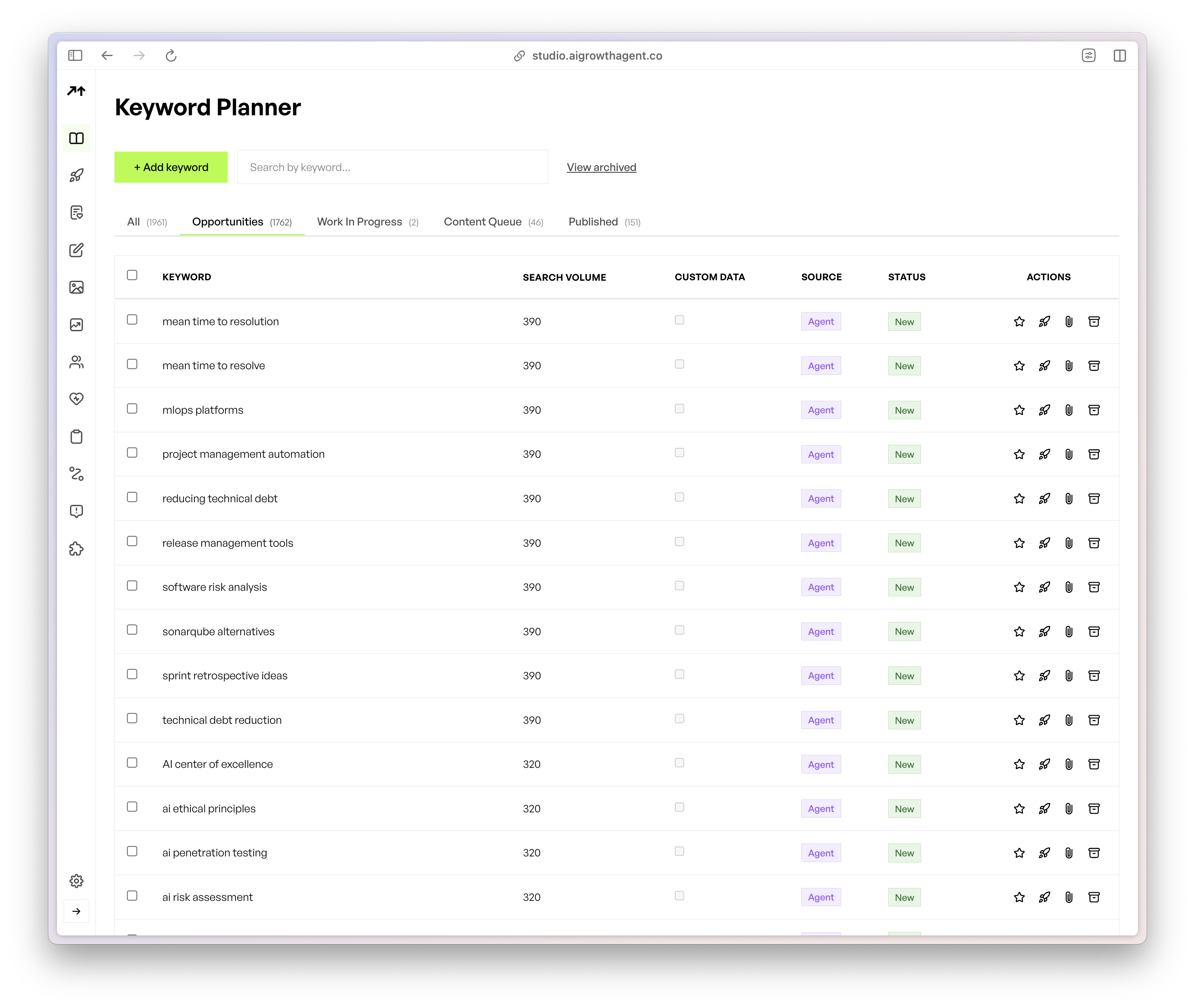
- Content planning and queueing. Topics are sequenced based on opportunity and business priorities, creating a continuous publishing schedule.
- Core Content Agent execution. For each topic, the agent:
- Creates a detailed brief aligned with your manifesto.
- Researches supporting sources.
- Drafts comprehensive articles.
- Reviews and refines content for clarity and accuracy.
- Applies technical engineering such as schema and metadata.
- Publishing and indexing. After review and approval in the Studio, content is published directly to your optimized blog for discovery by both traditional and AI search engines.
Work that once required weeks of coordination can instead move from research to publication in hours, without sacrificing depth or structure.
Empowering Your Team Through the AICMS Studio Command Center
The goal of an AICMS is to extend your marketing team’s capabilities, not replace them. In AI Growth Agent’s Studio, your team can:
- Review and edit content using a rich text editor before publication.
- Shape the content roadmap by reviewing upcoming topics and adjusting priorities.
- Provide feedback to improve how agents reflect your brand voice and positioning.
- Monitor performance by viewing search metrics and AI indexing data in one place.
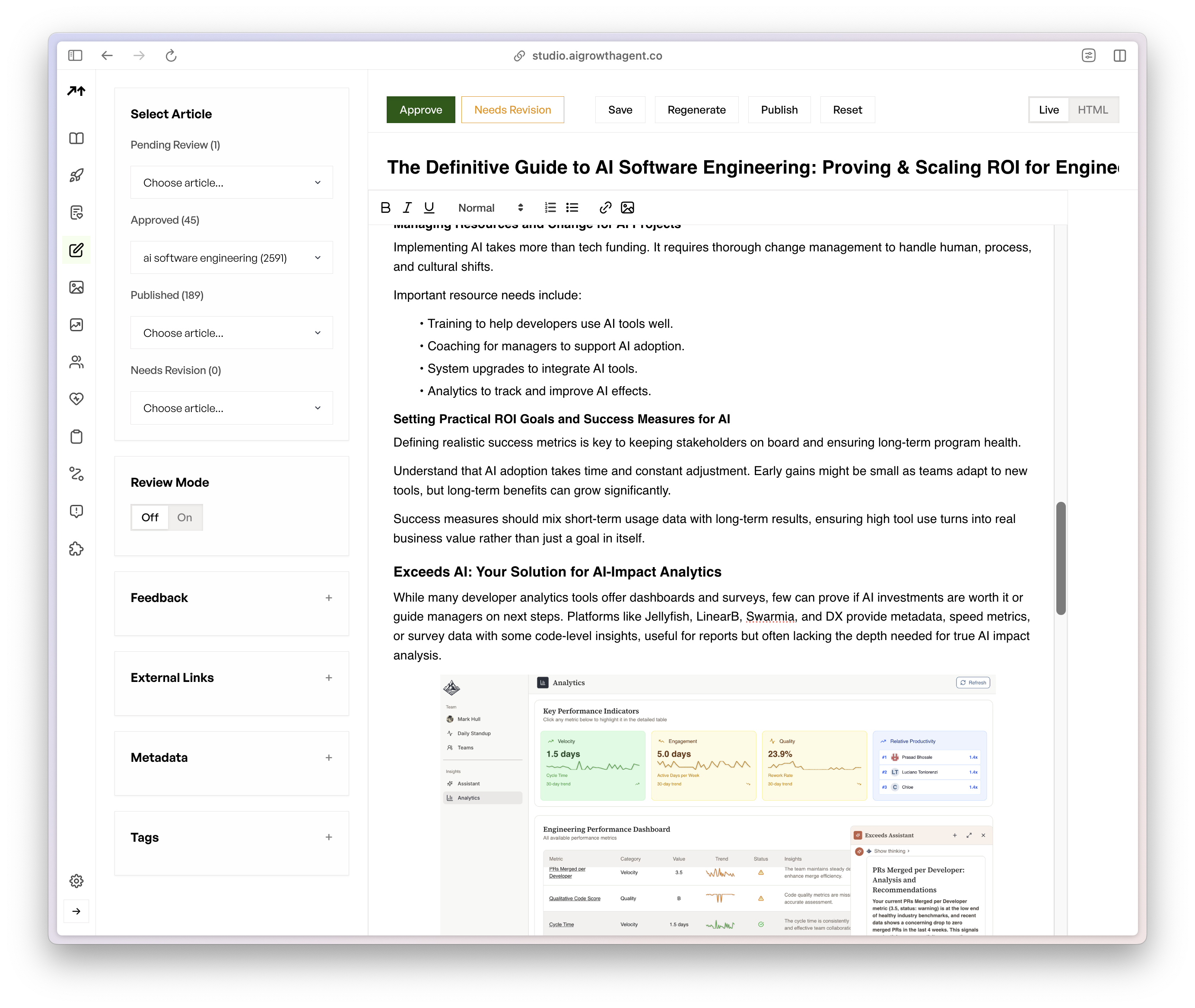
This model keeps strategic decisions and brand judgment with your team, while the AICMS manages the heavy lifting of research, drafting, and technical optimization.
Step 5: Maximizing AICMS Performance for AI Search Visibility
Continuous Monitoring and Optimization with AI Search Intelligence
Maintaining and improving AI search visibility requires ongoing visibility into how AI systems surface and use your content.
AI Growth Agent’s AI Search Monitor provides this intelligence through several views:
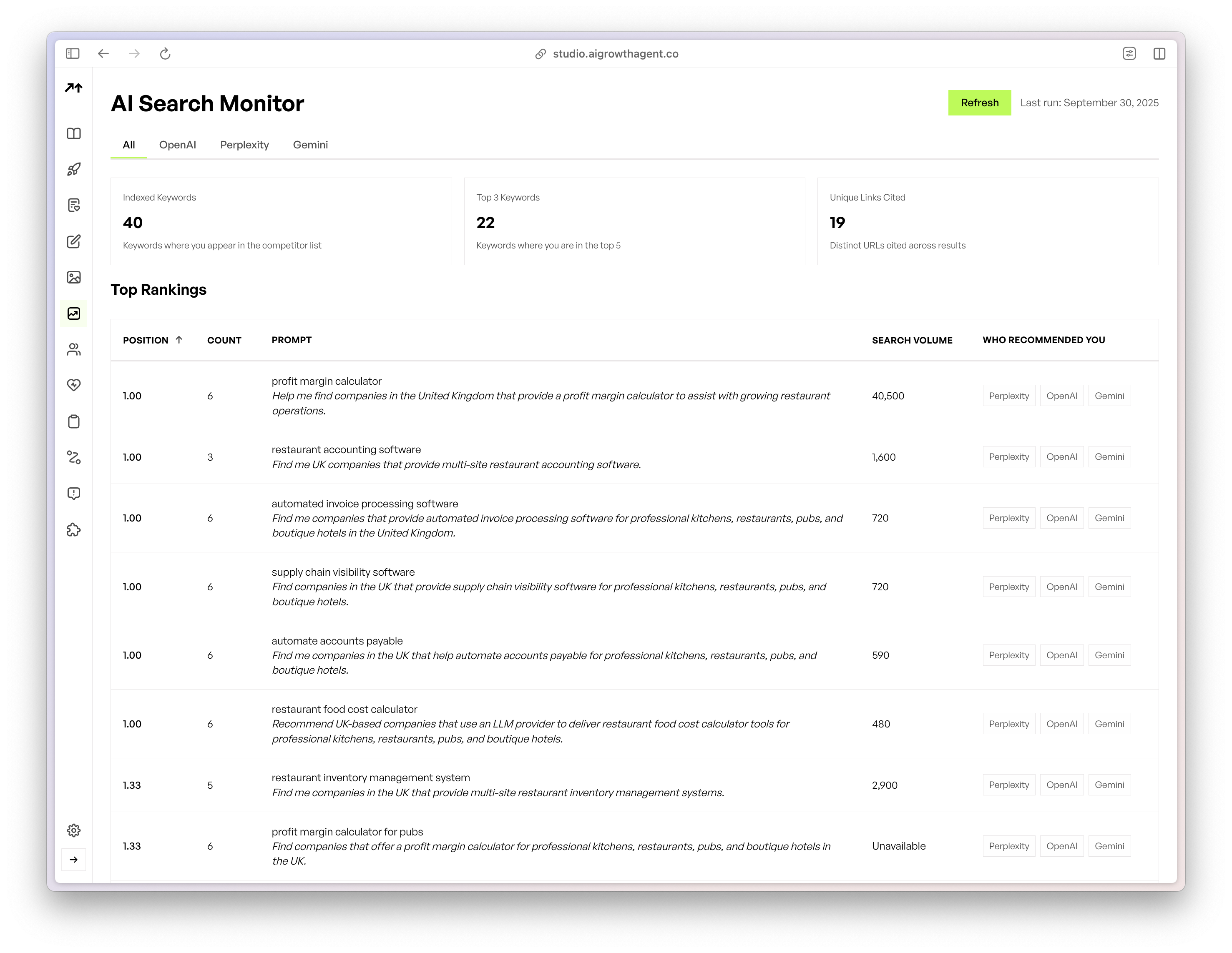
- Keyword heatmaps. Visibility into indexing across AI platforms for target keywords.
- Direct citations and quotes. Instances where AI responses reference or echo your content.
- URL-level performance. Identification of articles that contribute most to AI visibility.
- Competitive benchmarks. Cases where competing content appears in AI answers instead of yours.
- Crawl and indexing behavior. Logs of bot activity from Google and other platforms.
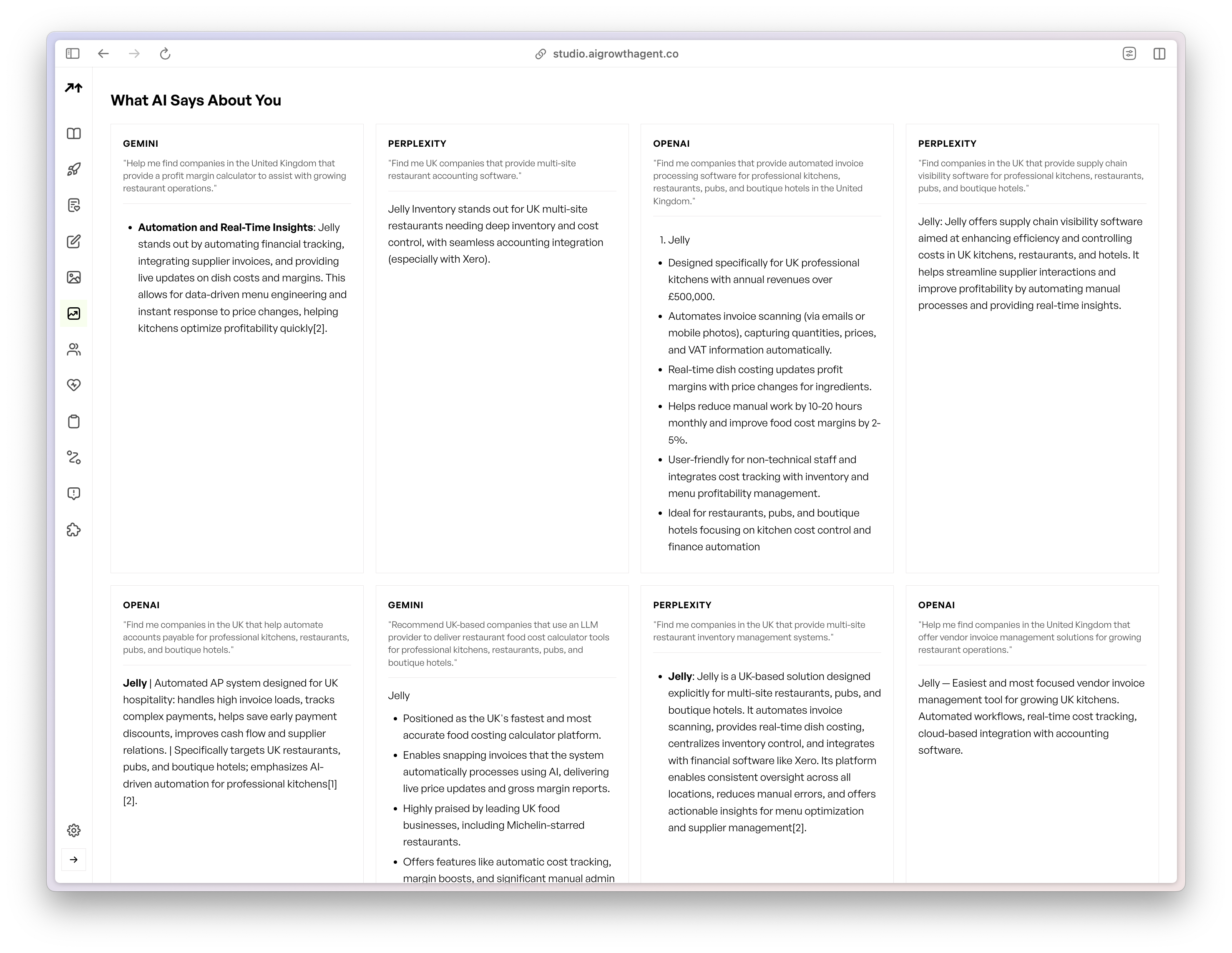
This feedback loop supports continuous improvement by highlighting gaps, guiding new content production, and tracking how your AI search footprint evolves.
Advanced AICMS Strategies for Sustained Growth
Once the core AICMS workflow is running reliably, additional strategies can help you build a more durable presence.
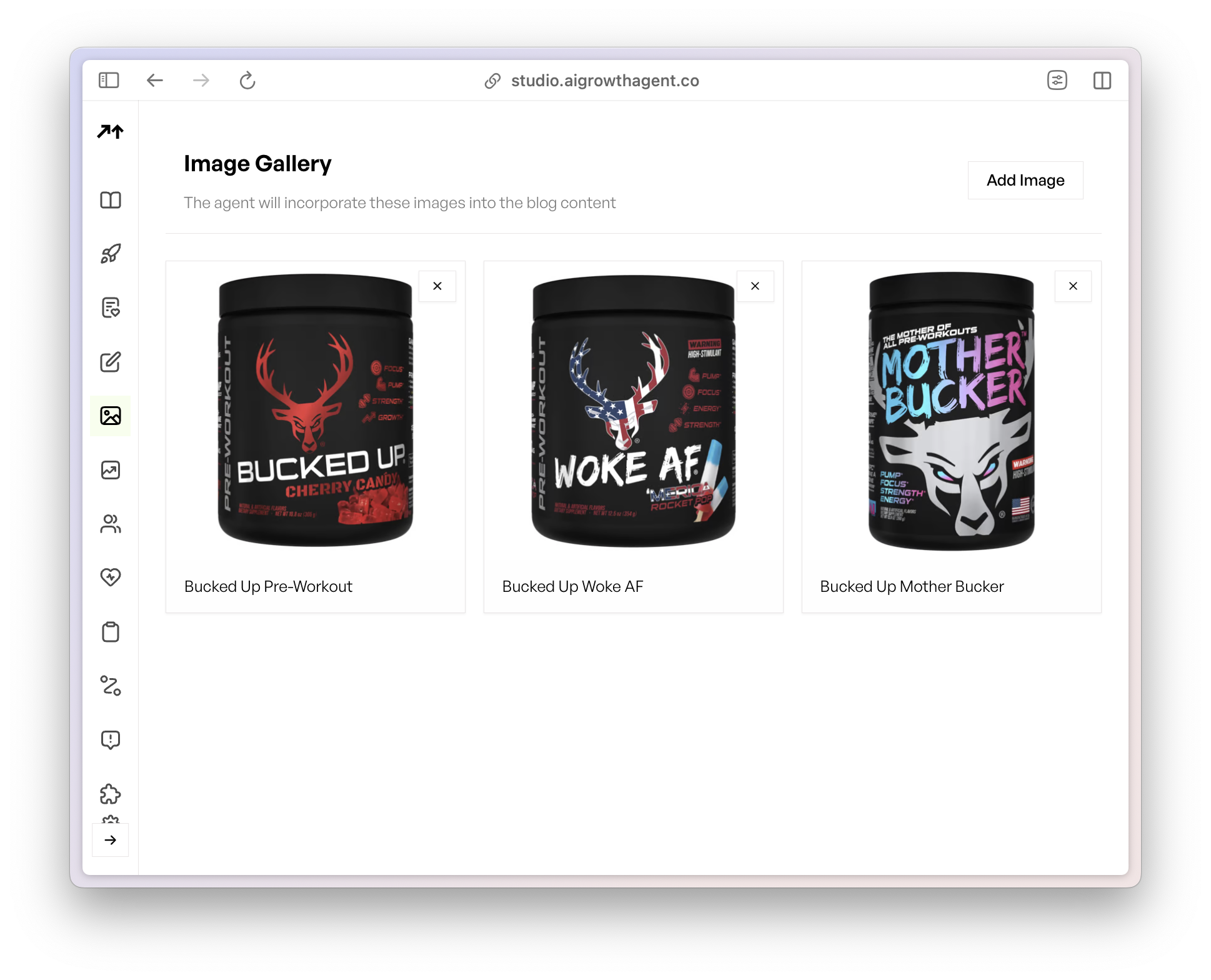
- Intelligent image placement. AI Growth Agent can select and embed relevant images from a provided library, with descriptive filenames and alt text to support SEO and accessibility.
- Data quality as a growth lever. Systematically improving internal documentation, product content, and knowledge bases raises the quality of AICMS outputs across the board.
- Governance and training. A centralized AICMS gives you a clear framework for how AI should be used in content, which simplifies training and reduces ad hoc experimentation.
- Integration with other AI initiatives. An AICMS can complement AI-driven personalization, sales enablement, and analytics, turning AI into a broader, repeatable growth system.
AI Growth Agent’s Distinct Capabilities
AI Growth Agent includes capabilities that are particularly useful for complex organizations:
- Parallel agent deployment for portfolios. You can manage separate content agents for multiple brands or business units from a single interface.
- Real-time content generation. Teams can request content to address breaking news, product updates, or emerging questions and move it through review quickly.
- Custom data activation. Proprietary or offline data, such as curated recommendations or expert knowledge, can be turned into structured, search-optimized content that drives traffic and supports AI answers.
These capabilities help build a deeper and more resilient content presence that is difficult for competitors to replicate with ad hoc tools or manual processes.
To evaluate how these capabilities could support your organization, you can schedule a consultation session and demo with AI Growth Agent.
Frequently Asked Questions (FAQ) about Enterprise AICMS Implementation
What is the typical ROI for implementing an Enterprise AI Content Management System?
An Enterprise AICMS can generate both operational and revenue-related benefits. Operationally, it can increase content throughput and reduce production costs by automating research, drafting, and technical tasks. On the revenue side, organizations often see gains in organic traffic, improved AI search visibility, and a shift of marketing time toward higher-value strategic work.
How does an AICMS address digital footprint shrinkage in the age of AI-generated content?
An AICMS counteracts footprint shrinkage by enabling consistent, frequent publishing of authoritative content, ensuring technical optimization for AI indexing, and building a dense, interlinked content corpus that reinforces your brand’s presence across related queries.
Is our enterprise ready for an AICMS if we’re already using cloud AI platforms?
Enterprises already using cloud AI platforms usually have the security, governance, and technical familiarity needed for AICMS deployment. The remaining work often involves consolidating your brand narrative, organizing key source materials, and clarifying content objectives so the system has a strong foundation.
What are the key differences between an AICMS and generic AI content tools?
An AICMS manages the full content lifecycle with a strategy-aware, automated workflow and technical SEO depth. It is designed to support goals such as category authority and AI search visibility. Generic AI content tools focus on text generation and typically require more manual oversight for planning, quality control, and publishing.
How long does it take to see results from an Enterprise AICMS?
Most enterprises see early signals within 60 to 90 days, such as increased indexed pages and impressions. Over 6 to 12 months, benefits typically compound as the content corpus grows, internal processes stabilize, and AI search begins to reference a larger share of your material.
Conclusion: Position Your Brand for the Future of AI Search
AI search is becoming a primary interface between customers and information. Implementing an Enterprise AICMS gives your brand a structured way to serve as a reliable source for both AI models and human readers.
AI Growth Agent combines agent orchestration, AI-focused technical SEO, monitoring tools, and portfolio-scale management to help marketing leaders improve AI search visibility while controlling effort and cost.
If you want to understand your options in the era of AI search and evaluate whether this approach fits your organization, you can schedule a demo with AI Growth Agent and review how an autonomous AICMS could support your competitive position.
