


Key Takeaways
- AI-powered search engines now drive discovery, so manual WordPress content workflows no longer support enterprise visibility.
- Traditional WordPress scaling fails because of plugin bloat, slow content production, and missing AI protocols such as LLM.txt.
- High-performing setups use headless WordPress, multisite networks, schema automation, and performance targets like LCP under 2.5 seconds.
- Programmatic SEO publishes fully optimized content every day, beating agencies on scale, speed, and consistency.
- AI Growth Agent delivers autonomous enterprise SEO with proven results; schedule a demo today to accelerate AI search dominance.
The Problem: Enterprise WordPress Struggles in the AI Search Era
Traditional WordPress scaling models cannot keep up with AI search requirements. Enterprises that rely on manual content creation, basic hosting, and conventional SEO agencies face three failures that directly reduce AI visibility.
Maintenance overload and plugin bloat slow down enterprise WordPress sites. Legacy stacks accumulate dozens of plugins, which create performance bottlenecks that block Core Web Vitals benchmarks like LCP under 2.5 seconds. When sites miss these performance grades, they lose ranking potential in both traditional and AI search results.
Content velocity limits create strategic risk. Manual content workflows cannot publish enough high-quality pages for modern AI indexing. LLMs reward recency, depth, and consistent structure. Manual teams rarely sustain that output at enterprise scale. Competitors that publish daily programmatic content steadily outrank brands stuck on monthly calendars.
AI optimization gaps keep enterprises invisible to next-generation search engines. Standard WordPress setups usually lack LLM.txt files and Model Context Protocol support. Without these protocols, AI crawlers from Perplexity, Gemini, and ChatGPT cannot reliably surface or cite enterprise content. Brands then miss citations and recommendations inside AI-generated answers.
Where Enterprise WordPress Scaling Breaks Down
Enterprise WordPress scaling introduces architectural challenges that most hosting providers and agencies cannot solve. Manual service models clash with the programmatic speed and precision that AI search now expects.
|
Approach |
Content Velocity |
Technical SEO |
AI Optimization |
|
Traditional Agencies |
1-2 posts/month |
Manual implementation |
No LLM.txt/MCP |
|
Internal Teams |
Inconsistent |
Plugin-dependent |
Limited AI protocols |
|
AI Growth Agent |
Daily automated |
Programmatic schema |
Full AI integration |
Hosting constraints amplify these gaps. WP Engine and WordPress VIP act as infrastructure providers, not full SEO systems. They deliver server resources and performance features, yet still require programmatic content generation and AI-focused optimization for true authority building. On their own, these platforms rarely reach the content velocity needed to compete in AI search.
|
Architecture |
Performance |
SEO Control |
Scalability |
|
Monolithic WordPress |
Plugin-dependent |
Limited by themes |
Resource intensive |
|
Headless WordPress |
Optimized CWV |
Full frontend control |
API-driven scaling |
Headless WordPress uses static site generation to reach near-perfect Core Web Vitals scores. These performance gains translate into stronger SEO rankings than typical monolithic setups.
Five Core Components of Scalable WordPress SEO Architecture
Enterprise WordPress SEO works best on a foundation of five components tuned for AI visibility and programmatic publishing. These elements support growth without the maintenance burden of legacy builds.
Performance tuning sits at the base of the stack. 2026 benchmarks for high-performance enterprise WordPress include LCP under 2.5 seconds, CLS ≤0.1, and TTFB under 200ms. Reaching these metrics requires smart caching, global CDN coverage, and lightweight themes that avoid plugin bloat.
Multisite architecture supports brand expansion. WordPress Multisite keeps SEO consistent across properties using tools like Yoast SEO, plus CDN integration and centralized management. Enterprises can then run multiple product lines or regions from one controlled environment.
AI protocol support unlocks next-generation search visibility. AIOSEO allows WordPress sites to generate LLM.txt files that guide AI models toward high-value content. This guidance improves citation odds in AI-generated responses. Model Context Protocol integration lets AI search engines read WordPress data more directly and understand context with greater accuracy.
Schema markup automation delivers structured data at scale. Programmatic schema injection ensures every article ships with rich snippets, FAQ markup, and clear entity relationships. Manual schema management cannot keep pace with enterprise content libraries.
Content delivery optimization completes the system. Global CDNs, compressed images, and lazy loading keep performance strong across regions while supporting frequent publishing. This combination supports both user experience and AI search authority.
AI Growth Agent: Programmatic SEO Built for Enterprises
AI Growth Agent provides an autonomous programmatic SEO platform tailored to enterprise environments. The system covers the full technical SEO lifecycle at a superhuman scale while protecting brand voice and quality. It also integrates with existing CMS platforms such as WordPress.
Our process starts with manifesto programming. A brand intelligence layer captures your positioning, tone, and strategic goals. This foundation ensures every article reflects enterprise standards and targets specific keyword opportunities uncovered by automated research.
The technical infrastructure layer removes engineering friction. Most clients choose our hosted solution because it delivers a seamless and technically advanced setup. For self-hosted WordPress, we connect to your stack and apply our custom integration, including advanced schema, metadata tuning, and LLM.txt support for AI platforms like Perplexity and Gemini.
Content generation runs through a specialized pSEO agent. This agent researches, drafts, fact-checks, and publishes in-depth articles every day. Each piece ships with full technical SEO, rich schema, and AI protocol coverage that manual teams rarely maintain at scale.
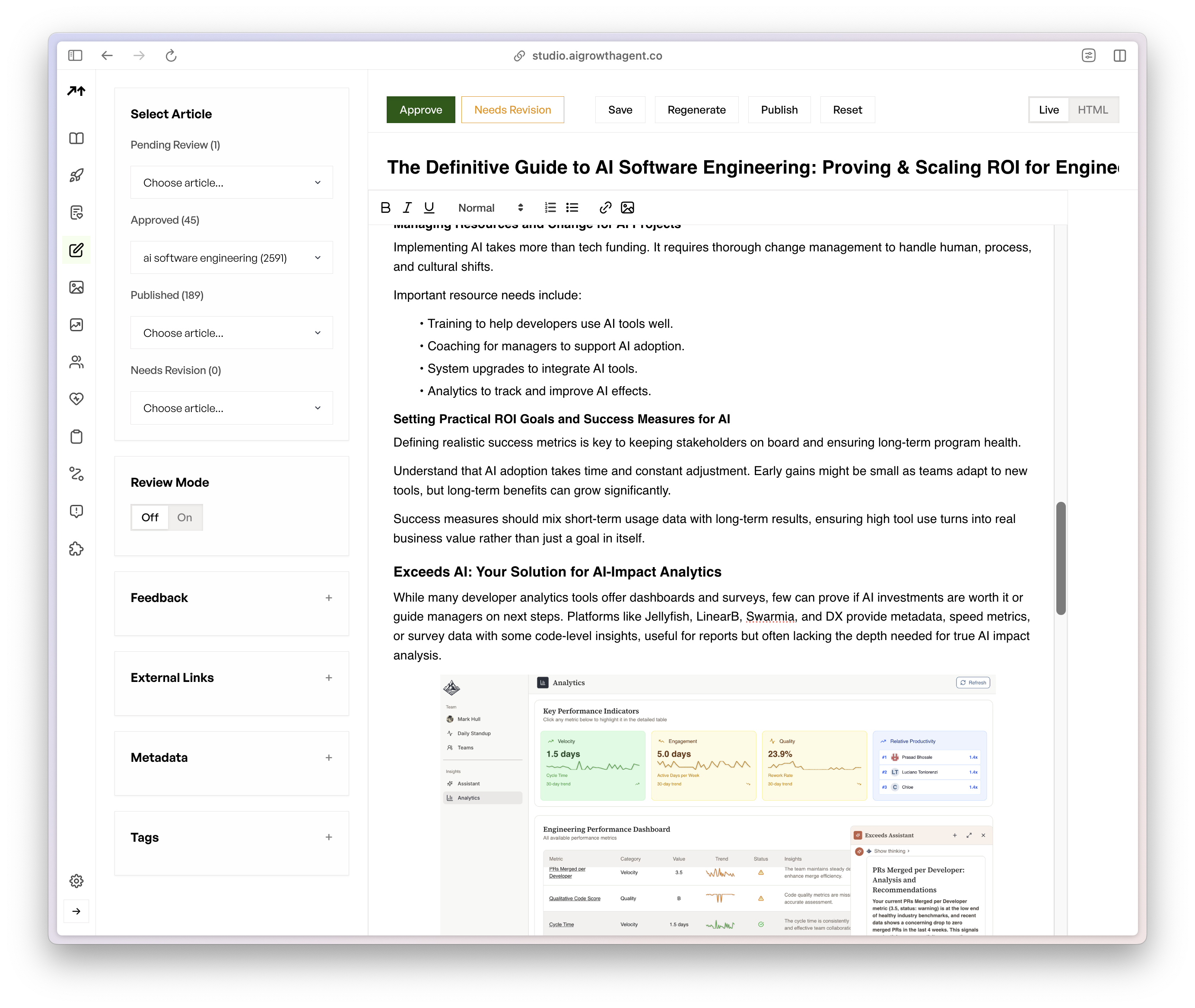
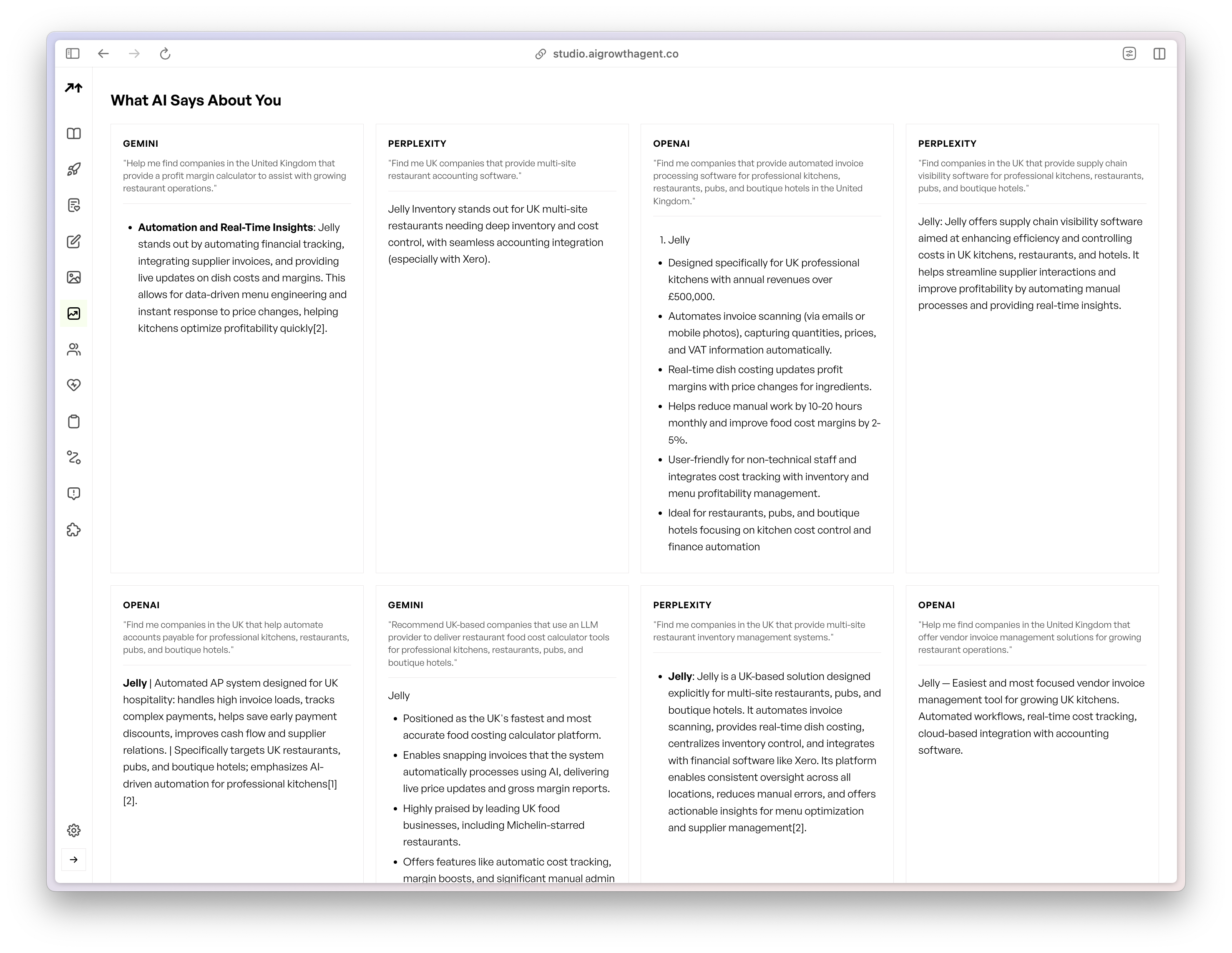
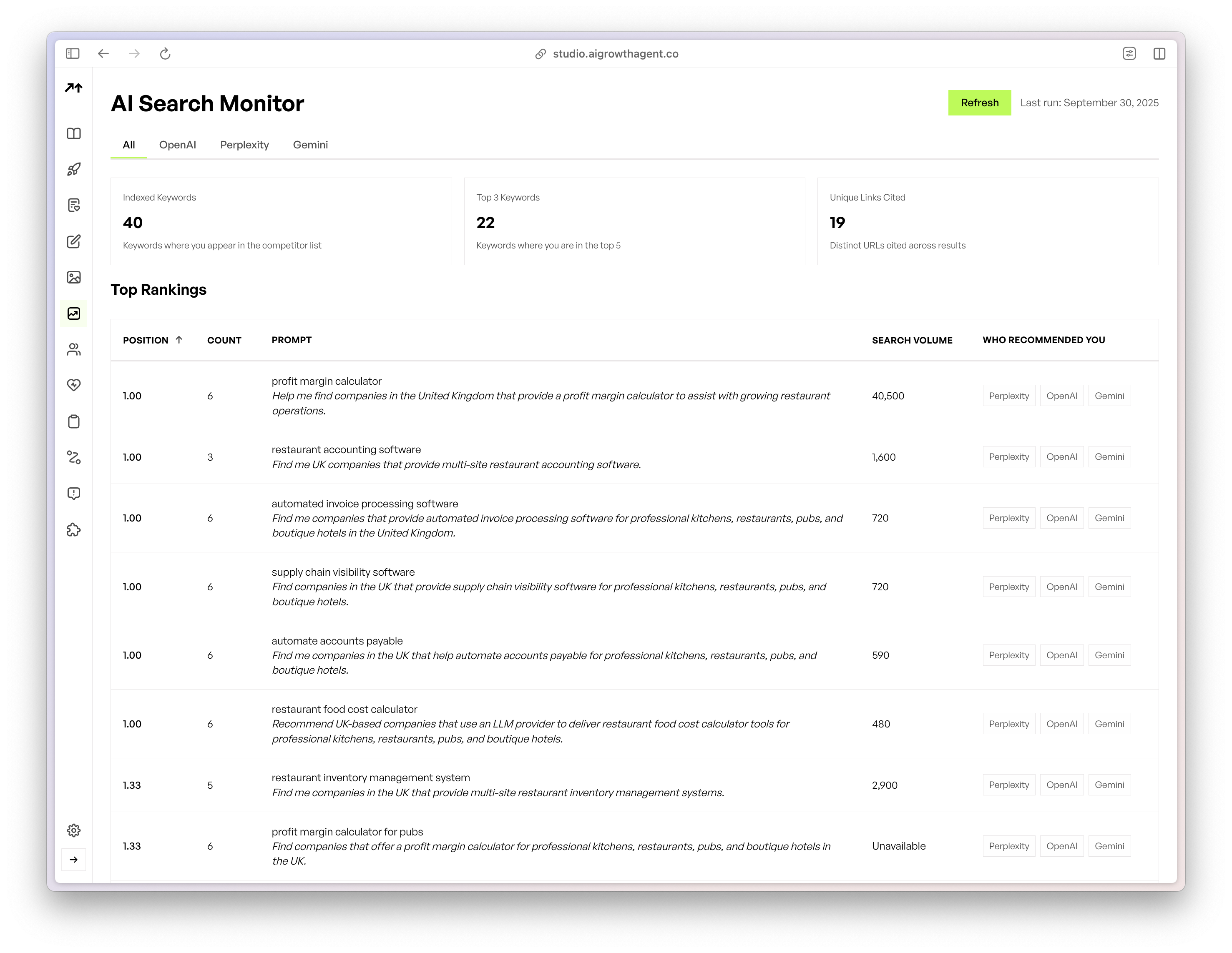
Client results validate this approach. Bucked Up secured the #1 citation for “best protein soda” in ChatGPT within three weeks. Gitar became the reference brand for AI-powered CI/CD automation across Google AI Overview, ChatGPT, and Perplexity in under two months.
Schedule a demo to see if you’re a good fit
How AI Growth Agent Implements Enterprise Programmatic SEO
Enterprise programmatic SEO follows a clear roadmap that reduces disruption while rapidly improving AI search visibility.
Phase 1 covers manifesto development and strategic programming. Our resident professional journalist gathers deep brand intelligence and converts it into programming for your autonomous SEO agent. Most teams complete this phase within one week of the first consultation.
Phase 2 focuses on programmatic keyword research and content strategy. The agent analyzes tens of thousands of relevant queries and builds content pillars and clusters that align with AI search patterns.
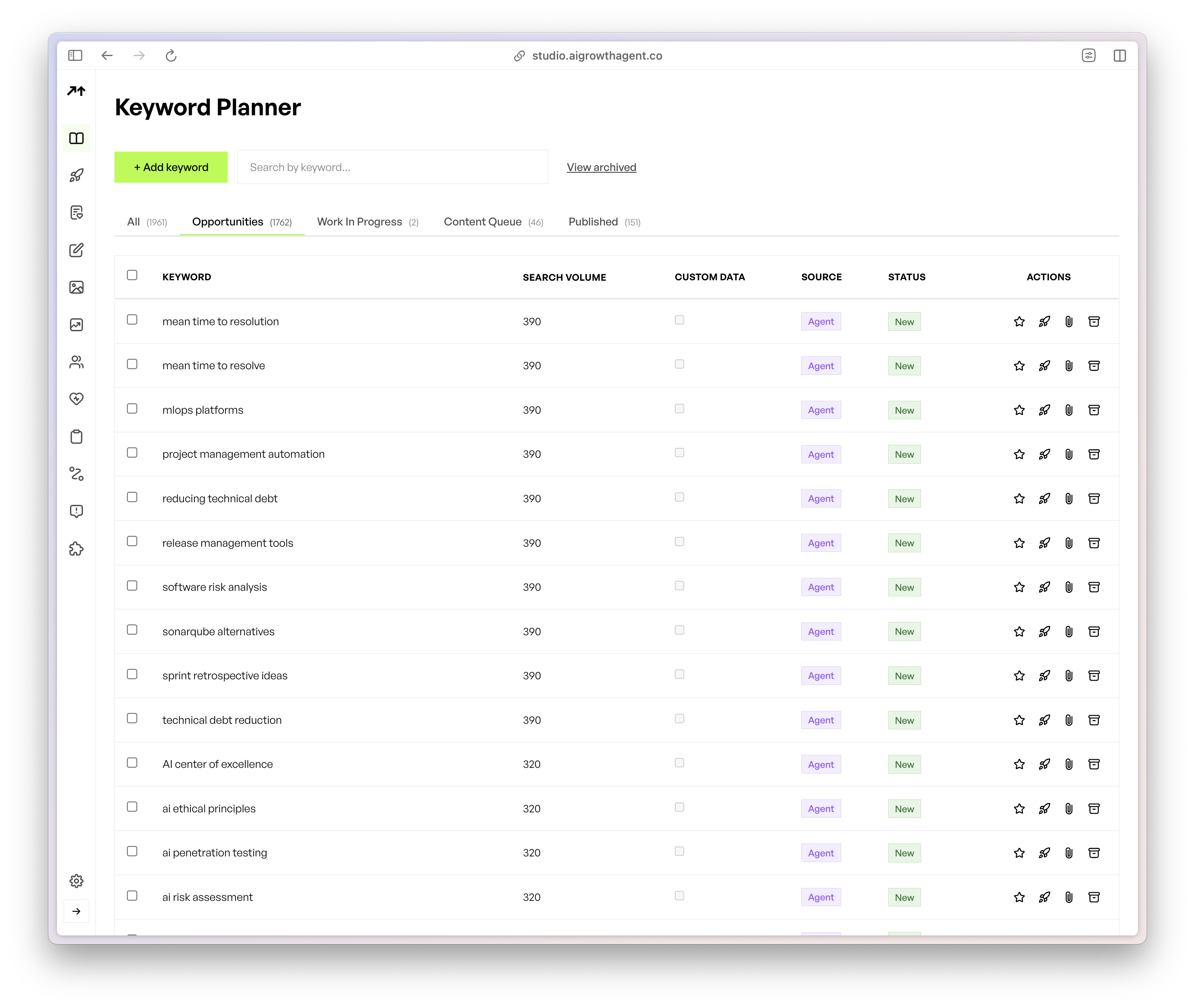
Phase 3 deploys the technical infrastructure. We remove engineering friction and launch a new, fully optimized blog as a subdomain such as blog.yourcompany.com. The design matches your existing site at a pixel level. While we integrate with platforms like WordPress, most clients still choose our hosted option because it performs better and requires less effort.
Phase 4 activates autonomous content production with initial human review. The agent starts publishing and adapts based on feedback to refine brand alignment and depth.
Phase 5 moves into full autonomy with ongoing monitoring. AI search performance tracking then guides continuous improvements and competitive positioning.
Enterprise concerns about WordPress viability no longer hold. WordPress holds 61.2% CMS market share and powers more than 522 million websites, including many enterprises. Programmatic SEO removes traditional bloat and maintenance pain through automation and stronger technical foundations.
Frequently Asked Questions
Is WordPress suitable for enterprise SEO in 2026?
WordPress remains the leading enterprise CMS, powering 43% of all websites and 61.2% of identifiable CMS installs. Its strength comes from a large ecosystem, flexible scaling paths, and constant technical evolution. Programmatic SEO now addresses bloat and maintenance concerns by automating optimization and reducing plugin reliance. Modern WordPress builds that use headless setups, advanced caching, and AI protocols deliver enterprise-grade performance while preserving customization.
What enterprise WordPress architecture works best for AI search?
Effective enterprise WordPress architecture for AI search combines programmatic content generation with AI-aware technical foundations. Key elements include LLM.txt for content prioritization, Model Context Protocol for direct AI access to structured data, and automated schema for deeper understanding. Headless WordPress with frameworks like Next.js improves Core Web Vitals while keeping SEO control. Multisite networks then support expansion across brands or regions. Programmatic automation keeps these elements consistent at scale.
How do WP Engine and WordPress VIP support scalable SEO?
WP Engine and WordPress VIP provide hosting infrastructure, not complete SEO systems. Both offer enterprise-grade servers, security, and performance features, along with tools such as content intelligence and AEO strategies. Enterprises still need programmatic SEO to generate content at scale, manage technical SEO, and implement AI protocols. WP Engine focuses on managed hosting with built-in caching and security. WordPress VIP adds deeper development support for complex builds.
How should enterprises roll out headless WordPress for SEO?
Headless WordPress for enterprise SEO starts with choosing a strong frontend framework and tuning it for both traditional and AI search. Next.js with static site generation often reaches LCP under 2 seconds and near-perfect performance scores. WordPress then acts as a content API while the frontend handles UX and crawlability. Critical tasks include server-side rendering, automated schema injection, sitemap generation, and precise meta tags. AI search support requires LLM.txt and Model Context Protocol. This approach gives teams programmatic control over SEO without theme limits.
Why choose programmatic SEO instead of a traditional agency?
Programmatic SEO delivers scale and consistency that manual agencies cannot match. Agencies usually ship one or two articles per month, which falls short of AI search expectations. Programmatic systems publish daily while keeping technical SEO, schema, and AI protocols aligned across every asset. Costs also improve because automation replaces billable hours. Quality becomes more consistent through encoded brand rules and repeatable optimization. Results from brands like Bucked Up show that programmatic SEO can secure top AI citations within weeks.
Schedule a demo to see if you’re a good fit for programmatic SEO
Conclusion: Build Enterprise SEO That AI Search Cannot Ignore
AI search now rewards architectures built for programmatic scale and precise technical execution. Manual workflows, basic hosting, and traditional agencies rarely reach the content velocity and AI readiness required for the 2026 competition.
AI Growth Agent turns your digital presence into an autonomous authority engine. The platform builds the technical base, automates content creation, and applies AI protocols that keep your brand visible and cited across emerging search platforms.
Ready to dominate AI search? Schedule a consultation session today.
