


Executive summary
- AI search engines such as ChatGPT, Google AI Overview via Gemini, and Perplexity now weigh content freshness and update frequency as core ranking inputs, not secondary signals.
- Manual content workflows and traditional SEO programs cannot match the publishing speed, structure, and technical precision that large language models reward.
- Brands that do not maintain consistently updated, semantically rich content libraries lose citations and visibility to competitors that publish programmatically.
- AI Growth Agent uses a Programmatic SEO Agent, technical automation, and an AI Search Monitor to keep content fresh, structured, and aligned with AI-specific ranking metrics.
- Marketing leaders can use this system to scale high quality content, monitor AI citations, and continuously improve performance across AI search platforms.
Your digital footprint is shrinking. Each day, as AI-powered search engines like ChatGPT, Google AI Overview via Gemini, and Perplexity process growing volumes of AI-generated content, your brand’s voice becomes harder to hear. While many marketing leaders still focus on traditional SEO metrics like backlinks and domain authority, AI search engines now prioritize content freshness and update frequency as primary ranking factors. This shift is changing how brands earn visibility and authority online.
Traditional content strategies, such as manual writing, slow agency workflows, and basic AI tools, struggle to meet the speed and technical demands of modern AI search. Brands that do not maintain programmatically fresh content lose visibility inside the AI systems that now power discovery and recommendation across the internet.
AI Growth Agent’s Programmatic SEO Agent addresses this challenge. The system builds autonomous content architectures that maintain continuous freshness while delivering semantic depth and technical optimization. The goal is not to publish as much content as possible. The goal is to engineer content systems that operate at the speed and precision required for AI search visibility.
The Problem: Why Traditional Content Strategies Fall Short for AI Search Freshness
How AI Search Engines Use Freshness as a Ranking Signal
AI search engines operate differently from traditional search algorithms. AI search engines like Perplexity and ChatGPT use explicit freshness metrics and scoring profiles, such as “time_decay_rate” and “use_freshness_scoring_profile”, that strongly prioritize how recent content is. This differs from older Google models, where strong content could often hold rankings for years.
The impact is measurable. Newer publication dates alone can push AI ranking decisions to favor new content up to 25% of the time, even against previously preferred older passages. Even highly authoritative content can lose visibility quickly if it is not updated.
Marketing leaders now face a direct strategic requirement. A “content freshness score” has become a major ranking factor across multiple leading AI models, including GPT-4o, GPT-4, and LLaMA-3. A brand’s authority now depends on what it has published and how recently and consistently it updates its knowledge base.
The Velocity Trap: Manual Updates Cannot Keep Pace with AI Volume and Demand
Velocity has become the core challenge. Manual content creation and traditional agency workflows move at human speed. AI search engines reward publishing frequency and update velocity that approach machine speed. Publishing one or two manually crafted articles per month, which once looked ambitious, no longer maintains technical relevance in AI-powered discovery.
Programmatic velocity is the new baseline as large language models reward recency, depth, and structural consistency. The challenge is not only writing faster. The challenge is engineering content that meets AI search engines’ requirements for semantic density, structured data, and technical optimization while still updating often enough to score well on freshness.
Traditional SEO agencies, which often bill by the hour and rely on manual workflows, find it difficult to reach this scale. Their craft-first approach, which favors quality over quantity, becomes a constraint when AI search engines evaluate authority based on both depth and update frequency. Internal marketing teams face similar issues. Many lack the technical resources to implement advanced schema markup, metadata optimization, and programmatic publishing systems that support reliable AI indexing at scale.
Shrinking Digital Footprint: Competing With AI-Generated Content
The explosion of AI-generated content has changed the competitive field. Each day, large numbers of AI-produced articles enter search indexes and model training data. This volume dilutes the visibility of manually created content. For premium brands, this creates a significant risk. Without enough fresh, structured data points for AI engines to reference, they can be overshadowed by competitors with broader, more frequently updated content libraries.
This shift affects market share in AI attention. If your brand does not publish with enough velocity to establish authority across your knowledge domain, AI search engines will rely on other sources, often your competitors. Their content becomes the AI’s reference point. Their perspective shapes AI-generated answers, and their brand earns citations and recommendations that influence modern discovery.
Progress requires moving beyond manual content strategies and toward programmatic approaches that match the scale and structure of AI-driven competition. Brands need programmatic content that builds real authority, not just volume.
If these challenges match what you are seeing, it is time for a new approach to content freshness in AI search. Schedule a consultation session to see how AI Growth Agent can address your content freshness challenges.
The Solution: Programmatic SEO for Reliable Content Freshness and Authority
AI Growth Agent: Engineering Continuous Content Freshness for AI Search
AI Growth Agent is a Programmatic SEO Agent built to solve content freshness and update frequency challenges in AI search. Instead of treating freshness as an occasional task, the system designs high authority content architectures that stay current through autonomous operations.
The approach goes beyond basic content creation. The Programmatic SEO Agent automates the technical lifecycle, including:
- Deep keyword clustering and semantic research
- Schema implementation and structured data
- Metadata optimization
- Publishing directly to a hosted, optimized blog environment
This process removes technical friction and helps each published asset meet advanced requirements for AI search visibility and citation frequency.
The result is a content system that operates at a high publishing velocity while preserving quality and technical rigor. Marketing leaders gain a way to balance scale and quality that traditional approaches struggle to deliver.
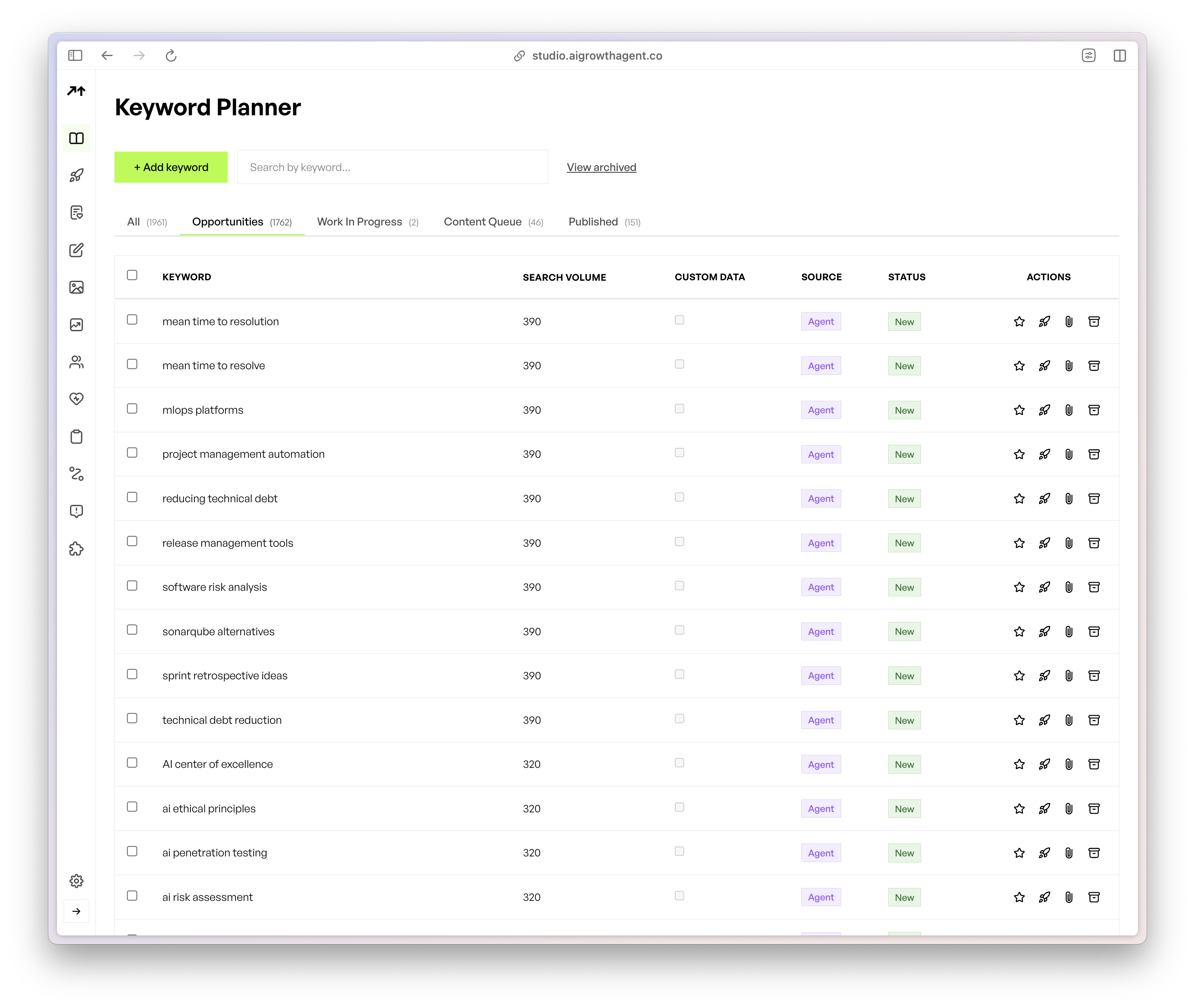
Autonomous Updates and Real-Time Content Injection for AI Relevance
AI Growth Agent uses autonomous update capabilities and real-time responsiveness to keep content aligned with what people and AI systems are searching for. The system continuously reviews your content landscape, refreshes existing assets, and generates new pieces that capture emerging search opportunities.
The Real-Time Programmatic SEO Content Injection feature enables fast responses to breaking news and trending topics. Marketing teams can share a link to a trending article, and the agent will generate SEO-optimized content with the brand’s perspective. This allows brands to capture search and AI attention from breaking topics in minutes instead of weeks.
For brands with proprietary data, the Database-to-Content Automation capability turns internal datasets into comprehensive, SEO-rich articles. This converts unique knowledge assets into programmatic SEO drivers while maintaining the freshness and update frequency that AI search engines prioritize.
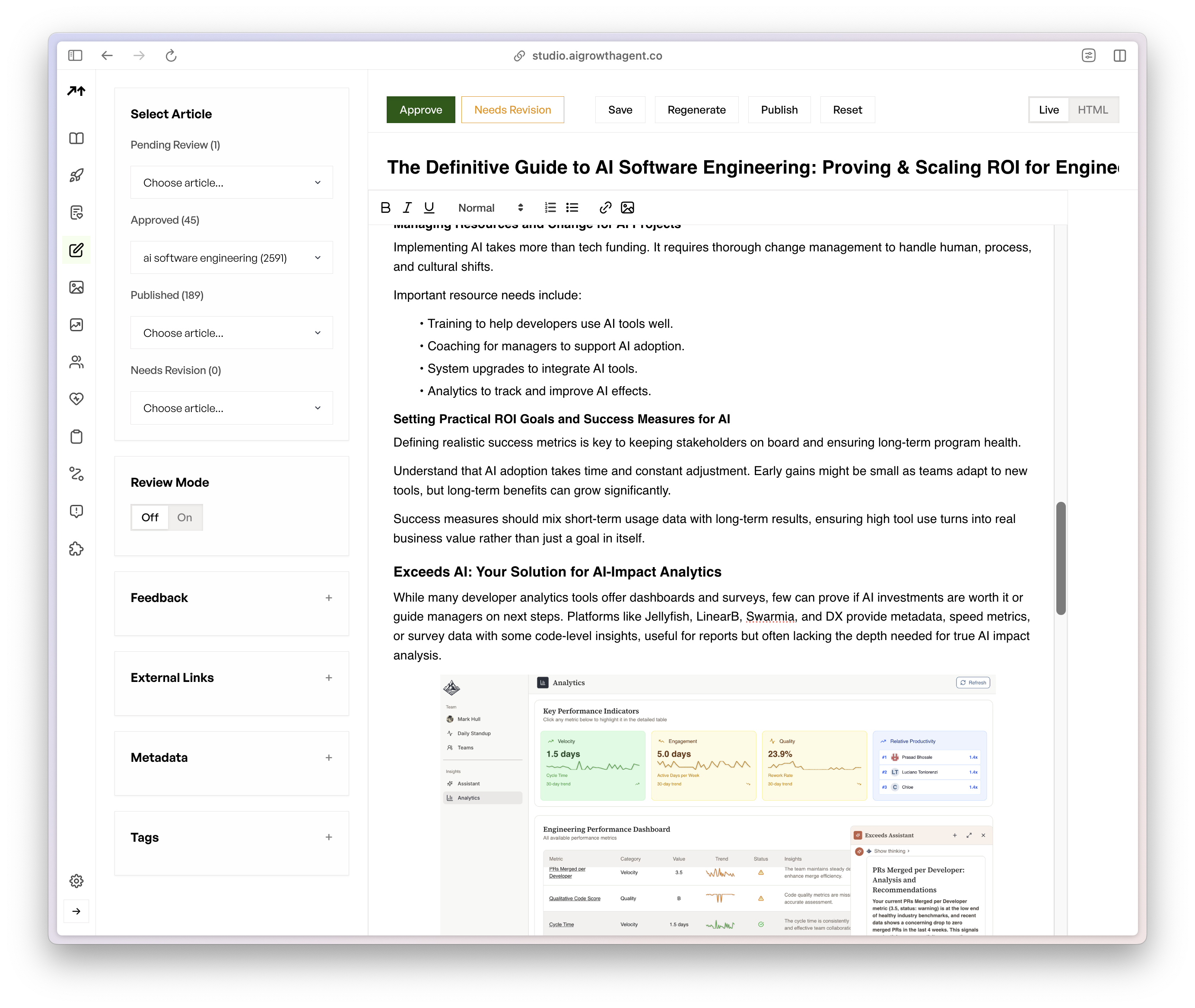
Beyond Basic SEO: AI Growth Agent’s Content Freshness Score Advantage
This approach aligns with the metrics that AI search engines use to evaluate content authority. Key AI search metrics include citation frequency, semantic relevance, structured data use, and content freshness, which extend beyond classic SEO indicators like backlinks and raw traffic.
AI Growth Agent automatically implements advanced technical elements, including rich schema markup, LLM.txt files, and a blog implementation of the Model Context Protocol (MCP). These elements help AI search engines crawl, index, and interpret both content freshness and semantic depth. The result is content that performs across critical AI search metrics while updating often enough to stay visible.
The system also treats freshness and quality as connected. Balance between update frequency and content quality is important, since excessive or superficial updates can hurt content depth and perceived trustworthiness. AI Growth Agent aims for each update to add real value while maintaining the frequency needed for strong freshness scores.
To see how AI Growth Agent builds AI search visibility through continuous content freshness, schedule a demo to decide whether our programmatic approach fits your needs.
How AI Growth Agent Keeps Your Content Fresh and Authoritative in AI Search
Manifesto-Driven Content: Consistent Quality and Update Value
AI Growth Agent starts with a White-Glove Onboarding process that includes building a Company Manifesto with your team. This living document provides the strategic foundation for all programmatic content creation, guiding both new articles and updates.
The Manifesto-driven method addresses a common programmatic content challenge, which is maintaining brand voice and strategic coherence at scale. By encoding your brand’s perspectives, positioning, and expertise into the operating framework, the system helps ensure that each piece of content, from quick updates to deep pillar articles, reinforces your authority and delivers the substantive updates required for AI authority.
This foundation helps the system make informed decisions about content priorities, update order, and topic coverage. Instead of generic updates, AI Growth Agent produces strategic content that builds cumulative authority while satisfying AI search engines’ expectations for freshness and semantic depth.
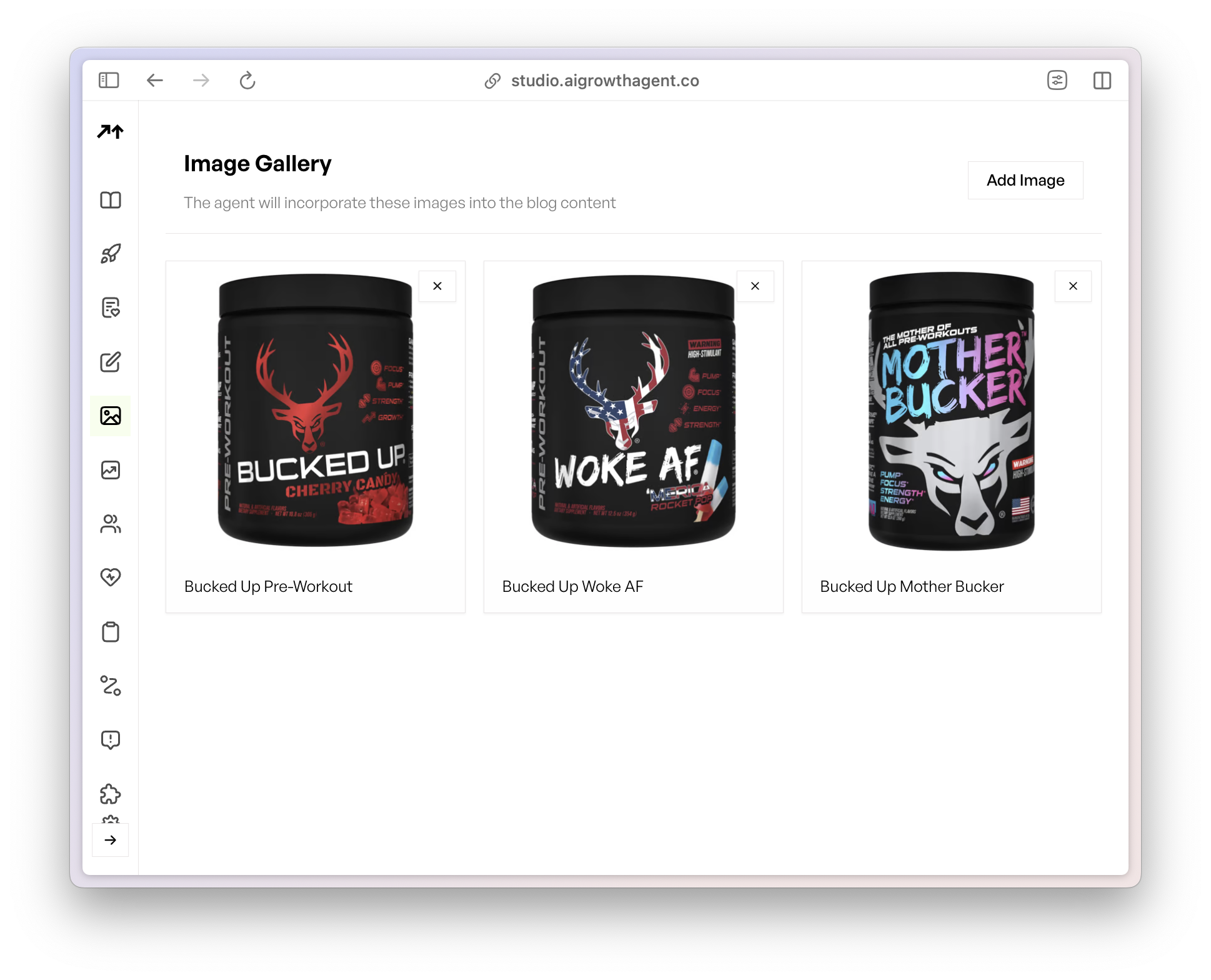
You can also provide approved brand images and assets, which the agent can incorporate into new and updated articles to keep visual elements aligned with your message.
Technical Engineering for AI Crawlability and Rapid Indexing
Technical execution is a core part of AI Growth Agent. The system automatically manages advanced SEO elements such as rich schema markup, optimized metadata, LLM.txt files, and Model Context Protocol integration. This technical layer helps AI search engines crawl, index, and interpret content freshness and depth.
The hosted blog architecture removes the need for internal engineering work while supporting AI-focused indexing. The system deploys optimized subdomain infrastructures that mirror existing brand aesthetics and provide the foundation for programmatic SEO.
Each published article includes:
- Structured data markup using Schema.org standards
- Optimized image tags with relevant metadata
- Technical elements that improve crawl success and indexing speed
This structure aims to support strong crawl rates and rapid indexing across major AI search platforms.
AI Search Monitor and Feedback Loop: Proactive Freshening at Scale
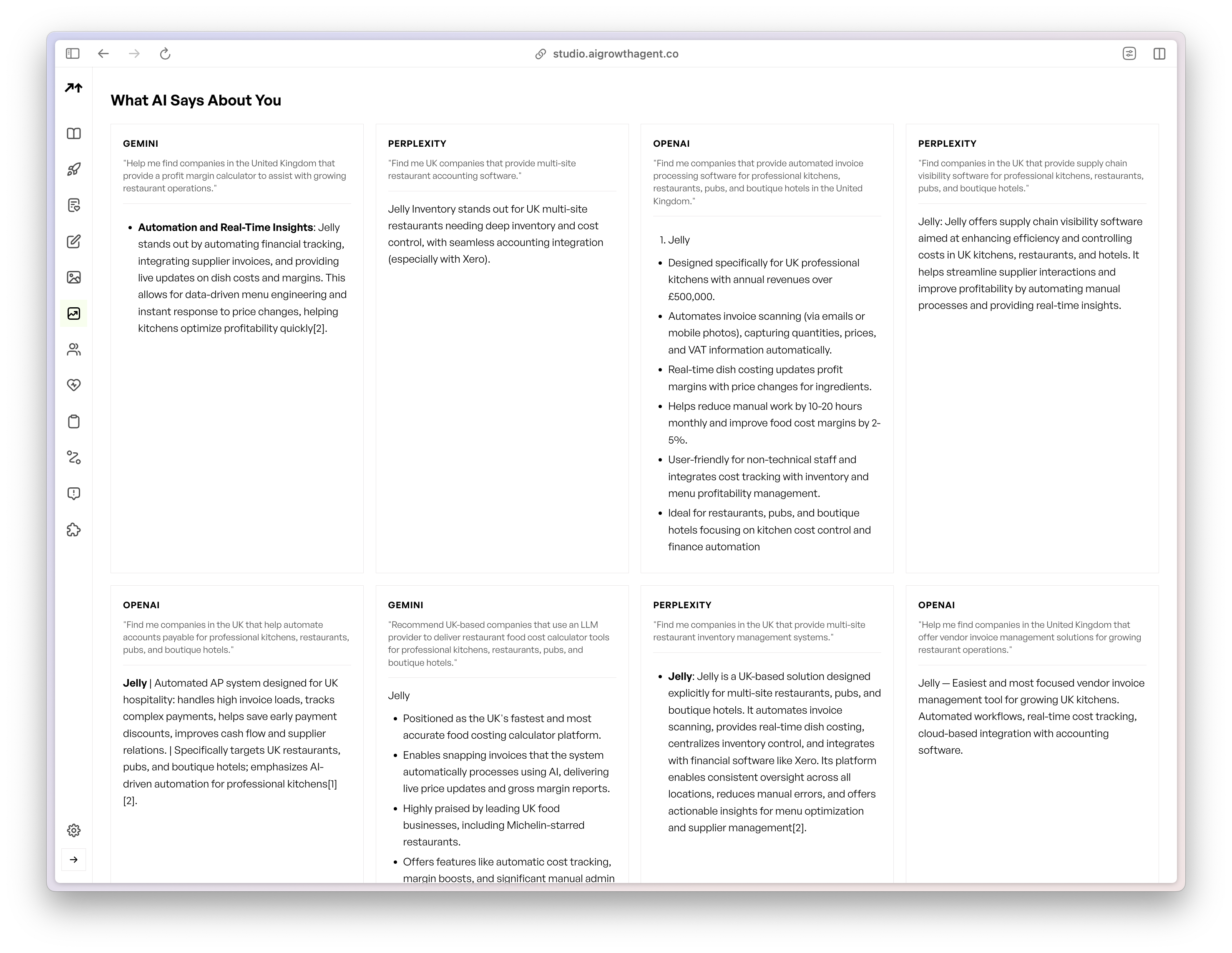
The AI Growth Agent Studio offers visibility into AI search performance through monitoring and analytics. Marketing leaders can see how their content performs across ChatGPT, Google AI Overview via Gemini, and Perplexity. The platform tracks citation frequency, indexing success, and indicators related to content freshness.
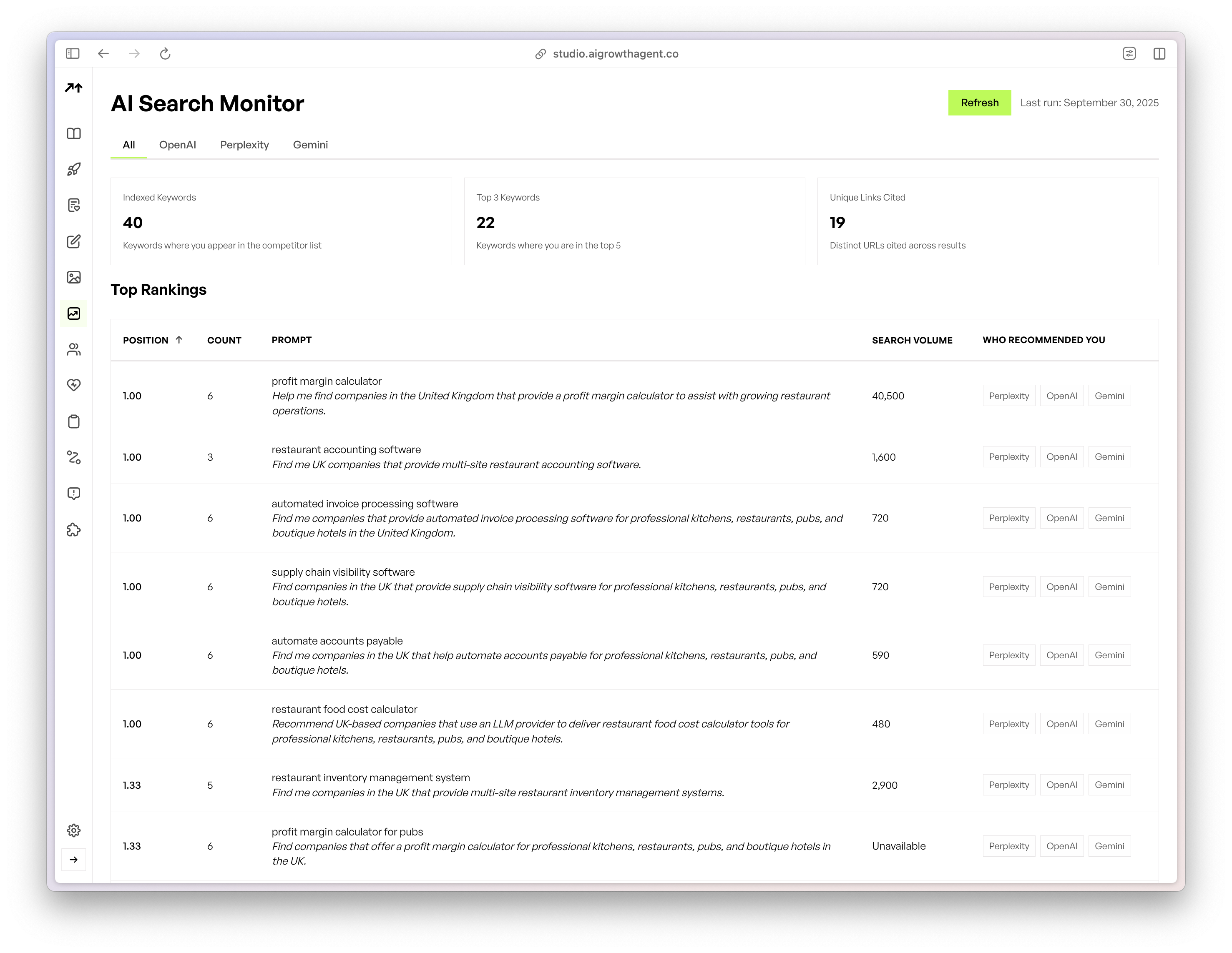
The monitoring system focuses on metrics specific to AI search. AI search introduces KPIs such as chunk retrieval frequency, embedding relevance score, attribution rate, and semantic density, all of which are influenced by how fresh and deeply updated content is. This supports proactive content updates based on real-time AI performance data.
The feedback loop drives continuous optimization. As the system gathers performance data across AI search platforms, it flags content refresh opportunities, new keyword targets, and update priorities. Over time, this creates a self-improving program that maintains freshness standards while strengthening AI search authority.
Comparison Table: Manual vs. Programmatic Content Updates for AI Search
|
Feature |
Manual Content Strategy |
AI Growth Agent (Programmatic) |
|
Update Frequency |
Infrequent, resource intensive, often delayed |
Continuous, automated, close to real time |
|
Technical SEO |
Often overlooked, requires manual input and development help |
Automated advanced schema, LLM.txt, MCP |
|
Content Velocity |
Slow because of human limits and manual workflows |
High speed, publishing daily or multiple times per day |
|
AI Indexing and Crawling |
Inconsistent, updates can be missed |
Optimized for strong AI crawl rates and fast reindexing |
|
Authority Building |
Slow and reactive |
Proactive and consistent, designed for citation and recommendation |
If you want your content to stay fresh and authoritative in AI search, schedule a consultation to see how AI Growth Agent can update your content strategy.
Frequently Asked Questions (FAQ) about Content Freshness in AI Search
Why is content freshness more important now in AI search than for traditional Google search?
AI search engines operate differently from traditional search algorithms. Older versions of Google’s algorithm could keep well established content visible for years. AI search engines use explicit freshness metrics and generate answers by synthesizing the most recent and relevant information they can access. Models such as GPT-4o, ChatGPT, and Perplexity use time decay approaches that gradually deprioritize older content, even if it was historically authoritative.
This behavior means previously strong content can lose visibility without consistent updates. AI search engines focus on delivering current, accurate answers rather than long standing search results. Recent publication dates and frequent updates now act as critical ranking factors.
How do semantic relevance and depth work with freshness to improve AI search ranking?
Freshness alone does not guarantee AI search success. Updates need to be meaningful and add value. Semantic relevance shows that fresh content demonstrates a clear, complete understanding of a topic, supported by accurate, well researched information. AI search engines look at both the recency of content and its semantic density, meaning the amount of useful facts and insight in each content segment.
Superficial updates that only change dates or minor details can reduce perceived trust and authority. Effective freshness strategies combine regular updates with deep, comprehensive coverage that expands knowledge instead of simply updating timestamps. This approach helps content stay current and maintain the depth that AI models prefer to cite and recommend.
Can traditional SEO tools measure my content freshness score for AI search?
Most traditional SEO tools do not provide the metrics needed to measure content freshness for AI search. Some platforms track recency at a basic level, but they usually do not monitor AI specific factors such as semantic density changes, structured data freshness, or citation frequency across AI models.
Modern AI search optimization benefits from tools that can track performance across ChatGPT, Google AI Overview, Perplexity, and similar platforms. These tools need to measure chunk retrieval frequency, embedding relevance scores, and citation rates inside AI generated responses. Traditional metrics like backlink freshness or crawl rates do not map directly to AI search behavior, so AI aware content analysis tools are more useful for accurate freshness assessment.
What is chunk retrieval frequency and why is it important for fresh content in AI search?
Chunk retrieval frequency measures how often specific content blocks or segments are pulled into AI generated answers. AI search engines do not only evaluate entire pages. They select individual chunks of content that best answer a user query.
Fresh, well updated content is more likely to score high on chunk retrieval because AI models favor recent, comprehensive information when forming responses. Chunk retrieval frequency reflects how often your brand’s content appears as part of AI answers across platforms. High values indicate that your content is not only indexed but also actively selected, which makes this metric a useful signal of AI search performance and content authority.
How quickly can AI Growth Agent implement content freshness improvements compared to traditional approaches?
AI Growth Agent can deliver freshness improvements quickly because of its autonomous publishing and update capabilities. Traditional programs may take weeks or months to design and execute freshness strategies. The Programmatic SEO Agent can begin publishing fresh, optimized content within about one week of onboarding.
The system runs continuously. It supports real-time content updates, fast responses to trending topics, and automated refresh cycles for existing content. Manual approaches often require 30 to 60 days to plan, create, and publish meaningful updates. AI Growth Agent can generate technically optimized articles daily or multiple times per day. This speed matters in AI search, where freshness scores decline quickly and consistent updates influence visibility and authority across AI platforms.
Conclusion: Protect Your Brand’s Authority with Programmatic Freshness in AI Search
The digital landscape has shifted toward AI powered search, and many traditional content strategies no longer match these new demands. Content freshness and update frequency now function as primary ranking factors, which creates pressure on marketing leaders to adopt programmatic approaches that can support sustained authority in AI search.
Manual content creation, slow agency workflows, and basic AI tools rarely provide the continuous freshness, semantic depth, and technical optimization that AI search engines reward. As AI generated content continues to grow in volume, brands that do not adopt programmatic freshness strategies risk losing visibility inside the AI systems that drive discovery and recommendation.
AI Growth Agent offers a structured option for marketing leaders who need to balance scale and quality in AI search. The Programmatic SEO Agent builds high authority content architectures that maintain continuous freshness and apply the technical practices needed for strong AI search performance. The focus shifts from working harder to working at a speed and precision level that matches AI search requirements.
Competitive advantage will favor brands that maintain comprehensive, fresh content libraries that AI search engines frequently cite and recommend. With AI Growth Agent’s autonomous operations, technical optimization, and real-time monitoring, marketing leaders can reach the programmatic content velocity needed for sustained AI search visibility.
To give your brand a clear, consistent voice in AI search, schedule a demo with AI Growth Agent to explore how programmatic freshness can support your goals.
